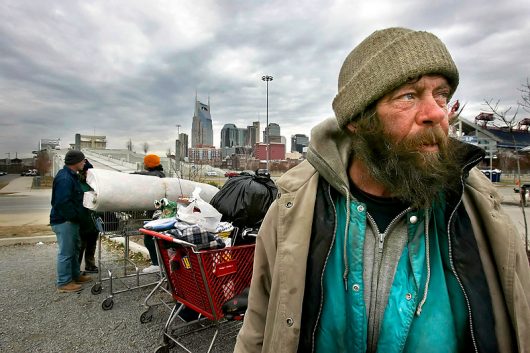
According to the U.S. Census Bureau in 2014, 47 million people — or 15% of the U.S. population — were living in poverty. Additionally, poverty in the United States is 2.3 percentage points higher than in 2007, the year before the recession hit in 2008.
Furthermore, 2014 was the fourth consecutive year that the poverty rate has remained stagnant. While conditions are not worsening, they are not improving either.
What Defines Poverty in the United States?
The federal government’s official poverty threshold for 2015 was as follows:
- Household of four (two children, two adults): $24,444
- Household of three (one child, two adults): $18,540
- Household of two (over 65): $14,326
- Household of two (under 65): $15,871
- One person (over 65): $11,376
- One person (under 65): $12,331
Click here to see additional information regarding the poverty threshold.
Who Lives in Poverty in the United States?
Poverty does not affect all demographics equally. Numbers from 2014 show that 13% of men lived in poverty, as compared to 16% of women. Poverty numbers for married couples were at six percent, while single-parent families with no wife were at 16%. Single-parent families with no husband saw a poverty rate of 31%.
As of 2014, 21% of all children in the United States lived in poverty. About 15.5 million children, more than the entire population of Ecuador, lacked the required resources to ensure even a basic level of comfort and freedom from distress.
What Can We Do To End Poverty in the United States?
There are several things that can be done to help bridge the gap between the richest and poorest Americans. Here is a list of five tips to help get you started:
1. Volunteer
Be giving of yourself. Find a local Open Heart Kitchen to work in. You can also volunteer with an organization that provides tutoring or afterschool programs for children living in impoverished areas. Your compassion can help immensely.
2. Donate
Find an organization that helps fight poverty in the United States. Additionally, it is important to find one that expresses values and a mission that you care about. The Borgen Project may be focused on fighting poverty abroad, but the work that they do helps create jobs and stimulate the already-struggling American economy. As nonprofits, these organizations also rely heavily on donations to fund their philanthropic and humanitarian endeavors.
3. Contact Your Congressional Representatives
Congress is supposed to represent its constituents, so contacting them can make a difference. Writing a simple letter or email, or making a phone call to your representative’s office lets them know that you are a concerned citizen. If enough people contact a representative in support of a particular issue, it sends the message that it is something that he or she should fight for. Above all, representatives speak for the people who elected them, so your voice does matter.
4. Support Local Small Businesses
Shopping local helps stimulate the economy in your area. When independent businesses are successful, they create jobs. Donating and volunteering are great ways to help fight poverty, and they can be very fulfilling. But providing a person with the opportunity to work and learn business skills sets that person up for future success.
5. Support and Use Public Transportation
For many people, buses and trains are a primary means of transportation. Getting to and from work and school would be impossible without these things. It is also an industry that employs over 400,000 people and generates $58 billion in revenue annually. According to publictransportation.org, every dollar invested in public transportation yields around $4 in economic returns. In addition, public transportation also creates and sustains 1.1 million each year.
In order to eradicate poverty in the United States, we need to work together. We need to invest in people, providing them with the necessary skills and resources. As a result, they can better provide for themselves and their families. Contact your congressional representatives, serve your community or buy from a local small business. These are all simple things that you can do to assist in the fight against poverty at home.
-Aaron Parr
Photo: Ivarfjeld

How Can Companies Improve Global Education?
Many CEOs don’t realize that helping improve global education is an investment in the future — not in an abstract future, but in their future. The more educated a country’s population is, the higher its gross domestic product (GDP) usually becomes.
With increased capital, more people can buy more products: someone living on less than a dollar a day will likely not buy Colgate toothpaste or Axe body wash, for example, because that money is reserved for food.
So how can companies help improve global education?
Justin W. van Fleet, director of the International Commission on Financing Global Education Opportunity, lists five strategies businesses can use when helping improve global education. Two important approaches are discussed below.
Prioritize Global Education
Companies can’t make a difference if they don’t prioritize doing so. Recognizing that alleviating global poverty — whether through health concerns or through education concerns — is investing in businesses’ futures, companies like Coca Cola have already made global poverty concerns a priority.
Coca Cola decided to invest in Tanzania in 1952, and the company has reaped benefits ever since. Coca Cola now has a presence in a previously untapped community.
“Whatever has to do with improvement of the Tanzania community it also touches improvement of, and welfare of, our company,” said a Coca-Cola Kwanza manager.
Education is integral to a healthy community, so businesses that prioritize developing countries’ education prioritize their own futures.
Collaborate with Governments
Governments are the largest sources of funding for education in developing countries. If businesses partner with government programs, then businesses may receive money for improving global education. In addition, not all funding efforts have to be out of pocket for companies.
Businesses and governments can work together in other ways, too. In 2006, for example, the Hess oil company invested $20 million in an Equatorial Guinea national educational initiative. Equatorial Guinea’s government matched that investment.
According to Brookings, “It is estimated that the program has reached roughly half of the students enrolled in primary school in Equatorial Guinea.”
Hopefully, more companies will adopt these strategies and others to improve global education in the future.
– Tyler New
Photo: Flickr
10 Facts About the Canadian Refugee System
According to the United Nations High Commissioner for Refugees (UNHCR), refugees are “people fleeing conflict or persecution. They are defined and protected in international law, and must not be expelled or returned to situations where their life and freedom are at risk.” Below are 10 facts about the Canadian refugee system.
– Bayley McComb
Photo: Migration Bureau Corp.
Issues with Water Quality in India
Over 20 percent of the country’s diseases can be traced back to the poor water quality in India. To make matters worse, less than 35 percent of the entire population of India has access to traditional sanitation, further exacerbating the spread of diseases in the country.
Most cities in India produce almost 40,000 million liters of sewage per day, the majority of which is dumped into rivers which feeds into groundwater that becomes used for agriculture or citizens’ homes. In fact, less than 20 percent of the sewage in India is properly treated.
There are almost 76 million people in India who are forced to spend 20 percent of their income on water, and often are forced to use the contaminated water instead, according to Water Aid. Although the groundwater in India is of poor quality, many rural residents have no choice but to use it for daily needs. However, the overall water availability in India is soon running dry.
The water crisis in India can partially be attributed to government corruption and lack of planning, as well as increased corporate privatization, which drives up the cost of clean water. If India is unable to control the water crisis, scarcity is predicted to significantly worsen by the year 2050 and become the main cause of political conflict.
Though many environmentalists are opposed, building dams in India could improve the issue with water quality and scarcity in India. Dams would collect water during the rainy season and provide during the dry season, but building storage dams would potentially submerge forests, disturb habitats, and displace tribal communities.
In order to improve water quality in India, the country needs to place more sewage treatment plants in more cities and towns. Overall, there are only 160 towns with sewage treatment plants out of the 8,000 towns total. As long as factories continue to dump untreated sewage into rivers that run into groundwater, the water quality in India has little chance of improvement.
– Amanda Panella
Photo: Global Moms Challenge
Five Ways to Help End Poverty in the United States
According to the U.S. Census Bureau in 2014, 47 million people — or 15% of the U.S. population — were living in poverty. Additionally, poverty in the United States is 2.3 percentage points higher than in 2007, the year before the recession hit in 2008.
Furthermore, 2014 was the fourth consecutive year that the poverty rate has remained stagnant. While conditions are not worsening, they are not improving either.
What Defines Poverty in the United States?
The federal government’s official poverty threshold for 2015 was as follows:
Click here to see additional information regarding the poverty threshold.
Who Lives in Poverty in the United States?
Poverty does not affect all demographics equally. Numbers from 2014 show that 13% of men lived in poverty, as compared to 16% of women. Poverty numbers for married couples were at six percent, while single-parent families with no wife were at 16%. Single-parent families with no husband saw a poverty rate of 31%.
As of 2014, 21% of all children in the United States lived in poverty. About 15.5 million children, more than the entire population of Ecuador, lacked the required resources to ensure even a basic level of comfort and freedom from distress.
What Can We Do To End Poverty in the United States?
There are several things that can be done to help bridge the gap between the richest and poorest Americans. Here is a list of five tips to help get you started:
1. Volunteer
Be giving of yourself. Find a local Open Heart Kitchen to work in. You can also volunteer with an organization that provides tutoring or afterschool programs for children living in impoverished areas. Your compassion can help immensely.
2. Donate
Find an organization that helps fight poverty in the United States. Additionally, it is important to find one that expresses values and a mission that you care about. The Borgen Project may be focused on fighting poverty abroad, but the work that they do helps create jobs and stimulate the already-struggling American economy. As nonprofits, these organizations also rely heavily on donations to fund their philanthropic and humanitarian endeavors.
3. Contact Your Congressional Representatives
Congress is supposed to represent its constituents, so contacting them can make a difference. Writing a simple letter or email, or making a phone call to your representative’s office lets them know that you are a concerned citizen. If enough people contact a representative in support of a particular issue, it sends the message that it is something that he or she should fight for. Above all, representatives speak for the people who elected them, so your voice does matter.
4. Support Local Small Businesses
Shopping local helps stimulate the economy in your area. When independent businesses are successful, they create jobs. Donating and volunteering are great ways to help fight poverty, and they can be very fulfilling. But providing a person with the opportunity to work and learn business skills sets that person up for future success.
5. Support and Use Public Transportation
For many people, buses and trains are a primary means of transportation. Getting to and from work and school would be impossible without these things. It is also an industry that employs over 400,000 people and generates $58 billion in revenue annually. According to publictransportation.org, every dollar invested in public transportation yields around $4 in economic returns. In addition, public transportation also creates and sustains 1.1 million each year.
In order to eradicate poverty in the United States, we need to work together. We need to invest in people, providing them with the necessary skills and resources. As a result, they can better provide for themselves and their families. Contact your congressional representatives, serve your community or buy from a local small business. These are all simple things that you can do to assist in the fight against poverty at home.
-Aaron Parr
Photo: Ivarfjeld
Movies About Ebola: A History of the Disease’s Film Coverage
Scientists discovered the first strain of Ebola in 1976, and the disease resurged in several relatively isolated outbreaks before the 2014 epidemic. Over the course of its history, the disease’s various strains had mortality rates fluctuating between 53 and 88 percent. The most recent strain was identified in 1994 after an ethologist contracted the disease during a necropsy on a dead chimpanzee. Despite this dramatic history, relatively few fact-based movies about Ebola exist. Regardless, Ebola has influenced the industry, inspiring both similar fictional diseases and more factual references.
The following films (both fiction and nonfiction) are related to Ebola.
1. The Fictional Comparison
The 1995 film “Outbreak” documents the course of a fictional disease from Africa to the U.S. and the controversial means used to eradicate it. While the disease, Motaba, is fictional, its highly infectious nature parallels that of Ebola. Despite key differences (Motaba is airborne) the film represents the extreme fear of incredibly contagious diseases with striking mortality rates. Among the largest similarities between and Ebola are the date and means of transmission. The movie premiered one year after the 1994 outbreak of Ebola, which reached humans via chimpanzee and represents the most recent strain of the disease. Meanwhile, the movie tracks the source of the resurgence of Motaba to a monkey in 1994.
2. The Movie Which Never Was
While the fictional approach to documenting Ebola-like terror made it to the big screens, a factual retelling of the Ebola epidemic did not. The writers of “Outbreak” adapted their story from Richard Preston’s book, “The Hot Zone: The Terrifying True Story of the Ebola Virus.” However, in securing the adaption, “Outbreak” superseded the never-made “Crisis in the Hot Zone.” This film would have been a nonfiction portrayal based upon Preston’s more journalistic account of events.
3. Factual Mention, Fictional Interpretation
“Ebola 21” tells the story of Ebola’s role in terrorism. In the 2015 movie, domestic terrorists kidnap 21 people. They then infect one with Ebola (without his or her knowledge) and release the hostages back into the population.
4. Honoring Those Who Aided the Crisis
The upcoming film “93 Days” tells the story of the medical personnel who risked their lives to respond to the Ebola epidemic. The Nigerian film will premiere later this year. Despite the movie’s goals, some are concerned that it will not accurately portray the lives and work of those it honors.
5. Sparking Renewed Interest
With the intense fear accompanying the Ebola outbreak came a renewed interest in Hollywood’s many disease outbreak movies. Films like “Contagion” suddenly resurfaced on TV. Other movies about Ebola captured the public’s attention with stories of people using Ebola to wreak havoc. “Formula for Death” is a made-for-TV example of this storyline.
Ebola’s emergence in pop culture over the years represents decades-long historical origins. While the 2014 outbreak has killed thousands, incidences of Ebola had taken several hundred lives since the 1970s. The fact that movies about Ebola have veered more towards fiction than fact demonstrates the emotionally-charged nature of frightening diseases and their ability to capture the imagination. However, as the crisis has subsided, upcoming portrayals of the disease may add more realism to movies about Ebola.
– Charlotte Bellomy
Photo: Pixabay
Farmer Training in the Dry Corridor
Guatemala, El Salvador and Honduras are experiencing extensive deforestation and soil degradation, exacerbated by the drought that has tormented these three dry corridor countries since 2014.
El Niño warms the Pacific Ocean’s surface, creating a hotter and drier environment. The effects of El Niño have only been exasperated by climate change, which causes longer dry spells and more frequent flooding.
While the changing environment presents detrimental challenges to those living in the Dry Corridor, the pre-existing states of poverty and hunger contribute to the problem. Out of the 10.5 million people living in the Dry Corridor, 60 percent are living in poverty, according to IFAD.
Small-scale farmers and rural areas are the first to feel the effects of the drought. With the decrease in crop production comes the risks of reduced dietary diversity, increased hunger among the poor, as well as a rise in malnutrition. There has been a 50 to 90 percent loss of crop harvests and 1.6 million people are food insecure, said FAO, the Food and Agriculture Organization of the U.N.
The United Nations held a meeting on June 30 at the Rome FAO headquarters to discuss the drought in Central America. Various U.N. organizations are training farmers to adapt to climate change and strengthen their food security. Farmers need support planting trees, creating more efficient irrigation systems, advancing rainwater harvesting and growing drought-resistant crops over shorter periods.
FAO is implementing risk prevention methods to help combat the impact of the drought. They are creating early disaster warning systems and assisting national and local abilities in risk management. FAO is also aiding farmers with agricultural rehabilitation and providing seeds for drought-resistant crops.
IFAD is training farmers in El Salvador to improve soil water conservation while helping them to build water-collecting structures. In addition, they are providing communities with the tools to improve basic household functions, like energy efficient stoves and low flow latrines.
The World Food Program (WFP) is distributing Super Cereal Plus to suffering communities in Honduras. The food supplement is enriched with nutrients and vitamins, to help children under five who are in danger of malnutrition. WFP is also giving aid to 600,000 families that are struggling with hunger until the end of August 2016.
Despite these efforts, there is currently a $17 million funding gap in humanitarian aid for countries in the Dry Corridor, according to FAO. An urgent response by the international community is necessary to continue to help small-scale farmers and people living in poverty survive the effects of El Niño and climate change.
– Erica Rawles
Photo: Flickr
Why Anoyara Khatun is a Hero for Indian Children
Upon returning to her village at age 13, Khatun realized that the situation was not much better for girls in her home in West Bengal than for girls in slavery. Girls from her home were forced into child marriages, and still more were being trafficked to cities.
According to the International Center for Research on Women, 47 percent of girls are married before age 18 in India. Meanwhile, a staggering 135,000 children are estimated to be trafficked in India annually.
When forced into marriage or work at a young age, children are robbed of their childhood; Khatun hopes to restore the gift of a childhood to young people in India.
Khatun joined the Save the Children’s Multi-Activity Centre almost immediately after escaping domestic slavery. However, she wasn’t able to reach as many Indian children as she thought was necessary to make a real impact.
Consequently, Khatun formed children groups throughout her village to discuss solutions to the rampant child marriage and trafficking in India, raise awareness about these issues and educate people about the dangers.
Over time, by working with Save the Children as well as a growing number of adults in the community, Khatun was able to accomplish amazing feats.
So far, she has been instrumental to reuniting 180 victims of trafficking with their families and rescuing 85 children from trafficking. She has also prevented 35 child marriages and registered 200 children into schools.
Recently, Khatun has expanded her horizons and joined many superstars in the charity world. She is working alongside Bill and Melinda Gates to push the Every Woman, Every Child initiative.
This initiative was launched during the UN Millennium Development Goals Summit in September 2010. It includes a goal to “address the major health challenges facing women, children and adolescents around the world.”
Clearly, Anoyara Khatun has a unique perspective and fervor for child rights. She is changing the lives of Indian children every day.
– Sabrina Yates
Lab At Your Fingertips: The Power of Low-Cost Diagnostic Tools
Diagnostics For All, a non-profit organization based in Cambridge, Massachusetts, strives to create innovative, point-of-care, low-cost diagnostic tools specifically designed for those that live in “resource-poor” communities. Among their research endeavors, Diagnostics For All has developed a paper-based diagnostic tool the size of a fingernail that can be used to diagnose a myriad of diseases including tuberculosis and diabetes.
Dr. George Whitesides, co-founder of Diagnostics For All, describes the paper microfluidic tool as a more advanced, quantitative version of a pregnancy test in a 2009 Boston TED Talk. The paper chip is used to wick away fluid such as urine and changes color depending on the micronutrients being tested.
Next, the idea is to have the user take a picture of the color-developed paper “microchip” and send it to a laboratory for analysis. This technology has the potential to eliminate the need to send doctors to these developing regions, lowers the risk of disease transmission that can occur when using “sharps” such as needles and can be inexpensively repeated various times for efficacy.
Why choose paper over other materials? “One reason for using paper is that it’s everywhere. We have made these kinds of devices using napkins and toilet paper and wraps, and all kinds of stuff,” says Whitesides. “So, the production capability is there. The second is, you can put lots and lots of tests in a very small place.”
Although paper is an economical resource, it would cost an estimated $800 to fund a single printer that is used to embed wax reading-strips into the chip to complete the device. Even then, the wax printer pays for itself when considering its ability to create 10 million tests per year if it ran 24 hours a day—each chip costing a mere five cents.
Cornell University’s Interaction Design Lab is currently developing a low cost diagnostic tool called Nutriphone. Nutriphone is a smartphone application and micronutrient testing device. Users add a dab of blood to a test strip that’s then inserted into a custom phone accessory which triggers the phone’s camera to take a photograph of the test strip. The Nutriphone app then analyzes the blood results to provide accurate health markers such as testing Vitamin B12—low levels of which may indicate anemia.
However, the main drawback of both Whitesides’ paper microfluidic chip and the Nutriphone app is cellular access in impoverished regions. While the spread of cellular technology is increasing in the developing world, 10 percent of the world population still lacks access to basic voice and text services, according to the Consumer Technology Association.
If increasing access to mobile phones in tandem with funding for the development and distribution of low-cost diagnostic tools were prioritized, the potential to bring DIY-medical testing to underprivileged communities could empower the world’s poor.
– Daniela N. Sarabia
Photo: Flickr
Five Opportunities to Teach Abroad
Teaching abroad may seem like a daunting task made only for the most experienced teachers, but this is not always the case. Here are some volunteer opportunities in multiple countries with either summer or year-long commitments. These opportunities to teach abroad offer an increase in cultural awareness, teaching experience, the opportunity to travel and unforgettable memories.
1. Sudan Volunteer Program (SVP)
SVP’s mission is to raise the standard of English amongst the Sudanese. SVP is working to accomplish their mission by sending native or native-level English speakers to Sudan to teach English at public higher education institutions. SVP has placed hundreds of volunteer teachers at schools that do not have qualified English teachers, in schools that are understaffed and in schools that are under-financed. SVP requires volunteers to commit to a minimum of six months and their only academic requirement is that volunteers must be a graduate or near graduate in any field.
2. WorldTeach
WorldTeach is an organization working around the world with volunteer opportunities in Morocco, Namibia, South Africa, Bangladesh, China, Nepal, Thailand, Poland, Samoa, the Marshall Islands, Micronesia, Chile, Colombia, Ecuador and Guyana. WorldTeach envisions a world where all children have access to a quality education and is working on that vision by teaching approximately 60,000 students yearly, according to their website. It has had over 7,000 volunteers who, together, have contributed over 12 million hours of service for WorldTeach. WorldTeach offers both summer and year-long teaching opportunities with potential TEFL certification.
3. CIEE
CIEE is an organization that offers a multitude of abroad experiences, one being volunteer teaching. CIEE has stations in Chile, China, Czech Republic, Dominican Republic, Morocco, Peru, Senegal, South Korea, Spain, Thailand and Vietnam that volunteers can choose from. CIEE encourages individuals to volunteer teach so they can see the world, gain real-world experience and make a difference in the lives of their students. They offer month-long, semester-long, and two-semester-long programs for individuals with the minimum of two years of a college education complete.
4. Projects Abroad
With 31 countries to choose from, Projects Abroad offers volunteer teaching opportunities to both professional teachers and individuals with little college education. Volunteers at Projects Abroad may teach full time, part time or simply be a teacher’s assistant. Program lengths differ between countries but typically can be anywhere from one month to two years. Projects Abroad gives its volunteers freedom to choose many aspects of their volunteer experience and make it unique to their aspirations.
5. United Planet
The mission of United Planet is to offer volunteers unique opportunities to live, learn and volunteer abroad while working alongside members of their destination’s local community. United Planet currently has volunteer teaching opportunities in Chile, China, Costa Rica, Ecuador, Ghana, Nepal, Peru, South Africa and Tanzania. Dependent upon the country, little to no teaching experience and college education is required. Volunteers have the option to choose programs anywhere from one week to three months, giving individuals with only a small window of time to volunteer a chance. United Planet’s programs strive to be immersive and authentic while providing their teaching volunteers with everything they may need to succeed.
– Bella Chaffey
Photo: Pixabay
10 Facts About Myanmar Refugees
While these 10 facts about Myanmar refugees are not an exhaustive list, they provide insight into how thousands of underprivileged people live in a system that seems to work against them.
– Alexis Pierce
Photo: Reuters