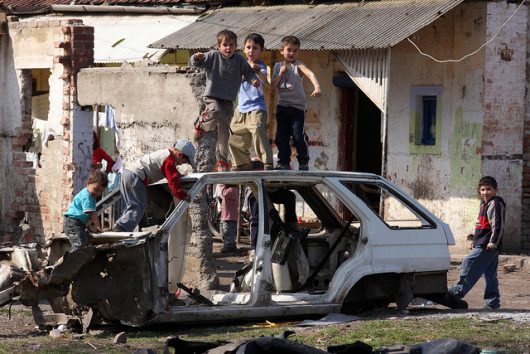
As poverty in Hungary continues to increase, aid from several countries has been provided to the struggling European nation. As of 2015, Hungary suffers from the highest child poverty rate in the European Union.
One in three children lives in a home detrimental to their health with leaking roofs, mold, lack of an indoor toilet, and other sources of health risk. Data from the same year shows over 35 percent of Hungarian families now live below the poverty line.
For those living under these circumstances, day-to-day reality can be bleak. Increased rates of child starvation when not in school, overcrowded flats, and homes lacking insulation are just a few struggles of daily life which confront impoverished Hungarian families.
These devastating circumstances combined with economic pressures have motivated Hungarian youth to leave for work abroad — producing a rapidly aging population threatening to present welfare issues.
In efforts to make international relief funds as effective as possible, a new series of reports from the World Bank offers a promising method for ensuring their strategic use.
European Union funding and the commission of Hungary’s Ministry of Human Capacities have produced the Promoting Inclusive Growth in Hungary Advisory Service Activity, a project which has provided the framework for the World Bank reports.
These reports have identified a need for concrete initiatives, coordination between local and national level efforts, and targeted investments in order to more successfully combat poverty in Hungary.
Working with communities to address the needs specific to local areas, in addition to learning from positive and negative examples of past initiatives, is hoped to improve the efficacy of targeting poverty in the country.
In counteracting the departure of young workers, the reports have identified a particular need for emphasis on better skill development and increased job prospects. These measures will be instrumental in combating a simultaneously aging and declining population.
An additional factor addressed by the reports is the social exclusion faced by impoverished Hungarian families. This exclusion is often accompanied by a lack of access to the job skills training needed by young Hungarians for the transition from school to the workplace.
Efforts to close the economic gap between Hungary’s advantaged and disadvantaged populations must also include attention to this accompanying social gap. The World Bank reports identifying investment in implementing social inclusion activities as a mechanism for accomplishing this.
In addition, there lacks institutional coordination in implementing these programs, which could be improved by streamlining the efforts of mayors and civil society.
With European Structural and Investment Funds providing Hungary with a 2014-2020 opportunity to invest in the socioeconomic incorporation of its disadvantaged families, the series of World Bank reports comes at a crucial time.
Equipped with these reports and a long-term investment framework, the nation stands to maximize its potential progress.
– Charlotte Bellomy
Photo: Flickr

World Refugee Day: Understanding the Plight of Refugees
June 20, 2016 was recognized by organizations, communities and leaders alike as World Refugee Day. According to a report conducted by the United Nations, there is a record number of 65.3 million refugees who were displaced due to war by the end of 2015. This is more than the population of France, California, and Texas combined, with more than half of these refugees being children.
With such a high traffic of refugees being displaced globally, understanding the truth about this displaced population is more relevant than ever. Recent studies have shown an increase in anti-immigrant and anti-Muslim sentiments in classrooms and the workplace. One such study, conducted by the Southern Poverty Law Center revealed in a survey that included over a third of American teachers reported an increase of anti-immigrant sentiments in their classrooms.
However, these sentiments are often caused by general fear and media misrepresentation rather than the refugees themselves. In fact, refugees are very beneficial to the communities they move in to, offering an increase in both civic participation and great economic contributions. World Refugee Day sheds light on these facts and aids in the perception of refugees.
A recent study of refugees residing in Columbus Ohio showed that these displaced families and individuals made economic contributions of about $1.6 million. Moreover, these refugees also contributed to social diversity as well which is ultimately conducive to building a more globalized identity.
Refugee settlement and mentor programs, such as those conducted by The Catholic Charities Archdiocese of New Orleans (CCANO), which spur acceptance, tolerance and the chance at assimilation for many displaced individuals and families result in amazing rewards for the communities that establish them.
According to a study by The Refugee Integration Survey and Evaluation (RISE), which focused on the integration progress of refugees over a span of five years, most refugees offer valuable and productive roles in the communities they are displaced to. Programs such as those conducted by CCANO simply quicken the process. And events, such as those in Rochester, New York on June 18, 2016, held in honor of World Refugee Day, allow refugees to share their stories as well as their cultures, reminding us that these displaced people are first and foremost, people.
– Jenna Salisbury
Photo: Flickr
Poverty in Iceland Drops as Tourism Rises
Tourism Fights Poverty in Iceland
The 2008 financial crisis took a major toll on Iceland’s economy, leading to homelessness and unemployment. As a result, a Welfare Watch was created the following year in order to help alleviate these conditions.
In addition, the recent popularity of Iceland as a tourist destination has helped bounce the economy back towards its former financial success. The growing tourism industry has also created many new jobs for Icelandic residents. Unemployment rates have fallen and 45 percent of the jobs created within the past five years are related to the tourism industry.
There is no rest for the tourists — rental cars and lodgings are rapidly booked, even during the coldest months of the year, and Airbnb locations are second only to increasingly booked hotels. However, a host told Grapevine that he does not believe that even Airbnbs (in combination with traditional lodging vacancies) can meet the high demand.
The Icelandic bank, Islandsbanki’s projected future tourism rates estimate that in 2016 alone visitors will equal, or surpass, the number of people who live full-time in the island nation. Iceland’s growing fame has been attributed to volcanoes, inexpensive flights and layovers through Icelandair, as well as pop culture references like Game of Thrones.
Although many Icelanders are rejoicing at the tourism industry’s success, others are still wary of the future. The waterfalls and volcanoes of Iceland are major tourist honeypots, but increased crowding to these areas may be dangerous to both the environment and its visitors.
In the future, tourists may be discouraged to visit Iceland if the Icelandic Krona appreciates, causing prices to rise, or if the economy takes another hit.
There is also the fear that Iceland may lose part of its charm and culture as foreigners flock in. This is a trade-off for alleviating poverty in Iceland. Iceland is in need of money and, in the words of Bradley Turner of Grapevine, “The market doesn’t care much for memory, nostalgia, sentimentality, history.”
Poverty in Iceland continues to decline as a result of increasing visitors, but financial security comes at a price. Ironically, the Icelandic landscape and culture may be negatively affected by the country’s newfound popularity.
– Carrie Robinson
Photo: Flickr
Why Foreign Aid is Important
Here at The Borgen Project, we are often asked why foreign aid is important. Foreign aid can save the lives of millions of people living in poverty around the world. It addresses issues such as health, education, infrastructure and humanitarian emergencies.
Foreign aid is a broad term. In a wide sense, it can be defined as “financial or technical help given by one country’s government to another country to assist social and economic development or to respond to a disaster in a receiving country.”
2 Ways Foreign Aid Helps the U.S.
Creates Jobs
Improves National Security
There are numerous reasons why foreign aid is important to help impoverished countries; discussed below are the six key targets.
Top 6 Benefits of Foreign Aid
Another reason why foreign aid is important is how it fosters a conducive diplomatic relationship between the donor and the recipient.
Impoverished nations receiving aid can eventually become independent and move towards democratic fundamentals with the help of donor countries.
There are hundreds of different donors of foreign aid. One of the most well-known donors of foreign aid comes in the form of Official Development Assistance (ODA).
It is provided by the Development Assistance Committee of the Organization for Economic Development Cooperation. The ODA provides foreign aid to poor countries in the form of grants and loans.
The ODA is important to impoverished countries as it provides specifically the materials needed to build effective infrastructure and expand educational programs and the access to schools. Additionally, it provides efficient responses to humanitarian emergencies.
One of the most well-known and largest providers of foreign aid is the International Development Association (IDA), which is part of the World Bank. It has 173 shareholders that provide grants and loans to 77 countries around the world, 39 of which are located in Africa.
The main goal of the IDA is to reduce inequalities, increase economic growth and improve the living conditions of those in poverty. These goals are addressed as IDA funds are given directly to the sectors of education, water, sanitation, agriculture and infrastructure.
The IDA provides little to no interest on its grants and loans and allows for a grace period of up to 10 years. It also allows the recipient country to make debt payments of up to 40 years.
Since 1960, the IDA has provided $312 billion in investments in 112 impoverished nations. In the last three years alone, there has been an average of $19 billion in grants and loans.
Foreign aid truly makes a difference to people living in poverty. It provides access to basic necessities and provides people essential conditions for living a peaceful and secure life.
– Kimber Kraus
Photo: U.S. Navy
Closing the Economic Gap to End Poverty in Hungary
As poverty in Hungary continues to increase, aid from several countries has been provided to the struggling European nation. As of 2015, Hungary suffers from the highest child poverty rate in the European Union.
One in three children lives in a home detrimental to their health with leaking roofs, mold, lack of an indoor toilet, and other sources of health risk. Data from the same year shows over 35 percent of Hungarian families now live below the poverty line.
For those living under these circumstances, day-to-day reality can be bleak. Increased rates of child starvation when not in school, overcrowded flats, and homes lacking insulation are just a few struggles of daily life which confront impoverished Hungarian families.
These devastating circumstances combined with economic pressures have motivated Hungarian youth to leave for work abroad — producing a rapidly aging population threatening to present welfare issues.
In efforts to make international relief funds as effective as possible, a new series of reports from the World Bank offers a promising method for ensuring their strategic use.
European Union funding and the commission of Hungary’s Ministry of Human Capacities have produced the Promoting Inclusive Growth in Hungary Advisory Service Activity, a project which has provided the framework for the World Bank reports.
These reports have identified a need for concrete initiatives, coordination between local and national level efforts, and targeted investments in order to more successfully combat poverty in Hungary.
Working with communities to address the needs specific to local areas, in addition to learning from positive and negative examples of past initiatives, is hoped to improve the efficacy of targeting poverty in the country.
In counteracting the departure of young workers, the reports have identified a particular need for emphasis on better skill development and increased job prospects. These measures will be instrumental in combating a simultaneously aging and declining population.
An additional factor addressed by the reports is the social exclusion faced by impoverished Hungarian families. This exclusion is often accompanied by a lack of access to the job skills training needed by young Hungarians for the transition from school to the workplace.
Efforts to close the economic gap between Hungary’s advantaged and disadvantaged populations must also include attention to this accompanying social gap. The World Bank reports identifying investment in implementing social inclusion activities as a mechanism for accomplishing this.
In addition, there lacks institutional coordination in implementing these programs, which could be improved by streamlining the efforts of mayors and civil society.
With European Structural and Investment Funds providing Hungary with a 2014-2020 opportunity to invest in the socioeconomic incorporation of its disadvantaged families, the series of World Bank reports comes at a crucial time.
Equipped with these reports and a long-term investment framework, the nation stands to maximize its potential progress.
– Charlotte Bellomy
Photo: Flickr
International Companies Bring Cheap Solar Power to Zambia
The World Bank has enabled three companies—First Solar Inc. from the U.S., Neoen SAS from France and Enel SA from Italy—to provide the cheapest solar power on the entire African continent to Zambia.
First Solar Inc. and Neoen SAS will jointly provide electricity to Zambian homes for 6.02 cents per kilowatt-hour, while Enel SA will be selling electricity for 7.84 cents per kilowatt-hour.
Through financial services as well as insurance and advisory roles, the World Bank, International Finance Corp. and the Multilateral Investment Guarantee Agency have created a sustainable energy movement through the Scaling Solar program. In addition, these groups are also investing in solar power for other sub-Saharan countries, such as Madagascar and Senegal.
This comes at a time in which renewable energy markets are emerging all over the world and becoming increasingly important. Investing in these companies and projects will allow electricity to expand to homes across the globe. As individuals who can afford it begin to purchase electricity, they will join the international market as new consumers of power.
Set for construction in the capital city of Lusaka, the private companies plan to complete their projects by mid-2017. They will work with local Zambian organizations, such as ZESCO, the state-run utility mogul, to ensure seamless operative standards between these international powers.
In recent years, the South African region has shown economic promise. Debt levels across the entire continent remain low and there is a set spending cap in the region. Consequently, these fiscal improvements have yielded an environment in which projects like cheap solar power can flourish.
Investing in countries stricken by poverty is an ideal way to receive a return on investment in U.S. companies, as citizens of those regions become future consumers of U.S. goods and services as they escape the cycle of poverty.
In the quest to intersect sustainability and capitalist ventures, bringing cheap solar power to Zambia—and hopefully to the rest of the continent—is a step in the right direction.
– Connor Borden
Photo: Greentechlead
The Impact of Drought in India
Although June marks the beginning of monsoon season, some experts believe the heavy rain will not alleviate India’s drought problem. The Central Water Commission recently reported that the country’s 91 water reservoirs are only at 17 percent of their total storage capacity.
The Indian government estimated over 300 million people to be effected by the drought. An estimated 370 people have died due to heat and water related issues within the country.
Drought is a major problem throughout the world with the worsening climate change conditions. Even developed countries like the U.S. suffer from water supply issues. However, in developing countries, drought can have a severe impact on an individual’s quality of life.
Small farmers are suffering major losses in their crops, leading to increased hunger and eventual starvation. Various areas in India rely on government shipments of water to survive. Consequently, some have uprooted their lives in rural regions to find more reliable water sources near cities. The drought in India has even led to increased suicide rates among crop growers.
Additionally, the heat wave and drought impact the ability of Indian children to attend school. Schools in some areas have been shut down due to excessive heat and lack of water.
The drought in India has also created political conflict within some states. In Punjab, there is a heated debate over the ownership of river water and the Satluj-Yamuna Link canal.
Nearly 1.3 billion people reside in India and require reliable and safe water to survive. Monsoon season may help the water crisis in the short run, but drought within the country is a common occurrence. Effective drought control efforts are a necessity to curb the issue.
So far, the government has placed restrictions on new sugar factories and sugarcane growth—both highly water-intensive. Additionally, water trains help provide water to drought-stricken areas.
Organizations like The Water Project and the Naam Foundation are attempting to raise awareness and assistance for drought-prone areas within the country. Responsible water usage and efforts to curb climate change are crucial to preventing severe drought in India and various other nations.
– Saroja Koneru
Photo: Youtube
Gates Foundation: Closing the Global Gender Data Gap
According to a press release by the organization, “a lack of comprehensive, current information about women and girls, especially in developing countries, hinders efforts to advance gender equality.” In order to achieve the health, educational and social proposals of the United Nations Sustainable Development Goals, world entities need access to accurate information about women everywhere. Closing the global gender data gap would provide that information.
The New York Times reports that standards for collecting data are gender-biased. These standards also fail to account for the complexity of women’s global situations. For example, many traditional surveys do not count female-led households in the same way as male-led households. They do not fairly count women who are homemakers or caretakers. Surveyors might end an interview after documenting “homemaker” as a woman’s primary activity, even if she has other economic occupations.
According to the same New York Times article, surveyors only collect about 30 percent of women’s economic activity. On the other hand, surveyors collect 75 percent of men’s activity. Statistics like this compelled the Bill and Melinda Gates Foundation to improve data collection methods. Entities such as the United Nations Foundation and the U. S. Department of State have also joined them.
The funding will support the creation of effective training techniques and improved tools for people who work with data. Tools like the Population Council’s Girl Roster Toolkit can provide those who collect and analyze data with holistic perspectives about issues girls suffer from globally and how they must properly document them. The Girl Roster also connects the world’s neediest young women with services in their areas.
In order to keep governments and politicians accountable to use the new and improved data, organizations like Avenir Health’s Track20 will help governments connect with women worldwide in order to give women access to family planning services.
The good news is that data gaps are already closing for women. According to the New York Times, the number of mothers dying during childbirth has dropped more than 40 percent worldwide. Similar statistics show much progress, but others show the need for more work to completely close the global gender data gap.
With the help of sponsors like the Bill and Melinda Gates Foundation and the work of data analysts and cooperative governments, the world can continue to give women everywhere the chances they need to live whole and happy lives.
– Addie Pazzynski
Photo: Flickr
How Statelessness Affects Global Poverty
Statelessness is as much of an economic burden as it is a social and political one. According to a recent Foreign Policy article, statelessness results in “chronic economic instability” because it is often accompanied by joblessness and poverty.
According to the U.S. Department of State, a stateless person is someone who does not “enjoy” the rights of “citizenship – the legal bond between a government and an individual – in any country.” In other words, these individuals do not have the same rights and opportunities as people who are recognized as citizens by the nations in which they live.
Although the U.N. High Commissioner for Refugees counted 3.5 million stateless people in 2011, they estimated that the number could be as high as 12 million people. Foreign Policy reports that as many as 15 million people might be stateless today.
The Department of State notes that the causes of statelessness are diverse. They include failure to register newborns properly, birth to stateless parents, discrimination against minorities and traditional attitudes towards registration, to name a few.
Not only are stateless people denied government-issued identification, preventing them from acquiring formal labor jobs, but they are also subjects of social discrimination. These realities exclude them from even more employment opportunities, leads to fewer chances of regular employment and leaves stateless persons even more destitute.
Foreign Policy also reports that very little research exists about the effects of statelessness on economies. Some existing studies suggest that stateless persons have a negative economic impact on smaller nations in which they may make up a more significant percentage of the population. In this case, granting citizenship to stateless persons might actually improve these nations’ gross domestic product output.
Although stateless individuals can obtain cards which signify their status, only a few thousand people have been able to take advantage of this opportunity. One of the Sustainable Development Goals of the United Nations aims to provide everyone with legal identity by 2030, which will give people access to formal job markets and increase economic opportunities for individuals and nations.
The U.S. State Department suggests that universal birth registration and increasing access to naturalization and citizenship will help solve statelessness. As Foreign Policy points out, nations must want to increase inclusiveness with stateless persons and cease the use of political reasoning for ostracizing them before changes can occur.
Policies and prejudices might take many years to change, but the economic, social and humanitarian advantages of granting citizenship to stateless people are worth the fight.
– Addie Pazzynski
Photo: UNHCR
Children in Crisis Areas Struggling with Education
Of this number, 75 million children are out-of-school, and the situation worsens for school-aged girls. UNICEF reports that over 63 million girls do not attend school and the numbers continue to rise. School-aged girls are in desperate need of a support system to improve their access to education and their chances at a successful future.
An education system not only provides basic instruction but also incorporates a daily schedule, food access and safe shelter for children during times of conflict. Conflicts in Eastern Ukraine have destroyed one out of every five schools and conflicts in Syria have rendered 6,000 schools unusable for education. The sites that can no longer be used as schools are now used as shelters for families or bases for armed forces.
As a result of the humanitarian crises in these areas, many children often receive no chance at an education. However, a recent emergency education fund will help to provide better education for the students facing difficulty, improving their family life and reactions to local conflicts as a result.
The World Humanitarian Summit was held in Istanbul in late May, where an emergency education fund called ‘Education Cannot Wait’ was proposed. The fund will provide for the educational needs of children who are suffering as a result of living in conflict zones.
Education Cannot Wait will attempt to raise $4 billion in the next five years for children in crisis areas struggling with education access and quality. This will support the 2015 Sustainable Development Goals which include a proposal for all school-aged children to have access to free and quality primary and secondary education by 2030. Improving the education systems for children in conflict zones will minimize or mitigate the issues of poverty on a larger scale.
– Amanda Panella
Photo: Flickr
Refugees in Lebanon Benefit from Double-Shift Schools
In the past years, Lebanon has accrued approximately 1.5 million Syrian refugees, aside from the large population of Palestinian refugees already present. While the country has provided a hospitable environment for those restarting their lives, there are many issues with access to food, shelter and education for refugees in Lebanon.
Recently, Lebanon has created an education system called “double-shift” schools located primarily in Beirut. The double-shift model has two shifts of students attending class each day, allowing Lebanese schools to reach beyond the already-enrolled students. The new afternoon shift gives Syrian refugees, who are not yet at the same education level as their Lebanese peers, an opportunity to receive quality education.
Education has been made free for both Lebanese and Syrian students to eliminate any discrimination against refugee students. Lebanon is able to thank international aid for allowing them the ability to provide education to all students. These international donors have paid up to $600 for each student to attend a double-shift school.
Some schools are able to accommodate up to 700 refugee students in the afternoons. Among the 259 schools offering double-shift education, there are now 85,000 children enrolled.
The increase in provided education for refugees in Lebanon also increases the access to food that many children are often without. The U.N. World Food Program has begun providing food access in schools for up to 10,000 children. The refugee children are provided with a snack, fruit and a box of either milk or juice when attending class. With access to regular meals and education, refugee students are able to pursue many of the same opportunities as their peers.
Though Syrian refugees have been unable to pursue sufficient education after being displaced, efforts are being taken to improve these issues largely through international aid. Providing basics such as food and education for refugees improves the ability to live normal lives for many of the children.
– Amanda Panella
Photo: Flickr