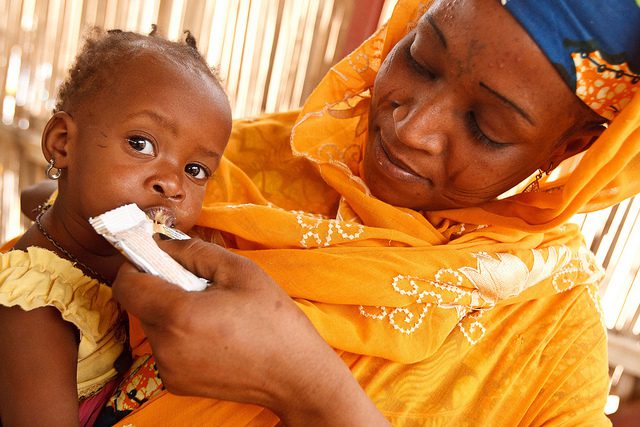
 Niger is a landlocked country in sub-Saharan Africa that struggles to feed its population. Three major factors that contribute to hunger in Niger are overpopulation, scarce water supply and armed conflict.
The food crisis in Niger is made worse by the staggering birth rates of the region. With an average of 7.6 children per woman, Niger’s population is growing fast.
This growth raises questions regarding how to feed these children. An estimated 2.5 million people have no secure source of food.
Niger has poor access to contraception, so the population is likely to continue increasing and put more strain on its already meager food supply.
Nigerien president Mahamadou Issoufou is working with the African Development Bank (AfDB) to better modernize the infrastructure of the country in an attempt to feed the growing population.
“We have launched the Nigeriens Nourish Nigeriens initiative, aiming to reduce poverty — which mainly affects women and rural populations — to 31 percent and enabling the complete eradication of hunger in Niger by 2021,” Issoufou said.
Niger is a landlocked country located just beneath the Sahara Desert. As a result, finding access to water can be difficult.
Niger’s food sources are vulnerable since the country relies heavily on subsistence rain-fed agriculture. The variance in rainfall and the harsh climatic conditions contribute to the chronic food insecurity.
AfDB president Akinwumi Adesina addressed members of Niger’s government on Sept. 26, 2017, in an effort to show how the AfDB plans to help mitigate the lack of water.
“I am convinced that the construction of the Kandadji dam, one of the projects we are financing here in Niger, will enable your country to overcome challenges in agriculture and energy. Once complete, the Kandadji dam will produce 1.5 billion square meters, 125 megawatts, and will allow about 45,000 hectares of land to be irrigated.”
Ongoing Boko Haram-related conflict has caused an influx of Nigerian refugees. Population displacement has left locals in the Diffa region of Niger food-insecure.
Boko Haram, the Islamist extremist group, has rampaged across the region for years, forcing more than two million people to flee their homes and farms. Across the border of Niger and Nigeria, trade has come to a halt. Markets have shut down because vendors have nothing to sell.
Because of Boko Haram-induced terror in Nigeria, refugees flee north into Niger. This places even more stress on the overpopulated and food-insecure country.
Farmers in Niger and Nigeria have begun to change their tactics, planting crops that lay low to the ground so as not to be easily spotted by raiding soldiers. However, this is a desperate solution to hunger in Niger that only direct actions from world powers can fix.
– Sam Bramlett
Photo: Flickr

A Nation in Need: How to Help People in Tajikistan
32 percent of Tajiks live below the poverty line, a rate significantly higher than its Central Asian neighbors. The nation is by far the most economically deprived in the Central Asian region, and its problems are frequently compounded by its unstable economy and geopolitical situation. More than one million Tajiks work in Russia and other ex-Soviet republics, leading 50 percent of the country’s GDP to be reliant on remittances. Additionally, its rarely-policed border with Afghanistan has led to pressure from Al-Qaeda extremists in its most remote corners.
How to help people in Tajikistan is reliant on the NGOs and aid organizations that operate there. Save the Children (STC) has had a presence in Tajikistan since 1992. Around 10 percent of school age children are currently absent from the education system. STC works to ensure Tajik children are in full-time education, especially girls. They have also made strides to protect the large homeless child population in the capital, Dushanbe, and have paid special attention to orphans. Consider donating or volunteering for STC to join them in their efforts.
The U.S. government has also joined the fight against poverty in Tajikistan. USAID has implemented the Feed the Future initiative, which assists farmers in achieving the crop development they need to sustain their families and communities. Thousands have achieved a more secure and sustainable relationship with their land as a result. USAID has multiple opportunities for American citizens to join them in their work. Volunteers are accepted on various projects both at home and abroad, and they are also eager to build partnerships with businesses and organizations to further their mission.
Rural Tajiks in the nation’s remote areas also receive support from groups such as the European Bank for Reconstruction and Development (EBRD). Its agricultural financing facility is helping alleviate the crushing debt faced by many agricultural communities due to uncertain crop yields. A 25 million euro investment through the Tajik Agricultural Finance Framework (TAFF), set up by EBRD, has allowed farmers access to purchasing the crop of their choice, diversifying production and allowing for more economic stability. The EBRD also accepts volunteers, as well as businesses interested in partnering with non-profits that work in the Central Asia region.
These organizations offer the most salient answer for how to help people in Tajikistan. Through participating with these organizations, those interested in alleviating the crushing poverty experienced by many Tajiks can make a tangible difference.
– Jonathan Riddick
Photo: Flickr
10 Facts About the LRA Insurgency
These 10 facts about the LRA insurgency are only a few aspects of an organization that has displaced almost two million people and kidnapped more than 20,000 children. Thanks to global effort and government assistance, the growth of these numbers is consistently slowing.
– Jenae Atwell
Photo: U.S. Air Force
UNHCR Financing Higher Education for Refugees
Specifically, the global number of refugees — people who have been forced from their home countries due to war or other life-threatening occurrences — has risen by 6.7 million in just five years.
Imagine if nearly the entire population of Washington state was suddenly forced to leave, and depend entirely on their ability to convince a political body, over which they have no control, of the unequivocal necessity of their leaving home. The total number of people living this reality stands at 16.5 million.
What does this situation mean for college-aged adults? What access is there to higher education for refugees? According to UNHCR statistics on refugee education, the situation is bleak. Just 1 percent of all college-aged refugees are able to seek higher education, while the other 99 percent is left out.
However, there is one program that seems to have had a profoundly positive impact on thousands of college-aged refugees. The UNHCR’s Albert Einstein German Academic Refugee Initiative Fund (DAFI).
DAFI was first implemented in 1992, and has continued to receive a majority of its funding from the government of Germany. Through the financing of higher education for refugees at approved universities, DAFI aims to:
So, what does it take for a potential scholar to be granted a DAFI scholarship? First, students must be in what the UNHCR terms “developing countries or countries in transition”, as well as have been granted asylum from the country in which they will pursue their studies. Second, they must be under 28 years of age when their studies begin.
Additionally, as the program is intended to arm a generation with the necessary skills required to help rebuild their countries of origin, all students must decide on a course of study that will see them quickly employed upon repatriation.
As of 2015, 2,321 people were able to achieve their dream of attending university. This is a substantial increase from a total of just 4,774 scholars in the first 15 years of its operation.
For its relatively short history, it would seem that the program of higher education for refugees has been hugely successful. Indeed, one of its only critiques may be that it cannot reach more would-be college students faster.
– Katarina Schrag
Photo: Flickr
The Ongoing Earthquake Recovery in Mexico
Much of the initial response to the earthquake was formed out of frustration toward the Mexican government, which many citizens view as corrupt and incompetent. The Mexican armed forces, who have taken over much of the recovery, have been accused of gravely mismanaging the earthquake recovery. The military has simultaneously drawn ire for bulldozing buildings suspected of still having people trapped in the rubble, as well as wasting time and resources on futile rescue attempts. One of the higher-profile examples of the latter occurred when the navy spent days searching in vain for Frida Sofia, a 12-year old girl who later turned out not to have existed at all.
Another concern is that the trucks sent by the government with much needed food and medicine will end up being siphoned by corrupt politicians and criminals, or simply sent to places that do not need the aid. This fear is not unfounded; Mexican president Enrique Peña Nieto and his Institutional Revolutionary Party remain very unpopular. Many do not trust the government on any level to handle the earthquake recovery in Mexico.
In spite of this, there have been some bright spots in the recovery efforts. Young people in particular have stepped up as volunteers. Social media apps like Facebook and WhatsApp have become critical tools in coordinating the earthquake recovery in Mexico. Some young people have joined the “brigadas,” which often venture into still-unsafe buildings to find survivors. Others have collected and distributed canned food to hungry citizens. Others still have used whatever talents they have, including music and performance, to entertain children in shelters who now have no home. Many volunteers have taken time off from their lives and livelihoods to assist in what ways they can.
Activists have also taken a stand to lead the way in the recovery. One notable example is a successful online campaign that has forced the major political parties in Mexico, set to spend record sums on the 2018 election, to redirect a quarter of the $375 million of public funds, originally earmarked by the National Electoral Institute, toward the earthquake recovery in Mexico instead.
Currently, many of the streets have been cleared, and people are going back to work and attempting to rebuild their lives. It may take years to fully complete the earthquake recovery in Mexico, but in a country known for its sharp socioeconomic divide, many Mexicans have been heartened by the way the earthquake recovery in Mexico has brought people together across class lines.
– Andrew Revord
Photo: Flickr
3 Causes of Hunger in Niger
The food crisis in Niger is made worse by the staggering birth rates of the region. With an average of 7.6 children per woman, Niger’s population is growing fast.
This growth raises questions regarding how to feed these children. An estimated 2.5 million people have no secure source of food.
Niger has poor access to contraception, so the population is likely to continue increasing and put more strain on its already meager food supply.
Nigerien president Mahamadou Issoufou is working with the African Development Bank (AfDB) to better modernize the infrastructure of the country in an attempt to feed the growing population.
“We have launched the Nigeriens Nourish Nigeriens initiative, aiming to reduce poverty — which mainly affects women and rural populations — to 31 percent and enabling the complete eradication of hunger in Niger by 2021,” Issoufou said.
Niger is a landlocked country located just beneath the Sahara Desert. As a result, finding access to water can be difficult.
Niger’s food sources are vulnerable since the country relies heavily on subsistence rain-fed agriculture. The variance in rainfall and the harsh climatic conditions contribute to the chronic food insecurity.
AfDB president Akinwumi Adesina addressed members of Niger’s government on Sept. 26, 2017, in an effort to show how the AfDB plans to help mitigate the lack of water.
“I am convinced that the construction of the Kandadji dam, one of the projects we are financing here in Niger, will enable your country to overcome challenges in agriculture and energy. Once complete, the Kandadji dam will produce 1.5 billion square meters, 125 megawatts, and will allow about 45,000 hectares of land to be irrigated.”
Ongoing Boko Haram-related conflict has caused an influx of Nigerian refugees. Population displacement has left locals in the Diffa region of Niger food-insecure.
Boko Haram, the Islamist extremist group, has rampaged across the region for years, forcing more than two million people to flee their homes and farms. Across the border of Niger and Nigeria, trade has come to a halt. Markets have shut down because vendors have nothing to sell.
Because of Boko Haram-induced terror in Nigeria, refugees flee north into Niger. This places even more stress on the overpopulated and food-insecure country.
Farmers in Niger and Nigeria have begun to change their tactics, planting crops that lay low to the ground so as not to be easily spotted by raiding soldiers. However, this is a desperate solution to hunger in Niger that only direct actions from world powers can fix.
– Sam Bramlett
Photo: Flickr
Uncommon Cocoa Farmers in Latin America
This systemic exploitation of smallholder farmers has caused many to become deeply entrenched in the cycle of poverty while the middlemen profit immensely from the hard labor of the farmers. Farmers can expect to receive no more than 6 percent of the final value of a chocolate bar containing their cocoa, while middlemen like processors will receive 40 percent of the final value of the same bar. Consequently, the economic impact on smallholder farmers is catastrophic, and has ultimately been creating a global decrease in the number of cocoa farmers despite an increase in demand for the product.
In 2010, a local social enterprise in Belize called Maya Mountain Cacao was founded in order to fight this system of exploitation. Maya Mountain Cacao cuts out the middlemen, partnering over 300 smallholder cocoa farmers directly with the fine chocolate industry. They start by purchasing the cocoa beans directly from the farmers themselves, and they do so at a higher rate than the farmers could receive from a purchaser involved in the traditional cocoa supply chain. After that, Maya Mountain Cacao ferments and dries the beans, finishing the whole process by selling them directly to exporters that cater to the fine chocolate industry.
Within two years, those farmers within the Maya Mountain Cacao network experienced an income increase of 20 percent, which allowed for an 85 percent increase in school attendance for their children. Maya Mountain Cacao had so much success that it ended up expanding its model to include nations outside of Belize, ultimately culminating in the creation of Uncommon Cacao, a transnational company serving smallholder cocoa farmers in Latin America.
Today, Uncommon Cacao farmers increase their income by over 100 percent, simply by eliminating the middlemen and connecting directly with the global fine chocolate industry. In an industry that is growing at an average of 3.1 percent per year, the need for sustainable value chain practices, such as those developed by Uncommon Cacao and its cocoa farmers in Latin America, is beyond significant; it is necessary.
– Kailee Nardi
Photo: Flickr
Addressing Malnutrition in Kenya with Local Grains
This understanding is especially important to note when looking at the issue of malnutrition in Kenya specifically, where 40 percent of children below the critical age of two are considered “stunted” (too short for their age), a condition which arises as a direct result of malnutrition. Malnutrition essentially holds a child’s body hostage by inhibiting its growth and development. Further, children that suffer from chronic malnutrition also run the risk of brain damage, as their brains typically underdevelop.
In the thick of the effort to combat malnutrition in Kenya is an organization called Insta Products. Insta creates micronutrient-rich instant porridge packets that are specifically designed to combat malnutrition. The products also provide all nine of the human body’s essential amino acids, which is extremely important when considering the rarity of animal products that would typically provide said acids. The porridge contains grains and soybeans, the majority of which are sourced locally from Ugandan and Kenyan farmers in an effort to contribute to local economies, working to combat malnutrition by combating poverty.
The organization’s product has become so successful that it is purchased on an extremely wide scale. Approximately 89 million servings of the product have been sold by major aid organizations such as UNICEF and the United Nations World Food Programme. Insta has been given the honor of being one of seven suppliers recognized by UNICEF, an incredible feat for a company who focuses on sourcing local goods in order to holistically tackle the issue of malnutrition.
– Kailee Nardi
Photo: Flickr
African Development Bank Group’s Global Strategies
The African Development Bank Group was born out of three different economic groups in Africa. It has set a plan that began in 2013, targeted to reach major benchmarks by 2022. The group has recognized that Africa has begun a transformative journey and progressed greatly over the last decade, yet this progress remains markedly uneven in some areas of the continent. This particular organization relies on a few major objectives to help lift regional member countries out of poverty, while staying congruent with ideals and values. The group first aids by mobilizing and allocating a country’s resources, then provides advice and guidance on technical aspects for development efforts. The African Development Bank Group has also laid out 17 sustainable development goals in order to achieve its mission. These goals include food security measures, sanitation, healthcare, sustainable energy use and procurement, social equality across gender and age gaps, economic growth and stability and ecological preservation plans.
The holistic approach to poverty reduction through economic growth and sustainability is what sets apart the African Development Bank Group. While taking advantage of models such as the World Bank and Multilateral Development Banks, The African Development Bank Group is able to remain primarily domestically-reliant and position itself in such a way as to gain more traction as the 2022 goal nears. Balance sheet optimizations have been a key focus in doing so, as projects continue to be carried out in both the private and public sectors through multilateral funds involving developed countries. The group’s procurement procedures – unlike other bank methods – involve strict standards. These include investments in member countries whose approval processes ensure that procurements are in line with the values and mission of The African Development Bank Group.
– Casey Hess
Photo: Flickr
UNDP Supports Universal Immunization Program in India
As the world’s largest immunization program, eVIN technology has already shown results in enabling real time information on cold chain temperatures and vaccine stocks and flows in all 371 implementing districts in India. It has managed to achieve over a 98 percent reporting rate from vaccine storage areas, with over 2 million transactions logged each month, and developed the skills of over 17,000 government staff in store keeping, data operating or cold chain handling in over 550 batches of training programs.
The eVIN is setup on a mobile application that easily allows cold chain handlers to log stock positions at the end of each routine immunization day, which is then relayed immediately onto a web interface for assessment by health officials. In India, this can come to play an important role as geography and communications can pose an issue, like in the small hill-state of Manipur, where vaccine vials are carried over extensive distances to session sites by auxiliary nurses and midwives. Instances of stock-outs have decreased by more than six times here, and eVIN has enabled staff to learn how to use a smartphone and other technology, improving quality of work and management in the process.
This immunization program in India has also significantly empowered women health workers, giving them the opportunity to work with technology after attending regional and district eVIN training sessions. This allows them to manage stocks and temperatures themselves, bridges the digital divide in rural parts of India and ensures transparency alongside accuracy. Over 50 percent of cold chain handlers are women, and many are from older age groups.
EVin has taken India out of the unproductive days of delayed decision making, shortages and expirations, and has created an efficient health system that allows for valuable state-wide geographic, stock-out or excess stock and temperature overviews on each district’s centers. It also allows for large savings by reducing vaccine wastage and allowing for timely and quality injections, as in Rewa, where around $70,000 was saved after six months of eVIN activation.
Though led by the UNDP and Ministry of Health and Family Welfare in India, the Universal Immunization Program is largely supported by GAVI, a global vaccine alliance established in 2000. With support from GAVI and the Indian government, the Universal Immunization Program in India has immunized at least 65 percent of India‘s children and expects to immunize 27 million more each oncoming year.
– Zar-Tashiya Khan
Photo: Flickr
10 Facts About the Turkey-ISIL Conflict
During the twenty-first century, Turkey utilized rapid urbanization and increasing trade to become an upper-middle-class country. As growth slowed in 2013, critics accused President Recep Tayyip Erdoğan of being soft on terrorism. Time Magazine suggests that Erdoğan declared war on ISIL to distract his populace and boost the economy.
The World Bank reports that exports and growth in Turkey will strengthen overall in 2017. In the midst of a turbulent time, the country continues decreasing its poverty rate past 9.3 percent, compared to 27.3 percent in the 2000s.
In spite of Turkey’s accomplishments fighting poverty, unemployment reached 12.1 percent in November 2016, rising from 11.1 percent a year earlier. The employment rate is even worse among men and women aged 15-24.
In 2015, Turkey provided a place to live for two million Syrian refugees. That number has since increased to three million. The 2015 Turkish Development Assistance Report named Turkey the second-largest donor country in the world.
The increase in transport and food expenses drove core inflation up to 10.2 percent in 2017. This is the first time in a decade for such numbers to reach double digits in Turkey. Combined with a poor harvest and increasing gas prices, it’s uncertain how long Turkey will allow its refugees to stay. No one can put a price on human life, but these 10 facts about the Turkey-ISIL conflict reveal that fighting global poverty is more than a moral issue.
Many Turkish neighborhoods packed with Syrians in the past three years. As Middle Eastern conflict continues, these un-integrated communities reveal that caring for migrants is more than a short-term solution.
When Syrian refugees first entered Turkey in 2011, the government gave migrants a special protection status in lieu of work permits. The country also granted their guests temporary accommodation centers and permission to enroll in universities without passports. Turkey has since rolled out work permits in response to complaints.
Due to the length and cost of providing work permits and social security for Syrian workers, most Turkish companies risk minor fines to hire illegal workers. Such practices do not comfort Turkish anxieties. Labor lawyer Mehmet Ata Sarikaripoglu notes “a public concern that Turkish people would be unemployed because of… Syrians… employed with lower fees.”
As of Oct. 4, 2017, Iraqi forces have retaken Hawija, a major Islamic State stronghold. Though Iraq routinely declares victory before fighting has finished, this latest strike continues a trend that has greatly reduced ISIL territory.
Turkish forces bombed more Kurdish separatists than ISIL targets during the war. The arrests of Kurdistan Workers Party members outnumber the amount of detained ISIL fighters. The Kurdistan Regional Government claimed territory close to Hawija, signaling that conflict in the region will continue for the foreseeable future.
These 10 facts about the Turkey-ISIL conflict reveal the inseparable relationships between war, economy and global poverty.
— Nick Edinger
Photo: Google