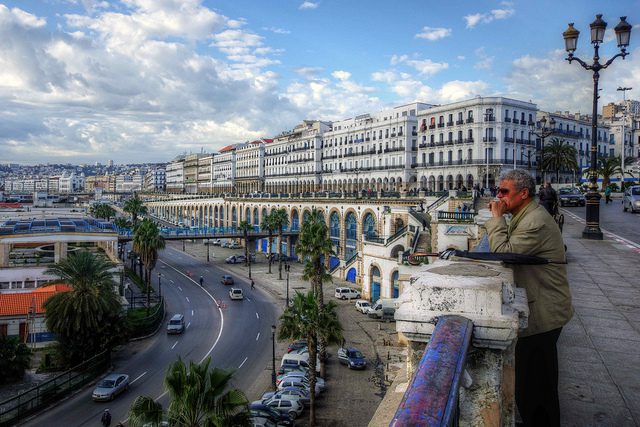
 Crowning a decade of substantial investment, the Chinese government gifted Algeria, its “comprehensive strategic partner” since 2014, with its very first opera house. After suffering through over half a century of political upheaval and extreme violence, Opera d’Alger represents the Algerian people’s hope for a future characterized by peace and cultural resurgence.
In 2010, the Chinese government announced a $40 million gift to Algeria in the form of the country’s first opera house, to be built in Algiers. After six years of planning and construction, the Opera d’Alger was completed in 2016.
Internationally, those keeping tabs on China’s rapid economic growth and increasing foreign investments see the Opera d’Alger as a symbol of Beijing’s considerable economic influence in Algeria. It is true that the Chinese-Algerian partnership has created close economic ties between the two countries. Since 2013, China has been Algeria’s top importer. According to Analyze Africa, a digital database providing macroeconomic data from leading global sources, “China’s influence in Algeria’s economy is undoubtedly most pronounced in the construction sector. Chinese firms have won billions in government infrastructure contracts in the past 15 years.”
Before 2015, when energy prices were favorable and Algeria’s economy was stable, the government announced a housing development plan to combat the rapid population growth and urbanization that had catalyzed a serious housing crisis, which had pushed many Algerians into slums and even into homelessness.
The government program, one of the most ambitious in the region, promised free, modern housing to those in need. Chinese firms fulfilled the majority of this exorbitant demand for construction; Chinese corporations have built nearly 250,000 homes in the country since the beginning of the 2000s. In addition to low-cost housing projects, Chinese construction contracts have included an East-West highway, an airport and shopping centers.
The foundation of the Chinese-Algerian partnership began in the 1950s, when China was the first non-Arab country to recognize Algeria’s bid for independence from France. Though ultimately successful in securing independence, the Algerian revolution was marked by extremely violent terrorist acts and a high civilian death toll. The post-revolutionary government in Algeria failed to achieve true stability, and in 1991 a civil war erupted between the state and various Islamic rebel groups. Algerian civilians once again suffered extreme and brutal violence, and tens of thousands of citizens were “forcibly disappeared”, never again to be heard from by their families.
Now referred to as the “Black Decade” in Algeria, the national recovery and reconciliation process is, according to many, still incomplete. The government’s housing program has been regarded as a significant step toward reconciliation with the Algerian people, but experts have criticized its efficacy, and the state’s newly instituted austerity measures necessitated by depressed energy prices have delayed its completion.
China’s gift of an opera house, then, is especially symbolic as a “home” for all. A glance through the events promoted on the Opera d’Alger’s Facebook page is indicative of the inclusive spirit its directors hope to promote in Algerian society. One of the first performances considered to be of a world-class standard given at the opera house was “Beyond Bollywood”, a theatrical showpiece of various traditional and modern forms of Indian dance. Recent performances include a concert dedicated to the memory and legacy of Algerian culture given by the National Ensemble of the Algerian Opera, a performance entitled “Rhythms and Colors of Algeria” given by the Algerian Ballet, “Agora: Greek Musical Fusion” and a rock concert by Algerian band Ithrene.
Though a concert of selected opera scenes from repertory standards such as Verdi’s La Traviata and Mozart’s Le Nozze di Figaro was given at the Opera d’Alger earlier this month, a complete opera has yet to be staged at Opera d’Alger. It is likely that the Chinese-Algerian partnership will be furthered by tour performances by the Peking Opera.
Noureddine Saoudi, the director of the house, stated in a recent interview that aspiring artists will soon be able to participate in free creative master classes at the Opera d’Alger, as he and his colleagues hope to see the opera become a “radiant centre of culture and arts”.
With a recent history fraught with conflict and violence, and fresh disappointment caused by the current economic downturn, the Chinese government’s gift of Opera d’Alger seems to have come just in time to renew the Algerian people’s hope to rebuild their communities and usher in a new era of pride in their homeland.
– Savannah Bequeaith
Photo: Flickr

The Chinese-Algerian Partnership Focuses on Social Housing
In 2010, the Chinese government announced a $40 million gift to Algeria in the form of the country’s first opera house, to be built in Algiers. After six years of planning and construction, the Opera d’Alger was completed in 2016.
Internationally, those keeping tabs on China’s rapid economic growth and increasing foreign investments see the Opera d’Alger as a symbol of Beijing’s considerable economic influence in Algeria. It is true that the Chinese-Algerian partnership has created close economic ties between the two countries. Since 2013, China has been Algeria’s top importer. According to Analyze Africa, a digital database providing macroeconomic data from leading global sources, “China’s influence in Algeria’s economy is undoubtedly most pronounced in the construction sector. Chinese firms have won billions in government infrastructure contracts in the past 15 years.”
Before 2015, when energy prices were favorable and Algeria’s economy was stable, the government announced a housing development plan to combat the rapid population growth and urbanization that had catalyzed a serious housing crisis, which had pushed many Algerians into slums and even into homelessness.
The government program, one of the most ambitious in the region, promised free, modern housing to those in need. Chinese firms fulfilled the majority of this exorbitant demand for construction; Chinese corporations have built nearly 250,000 homes in the country since the beginning of the 2000s. In addition to low-cost housing projects, Chinese construction contracts have included an East-West highway, an airport and shopping centers.
The foundation of the Chinese-Algerian partnership began in the 1950s, when China was the first non-Arab country to recognize Algeria’s bid for independence from France. Though ultimately successful in securing independence, the Algerian revolution was marked by extremely violent terrorist acts and a high civilian death toll. The post-revolutionary government in Algeria failed to achieve true stability, and in 1991 a civil war erupted between the state and various Islamic rebel groups. Algerian civilians once again suffered extreme and brutal violence, and tens of thousands of citizens were “forcibly disappeared”, never again to be heard from by their families.
Now referred to as the “Black Decade” in Algeria, the national recovery and reconciliation process is, according to many, still incomplete. The government’s housing program has been regarded as a significant step toward reconciliation with the Algerian people, but experts have criticized its efficacy, and the state’s newly instituted austerity measures necessitated by depressed energy prices have delayed its completion.
China’s gift of an opera house, then, is especially symbolic as a “home” for all. A glance through the events promoted on the Opera d’Alger’s Facebook page is indicative of the inclusive spirit its directors hope to promote in Algerian society. One of the first performances considered to be of a world-class standard given at the opera house was “Beyond Bollywood”, a theatrical showpiece of various traditional and modern forms of Indian dance. Recent performances include a concert dedicated to the memory and legacy of Algerian culture given by the National Ensemble of the Algerian Opera, a performance entitled “Rhythms and Colors of Algeria” given by the Algerian Ballet, “Agora: Greek Musical Fusion” and a rock concert by Algerian band Ithrene.
Though a concert of selected opera scenes from repertory standards such as Verdi’s La Traviata and Mozart’s Le Nozze di Figaro was given at the Opera d’Alger earlier this month, a complete opera has yet to be staged at Opera d’Alger. It is likely that the Chinese-Algerian partnership will be furthered by tour performances by the Peking Opera.
Noureddine Saoudi, the director of the house, stated in a recent interview that aspiring artists will soon be able to participate in free creative master classes at the Opera d’Alger, as he and his colleagues hope to see the opera become a “radiant centre of culture and arts”.
With a recent history fraught with conflict and violence, and fresh disappointment caused by the current economic downturn, the Chinese government’s gift of Opera d’Alger seems to have come just in time to renew the Algerian people’s hope to rebuild their communities and usher in a new era of pride in their homeland.
– Savannah Bequeaith
Photo: Flickr
What Education in Liechtenstein is Doing Right
Small Class Sizes
Education in Liechtenstein has one of the lowest student to teacher ratios around the globe, at about 10 students per teacher. Class size can have profound effects on learning, particularly during the early years of schooling, as the material learned is foundational for future subjects. Research has also shown that smaller class sizes can improve non-cognitive skills such as self-control, motivation, perseverance and stronger relational skills. These small classes also enable teachers to work more directly with students who may have learning disabilities such as dyslexia.
Less Homework
Students in Liechtenstein often have 4 hours or less of homework per week, while students in the United States frequently have up to 3 hours per night. Yet, one study indicated that students who spent more time doing homework each week often had more academic stress, physical health problems and an overall lack of balance. Thus, instead of giving students hours of homework every night, the education system in Liechtenstein offers students a wide variety of extracurricular activities that can enhance their social skills. This allows students to participate in activities they enjoy, helping to encourage students to live a healthy and balanced lifestyle.
Teachers are Paid Well
In the United States, oftentimes teachers are paid a low wage. Yet, that is not the case in Liechtenstein. Teachers make a minimum of approximately $90,000 per year before taxes and that number only increases depending on the grade level that is taught. Upper secondary education or high school teachers make upwards of $118,000. Due to teachers being paid well, they are often more motivated in their work, and this can make them more effective and invested teachers.
– Sarah Jane Fraser
Photo: Flickr
How You Can Help the People of Estonia
To help the people of Estonia, it is important to consider how to improve the state of their home lives. There are a lot of charitable groups that donate to help displaced children and young mothers.
Caritas Estonia is a valuable organization in Estonia which dedicates itself to improving the lives of vulnerable Estonian women. Their approach to helping the people of Estonia is to provide the support necessary to empower underage mothers and pregnant teenagers to participate and advance in the Estonian workforce.
Another organization working to strengthen Estonian families is SOS Children’s Villages (SOS CV). The organization started in 1992, shortly after Estonia gained its independence from Russia. SOS CV offers a valuable service to the most vulnerable 20 percent of Estonia’s population: it’s children. SOS CV provides homes for children whose parents can no longer afford to house them.
How can you help the people of Estonia? Browse the websites of these organizations to learn more about the work they do. You can donate your time and money to a worthy cause helping to strengthen the Estonian workforce and care for children in Estonia.
You can also email Congress via The Borgen Project’s website. The Borgen Project is an American organization whose purpose is to lobby U.S. Congress to implement policy changes to help reduce poverty around the globe.
These are just a few ways how you can help the people of Estonia.
– Tim Sherwood
Photo: Flickr
How to Help the United States Shipping Industry: Less Is More
The World Food Programme studied the role of hunger in cross-border migration. They discovered that “countries with the highest level of food insecurity…have the highest outward migration of refugees.” This statement supports the main thesis of the WFP: migrants seek security and safe living environments.
Politicians debate how to best help refugees abroad and whether America’s borders should open for migrants. Compelling arguments exist on both sides. One way to cut this Gordian knot of a debate is to alleviate the conditions that cause migrations in the first place. In short, less hunger results in fewer refugees.
But isn’t the United States shipping industry helping the world when it provides aid across the ocean? Though America does deliver a large portion of the world’s food, the country is not always best suited to help.
The magazine World Development conducted a study concerning the effectiveness of food aid. They discovered that acquiring food locally during a crisis is not only more cost-effective than oceanic food shipments by over 50 percent, but that locally delivered food saves, on average, 14 weeks compared to American deliveries. To save time (and money), the United States government could just provide food vouchers and significantly decrease world hunger. The American Enterprise Institute agrees, noting that shipping aid on U.S. vessels costs 46 percent more than aid sent at international rates.
By law, 50 percent of all food aid must be transported on U.S. flagged vessels. Half of the U.S.’s foreign food aid budget ($1.4 million) goes to shipping and storage. These regulations originate from the Jones Act, a 1920 bill designed to maintain domestic maritime commerce in times of emergency or war.
The American Maritime Partnership maintains this status quo by lobbying for the United States shipping industry. Even when Puerto Rico suffered from the destruction of a hurricane in 2015, the AMP considered the Jones Act crucial for U.S. security and refused to support a waiver.
In June 2017, the Trump administration drafted an executive order that would require all U.S. food aid to be transported on U.S. ships. This order was never finalized, despite Trump’s stated policy of supporting American businesses. The order stalled, in part, due to bipartisan opposition. In response to the reported draft, both Republicans and Democrats sent senators to inform the executive branch that Congress would not support such a measure. The Trump administration later waived requirements from the Jones Act in order to deliver aid to Puerto Rico after Hurricane Maria in 2017.
International welfare enjoys support from both sides of the aisle. Advocacy and communication from Democratic and Republican citizens have made their voices heard. Through organizations such as The Borgen Project, these voices declared that supporting foreign aid will support the American economy. The same activism has the same potential to make the foreign aid budget work at peak efficiency as well.
– Nick Edinger
Photo: Flickr
Hunger in Mozambique
Current Challenges
Underlying Factors
Helping Hands
Many organizations are working and striving for change in Mozambique. Two are the World Food Program (WFP) and Action Against Hunger.
Path Forward
The challenges in Mozambique require urgent and sustained action. The situation is complex, but by promoting sustainable agriculture practices, providing immediate food assistance and building resilience in communities through disaster preparedness tools, we can help create a healthier and more secure future for the people of Mozambique. Achieving zero hunger and lifting communities out of poverty will only be possible through the collaborative efforts of the government, aid organizations and the international community.
– Maria Waleed
Photo: Flickr
Updated: November 26, 2024
Understanding the Importance of Native-Language Instruction
Development of a student’s first language facilitates development in a second language. In other words, it is far easier to learn a second language when students already have a strong foundation in their first language. Knowledge and skills are also completely transferable from one language to another.
Native-language instruction also benefits a student’s overall well-being. Students enjoy school and are happier and more successful when they are taught in their own language. Conversely, students who are taught in a language other than their first language are more likely to fail early grades or drop out of school completely.
Girls are more likely to go to school and stay in school when the language of instruction is their first language, and parents are more likely to be involved in their children’s schooling. On a larger scale, native-language instruction emphasizes the importance of that language and its culture, and preserves the language for future generations.
Schools are typically taught in one of the national languages of a country. For example, Burundi recently declared that English was one of its national languages, so an increasing number of schools are now taught in English. This privileges urban students over rural ones. Urban students are more likely to already speak the national language or at least to have been exposed to it. Rural students are far more isolated and often enter school knowing only the language spoken at home.
In countries with large indigenous populations and a multitude of languages, the lack of resources is a barrier to adequate native-language instruction. It costs money to employ teachers who are fluent in each of the native languages, and to provide textbooks that are in those languages and are culturally appropriate.
In Mongolia, the Kazakhs are the largest minority. Until 2005, teachers were only given textbooks written in Mongolian, even when they were teaching in Kazakh. In Botswana, schools teach exclusively in English and Setswana, the national languages and the languages of the ethnic majorities. These languages are also core subjects in the national curriculum, and thus students are required to take and pass exams in those languages. This disadvantages indigenous children who enter school with no prior knowledge of English or Setswana.
There are many programs targeted at addressing bilingual students and bridging language gaps. In the Bronx, there are schools which alternate teaching in English and Spanish every other week, meeting the needs of students who are fluent in both languages and enhancing their bilingualism.
In the U.S. alone, 175 indigenous languages are still spoken. All but 50 of these are projected to be extinct by 2024. Project SEED (Scholarships for Economic and Educational Development) and AILDI (American Indian Language Development Institute) develop curriculum in, teach and work to preserve native languages. In Cameroon, indigenous peoples have created a culturally sensitive education policy called ORA (Observe, Reflect, Act) which is tailored specifically toward young Baka children.
For curriculum to be most effective, especially for disadvantaged and marginalized students, it should be in their language, culturally sensitive and incorporate indigenous culture and traditions.
– Olivia Bradley
Photo: Flickr
Top Three Causes of Poverty in Kyrgyzstan
The GDP of Kyrgyzstan is $5.4 billion and it has the second-lowest GNI in Europe and Central Asia, after Tajikistan. The poverty rate is 32.1 percent. Kyrgyzstan ranks 126th out of 187 countries on the Human Development Index and 66th out of 146 countries on the Gender Inequality Index. Poverty is a relevant issue, and there are three main causes of poverty in Kyrgyzstan.
1. No more Soviet support
Kyrgyzstan does not export many goods, though agriculture is the largest sector. While it has gold deposits that make mining attractive, the deposits do not make up for the other economic deficiencies. When Kyrgyzstan was part of the Soviet bloc, it could count on other Soviet satellite states for market opportunities, specifically on Russia for investment. Since independence, it no longer has this safety net.
Unemployment is 8.4 percent, so many workers leave the country and go to Russia to find opportunities. However, the remittances from former workers are not enough to sustain the economy. The economy has stabilized since the 1990s, but it has a long way to go before it can support the 6 million citizens of Kyrgyzstan.
2. Insufficient agricultural development
Perhaps one of the largest causes of poverty in Kyrgyzstan is its dependence on agriculture despite gaps in knowledge and resources. Two-thirds of the population live in rural areas: however, these people are not adequately trained in land management, animal husbandry, veterinary practices and harvest techniques. This results in land that can no longer produce food and feed animals at full capacity and a group of people who cannot subsist on their agricultural efforts alone.
It is not surprising then that 75 percent of poor people in Kyrgyzstan live in rural areas and that 12 percent of the total population is food insecure.
3. Lack of financial resources
Another result of the Soviet collapse in Kyrgyzstan is weak financial institutions. Financial institutions – such as a strong banking system, investment capabilities, microfinancing and personal finance management – are all key to sustaining economic growth, regardless of the dominant sectors.
Few people, especially those in rural areas, have access to banks and therefore have no ability to invest or save. Even at a national level, money is frequently mismanaged and Kyrgyzstan ranks poorly on the Corruption Perceptions Index.
Kyrgyzstan may have a high poverty rate, but it has made great strides in reducing poverty in recent years. In 2000, the poverty rate was 62 percent: it has since been halved.
Economic and political uncertainty pose barriers to poverty reduction and economic development, but there is hope. The causes of poverty in Kyrgyzstan are not incurable. Since the political revolution in 2010, Kyrgyzstan has been steadily stabilizing and there is no reason to believe it won’t continue reducing its poverty rate.
– Olivia Bradley
Photo: Flickr
Causes of Poverty in Saint Vincent and the Grenadines
The Failure of the Banana Industry
The failure of the banana industry around 2008 pushed much of the population into unemployment or poverty and the sudden rise of the construction industry has created an income gap. Very low wages across the country and few job opportunities led to a poverty rate of 30% in 2016.
In 2021, the United Nations Children’s Fund (UNICEF) reported that Saint Vincent and the Grenadines’ poverty rate is higher than the average rate (23%) for the Eastern Caribbean. The nation needs to focus on better integration into the global economy and on creating a more competitive national economy.
Low Education Level
Low education levels have also been one of the larger causes of poverty in Saint Vincent and the Grenadines. While programs exist, such as the School Meals and Textbooks program, to help low-income families educate their children, many poor children still need to attend school every day. The literacy rate was 96% in 2022, but younger generations had higher levels than older generations.
Gender Inequality
Gender inequality in relation to access to education is another of the causes of poverty in Saint Vincent and the Grenadines. In 2017, it was reported that more than 52% of women had their first pregnancy between the ages of 15 and 19. Additionally, women occupied only 18.2% of seats in parliaments.
It was also noted that the labor market was inherently biased and women needed much higher levels of education to be able to compete with men. Households with a female head tended to be much poorer and there was no formal legislation to deal with gender discrimination in the workplace.
Efforts From the Government
Strides have been made, however, toward reducing poverty in Saint Vincent and the Grenadines. In terms of the economy, tourism has become a larger sector and has created more jobs. With increased tourism has come increased construction, which has also created the need for more labor.
In terms of education, in 2014, the government developed an Education Sector Development Plan, which aims to create a set of objectives to improve education in the country. These goals focused on providing good quality and compulsory primary education to all children, particularly girls and ethnic minorities and improving literacy rates and access to higher education for both boys and girls.
While there is only a little recent data about poverty in the nation, these goals are quite progressive and have shown solid attempts to reduce the causes of poverty in Saint Vincent and the Grenadines. With continued effort from the government, the small island nation should be able to develop further and improve the quality of life for its citizens.
– Liyanga De Silva
Photo: Flickr
Updated: May 29, 2024
12 Countries Selected for Next Phase of Feed the Future
Feed the Future is a global hunger and food insecurity initiative that was founded in 2010. Originally, the project targeted 19 countries: Bangladesh, Cambodia, Ethiopia, Ghana, Guatemala, Haiti, Honduras, Kenya, Liberia, Malawi, Mali, Mozambique, Nepal, Rwanda, Senegal, Tajikistan, Tanzania, Uganda and Zambia.
Since 2011, Feed the Future has contributed to reducing poverty by 19 percent and dropped child stunting by 26 percent. 9 million more people are living over the poverty line and 1.7 million households are no longer suffering from hunger. Feed the Future farmers have produced higher maize and groundnut yields that were, on average, 23 percent and 64 percent higher than national averages.
Going forward, Green stated that the countries that would be targeted for this next phase are Bangladesh, Ethiopia, Ghana, Guatemala, Honduras, Kenya, Mali, Nepal, Niger, Nigeria, Senegal and Uganda. These countries were chosen based on their level of need, potential for growth, opportunities for partnership, opportunities for regional efficiencies, host government commitment and resource availability.
In Bangladesh, 40 million people (25 percent) remain food insecure and 31.5 percent of the population live below the poverty line. Ethiopia faces a 29.6 percent poverty rate and 40.2 percent of people are malnourished. In Ghana, the poverty rate is 25.2 percent which is a significant decrease, however there are still a lot of Ghanaians who are food insecure and live below the poverty line.
In Honduras, there is a 33 percent poverty rate and it is one of the poorest countries in Latin America. Kenya has a 42 percent poverty rate and faces a humanitarian crisis as an influx of refugees enter the country. Mali’s gross national income is $580 and the poverty rate is 59.2 percent as of 2005. 25.2 percent of Nepal’s population lives below the poverty line.
The poverty rate in Niger is 48.9 percent. In Nigeria, the poverty rate is 53.5 percent and their GDP growth is -1.5 percent. Senegal’s poverty rate is 38 percent and the GNI is $950. Finally, Uganda has a 34.6 percent poverty rate and a GNI of $660.
In the new phase, each of the target countries will develop a whole-government plan for reaching the goals laid out in the Global Food security strategy. This will focus its efforts on promoting sustainable developments and providing people in these areas with knowledge and resources to be able to feed themselves long term.
The announcement arrived just a year after the passing of the historic U.S. Global Food Security Act and is meant to continue the progress that began with that law.
– Téa Franco
Photo: Google
How a New Generation of Researchers Could Conquer Malaria
MalariaX, a new online global health course, may be an important step toward inspiring scientists to study malaria and equipping them to combat it effectively in today’s environment. Hosted by Harvard University, Barcelona Institute for Global Health and the Swiss Tropical & Public Health Institute, this course aims to provide an all-encompassing education in several topics crucial to the elimination of malaria. The core curriculum includes the biology of malaria, the specifics of disease transmission, new methods for elimination and, most importantly, offers instruction on the use of real-world data and analytical strategies to implement prevention programs
Unlike other courses before it, MalariaX emphasizes training a new generation of researchers to have the knowledge and skills to approach malaria eradication from varying perspectives. Furthering our understanding of the intricate connections between the social, political, historical and economic context of malaria transmission continues to be as important as exploring the biological aspects of the disease itself.
Implementing efficacious vaccine programs requires a deep knowledge of a country’s health systems and the way that the population will react to certain public health techniques. There is no “one size fits all” method in public health. Thus, strategies to eradicate a disease must vary between countries, and sometimes even between regions of a country if necessary. The new generation of researchers will need to focus on the various scientific and social underpinnings of malaria if they wish to truly suppress and eliminate it.
One of the most important trends in global health has been the rise of evidence-based interventions, which are a prominent portion of MalariaX’s curriculum. Researchers in the 21st century have unparalleled access to various technologies that allow them to gather data from the countries affected by malaria.
Equipped with the appropriate information, malaria-eradication efforts become more fine-tuned and are more likely to succeed as they have been developed and implemented based on real-world data. In the past, applying many of the theories and plans proved to be ineffective due to a lack of valid information.
Malaria is preventable and curable, and global efforts to combat the disease have already been incredibly successful. Although there have been reductions in the mortality rate for all groups by 29 percent, as well as for children under five by 35 percent, there is still much work to be done. With its innovative, easy-to-access curriculum, MalariaX could prove to be a difference maker in providing a new generation of researchers with the skills to conquer malaria.
– Akhil Reddy
Photo: Flickr