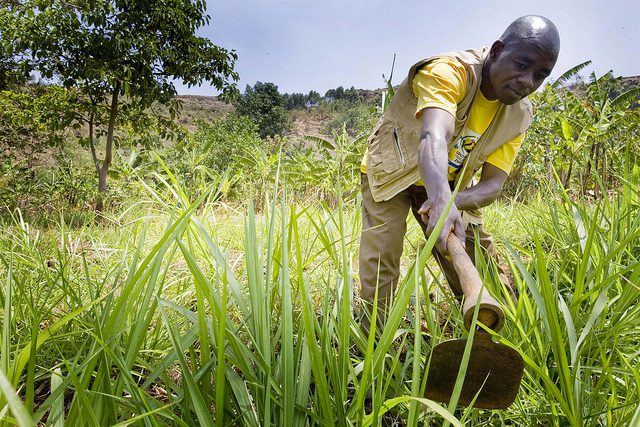
Africa faces the challenges of a growing population as well as low farm productivity. Weather changes, shorter fallow periods, deforestation, worsening farmland and the loss of young people in farming communities that move to urban areas further hinders the ability of African farms to increase farm yields.
Fortunately, many tools like drones and soil sensors are becoming more and more accessible and affordable within the continent. Especially with the African population growing at such a high rate (it’s projected to reach 2 billion people by 2050), farming in Africa needs to make use of new technologies to improve in order to prevent mass hunger in its own countries as well as in the world. Here are some examples that demonstrate how technology in Africa improves farming:
Precision Farming
Zenvus, a precision farming startup in Nigeria, helps farmers determine appropriate fertilizers to apply to their soil as well as to optimally water their farms. The company acquires such information by measuring and analyzing soil data such as nutrients, temperature and vegetative health. The group improves farm productivity and reduces input waste for small-scale farmers.
UjuziKilimo, a big data analytics startup in Kenya, also uses precision farming to adjust irrigation needs for individual plants. While these precision farming examples demonstrate that technology in Africa indeed improves farming, Africa still requires major changes in their infrastructure in order to technologically connect the entire continent and make a large-scale soil map.
More Affordable and Effective Irrigation Methods
Sunculture sells solar-powered drip irrigation kits in Africa that make watering crops more affordable. Other efforts have also been made to increase the use of groundwater through the distribution of low-cost treadle pumps and drip-irrigation kits in Kenya, Tanzania, Zambia and other countries.
One example is portable water pumps occurs via the nonprofit organization, Kick Start. Their pumps are sold in Kenya, Tanzania and Mali from $35 to $95, and the product has been able to take 667,000 people out of poverty! For now, however, surface water is the main source of irrigation for most of Africa, so more surface water storage systems are required to optimize the numerous parts of Africa’s use of river water.
Unfortunately, some obstacles to the development of surface water storage (in some places) would be the cost of construction and possible environmental effects. The Hippo water roller, a drum that hauls large amounts of water by being rolled on the ground, helps numerous people in Africa that lack local water facilities and result in walking long distances to reach their water sources.
Improved Soil Management
Western Kenya is the perfect example of a densely populated area in Africa with low and declining soil fertility and continued threat to land resources. While also facing poverty and food security issues, such areas desperately need to conserve their natural resources, slow population growth rates and fight the HIV/AIDS pandemic.
One solution delivered by the World Agroforestry Centre was a low-cost integrated soil package that used organic manure to supplement phosphorus dressings as well as existing organic resources like biomass transfer to provide nitrogen to crops. A set of other technologies like high-quality crop seeds replenished phosphorus and nitrogen in the soil.
With the help of these technologies, farmers in Kenya increased their maize production by 2 to 3 times their typical yields!
Financial Solutions
FarmDrive connects smallholder farmers to credit and helps financial institutions increase their agricultural loan portfolios in Kenya. M-Farm in Kenya and AgroSpaces in Cameroon assist farmers to earn more by providing pricing data to prevent asymmetric price transmission.
Better Crop Storage Techniques
In 2015, the Alliance for a Green Revolution in Africa (AGRA), supported by agronomist experts from The Rockefeller Foundation, trained 2,000 farmers on various methods to reduce post-harvest loss. This made a significant impact because before the training, over 50 percent of the farmers AGRA trained either made no use of storage at all or only utilized sacks to store grain.
Some did use plastic containers, custom-made mud-walled structures, baskets and other traditional methods. However, these methods lead to 30 to 40 percent loss of their grain harvests. In comparison, AGRA’s simple storage technologies such as hermetic cocoons and bags, metal silos and polypropylene storage bags successfully kept harvested maize in good condition for six months.
Without rotten produce or pests after 12 months of storage in Tanzania, maize could be sold over longer periods of time. This enabled farmers to make more sales and thus accumulate more income and provide for improved nutrition for families and communities. So, to sustainably feed the entire growing population in Africa, such storage technologies need to be distributed and made locally.
Agricultural development is essential to eradicating poverty and to bringing food security to developing nations, so it is crucial that technology in Africa improves farming.
– Connie Loo
Photo: Flickr

5 Major Ways Technology Improves Farming in Africa
Africa faces the challenges of a growing population as well as low farm productivity. Weather changes, shorter fallow periods, deforestation, worsening farmland and the loss of young people in farming communities that move to urban areas further hinders the ability of African farms to increase farm yields.
Fortunately, many tools like drones and soil sensors are becoming more and more accessible and affordable within the continent. Especially with the African population growing at such a high rate (it’s projected to reach 2 billion people by 2050), farming in Africa needs to make use of new technologies to improve in order to prevent mass hunger in its own countries as well as in the world. Here are some examples that demonstrate how technology in Africa improves farming:
Precision Farming
Zenvus, a precision farming startup in Nigeria, helps farmers determine appropriate fertilizers to apply to their soil as well as to optimally water their farms. The company acquires such information by measuring and analyzing soil data such as nutrients, temperature and vegetative health. The group improves farm productivity and reduces input waste for small-scale farmers.
UjuziKilimo, a big data analytics startup in Kenya, also uses precision farming to adjust irrigation needs for individual plants. While these precision farming examples demonstrate that technology in Africa indeed improves farming, Africa still requires major changes in their infrastructure in order to technologically connect the entire continent and make a large-scale soil map.
More Affordable and Effective Irrigation Methods
Sunculture sells solar-powered drip irrigation kits in Africa that make watering crops more affordable. Other efforts have also been made to increase the use of groundwater through the distribution of low-cost treadle pumps and drip-irrigation kits in Kenya, Tanzania, Zambia and other countries.
One example is portable water pumps occurs via the nonprofit organization, Kick Start. Their pumps are sold in Kenya, Tanzania and Mali from $35 to $95, and the product has been able to take 667,000 people out of poverty! For now, however, surface water is the main source of irrigation for most of Africa, so more surface water storage systems are required to optimize the numerous parts of Africa’s use of river water.
Unfortunately, some obstacles to the development of surface water storage (in some places) would be the cost of construction and possible environmental effects. The Hippo water roller, a drum that hauls large amounts of water by being rolled on the ground, helps numerous people in Africa that lack local water facilities and result in walking long distances to reach their water sources.
Improved Soil Management
Western Kenya is the perfect example of a densely populated area in Africa with low and declining soil fertility and continued threat to land resources. While also facing poverty and food security issues, such areas desperately need to conserve their natural resources, slow population growth rates and fight the HIV/AIDS pandemic.
One solution delivered by the World Agroforestry Centre was a low-cost integrated soil package that used organic manure to supplement phosphorus dressings as well as existing organic resources like biomass transfer to provide nitrogen to crops. A set of other technologies like high-quality crop seeds replenished phosphorus and nitrogen in the soil.
With the help of these technologies, farmers in Kenya increased their maize production by 2 to 3 times their typical yields!
Financial Solutions
FarmDrive connects smallholder farmers to credit and helps financial institutions increase their agricultural loan portfolios in Kenya. M-Farm in Kenya and AgroSpaces in Cameroon assist farmers to earn more by providing pricing data to prevent asymmetric price transmission.
Better Crop Storage Techniques
In 2015, the Alliance for a Green Revolution in Africa (AGRA), supported by agronomist experts from The Rockefeller Foundation, trained 2,000 farmers on various methods to reduce post-harvest loss. This made a significant impact because before the training, over 50 percent of the farmers AGRA trained either made no use of storage at all or only utilized sacks to store grain.
Some did use plastic containers, custom-made mud-walled structures, baskets and other traditional methods. However, these methods lead to 30 to 40 percent loss of their grain harvests. In comparison, AGRA’s simple storage technologies such as hermetic cocoons and bags, metal silos and polypropylene storage bags successfully kept harvested maize in good condition for six months.
Without rotten produce or pests after 12 months of storage in Tanzania, maize could be sold over longer periods of time. This enabled farmers to make more sales and thus accumulate more income and provide for improved nutrition for families and communities. So, to sustainably feed the entire growing population in Africa, such storage technologies need to be distributed and made locally.
Agricultural development is essential to eradicating poverty and to bringing food security to developing nations, so it is crucial that technology in Africa improves farming.
– Connie Loo
Photo: Flickr
How the Media Misrepresents Russia and its Ramifications
The fourth estate continues to plays a very crucial role in representing Russia on the global stage, especially as it remains at the epicenter of international political discourse (and even propaganda) in recent years. Yet, at the same time, the media misrepresents Russia and and helps create a subject of polarization and contentious, worldwide debate.
Over the years, media portrayal of current affairs in the country — particularly its involvement in the Syrian Civil War and the Ukrainian crisis — as alleged human rights violations and treatment of dissidents has sparked a great deal of controversy.
How Does the Media Misrepresent Russia?
Historically, the media misrepresents Russia largely in regard to the country’s fractious relationship with its western counterparts, divisions that date back to the Cold War era and the entrenched divisions between East and West. Consequently, many ordinary Russians strongly believe that the way the media misrepresents Russia has not altered much since the collapse of the Soviet Union.
Given the ubiquitous influence of the mainstream media globally, there is a definite positive correlation between media and poverty reduction due to the medium’s power and impact on public opinion and global political agendas. At the same time, the mainstream media caters to a wide array of stakeholder groups and other parties within their target audiences.
Global Representations
As a result of the misleading representation, perceptions of poverty and other important social and economic issues in Russia can become distorted. For example, Russian poverty rates and economic growth and recovery figures tend to vary with different sources. These can grow to be major impediments to understanding long-run social progress and development in the country.
Moreover, the inordinate amount of coverage dedicated to geopolitical issues in Russia greatly debilitates the already preexisting lower levels of coverage for poverty-related issues. Additionally, Russian President Vladimir Putin is often branded a pariah in regard to the intense international media attention and scrutiny placed on his actions, decisions and Russia’s foreign policy goals.
The Ramifications of International Media Attention
There seems to be a near-constant deficiency in the presentation of domestic social issues in the country, particularly President Putin’s promised six-year poverty reduction plan and the country’s economic recovery after the fall in global oil prices.
There could be a significant number of effects on the perspective and reputation of the country due to the media misrepresenting Russia. Media coverage can also become an important precursor for international credit ratings and global economic and financial rankings. These scores may have unforeseen impacts on important trade relationships, diplomatic relations and future investments to the country.
Overall, eradicating inconsistencies in media coverage can perhaps serve as a stepping stone to address social issues with more clarity and look past the lens of double standards that can often impact a nation’s representation. Hopefully, the international community will be able to participate in this new news coverage, and take on a more effective role in aiding the world’s poor.
– Shivani Ekkanath
Photo: Flickr
Struggle and Sanctuary: How the Media Misrepresents Burundi
The general public is unable to form any positive conclusions from media sources due to how the media misrepresents Burundi. Through closer analysis, however, the public may see a shimmer of hope behind all the destruction that the media portrays is occurring in Burundi.
How Does the Media Portray Burundi?
The media portrays Burundi as economically unstable; however, this fact is only partially true. Population growth in Burundi continues to rapidly increase, leaving the nation fighting to support their growing nation.
Burundi’s economy is lacking in their growth rate with the population growth rate at 3.1 percent annually, and the GDP per capita not growing more than 1.5 percent even in the best of recent years. Because of these economic difficulties the country has endured, Burundi’s economy relies 49 percent on international financial aid.
International Aid
The media states that Western donors are in the process of cutting support towards Burundi, pushing the nation even more towards intolerable levels of poverty; however, in the past three years alone, the United States has donated over $135 million in foreign aid towards the country of Burundi.
Other organizations such as the World Bank pledged $440 million towards helping the country’s financial crisis, and the EU has already made firm commitments towards achieving this goal. Overall, donors have pledged over $2 billion for Burundi’s development strategy in order to rebuild the nation after its civil war and national political crises.
Internal Controversy
How the media misrepresents Burundi can also be seen in the violence occurring in the country due to political turmoil. Burundi’s president, Pierre Nkurunziza, who has been in office since 2005, released a referendum date for May 17 for a controversial constitutional reform. If this reform is passed, it would allow President Nkurunziza to remain in power until 2034 — an unjust situation that would cause public uproar.
The violence has increased to such a degree that the U.S. State Department has warned Americans not to travel to Burundi, and that Burundi citizens are trained to promote violence and on the path towards another civil war. However, this media representation fails to mention measures taken within the nation to ensure the people of Burundi have alternative methods to violence.
New Generation
Diedonné Nahimana, an award-winning Burundi citizen, created the program of New Generation in Bujumbura to coach victims of war to become ambassadors for peace. New Generation was created to provide victims or orphans of war with alternative opportunities for a successful life rather than turning to violence.
This program develops a new generation of leaders who will restore Burundi after their 12-year civil war, and hopefully prevent the return of war. The foundation of their teaching is based upon non-violence as in the steps of Ghandi and Martin Luther King Jr.
The dream is that by 2020, this new generation will control leadership positions in the country and teach this method of non-violence to others and ensure peace in the country. Due to all of this violence, more than a quarter of a million people have Burundi in terror, seeking refuge in other countries.
Global Priority
Despite this, sources claim that the world doesn’t seem to notice this violence occurring in Burundi and thus serve as another example of how the media misrepresents Burundi.
The people of Burundi are under constant persecution and live in terror in their country due to the political crises and increased poverty conditions; however, it is not the case that the world has turned their back on this African country. Since 2015, over 300,000 people have fled the country of Burundi, many to refugee camps in neighboring African countries where unfortunately, persecution and inhumane actions still exist.
Struggle and Sanctuary
Other countries, such as Canada, have developed methods to ensure Burundi refugees are welcome in their countries. Canada has designated refugee claims from Burundi which welcomes refugees into their country. In fact, Canada proudly holds a Burundian community of roughly 10,000 and continues to allow refugees inside its borders. The United States has also welcomed over 2,000 Burundian refugees in the past two years and the numbers increase daily.
Although Burundi endures many hardships from political crises, poverty and population growth, there is more good occurring in the country than what the media showcases to the public.
– Adrienne Tauscheck
Photo: Flickr
How to End Slavery: Five Important Modern-Day Theories
Slavery has been practiced for centuries, and although many believe it is a practice of the past, modern-day slavery is very prevalent in today’s society. It’s estimated that about 40 million people are modern slaves, and this article will explore how to end such prominent slavery.
Modern-day slavery has been defined as “debt bondage, serfdom, forced marriage of a child for the exploitation of that child.” Out of the 40 million people trapped in the slave system, around 25 million people are in forced labor, 15 million are involved in forced marriage and five million people work as sex slaves. Statistics also show that 25 percent of slaves are children and 71 percent are women.
Parts of Asia and the Pacific hold the most substantial amount of slaves, while Europe, Africa, the Arab states and the Americas also suffer from the same crisis. It is essential to know what steps and measures can be taken to know how to end slavery.
Social Media
Social media is a key component on how to end slavery. Modern slavery is not a priority compared to other political agenda movements, so utilizing social media to bring awareness to the issue can be a significant first step.
In this age of technology, social media platforms such as Twitter, Facebook and Instagram started as a device used to spread and share news, as well as connect individuals; thus, a simple post can be the beginning of an entire movement.
Education
Another way to end slavery is to educate yourself on the topic. Be able to note the difference between slavery of the past compared to the new definition of slavery; learn which demographic is most affected by slavery; discover which organizations strive to end slavery; and finally, how you can make a difference.
Donating Money and Time
Becoming involved in organizations that solely work to end slavery such as the Anti-Slavery International or the CNN Freedom Project is another excellent action-item, as is joining campaigns or hosting fundraisers for the organizations.
Fundraising at schools, churches, after-school programs and around your local community can significantly help organizations fund campaigns and other events that will lead to the end of slavery. Another significant method of donating time is to write to local newspapers and magazines to spread concerns.
Pay Attention to Survivors
Fighting for freedom is an important step to ending slavery, but ensuring that survivors do not fall back into the system is just as essential. A way to help survivors is finding them jobs and helping them adjust to society.
Survivors can also be necessary tools for how to end slavery — people tend to sympathize with survivors when they hear their testimonies and experiences first-hand.
Contact Your Government
Possibly one of the most beneficial measures is to express your concerns with modern slavery to your local government; contacting your senator or representative can in fact lead to mass amounts of change. The United States government has an essential hand in international affairs, and one should use this privilege as a tool to fight against modern-day slavery.
Slavery has been a virus to this world for too long, and now it is finally time to put an end to this dehumanizing practice.
– Cassidy Dyce
Photo: Flickr
Understanding How the US Benefits from Foreign Aid to Algeria
The diplomatic relationship between the U.S. and People’s Democratic Republic of Algeria officially began in 1962 after the close of a long war for independence from France. Although there was a brief break in diplomatic relations in 1967, Algeria has remained one of the United States’ most reliable partners in the Middle East/North African region.
Having maintained this relationship since 1974, U.S. benefits from foreign aid to Algeria have returned dividends. According to the State Department on U.S.-Algerian relations, the “U.S. has strong diplomatic, law enforcement and security cooperation.” Continuing the current diplomatic status quo through foreign aid benefits the U.S. for multiple reasons.
First and foremost, Algeria holds an important strategic location in North Africa which provides a foothold for U.S. economic and security interests. In comparison to Algeria’s neighbors, mainly Libya and Northern Mali, the country has remained relatively stable. Furthermore, Algeria has sought to promote regional stability in lieu of the current Libyan conflict and security situation in Northern Mali.
In recent years, North Africa has seen an increased presence in extremist activity. Most notably, ISIS and al-Qaeda in Islamic Maghreb have continued to launch terror attacks within Algeria and its neighboring countries. Algeria continues to be a key partner in the U.S. initiative to combat terror groups in both the Middle East and North Africa. As of today, a major component of the U.S. foreign assistance programs seeks to strengthen Algeria’s ability to combat terrorism. Algeria also is an active member of the Global Counter Terrorism Forum.
Furthermore, the U.S. benefits from foreign aid to Algeria through ironclad bilateral economic relations in conjunction with security benefits. Algeria has seen a large U.S. investment in the sector of hydrocarbons. In return, the U.S. imports a large amount of the country’s crude oil. The U.S. continues to assist Algeria through modernization in fiscal and monetary policy. Moreover, the U.S. has sought to diversify the Algerian economy by promoting other exported goods in addition to crude oil.
Planned U.S. funding in foreign assistance to Algeria currently sits at $1.5 million for FY 2019. Out of the total budget, all 100 percent of the funds will go toward peace and security; 33 percent focuses on “combating weapons of mass destruction,” while the other 67 percent has been earmarked for “stabilization operations and security sector reform.”
As armed conflict continues throughout North Africa and the Middle East, Algeria remains an essential target for U.S. foreign aid. U.S. benefits from foreign aid to Algeria provide both economic benefits in the form of crude oil imports and a strong partner in addressing extremist groups. The U.S. mission of eliminating terror groups and maintaining regional security leaves Algeria in an important place. For U.S. interests, the country has proved to be a reliable ally in the war on terror and continues to act as a strong economic partner.
– Colby McCoy
Photo: Flickr
Progress and Development: How the Media Misrepresents India
India is the world’s second-most populated country with 1.3 billion people, and is ahead of the United States — the third highest population — by nearly 1 billion people. When comparing the populations of the two countries, it is easy to understand how the media misrepresents India as an overcrowded, poverty-stricken country.
While true that India has a high population and a large percentage of the nation lives off of incomes considered below the world poverty line, there is also financial and social growth leading to improved conditions in India.
It is also easy to understand how the media misrepresents India as an environmentally unfriendly country: many cities in India suffer from problems of air and water pollution. However, India is instituting new policies to combat those issues and to improve the quality of the environment.
Economic Progress
Even though 68 percent of India’s population lives in poverty according to World Bank standards, the poverty level has declined since 2004. Further, India has one of the world’s fastest growing economies — growth of India’s GDP is expected to be 7 percent in fiscal year 2018, and increase to 7.4 percent by fiscal year 2020.
India also has a growing international business market that will increase industries and jobs. For example, solar panel manufacturing is becoming an important market and there are multi-billion-dollar investments being made to further expand and produce panels for both domestic and exportation purposes.
Social Progress
In recent years, India has improved in its quality of life measurements in addition to moving up from the low social progress category. This shift means that measured standards indicate that India is meeting an increasing number of basic human needs for all its people. One large factor in that advancement was progress made in providing shelter; 67 percent of the population now has access to affordable housing.
India also increased general access to information and communication. The numbers of both internet and phone users increased since 2014, allowing people to connect and obtain information more easily.
Environmental Progress
The smog in India’s capital, New Delhi, is infamously thick; however, solutions to the pollution exist that are less readily portrayed by the media. One such solution is an air purifier that can be used indoors to help clean the air, and bigger policy initiatives to help tackle the root of the pollution problems are also being pushed by the government.
India is trying to eliminate its manufacturing of gas-running engines by 2030 and turn toward electric vehicles to remove one source of pollution. Along with other policy measures, and investments in cleaning polluted air and water, India aims to alleviate its problems of environmental degradation.
How the Media Misrepresents India
How the media misrepresents India is through its focus on big picture negatives rather than on the positive growth of the country. All the separate instances of progress add together and help to create a more sustainable future for the people of India.
With monetary and policy support, further strides can be made in the media’s notation and highlighting of the resilience of India.
– Hayley Herzog
Photo: Flickr
Top Contributors and Efforts to Aid Orphans in Pakistan
Foreign aid is crucial to the well-being of the 4,400,000 orphans in Pakistan who do not have the support of immediate family to assist them with their everyday needs. From a young age, children in Pakistan face multiple challenges from an infant mortality rate of 8.55 percent to lack of everyday resources.
There are several factors that contribute to the issues that orphans in Pakistan face including limited access to resources such as food, education and financial stability. According to SOS Children’s Villages, approximately twenty-five percent of the 193.2 million people living in Pakistan do not meet the poverty line.
However, activists looking to reduce the effects of poverty in Pakistan — as well as assist children with meeting their everyday needs — have organized ways to assist children to locate support.
Foreign Aid
The U.S. Department of State provides information for those who seek to adopt or who plan to travel before finalizing their plans for adoption, and assists orphans in Pakistan as well as children looking for homes across the world. One organization, SOS Children’s Villages, allows people who are interested in sponsoring children to make a monthly donation.
The organization works to provide healthcare, counseling services and education to children who would otherwise have limited access these resources.
Role of USAID
USAID plays an influential role as well, working to create jobs and to support the agricultural industry in Pakistan through the introduction of new crops. According to USAID, the organization has been able to assist more than 1 million households through its agricultural aid efforts.
According to USAID, approximately forty percent of Pakistan’s working population is employed in agricultural industries. By working to support such endeavors, USAID not only helps create new jobs but it is also aids in cultivating industries to boost the economic health of the country overall.
Activism in All Forms
Among the top contributors to foreign aid efforts in Pakistan are the U.S. Government Department of Defense, the World Food Program, the International Rescue Committee and USAID. Although activists from these organizations have different specialties, different aid efforts are needed in this area where orphans do not have access to adequate education, defense or food resources.
Although these organizations support orphans in Pakistan and children in need by providing aid to Pakistan and, in many cases, providing resources directly to children, those who do not have access to the resources from foreign aid are forced to find alternate ways to support themselves.
Efforts to Aid Orphans in Pakistan
This issue has been going on for many years, and one video from the Associated Press shows some of the kinds of work children have had to do in the past to support themselves.
As Pakistan and the children living there continue to receive aid, however, the effects of poverty will continue to decrease. Aid organizations that have already made a difference will continue working to reduce the struggles orphans face in their everyday routines.
– Gabriella Evans
Photo: Flickr
Redefining Common Conceptions: How the Media Misrepresents Iran
Western media has a notorious reputation for misrepresenting developing countries. This article will discuss how the media misrepresents Iran with framing, agenda-setting and manipulation. It will also debunk the common stereotypes embedded in these examples of misinformation.
Iran as a Pro-Terrorism Country
Categorizing Iran as a pro-terrorist country is the largest example of how the media misrepresents Iran. Western media is very quick to blame Iran-based problems on terrorism and, often times, radical Islam. In fact, Iran’s legislation and government officials have clearly proven that they’d prefer Iran to be on sound terms with other nations.
Iranian citizens have been dissatisfied about government spending and its foreign ventures for over a decade now; they would rather spend money internally. To note, reformist president Hassan Rouhani was actually approved for office because of his promise to improve relations with other nations.
Both him and Foreign Minister Javad Zarif are seen as national heroes for their desire for peaceful relations with other countries. To note, western media emphasizes this (false) aspect of Iran the most.
Iran as an Anti-Israeli Country
Characterizing it as a nation with a vendetta against Israelis is the next most common way of how the media misrepresents Iran. Though some Iranian leaders have verbally attacked Israel (like president Mahmoud Ahmadinejad, whose presidency ended in 2013), Iranian citizens have proven to contradict this anti-Israeli feeling.
Larry Cohler-Esses, Jewish journalist, decided to travel to Iran for an exclusive look at Iranian citizens daily lives and genuine feelings. He found that most Iranians are, again, more concerned with domestic issues, with fears surrounding isolation and struggling economically. Indeed, individual citizens have no interest in attacking Israel, but the Iranian government does.
Iran as an Oppressive Country
Western media also misrepresents Iran as a country that oppresses and discriminates against religious minority groups. Iran is known for typically having a conservative, Muslim government that many assume oppresses other religions.
It is true that there has been discrimination against the Baha’i community, but this is because the Baha’i faith has been consider heretical since the 19th Century; however, discrimination is only directed toward the Baha’i community but not to Jews, Christians, Zoroastrians and other religious communities.
Iran as a “Backwards” Nation
The media has presented Iran as an impoverished country that is struggling to modernize society. When Cohler-Esses traveled to Iran, he saw no evidence of this.
Instead, he saw a well-educated, youthful population that was fashionable, modern, and critical of their own government. The media also presents Iran as a country with little to no free press, but instead, reformist newspapers have gotten more popular over the years. While Iran does frequently have issues with legislation that constantly changes and effects freedom of press, the nation’s press ultimately has a fair range of freedom to vocalize their concerns.
The media continues to paint Iran as a country with little to no growth or progress, ignoring its efforts to modernize and industrialize society; fortunately, though, this myth continues to be disproven, time and time again.
The media landscape continues to paint blurry pictures of developing countries, but as countries continue to modernize, the reality will present itself — especially in the case of Iran.
– Chylene Babb
Photo: Flickr
Facts and Figures Towards Rising Above Poverty in Malawi
With severe poverty automatically comes hardships and struggles, and Malawians are no strangers to this reality. A largely agricultural country located in southeastern Africa, poverty in Malawi is widespread among the population of more than 18 million. Landlocked by Tanzania, Zambia and Mozambique, Malawi is faced with 50.7 percent of the population living below the poverty line, and a staggering 25 percent living in what is considered to be extreme poverty.
The Southern African Regional Poverty Network (SARPN), gives insight to the widespread poverty among Malawians by defining poverty: “…as a state of continuous deprivation or a lack of the basics of life.”
Similar to most poverty-stricken areas, their government lacks the means to expand the economy, meaning Malawians oftentimes do not receive adequate healthcare, environmental protection or education. Below is a list of five pertinent facts that illuminate the poverty that Malawians face on a daily basis.
5 Facts About Poverty in Malawi:
Although the majority of the people in Malawi live in destitute conditions, it is deservingly known as the “Warm Heart of Africa” because the residents are known to be among the friendliest and hospitable to tourists.
It is important to note that among the struggles and inconveniences, Malawians are increasing their quality of life more and more as the years go on. Listed below are five facts delineating the efforts being made to combat poverty in Malawi, according to the Malawi Vision 2020 Statement:
5 Facts About Combating Poverty in Malawi:
Efforts being made by works such as the Malawi Vision 2020 Statement set the tone of a less impoverished nation for millions of individuals. The people of Malawi are taking strides and uniting together to generate a more sound and prosperous country.
– Angelina Gillespie
Photo: Flickr
Developing STEM Education for Women in Vietnam
At the beginning of 2016 in Vietnam, the United States Agency for International Development (USAID) and Arizona State University created and implemented the Building University-Industry Learning and Development through Innovation and Technology (BUILD-IT) project.
BUILD-IT
BUILD-IT exercises the goal of connecting science, technology, engineering and math (STEM) instruction in Vietnamese higher education institutions to students, who then can advance inclusive, technology-based growth. The project works mainly to promote STEM Education for women in Vietnam.
To increase educational innovation in STEM, BUILD-IT hosts semi-annual solutions councils and meetings to discuss problems and potential solutions. Additionally, the project funds innovation labs to develop ideas through technology. To assist in tracking educational innovation, the Higher Education Learning and Innovation Exchange acts as a database for all innovations.
One main priority of the initiative is to facilitate collaboration between universities and the private sector by providing students experiential opportunities in preparation for STEM careers. The project hosts leadership forums to develop academic initiatives, scholarships and networking opportunities for women in STEM.
Women in STEM Leadership Forum
The first leadership forum for the Women in STEM Leadership Program was held at the University of Danang in Vietnam in August 2016 and attracted over several hundred participants. The forum featured female role models, inspired the transfer of knowledge and established paths to entrepreneurship through STEM Education for women in Vietnam.
Katy Wigal, BUILD-IT project director and associate director for Curricular Innovation at Arizona State University, stated “the Forum enabled open discussions on the roles of women in the high demand professions of math, engineering, technology and science. The insights they (female speakers) offered about their personal journeys were inspiring to a new generation of women.”
The USAID Vietnam Mission Director Michael Green also said that “increasing opportunities for women in these fields are critically important in realizing greater economic success and equality for women across the board.”
Report on Women-Owned Enterprises in Vietnam
In a recent report of a market study on women-owned enterprises in Vietnam, the IFC Asia Manager for Financial Institutions Group Advisory Services, Rachel Freeman, concluded that social and traditional expectations can sustain prejudices against female business owners and, in particular, young women.
Businesses traditionally can involve women, but these prejudices can have negative impacts against women and their businesses. From STEM to the business field, social and traditional expectations can infiltrate all aspects of society in Vietnam.
Women in STEM: Sustainable Development
For sustainable development and participatory citizenship, STEM education is innovative and essential for every citizen, especially in regard to women. Women’s involvement in the STEM field benefits social engagement and domestic work in addition to sustaining technological innovation.
Vietnam has successfully increased enrollment rate of female students at the university level from 30 to 52 percent between the 2012-2013 and 2013-2014 academic years. The STEM Education for Women in Vietnam initiative is one main priority of the BUILD-IT project because of the importance of inspiring women to modify the status quo and facilitate a global revolution.
– Andrea Quade
Photo: Wikimedia Commons