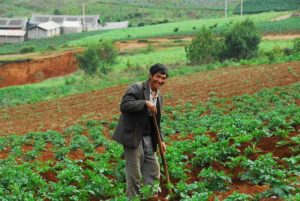
The global tobacco market accounted for $663.76 billion in 2017, and the tobacco industry is an economic sector employing millions of men and women. However, behind the scenes of the tobacco industry lies the death of 8 million people yearly, the creation of dependency and diseases for tobacco farmers, as well as extreme poverty, child labor and environmental issues. Tobacco industry labor conditions are very poor and require reform.
Tobacco Farmers
The tobacco industry controls the tobacco cycle from seed to sale and in most producing countries, tobacco companies operate in a contract system through which companies provide the inputs required–including seeds and chemicals for production–in the form of credit for farmers. Farmers agree to sell their tobacco leaf to specific companies at a set price in return. For many farmers, the revenue earned from their tobacco leaf sales barely suffices to cover their costs or repay their loans. This creates a debt cycle.
Moreover, Human Rights Watch reported labor rights abuses on large-scale tobacco farms. In Zimbabwe, some workers reported overtime and excess working hours after their employers pressured them, but they did not receive compensation for it. Other incidents and labor abuses include underpaid or delayed wages and occasionally going two months without receiving their salary, which makes it hard for workers to maintain a basic living standard.
Health Issues
Tobacco cultivation exposes workers and farmers to health hazards from pesticide exposure to nicotine poisoning. Physical contact with wet tobacco leaves causes the body to absorb nicotine leading to poisoning called green tobacco sickness (GTS). This involves symptoms of nausea, vomiting, fluctuating blood pressure and heart rate and trouble breathing, and they are quite frequent among tobacco workers.
Tobacco industry labor conditions expose workers to high amounts of pesticides which damages the human nervous system and can also cause pesticide poisoning; common symptoms include convulsions, respiratory problems, nausea, kidney damages and skin irritation. Children to have a lower intoxication threshold due to their smaller body mass and weaker immune system, which reinforces the issue of child labor in the tobacco industry.
Child Labor in the Tobacco Industry
According to the International Labour Organization (ILO), 108 million children work in agriculture, representing 70 percent of overall child labor. Although child employment is not easy to verify, some believe that millions work in the tobacco industry. Families living in poverty and dependent on tobacco production for a living often make their children work in tobacco farms and factories to help them. Because children start working from a very early age, they do not obtain a necessary education which could help them break away from the poverty cycle.
Child labor in the tobacco industry is prominent in India, especially in the production of Bidi. The World Health Organization (WHO) estimates that 10 percent of female workers and 5 percent of male workers in the bidi industry in India are below the age of 14 and that 40 percent of those children never went to school. Besides, although child labor is illegal in India, the county cannot incriminate employers as they do not include working children officially on their payrolls.
Many companies in the tobacco industry have adopted policies prohibiting children from working in direct contact with green tobacco, which is a step forward in limiting the health risks for children working in the tobacco industry. However, none of the tobacco companies adopted policies prohibiting the involvement of children working in direct contact with tobacco (such as dry tobacco). Moreover, the tobacco industry does not have, unlike other industries, a zero-tolerance policy for child labor, despite publicly condemning it.
International Reaction
In June 2018, 130 public health and sustainable development organizations wrote a letter to the ILO urging it not to renew or extend contracts with Eliminating Child Labour in Tobacco-Growing (ECLT), which is a group that the tobacco industry funds, and Japan Tobacco International (JTI), which ties the ILO to the tobacco industry. Yet, despite the recommendations from the U.N. Interagency Task Force (UNIATF), the ILO still has not cut its ties, which include funding, and its partnerships with the tobacco industry. With regards to tobacco companies, some ‘Tobacco giants’ begun reforming their practices, such as Philip Morris International who committed to eliminating child labour entirely from its supply chain by 2025, hopefully leading the way for the rest of the industry.”
Considering that one of the United Nation’s Sustainable Development Goals (Target 8.7) aims to eradicate child labor in all its forms by 2025, the ILO must make it a priority and address the root causes of child labor. Besides, companies and governments must work hand in hand to increasingly adopt adequate labor policies to improve tobacco industry labor conditions, reduce the health risks workers and farmers suffer from, as well as enforce a zero-tolerance child labor policy.
– Andrea Duleux
Photo: Flickr
Schistosomiasis and Poverty
Schistosomiasis (also known as bilharzia) is a disease that is rarely heard outside of scientific circles. This has less to do with the severity of schistosomiasis, and more to do with the fact that its parasitic sibling, malaria, is a far more common and well-known illness. The largest concentration of schistosomiasis in the world, a staggering 90 percent, is in Africa.
Schistosomiasis: What is it?
While schistosomiasis tends to be overshadowed by its well-known cousin malaria, there is still a wealth of information on how it functions, spreads and affects the human body. Schistosomiasis is caused by parasitic worms that inhabit the bodies of some freshwater snails. Humans are infected when they interact with bodies of water containing these snails. Common recreational and domestic activities like swimming and washing clothes in and near infected waters are attributed to the spread of schistosomiasis.
Schistosomiasis comes in two different types: urinary schistosomiasis and intestinal schistosomiasis. Urinary schistosomiasis is characterized by extensive damage to the kidneys, bladder and ureters. Intestinal schistosomiasis is characterized via symptoms of an engorged spleen and liver, which leads to intestinal damage and hypertension in the abdominal blood vessels. The first symptom of schistosomiasis is a light skin rash known as “swimmers itch.” Once a human is infected, symptoms (chills, aches and coughing fits) can appear within one to two months. However, many infections are asymptomatic; the infection is there, but no symptoms appear.
Schistosomiasis is transferred from person to person when an infected individual’s excrement reaches a water supply. The parasitic eggs from then hatch, infect another snail (or human) and the cycle begins anew. Proper sanitation and potable water are the main ways to prevent the spread of this disease.
The disease schistosomiasis does not always result in death. Schistosomiasis commonly ends in stunted growth and anemia in children, and can even lead to infertility in cases of urinary schistosomiasis. Children can also find themselves with a reduced ability to learn due to the crippling symptoms this disease comes with.
There is no vaccine to cure schistosomiasis and no antibiotic has proven effective in preventing infection. However, there are effective means to diagnose and treat schistosomiasis before the infection truly takes hold. The drug, praziquantel, has proven useful in removing the worms and their eggs from the human body. Although there is poor access to praziquantel, this treatment has reached more than 28 percent of people around the world.
Where Schistosomiasis Congregates
Africa has a truly staggering number of schistosomiasis cases compared to the rest of the world. Nigeria has the most cases out of any African country, with approximately 29 million infected. The United Republic of Tanzania has the second-most cases of infection at 19 million with Ghana and the Democratic Republic of Congo tied at 15 million.
Schistosomiasis and Poverty: The Correlation
Schistosomiasis is predominantly found in areas of extreme poverty; where ever this disease goes, destitution soon follows. Schistosomiasis and poverty are intrinsically linked, and the most common reasoning for this occurrence is that extreme poverty often restricts access to clean water sources, which in turn causes people to use unsanitary water sources where schistosomiasis thrives and infection occurs. From there, the infected individual will succumb to the crippling disabilities that schistosomiasis infection eventually brings. This leads to reduced productivity in the community as the disease continues to spread, ensuring no end to this vicious cycle of poverty without outside intervention.
What Next? The Future of Schistosomiasis
There is hope, however, as NGO’s like the SCI foundation (founded in 2002) have dedicated themselves to the eradication of parasitic worm diseases. The SCI foundation’s biggest success in the fight against schistosomiasis is in Mozambique, where SCI has treated more than 30 million people of parasitic worm diseases. Further, SCI has already treated more than 12 million people in Tanzania alone since 2004. The foundation also recently (as of 2016) started to extend their treatment programs to Nigeria. With more than 2 million people already treated in such a short time, the SCI foundation can be trusted to reach Tanzania levels of treatment soon enough.
The future is bright for communities burdened with schistosomiasis and poverty, as many countries have been able to eradicate this disease from their lands. Tunisia and Japan were able to completely eradicate schistosomiasis within their borders, and China, Brazil and Egypt are well on their way to reaching that end goal.
– Ryan Holman
Photo: Flickr
A Look at The Water Crisis in Kashmir Region
Many countries around the world do not have sufficient access to clean water and two of the most deprived counties are India and Pakistan. Both countries are seeing rapid population growth, but they also lack the proper infrastructure to provide their citizens with water. There is a long history of conflict between the two neighbors, and the heavily disputed Kashmir region has added to the conflict. The water crisis in Kashmir should be the focus, however.
Background on Pakistan
Pakistan is in eastern Asia, bordering Iran, Afghanistan and India, as well as sharing a small border with China. It is the sixth most populated country with around 207 million people. The country also borders the Arabian Sea to the south. It recently ranked 140 out of 180 countries in the quality of water and sanitation on the Environmental Performance Index. Regional conflict, arid land, inefficient sanitation and water conservation resources have contributed to Pakistan’s lack of clean water. In Pakistan, about 21 million people are without clean water.
Background on India
India has the second-largest population in the world at 1.3 billion people and it lives within an area smaller than the United States. Despite many improvements to water facility access, India still lacks the adequate resources necessary to provide its large citizenry with clean water. Rapid urbanization has caused sprawling urban areas, where the people who live on the outskirts have no access to water unless they build wells.
Close to 600 million people are facing acute water shortages, and 21 cities might run out of groundwater by 2020. Both India and Pakistan commit much of their water to agriculture. India is a grain-producing country, which requires large amounts of water. India and Pakistan both have very low groundwater levels due to using it for farming.
The Indus Treaty
In the 1960s, the two neighbors agreed on a treaty to allocate the water that flows through the Kashmir region. The World Bank brokered the treaty, called the Indus Treaty, in an attempt to properly divert the water that flows into India and Pakistan throughout the disputed area.
Both sides have threatened to leave the treaty. Indus is the name of one of the longest rivers in Asia and its tributaries provide many countries with water. As the conflict over the Kashmir region has risen, the Indian government has threatened to divert one of the rivers by building dams and ultimately reducing the amount of water that flows to Pakistan.
India is also looking to build a dam in the Rari River. Since the creation of the treaty, the Rari River has been one of the main sources of water for Pakistan coming from the Kashmir region.
The Feud Over Kashmir
In 1834, the Sikh Empire annexed Kashmir, but after the war with Britain, the British gained control in 1846. Kashmir ultimately became part of Britain’s Indian colony, with the name Jammu and Kashmir.
Britain relinquished control of India in 1947, after which the Pakistani and Indian nations emerged. Pakistan controls the northern part of Kashmir, while the more southern Jammu and Kashmir are under Indian control. At the time of the British withdrawal, the ruler of Kashmir wished to stay neutral and maintain control over the region.
Kashmir has undergone long disputes. It stands at the northernmost point in India, and to this day, looks to obtain as much autonomy as it can from the Indian government. Both Indian and Pakistan lay claim to the Kashmir region and the region has been the basis of two of the wars between the neighboring countries. In fact, one of the wars was the first war between the two nuclear-armed nations.
As a way to maintain control over the region, the Indian government recently revoked the special rights afforded to the Muslim population in the Kashmir region and took many steps to diminish dissent. These steps included sending troops, enforcing a curfew, shutting down telecommunications like text messaging and internet services and arresting people the government deemed political prisoners.
Many in the region look to obtain independence or even to succeed in Pakistan since their Muslim majority sees Pakistan as a more welcome nation to be a part of. Pakistan and India have fought over the divided region to maintain control, but just recently, India looked to use the region as a weapon against its neighbor. After a suicide attack in February 2019 on Indian soldiers, which the Indian government blamed on Pakistani backed militants, relations between the countries have worsened with both sides threatening the other, and the conducting of airstrikes against Pakistan.
The Conclusion
The disputed Kashmir region will only increase in importance as both India and Pakistan face growing populations and decreasing groundwater levels. India and Pakistan are two of the most water-scarce countries in the world, so the water coming from the Indus River system is essential. The water crisis in Kashmir is affecting both countries, and both countries are working to improve access to clean water. There are also many organizations making it their mission to provide people with clean water.
UNICEF has promoted WASH programs to provide communities with education and resources on the importance of hygiene. Groups like charity: water has dedicated itself to providing clean water to countries in need, including Pakistan and India. It does this by building wells, improving sanitation to ensure clean water remains clean and other techniques to obtain and maintain clean water. With better techniques, the water crisis in Kashmir should diminish significantly. Also, the use of water as a political tool would no longer be a viable option.
– Jared Hynes
Photo: Flickr
10 Facts About Sanitation in Guyana
Despite Guyana having the image of being a land of many waters, the country underfunds and underregulates its litter, sewer and waste management, thus compromising sanitation in Guyana. The country, however, shows excellent foundations for sanitary progress with controlled landfills, water and sewer improvements.
10 Facts About Sanitation in Guyana
Underfunded Waste Management: Foundations for Guyana’s Solid Waste Management exist within The Municipal and District Councils Act as it designates the maintenance of sanitary services, including the removal and destruction of trash to the Mayor and City Council. Likewise, individuals must appropriately dispose of trash in receptacles. However, services remain underfunded due to inadequate tax collection. For example, in Georgetown (Region Four) and Linden (Region 10), the collection is respectfully at 70 and 20 percent. Thus, waste collection and transportation are constrained, resulting in irregular pickups.
Unregulated Waste Management: National and regional regulations exist for sanitation, like penalties for illegal littering and dumping at G$5,000-$20,000. However, the Ministry of Health, municipalities, the police force and the EPA follow through on monitoring and enforcement duties at a minimal level. For example, due to a lack of sensitization in waste management, police refuse to see littering as a real issue.
Littering Increases Plastic in Waterways: Littering and dumping persist due to minimal monitoring and enforcement. Data from a 2018 study focused on Guyana’s coastal regions, including Corriverton, 63 Beach, Rossignol, Mahaicony and Georgetown. It indicated that the highest concentration of litter including plastic bags, bottles and fragments was at 48.2 percent. Combined with an underfunded and unregulated waste management system and the forecasted Guyanese waste generation of 0.77 kilograms per person a day by 2024, non-biodegradables in waterways will continue to increase, resulting in blocked drains and exacerbating flooding.
Sewage Access and Wastewater Management: Only 13 percent of the Guyanese population, mostly within the main Georgetown area, have access to modern sewage of flushable toilets, septic tanks, latrines or compostable toilets. As a result, untreated waste contaminates already flooding waters as both the Georgetown and Tucville sewage systems release untreated waste into the Demerara River and Laing Canal, compromising sanitation in Guyana.
Disease from Disposal and Flooding: Due to litter and untreated sewage, flies, rodents and mosquitoes spread deadly diseases including typhoid, cholera, dysentery, leptospirosis, dengue, yellow fever, malaria and filariasis. On the other hand, contaminated water spreads diarrhea, typhoid, cholera, hepatitis, gastroenteritis and dysentery. For example, from 1996 to 1998, gastroenteritis deaths increased from 2,200 to 8,604. However, the country shows excellent improvement given that although such diarrheal diseases ranked number two for causes of death in Guyana at 8.9 percent in 1990, and that by 2010 it was number 12 at 2.9 percent of total deaths.
Contaminated Water: Drinking water contamination is mostly due to improperly disposed of waste, including household, animal, agricultural, industrial, chemical and untreated sewage. Despite water contamination, safe drinking water is more accessible than previously. In 1994, only 88 percent of the population had such access as opposed to 98.3 percent in 2015. Such success is in part due to initiatives like the 2008 Turn Around Plan with Guyana Water Inc (GWI), that completed the rehabilitation of 100 kilometers of networked pipes and 24 Tucville sewer pumping stations. To further TAPs’ success, the 2012-2016 Water and Sanitation Strategic Plan increased Hinterland water coverage to about 80 percent, treated water coverage to 50 percent and invested $1.5 billion in new meters, pumps, motors and panels.
Legal Disposal in EPA Landfills: While illegal methods of disposal threaten sanitation in Guyana, legal methods exist as a remedy. For example, the Environmental Protection Agency approved controlled dumping sites in at least six out of 10 regions because it intends to protect the environment from contaminants in the disposed waste.
Improved Sewage in Georgetown: Local systems in Stevedore Postal Housing Scheme, Wortmanville, Werk-en-Rust and Albouystown to Queenstown received maintenance thanks to aid from GWI in 2016. For instance, the organization invested a part of its G$80 million capital to reduce blockages that illegal dumping caused.
Upgraded Sanitary Facilities Outside of Georgetown: In 2016, loans from the Caribbean Investment Facility of EUR$10.6 million and the Inter American Development Bank of $16.8 million aided in The Water Supply And Sanitation Infrastructure Improvements Project of upgrading sanitary facilities. About 1,000 families across Georgetown and outer areas of Cornelia Ida, DeKendren, West Coast Demerara, Diamond, Herstelling, East Bank, Demerara, No. 19 Village Corentyne, Sheet Anchor, Good Bananen Land, East Canje and Berbice benefitted from Sanitary upgrades, signifying an important step as only 13 percent of the population had access to sanitary services before.
GWI Sustainable Development Goal: GWI seeks sustainable water and sanitation management by 2030. Thanks to the loans this article discussed above, the free installation of 335 septic tanks in September 2019 should ensure that progress. The initiative favored those of low economic standing, including single mothers, teen girls, elderly and disabled, thus providing these demographics with an important human right.
These 10 facts about sanitation in Guyana show that it is on a progressive path. Developments such as legal disposal, improved sewage and sanitary facilities, eradicate water contamination and instead allow for Guyana to work on being the land of abundant clean water.
– Elizabeth Yusuff
Photo: Flickr
The Solomon Islands Develop Telecommunication Technology
The Solomon Islands has reached a deal with Australia to help develop telecommunication technology in the country. Only about one-sixth of the country’s 660,000 people are currently connected to the Internet, with most of that population concentrated in the Solomon Islands’ urban areas and relying on satellite connections to use it. The Solomon Islands tech deal with Australia will allow the country to connect to outside servers and develop telecommunication connections within. Australia had also previously helped the Solomon Islands quell civil unrest between various indigenous militias between 2003 to 2017.
The Giant Undersea Cable Project
The Australian communications company Vocus is in charge of the construction of a major underwater cable known as the Coral Sea Cable System. Australia granted it in 2017 with a grant of $137 million, and Australia, the Solomon Islands and Papua New Guinea agreed to the deal to build the cable in 2018. The Coral Sea Cable System is a 4,700 km (2920 mi) underwater cable that will link Sydney to Port Moresby and Honiara, with the latter also connecting to Solomon Islands Domestic Network linking the archipelago. The cable will transfer over 40 TB of data to all three ports in the network, which would allow for 300,000 new jobs and growth of $5 billion in GDP for Pacific countries such as the Solomon Islands by 2040. As noted previously, only a small percentage of the population that uses the Internet use satellite to connect to it. As such, the underwater cable should grant the island nation more reliable and stable connections in part for the Solomon Islands tech deal which has helped to develop telecommunication technology significantly.
Since making the deal official, the project has made much progress in building its undersea cable network. The project installed landing sites at Port Moresby and Honiara in July 2019, symbolized by a golden buoy marking the occasion. In August 2019, it installed the landing site in Sydney and the final splice in September 2019. The Solomon Islands Domestic Network planned to finish in time for the December 2019 activation. Once complete, the Solomon Islands, alongside neighboring Papua New Guinea, can connect to a more reliable broadband connection and reliable Internet access.
Other Developments
Before the Solomon Islands tech deal with Australia, the Solomon Islands’ fisheries brokered a deal with the World Wide Fund for Nature (WWF) for training tech. Beginning in May 2018, the WWF provided funds for new tech such as tablets that allow for training of observers to monitor and observe fishing levels in the Solomon Islands and currently has 85 percent of electronic reporting by satellite commutation with the Ministry of Fisheries and Marine Resources (MFMR). This efficient approach also lets observers electronically report between fishing boats out at sea and stations back on land. While the deal occurred before the Coral Sea Cable system deal, the e-reporting will benefit greatly from the system implementation upon its completion in 2019.
The Solomon Islands tech deal with Australia will build the internal infrastructure and bolster the Internet connection in the country by connecting the Solomon Islands with not only neighboring Papua New Guinea and Australia but the archipelago as well. The project also will bolster existing tech programs with improved infrastructure once completed. The project should complete by the end of 2019. Continuing to develop telecommunication technology is important for the global population.
– Henry Elliott
Photo: Pixabay
8 Facts About Education in Venezuela
The Bolivarian Republic of Venezuela, located on the northern coast of South America, is well-known for its education system. For many years, Venezuela was the pinnacle of education in the region for decades, but following recent political and economic crises, the education system has suffered greatly. Here are eight facts about education in Venezuela.
8 Facts About Education in Venezuela
To conclude these eight facts about education in Venezuela, one should note that the main reason Venezuela’s education system was so successful in the past is because of the amount of resources it dedicated to it. The country has not changed this and combined with the worldwide collective desire to ensure the protection of education as a right, it should have a hopeful future.
– Anna Langlois
Photo: Flickr
Safe and Voluntary Refugee Repatriation
Despite the constant divisive debates about whether to welcome refugees, they have protection under international law by the 1951 refugee convention, a multilateral United Nations treaty. It defines who people can consider refugees and outlines their basic rights, including access to fair and efficient asylum procedures. Despite the ever-present debates about acceptance, very little of it has actually been to talk about what happens when countries refuse asylum seekers including the problem of ensuring safe and voluntary refugee repatriation rather than returning them to dangerous situations in their home countries.
Refugees in the US
A country must ensure that refugees live in safety and dignity while it is processing their claims, and safety and dignity are also integral to voluntary repatriation. In 2020, the United States will only accept 18,000 refugees. This will be the lowest number of refugees that the U.S. resettled in a single year since 1980 when Congress created the nation’s refugee resettlement program. In light of such low acceptance rates, a national debate around safe and voluntary repatriation is crucial so that those a country turns away will have safe alternatives. Without debate, there is no clear answer to where those refugees should go, if not the United States.
Migrants, Refugees and Asylum Seekers
People often confuse the matter even more because they use the terms “migrants,” “refugees” and “asylum seekers” interchangeably, despite very different legal meanings and obligations. Amnesty International defines an asylum seeker as an individual who is seeking international protection whose claim a host country has not yet determined. In short, a country will not recognize every asylum seeker as a refugee, but every refugee is initially an asylum seeker. “Migrant” is a broad term that describes anyone who moves to another country for at least one year, for any reason.
“Repatriation” is when a person returns to their country of origin, whether it is because conditions have improved and they want to go home or because their host country has refused their request for asylum. According to the U.N. Refugee Repatriation Agency, safe and voluntary refugee repatriation requires not only the commitment of the international community to safely bring displaced people home but also the cooperation of the country of origin, which has to do the difficult work of reintegration and ensuring stability and safety.
So who will be the 18,000 refugees the U.S. allows in 2020? In 2019, refugees coming to the United States from the Democratic Republic of Congo far outnumbered those from other countries. D.R. Congo accounted for nearly 13,000 refugees, followed by Burma (Myanmar) with about 4,900, then Ukraine (4,500), Eritrea (1,800) and Afghanistan (1,200).
Repatriation
As of November 13, 2019, a total of 1,439 individuals repatriated. ReliefWeb, an online news source for humanitarian information on global crisis and disasters, reported that approximately 14,700 refugees chose to return to their country spontaneously and by their own means. However, home countries and the international community are working together to help with safe and voluntary refugee repatriation.
The United Nations, the U.N. High Commissioner for Refugees (UNHCR) and the Angolan government collaborated on organizing convoys for voluntary repatriation. Wellington Carneiro, UNHCR’s interim representative in Angola, stated that voluntary repatriation faced challenges like poor road conditions in the rainy season and the need to find suitable vehicles as a result. However, Carneiro assured that the operation, which he expected to finish by mid-December 2019, would fully guarantee the returning Angolans’ safety and dignity. While the international community’s collaborative work was a big part of the success of these trips, the Angolan government played the most important role. Paolo Balladelli, the U.N. Resident Coordinator in Angola, highlighted this when he said that “the Angolan authorities have shown their solidarity by welcoming people, including children, who were at risk of life due to serious ethnic conflicts. The conclusion of this chapter demonstrates to Africa and the world that Angola is a good example of good international practices.”
– Julia Stephens
Photo: Flickr
10 Facts About Corruption in Argentina
Political corruption has long plagued Argentina’s government, dating all the way back to the 1800s. In the country’s modern history, there has rarely been a decade where some sort of political scandal has not occurred. However, the country has been steadily improving over the past decade. Here are 10 facts about political corruption in Argentina.
10 Facts About Corruption in Argentina
Political corruption in Argentina has plagued the country for centuries and one can trace much of this corruption back to issues with federal officials. There is not enough separation between the executive and judicial branches, which has led to the country’s continual issues with properly handling crime and enforcing justice. More citizen lobbying and human rights groups will be necessary to end government corruption and further push for the protection of human rights in Argentina’s near future.
Photo: Flickr
9 Facts About the Velvet Revolution
9 Facts About the Velvet Revolution
H.Res. 618
On Oct. 4, 2019, House Representative Peter Visclosky [D-IN-1] introduced H.Res. 618. The resolution congratulated “the peoples of the Czech Republic and the Slovak Republic on the 30th anniversary of the Velvet Revolution” and the progress that each country has made in gaining independence. The House referred the resolution to the House Foreign Affairs Committee, which will debate the resolution before it is brought to the entire chamber.
The Czechoslovakian Velvet Revolution of 1989 catalyzed the process of democratization in the Czech Republic and Slovakia through a nonviolent, popular uprising against an oppressive regime. Civic society and grassroots movements were essential to this revolution. Thus, these 9 facts about the Velvet Revolution prove the importance of civic protest to change a society’s political, economic and social culture.
– Sarah Frazer
Photo: Flickr
Tobacco Industry Labor Conditions
The global tobacco market accounted for $663.76 billion in 2017, and the tobacco industry is an economic sector employing millions of men and women. However, behind the scenes of the tobacco industry lies the death of 8 million people yearly, the creation of dependency and diseases for tobacco farmers, as well as extreme poverty, child labor and environmental issues. Tobacco industry labor conditions are very poor and require reform.
Tobacco Farmers
The tobacco industry controls the tobacco cycle from seed to sale and in most producing countries, tobacco companies operate in a contract system through which companies provide the inputs required–including seeds and chemicals for production–in the form of credit for farmers. Farmers agree to sell their tobacco leaf to specific companies at a set price in return. For many farmers, the revenue earned from their tobacco leaf sales barely suffices to cover their costs or repay their loans. This creates a debt cycle.
Moreover, Human Rights Watch reported labor rights abuses on large-scale tobacco farms. In Zimbabwe, some workers reported overtime and excess working hours after their employers pressured them, but they did not receive compensation for it. Other incidents and labor abuses include underpaid or delayed wages and occasionally going two months without receiving their salary, which makes it hard for workers to maintain a basic living standard.
Health Issues
Tobacco cultivation exposes workers and farmers to health hazards from pesticide exposure to nicotine poisoning. Physical contact with wet tobacco leaves causes the body to absorb nicotine leading to poisoning called green tobacco sickness (GTS). This involves symptoms of nausea, vomiting, fluctuating blood pressure and heart rate and trouble breathing, and they are quite frequent among tobacco workers.
Tobacco industry labor conditions expose workers to high amounts of pesticides which damages the human nervous system and can also cause pesticide poisoning; common symptoms include convulsions, respiratory problems, nausea, kidney damages and skin irritation. Children to have a lower intoxication threshold due to their smaller body mass and weaker immune system, which reinforces the issue of child labor in the tobacco industry.
Child Labor in the Tobacco Industry
According to the International Labour Organization (ILO), 108 million children work in agriculture, representing 70 percent of overall child labor. Although child employment is not easy to verify, some believe that millions work in the tobacco industry. Families living in poverty and dependent on tobacco production for a living often make their children work in tobacco farms and factories to help them. Because children start working from a very early age, they do not obtain a necessary education which could help them break away from the poverty cycle.
Child labor in the tobacco industry is prominent in India, especially in the production of Bidi. The World Health Organization (WHO) estimates that 10 percent of female workers and 5 percent of male workers in the bidi industry in India are below the age of 14 and that 40 percent of those children never went to school. Besides, although child labor is illegal in India, the county cannot incriminate employers as they do not include working children officially on their payrolls.
Many companies in the tobacco industry have adopted policies prohibiting children from working in direct contact with green tobacco, which is a step forward in limiting the health risks for children working in the tobacco industry. However, none of the tobacco companies adopted policies prohibiting the involvement of children working in direct contact with tobacco (such as dry tobacco). Moreover, the tobacco industry does not have, unlike other industries, a zero-tolerance policy for child labor, despite publicly condemning it.
International Reaction
In June 2018, 130 public health and sustainable development organizations wrote a letter to the ILO urging it not to renew or extend contracts with Eliminating Child Labour in Tobacco-Growing (ECLT), which is a group that the tobacco industry funds, and Japan Tobacco International (JTI), which ties the ILO to the tobacco industry. Yet, despite the recommendations from the U.N. Interagency Task Force (UNIATF), the ILO still has not cut its ties, which include funding, and its partnerships with the tobacco industry. With regards to tobacco companies, some ‘Tobacco giants’ begun reforming their practices, such as Philip Morris International who committed to eliminating child labour entirely from its supply chain by 2025, hopefully leading the way for the rest of the industry.”
Considering that one of the United Nation’s Sustainable Development Goals (Target 8.7) aims to eradicate child labor in all its forms by 2025, the ILO must make it a priority and address the root causes of child labor. Besides, companies and governments must work hand in hand to increasingly adopt adequate labor policies to improve tobacco industry labor conditions, reduce the health risks workers and farmers suffer from, as well as enforce a zero-tolerance child labor policy.
– Andrea Duleux
Photo: Flickr
Top 10 Facts About Living Conditions in Guyana
Guyana is located in the northeastern corner of South America. After gaining independence from the British in 1966, it has struggled economically and politically, but the recent find of over five billion barrels worth of oil should bring in vast amounts of money. These 10 facts about living conditions in Guyana go to show the great potential the country has to improve its population’s quality of life.
Top 10 Facts About Living Conditions in Guyana
When it comes to these 10 facts about living conditions in Guyana, the country has faced political and economic issues, but this has the potential to change soon. After finding over five billion barrels worth of oil off the coast, Guyana’s potential for economic growth skyrocketed. Predications state that Guyana’s GDP should triple within the next five years.
This new influx of money will allow Guyana to improve the lives of all ethnicities within the country. Guyana should be able to achieve this by investing money into education, job creation, natural resources and tourism while using greener practices.
– James Turner
Photo: Flickr
“The Borgen Project is an incredible nonprofit organization that is addressing poverty and hunger and working towards ending them.”
-The Huffington Post
Inside The Borgen Project
International Links
Get Smarter
Ways to Help