• Link to X
  • Link to Facebook
  • Link to Instagram
  • Link to TikTok
  • Link to Youtube
  • About
    • About Us
      • President
      • Board of Directors
      • Board of Advisors
      • Financials
      • Our Methodology
      • Success Tracker
      • Contact
  • Act Now
    • 30 Ways to Help
      • Email Congress
      • Call Congress
      • Volunteer
      • Courses & Certificates
      • Be a Donor
    • Internships
      • In-Office Internships
      • Remote Internships
    • Legislation
      • Politics 101
  • The Blog
  • The Podcast
  • Magazine
  • Donate
  • Click to open the search input field Click to open the search input field Search
  • Menu Menu

Archive for category: Refugees and Displaced Persons

Information and news on Energy and Electricity

Global Poverty, Refugees and Displaced Persons, Water

Water for South Sudan Inc.

Spearheaded by founder and former “lost boy” Salva Dut, Water for South Sudan Inc. is dedicated to providing the people of South Sudan with “access to clean, safe water and to improving hygiene practices in areas of great need.”

After the Sudanese civil war in 1985, millions of people were displaced. Salva Dut was able to lead 1500 “lost boys” to Kakuma, a refugee camp in Kenya. He was able to move to the U.S. in 1996, and founded Water for South Sudan Inc. in 2003 in an attempt to help those still living in Sudan.

While Salva holds dual citizenship between the U.S. and South Sudan, he spends most of his time in South Sudan supervising drilling expeditions. He also travels throughout the U.S. in order to fundraise for this non-profit organization.

Becoming a country in 2011, South Sudan is the world’s newest country—and it’s also one of the poorest. In an effort to help this developing nation, as of May 2014, 217 borehole wells have been successfully drilled by Water for South Sudan Inc. These wells are responsible for providing thousands of people with clean water in South Sudan. The drilling teams work west and east of the White Nile River in villages in the two surrounding areas. (The White Nile River is a river that bisects Sudan.)

Water for South Sudan operates on the basic principle that “the ethical and moral way to create lasting change is to respect and empower people’s capacity to transform their own lives.”

The effects of the wells are enormous. Having greater access to water means that children can go to school instead of searching for water, women are not forced to spend days journeying long distances to bring back water for their families, and that businesses have a greater chance of being successful.

– Jordyn Horowitz

Sources: Water for South Sudan, Social Work and Society International Online Journal, Global Giving
Photo: Global Giving

July 11, 2014
https://borgenproject.org/wp-content/uploads/borgen-project-logo.svg 0 0 Borgen Project https://borgenproject.org/wp-content/uploads/borgen-project-logo.svg Borgen Project2014-07-11 09:44:142024-12-13 17:50:24Water for South Sudan Inc.
Global Poverty, Refugees and Displaced Persons

World Food Program to Provide Food to Waziristan Refugees

world food program
As a result of the recent, escalating conflict in the northern part of Pakistan, the World Food Programme has rapidly scaled up their food distribution in the region. Since June 22, the World Food Program has given 15 day food rations to over 4,600 families in the Bannu and Lakki Marwat districts.

Since the start of the offensive, launched by the Pakistani military, at least 350,000 people have been displaced, with most of them fleeing to the nearby town of Bannu. Unfortunately there is only one refugee camp in Bannu, and it lacks the basic necessities like food, water, and sanitation. Government officials have been urging people to flee the region as soon as they can, but according to the government approximately 80 percent of the 7 million people that live in the Waziristan region still remain in the area. In addition to other problems that typically go hand in hand with refugee crises, children that have been fleeing from the region are at an especially high risk of catching and spreading infections diseases. In addition to this, there at least 200 militant deaths already recorded and, most likely, many more which haven’t.

According to the Disaster Management Authority located in the Waziristan area, only 36,000 families have registered as displaced. Because these are only families that have registered, even higher numbers have been estimated, and the number continues to climb as the conflict continues. The Government of Pakistan announced on June 22 that they would contribute an additional 25,000 tons of wheat to the World Food Program for distribution to those who have been affected by the conflict. USAID has also provided an additional $5.5 million USD to cover the cost of milling, fortifying, and distributing this wheat to those most in need. The food distributed by the World Food Program consists of fortified wheat flour, vegetable oil, iodized salt, and emergency rations of high-energy biscuits for children.

The World Food Program Country Direct in Pakistan, Lola Castro, recently released a statement on the issue: “We are working closely with the national and provincial authorities and civil society and our utmost priority is to provide food to all displaced people in the shortest possible time.” With any luck the World Food Program will be able to distribute this food to those who need it as soon as possible.

– Andre Gobbo

Sources: World Food Programme, The Borgen Project, BBC News
Photo: Wikimedia

July 7, 2014
https://borgenproject.org/wp-content/uploads/borgen-project-logo.svg 0 0 Borgen Project https://borgenproject.org/wp-content/uploads/borgen-project-logo.svg Borgen Project2014-07-07 16:56:222024-05-27 09:18:08World Food Program to Provide Food to Waziristan Refugees
Government, Refugees and Displaced Persons

5 Famous Refugees

famous refugees
June 20 marked the 65th World Refugee Day, described by the United Nations High Commissioner for Refugees as “a special day when the world takes time to recognize the resilience of forcibly displaced people throughout the world.”

The official definition of the term “refugee,” quoted from the 1951 Refugee Convention, states:

“A refugee is someone who owing to a well-founded fear of being persecuted for reasons of race, religion, nationality, membership of a particular social group or political opinion, is outside the country of his nationality and is unable to, or owing to such fear, is unwilling to avail himself of the protection of that country.”

While many associate this definition to the countless faces pictured in the midst of crisis, like the current situation in Syria, the term refugee can be applied to prominent figures that have made a significant change in our international history. Below are just five examples of famous refugees that have made a difference.

1. Albert Einstein
Profession: Scientist
Country of Origin: Germany
Country of Asylum: United States of America
Backstory: As a German Jew, Einstein was accused of treason and his books were thrown into Hitler’s bonfires. Finding it increasingly difficult to work in Nazi Germany, Einstein took a job at Princeton University in 1932 and gained United States citizenship. Despite having left Germany, Einstein and his wife continued to support the German Jews from abroad, making visa applications for refugees and later selling his 1905 research paper on special relativity, earning $6 million towards the war effort.
Quote: “I am privileged by fate to live here in Princeton,” Einstein wrote in a letter to the Belgian Queen. “In this small university town the chaotic voices of human strife barely penetrate. I am almost ashamed to be living in such peace while all the rest struggle and suffer.”

2. Frédéric Chopin
Profession: Composer
Country of Origin: Poland
Country of Asylum: France
Backstory: Chopin left his home country to advertise Poland’s fight, against the Russians, through music abroad. After leaving Warsaw for Vienna, the fighting broke out and Chopin was notified that he was longer welcome back in Poland.
Quote: “Oh, how hard it must be to die anywhere but in one’s birthplace.”

3. Madeline Albright
Profession: First Female U.S. Secretary of State
Country of Origin: Czech Republic
Country of Asylum: United States of America
Backstory: Albright is unique in the fact that her family was forced to leave her home country on two separate occasions. The family fled to England when Nazis invaded Czechoslovakia during World War II and later fled Prague during the Communist takeover of 1948.
Quote: “My father had been in the Czechoslovakian Diplomatic Service. I was a refugee during World War II in England as a little girl and lived through the Blitz. I then went back and had a fairly glorious life as a daughter of an ambassador. And then all of a sudden we were again refugees and came to the (U.S.) with nothing.”

4. Sigmund Freud
Profession: Neurologist
Country of Origin: Austria
Country of Asylum: England
Backstory: Upon the Nazi army’s attack on Austria, Freud fled to London and became a refugee at age 84, after living in Austria for 79 years.
Quote: “Civilized society is perpetually menaced with disintegration through this primary hostility of men towards one another.”

5. Henry Kissinger
Profession: 56th U.S. Secretary of State
Country of Origin: Germany
Country of Asylum: U.S.
Backstory: Kissinger did not publicly share much information about his experience as a refugee. However, it is known that Kissinger fled with this family to the U.S., escaping the Nazi regime in his homeland of Germany. Dr. Kissinger became a U.S. citizen in 1938 at age 15.
Quote: “When you see the mass exodus of people in war situations, or in genocidal situations, that magnifies my personal experience. But I think my personal experience creates an understanding and, I like to think, a sense of obligation to being sympathetic and supportive. So for all of these reasons I think helping refugees is something this country must do.”

– Blythe Riggan

Sources: United Nations High Commissioner for Refugees, History, Huffington Post, BrainyQuote, United Nations High Commissioner for Refugees, United Nations High Commissioner for Refugees, Nobel Prize, International Rescue Committee
Photo: Colombo Telegraph

July 7, 2014
https://borgenproject.org/wp-content/uploads/borgen-project-logo.svg 0 0 Borgen Project https://borgenproject.org/wp-content/uploads/borgen-project-logo.svg Borgen Project2014-07-07 04:00:142024-06-05 01:57:395 Famous Refugees
Foreign Aid, Global Poverty, Refugees and Displaced Persons, War and Violence

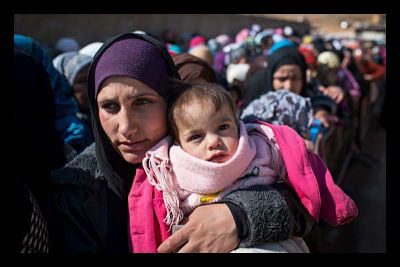
Displaced Syrian Refugees Seek Safety

displaced syrian refugees
The violent blitzkriegs currently commanding Syria and Iraq are causing unfathomably grave circumstances-so many that it is impossible to convey their consequent terror and devastation. Among countless other results, is the widespread population displacement occurring throughout the region.

It is estimated that 2.8 million displaced Syrian refugees are currently residing in neighboring areas, such as northern Iraq, having been forced out of their native country due to the infamous civil war. This number significantly increases daily, as the violence continues to grow in breadth and magnitude. Over 9.3 million Syrian refugees have been displaced as a result of the conflict. Many refugees are living in camps and in host communities in the Kurdish, northern region of Iraq. In last August, alone, over 60,000 Syrian refugees arrived at these designated camps. In one record day that month, a whopping 10,000 refugees arrived. Initially, the Iraqi government accepted the refugees and accommodated their medical needs, in addition to providing shelter and work permits. However, the massive influx stretched the Iraqi accommodations, dramatically.

This is a growing humanitarian crisis that demands attention. An average of 100,000 Syrians are registering as official refugees, every month. The refugees often suffer from dehydration and diarrheal diseases as a result of scarce resources, poor nutrition, and unhygienic conditions. Among the millions are a considerable amount of children; the United Nations reported that, of the displaced, over 1.4 million are child refugees. These circumstances are inherently devastating and disorienting; for children it is particularly disrupting, as they are forced to pick up and leave, ending their educations in the process. The crowded conditions have been conducive to child outbreaks of polio and measles, threatening the children’s lives, as well as their safety and well-being.

Humanitarian group Mercy Corps has intervened on behalf of all the refugees, as well as the child refugees. They have been distributing necessary items, such as shelter materials and mattresses. They additionally built a playground for children and brought toys to an Arbat refugee camp, to ease the children’s traumatic transitions. World Vision is also helping to alleviate refugee strife; the group has been distributing personal sanitation supplies and clean water. They are providing education services for children in addition to creating Child-Friendly Spaces, which are designated areas in which children can play and unwind.

As the conflict continually unfolds in geographical conjunction with the current crises resulting from the ISIS presence, the amount of displaced refugees increases daily.

– Arielle Swett

Sources: MercyCorps, World Vision
Photo: UNHCR

July 5, 2014
https://borgenproject.org/wp-content/uploads/borgen-project-logo.svg 0 0 Borgen Project https://borgenproject.org/wp-content/uploads/borgen-project-logo.svg Borgen Project2014-07-05 04:00:232024-06-05 01:57:38Displaced Syrian Refugees Seek Safety
Global Poverty, Refugees and Displaced Persons

Malian Refugees Face Drought and Uncertainty

If faced with a choice between remaining in the relative safety of a refugee camp but being hungry, or returning to your home country to face violence and uncertainty, which would you choose?

The increasingly severe drought conditions that are affecting several countries in the West African Sahel states has forced many Malian refugees to consider this very question. Lack of food, shelter and other basic resources at refugee camps in nearby Mauritania, Burkina Faso and Niger have many considering a return to Mali, which continues to be wracked by violence.

Since the violence that pitted the government against rebel groups (mainly the Tuareg) began in Mali in 2012, nearly 146,000 Malians have been displaced both internally and abroad. Thousands fled to nearby Burkina Faso, further stretching the resources of a country that is consistently listed at the bottom of the Human Development Index (183 of 186 in 2013). Burkina Faso, which already faces its own high rates of poverty, has seen its food security become dramatically more uncertain due to both the drought and influx of refugees.

The drought affects seven West African countries (including Mali and Burkina Faso) and is mainly due to poor weather conditions – exacerbated by poor governance. Nearly 15 million people are affected, many of whom rely on good weather for strong harvests that serve as their livelihoods.

Malian refugees who fled during the past two years are making difficult choices between remaining in the safety of camps abroad, where there is no longer enough basic resources for them, or returning to their war-torn homes to try and make a new life. Mali has a population of 16 million, where 50% live below the poverty line and 47.6% fall between the ages of 0 and 14. Considering these statistics and the violence that continues, many needs of the young population that will allow it to grow in the future are not being met.

Both choices that the refugees face leave a strong possibility of falling into poverty and facing difficulty in securing a livelihood. The combination of food insecurity, conflict and displaced populations is and will continue to be a source of concern for countries throughout the world as this mixture is often at the root of instability that spills into further conflict and terrorism.

– Andrea Blinkhorn

Sources: VICE, The World Bank, Al Jazeera, Al Jazeera, Central Intelligence Agency, Google Drive, BBC News
Photo: The Guardian

July 3, 2014
https://borgenproject.org/wp-content/uploads/borgen-project-logo.svg 0 0 Borgen Project https://borgenproject.org/wp-content/uploads/borgen-project-logo.svg Borgen Project2014-07-03 07:36:352024-12-13 17:50:23Malian Refugees Face Drought and Uncertainty
Refugees and Displaced Persons

2013 was Crisis Year for Refugees

crisis_year
A report released by the United Nations High Commission for Human Rights (UNHCR) detailed the global refugee situation for 2013. The news was bleak. 2013 was a crisis year for refugees, and saw more refugees than any year since the Rwandan genocide. The hardest hit areas are in the Middle East and Africa, but the United States is also experiencing its own refugee crisis along its Southwest border.

The Syrian Arab Republic contributed the most refugees for the year. In August of 2013, the 1 millionth Syrian refugee child was registered, while only a few weeks later the number of Syrian refugees passed the 2 million mark.

The crisis in Syria has prompted mass migrations, but the numbers still fall shy of the leading source country for refugees. Afghanistan, with its 2.56 million refugees spread across over 86 countries, remains the largest source country for the 33rd consecutive year. Afghanistan is the country of origin for one of every five refugees in the world. The brunt of the responsibility for Afghan refugees has fallen on neighboring Pakistan or Iran, who together hold 95 percent of Afghan refugees.

The UNHCR report makes it clear that most of the crisis is centered in the Middle East and Africa. The top three source countries — Afghanistan, Syria and Somalia — which account for 53 percent of the world’s refugees, as well as the top refugee hosting countries — Pakistan, Iran and Lebanon — are all located in the region. The U.S. comes in as the 10th largest host, with some 1 million less refugees than Pakistan — the largest host country.

However, the U.S. has recently been faced with its own refugee crisis. Abject poverty and violence in Central America has led to an unprecedented surge of unaccompanied child immigrants making their way across the U.S.-Mexico border. These children, some as young as 5 years old, make the dangerous journey across Mexico, where kidnappings and assaults of lone children are common.

Once they arrive in the U.S., conditions do not necessarily improve. Federal border housing facilities are established to take in children, but are not equipped to handle the recent surge. Built for around 7,000 children a year, the facilities have processed 47,000 in the last eight months. They are overcrowded, disease ridden and children lack beds and adequate meals.

President Obama has declared the trend of unaccompanied children crossing the border “an urgent humanitarian situation,” and it has caused lawmakers to think critically about U.S. immigration policy.

June 20 marked World Refugee Day, and, this year, provided a much needed time for reflection. As the refugee crisis around the world hits is lowest point in decades, leading officials and politicians recognize that something must be done. Antonio Guterres, the U.N. High Commissioner for Refugees, stated in the UNHCR report: “we are seeing here the immense costs of not ending wars, of failing to resolve or prevent conflict. Peace today is dangerously in deficit…political solutions are vitally needed.”

— Julianne O’Connor

Sources: NPR, UNHCR, Borgen Project, CNN
Photo: Huffington Post

June 26, 2014
https://borgenproject.org/wp-content/uploads/borgen-project-logo.svg 0 0 Borgen Project https://borgenproject.org/wp-content/uploads/borgen-project-logo.svg Borgen Project2014-06-26 18:50:332024-06-05 01:57:352013 was Crisis Year for Refugees
Disease, Health, Refugees and Displaced Persons

Polio Revisited

The date is August 24. The year is 1960. A vaccine for polio is licensed for use in the United States for the first time. Nineteen years later, after a widespread campaign for immunization, the disease is completely eliminated from the U.S.

The year is 1988. The United Nation’s World Health Assembly has launched a campaign to eradicate polio globally. During that year there were 350,000 cases of polio. By 2012, that number dropped to 223. It was a disease that scourged millions. For the first time since the eradication of small pox, we had the power to eradicate a disease from the entire planet that has affected human beings, sometimes leading to paralysis and death, for thousands of years.

Despite a few sporadic cases elsewhere, the disease was mostly contained to Afghanistan, Pakistan and Nigeria. However, in 2013, two years into the Syrian Civil War, polio reappeared in Syria for the first time in 15 years. And now, for the first time since before mass vaccination efforts began, the disease is now gaining ground.

Recording an exact number of cases is tricky, particularly in a war zone, but several sources on the ground in Syria place the number above 100. The World Health Organization has taken a more conservative stance at around 25, but any number of cases could have devastating global consequences.

Polio spreads rapidly, but most who contract it never show any symptoms. Instead, they remain carriers for the duration that the disease incubates in their body. Therefore, doctors suggest that for every one symptomatic case, there could be 200 people infected.

Some estimates are much higher. With that in mind, we don’t need exact numbers to know that any number of new documented polio cases is a threat.

According to the U.N., during the course of the Syrian Civil War approximately 2.5 million refugees have fled Syria to neighboring countries. These countries are mainly Syria’s immediate neighbors; Turkey, Iraq, Jordon and Lebanon. With so many people fleeing Syria, polio could spread with them, and what was once a national crisis could become a regional one in much the same way the war itself has spread to other countries.

And in a world as globalized as ours, the potential impact of this resurgence could reverberate to the U.S.

This scenario is an immediate and physical example of how what happens outside our borders and across oceans has a direct impact on American lives. In times of war, formerly robust food and medical facilities often shut down, sometimes as collateral damage, at other times as a means to intentionally damage an enemy. But under any circumstances, when disease spreads, nobody wins. The year is 2014, and we are now in danger of revisiting a disease that we came within the final steps of eradicating a few short years ago.

– Julian Mostachetti

Sources: ABC News(1), ABC News(2), BBC, The History of Vaccines, Migration Policy Centre, New York Books
Photo: Tribune

June 8, 2014
https://borgenproject.org/wp-content/uploads/borgen-project-logo.svg 0 0 Borgen Project https://borgenproject.org/wp-content/uploads/borgen-project-logo.svg Borgen Project2014-06-08 19:20:132024-12-13 17:50:18Polio Revisited
Aid Effectiveness & Reform, Refugees and Displaced Persons

33.3 Million Internally Displaced People in 2013

There are 33.3 million internally displaced people worldwide as of 2013 according to The Internal Displacement Monitoring Center (IDMC) in a report released mid-May.

The Global Overview 2014: people internally displaced by conflict and violence, the IDMC’s flagship annual report, was launched at an event co-organized by the IDMC, the Norwegian Refugee Council (NRC) and the U.N. Refugee Agency (UNHCR).

The IDMC has been monitoring internal displacement figures since the late 90’s. The current numbers show 8.1 million newly displaced people in 2013, up 1.8 million from 2012.

Displacement occurs heavily in areas experiencing extreme conflict and violence, leaving the most unstable countries with the highest population of displaced people. Figures from the IDMC show the rankings of these areas as follows:

Countries with the largest displacement related to conflict and violence

  1. Syria (6.5 million)
  2. Columbia (5.7 million)
  3. Nigeria (3.3 million)
  4. DRC (2.9 million)
  5. Sudan (2.4 million)
  6. Iraq (2.1 million)
  7. Somalia (1.1 million)

As seen, 63 percent of the total displacement numbers come from Syria, Columbia, Nigeria, the Democratic Republic of the Congo and Sudan. Syria passed Columbia as having the most internally displaced people (IDPs) last year and accounts for almost half of new displacements in 2013.

However, Sub-Saharan Africa remains the region containing the highest number of internally displaced people since 2003. “These numbers show why it’s so vitally important that the international response to Syria should not be at the expense of displaced people in Africa or elsewhere,” says Antonio Guterres, the High Commissioner for Refugees.

Currently, 12.5 million people are internally displaced in Sub-Saharan Africa, with a 55 percent increase in new displacements in the region from the previous year. The most problematic areas are the Central African Republic, the Democratic Republic of Congo and South Sudan.

Aside from being forced to migrate from their homes, IDPs suffer various health issues associated with the move as well. Displacement camps are often militarized and lack inadequate shelter. Proper health treatment is often inaccessible while living conditions are unsanitary.

Continuing conflict also makes it difficult for governments and humanitarians in the field to deliver aid. Conditions are so bad that the average displacement time for affected people is now 17 years, according to Jan Egeland, secretary general of the Norwegian Refugee Council.

“We have a shared responsibility to act to end this massive suffering,” urges Guterres, “Immediate protection and assistance for the internally displaced is a humanitarian imperative.”

A promising sign for positive change comes with the African Union’s Kampala Convention, the world’s first international treaty that legally binds states to assisting and protecting their IDPs. Five additional countries signed on this year alone.

The fact that internal displacement is an upward trend reveals an inherent flaw in the way the issue is being addressed. Comprehensive reform on the local, national and international approach is now being discussed as efforts increase to resolve the IDP crisis.

– Edward Heinrich

Sources: Internal-Displacement,Algazeera,The Chicago Citizen
Photo: FT Photo Diary

June 8, 2014
https://borgenproject.org/wp-content/uploads/borgen-project-logo.svg 0 0 Borgen Project https://borgenproject.org/wp-content/uploads/borgen-project-logo.svg Borgen Project2014-06-08 12:00:482024-06-04 01:08:0433.3 Million Internally Displaced People in 2013
Food & Hunger, Food Security, Global Poverty, Malnourishment, Refugees and Displaced Persons

1,000 Days Campaign in Rwanda 

1,000_days_campaign
Since conflict started in the Democratic Republic of Congo, children have been fleeing the violence to Rwanda and into the hands of another challenge: malnutrition. The state of food security and proper nourishment in Rwandan refugee camps is becoming dire as nearly 44 percent of children under 5 face serious chronic malnutrition.

However, the Rwandan government is making strides to welcome its new residents with open arms and humanitarian aid. Under the command of Prime Minister Pierre Damien Habumuremyi, the Rwandan government launched the “1,000 Days in the Thousand Hills” campaign back in September of 2013 to combat malnutrition in both its refugee camps and its local population. With the help of the Ministry of Disaster Management and Refugee Affairs (MIDIMAR), the 1,000 days campaign was implemented first in the Kiziba camp in Western Rwanda, then in all five refugee camps in the country.

The mission of the campaign: combat malnutrition using programs that make populations more self-reliant and educated on proper health. The approach: provide children with the proper nutrients for the first 1,000 days from birth until the child’s second birthday and establish local community efforts to produce more nutritious food.

The 1,000 Days campaign in Rwanda is not unique. In fact, similar programs have been implemented in a variety of other locations including Ethiopia, Indonesia and Guatemala. But what makes Rwanda’s campaign special is its focus on integration. Like all of MIDIMAR’s programs, the 1,000 Days in the Thousand Hills campaign aims to connect the refugee and local populations by using their combined forces to solve mutual problems. All practices used in the local population are being used in refugee camps and vice versa.

What are these practices? As established, the campaign seeks to make populations at risk more self-sufficient while still receiving help to reduce malnutrition. Programs include setting up kitchen gardens and animal breeding programs. At the start of the campaign, 315 kitchen gardens were set up and 151 families received rabbits to breed, eat and sell. The hope is to make refugees and local populations independent with livestock and farming techniques that provide them with greater nutrients.

On top of this, the 1,000 days campaign aims to provide children with the necessary sustenance for healthy development and nutrition from day one until age 2. This allows children to escape malnutrition and stunting of growth and to have better immune systems and brighter futures. The program achieves this goal both by putting more food into the community and educating parents on what counts as fortified and healthy foods, such as vegetables, fruits and milk. In addition, the campaign seeks to spread awareness on the warning signs of malnutrition and the diseases associated with the condition.

All of this culminates in two results: first, it brings children out of risk of malnutrition by providing them with necessary protein from the start. Second, it pulls populations into a state of food security by providing sustainable ways of harvesting good food.

The program is set to end in October of 2016, but many strides towards success can be taken by then. With any luck and lots of hard work, malnutrition will cease to be an insurmountable problem facing refugees in Rwanda.

– Caitlin Thompson

Sources: All Africa, Doctors Without Borders, Ministry of Disaster Management, Relief Web, Republic of Rwanda, Republic of Rwanda Ministry of Health, World Vision International, 1000 Days
Photo: Republic of Rwanda Ministry of Health


June 5, 2014
https://borgenproject.org/wp-content/uploads/borgen-project-logo.svg 0 0 Borgen Project https://borgenproject.org/wp-content/uploads/borgen-project-logo.svg Borgen Project2014-06-05 20:39:262024-06-05 01:57:291,000 Days Campaign in Rwanda 
Global Poverty, Refugees and Displaced Persons

Spotlight: Refugees International

Fleeing political, racial and religious persecution, more than 15 million people worldwide have left their homes and sought safety across international borders. They are refugees; often as unwelcome in their host countries as they were in their own.

For many, it is out of the frying pan and into the fire.
International law forbids the deportation of peoples with refugee status. Still, deeply rooted ethnic and national divides can make neighboring countries reluctant to accept them.
It is estimated that half of refugees today settle in major cities. Hundreds of thousands of Somali citizens, for example, have gone not to internationally established camps, but to Nairobi, Kenya. These urban refugees, with neither shelter, funds nor connections, find themselves in situations nearly as desperate as the ones they left.
Hindered by language and social stigma, they are limited to the poorest paying jobs. Their ambiguous political standing, meanwhile, affords them none of the safeguards given to citizens of their new homes. The British organization, Hidden Lives, quotes one man, “I don’t have legal documentation. I don’t have a job. I don’t leave my house.”
Access to health care, though needed by many, is often restricted.
So why not just head for a refugee camp? Conditions there are no better. Camps are notoriously overcrowded and vulnerable to the spread of communicable disease. Violence and sexual assault goes largely unchecked. For basic needs such as food and water, refugees are reliant on international aid. Refugees also must rely on international aid for health care, education and development. Who do they rely on for security forces? International aid. International aid, unfortunately, must come in waves.
Consequently, any group that raises awareness or funds to sustain displaced peoples, in and out of country, becomes integral to their survival. None is more widely known, perhaps, than Refugees International (RI).
RI focuses on advocacy and policy reform. In addition to meeting with world leaders, it organizes 15 yearly field missions to determine the living conditions of refugees and internally displaced people across South America, Africa, the Middle East and Asia. These missions are essential to the organization: because of the information gathered, it is an influential authority. RI is consulted on not only the need for aid, but also the amount required and its distribution.
It was RI that alerted the United Nations to the lack of post-rape kits available in the Central African Republic earlier this year. It was RI that encouraged the United States to support the Nansen initiative, which protects displaced victims of climate-related disasters. The U.S. set aside more than $150 million for the deployment of peacekeepers to the CAR at the request of the organization. In response to their report of violence against women in Syria, the United Kingdom provided more than $14 million dollars in funding.
The U.N. Refugee Agency calls 10.8 million people ‘refugees of concern.’ Almost three times as many live as IDPs. While they wait for resettlement, or war and persecution to end, they have to entrust their lives to the international community at large. But the nations most capable of giving aid are often the furthest removed. It is left to Refugees International, and organizations like it, to bridge the gap.
– Olivia Kostreva

Sources: UNHCR, Health Poverty Action, Refugees International, Hidden Lives
Photo: The Global Herald

June 4, 2014
https://borgenproject.org/wp-content/uploads/borgen-project-logo.svg 0 0 Borgen Project https://borgenproject.org/wp-content/uploads/borgen-project-logo.svg Borgen Project2014-06-04 14:56:392024-06-05 01:57:28Spotlight: Refugees International
Page 24 of 29«‹2223242526›»

Get Smarter

  • Global Poverty 101
  • Global Poverty… The Good News
  • Global Poverty & U.S. Jobs
  • Global Poverty and National Security
  • Innovative Solutions to Poverty
  • Global Poverty & Aid FAQ’s
Search Search

Take Action

  • Call Congress
  • Email Congress
  • Donate
  • 30 Ways to Help
  • Volunteer Ops
  • Internships
  • Courses & Certificates
  • The Podcast
Borgen Project

“The Borgen Project is an incredible nonprofit organization that is addressing poverty and hunger and working towards ending them.”

-The Huffington Post

Inside The Borgen Project

  • Contact
  • About
  • Financials
  • President
  • Board of Directors
  • Board of Advisors

International Links

  • UK Email Parliament
  • UK Donate
  • Canada Email Parliament

Get Smarter

  • Global Poverty 101
  • Global Poverty… The Good News
  • Global Poverty & U.S. Jobs
  • Global Poverty and National Security
  • Innovative Solutions to Poverty
  • Global Poverty & Aid FAQ’s

Ways to Help

  • Call Congress
  • Email Congress
  • Donate
  • 30 Ways to Help
  • Volunteer Ops
  • Internships
  • Courses & Certificates
  • The Podcast
Scroll to top Scroll to top Scroll to top