• Link to X
  • Link to Facebook
  • Link to Instagram
  • Link to TikTok
  • Link to Youtube
  • About
    • About Us
      • President
      • Board of Directors
      • Board of Advisors
      • Financials
      • Our Methodology
      • Success Tracker
      • Contact
  • Act Now
    • 30 Ways to Help
      • Email Congress
      • Call Congress
      • Volunteer
      • Courses & Certificates
      • Be a Donor
    • Internships
      • In-Office Internships
      • Remote Internships
    • Legislation
      • Politics 101
  • The Blog
  • The Podcast
  • Magazine
  • Donate
  • Click to open the search input field Click to open the search input field Search
  • Menu Menu

Archive for category: Human Rights

Information and stories about human rights.

Global Poverty, Human Rights, Human Trafficking

Thailand’s Trouble with Human Trafficking

sex_trafficking_thailand
Human trafficking has grown into a widespread and horrific issue in Thailand. The country has become a trafficking hub, sending and recruiting people all over the world to work in prostitution, unfair labor situations, forced marriages, sex tourism, and other crimes.

The majority of the human trafficking in Thailand feeds into prostitution. The country has struggled with its treatment of women since it became a country in the 1930s. The country did not grant equal rights to women until 1997 and today is still not enforcing these standards of equal rights consistently. Research conducted by the Ministry of Public Health in Thailand explains that approximately 1.5 million female children report cases of abuse annually. This shocking number does not include the vast number of cases left unreported. Further inquiry into these discoveries by the Ministry of Public Health reveals that females under 15 years old made up nearly one half of all reported rape and abuse cases in Thailand.

Sex trafficking and prostitution have always been a part of Thailand’s history, however, the Vietnam War contributed to an explosion of the issue between 1955 and 1975. With an influx of anxious, homesick, and bored soldiers into the country, spilling over from Vietnam, the demand for prostitution skyrocketed, resulting in the growth of the human trafficking industry which still remains today. The influx in human trafficking during this time, combined with a historical view of women as inferior, has led to the cultural acceptance of prostitution throughout most of Thailand. The World Health Organization estimates that Thailand currently has nearly 2 million sex workers.

Deep poverty and desperation of many Thai citizens have contributed to the human trafficking industry and problems that have derived from it. People who do not hold proper immigration documentation or citizenship are the most vulnerable recruits, as they perceive this path as their only opportunity to make money. Recruiters target many impoverished people, telling them they are being led to a job where they will have an opportunity to make money to send to their family. The hill tribe women in Northern Thailand, who lack citizenship papers, often fall into prostitution, as it is the only job they can perform without needing proof of citizenship.

Victims of human trafficking can be forced into prostitution or the sex trade or other forms of difficult labor, often without any pay or any limitation on the amount of hours they must work. Though exact numbers are currently unknown, trafficked children make up a significant part of the labor force in construction work zones or factory sweatshops. Many of these trafficking victims work in the fishing industry and relayed how it was not uncommon for a boat captain to kill any of the fishermen who fell sick or too weak to work under these harsh conditions.

Some critics have called for the legalization of prostitution in Thailand as a method of curbing the trafficking problem. This could lead to better legal protection for prostitutes and would put many traffickers out of business. Additionally, if the industry were legal the government could tax it, making a profit of it and discouraging people from prostitution, as it would be more expensive to cover the tax. However, Thailand would be taking a step backwards in their push to end trafficking and prostitution. While it may sound economically beneficial to legalize prostitution, one must not forget the basic violation of human rights that prostitution, forced labor, and the slave trade infringes on its victims.

– Allison Meade

Sources: State Department, Human Rights Watch, Human Trafficking
Photo: Sabre

August 6, 2013
https://borgenproject.org/wp-content/uploads/borgen-project-logo.svg 0 0 Borgen Project https://borgenproject.org/wp-content/uploads/borgen-project-logo.svg Borgen Project2013-08-06 04:58:032024-05-25 00:14:37Thailand’s Trouble with Human Trafficking
Global Poverty, Human Rights, Poverty Reduction

Proposed Begging Ban in Finland

Begging Ban in Finland
Politicians from the National Coalition Party, Centre Party and Swedish People’s Party have proposed a ban against begging in Finland. Ban supporters see begging as an annoyance and want to fine perpetrators, predominately the Roma (or “gypsies”) who are most infamous for begging in Helsinki, the Finnish capital.

Proponents of the ban see it as a positive move for human rights in Finland, where many are coerced into begging by sex traffickers and street criminals. The European group The Group of Experts on Action against Trafficking in Human Beings (GRETA) advocates for the ban for this very reason.

Opposers of the ban see it as a violation of human rights, as it prevents those who are begging out of free will from obtaining help from the more advantaged. The Roma population has substantially increased over the last few years due to their migration from Eastern Europe into Scandinavia, increasing the number of poor people in need of assistance there. University of Helsinki’s Professor of Constitutional Law, Tuomas Ojanen points out the problematic implications of the fledgling law, stating: “(m)eans other than a prohibition on begging should be pursued to deal with the human rights issues related to the poverty of, and systematic discrimination against, Roma people.” Historically, the Roma have been treated poorly and shouldered the blame for many societal problems. One must not forget that the Roma were persecuted in the Holocaust in much the same way as Jews, with anywhere from 200,000-1,000,000 killed by the Nazis from 1939-45.

Is a ban on begging really necessary in Finland? The ban may curb the “annoyance” of beggars asking for money, but what will it accomplish in the long run? It certainly will not result in a greater reduction of poverty. After all, a beggar is begging for money, and will be unable to pay a fine if he or she is required to pay one. Yes, a ban may be conducive to ending forced begging and sex trafficking in Finland, but it will only worsen the situation of the Roma in the region. Further disenfranchising an already downtrodden people is a high price to pay for ending a petty irritation.

– Josh Forgét

Sources: Romanies and the Holocaust: A Reevaluation and an Overview, Ice News, The Human Rights Blog

August 2, 2013
https://borgenproject.org/wp-content/uploads/borgen-project-logo.svg 0 0 Borgen Project https://borgenproject.org/wp-content/uploads/borgen-project-logo.svg Borgen Project2013-08-02 07:36:222024-05-25 00:11:54Proposed Begging Ban in Finland
Health, Human Rights, Nonprofit Organizations and NGOs

3 Incredible Accomplishments of the Carter Center

Jimmy and Rosalynn Carter in Ambassador's Circle
“We can choose to alleviate suffering. We can choose to work together for peace. We can make these changes—and we must.” These words of our remarkable former President Jimmy Carter form the foundation of a center striving for a better world. In 1982, former President Carter and wife, Rosalynn founded a non-profit organization “committed to advancing human rights” named, “The Carter Center.” In partnership with Emory University, the Atlanta-based organization has made great strides in improving the human condition worldwide. Here are three noteworthy initiatives of the Carter Center:

  1. In promoting global health, the Carter Center led a coalition poised to bring an end to Guinea Worm Disease. Also known as dracunculiasis, this disease was found in 3.5 million people in 1986. In that year, the Carter Center came to the fore and led a campaign to prevent this preventable infection in countries throughout Africa. In the years that followed, the Carter Center has been able to drastically reduce the prevalence of the disease through water filtration programs, water treatment programs, and programs educating the public about dracunculiasis. Today, Guinea Worm Disease is on the brink of eradication, with only 542 reported cases in 2012.
  2. In promoting democracy, the Carter Center has played an extensive role in overseeing elections in countries globally. Since its founding, the center has monitored over 90 elections in some 37 countries. In each election, the center plays a role in evaluating a given country’s electoral laws, overseeing voter registration, and assessing the fairness of campaigns. In 2005, the center became involved in drafting a document outlining the standards for election observers in countries around the world. Known as the Declaration of Principles for International Observation, this document has been embraced by organizations internationally
  3. Among the Carter Center’s most innovative programs is its Conflict Resolution Program. The center aims to improve dialogue and negotiations as a means of producing real solutions tailored to each given nation. In Liberia, for example, a country that endured lawlessness for years, the center is working to “reestablish the rule of law.” The center spearheaded a campaign promoting and strengthening legal institutions in the country, as well as creating constructive partnerships between citizens and their government.

Learn more at https://www.cartercenter.org/index.html.

– Lina Saud

Sources: Carter Center, CDC

July 27, 2013
https://borgenproject.org/wp-content/uploads/borgen-project-logo.svg 0 0 Borgen Project https://borgenproject.org/wp-content/uploads/borgen-project-logo.svg Borgen Project2013-07-27 10:06:512024-05-25 00:13:043 Incredible Accomplishments of the Carter Center
Human Rights, Women and Female Empowerment

What is FEMEN?

Femen_Women
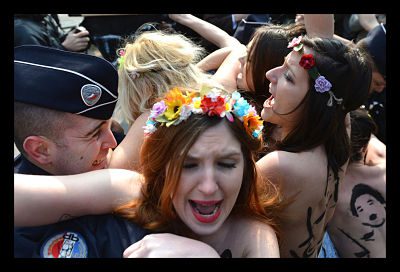
You have probably heard about the women who have been protesting, bare-breasted, all over Europe. They are FEMEN.

Started in Ukraine, the FEMEN movement describes itself as “the scandal famous organization of topless women activists, who defend with their breast sexual and social equality in the world.” With “Sextremism” as their motto, FEMEN activists clearly display their struggle: “Be FEMEN – means to mobilize every cell of your body on [sic] a relentless struggle against centuries of slavery of women!” Radical in their beliefs and actions, FEMEN activists depict themselves as “morally and physically fit soldiers, who every day make civil actions of the high [sic] degree of difficulty and provocativity [sic].”

Radical words require radical actions. Since 2010, FEMEN have become increasingly visible on the international political scene because of their turbulent interventions throughout Europe. FEMEN have been protesting intensively against sexism, homophobia, prostitution and religion. Using their bodies as their best weapons, FEMEN activists fight for women’s rights against dictates imposed by dictators, the church and the sex industry. “My Body, My Manifesto,” “Sextremism – FEMEN is the death of Patriarchy,” “I am Free” are some of the messages you can read on FEMEN activists’ breasts. Their protests incorporate political messages displayed on their bodies, enacting shocking scenes which gather attention and mobilization of greater numbers of people.

For instance, on July 3, three FEMEN activists demonstrated in front of the Elysee Palace, in Paris, in order to ask the French President to show solidarity with their imprisoned Tunisian fellow Amina. They were wearing barbed wired around their breasts and faces, lacerating their flesh as the police arrested them.

Banned from Ukraine after she denounced the arrest and subsequent imprisonment of the Pussy Riot – a Russian female punk group that had organized a punk prayer at Moscow’s Cathedral of Christ the Savior- Inna Shevchenko, one of the leading activists of the group, has been granted “political refugee” status in France.

The FEMEN ‘headquarters’ are now based in Paris, France. Recently, the creation of a new postage stamp in effigy of Marianne triggered political turmoil in France. Indeed, the Marianne depicted on the stamp is wearing a crown of flowers, symbol of the FEMEN activists. Inna Shevchenko provocatively commented “FEMEN is on [sic] French stamp. Now all homophobes, extremists, fascists will have to lick my ass when they want to send a letter.” Protest against the new French stamp has arisen, mostly because of the many Islamophobic comments of FEMEN activists.

FEMEN’s extreme actions and statements have been criticized by other feminists. Journalist Mona Chollet denounced the use of stereotyped young, skinny and beautiful women who display their bodies naked to fight for human rights, at the detriment of all those who do not fight naked and do not abide by the classic criteria of beauty and youth.

– Lauren Yeh

Sources: Le Monde, FEMEN, L’Express
Photo: The Atlantic

July 27, 2013
https://borgenproject.org/wp-content/uploads/borgen-project-logo.svg 0 0 Borgen Project https://borgenproject.org/wp-content/uploads/borgen-project-logo.svg Borgen Project2013-07-27 05:12:572017-02-15 10:53:17What is FEMEN?
Human Rights, Women and Female Empowerment

5 Ways to Empower Women

5 Ways to Empower Women
Though women produce roughly half of the world’s food supply and are often held responsible for their family’s well being, they are treated as second-class citizens in many places around the world. According to the United Nations, women’s empowerment is important not only from a human rights standpoint but also because it is “a pathway to achieving the Millennium Development Goals and sustainable development.” Listed below are five ways to empower women that will simultaneously bolster the fight against global poverty.

1. Give a Microloan

Organizations such as Kiva allow people to lend small amounts of money to individuals who cannot access traditional banking systems. When given microloans, women can start their own small businesses and better support themselves and their families. Microloans also help women to gain financial independence, which often allows them to escape domestic violence.

2. Help Girls Empower Each Other

Girl Up, a United Nations organization, allows American girls to connect with their peers in developing nations. Girl Up ensures that girls across the world can inspire each other and learn to stand up for the rights and opportunities to which they are entitled.

3. End Gender-Based Violence

Roughly 70% of females experience physical or sexual violence during their lifetime, and many more are subjected to other forms of abuse. Social mobilization is imperative in the battle against gender-based violence because it ensures that educational, psychological, and legal resources are offered to the many women who face violence. Organizations such as Say NO: UNiTE To End Violence Against Women provides funding for advocacy programs, volunteer opportunities at shelters, and protective government legislation in order to eliminate gender-based violence.

4. Grant Equal Educational Opportunities

Two-thirds of children denied an education across the world are girls. Left uneducated, girls are much more likely to live in poverty because of their low-earning potential and high fertility rate. Girls who attain higher levels of education have fewer children, earn higher salaries, and encourage education within their own households, gradually reducing poverty over time. The UN’s Global Fund for Women works to bridge the educational gap by investing in organizations that provide women with valuable skills and knowledge.

5. Help Women Recover from Conflicts

Women are one of the most vulnerable populations in times of conflict, subject to higher rates of violence, rape, and poverty. Advocating for food assistance following violent conflict helps to ensure that women receive food assistance after they have been crippled by the difficult side effects of war. This assistance helps them to restart their lives, giving them the tools and training they need to rebuild their communities.

– Katie Bandera

Sources: WFP, Oprah, Huffington Post
Photo: Flickr

July 23, 2013
https://borgenproject.org/wp-content/uploads/borgen-project-logo.svg 0 0 Borgen Project https://borgenproject.org/wp-content/uploads/borgen-project-logo.svg Borgen Project2013-07-23 09:26:282024-05-25 00:03:385 Ways to Empower Women
Human Rights, Women and Female Empowerment

Widows Rights Limited in Cameroon

Widows Rights Limited in Cameroon

Widows’ rights have been an issue for centuries, but, with the advent of the HIV/AIDS epidemic, the cause for concern has grown exponentially.

In Cameroon, when a woman’s husband dies, all of his belongings go directly to his surviving family regardless, of whether he had children. This is because women and children are regarded as property and therefore cannot inherit it, this practice leaves many women struggling to raise children after having been stripped of assets that they feel are rightfully theirs. Furthermore, many are forced to take part in mourning rituals that can last years.

One woman, who is now an advocate for the program, states, “I would get up in the morning and sit with those who came to mourn with me. I could not go out, I could not attend church. It was like you were not your own person.” Joseph Nij, a retired police officer, also told of the hardships he saw some widows face. “They had ­widows isolated and barefoot,” he said. “Some of them were told not to wear clothes, and could only eat from a separate dish.”

Another woman was forced to urinate in front of a large crowd to prove she had no part in her husband’s death. Other injustices include forcing the widow to have sexual relations with her male in-laws, making her lie next to her husband’s corpse for up to three days, forcing her to remarry or prohibiting her from marrying again, and required displays of public nudity.

The rationale for such behavior is almost as shocking as the abuse itself. A report by Pingpoh Margaret Hongwe from the Cameroon Association of University Women (CAMAUW) reads, “Hardly is any death considered natural. Most deaths are attributed to witchcraft and the power of witchcraft is very often attributed to women. When a man dies, society quickly accuses the wife. The ill-treatment of the widow is considered a punishment, a test of fidelity and a cleansing exercise.”

In Cameroon, one young student is looking to turn things around. Sundze Mamah Natari, known as “Mallam,” is the president of the Muslim Students’ Association of Bamenda (MUSAB), and is working with the fons, or kings, of different regions within the country. He believes that because some of the younger fons have been university-educated, they may be able to approach this issue with an open mind. Noting that change will not happen overnight, Mallam adds, “Some of these traditions have lasted more than 500 years. This project is very sensitive.”

Fortunately, some are starting to pay attention to the issue. This year on June 23rd marked the first International Widows’ Day, which was started by the United Nations to raise awareness on the rights of widows around the world.

– Samantha Mauney

Sources: Mail & Guardian, Widows’ Rights, All Africa
Photo: Flickr

July 21, 2013
https://borgenproject.org/wp-content/uploads/borgen-project-logo.svg 0 0 Borgen Project https://borgenproject.org/wp-content/uploads/borgen-project-logo.svg Borgen Project2013-07-21 09:22:182024-05-24 23:42:26Widows Rights Limited in Cameroon
Human Rights, Refugees and Displaced Persons

Jesuit Refugee Service USA Gives Voice to Refugees

Jesuit Refugee Service USA Gives Voice to Refugees
Jesuit Refugee Service is a non-profit Catholic organization that works “to defend the rights of refugees and migrants throughout the world.” The U.S. division of JRS employs advocacy efforts to fight for “just and generous policies and programs” that will benefit refugees and ensure their protection during times of conflict.

JRS/USA partners with JRS branches across the world along with other aid organizations to make the voices of refugees heard and to propose actions that will properly address their situation.
Though JRS/USA focuses on select domestic issues such as U.S. detainees’ right to religious expression, the organization has pinpointed the following international advocacy issues to focus on during 2013:

  • International Detention: JRS/USA works to assist refugees and asylum seekers who risk being detained. The use of detention to limit asylum seekers has increased over the past ten years, and JRS/USA advocates against the unnecessary detainment of those seeking asylum.
  • Haiti and Dominican Republic: JRS/USA is currently fighting against the unfair treatment of refugees and immigrants that is occurring in the Dominican Republic. The government of the Dominican Republic recently enacted policies that have resulted in “the denial and/or revocation of the nationality of Dominican-born persons of Haitian ethnicity,” and mass deportations of people of Haitian descent are occurring. Dominican-born persons of Haitian descent face xenophobia, arbitrary detention, and denationalization.
  • Colombia: Colombia is home to five million internally displaced people, and 500,000 Colombians have fled to countries such as Panama, Ecuador and Venezuela. Most of these refugees lack access to basic services, and legal barriers prevent them from fully integrating into their countries of asylum. U.S. and global funding for the protection and assistance of Colombian refugees and internally displaced people remains insufficient, so resettlement efforts have not been successful. JRS/USA advocates for increased funding for Colombian refugees and internally displaced people and fights to increase the number of Colombian refugees resettled in the United States.
  • Migrants and Asylum Seekers: JRS/USA advocates for more generous international standards for the treatment of refugees and those who have been internally displaced. JRS/USA also fights for improvements in U.S. treatment of asylum-seekers, detained immigrants, and other displaced people.

Most U.S. citizens agree that certain standards of treatment towards refugees and internally displaced people should be upheld, but they disagree about the role the U.S. government should play in upholding these standards. JRS/USA seeks to highlight the difference U.S. policymakers can make in the lives of those threatened by their own government or country of origin.

– Katie Bandera

Source: Catholic Sentinel, JRS/USA
Photo: JRUSA

July 20, 2013
https://borgenproject.org/wp-content/uploads/borgen-project-logo.svg 0 0 Borgen Project https://borgenproject.org/wp-content/uploads/borgen-project-logo.svg Borgen Project2013-07-20 04:39:422024-05-25 00:03:05Jesuit Refugee Service USA Gives Voice to Refugees
Human Rights, Refugees and Displaced Persons

The Voluntary Relocation of Tibetans

The program is known as the New Socialist Countryside, and has provided up to 2.1 million Tibetans with running water, electricity, and access to improved healthcare and education in the past 7 years. Run by planners in Beijing, the program is ostensibly aimed at raising living standards and improving the economy of Tibet, one of the poorest regions within China.

However, a recent report by Human Rights Watch suggests that the program has had a severe effect on the traditional Tibetan way of life. Says Sophie Richardson, China Director for Human Rights Watch, “…while it may be true that some Tibetans have benefitted, the majority have simply been forced to trade poor but stable livelihoods for the uncertainties of a cash economy in which they are often the weakest actors.”

Having observed the income disparity between rural and urban dwellers, the Chinese government has relocated nearly three-quarters of Tibetans to urban areas. However, upon arriving in cities, rural Tibetans can’t compete with immigrants from other regions of China, nor with educated locals who speak Mandarin. As such, large portions of the population are being moved, supposedly voluntarily, but not being given a support structure once resettled that would allow them to survive in a setting wholly foreign to their previous nomadic lifestyle.

There are many claims for the motives of the government, including protecting the ecologically fragile grasslands of the Tibetan plateau, and facilitating improved utility distribution for the population, but at the same time the thought lingers that the relocations have more to do with control of the population and improving rural incomes to avoid unrest.

120 self-immolations have taken place in Tibet in the past five years. Sadly, civil unrest is an ongoing theme in Tibet, and with governmental policies such as New Socialist Countryside, improvement is a double-edged sword.

– David Wilson

Sources: NY Times, Huffington Post

July 18, 2013
https://borgenproject.org/wp-content/uploads/borgen-project-logo.svg 0 0 Borgen Project https://borgenproject.org/wp-content/uploads/borgen-project-logo.svg Borgen Project2013-07-18 10:55:522015-04-14 14:39:53The Voluntary Relocation of Tibetans
Human Rights

Physicians for Human Rights

Physicians for Human Rights (PHR) uses science and medicine to prevent severe human rights violations against individuals. The independent organization was founded in 1986 by a group of doctors, all who witnessed first hand the extent to which mass atrocities and extreme physical and mental harm were occurring around the world.

Among the founders is Dr. Jonathan Fine, who previously worked at the North End Neighborhood Health Center in Boston. Dr. Fine received a call in 1981 from a Harvard History Professor who asked if he knew a Spanish-speaking physician willing to fly to Chile as soon as possible. The individual was to lead a delegation seeking the release of 3 physicians who had disappeared by the brutal regime of General Augusto Pinochet. Dr. Fine found himself before a military judge in Valparaiso one week later. After an hour, Dr. Fine’s delegation was given permission to enter the prison and meet with the Chilean physicians. He described them as, “psychologically terrorized” and said, “…their testimonies were riveting, and so outraged me that within a few years I left my medical practice to do this work full time.”

Over the past 25 years, PHR has worked on a wide range of human rights issues in over 40 countries. Today, the organization focuses on torture, mass atrocities (including war crimes, crimes against humanity, and genocide), the use of rape as a weapon of war, and the persecution of health workers.

The philosophy behind Physicians for Human Rights is that health professionals, with their specialized skills, ethical responsibility, and credible voice, are in a powerful position to stop human rights violations. Local human rights organizations, governments, the United Nations, international courts, and regional groups such as the African Union and European Union seek out the work and expertise of PHR.

There are three steps PHR takes to gather the necessary information for prevention and change. First, medical and scientific investigations are conducted using forensic science, medical and psychological examinations, and epidemiological research. Next, the evidence and human stories of the investigation are documented as reports, court-admissible evidence, testimony for governmental bodies, and various other forms for targeted audiences. Finally, the human rights experts of PHR meet with key representatives from governments, courts, or international groups to push for interventions, the prosecution of individuals, the drafting of legislation, and other calls to action. The following is work the organization has done:

  • 1986 – Led investigations of torture in Chile, freeing heroic doctors
  • 1988 – First to document the Iraqi use of chemical weapons on Kurds providing evidence for the prosecution of war criminals
  • 1996 – Exhumed mass graves in the Balkans and Rwanda to provide evidence for International Criminal Tribunals
  • 1997 – Won the Nobel Peace Prize in conjunction with the International Campaign to Ban Landmines
  • 2003 – Warned U.S. Policymakers about health and human rights conditions prior to and during the invasion of Iraq
  • 2004 – Documented genocide and sexual violence in Darfur in support of international prosecutions
  • 2010 – Investigated the epidemic of violence spread by Burma’s military junta
  • 2011 – Championed the principle of noninterference with medical services in times of armed conflict and civil unrest during the Arab Spring
  • 2012 – Trained doctors, lawyers, police, and judges in the Democratic Republic of the Congo, Kenya, and Syria on the proper methods for collecting evidence in sexual violence cases
  • 2013 – Won first prize in the Tech Challenge for Atrocity Prevention with MediCapt, the mobile app that documents evidence of torture and sexual violence

– Ali Warlich

Source: PHR Charity Navigator
Photo: Arabian Business

July 17, 2013
https://borgenproject.org/wp-content/uploads/borgen-project-logo.svg 0 0 Borgen Project https://borgenproject.org/wp-content/uploads/borgen-project-logo.svg Borgen Project2013-07-17 07:10:352024-05-24 23:52:03Physicians for Human Rights
Children, Human Rights, United Nations

The World’s Most Oppressed People: The Rohingya

Rohingya_people_in_Myanmar

The Rohingya people represent a small Muslim minority in the Southeast Asian country of Myanmar. They are denied citizenship, forbidden from colleges, and have suffered mass killings and violence that the government has done nothing to halt. And recently, Myanmar passed a law restricting Rohingya childbirths, an action which may qualify as an act of genocide.

The Rohingya people have lived in Myanmar since the eighth century. However, their existence was wiped from official record in 1982 with the passage of a citizenship law. The law had the effect of making the Rohingya stateless peoples, illegal immigrants in their own country, with no rights or international recognition.

Rohingya people have experienced harsh violence and now will suffer an enforced two-child limit. The limitation is officially claimed as an effort to ease tensions between the Buddhist majority and Muslim minority, however the policy serves as a frightening indicator that genocide may not be far away. Genocide Watch has even gone so far as to issue a “Genocide Emergency Alert” for Myanmar, and the United Nations has also expressed similar concerns.

Genocide Watch breaks down genocides into eight distinct stages. In order, they are as follows: Classification, Symbolization, Dehumanization, Organization, Polarization, Preparation, Extermination and Denial. Myanmar is quickly ticking stages off the list.

Rohingya people are regularly forced to live in ethnic enclaves with enforced curfews. They experience intense violence which the government has done little if anything to prevent. They are becoming increasingly isolated from resources and from the outside world. If nothing is done to stop these policies, the Rohingya may be removed entirely from their country. The international community must act now to hold the Burmese government responsible and stop the eradication of the Rohingya ethnic group before it is too late.

-Caitlin Zusy

Sources: UN Dispatch, News.com
Photo: News.com

July 13, 2013
https://borgenproject.org/wp-content/uploads/borgen-project-logo.svg 0 0 Borgen Project https://borgenproject.org/wp-content/uploads/borgen-project-logo.svg Borgen Project2013-07-13 06:59:012024-12-13 17:49:27The World’s Most Oppressed People: The Rohingya
Page 43 of 45«‹4142434445›»

Get Smarter

  • Global Poverty 101
  • Global Poverty… The Good News
  • Global Poverty & U.S. Jobs
  • Global Poverty and National Security
  • Innovative Solutions to Poverty
  • Global Poverty & Aid FAQ’s
Search Search

Take Action

  • Call Congress
  • Email Congress
  • Donate
  • 30 Ways to Help
  • Volunteer Ops
  • Internships
  • Courses & Certificates
  • The Podcast
Borgen Project

“The Borgen Project is an incredible nonprofit organization that is addressing poverty and hunger and working towards ending them.”

-The Huffington Post

Inside The Borgen Project

  • Contact
  • About
  • Financials
  • President
  • Board of Directors
  • Board of Advisors

International Links

  • UK Email Parliament
  • UK Donate
  • Canada Email Parliament

Get Smarter

  • Global Poverty 101
  • Global Poverty… The Good News
  • Global Poverty & U.S. Jobs
  • Global Poverty and National Security
  • Innovative Solutions to Poverty
  • Global Poverty & Aid FAQ’s

Ways to Help

  • Call Congress
  • Email Congress
  • Donate
  • 30 Ways to Help
  • Volunteer Ops
  • Internships
  • Courses & Certificates
  • The Podcast
Scroll to top Scroll to top Scroll to top