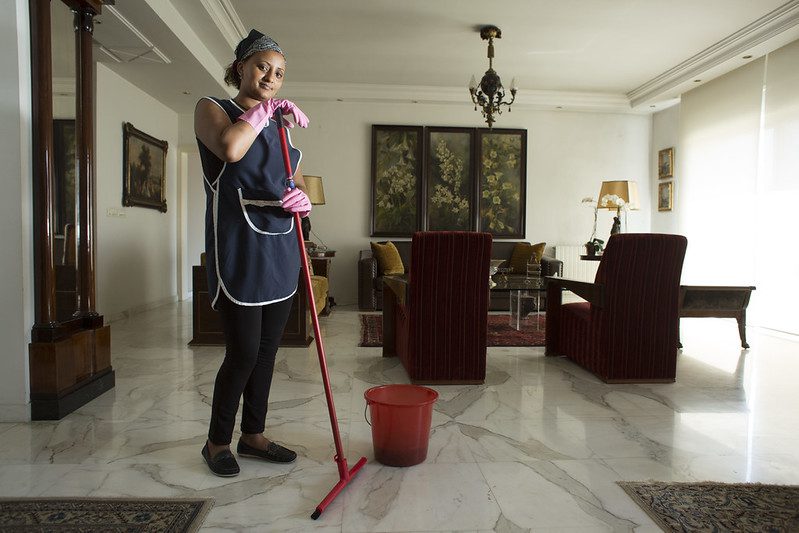
 In Lebanon, migrant domestic workers (MDW) experience multidimensional poverty on an exacerbated level. More than 250,000 migrant domestic workers in Lebanon predominantly come from “African and Asian countries” under the kafala system, a sponsorship system that is described as “modern-day slavery.” Women are most affected by this system. According to U.N. Women, women make up 76% of all migrant workers and 99% of MDW who come to Lebanon.
The Kafala System
The Lebanese state excludes MDW from the Labor Law, leaving them without basic legal protections. Instead, they are in a contractual relationship with their employer, who is responsible for their “legal status and visa.” Employers frequently confiscate passports and restrict movement, shaping their daily lived reality.
U.N. Women reports that “94% of employers withheld the worker’s passport and 61% of employers did not allow the worker to engage in social or learning activities with NGOs.” Working conditions for MDWs under the kafala system are extremely difficult. They are subject to long hours with little to no time off.
MDWs report “verbal and psychological abuse and physical violence” inflicted on them by their employer. U.N. Women has documented that 22.5% of Lebanese employers “always or sometimes lock their domestic worker inside the house.”
Racialized Labor and Social Discrimination Against MDWs
Racism underpins the treatment of MDWs in Lebanon. Migration patterns document that the majority of MDWs in Lebanon are from Ethiopia. As a result, the term “El-Ethiopiyye,” meaning “The Ethiopian,” is a derogatory label used to refer to all MDWs, regardless of what their actual nationality is.
Furthermore, health care access remains severely restricted for them. Hospitals and doctors turn MDWs away for “not having legal documents, or simply because they’re not Lebanese.” Many MDWs avoid seeking health care because they fear deportation and lack the financial means to pay for the treatment.
The combination of poor working conditions and inability to access health care is prevalent in the increasing number of cases in psychiatric consultations. Doctors Without Borders reports that from 2023 to 2024, “psychiatric consultations in the Bourj Hammoud clinic doubled.”
Economic Collapse, COVID-19 and Armed Conflict
Economic collapse, the COVID-19 pandemic and armed conflict have intensified the vulnerability of MDWs in Lebanon. Following COVID-19, the Lebanese lira depreciated, leading to wage cuts for MDWs. A worker who was able to send their family $200 is now only able to send $120, subject to fluctuating exchange rates.
The 2024 Israel bombing of Lebanon left MDWs extremely vulnerable. Many employers fled Beirut, leaving their workers behind. Doctors Without Borders reports that employers abandoned MDWs on the streets or locked them inside their homes as they fled for safety.
Doctors Without Borders
Doctors Without Borders is an international medical humanitarian organization that delivers lifesaving aid to people in crisis worldwide. The organization operates in more than 75 countries, including Lebanon. Since its founding in 1971, it has been working to deliver care, including surgery, vaccination, nutrition support and mental health support.
The charity has a clinic in the northern Beirut suburb of Bourj Hammoud. Here, the organization responds to medical needs through consultations, sexual and reproductive health services and mental health services. Its clinic also covers any life-threatening referral costs from hospitalization.
To break down barriers for migrant workers accessing health care in Lebanon, it offers translators for medical appointments. This decreases the risk of migrant workers being unable to access appropriate health care due to language barriers. The organization expands its medical care to encompass meeting migrant workers’ basic needs. To support this, it has social workers who refer patients to services that provide basic needs such as food and shelter.
Following the Israeli bombing of Lebanon, the initiative set up a mobile clinic from which it donated essential relief items and delivered medical care. During this aid effort, the organization delivered 400 kits of basic relief items to shelters, which included hygiene materials and mattresses. The organization further provided mental health outreach for those affected by the bombing.
Beatrice’s Story
Doctors Without Borders has helped hundreds of migrant workers, including Beatrice. It documented that on October 6, 2024, Lebanon was under bombardment by Israel and Beatrice had been left locked inside the house alone. To flee her employer’s home, Beatrice jumped from the balcony and broke her ankles.
The organization interviewed Beatrice, who stated: “My friends called an organization to see if they could support me with the treatment. That organization, along with Doctors Without Borders, covered my surgery, medication and the two-month recovery period.” Without the aid of the charity, Beatrice would have suffered her injuries without hope of medical attention.
Hope Beyond Kafala
While the kafala system continues to exploit migrant domestic workers in Lebanon, the work of humanitarian organizations offers a powerful counter-narrative of hope and resilience. Groups such as Doctors Without Borders demonstrate that access to health care, dignity and protection is possible even within deeply unequal structures.
– Lucy Kerr
Lucy is based in Coventry, UK and focuses on Good News and Politics for The Borgen Project.
Photo: Flickr

Renewable Energy in Kyrgyzstan
Kyrgyzstan has made noticeable agreements with multiple leaders of the energy transition such as the UAE, China and Japan largely due to the expansive amount of minerals found in the country. While these countries get cheap access to important materials needed for renewable energy technology, Kyrgyzstan gets direct access to that technology. This is crucial to Kyrgyzstan’s economic development as the country currently suffers from unequal resource distribution and labor inequality. It is important to note the possible benefits Kyrgyzstan can gain through its current traction in clean energy because these issues are found in multiple corners of the world, not just to Kyrgyzstan.
Larger Access to Electricity
The current infrastructure for energy in Kyrgyzstan proves to be in poor shape; however, the increased investments in renewable energy in Kyrgyzstan will channel that energy to larger audiences with improved infrastructure. There is already evidence of this transition in the country: more than 50% of the urban population has a primary reliance on clean energy and fuels. This dependence indicates lower energy vulnerability which is a strong sign ending energy poverty.
Increased Jobs and Export Opportunities
New initiatives to increase private investment from the government offers the chance of more opportunities to employ local populations to work on renewable energy systems. This would have immense impacts on the Kyrgyz economy. While many initiatives are still in talks, Kyrgyzstan has already showcased the future through its current plans like the newly implemented the Partnership for Action on Green Economy. This plan directly assesses gaps and finds opportunities for local participation, with a particular dimension of gender-specific participation.
Some analysts note that Kyrgyzstan’s energy production will lead to a surplus generation which can then be exported to foreign entities interested in both renewable energy resources and technology and the actual energy itself. This would turn Kyrgyzstan into an export economy which would help with economic development as a whole.
Climate Resilience
There is a common perception that consumption of fossil fuels is necessary for economic and national development. However, the impacts of Kyrgyzstan’s investments in clean energy show otherwise. The nation is directly contributing to climate resilience and the energy transition while still being able to develop its population, providing an alternative path to other nations in similar positions. Furthermore, this investment helps to address a key problem in local energy poverty rates. Central Asia, as a whole, generates 75% of its electricity through fossil fuel consumption making the region susceptible to global disruptions. By investing into clean energy, like Kyrgyzstan, nations in the region can combat this vulnerability as they would rely on their local energy sources for electricity generation thereby reducing this chokepoint.
Looking Ahead
Kyrgyzstan’s current patterns and position towards clean energy development have not been solely towards the interests of foreign entities or even the global energy transition. Kyrgyzstan stands as an example of how clean energy is very much the future and what it can do to improve the livelihoods of future populations. The country’s investments in renewable energy in Kyrgyzstan are not only enhancing the day-to-day lives of its population through larger access to electricity and increased jobs for citizens but also changing the perception of the country as a whole as they invite foreign investments and development alongside exporting current capital. These initiatives are essentially reshaping Kyrgyzstan’s role in the global economy into both a provider and teacher for other nations.
– Saanvi Mudpa
Photo: Unsplash
Seeds of Sustainability: Reducing Food Insecurity in Bolivia
One of the biggest factors affecting food insecurity in Bolivia is extreme weather conditions. The country faces recurring droughts and floods that heavily impact its agricultural sector. One organization, Fundación Patiño, demonstrates that reducing food insecurity across the country can be addressed through practical solutions.
Fundación Patiño
Fundación Patiño, established in 1931, aims to make a lasting impact by providing young Bolivians with the tools to build stronger and safer communities. In addition to providing direct care for more than 2,000 malnourished children each year, it also carries out projects and initiatives in education, agroecology, pediatric health and culture to address challenges that hinder progress.
Agroecology is a discipline that combines science and society to implement farming techniques that are sustainable and resilient. Fundación Patiño has undertaken multiple projects to promote and apply these techniques, including the Cochuna Project, its haciendas and the agroecology farm and seed center in Pairumani.
Education and the Cochuna Project
In the mountains of the Yungas region, a remote location, Fundación Patiño built and maintains a boarding school. Now accessible to small, isolated communities, teenagers in the region can continue their general education while deepening their farming and agricultural knowledge to develop sustainable practices for the future. The school currently hosts and educates 120 teenagers.
The Haciendas
The two haciendas located in Pairumani and Santa Cruz consist of large agricultural estates that serve as open-air laboratories combining science, society and pedagogy. Their focus is to promote economic independence by training farmers and researchers in sustainable techniques through hands-on practice and experimentation.
Each year, they organize “Field Days,” where community members are invited to learn about agricultural developments taking place. The foundation estimates that seeds improved through experimentation at the haciendas have benefited more than 10,000 farmers.
Food Sovereignty and the Seed Center
Fundación Patiño also runs an initiative that preserves and nurtures local seed varieties in its seed center located in Pairumani. This directly addresses food insecurity in Bolivia, as these local seeds are suited to Andean ecosystems. As a result, they are more resilient to weather conditions such as droughts and floods that affect Bolivia’s agricultural sector.
By prioritizing local and indigenous seed varieties over imported or hybrid ones, the seed center supports food sovereignty in Bolivia. Communities rely less on expensive imported foods when they can grow, sustain and sell their own produce.
In addition to strengthening food autonomy, training farmers to grow crops using techniques that reduce vulnerability to climate shocks supports local economic activity. Surplus food can be sold in markets and potentially exported.
Fundación Patiño’s model is designed to be replicable. Its initiatives have benefited more than 50,000 individuals, contributing to efforts to reduce food insecurity in Bolivia by promoting food sovereignty through education and community engagement.
– Brittany Buscio
Photo: Flickr
Clean Cooking Solutions in India Reduce Health Risks
The World Health Organization (WHO) reports that household air pollution from solid fuels leads to approximately three million deaths globally each year. Many of these deaths occur in developing countries, including India. This level of preventable illness and death demonstrates the urgent need for cleaner cooking solutions.
India continues to experience high levels of indoor air pollution because a large portion of its population depends on biomass fuels. Exposure to smoke from cooking fires increases the risk of respiratory infections, chronic obstructive pulmonary disease (COPD), cardiovascular disease and lung cancer. The health effects extend beyond individual suffering.
Families often face rising medical costs, reduced productivity and lost income when adults become ill. Children exposed to smoke are more likely to miss school due to sickness, which can limit long-term educational outcomes and future opportunities. These combined impacts place additional strain on households already living with limited financial resources.
Government Programs Supporting Clean Cooking
One of the most important government efforts to address indoor air pollution in India is the Pradhan Mantri Ujjwala Yojana (PMUY). This program provides subsidized liquefied petroleum gas (LPG) connections to low-income households to encourage families to move away from traditional biomass fuels. LPG burns much more cleanly than wood or dung, producing far less smoke inside the home.
As a result, households that adopt LPG experience improved indoor air quality and reduced exposure to harmful pollutants. The International Energy Agency reports that households using LPG instead of traditional fuels experience lower rates of respiratory illness and spend less time collecting firewood.
For many women, this change is particularly significant. In households that rely on wood or dung, women often spend hours each day gathering fuel and cooking in smoky conditions. Switching to LPG saves time and reduces daily exposure to harmful smoke, improving both health and overall quality of life.
In addition to LPG, government-supported programs have encouraged improved kitchen ventilation and safer stove designs in areas where LPG access remains limited. While these measures do not eliminate smoke, they help reduce the concentration of harmful particles inside homes and provide a transition pathway toward cleaner fuels.
The Role of Nonprofits and Community-Based Solutions
Nonprofit organizations have played a key role in expanding access to safer cooking options. The Clean Cooking Alliance works with local partners in India to promote improved cookstove technologies that burn fuel more efficiently and release fewer pollutants than traditional open fires. These stoves often include enclosed combustion chambers and chimneys that direct smoke outside the home, helping reduce indoor air pollution levels.
In rural communities, biogas initiatives have also contributed to cleaner cooking options. Biogas systems convert organic waste, such as animal dung, into cooking fuel, reducing dependence on wood and improving household sanitation. The Food and Agriculture Organization (FAO) highlights that biogas programs in India support cleaner energy access while reducing environmental damage linked to deforestation and unmanaged waste.
These projects often involve community-level participation, which helps ensure long-term use and maintenance of the systems.
Long-Term Benefits for Health and Communities
Clean cooking solutions in India offer benefits that extend beyond reducing indoor air pollution. Healthier families spend less money on medical care and experience fewer missed workdays, improving household economic stability. Children who live in smoke-free environments are more likely to attend school regularly and perform better academically.
In addition, reduced demand for firewood eases pressure on local forests, helping protect natural ecosystems. The World Bank notes that access to clean cooking supports economic development while improving health and environmental sustainability. Continued investment in LPG programs, improved distribution of cookstoves and community biogas initiatives will be essential to expanding access to clean cooking across India.
By improving how meals are prepared in everyday households, clean cooking solutions reduce health risks and create safer living environments for millions of families. These efforts demonstrate how practical, targeted interventions can lead to long-term improvements in health, education and economic stability.
– Dylan Chandran
Photo: Flickr
Education Innovation in Cuba Expands Cultural Learning
UNESCO Launches “African Diaspora” Game
UNESCO introduced the “African Diaspora” game through its Regional Office in Havana as a new educational tool for learning about Africa and its descendants in the Caribbean. The resource uses illustrated cards, game boards and creative activities that promote collaboration and help participants place episodes, characters and Afro-descendant traditions in context.
Supporting the General History of Africa Project
UNESCO launched the General History of Africa project in 1964 to address gaps in how Africa’s history is documented and taught from an African perspective. The United Nations (U.N.) describes the project as an effort to remedy widespread ignorance of Africa’s history and to promote a fuller understanding through education.
The “African Diaspora” educational game draws inspiration from this broader initiative by focusing on Africa’s connections to the Caribbean region.
Education Innovation in Cuba and Inclusive Learning
Education innovation in Cuba reflects efforts to modernize teaching approaches while supporting student engagement through interactive classroom tools. According to World Bank data, Cuba reports near-universal adult literacy.
The “African Diaspora” tool aims to help students examine cultural traditions and historical narratives linked to Africa and Afro-descendant communities in the Caribbean.
Regional Collaboration and Broader Impact
Prensa Latina reported that the resource highlights Afro-descendant traditions from Cuba, the Dominican Republic and Venezuela, supporting a regional approach to learning.
UNESCO continues to promote and expand the General History of Africa project as a long-standing effort to strengthen educational materials on Africa and its diasporas, showing how interactive classroom tools can support cultural awareness while strengthening student engagement.
– Isil Ertas Senturk
Photo: Flickr
Tackling NTDs in Fiji
NTDs have a far-reaching impact on the communities where they circulate, often carrying a poor prognosis and leading to disfigurement or death. Beyond the severe physical implications, NTDs are associated with social exclusion and cycles of poverty stemming from the poor health of the infected individual. However, with effective management and coordination strategies, the impact of NTDs can be significantly reduced. Through sustained effort from both a social and medical perspective, Fiji has seen several landmark successes in its fight against NTDs. Below are three examples of progress in the fight against NTDs in Fiji.
Elimination of Trachoma
Trachoma is the leading infectious cause of blindness in the world and is spread by direct contact with infected individuals. The overall number of people at risk of contracting trachoma due to residence in an endemic region has more than halved between 2010 and 2024, due to improved data collection and the successful implementation of the WHO’s reduction strategy. In 2025, Fiji eliminated trachoma as a public health problem. This made it the first Neglected Tropical Disease in the country to achieve this status, as granted by the WHO.
The WHO attributed the elimination to extensive testing, public health initiatives and awareness efforts. The elimination of the disease marks a turning point in a country where trachoma had at several points been a public health concern, notably during a resurgence in the 2000s.
National Response to Scabies
Scabies is a highly infectious disease that is particularly prevalent in impoverished communities in tropical areas. It can lead to severe illness, including heart disease and kidney disease.
Scabies has historically been prevalent in Fiji. In 2016, the government found that skin and soft tissue infections, of which scabies is a part, were the fifth-highest cause of death in the country. Faced with this challenge, Fiji carried out a national scabies audit and subsequently embarked on a program of mass drug administration (MDA).
Fiji was one of the first two countries in the world to implement MDA for scabies. One study showed that the program significantly reduced community prevalence of scabies within a year, from 32% to 2%. The campaign was successful in reducing the prevalence of the NTD to a controllable level, marking a significant achievement for national disease prevention efforts.
Lymphatic Filariasis
Lymphatic filariasis is a Neglected Tropical Disease spread by infected mosquitoes that causes abnormal swelling. It is commonly found in low-income communities where access to health care and sanitation is limited. Although it has faced several challenges in the effective control of lymphatic filariasis, Fiji has made and continues to make progress in tackling the disease. Between 1997 and 2007, Fiji significantly reduced the presence of the NTD, partly due to successful mass drug administration. The mass drug administration program is still underway, with coverage having reached more than 94% of the population, and transmission of the disease among at-risk populations having dropped by 43%.
Looking Ahead
Neglected Tropical Diseases remain a significant global health priority, especially among impoverished communities in tropical areas. However, Fiji has demonstrated how public health measures, community engagement and awareness efforts can contribute to reducing, and in some cases eliminating, NTDs.
– Phoebe Lang-Clapp
Photo: Flickr
How Aid Groups Support Migrant Domestic Workers in Lebanon
The Kafala System
The Lebanese state excludes MDW from the Labor Law, leaving them without basic legal protections. Instead, they are in a contractual relationship with their employer, who is responsible for their “legal status and visa.” Employers frequently confiscate passports and restrict movement, shaping their daily lived reality.
U.N. Women reports that “94% of employers withheld the worker’s passport and 61% of employers did not allow the worker to engage in social or learning activities with NGOs.” Working conditions for MDWs under the kafala system are extremely difficult. They are subject to long hours with little to no time off.
MDWs report “verbal and psychological abuse and physical violence” inflicted on them by their employer. U.N. Women has documented that 22.5% of Lebanese employers “always or sometimes lock their domestic worker inside the house.”
Racialized Labor and Social Discrimination Against MDWs
Racism underpins the treatment of MDWs in Lebanon. Migration patterns document that the majority of MDWs in Lebanon are from Ethiopia. As a result, the term “El-Ethiopiyye,” meaning “The Ethiopian,” is a derogatory label used to refer to all MDWs, regardless of what their actual nationality is.
Furthermore, health care access remains severely restricted for them. Hospitals and doctors turn MDWs away for “not having legal documents, or simply because they’re not Lebanese.” Many MDWs avoid seeking health care because they fear deportation and lack the financial means to pay for the treatment.
The combination of poor working conditions and inability to access health care is prevalent in the increasing number of cases in psychiatric consultations. Doctors Without Borders reports that from 2023 to 2024, “psychiatric consultations in the Bourj Hammoud clinic doubled.”
Economic Collapse, COVID-19 and Armed Conflict
Economic collapse, the COVID-19 pandemic and armed conflict have intensified the vulnerability of MDWs in Lebanon. Following COVID-19, the Lebanese lira depreciated, leading to wage cuts for MDWs. A worker who was able to send their family $200 is now only able to send $120, subject to fluctuating exchange rates.
The 2024 Israel bombing of Lebanon left MDWs extremely vulnerable. Many employers fled Beirut, leaving their workers behind. Doctors Without Borders reports that employers abandoned MDWs on the streets or locked them inside their homes as they fled for safety.
Doctors Without Borders
Doctors Without Borders is an international medical humanitarian organization that delivers lifesaving aid to people in crisis worldwide. The organization operates in more than 75 countries, including Lebanon. Since its founding in 1971, it has been working to deliver care, including surgery, vaccination, nutrition support and mental health support.
The charity has a clinic in the northern Beirut suburb of Bourj Hammoud. Here, the organization responds to medical needs through consultations, sexual and reproductive health services and mental health services. Its clinic also covers any life-threatening referral costs from hospitalization.
To break down barriers for migrant workers accessing health care in Lebanon, it offers translators for medical appointments. This decreases the risk of migrant workers being unable to access appropriate health care due to language barriers. The organization expands its medical care to encompass meeting migrant workers’ basic needs. To support this, it has social workers who refer patients to services that provide basic needs such as food and shelter.
Following the Israeli bombing of Lebanon, the initiative set up a mobile clinic from which it donated essential relief items and delivered medical care. During this aid effort, the organization delivered 400 kits of basic relief items to shelters, which included hygiene materials and mattresses. The organization further provided mental health outreach for those affected by the bombing.
Beatrice’s Story
Doctors Without Borders has helped hundreds of migrant workers, including Beatrice. It documented that on October 6, 2024, Lebanon was under bombardment by Israel and Beatrice had been left locked inside the house alone. To flee her employer’s home, Beatrice jumped from the balcony and broke her ankles.
The organization interviewed Beatrice, who stated: “My friends called an organization to see if they could support me with the treatment. That organization, along with Doctors Without Borders, covered my surgery, medication and the two-month recovery period.” Without the aid of the charity, Beatrice would have suffered her injuries without hope of medical attention.
Hope Beyond Kafala
While the kafala system continues to exploit migrant domestic workers in Lebanon, the work of humanitarian organizations offers a powerful counter-narrative of hope and resilience. Groups such as Doctors Without Borders demonstrate that access to health care, dignity and protection is possible even within deeply unequal structures.
– Lucy Kerr
Photo: Flickr
The Rajpura–Mohali Rail Link & Regional Economic Access
Effective Regional Development
India’s rail network already serves as one of the largest public transportation systems in the world, carrying more than eight billion passengers annually. This development project to create a Rajpura–Mohali rail link will provide fast, affordable rail access, reduce commuting costs for low-income households and connect rural populations to urban job markets. The availability of reliable, affordable access to employment opportunities also enables workers to support themselves and their families while contributing to their communities by paying taxes and supporting local businesses.
Rail infrastructure is an important factor in reducing poverty, as it provides reliable access to employment opportunities through safe, affordable transportation. Reliable access to employment opportunities is essential to economic mobility; therefore, workers must be able to travel to their employment centers safely and affordably. Beginning with reasonably priced public transportation such as buses and trains, access to reliable employment allows workers to utilize employment opportunities they would not have had otherwise due to a lack of transportation.
Access to reliable employment opportunities also provides workers with the ability to increase their earning potential, which could provide them with a better quality of life through better living conditions, greater food security and better access to other necessities of life.
The Indian Government’s Infrastructure Development Strategy
Punjab is witnessing a significant increase in urbanization, primarily around Chandigarh. However, many rural and smaller towns are constrained by limited connectivity, hindering access to economic opportunities. The improved Rajpura–Mohali rail link may allow travelers to reach their destinations faster and rely less on expensive personal transportation.
In its pursuit to develop India, the Government of India views infrastructure as a key to long-term development. As part of this, it has committed, through the National Infrastructure Pipeline, to invest billions of rupees in transportation, energy and urban development to fuel long-term growth. Improved rail systems can create jobs during construction and support long-term employment by increasing mobility.
Research from the World Bank shows that infrastructure investment can boost productivity and reduce poverty when it improves access to markets and services. In regions where public transit remains the primary mode of travel for lower-income communities, expanding rail access can help narrow economic gaps.
Socioeconomic Mobility
Low-income households often spend a larger share of their income on transportation. Expanded rail access can reduce commuting costs and open up more job opportunities. Better connectivity also helps women access education and employment.
Students can commute safely to universities in Chandigarh, rural residents can reach specialized health care facilities and small businesses can move goods more efficiently. Transportation access is directly tied to economic participation. When people can move safely and affordably, they can earn better wages, improve health outcomes and invest in education.
Final Thoughts
The Rajpura–Mohali railway corridor shows how targeted rail development can reduce long-term geographic inequality in Punjab. The project will connect new urban centers with their surrounding areas. As construction moves forward, the corridor highlights a broader point: strategic infrastructure development is more than a physical building project. It can also be a powerful tool for reducing poverty.
– Julia Lavelle
Photo: Pexels
Digital Aid in Ukraine: Diia Platform as Wartime Lifeline
Aid Disruption
In addition to the growing number of casualties, of both soldiers and civilians, Ukraine has suffered the mass displacement of its citizens, economic and infrastructural decimation and a worsening refugee crisis. Since the beginning of the war, more than 14 million Ukrainians, roughly a third of the total population, have fled their homes. By November 2024, damage to infrastructure and resources had amounted to $170 billion.
Residential buildings, administrative buildings, energy supplies, health care services and digital infrastructure are the main targets.
Ukraine and E-Governance
However, in Ukraine’s case, the anticipated disruption to essential governmental and social services did not cause as much disruption. This is because the country significantly mitigated it six years ago by migrating from localized paper-based systems to an integrated digital “e-governance” platform called Diia. The government of Ukraine launched Diia nationally in 2020 under President Volodymyr Zelenskyy.
The Ministry of Digital Transformation of Ukraine developed the platform as a mobile application and online portal to digitize public services and reduce bureaucratic inefficiency. The national platform allows citizens to access digital passports, business registrations and social services through a centralized system.
Diia During Warfare
Under siege, Diia has demonstrated administrative resilience and played a critical role in streamlining and maintaining the continuity of government operations disrupted by the war. For example, through its partnership with Visa, the system enabled the state to make financial transactions to citizens, ensuring they continued to receive financial aid throughout the conflict. This includes the UAH 6,500 ($158) in cash the government gave to those living in areas affected by the war and monthly government transfers of UAH 2,000 ($49) per adult and UAH 3,000 ($73) per child to those who have lost their homes and livelihoods.
Moreover, Diia has enabled accurate, consistent communication between the state and citizens, providing essential updates on the conflict’s proceedings. The public can also report any damage to property or infrastructure, keeping records precise and aiding the process of reparation and rebuilding. Vitally, Diia has ensured that Ukrainians can travel domestically and to neighboring European countries without hindrance, as border officials recognize Diia documents in several European nations.
Access to digital identification, including passports and relevant birth certificates, has streamlined crossings, reduced pressure on refugee processing systems and facilitated safer migration.
Final Thoughts
Responding to the mass displacement, infrastructural decimation and refugee crisis caused by Russia’s full-scale invasion, Diia has kept vital governmental services functioning and aided cross-border mobility. It has offered a unified platform for social assistance. By preserving digital aid distribution throughout Ukraine, the platform has restored financial and mobile agency to its citizens and bolstered their struggle against the disruptive and impoverishing effects of conflict.
– Jude Parsons
Photo: Flickr
Fighting Poverty Through Education in Latin America
Before COVID-19, roughly 52% of children in Latin America were unable to read and understand simple text. The pandemic has made this situation even worse, with young generations being less educated and lacking the tools necessary to transition into adulthood. However, international organizations are fighting poverty through younger generations by increasing investments in education to create a brighter future for millions of children across Latin America.
Learning Crisis
Over the last two decades, many countries in Latin America have experienced a learning crisis related to their younger generations. This crisis can take different forms across countries, depending on their specific geographic and social characteristics. In Argentina, for example, the most affected children are those living in rural areas, far from cities and their services.
As a result, many teachers are forced to teach children from multiple grades, ages and abilities in the same classroom, being unable to personalize the learning experience and focus on individual students. In other countries, such as Haiti, the learning crisis is related to the provision of educational opportunities to all members of the population.
In Haiti specifically, nearly 80% of primary schools are non-public, thus limiting access to education to those who can pay, on average, $130 per year. Many families cannot afford education and other necessities, so they decide not to send their children to school.
What Is Being Done?
To address the education crisis plaguing Latin America, several international organizations have stepped up efforts to expand access to education across the region. In September 2025, the Development Bank of Latin America and the Caribbean (CAF) launched the LAC Future Bank. It is a five-year strategy designed to benefit 50 million children in Latin America through a $5 billion regional investment.
These funds will be used to develop projects that prioritize children and their needs, including education. Although this initiative addresses other issues related to childhood well-being, education is a main area of focus to “break cycles of poverty and inequality.” In Haiti, programs and organizations, such as the International Development Association (IDA) and its partners, have focused primarily on funding for millions of children.
From 2013 to 2023, IDA and partner organizations provided roughly half a million tuition waivers to children who could not afford to attend school. In other countries, such as El Salvador, projects like the “Growing up and Learning Together: Comprehensive Early Childhood Development Project” are working to create safe, clean schools with essential services for children.
The Impacts
Although it is difficult to measure the effectiveness of these investments in the short term, there have been early signs of improvement. World Bank investments have enabled middle-income countries to reduce their dropout rates and boost learning outcomes. Slowly but surely, improvements in education quality and access in Latin America are key to a more productive, inclusive and sustainable development pattern in the future for many countries across the region.
– Rodrigo Salgado
Photo: Unsplash
Digital Banking in Sierra Leone Expands Financial Inclusion
Financial Exclusion and Structural Barriers
Financial exclusion remains closely tied to poverty. Data from the 2023 Multidimensional Poverty in Sierra Leone report shows that 81.6% of the population lives in a household without a bank account. Additionally, 55.2% of the population is both multidimensionally poor and lives in a household without a bank account.
One major barrier is identification. Although 6.4 million people have a National ID number, fewer than 500,000 physical ID cards have been issued as of 2024 due to cost constraints in its first year. However, on July 31, 2024, Sky Bank partnered with Orange Money to launch “Bank2wallet” services, enabling seamless transfers between bank accounts and mobile wallets.
How Digital Banking in Sierra Leone Works
The Bank of Sierra Leone and the U.N. Capital Development Fund (UNCDF) are promoting digital financial services in the country by jointly producing the State of the Digital Financial Services Market report. The report tracks adoption trends, transaction patterns and barriers to inclusion to inform policy and market strategy. Their collaboration helps shape regulatory priorities and supports efforts to expand mobile money, agent networks and inclusive digital channels. This enables more people, especially women and underserved groups, to participate in the formal financial system.
Mobile money and USSD technology let users with basic feature phones access financial services without internet connectivity. By dialing short codes, users can check balances, transfer funds and pay bills. The system works through “push and pull” integration, allowing transfers between bank accounts and mobile money wallets such as Orange Money and Afrimoney.
Telecom providers Orange Money and Africell (Afrimoney) are the country’s main mobile money operators, while commercial banks have expanded their digital channels. Sierra Leone Commercial Bank offers the “Mi Yone” suite, which integrates with mobile wallets. Sky Bank provides mobile and online banking and enables transfers to Orange Money and Afrimoney via USSD.
Impact on Households and Small Businesses
Digital systems are increasingly used to deliver government support. In a recent emergency program, 35,000 households received cash transfers directly on their mobile phones. Linking digital IDs to mobile money is helping farmers access credit and markets and the instant payments switch is expected to make it easier for citizens to get loans and start businesses.
Broader economic initiatives have supported women and entrepreneurs. Action on Poverty helped 3,500 women and girls start small businesses and boosted incomes for 6,000 people by at least 50% by the end of 2019. The African Development Bank also partnered with Access Bank to fund small and medium-sized enterprises in Sierra Leone.
With several households lacking traditional bank accounts, digital banking in Sierra Leone offers a scalable alternative that avoids costly physical infrastructure and documentation barriers. By leveraging mobile money and USSD technology, these services expand access to basic financial tools.
Final Remarks
Recent years have seen rapid growth in digital banking in Sierra Leone. In 2023–2024, Metro Cable launched Vult, a digital banking platform designed to unify bank accounts, mobile money and payment services. The app onboarded more than 475,000 users into interoperable payment systems, making financial services more accessible to rural and low-income populations.
As partnerships among the government, the World Bank, UNCDF, telecom providers and commercial banks continue to expand, digital banking in Sierra Leone is gaining momentum. Indeed, it is becoming a measurable, technology-driven push to reduce financial exclusion and strengthen economic resilience.
– Aila Alsakka
Photo: Unsplash