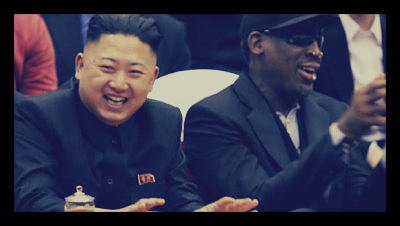
Last month, ex-NBA basketball player, Dennis Rodman, did what many political leaders will never have the opportunity to do. He made the long trip over to North Korea and met with its mysterious and very powerful leader, Kim Jong Un.
North Korea is known for its isolation, yet, recently, has begun to make huge headlines in the United States. North Korea and the United States have never been allies and tension between the two countries have existed for years. North Korea’s nuclear test last month has only increased this tension, making new threats against American military bases in Japan and in Guam even more pressing and serious. The threat came earlier this month from a spokesperson for the Supreme Command of the North Korean People’s Army, who said “the U.S. should not forget that the Andersen Air Force Base on Guam, where B-52s take off, and naval bases in Japan proper and Okinawa, where nuclear-powered submarines are launched, are within the striking range of the D.P.R.K.’s precision strike means.” Videos depicting the White House and Congress buildings being blown up have recently come out of North Korea.
Yet, even with all of this, communication between President Obama and Kim Jong Un has been very little. In fact, any communication on the matter, is made through the media. The spokesperson for the Supreme Command of the North Korean People’s Army made his statement to the state-run Korean Central News Agency. The Pentagon retaliated by making a rare announcement about the missions nucelar-capable B-52 bombers have and will continue to take over South Korea.
Chances of any U.S. political official making his or her way to a police state, such as North Korea is very rare. And, yet, Dennis Rodman recently acted as an ambassador for the Harlem Globetrotters, flying to North Korea to meet and spend two days with Kim Jong Un.
Dennis Rodman has come back with a lot of insight into Kim Jong Un, making it seem as if the North Korean dictator is willing to speak directly with President Obama to meet some sort of peace agreement. He even offered advice to Kim Jong Un in talking to President Obama, saying, “[Kim] loves basketball. And I said the same thing, I said, ‘Obama loves basketball.’ Let’s start there.” While President Obama has not made any efforts to talk to Kim Jong Un, Dennis Rodman has been making his rounds to talk about his trip to North Korea, appearing on many talk and news shows. Recently he appeared on The Tonight Show with Jay Leno and referred to Kim Jong Un as his friend and a nice guy. In an interview on “This Week,” Dennis Rodman on talking about Kim Jong Un said, “I love him. He’s awesome.”
Whether or not Dennis Rodman’s knowledge of North Korea and Kim Jong Un will be helpful to the United States in its dispute with North Korea is unknown as U.S. State Department officials have no plans to debrief the former basketball star. Former deputy assistant secretary of state, Col. Steve Ganyard, finds this ridiculous as “There is nobody at the CIA who can tell you more personally about Kim Jong Un than Dennis Rodman.”
-Angela Hooks
Sources: CNN, NY Times, ABC News
Photo: CBS News

World Poverty Still Urgent
The documents, outlining “A common vision for the World Bank Group,” introduced two new goals to guide the bank’s development work: reducing the percentage of people living in extreme poverty to 3% globally by 2030 and promoting “shared prosperity” by monitoring the income growth of the bottom 40% in every country.
Critics say the “shared prosperity” target merely expands the bank’s focus on the world’s poorest people rather than shifting it to tackle inequalities and growing gaps between rich and poor.
David Woodward, the fellow at the New Economics Foundation and previously an adviser at the IMF and World Bank, said the documents reveal a “business-as-usual scenario, with little or no change in the basic thrust of its development approach”. He said the documents showed the bank is still subordinating development goals to an overall economic growth agenda. “What we’ve still got is a global version of trickle-down economics,” he said. “We should not be designing policies promoting growth on the assumption that this will deliver everything else.”
Nuria Molina, policy director at Save the Children UK, said the targets were “very unambitious”. “The narrative is right, the terminology is right, but the devil is always in the details,” she said. To address inequality you must also rein in growth at the top, she argued. “You need to have a meaningful measure, and just looking at the bottom is not sufficient. It’s very important to look at the gaps.”
“Increasing the income growth of the bottom 40% in every country will necessarily require accelerating the pace of overall economic growth,” Woodward said the goal to reduce to 3% the share of the world’s population living on less than $1.25 a day would still leave 200 million people in extreme poverty.
Alex Cobham, a research fellow at the Center for Global Development in Europe, said the document was “disappointing.” “What this document says is we’re not going to look at ratios. It feels very much against the flow of where the global conversation has gone,” he said.
World poverty is still urgent. It is a very big issue that needs to be fixed whether the world economy is good or bad. And that is also the whole world’s task, for which we cannot just depend on the World Bank. It may not reach our expected level but maybe this is a signal to tell us we need to find more ways to solve or change the situation about world poverty.
– Caiqing Jin (Kelly)
Source: Guardian
Photo:Flickr
Thankyou Water
Flynn discovered that many people around the world not only lack access to water but also that water is usually unsafe and unsanitary to drink to the point that it may cause serious illness. Flynn also found that Australians are a part of a 600 million dollar bottled water industry. Flynn’s project to tackle the global Water Crisis gives all its profit to fund safe water projects all around the world.
For over three years, Flynn and four other college students, volunteered and managed part-time jobs to cover their costs of living. This year marks the enterprise’s fourth year and the project is showing expansive growth. In December of 2012, Thankyou Water sold its five millionth bottle. Australians are increasingly supporting this project and have switched to Thankyou Water making it their new bottled water brand of purchase. Australians can “track [their] impact” through a newly developed web app where they can see which specific project is being funded by their purchase.
For more information, check out Thankyou Water.
– Leen Abdallah
Source: The Global Poverty Walk
Photo: Google
Kenya is Going Green and Improving Its Economy
One of these initiatives, entitled the Lake Turkana Wind Power project, is a very large proponent of wind-power. In fact, this wind-power project is the biggest in the entirety of Africa. It is set to begin operating this year and is predicted to bring about 2,500 new jobs, as well as protect the environment. This alone is a great success for Kenya. And the Lake Turkana Wind Power project keeps on giving. The creation of an alternative energy source means lower energy costs, making it easier to produce goods and making services cheaper.
Another one of these initiatives, which offers similar benefits to Kenya, is the Olkaria IV Geothermal Power Project. Upon its completion in 2014, the Olkaria IV Geothermal Power Project will add 288 megawatts of power.
Green energy and power sources are desperately needed in Kenya, where polluting fuels, such as coal, are the current energy sources. Currently, 80% of Kenyans utilize wood-based fuels for their daily needs. This leads to a lot of waste going into the environment, as well as waste as tons and tons of trees are cut down and only a portion are used in the creation of charcoal.
Finding alternative fuel sources and coming up with the funding necessary to build farms like the Lake Turkana Wind Power project – which is 100% privately funded – is helping Kenya in their move towards being green and creating social equity. A lot of the benefits of such projects require long-term maintenance and support; yet they are important in making Kenya stronger economy.
– Angela Hooks
Source: allAfrica
Photo: EcoMENA
Violence in Myanmar Continues to Spread
Regions of Myanmar have experienced protracted violence, with a majority of the victims being Muslim. Over 150 people have died in the past year as attacks spread inland from coastal areas. Often, police and military units fail or outright refuse to intervene. The national government has ceded some of its authoritarian power in recent years, which had previously helped to quash inter-ethnic violence swiftly. While human rights advocates have been cautiously optimistic about these reforms, the lack of protection for victims of vicious attacks demonstrates how far Myanmar has yet to go.
President Obama has made Myanmar a focus of his travels in Southeast Asia; in November 2012 he was the first American president to ever visit the country. He met with the opposition leader, longtime political dissident Aung San Suu Kyi, who cautioned him against being too optimistic when victory appears close. Mr. Obama’s efforts to foster democracy in Myanmar are reflective of his overarching strategy of diplomacy and engagement with those leaders who he seeks to persuade on human rights issues. Now, as inter-ethnic clashes are on the rise, it is time for Myanmar to demonstrate its commitment to a society that protects the livelihoods of all its citizens.
– Jake Simon
Sources: New York Times, Reuters
Dennis Rodman Travels to North Korea and Meets Kim Jong Un
Last month, ex-NBA basketball player, Dennis Rodman, did what many political leaders will never have the opportunity to do. He made the long trip over to North Korea and met with its mysterious and very powerful leader, Kim Jong Un.
North Korea is known for its isolation, yet, recently, has begun to make huge headlines in the United States. North Korea and the United States have never been allies and tension between the two countries have existed for years. North Korea’s nuclear test last month has only increased this tension, making new threats against American military bases in Japan and in Guam even more pressing and serious. The threat came earlier this month from a spokesperson for the Supreme Command of the North Korean People’s Army, who said “the U.S. should not forget that the Andersen Air Force Base on Guam, where B-52s take off, and naval bases in Japan proper and Okinawa, where nuclear-powered submarines are launched, are within the striking range of the D.P.R.K.’s precision strike means.” Videos depicting the White House and Congress buildings being blown up have recently come out of North Korea.
Yet, even with all of this, communication between President Obama and Kim Jong Un has been very little. In fact, any communication on the matter, is made through the media. The spokesperson for the Supreme Command of the North Korean People’s Army made his statement to the state-run Korean Central News Agency. The Pentagon retaliated by making a rare announcement about the missions nucelar-capable B-52 bombers have and will continue to take over South Korea.
Chances of any U.S. political official making his or her way to a police state, such as North Korea is very rare. And, yet, Dennis Rodman recently acted as an ambassador for the Harlem Globetrotters, flying to North Korea to meet and spend two days with Kim Jong Un.
Dennis Rodman has come back with a lot of insight into Kim Jong Un, making it seem as if the North Korean dictator is willing to speak directly with President Obama to meet some sort of peace agreement. He even offered advice to Kim Jong Un in talking to President Obama, saying, “[Kim] loves basketball. And I said the same thing, I said, ‘Obama loves basketball.’ Let’s start there.” While President Obama has not made any efforts to talk to Kim Jong Un, Dennis Rodman has been making his rounds to talk about his trip to North Korea, appearing on many talk and news shows. Recently he appeared on The Tonight Show with Jay Leno and referred to Kim Jong Un as his friend and a nice guy. In an interview on “This Week,” Dennis Rodman on talking about Kim Jong Un said, “I love him. He’s awesome.”
Whether or not Dennis Rodman’s knowledge of North Korea and Kim Jong Un will be helpful to the United States in its dispute with North Korea is unknown as U.S. State Department officials have no plans to debrief the former basketball star. Former deputy assistant secretary of state, Col. Steve Ganyard, finds this ridiculous as “There is nobody at the CIA who can tell you more personally about Kim Jong Un than Dennis Rodman.”
-Angela Hooks
Sources: CNN, NY Times, ABC News
Photo: CBS News
USAID Funds Partnerships for Women’s Leadership
The partnership between universities aims at encouraging women’s status in a number of vital sectors for economic development, including agriculture, business, and education. The goals of the program also fall in line with previous goals laid out by USAID as part of the Gender Equality and Female Empowerment Policy, which was released in 2012.
HED will be in charge of administering the programs, which will total one in each country and two in Rwanda. Funding for the program from USAID will total $8.75 million.
Some of the more specific goals of the Women’s Leadership Program will include increased access to higher education and advanced degrees for women, increases in foreign universities research on women’s leadership, and encourage women’s leadership through advocacy in struggling communities. The American universities that are participating in the program are Arizona State University, Michigan State, Indiana University, UCLA, and the University of Florida.
USAID Senior Coordinator for Gender Equality and Women’s Empowerment, Carla Koppell, said “USAID is very excited to be collaborating with academic institutions in the United States and abroad in advancing women’s leadership. These partnerships offer a meaningful and important opportunity to ensure women are empowered and advance in economies and societies globally.”
– Christina Kindlon
Source: USAID
World Water Day: Palestine Edition
In honor of the World Water Day, March 22nd, the Thirsting for Justice Campaign has called for solidarity with the Palestinian people and children who lack sufficient clean and safe water. The campaign suggests to all supporters to organize “community teach-ins” to gain factual insight and spread awareness regarding the Palestinians’ challenges under Israeli occupation, specifically their challenges when trying to access clean water since water supply is controlled by the Israeli army. The teach-ins would also push for discussion on the courses of action that must be taken to achieve Palestinian water rights.
As a Thirsting for Justice initiative, along with the Jenin Freedom Theater, “hundreds of Palestinians and internationals in the West Bank” occupied the Jordan Valley and walked leaving their footmarks on this global Water Day; the West Bank demands to be heard and is taking action through its people’s “walk for water justice.”
To join the teach-in action, check out Thirsting For Justice
–Leen Abdallah
Source: Thirsting for Justice
Photo: Thirsting for Justice: Visualizing Palestine
What Is The Poverty Line?
Stefen is a photographer while his wife Hui-yi is an economist. From their frequent traveling, both had become affected by the vast differences between not only the rich and poor but the differences between the poor in each country. The question and this mission became to document what it really meant to be poor.
Although calories are the same around the world, how much can $4.91 buy-in America compared to 64 cents in Madagascar? Through their investigation, the couple spoke with the poor, trying to gain real insight into how they shop for their food. They took into account the basic essentials such as grains, fish, and vegetables but also included food such as candy and more extravagant meats to see how much could be bought in each country.
Going through the markets, Stefen Chow would photograph each amount of food against a newspaper. When asked why he chose this specific setting, he responded that as a photojournalist, the newspaper was merely a product of the artistic process. His focus was on poverty and before visiting each country, they only had in mind the set currency amount they had to work with and nothing else.
Recently, their website received a makeover. It is absolutely amazing how interactive it is with all prices listed in USD. Site visitors can easily see how much meat could be bought in Switzerland, a country whose food allowance for those at the poverty line is $10.25, compared to Nepal, where the poor are expected to survive on 45 cents per day. Images are separated based on developed countries, developing countries, food groups, and even processed or unprocessed foods.
Simple awareness through such well-assembled visual representation will no doubt bring hundreds of thousands of visitors to the site. It may shock some while confirming the assumptions of others. It can also exemplify a need for policy changes in certain countries where controversy exists whether the set caloric intake as well as money allocated to food is enough for someone to survive on.
– Deena Dulgerian
Source: BBC
Photo: The Poverty Line
More US Aid to Jordan to Help With Syrian Refugees
The Civil War in Syria has driven thousands of people out of the country and into Jordan. This has resulted in major problems in Jordan as they try to figure out what to do with all of the Syrian refugees. Recently, President Barack Obama made a public announcement offering $200 million in U.S. aid to help with the Syrian refugees in Jordan.
This pledge from Barack Obama for foreign aid money comes at an interesting time as it follows the extensive budget cuts recently put in place by the United States Congress. However, President Obama seems adamant on offering aid money to Jordan for basic services to help place and educate displaced Syrians, saying he will work with Congress to find a way to give $200 million extra dollars in U.S. aid. According to Jordan’s King Abdullah II, whom Obama met with on Friday, March 22, more than 460,000 Syrians have fled their country in search of refuge within the Jordanian borders. This number is estimated to double in the upcoming months if the turmoil in Syria continues.
Putting these numbers into perspective: 460,000 people make up approximately a tenth of the Jordanian population. Doubling the number of Syrian refugees causes an almost 25% increase in the number of people in Jordan.
This increase in people will have serious effects on the economic situation in Jordan. Some economists predict a nearly 30% unemployment rate by the end of the year as more and more Syrians pour into the county. These many refugees are also predicted to cost over $1 billion. Yet, King Abdullah pledges to not turn away any refugees, asking “how are you going to turn back women, children or the wounded?”
The Obama administration seems committed to helping end the fighting in Syria, pushing for the current Syrian president Assad to step down. Yet, Obama absolutely refuses to provide U.S. military assistance for the Syrian opposition movement, saying that interference may discredit the message the Syrian rebels are advocating or may lead to even larger security issues. Financial support in Jordan to take care of the many Syrian refugees seems to be a substitute solution for showing its support for bringing peace to Syria without getting directly involved in the civil war.
Obama pledging the extra aid money is only half of the equation. Congress must now scrape together this money, which may be a difficult task, as evident from the inability for Congress to come to an agreement over budget cuts.
– Angela Hooks
Sources: CNN, Wall Street Journal
Photo: UPI
Abu Dhabi at the Forefront of Solar Energy Development
The energy produced by the plant, called Shams 1, will increase Abu Dhabi’s renewable energy source consumption to 7% of its total energy consumption. The plant is part of what the head of Abu Dhabi Future Energy Co., Ahmed al Jaber, called a “strategic plan to diversify energy sources in Abu Dhabi.” It is the first of several plants scheduled for development in the coming years.
Shams 1 has a similar design to California’s Solar Energy Generating System (SEGS). Even though Shams 1 is the largest single plant, the nine SEGS plants combined generate three times as much energy.
The irony of Abu Dhabi’s use of its oil money cannot be overlooked: by investing in solar energy development for its own electricity needs, Abu Dhabi will be able to export even more of its bountiful oil resources. Shams 1 will eliminate 175,000 tons of carbon dioxide each year, the equivalent carbon dioxide production of 15,000 cars.
But how many more cars across the globe will the city’s oil reserves enable to run, even as Abu Dhabi cleans up its own energy usage?
– Kat Henrichs
Source: NPR
Photo:Giz Mag