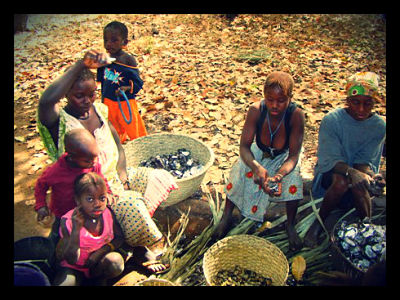
 The Republic of Guinea-Bissau is a tiny country in West Africa that borders Senegal, Guinea, and the Atlantic Ocean. Its population is estimated at 1,600,000 people.
Guinea-Bissau is regarded as one of the poorest countries in the world as it has one of the lowest GDP per capitas compared to other nations. In 1998 alone, the GDP per-capita of Guinea-Bissau was only $173 compared to the per-capita GDP of the US at $29,683.
Today, the GDP per-capita of Guinea-Bissau has risen to $625.55. However, this level is still amongst the lowest in the world. Consequently, the population of Guinea-Bissau is suffering with a life expectancy of only 48 years in 2012.
Furthermore, Guinea-Bissau has one of the lowest Human Development Index scores. The poor nation ranks 176th out of 185 countries in 2013.
The economy of Guinea-Bissau relies primarily on agriculture, fish, and groundnuts as exports. In particular, the cashew nut exports have been vital to Guinea-Bissau. Yet in recent days, the exports have been on the decline. Cashew nut farmers have been unable to sell their produce as India, the prime importer of the nuts, has slashed its import size. Farmers are left holding tons of unsold cashews.
Guinea-Bissau’s economic depression is largely the result of a long period of political instability. The nation was a Portuguese colony until its declaration of independence on September 24, 1973. Guinea-Bissau was officially recognized as a country the following year following a socialist-inspired military coup in Portugal. From then on the country would be embroiled in civil unrest and several uprisings. Even now, the coup-prone country is severely embattled. In November 2008, the President of Guinea-Bissau was assassinated, following the death of the head of Joint Chiefs of Staff. In 2012, President Raimundo Pereira was deposed in yet another coup d’état.
Guinea-Bissau has yet to recover complete stability and its political chaos has severely affected its economic situation. Due to this very recent coup d’état, the country’s GDP has contracted 1.5% according to the African Development Bank Group.
However, projections for the future of Guinea-Bissau are not as grim as real GDP growth is expected to recover to 4.2%. Inflation, which had previously been at 5%, is expected to ease to 2.1%. Food imports are expected to decline with a rise in production and export of cashews for 2013.
– Grace Zhao
Sources: IRIN, African Development Bank Group, Info Please, Encyclopedia of the Nations
Photo: Wiki Spaces

Bread For The World Institute
Finding up-to-date information on research concerning hunger, poverty, and agriculture can be a difficult task. To make this easier, the Bread for the World Institute compiles all their research into easy-to-understand formats. Bread for the World Institute is the research arm of Bread for the World. The institute focuses on research in several key areas including U.S. hunger and poverty, trade and agriculture, the Millennium Development Goals, maternal and child nutrition, immigration, global hunger and poverty, foreign assistance to reduce poverty, and climate change and hunger. The staff work on policy analysis focused on hunger and strategies to end it. They use their research to educate world leaders, policymakers, and the public about hunger in the United States and abroad.
Within each research area, working papers can be found highlighting current research and findings happening. In addition, the institute is committed to the idea that development assistance does indeed work. They have a section of seven short essays telling stories and providing facts relating to the results of effective development aid. The essays are available for use by anyone from activists to politicians to Sunday school teachers. The essays serve to help individuals get a better picture of the fight against global hunger and extreme poverty.
The Bread for the World Institute also has a blog that provides current updates on what is going on within the fight to end world hunger and extreme poverty. The blog breaks down some of the information into a more comprehensible format. The goal of the institute and the research is to help people become informed and take action in the fight.
The 2013 Hunger Report is also produced by the Bread for the World Institute. The Hunger Report looks at issues surrounding global hunger such as malnutrition and food insecurity. The 2013 edition calls for a final push towards meeting the Millennium Development Goals. Overall, the Bread for the World Institute is an excellent resource for information and facts on global hunger and on the fight to end it.
– Amanda Kloeppel
Source:Bread for the World Institute,Hunger Report
Cannon House Building 101
The Cannon House Office building is the oldest congressional office building. It is named after Joseph Gurney Cannon who was Speaker of the House of Representatives during the authorization and completion of the building.
Completed in 1908, the Cannon House building provided fresh new space for members of the House of Representatives. Previously, overcrowding was a severe problem in the capital as committees fought over meeting space. Finally, in 1901, the Sundry Civil Appropriation Act authorized plans for a new building near the Capitol to be used as office and storage space.
After the Cannon House Office building’s opening, all US House of Representative members had their own office space for the first time in history. Each representative was given a room 15 feet wide, 23 feet long that contained a desk, chairs, wardrobe and filing cabinets. These modest offices were also supplied with telephones, lavatories, heat and ventilation. The building also contained a barbershop, restaurant and telegraph office.
Architecturally, the Cannon building is characteristic of the Beaux Arts style of architecture. Covered in limestone and marble, the exterior of the building is similar to the Colonnade du Louvre in Paris. 34 Doric columns line the side of the building facing Independence Avenue while pilasters face the New Jersey Avenue side. The building is built in the shape of a hollow trapezoid. It was designed this way to allow light to reach the inner rooms. Upon completion, there were 397 and 14 committee rooms offices constructed within to hold each member of the 61st Congress.
The building was immediately used by the 60th congress after it opened in 1908. However, by 1913, the House once again had maxed out on allotted space and more offices were required. Thus, 51 more rooms were added to the structure of the building with the construction of a fifth floor. By 1924, the building was renovated again and an additional building constructed to house the growing number of representatives.
Today the Cannon Building is still being used as office space for current representatives. Since 1908, the Cannon building has been joined by the Longworth and Rayburn buildings on the Representative side of the Capitol.
– Grace Zhao
Sources: House of Representatives Archives, Architect of the Capitol
Photo: Visiting D.C.
PATH: Transforming Global Health
PATH attempts to address a wide breadth of health problems ranging from vaccines for bird flu, to cheap ways to heal broken bones, to developing practical ways to purify water. The organization focuses to a large extent on collaboration. They develop health solutions with the communities that will use them, keeping them in contact with the specific needs of the people they serve. According to their website, PATH “infuses innovation and collaboration into those solutions to ensure they work in poor as well as rich countries.”
PATH began in Seattle, Washington in 1977 with the goal of implementing new contraceptives into poor countries that needed them but could not afford them. Now PATH has expanded to include all health issues in developing countries.
Today, the innovators at PATH now spend their time trying to figure out how to meet basic health needs. In the face of this daunting task, the secret to operations at PATH is their specific and autonomous projects.
PATH is organized project by project with small teams gearing solutions towards very specific health issues in specific communities. A large portion of PATH staffers also come from the for-profit community, making it easier for PATH to forge partnerships and deals with commercial companies which, according to PATH’s website, “…are a critical and unique element of our approach.”
One significant health technology developed by PATH is their Ultra Rice. Ultra Rice is made from combining rice flour with essential micronutrients and then molding the product into a rice shape. These new fortified rice grains are typically blended with normal white rice to fight malnutrition in poor communities. By addressing things like iron deficiency, vitamin A deficiency, folic acid deficiency and zinc deficiency, Ultra Rice gives children in developing countries the opportunity to grow into health adults and become productive members of their communities.
Ultra Rice is just one example of how PATH is using innovative technologies to transform the developing world. The organization’s work is important given that, in many communities, solvable health issues like malnutrition are the biggest obstacles to development. Innovations like Ultra Rice give these communities the ability to overcome obstacles and rise out of poverty.
– Martin Drake
Source: PATH, XConomy
New World Bank Program and Renewable Resources
Currently, about one-third of Pakistan’s population does not have access to electricity, yet Pakistan has abundant renewable resources including solar energy, wind, hydropower and biomass. These renewable resources are not being fully utilized because of the lack of credible data. The existing maps are not complete and do not identify specific sites for resource development. This new program will identify the areas that have the greatest potential for resource development.
“The importance of this resource mapping [for Pakistan] cannot be overstated,” says Arif Alauddin, former CEO of Pakistan’s Alternative Energy Development Board. “There is a need to shift to domestic renewable energy resources.”
According to the SE4ALL Global Tracking Framework report, renewable energy made up only 1.6 percent of total final energy consumption in Sub-Saharan Africa, and 1.8 percent in Southern Asia as of 2010. In addition to their environmental benefits, renewable resources will create new jobs, improve the country’s energy security and access, and allow the country to transition to a more sustainable energy sector. This new program will provide governments and private companies the foundation they need to develop resources such as solar, wind and hydropower.
– Catherine Ulrich
Sources: AllAfrica, World Bank
Photo: Energy Advisor
The Widening Gap of Global Inequality
Rising inequality has impeded efforts to eliminate global poverty. With a greater share of wealth being captured by those in the highest income bracket, the amount reaching the lowest is continually decreasing. Two nations with equivalent GDP growth rates could have drastically different levels of poverty depending on income equality. For example, in India, the net worth of 46 billionaires is $176 billion. This number represents 12% of the GDP of India, as opposed to 1% fifteen years ago. Half of that amount would be enough to eliminate absolute poverty in India.
The irony of this unchecked growth of the upper classes is that eventually it can result in a restriction of growth. Extreme inequality slows the development of markets and limits investment opportunities for the poor. Inequality also diminishes the political power of the poor. This skewing of power can reduce government efficiency and allow for tax evasion by the wealthy, limiting the government’s ability to invest in necessary infrastructure to sustain growth.
If we’re to see success in the fight against global poverty, then rising equality must be allowed to play its part.
– David Wilson
Source: The Guardian
Photo: Global Post
Poverty in Algeria
Algeria, a French-speaking country in the north of America, enjoyed relative prosperity until around the 1980s. After independence, the economy was buoyed by booming oil prices. However, a blow to the oil market and inept management saw conditions in the country decline after the 1980s, and Algeria’s poverty has continued to rise since.
Today, nearly a quarter of Algerians are living close to or below the poverty line. The majority live in rural areas, though the urban centres are also suffering from unemployment rates, the most affected being unskilled youth.
Algeria suffers from major inequality in the distribution of wealth. A select minority control a large amount of the resources and live in relative affluence, able to enjoy modern conveniences, private school educations, and trips abroad. Yet the majority of the population lives in squalor and struggles for access to healthcare, clean water, education, and food.
The poorest in Algeria are the landless farmers who live in the mountainous regions to the north or near the south Saharan region. Working on the production of crops, and unable to procure their own land, they have been particularly affected by soil erosion and degradation, droughts, poor irrigation, and drainage.
Algeria’s problems are not unsolvable and could be improved by improvements in agricultural practices or providing support services or education. Yet internal conflicts have worsened the problem in recent years, and a lack of political stability has prevented governments from implementing the necessary long term structural reforms that are needed to provide resources to lift the nation out of poverty.
– Farahnaz Mohammed
Source: World Bank, Nation’s Encyclopedia, Rural Poverty Portal
Photo: Brookings
Toy Philanthropist Invents a Super Truck for Africa
To Sir Torquil Norman, an 80-year-old toy entrepreneur in the UK, this problem has an easy solution: when roads are bad, just get better vehicles. The long-time philanthropist, who is the creator behind toy sensations like Polly Pockets and Yellow Teapot Dollhouses, recently turned his attention to inventing a cheap vehicle that could provide reliable transportation in the world’s least developed areas, like Africa.
The OX, a 1.5-ton all-terrain truck, is his answer. Designed to withstand potholes and dirt roads, the oddly toy-like truck is an impressive feat of engineering. Six OX’s can pack into a standard vehicle shipment (which usually holds only two) and each one takes three men eleven hours to assemble. Norman has tailored every aspect of the truck for rough terrain, heavy loads, and cheap repair—like interchangeable doors, seats that become ramps, and an engine that doubles as a generator.
Norman’s claim is that the OX, unlike its flat-bed counterparts, uniquely fits a market niche undiscovered by major car manufacturers. While the wealthiest parts of the world demand increasingly heavier and more expensive trucks, he claims that the developing world craves a cheap, lightweight, and durable transport vehicle—an unmet demand that not only offers a lucrative opportunity, but also a philanthropic one.
“A village with an OX would suddenly be independent and could conceivably prevent its young people being forced to move to some terrible slum in a huge city,” Norman says. “I think we might just have the tiger by the tail. It seems to me we may be opening a door to making a lot of people’s lives better.”
– John Mahon
Sources: The Independent, Devex, Global Vehicle Trust
Photo: Needpix
Poverty in Guinea-Bissau
Guinea-Bissau is regarded as one of the poorest countries in the world as it has one of the lowest GDP per capitas compared to other nations. In 1998 alone, the GDP per-capita of Guinea-Bissau was only $173 compared to the per-capita GDP of the US at $29,683.
Today, the GDP per-capita of Guinea-Bissau has risen to $625.55. However, this level is still amongst the lowest in the world. Consequently, the population of Guinea-Bissau is suffering with a life expectancy of only 48 years in 2012.
Furthermore, Guinea-Bissau has one of the lowest Human Development Index scores. The poor nation ranks 176th out of 185 countries in 2013.
The economy of Guinea-Bissau relies primarily on agriculture, fish, and groundnuts as exports. In particular, the cashew nut exports have been vital to Guinea-Bissau. Yet in recent days, the exports have been on the decline. Cashew nut farmers have been unable to sell their produce as India, the prime importer of the nuts, has slashed its import size. Farmers are left holding tons of unsold cashews.
Guinea-Bissau’s economic depression is largely the result of a long period of political instability. The nation was a Portuguese colony until its declaration of independence on September 24, 1973. Guinea-Bissau was officially recognized as a country the following year following a socialist-inspired military coup in Portugal. From then on the country would be embroiled in civil unrest and several uprisings. Even now, the coup-prone country is severely embattled. In November 2008, the President of Guinea-Bissau was assassinated, following the death of the head of Joint Chiefs of Staff. In 2012, President Raimundo Pereira was deposed in yet another coup d’état.
Guinea-Bissau has yet to recover complete stability and its political chaos has severely affected its economic situation. Due to this very recent coup d’état, the country’s GDP has contracted 1.5% according to the African Development Bank Group.
However, projections for the future of Guinea-Bissau are not as grim as real GDP growth is expected to recover to 4.2%. Inflation, which had previously been at 5%, is expected to ease to 2.1%. Food imports are expected to decline with a rise in production and export of cashews for 2013.
– Grace Zhao
Sources: IRIN, African Development Bank Group, Info Please, Encyclopedia of the Nations
Photo: Wiki Spaces
Israel Has the Highest Poverty Rate in the Developed World
The OECD speculates that these struggling economic times have greatly contributed an increase in poverty rates as well as a greater gap between the rich and poor. The organization notes that the inequality gap grew more in the past three years than in the twelve years before then.
As expressed in OECD’s report, “With higher unemployment and lower returns from capital, the crisis not only weighted heavily on incomes from work and capital but also made their distribution more unequal.” There are only a few other countries that are rated higher than Israel in income inequality: Chile, Mexico, Turkey, and the United States.
Israeli Prime Minister Benjamin Netanyahu has recently been under scrutiny over his prodigal spending habits with taxpayer money. Among his expenses have been an 80% pay raise for himself and a $127,000 cabin for a trip to London. The struggling Israeli population heavily criticized his actions. The Prime Minister also plans to cut funding for benefits and child allowance, which is likely to put even more families below the poverty line.
Israel is among those developed countries that are particularly struggling with a massive inequality gap. The Israeli government must step in and create policies that will bring these people out of poverty and shorten the gap between the rich and poor.
– Mary Penn
Source: Huffington Post
Photo: Christoin
African Perspective on Foreign Aid
According to Thompson Ayodele and other experts, Africans are for the most part skeptical about many of the initiatives put forward by western donors and international organizations. This skepticism is founded in the fact that many multibillion-dollar initiatives put in place by the United Nations have “fizzled” and left the African continent with small percentages of economic growth. In 2005, after $500 billion in foreign aid from 1960-1997 had been funneled into Africa, the budgets of some countries like Ghana and Uganda had been more than 50% aid-dependent.
It is interesting to note, however, that now in 2013, Ghana is among those countries that have met targets of the Millennium Development Goal before the 2015 deadline. The country as a whole has cut the number of hungry people by half as well as reduced to half the number of undernourished people between 1990-92 and 2010-2012. The GDP per capita has nearly doubled since 2005.
Still, there are other problems to consider other than the economic goals being achieved. David Karanja, a former Kenyan member of parliament, for example, has said that “Foreign aid has done more harm to Africa than we care to admit. It has led to a situation where Africa has failed to set its own pace and direction of development free of external interference.” The truth is that the majority of those giving aid or lobbying for aid have no experience with the reality of life in Africa or how this aid is really being put to use. Those who possess such experience should be brought to the forefront of the discussion.
A big problem that foreign assistance often encounters is corruption and the lack of transparency from governments, organizations, and corporations. This is why a commitment to transparency must be made in order to work around those who would funnel aid money away from where it is sorely needed. The important thing to take away from this differing perspective is the focus on making aid as effective as possible by creating strategies to circumvent corruption and commit to transparency in trade, taxation, and government processes. In order to assist in the most efficient way, it is imperative that we take into account the real needs and desires of those we are attempting to aid, rather than competing to see who can donate the most to the cause.
President Alpha Conde of Guinea weighs in on the topic commenting that they “do not want to live in dependence on the generosity of others when our resources can make us prosperous and strong.”
Impact of Foreign Aid on Africa and the World
– Sarah Rybak
Source: Ghana Business News, Nation of Kenya, CATO, United Nations
Photo: The Wall Street Journal