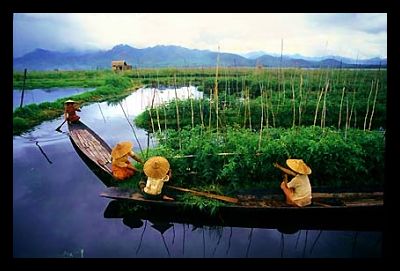
Floating gardens are rafts of aquatic weeds on which vegetables and other edible products can be grown. Practical Action, a UK-based development organization, is currently heading a program to introduce these floating gardens in the Gaibandha district of northern Bangladesh.
Bangladesh is home to some of the world’s most unstable rivers. Monsoon season has always left fields and land submerged for certain periods throughout the year, but climate change has intensified these seasonal floods. Often fields are submerged for longer than two months and, even when the waters recede, are left too water-logged to yield crops.
Floating gardens are a pragmatic agricultural alternative for the more than a million Bangladeshis affected annually by flooding. Much of the appeal of this method is the relative ease of constructing and cultivating a floating garden.
Steps to Make a Floating Garden:
1. Decide on an appropriate size for the floating garden. Generally, rafts are about 8m long and 2m wide and are 0.6m to 1m deep. The exact size depends on the amount of space and resources available.
2. Collect water hyacinth. This aquatic weed will serve as the base, or raft, for the floating garden. Water hyacinth is fairly abundant in Bangladesh and is free for collection.
3. Lay bamboo poles over the collected plants. The poles should be appropriate to the overall size of the raft.
4. Collect additional water hyacinth and place it on top of the bamboo layer to build the thickness. Weave the water hyacinth into a raft.
5. Once the plants have been woven and the general structure of the raft has been established, remove the bamboo poles.
6. Wait for 7 to 10 days and add more water hyacinth to the existing raft.
7. Add a mulch of soil, compost, and cow dung to cover the raft. This layer should total about 25cm deep. Usually, the compost is composed of azola and other easily accessible organic matter.
8. Pick an appropriate place for the raft. Floating gardens should not be placed in waters with tides or currents as the water movement damages the water hyacinth and risks the total disintegration of the raft.
9. Plant seeds. The most effective technique is to place a couple of seeds into a ball of compost and tema, an organic fertilizer. These balls are placed in a shaded, protected area while the seeds germinate. Once seedlings sprout, plant them on the raft.
10. Tend the floating garden as appropriate to the crops planted. In Bangladesh, the most common crops tend to be leafy vegetables, okra, gourds, eggplant, pumpkin, and onions. Animals like ducks and rodents might be attracted to the rafts. Fencing, even using improvised means like fishing nets, can effectively protect the gardens.
11. Harvest the crops. Rafts can be reused or, if no longer in a useable condition, can be used as compost on a new raft.
– Lauren Brown
Sources: Practical Action, FAO
Photo: Visiting Paradise

5 Facts about Child Soldiers
The subject of many a documentary, news report, and even novel, the figure of the child soldier emerged onto the global stage in the late 20th century, largely the result of publicized conflicts in places like Uganda and the Democratic Republic of Congo. The heartbreaking and sometimes frightening images of children—almost all of them African boys—turned into violent killers captured the attention of many in the west. Like most images, these tell only a part of the story. Here are five important and sobering facts about child soldiers.
1. Not all child soldiers are African. The organization Child Soldiers International reports that “since 2000, the participation of these soldiers has been reported in most armed conflicts and in almost every region of the world.” No exact figures have been compiled, but some estimates put the number at 250,000 child soldiers currently fighting in conflicts around the world. Countries, where child soldiers can be found, include Afghanistan, Burma, Iraq, the Philippines, Colombia, Thailand, India, Somalia, and Yemen.
2. They do more than just fight. Child soldiers not only fight on the front lines, but they also serve as runners, spies, and in some cases human shields. Many of them are also sexually abused and exploited.
3. Not all child soldiers are boys. Girls under 18 are often recruited or captured during conflicts, and most of the time they suffer sexual abuse and exploitation. An estimated 40% of them are girls.
4. They are both recruited and forced into serving. Many soldiers are violently kidnapped and forced to serve in armies or in opposition groups. Some, however, are drawn in because poverty and deprivation leave them vulnerable to the promise of money, food, and clothing if they take up arms. Desperation proves to be a powerful motivating force for some children.
5. They can be and have been rehabilitated. Despite the horrors they have suffered and in many cases committed, these soldiers are children forced or lured into war. Many organizations around the globe work to provide the therapy, medical attention, and education that these children need. Hundreds of former soldiers have benefited from this kind of care and been reunited with family members and loved ones.
– Délice Williams
Sources: Child Soldiers.org, Peace Direct USA
Photo: MW
Climate Change in Ethiopia
Ali Hamandu, a pastoralist in the Afar Region of Ethiopia, knows all too well the destruction a drought can bring. In the past five years of incredible drought in Ethiopia he has lost all of his livestock.
“I was previously a respected figure in my community for my wealth, having nearly a hundred heads of animals, including sheep, goats and cattle. All of a sudden I have nothing,” he explains. He now relies on food aid to support himself and his family.
Almost 14% of Ethiopia is made up of pastoralist communities. However, over the past five years of drought there has been a decline in the number of those who live as pastoralists due to climate change in Ethiopia. Many pastoralists have moved to urban life hoping to find jobs to provide food and water. Because pastoral life is so dependent on weather it is important to find solutions so pastoralists can continue their livelihood even with a changing climate.
The U.N. has been addressing this problem in Ethiopia by using money from the MDG-Fund to promote climate change mitigation and adaptation strategies into the government’s development plans, and policies. The “Enabling Pastoral Communities to Adapt to Climate Change and Restoring Rangeland Environments” is a UN joint program between the UNDP, FAO, and UNEP, has developed water facilities and activities that have helped 32,000 pastoralists in different regions of Ethiopia.
One of these activities is a program called “Jeldi Livestock Marketing Cooperative”, which Ali is now a member of. The Jeldi Cooperative is made up of 172 heads of households, many of whom are women. One of the main activities of the Jeldi Cooperative is buying sheep at low costs and fattening them up to be resold at a better price. Even though the Jeldi Cooperative is only a year old, it is making a profit for its members. It is one of three cooperatives in the area, and one of many in the entire country. Programs like this are what will help Ethiopians overcome climate change.
– Catherine Ulrich
Sources: AllAfrica, UNDP
Photo: UNDP
Poverty in Botswana
Botswana is a landlocked nation in the southern part of Africa. The economy of this country is defined by a single luxury export: diamonds. Beginning in the mid 1960’s, the economy of Botswana expanded exponentially. Due to her dependence on the success of one export, however, Botswana suffered from an economic contraction in 2009. This contraction occurred as the result of a shrinking global demand for Botswana diamonds. An already significant portion of the population in Botswana was living in extreme poverty prior to 2009. The economic downturn only perpetuated and strengthened a trend toward more abject conditions.
HIV/AIDS, however, is the largest contributor to poverty in Botswana. According to the CIA World Factbook, the prevalence of HIV/Aids is “second highest in the world and threatens Botswana’s impressive economic gains”. In 2012, 25% of the adult population was infected with the deadly virus. A health problem of this magnitude is detrimental to a nation’s economic well-being because it reduces human capital.
The good news is that the government of Botswana has begun to address HIV/AIDS with great success. President Festus Mogae who led the nation from 1998-2008 instituted a program to distribute AIDS medication to his people in 2002. This resulted in the medication of 95% of infected adults in Botswana.
In addition to Mogae’s initiative, the United States contributed vast amounts of aid money to the beleaguered country since the enacting of George W. Bush’s PEPFAR (President’s Emergency Plan for AIDS Relief) from 2003-2008. With this boost from the U.S. government, Botswana has begun to rise from the ashes of economic recession and improve the health of its citizens.
– Josh Forgét
Source: The World Bank, PBS, CIA World Factbook
Photo: Chobe Safari
What Americans Should Learn from Sk8 to the Finish
In an age of airplanes and automobiles, biking 264 miles would be considered wildly inadequate. Yet Australian activist Michael Traffard will perform this task as a metaphor for Australia’s “inadequate” foreign policy, and Americans should be taking notes.
On July 7th, Traffard will begin his Sk8 to the Finish campaign, in which he will skateboard and BMX riders from the town of Emerald to the city of Gladstone throughout the following 20 days. Along the way, Traffard will be making appearances at churches and schools to raise poverty awareness. This will be taking place two months prior to Australia’s 2013 federal election in September.
Traffard is conducting this campaign to raise awareness of the U.N. Millennium Development Goals established in 2000 by the world’s developed countries. The Millennium Project is an initiative to halve global poverty by 2015, yet few nations are still meeting the requirements to make this possible. A target of 0.70% of each nation’s budget was established to make this goal a reality. Australia currently gives 0.36% of its budget to the cause: about half of what is needed.
Although Australia’s aid is lacking, they are not the only ones falling short. The United States may appear to be leading the pack by giving roughly 30 billion dollars for Official Development Assistance (ODA), but that figure isn’t as pretty when held relative to the nation’s Gross National Income (GNI). The United States currently gives 0.19% of its budget to the cause, which is almost half of Australia’s level of giving.
As of 2012, only five developed countries are meeting or exceeding the 0.70% requirement: Luxembourg, Sweden, Norway, Denmark, and the Netherlands. Australia rests in 13th place when ranking countries by their degree of charity. The United States sits in 19th place.
One of the Millennium Project’s greatest enemies is a lack of awareness. Numerous citizens worldwide are not educated about the existence of the Millennium Development Goals, and political leaders are not informed of the issues as a result. Traffard hopes to give his audiences a clear understanding of the facts to take with them to the polls when election day arrives.
Traffard’s campaign does not mean to undercut the progress Australia has made in the past 13 years. Victories in global poverty have been numerous, including the eradication of smallpox and a 33% increase in life expectancy in the developing world. Traffard hopes his campaign will lead to an increase in aid that will be focused directly on life-saving programs.
Upon the conclusion of his trip, Traffard hopes to amass 3000 signatures for the Australian Movement to End Poverty Petition. The Petition currently has 57,968 signatures, and the Sk8 To The Finish campaign has already yielded 200 signatures.
Sk8 to the Finish is a perfect example of how an individual’s talents and passions can be utilized to combat global poverty. The Millennium Project’s goal to halve global poverty is well within reach if citizens of every applicable country demand it, and seemingly outrageous feats are effective in gathering attention. The United States needs to play catch up in order to reach the 2015 Millennium Development Goals, so Traffard’s message should be heeded by American citizens as well. Even from thousands of miles away, the same principles can still be applicable.
– Timothy Monbleau
Sources: OECD, The Gladstone Observer, UN Millennium Project
Photo: Men’s Fitness
London Hunger Summit Funds $4 Billion
The London Hunger Summit this year encouraged global leaders to take a stand on global hunger and poverty and make a difference. As a result, by the end of the day, $4 billion of funding had been secured to go towards ending hunger and malnutrition across the world. The Summit was a global accomplishment, with donations coming from businesses, governments, charities, and foundations in many countries.
The money will be distributed to several different causes, and some countries specified where they would like their donations to be spent. For example, Australia asked that their $40 million donations go towards improving nutrition in the Pacific Ocean area, and the British company Del Agua’s $670 million donations will be spent throughout the following years on providing clean drinking water in Rwanda.
However, even though raising $4 billion is a huge accomplishment, the U.K. can still improve to do even more for the world’s poor by more closely monitoring donations to determine where they are most needed. Some donors are not as transparent as they should be when they give back, so the U.K. doesn’t have the best data to learn where those donations are going and how much is actually making it to the people who need help. By monitoring how much money is given and which areas are receiving the help, the U.K. can decide which areas still need assistance, therefore maximizing efficiency and helping the most people possible.
– Katie Brockman
Source Huffington Post, The Guardian
What is “No Regret” Climate Adaptation?
The world poor is primarily made up of small scale subsistence farmers who often struggle to produce enough to feed their families. When they do produce a surplus, they sell it for profit. These small scale farmers are often living in hot climates in Central American and African countries. As such, global climate change is affecting them, often making their environment hotter and arider, which affects their production levels. Recent record levels of drought in places such as the Horn of Africa exemplify the impact that climate change can have on agriculture in the developing world.
There seems to be a simple solution to this problem: If people know that climate change is happening, then methods of production in agriculture simply need to be adjusted to reflect what the climate will change into. Sound easy? It would be, but the problem lies in a lack of accurate climate prediction models. Regional climates are incredibly complex, and no reliable model has been created to predict the path that climate change is going to take, especially in the short term. Farmers can’t afford to adjust their growing practices to changes in climate that don’t actually occur, and then lose out on production as a result.
No regret climate adaption is a way around such an issue. No regret climate adaptation strategies are practices that are beneficial even in the absence of climate change, and where the costs of adaptation are relatively low when compared to the results of the adaptations. Actions such as controlling water pipe leakages and scaling back groundwater use to sustainable levels qualify as no regret adaptations. Regardless of climate change, such practices yield results in the communities and have little to no negative impact. In Central America, for instance, increasing temperatures can make coffee production not feasible for low altitude farmers. These farmers instead can switch to growing cocoa, which will be similarly productive but lacks as much risk associated with these higher temperatures.
However, these adaptations only present a short term solution to climate change. In the long term, farmers will need to know what new climates they are dealing with in order to produce significant crop yields. Experts recommend a marrying of both approaches: no regret adaptations are very useful when facing a lack of reliable information, but it does not replace adaptations fitted to more specific and certain climate changes.
– Martin Drake
Source: IRIN News, European Climate Adaptation Platform
Photo: Ecologist
Miseducation: A Short Film for the Why Poverty? Initiative
Source: Why Poverty, New York Times, The Borgen Project
How to Make a Floating Garden
Floating gardens are rafts of aquatic weeds on which vegetables and other edible products can be grown. Practical Action, a UK-based development organization, is currently heading a program to introduce these floating gardens in the Gaibandha district of northern Bangladesh.
Bangladesh is home to some of the world’s most unstable rivers. Monsoon season has always left fields and land submerged for certain periods throughout the year, but climate change has intensified these seasonal floods. Often fields are submerged for longer than two months and, even when the waters recede, are left too water-logged to yield crops.
Floating gardens are a pragmatic agricultural alternative for the more than a million Bangladeshis affected annually by flooding. Much of the appeal of this method is the relative ease of constructing and cultivating a floating garden.
Steps to Make a Floating Garden:
1. Decide on an appropriate size for the floating garden. Generally, rafts are about 8m long and 2m wide and are 0.6m to 1m deep. The exact size depends on the amount of space and resources available.
2. Collect water hyacinth. This aquatic weed will serve as the base, or raft, for the floating garden. Water hyacinth is fairly abundant in Bangladesh and is free for collection.
3. Lay bamboo poles over the collected plants. The poles should be appropriate to the overall size of the raft.
4. Collect additional water hyacinth and place it on top of the bamboo layer to build the thickness. Weave the water hyacinth into a raft.
5. Once the plants have been woven and the general structure of the raft has been established, remove the bamboo poles.
6. Wait for 7 to 10 days and add more water hyacinth to the existing raft.
7. Add a mulch of soil, compost, and cow dung to cover the raft. This layer should total about 25cm deep. Usually, the compost is composed of azola and other easily accessible organic matter.
8. Pick an appropriate place for the raft. Floating gardens should not be placed in waters with tides or currents as the water movement damages the water hyacinth and risks the total disintegration of the raft.
9. Plant seeds. The most effective technique is to place a couple of seeds into a ball of compost and tema, an organic fertilizer. These balls are placed in a shaded, protected area while the seeds germinate. Once seedlings sprout, plant them on the raft.
10. Tend the floating garden as appropriate to the crops planted. In Bangladesh, the most common crops tend to be leafy vegetables, okra, gourds, eggplant, pumpkin, and onions. Animals like ducks and rodents might be attracted to the rafts. Fencing, even using improvised means like fishing nets, can effectively protect the gardens.
11. Harvest the crops. Rafts can be reused or, if no longer in a useable condition, can be used as compost on a new raft.
– Lauren Brown
Sources: Practical Action, FAO
Photo: Visiting Paradise
Ethiopia No Longer Crippled in Poverty
Ethiopia has proven to be a country to model economic growth for other African nations. The World Economic Forum on Africa will be meeting soon to discuss, among other issues, how Ethiopia was able to bring itself out of high poverty levels and into a relatively flourishing state. As a country that has a history of civil, Ethiopia’s progress is an inspiration to all of Africa.
Ethiopia has made huge strides in its economic sector as well as healthcare and government accountability. In the past two decades, Ethiopia has decreased the child mortality rate by 60 percent and built more than 15,000 primary healthcare facilities in rural areas. The country is also well on its way to meet the Millennium Development Goals by 2015.
The government of Ethiopia has been adamant about implementing policies that will better the economy and all aspects of the country. Haddis Tadesse, a representative of the Bill and Melinda Gates Foundation in Addis Ababa, has described Ethiopia’s policymakers as shifting from the mentality of “we can’t” to “we can.” This philosophy has done wondrous things to inspire hope for everyone living in Ethiopia.
Politicians and government authorities are now developing strategies to end hunger and create food stability for all citizens, build a new, impressively large hydro electronic power plant, an electrified railway system and a light manufacturing industry. Once these projects are complete, Ethiopia’s economy will continue to boom.
By following the examples of India, Malaysia, China, Brazil and Turkey, Ethiopia has been able to mold itself into a prospering economy and society. As Haddis Tadesse says, “Ethiopia is well-positioned to escape the poverty trap. But it won’t be easy.” With further improvements in infrastructure, human rights and creating a stable market, the country is likely to become dependent on foreign assistance and begin to provide aid to other African countries.
– Mary Penn
Source: World Economic Forum
Photo: Celebrate Children
6 Steps To Organizing a Successful Fundraiser
Do you ever wonder what it would feel like to organize your own fundraiser to raise money for the most important causes? Fundraising is actually much simpler than it may seem, and with the right knowledge and some effort, you can start raising donations in no time.
1. Set a goal for how much you want to raise. This is the most important step because the following steps depend on it. You don’t need to decide to the penny how much you would like to raise, but try to come up with a ballpark number. This way, you can decide what type of event is best for your goal, how long to take donations, and how many volunteers you should recruit.
2. Pick your event. This will likely depend on a few factors, one of which is how much you are looking to raise. If you are looking to raise thousands of dollars, a neighborhood bake sale may not get you what you’re looking for. On the other hand, if you’re aiming for a couple of hundred dollars or less, you don’t need to rent the Town Hall and buy TV ads for your fundraiser. Another important aspect is your community. Catering to their interests will likely get you better results because people want to donate to something they support and have fun at the same time. It’s also important to choose an event or program that interests you. Sponsoring a car wash for charity won’t be enjoyable if you don’t enjoy the sun, water, and physical labor.
3. Decide on a deadline, and make it clear. If people know upfront your fundraiser will only be accepting donations for an afternoon, a day, or a week, they will be less likely to miss the deadline. It’s also easier to get people to put the dates on their calendar, which will likely result in more donations. Your deadline will also depend on where you’re giving the money. If the organization needs it by a certain date, your fundraiser should end before that date to make sure all the people who wanted to give had the chance to donate.
4. Recruit volunteers. If your fundraiser is small enough to run alone, your volunteers will be the people who help spread the word. Word of mouth is some of the best advertising, and can dramatically increase your results. If your project is larger, you may need people to help you run and organize the fundraiser. Their duties can include calling/emailing potential sponsors to help host the event, tracking donations, creating publicity, and managing other volunteers.
5. Ask for sponsors to help pay for hosting the event or program. Although it’s possible to create a fundraising event with money from your own pocket, many times local businesses or individuals are willing to help for the publicity and free advertising. Sometimes businesses or other organizations will even let you use their building or supplies for your fundraiser, and in that case, it’s a win-win situation for everyone involved.
6. A few days before your event is set to begin, double-check to make sure everything is in order. Follow up with sponsors and volunteers to ensure you all are on the same page, make sure you have all the supplies you will need, check to make sure you have the necessary permits for your city, if you need them, and make any other last-minute confirmations to make sure your fundraiser goes exactly as planned.
– Katie Brockman
Sources: Helium, Fundraising.com
Photo: Entertainment