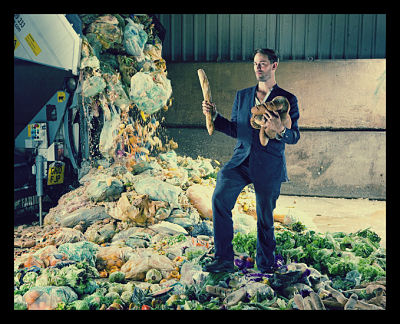
With hopes to change the global opinion about the waste of “unwanted” food, Tristram Stuart, author of Waste: Uncovering the Global Food Scandal and founder of Feeding the 500, prepared a meal for global ministers and diplomats February 19, 2012 in Nairobi. The meal was
prepared with only “ugly” ingredients, Stuart claims.
The five course meal consisted of yellow lentil, grilled sweet corn, French Beans and pleothra of other vegetables. Although well- presented, the dinner ingredients likely would have been rejected by various UK supermarkets for their appearance. Through his meal, Stuart hoped to uncover the truth about unwanted fruit and vegetables.
“The waste of perfectly edible ‘ugly’ vegetables is epidemic in our food production systems and symbolizes our negligence,” Stuart tells.
In addition to cost and environmental impact, food waste increases pressure on the already fragile global food system. In a country with millions of hungry people, it is a scandal that UK supermarkets waste so much food, adds Stuart. The expected amount of vegetables wasted every week is 40 tons, 40 percent of what the farmer grows.
A study by the Food and Agriculture Organization (FAO) reported that one third of all food produced worldwide is either wasted or lost, resulting in 1.3 billion tons annually. Combined data from the FAO and Unep estimates the annual cost at approximately $1 trillion.
Half of all consumable food in industrialized countries is wasted, the FAO claims. In retrospect that is 300 million tons of usable food, more than the total amount of food production of Sub-Saharan Africa sufficiently feeding 900 million hungry.
With these figures as evidence, use of wasted food can benefit farmers and the global hungry alike. Instead of simply asking to reduce food waste, it would more beneficial to utilize the food wasted, Stuart claims.
In his TED talk about global food waste, Stuart reflected on personal application of food waste utilization as a teen raising livestock. By utilizing scraps from his school, local bakers and other farmers “throwing out potatoes because they are the wrong shape and size”, Stuart was able to provide plump, healthy and profitable pigs. Not only was this method environmentally friendly, it was the most economically sufficient, Stuarts exclaims.
Farmers have learned to use “leftovers” to feed their livestock. Because livestock serve as a source of livelihood and supplement for farmer family diets, the use of food waste helps famers both health-wise and economically, Stuart adds. If applied by all farmers and non-farmers alike, quality of life would increase while global hunger would decrease.
Reflecting on yet another example from his pig-raising days, Stuart told his TED talk listeners of yet another applicable story. One day when he was feeding his pigs, Stuart saw a rather consumable tomato loaf. Stuart washed it off, sat down and ate it. For Stuart this was the first application of what he would later term Freeganism, an exhibition of the injustice of food waste and the provision of the solution. The solution to food waste and global hunger is simple: to sit down and eat the food than throw it away, Stuart concludes.
– Danielle Doedens
Sources: TED Talk, The Nation
Sources: The Guardian

Where Does the ‘Ugly’ Food Go?
With hopes to change the global opinion about the waste of “unwanted” food, Tristram Stuart, author of Waste: Uncovering the Global Food Scandal and founder of Feeding the 500, prepared a meal for global ministers and diplomats February 19, 2012 in Nairobi. The meal was
prepared with only “ugly” ingredients, Stuart claims.
The five course meal consisted of yellow lentil, grilled sweet corn, French Beans and pleothra of other vegetables. Although well- presented, the dinner ingredients likely would have been rejected by various UK supermarkets for their appearance. Through his meal, Stuart hoped to uncover the truth about unwanted fruit and vegetables.
“The waste of perfectly edible ‘ugly’ vegetables is epidemic in our food production systems and symbolizes our negligence,” Stuart tells.
In addition to cost and environmental impact, food waste increases pressure on the already fragile global food system. In a country with millions of hungry people, it is a scandal that UK supermarkets waste so much food, adds Stuart. The expected amount of vegetables wasted every week is 40 tons, 40 percent of what the farmer grows.
A study by the Food and Agriculture Organization (FAO) reported that one third of all food produced worldwide is either wasted or lost, resulting in 1.3 billion tons annually. Combined data from the FAO and Unep estimates the annual cost at approximately $1 trillion.
Half of all consumable food in industrialized countries is wasted, the FAO claims. In retrospect that is 300 million tons of usable food, more than the total amount of food production of Sub-Saharan Africa sufficiently feeding 900 million hungry.
With these figures as evidence, use of wasted food can benefit farmers and the global hungry alike. Instead of simply asking to reduce food waste, it would more beneficial to utilize the food wasted, Stuart claims.
In his TED talk about global food waste, Stuart reflected on personal application of food waste utilization as a teen raising livestock. By utilizing scraps from his school, local bakers and other farmers “throwing out potatoes because they are the wrong shape and size”, Stuart was able to provide plump, healthy and profitable pigs. Not only was this method environmentally friendly, it was the most economically sufficient, Stuarts exclaims.
Farmers have learned to use “leftovers” to feed their livestock. Because livestock serve as a source of livelihood and supplement for farmer family diets, the use of food waste helps famers both health-wise and economically, Stuart adds. If applied by all farmers and non-farmers alike, quality of life would increase while global hunger would decrease.
Reflecting on yet another example from his pig-raising days, Stuart told his TED talk listeners of yet another applicable story. One day when he was feeding his pigs, Stuart saw a rather consumable tomato loaf. Stuart washed it off, sat down and ate it. For Stuart this was the first application of what he would later term Freeganism, an exhibition of the injustice of food waste and the provision of the solution. The solution to food waste and global hunger is simple: to sit down and eat the food than throw it away, Stuart concludes.
– Danielle Doedens
Sources: TED Talk, The Nation
Sources: The Guardian
Single Mothers and Poverty in Latvia
Latvia is a country with one of the widest income gaps in the European Union. This gap was expanded by the global economic crisis, which caused income levels in the country to decline by 19%. The IMF confirms that the economic recession very severely damaged the economy of Latvia. According to the Fund, “the richest 20 percent of the population (in Latvia) earn seven times more than the bottom 20 percent.” The IMF warns that these adverse conditions put Latvians at a higher risk of poverty.
The Baltic Center for Investigative Journalism notes that the country does not provide adequate government-funded support for its poor. In fact, the small Baltic nation spends less on social welfare programs than any other European Union member state. For example, when compared to her northern neighbor Estonia, which spends 40% more per capita on social protection programs annually for the poor than Latvia, the lack of poverty-reduction programs from the Latvian government is quite conspicuous.
One of the most “at risk” groups in post-recession Latvia are single mothers. The cost of living has increased over the last few years, due in a large part to changes in tax policies which caused the price of heat and water utilities to rise significantly. The Baltic Center’s report highlights the struggles of a single mother living in Saldus, a town in western Latvia, trying to make ends meet in a small apartment with her two young children. The mother can’t afford to buy or run a refrigerator, so the family lives off of a meager subsistence of room temperature dry foods and water. The tiny apartment also does not have a shower, so the children are forced to wash in the gym locker rooms at the primary school, a school where they attend classes with no supplies because their mother doesn’t have the money to buy them.
The plight of single mothers in Latvia has prompted many of them to leave the country. The income provided from a minimum wage job in Latvia is simply not enough to support a woman with one or more children, even in the smallest of living spaces. The mother in the Baltic Center article earns only three euros a day and has been forced to ask her friends for donations to keep her family afloat. Three euros a day is hardly enough money for a single, childless woman to survive in a developed country, let alone a mother responsible for a family.
As the Latvian government comes out of the recession, politicians should propose welfare programs for single mothers living below the poverty line. Failure to confront this critical social issue will only result in increased emigration and a more extreme wealth gap.
– Josh Forgét
Sources: Baltica, The Washington Post
Photo: Baltica
Homemade Helicopters Lift Africa out of Poverty
A growing movement in Africa finds solo innovators experimenting with homemade flight technologies out of mere curiosity. The daring, Wright-esque pioneers involved are sourcing materials from scrapped vehicles and local junkyards to build helicopters, and even piecing their projects together with cheap gum. One would-be pilot, Gabriel Nderitu Muturi from Kenya, hopes the interest in flight will one day lift Africa out of poverty.
On the ground, individuals are making progress with their flying machines, from life-size, remote control helicopters to two-seater airplanes, but they receive no governmental support for their projects. In some cases, the government obstructs the aviation development. One man had his helicopter confiscated as a security risk and was fired from his job for pursuing the interest on the basis of media attention distracting from his work. Those continuing the fight for flight say such obstacles result in wasted talent that could help lift developing nations and their people out of poverty. The technological curiosity is apparent, but the capacity and reward system stands lacking.
Hackerspaces and fab labs have cropped up to support the solo innovators in impoverished nations, where government assistance is either minimal or nonexistent, but they are by no means commonplace. For creators of homemade airplanes these spaces are a veritable Godsend, as they offer community-based resources and the actual space to design and experiment. Without these spaces, these pioneer inventors would face many obstacles to the flight of their helicopters.
Mr. Muturi reports his use of the Internet as the most significant variable in his formula for success. He cites the web as a source of information for research and a marketplace for fabrication as it allows him to order parts from the United States. Though he completed the project on his own, he urges governments to recognize the importance of supporting interest in science and research as an indispensable resource that will pull Africa out of poverty and underdevelopment.
In light of increased fiber optic connectivity from more developed nations investing in Africa, the Internet will likely prove a valuable resource for individual and community-based projects like Mr. Muturi’s. Nonetheless, there is the problem of providing such a resource to rural communities, where e-learning depends on first establishing free digital centers, heretofore inadequately represented in such locations.
– Herman Watson
Source: BBC, Hackerspaces, CNN
Photo: BBC
Poverty Reduction Efforts Must Address Climate Change
The World Bank has recently warned that global poverty could worsen due to climate change, if left unchecked. Climate change is responsible for a number of negative effects that can exacerbate poverty, including stronger storms and increased global temperatures.
Stronger storms can lead to poverty by causing destruction to homes, businesses, and crops. Likewise, increased temperatures can negatively affect crop yields by worsening droughts.
Overall, the World Bank has predicted a “two degree rise in average global temperatures” and sea levels rising to the point that “portions of Asia will be permanently underwater.” If not mitigated, these effects of climate change could decrease crop yields and displace millions of people, increasing poverty throughout the globe.
Already, 300,000 people die each year from the negative effects of climate change. Those most vulnerable to the impacts of climate change are those who live in extreme poverty and in countries that lack the resources necessary to respond to food shortages and natural disasters. One of the most concerning aspects of a changing global ecosystem is that “climate change threatens to undermine, and even reverse, the progress we’ve made to reduce poverty and promote development” due to increased droughts and destructive storm systems.
In order to prevent an increase in poverty in the future, policies must be developed to reduce the negative effects of climate change now. Technologies are available in both developed and developing countries that produce energy without generating greenhouse gasses. While the green technologies may be more expensive than fossil fuels, their use will help reduce the amount of carbon released into the atmosphere. A reduction of greenhouse gasses in the atmosphere will help reduce climate extremes and the poverty that it could potentially create.
– Jordan Kline
Sources: Mother Nature Network, The Journal, WWF
USAID Helps Boost Pakistan Mango Exports
The US Agency for International Development (USAID) has helped boost Pakistan mango production and exports to international markets. This has led to a 75% increase in farm revenues and the creation of hundreds of jobs across the country. Through USAID, the U.S. government is supporting Pakistan’s mango farmers by creating new market opportunities, infrastructure upgrades, and access to international certifications. The programme’s achievements were celebrated in Islamabad on Monday at the 3rd Annual Mango Conference.
According the USAID, limitations to Pakistan’s export supply chain and lack of farm infrastructure for processing mangoes have been holding back the nation’s mango sector. The USAID Firm Project has invested $5.8 million in Pakistan’s mango production, providing the means for new infrastructure and marketing assistance to help farmers sell their products globally. $1.6 million has also been invested in small and medium sized farms to work with USAID to develop commercially feasible fresh and dried mango businesses.
The program has helped 26 mango orchards receive the Global GAP certification required for exports to high-end markets. 15 on-farm mango processing facilities have been established, with around 2,500 jobs created and 3,700 farmers trained in the process. Mango sales have increased about $20.5 million with a five-fold increase in exports of mangoes to the international market.
“We are thankful to the US government for their support to mango growers and producers, which has led to increased productivity and jobs for Pakistani people. A relationship that is based on trade, not just aid is one that we will look forward to in our relationship with the United States,” said Qasim Niaz.
Richard Olson, the US ambassador to Pakistan expressed that the US government will continue to focus on its partnership with Pakistan in strengthening the country’s private sector.
– Ali Warlich
Source: Tribune, Daily TImes
Photo: The News Tribe
Extreme Poverty Has Been Cut in Half Since 1990
In 1990, 43% of the world’s population subsisted on less than $1.25 per day. By 2010, that number had shrunk to 21%. This success comes 5 years before the United Nation’s Millennium Development Goal of achieving such a number by 2015.
The conversation has now shifted to the remaining 21%. Optimists hope to achieve similar success by 2030. However, there are several unique obstacles to addressing that 21%, and the economic conditions that allowed such a rapid decline before are unlikely to be replicated in the coming decade.
Much of the success of the last two decades was achieved by slightly elevating the conditions of those living just below the $1.25 per day line. Pulling a person living at $1.15 per day over the $1.25 line is much easier than pulling someone living at $0.25 to over $1.25. In other words, much of the remaining 21% was the bottom half of the original 43 percent. The challenge of the next decades will be to improve the lives of the most impoverished people on Earth.
China’s growth over the past decades was instrumental in lowering the extreme poverty rate. In the twenty years, from 1981 to 2001, China pulled 680 million of its own citizens out of extreme poverty as it rapidly developed. With China’s extreme poverty rate now at low levels, the focus will now shift to new developing countries, primarily India and Africa. The challenge will be to replicate the economic conditions for such an achievement in vastly different governmental and cultural contexts.
Should such a success be achieved by 2030, however, the fight against poverty will hardly be over. The $1.25 a day figure is simply an accepted global standard of extreme poverty, and does not account for those living in poverty in developed countries. In the U.S., the poverty line sits at $30 a day–a marked difference. However, with extreme poverty levels eradicated, the world would be able to focus anew on those living just below the line.
– Andrew Rasner
Sources: The Economist, The Wall Street Journal, The Economist
Photo: The Economist,
Physicians for Human Rights
Physicians for Human Rights (PHR) uses science and medicine to prevent severe human rights violations against individuals. The independent organization was founded in 1986 by a group of doctors, all who witnessed first hand the extent to which mass atrocities and extreme physical and mental harm were occurring around the world.
Among the founders is Dr. Jonathan Fine, who previously worked at the North End Neighborhood Health Center in Boston. Dr. Fine received a call in 1981 from a Harvard History Professor who asked if he knew a Spanish-speaking physician willing to fly to Chile as soon as possible. The individual was to lead a delegation seeking the release of 3 physicians who had disappeared by the brutal regime of General Augusto Pinochet. Dr. Fine found himself before a military judge in Valparaiso one week later. After an hour, Dr. Fine’s delegation was given permission to enter the prison and meet with the Chilean physicians. He described them as, “psychologically terrorized” and said, “…their testimonies were riveting, and so outraged me that within a few years I left my medical practice to do this work full time.”
Over the past 25 years, PHR has worked on a wide range of human rights issues in over 40 countries. Today, the organization focuses on torture, mass atrocities (including war crimes, crimes against humanity, and genocide), the use of rape as a weapon of war, and the persecution of health workers.
The philosophy behind Physicians for Human Rights is that health professionals, with their specialized skills, ethical responsibility, and credible voice, are in a powerful position to stop human rights violations. Local human rights organizations, governments, the United Nations, international courts, and regional groups such as the African Union and European Union seek out the work and expertise of PHR.
There are three steps PHR takes to gather the necessary information for prevention and change. First, medical and scientific investigations are conducted using forensic science, medical and psychological examinations, and epidemiological research. Next, the evidence and human stories of the investigation are documented as reports, court-admissible evidence, testimony for governmental bodies, and various other forms for targeted audiences. Finally, the human rights experts of PHR meet with key representatives from governments, courts, or international groups to push for interventions, the prosecution of individuals, the drafting of legislation, and other calls to action. The following is work the organization has done:
– Ali Warlich
Source: PHR Charity Navigator
Photo: Arabian Business
Poverty in Cape Verde
Cape Verde is a small archipelago island nation in the Atlantic Ocean off the northwest coast of Africa. The country is mired in absolute poverty, with 30% of its citizens below the poverty line. The World Bank estimates that 14% of the population is living in extreme poverty. With a crisis of this magnitude, the government of Cape Verde is dependent on the receipt of international aid to maintain relative stability.
Poverty in Cape Verde is precipitated by a number of factors, but the main inhibitors of economic growth are a gross lack of a natural resources and a limited economic base. Due to repeated droughts, Cape Verde is beleaguered by water shortages and poor soil. Due to a lack of domestic agriculture, over 82% of the country’s food supply is imported. The nation’s narrow economic base stems from over dependence on tourism as the sole source of economic revenue.
The World Bank has agreed to provide significant amounts of funding to Cape Verde and has developed an economic strategy to alleviate the poor conditions there. The World Bank’s plan is four-fold, involving an improvement in the quality of education and healthcare, a diversification of the economic base (exploiting tuna fishing as an additional source of income), an improvement of the already existing infrastructure, and the institution of welfare programs for the disadvantaged.
These changes will have to be implemented from the top down in order for them to be successful. The World Bank is working with the government of Cape Verde to implement these much needed changes. This combination of economic diversification, aid, and development will most assuredly provide a way for Cape Verde to rise out of extreme poverty.
– Josh Forgét
Sources: The World Bank, The CIA World Factbook
Photo: Cape Verde Against Poverty,
Water in New Delhi
In the north Indian city of New Delhi, severe water shortages affect the entire city, a problem that will only be exacerbated as demand rises in the summer months. As the heat rises, demand for water can outstrip availability by 25% — and this number only refers to those areas of the city connected to the city infrastructure. Up to a quarter of the inhabitants of New Delhi have no access to piped water. In these areas people are forced to seek water from overused wells or polluted rivers, or the occasional tanker of water that is delivered.
As ever, the shortages are felt more strongly in lower economic circles. But even middle-class citizens are left scrounging for water to supplement what the city provides.
Many factors contribute to these continuing shortages. New Delhi’s population has swollen by nearly 50% over the past 20 years, and the city has been unable to keep up with infrastructural development. Across the city’s network, 25-40% of piped water is lost due to leaks, before arriving at its destination. Additionally, the majority of waste produced goes untreated, and is released into local bodies of water, polluting them and making them unusable as resources. For example, the Yamuna river, whose source lies in the Himalayas, enters the city still relatively clean, at which point some 200 million gallons are extracted from the river every day by the public water agency. However, as the river runs through the city, nearly a billion gallons of public sewage is dumped into it daily.
This problem of waste causes severe health concerns, especially in slums with no connection to the city’s sewage systems. In these areas sewage is left exposed, contaminating water sources used for bathing and washing.
The irony of these water shortages is that New Delhi has access to enough water to feasibly provide for the demand. But due to these issues of infrastructure and treatment, the system is failing. And those most strongly affected are those underprivileged to begin with.
With water scarcity becoming increasingly a source of potential conflict, providing the infrastructure to alleviate the burden must be a primary concern of governments globally. Demand will only continue to increase exponentially, and while cities like New Delhi will be the first to feel the strain, they will not be the last.
– David Wilson
Source: New York Times, Wall Street Journal
Rice Farming Must Adapt to Climate Change
Climate change is having a profound effect on coastal rice farming. The resulting increase in pests, diseases, water scarcity, and salinity has been devastating to farmers.
Research conducted over the past decade demonstrates a strong relationship between climate change and the prevalence of disease and pests in rice paddies. Crop stressors like irregular rainfall often increase the virulence of rice blights such as brown spot and blast. Extreme weather, like flooding or drought, forces farmers into asynchronous, or unseasonal, cropping. Such practices, along with the weather events themselves, often lead to pest population explosions.
Water scarcity is another factor affecting rice production. As rice requires a certain amount of water to grow, even less-severe droughts can take a toll on production yields. Climate change continues to cause more frequent and more severe droughts, and rice farmers are starting to feel the pressure of drying rice paddies.
As higher temperatures and lower rainfall cause a decrease in ground water, sea levels continue to rise and intrude into fresh water areas. These factors cause a noted increase in salinity. Rice, particularly higher-yielding hybrids, is only moderately tolerant of salt. Thus, increases in the salinity usually see a decrease in yields for the affected paddies.
Drastic decreases in production are causing some farmers to abandon their fields. Several governments and NGOs, like Practical Action, a UK-based development organization, are launching initiatives to help these rice farmers cope with the growing challenges of climate change.
Practical Action partnered with farmers in southern Sri Lanka, a country that has seen significant effects of climate change over the past 20 years. The organization participated in farmer-led trials of traditional varieties of rice to assess each type’s resistance to temperature, pests, and salinity. The varieties were held against standards of crop duration, plant height, grain quality, and overall yield.
Sri Lanka has over 2,000 traditional varieties of rice. Most of these varieties had been abandoned for modern rice types and hybrids, but new climate challenges are turning many farmers back to indigenous varieties. The traditional rice is nutritional, some even having medicinal properties, and according to tests are more resilient in the face of climate change.
In fact, of the ten varieties tested by farmers in the Practical Action program, four scored high enough to now be officially promoted through farmer organizations as hardy and saline tolerant. The traditional rice cannot, generally, produce the high yields of hybrids, but its resilience and popularity in the consumer market still enable a farmer to generate profit.
It seems that for an agricultural community faced with emerging climate challenges, revisiting traditional methods could be the best solution.
– Lauren Brown
Sources: Practical Action
Photo: International Land Coalition