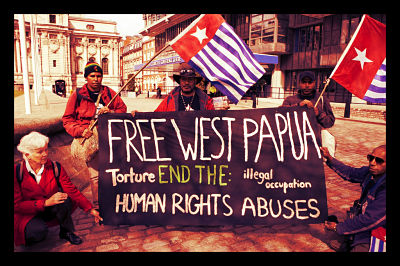
The region of West Papua does not make the news often; in fact, it rarely merits a news blurb in most Western headlines. However, West Papua is arguably one of the most under-reported cases of exploitation an indigenous groups in the 21st century.
Since 1969, the people of West Papua have been in conflict with the government of Indonesia in one way or another. The University of Sydney’s Center for Peace and Conflict Studies put out a report stating that for the better part of 40 years, the people of West Papua have been under the boot heel of the Indonesian Security forces.
The report goes on to state that due to wide scale incursions by Indonesia’s armed forces, West Papua has seen over 100,000 of its citizens die and much of its national resources depleted.
A report by The Guardian also notes the devastating effect that Indonesian resource extraction is having on the people of West Papua. It notes the case of the Mooi people, who are one of the 250 indigenous tribes that are having their way of life destroyed due to the deforestation of their lands by timber and palm oil companies.
The oceans off the coasts of West Papua are also being devastated due to nickel mining in the area, which is flooding the bountiful coral reefs with polluted sediment.
It is not only the eco-system of West Papua that is being destroyed. Even though it has been close to 45 years, the Indonesian military is still cracking down severely on people who are part of the Free Western Papua Movement.
Last year, the Free Western Papua Movement’s Facebook published the photo of a dead Papuan named Edward Apaseray, who was reportedly tortured and killed by the Indonesian Special Police Forces for being a “separatist.” The Diplomat, a current affairs magazine for the Asian-Pacific region, published a report in which a recent study noted that in West Papua, an incident of torture occurred every six weeks for the past half-century.
The human rights organization Tapol that monitors human rights abuses in West Papua published the story of Yawan Wayeni. He was a tribal leader and formal political prisoner who was tortured and killed by Indonesian security forces in brutal fashion.
The media have long overlooked the plight of the people of West Papua. It has only recently begun to receive real traction in Western media. The International Parliamentarians for West Papua (IPWP) is a group of politicians around the world who support the right self-determination for the people of West Papua.
One of its members, Benny Wenda, an exile from West Papua, recently had an article published in which he decried the recent statement of Australian Prime Minister Tony Abbot, who stated that things in West Papua are “better and not worse.”
West Papua is one of the forgotten atrocities of the 21st century; the responsibility making sure that it does not continue to be rests with us and our elected officials. The Arab Spring occurred with the help of Facebook and a determined populace. The plight of West Papua needs the same type of support from those who have the ability to stand up to the Indonesian government.
– Arthur Fuller
Sources: Amnesty International, The Guardian, Tapol, The Diplomat, The University Of Sydney, Tapol, CNN, The Guardian, Tempo, Australia News Network
Photo: London Mining Network

Carbon Emissions Outsourced to Developing Countries
Currently, carbon emissions from the burning of fossil fuels are sought to be decreased on an international scale. Nations have been working together to combat the dilemma of climate change by seeking zero emissions technologies and by addressing carbon emissions within their own borders.
However, what makes it more difficult to calculate carbon emissions by country is that many institutions of wealthy, developed nations have been able to outsource their carbon emissions to developing countries. Apparently, studies show that, “the United States, Japan and many Western European nations have managed to ‘outsource’ more than half of their carbon dioxide emissions and evade responsibility for their share of the climate-altering pollution.”
There is already a prevalence of goods manufactured in developing countries such as India or China and consumed in developed countries in the United States and Europe. Accordingly, the carbon emissions produced by businesses or corporations are often unconsidered in regards to their total impact on the world.
After all, climate change is a global issue rather than regional or domestic. When carbon emissions are outsourced, the only winner is the public image of the institution that outsources the pollution—that is unless it is uncovered.
With prior calculations of carbon emissions categorized by country, analysts say that they will apparently have to be redone to account for all of the outsourcing. The implications are substantial for European countries who—in comparison to the rest of the world—seem to have low carbon emissons. However, with European nations accounting for a large amount of carbon emission outsourcing, the numbers may reflect their status differently.
Additionally, nations such as China and India—who attain international status as some of the highest ranking carbon polluters—see that many of their emissions actually ought to be attributed to institutions of other developed nations, such as the United States.
China and India in particular serve as examples that reflect the problems that may arise from outsourcing outdated and polluting technologies to developing countries in order to boost their economies. While their rapid industrialization has been able to increase their economic status to an extent, it has done much harm to the environment with their heavy reliance on fossil fuels.
Therefore, the issues presented require much more in-depth analysis on the true extent of carbon emissions. Thus it seems as though categorizing emissions by nation are essentially misleading.
– Jugal Patel
Sources: Carnegie Science, The Guardian, Stanford
Photo: Lemonde
Bolivia: Inequality Of Wealth
The South-American country of Bolivia has struggled as on the poorest countries in South America. Wealth inequality is a critical issue for the country of 10 million. 65 percent of the population resides in poverty, with “nearly 40 percent” of the population in extreme poverty.
Bolivia boasts a elevated population of indigenous South Americans, who are the most dangerously affected by poverty. Bolivians of Spanish descent dominate the political and economic life of the nation, depriving the indigenous population of many economic opportunities. Many of the impoverished residents of Bolivia subside on “subsistence” farming, and working as “miners, small traders or artisans.”
Bolivia is home to a well-built informal economy, which has distressed the primary economy of Bolivia. The indigenous population which is perilously unemployed, survive through their own means, not effectively participating in the national economic structure.
The nation is habitat to countless natural resources, chiefly natural gas. Despite the abundance of natural resources, the nation is more often than not exploited by foreign corporations and by it’s own political elites. The profits from such ventures rarely make it back to the poorer residents, allowing for a widening gap in income inequality.
The rural population which are primarily American Indians are critically malnourished, unable to access adequate health-care, less enrolled in education, and suffer from a lack of infrastructure. Urban areas suffer less from poverty, while rural areas such as Pando and Chuquisaca have the highest rates of poverty. Urban areas are not free of poverty though.
Urban populations suffer from “low quality employment” and the downward spiral of income levels. People are finding it complicated to find work, and those who work, are making less capital. Bolivia has struggled with employing its population.
The country remains primarily invested in “natural resource-based” exports as its economic crutch. This has led to many people unemployed as this economic base does not require many people to function properly.
Few educational opportunities for poorer residents have prevented many citizens from escaping extreme poverty. The country has not taken advantage of it’s ‘human capital.” With many residents not gaining proper higher education, or even primary education, has resulted in a poorly trained populace who can not work in many sectors besides the labor sector.
With many jobs not available in that sector, employment opportunities remain few and far in-between.
The country remains stifled by not adjusting it’s infrastructure to improve the amount of job opportunities. Bolivia has not made many attempts to modernize much of the nation, allowing unemployment to persist. Many observers argue Bolivia modernizing its economic approach is the only “necessary condition to reduce poverty and inequality” in the nation, and supporting new economic policies will help “improve labor productivity” and help curb unemployment.
– Joseph Abay
Sources: BBC, UNICEF, World Bank, BBC , World Bank
Photo: The Guardian
Advancing Girls’ Education in Africa
As the world’s leading countries and corporations search for new frontiers, all eyes are focused on Africa. The continent offers many opportunities for economic activity and prosperity. African nations are seeking to take advantage of their position but face tough obstacles due to an undereducated population.
In Sub-Saharan Africa, 176 million adults are unable to read and write. 47 million youths ages 15-24 are illiterate and 32 million primary aged children are not in school. In nations like Malawi, one of the world’s poorest nations, where 45 percent of the population is under 14 years old, it is imperative to produce future generations of educated citizens capable of lifting the nation out of poverty.
Malawi is a land locked nation and is home to approximately 17 million people. The country does not have many natural resources such as oil like its neighboring countries. The economy is based on agriculture, mainly, the export of tobacco and is supported through financial aid by the World Bank and International Monetary Fund.
In order to turn the tide and help the people of Malawi, Xanthe Ackerman founded Advancing Girls’ Education in Africa, or AGE Africa.
AGE Africa seeks to transform the lives of millions of young girls by providing them with opportunities to become educated leaders. Beginning with Malawi, the organization’s vision is to ensure all girls in Africa have equal access to secondary education and that they be able to leverage their education into economic opportunities.
Advancing Girls’ Education in Africa seeks to create informed citizens capable of making their own life choices.
The Advancing Girls’ Education in Africa organization has a multidimensional approach to achieving their stated goals. The first begins with comprehensive scholarships that allow girls to not only attend schools but also complete their education. Scholarships go towards providing for tuition and school related expenses.
The second approach deals with extracurricular programs that promote life skills, leadership development, self-advocacy and career guidance. The final piece of the program, post-secondary transitions, ensures that the girls have the necessary information, resources, and support to apply for educational and economic opportunities beyond high school.
AGE Africa’s impact on the girls of Malawi is extraordinary.
By age 20, just 17 percent of Advancing Girls’ Education in Africa participants are mothers compared to 65 percent of 20-year old women in Malawi. About 88 percent of AGE Africa students finish all four years of secondary school, compared to just 8 percent nationwide.
Among these students, 74 percent are now pursuing higher education, have wage-based employment or engage in economic activity that provides income above the poverty threshold.
The tremendous success of Advancing Girls’ Education in Africa within the country of Malawi is beacon of hope for the nation and a promising sign of the future for other girls throughout the continent.
– Sunny Bhatt
Sources: AGE Africa, AGE Africa, AGE Africa, FAO
Photo: Development Diaries
Human Rights Abuses in Sri Lanka
After 25 years, the civil war that plagued Sri Lanka and claimed thousands of lives is finally finished. The war, between the Sri Lankan government forces and the Tamil Tigers separatist group, is estimated to have killed over 40,000 people in its final months.
The long war was between the Sri Lanka government and the Liberation Tigers of Tamil Eelam (LTTE,) or simply the Tamil Tigers. The LTTE desired an independent state for the Tamil minority in Sri Lanka.
The Tamils claim to have been victimized by the Sinhalese majority once the country became fully independent in 1948.
But, just because the war is finished, does not mean its opponents are any less quiet. In fact, many human rights groups are accusing the Sri Lankan government of destroying mass burial sites in order to cover its fingerprints on various human rights abuses.
Australia’s Public Interest Advocacy Center detailed an in-depth report chronicling the various abuses perpetrated by both sides of the conflict. The Tamil Tigers have been accused of using civilians as human shields and recruiting child soldiers. While these violations are heinous, the report lays the majority of the blame at the feet of the Sri Lanka government forces.
A United Nations report shows the majority of those 40,000 killed in the war’s final months can mostly be attributed to government action.
The team of investigators highlight the years 2008 and 2009, where the Sri Lankan government is accused of mass civilian bombardment. For example, in 2009, civilians were blocked by rebel fighters from leaving the war zone; the government shelled the entire area.
U.N. satellite images show the area the government shelled was occupied by up to 50,000 noncombatants. The government forces are also accused of purposefully targeting hospitals as well as blocking food and medicine to civilians and miscounting the number of civilians located in the war zone.
The abuses have been noted by the United States Government, resulting in intensified relations between the two countries. Recently, the U.S. has floated the idea of a third U.N. resolution against Sri Lanka. It responded by denying a visa request for a State Department official.
The government remains obstinate in the face of international pressure. Its President Mahinda Rajapaksa stated that it would be a “great crime” to accuse the government of war crimes. He went as far as to say that those bringing these allegations against the Sri Lankan government shows they are “opposed to peace.”
It is uncertain where these U.N. resolutions will lead or if they will be effective at all in finding justice for the many thousands that were needlessly slaughtered by their own government.
– Zack Lindberg
Sources: Al Jazeera, CFR, ABC News
Photo: The Telegraph
Cambodia’s ‘Killing Fields’
“I looked at them and I thought: ‘You are so lucky! You’re dying now. You’re going now, you’re not suffering any more. I am the one who’s still alive here and I don’t know what’s going to happen to me’.”
These painful words came to bare as Sokphal Din recalled to The Guardian his dark emotions as he held his grandmother and 4-year-old brother in his arms as they took their last breaths.
Though Din survived, his family members were some of the more than two million victims of the Khmer Rouge’s brutal Communist rule in Cambodia. The Khmer Rouge took charge of the country in 1975 under the leadership of Pol Pot, an avid admirer of the Chinese and Maoist communism. Inspired by fundamental Marxist-Leninist ideologies, the Khmer Rouge instigated a radical transformation of the nation: “They wanted to transform Cambodia into a rural, classless society in which there were no rich people, no poor people, and no exploitation,” according to the Cambodia Tribunal Monitor.
That mission may sound utopian, but it led to a severe deprivation of basic human rights, including the abolition of money, religion, private property and free markets. The regime forcibly relocated people from the cities to the countryside to work the fields. Under strict production guidelines that required a 12-month harvest season, many were forced to work more than 12 hours per day with little food and no time for rest. These ‘killing fields’ claimed the lives of nearly two million Cambodians.
The Khmer Rouge also imprisoned and executed hundreds of thousands that were considered impure and unqualified for the work of the revolution. Intellectuals, city dwellers, minorities and other ‘traitors’ of the Communist party were detained and tortured in some of the most brutal prisons. “The most important prison in Cambodia,” said the Cambodia Tribunal Monitor, “known as S-21, held approximately 14,000 prisoners while in operation. Only about 12 survived.”
In just four years, the Khmer Rouge’s genocide of its own people claimed more than 20 percent of the Cambodian population and left thousands more orphaned, widowed or stranded in other nations as refugees. Despite these atrocities, reconciliation is possible. “They say that time heals all wounds,” says Youk Chhang of the Documentation Center of Cambodia to National Geographic News. “But time alone can do nothing. You will always have time. To me, research heals. Knowing and understanding what happened has set me free.”
Several institutions and programs, such as the Documentation Center of Cambodia and Yale University’s Cambodian Genocide Program, approach research and education as the best way to reconcile crimes such as those committed under the Khmer Rouge regime.
– Mallory Thayer
Sources: National Geographic, Cambodia Tribunal Monitor, The Guardian
Photo: WSJ
Childhood Blindness and the Cycle of Poverty
In developing countries, childhood blindness ruins the lives of millions. In fact, three-fourths of all blind children live in developing countries. A major cause of childhood blindness in developing countries is vitamin A deficiencies.
Vitamin A deficiency happens when children do not receive enough of the foods rich in the nutrient. Orange foods such as carrots, oranges, eggs, liver and sweet potatoes contain this powerful nutrient. Due to poverty, many children have a hard time attaining foods such as these. Lack of foods, along with lack in breastfeeding, which provides vitamin A, results in childhood blindness that cannot be reversed.
Blindness affects 1.4 million children every year; over 50 percent of these children end up dying within 12 months of losing their sight.
The half that do end up surviving end up leading a lifelong struggle with the disability. According to the United States Agency for International Development (USAID,) impoverished families who have blind children have a harder time getting out of poverty then those who do not.
Time that is otherwise used to rise out of poverty is spent caring for the child. It is unnecessarily harder to care for a child who has suffered blindness due to the fact that resources are not attainable. Approximately 90 percent of blind people in developing countries do not have resources available to them. This includes visual aids, services and eye wear. In addition, health care workers are spread thin throughout lower income countries.
Approximately 85 percent of blind children do not attend school. This is usually because parents become fearful of children getting hurt or embarrassed. All of this adds up to a lower quality in life. According to the USAID, children receive a poorer education, suffer isolation, and increased poverty.
All of these attributes follow children into adulthood, where they continue to struggle with lack of employment opportunities and social skills. This eventually creating extra burdens for the family of blind adults who are unable to function properly and provide for the family. Usually this leaves younger children to care for their blind parents and quit school to do so, adding to the cycle of poverty.
The cost of vitamin A supplementation is a small price for life. Astonishing this cost is the amount someone would pay for a piece of candy (5 cents.) According to the World Health Organization, supplementation would reduce child mortality by 34 percent. Other preventions to childhood blindness are linked to measles.
When programs are promoted in vaccinating against this disease, blindness is lowered. From efforts through these measures, an estimated 1.4 million death have been prevented since 1998.Wonderful news for the poverty stricken areas suffering from lack of vitamin A; however, over 250 million children under the age of 5 still lack access to the vital nutrient and become vitamin A deficient each year.
Even with the continued effort toward combating childhood blindness, more needs to be addressed. There seems to be a cycle of poverty and blindness repeating over and over. More resources and aid should be put toward programs helping the blind instead of trapping them in a constant cycle of poverty.
– Amy Robinson
Sources: Relief Web, WHO, WHO
Photo: Hollows
The Humanitarian Service Medal
The Humanitarian Service Medal was created in 1977 by Gerald Ford, President of the United States at that time. Ford wanted an award established to recognize service members who go above and beyond the call of duty during national and natural disasters. The medal is awarded to people of the U.S. Armed Forces.
It is earned when a service member gives help to others during a time of need that is not part of normal duties and standards. The service member must also be active duty status to receive the medal. The humanitarian medal is a bronze medallion bearing a facing up palm on one side, which symbolizes “a helping hand.” The other side adorns an oak branch.
Recently, 5,600 members of the Minot Air Force Base have been approved to receive the humanitarian award.
In 2011, North Dakota cities Minot Burlington and Velva, respectively, became severely flooded by the Souris River. Over 4,000 homes were destroyed and 11,000 people were displaced. Over 5,000 airmen of the Minor Air Force immediately responded to the need for help.
They began filling and loading sandbags for the levies. What was truly a humanitarian gesture was when the service members offered their own homes to the displaced townspeople.
Another selfless act arose when employees who worked on Fort Hamilton base received the Humanitarian Service Medal for their help during Hurricane Sandy. The civilian workers turned the base into an emergency services area for people in need.
Medal recipient Francis Mitchell explains that, “Fort Hamilton is the only military installation in the metropolitan area, so in the event of a crisis, in order for the military to be able to coordinate their work they need a staging ground.”
Marines deployed to the Philippines during the typhoon in 2010 have also been approved to receive the humanitarian medal.
Typhoon Juan killed dozens of people and displaced over 200,000 people due to millions of dollars of destruction.
The humanitarian service medal exudes leadership to all members that adore it. Being a humanitarian is something everyone should be proud of and excel toward in life.
Whether one’s humanitarian actions are geared toward helping combat global poverty, volunteering during a natural disaster, or administering vaccines to impoverished children in Africa, it is always in need. If the world is going to become a better place, humanitarians must continue to be on the front lines.
– Amy Robinson
Sources: Marine Corps, Army Times, News 12, AFPC, UCSB
Photo: Savannahnow
Human Rights Abuses in West Papua
The region of West Papua does not make the news often; in fact, it rarely merits a news blurb in most Western headlines. However, West Papua is arguably one of the most under-reported cases of exploitation an indigenous groups in the 21st century.
Since 1969, the people of West Papua have been in conflict with the government of Indonesia in one way or another. The University of Sydney’s Center for Peace and Conflict Studies put out a report stating that for the better part of 40 years, the people of West Papua have been under the boot heel of the Indonesian Security forces.
The report goes on to state that due to wide scale incursions by Indonesia’s armed forces, West Papua has seen over 100,000 of its citizens die and much of its national resources depleted.
A report by The Guardian also notes the devastating effect that Indonesian resource extraction is having on the people of West Papua. It notes the case of the Mooi people, who are one of the 250 indigenous tribes that are having their way of life destroyed due to the deforestation of their lands by timber and palm oil companies.
The oceans off the coasts of West Papua are also being devastated due to nickel mining in the area, which is flooding the bountiful coral reefs with polluted sediment.
It is not only the eco-system of West Papua that is being destroyed. Even though it has been close to 45 years, the Indonesian military is still cracking down severely on people who are part of the Free Western Papua Movement.
Last year, the Free Western Papua Movement’s Facebook published the photo of a dead Papuan named Edward Apaseray, who was reportedly tortured and killed by the Indonesian Special Police Forces for being a “separatist.” The Diplomat, a current affairs magazine for the Asian-Pacific region, published a report in which a recent study noted that in West Papua, an incident of torture occurred every six weeks for the past half-century.
The human rights organization Tapol that monitors human rights abuses in West Papua published the story of Yawan Wayeni. He was a tribal leader and formal political prisoner who was tortured and killed by Indonesian security forces in brutal fashion.
The media have long overlooked the plight of the people of West Papua. It has only recently begun to receive real traction in Western media. The International Parliamentarians for West Papua (IPWP) is a group of politicians around the world who support the right self-determination for the people of West Papua.
One of its members, Benny Wenda, an exile from West Papua, recently had an article published in which he decried the recent statement of Australian Prime Minister Tony Abbot, who stated that things in West Papua are “better and not worse.”
West Papua is one of the forgotten atrocities of the 21st century; the responsibility making sure that it does not continue to be rests with us and our elected officials. The Arab Spring occurred with the help of Facebook and a determined populace. The plight of West Papua needs the same type of support from those who have the ability to stand up to the Indonesian government.
– Arthur Fuller
Sources: Amnesty International, The Guardian, Tapol, The Diplomat, The University Of Sydney, Tapol, CNN, The Guardian, Tempo, Australia News Network
Photo: London Mining Network
Education in India Suffers from Income Inequality
India is known for having one of the fastest growing economies in the world. Currently, the growth for GDP within India rests at 4.9 percent, but this is far below its potential.
Similarly to the United States, India is another one of the world’s largest democracies. However, they both also have some of the worst cases of income inequality. In the past 15 years, the net worth of India’s top billionaires have increased 12 times, enough to eliminate poverty in India twice.
The public infrastructure of India is developing at a decent pace, but there are problems that are often left unaccounted for by the Indian government. For example, education in India is a system in dire need of improvement.
According to UNESCO’s Education For All global monitoring report, “At 287 million, India has 37 percent of the total population of illiterate adults across the world.” The report also asserts that the poorest of India will not expect to receive universal education until around the year 2080.
In regards to the specific problems that India faces with education, access and quality are two of the greatest concerns. Much of it is tied to the proper functioning and funding of Indian government, which may not be reliable in certain instances.
90% of people do not continue to college in India, 58% do not finish primary school and 4% never even have the opportunity to start.
The extensive lack of universal education in India also goes on to provide problems for India’s human capital in general. Out of 122 total countries released by the World Economic Forum’s Human Capital Index, India is ranked a measly 78.th The problems India faces may require the nation to make steps toward realizing more inclusive growth and development.
Income inequality ought to be addressed in India for their human capital to rise.
This means core public services including basic healthcare, education and power or water supply must be established by Indian government at multiple levels. Investment in people has proven a successful method to national development. In other words, India still has a ways to go in realizing its full potential.
– Jugal Patel
Sources: World Bank, India Times, Teach For India, Live Mint, Outlook India
Photo: The New York Times
Poverty in Ecuador: Plans for Development and Growth
The Republic of Ecuador was part of the northern Inca Empire until the Spanish conquered it in 1533. Between 1904 and 1942, Ecuador lost a lot of territory in a series of conflicts with its northern and southern neighbors. In 1995, there was a war between Peru and Ecuador over the borders, but the war ended in 1999.
Ecuador has now had 40 years of civilian governance, but since 2004, there has been political instability with protests breaking out in Quito against the past four presidents. Near the end of 2008, the country’s adopted its 20th new constitution. In early 2013, Ecuador’s President, Rafael Correa was re-elected. Correa has been promising a social revolution to benefit the poor during the entirety of his presidency.
Despite the 1970’s oil boom that led to extraordinary growth, poverty in Ecuador is still very prevalent in the country. The distribution of wealth is incredibly skewed; roughly 35 percent of the population (4 million Ecuadorians) living in poverty and about 17 percent more citizens are in danger of entering poverty. Additionally, there are 1.5 million Ecuadorians living in extreme poverty; even if they only spend their money on food, they still are not able to meet their daily nutritional requirements.
Rural poverty in Ecuador is ultimately caused by lack of education, lack of employment, a low amount of market integration and little access to land. There are many indigenous people who live in the rural highlands and the Amazon region that are in poverty and the amount of impoverished indigenous is much higher than those that are not indigenous. These people show extremely high levels of child mortality and malnutrition and they are much less educated than the non-indigenous Ecuadorian population.
The population living in poverty in urban areas is estimated at around 1.5 million. Even though they live in somewhat more developed areas, they still lack fundamental things such as a functioning water supply or sewage system. They, like those living in rural poverty, are also dealing with low education levels, troubles with employment and very low rates of labor.
In Ecuador, certain indigenous communities follow the tradition of the minga, which is where the entire community comes together to work for the benefit of everyone. An organization called Free The Children has been working with this communal unification to provide educations to people in the Ecuadorian province of Chimborazo and to people in the Amazon region. More than 300,000 children in Ecuador are working as child laborers, 25.8 percent of the population suffers from chronic malnutrition and 55 percent of the indigenous population lives in poverty.
Free The Children is working to lower these numbers significantly. They are also trying to provide aid for the thousands of indigenous from the Amazon that are most vulnerable due to limited authority over labor opportunities, land use, and health care. Organizations like these are essential for helping the natives of Ecuador to be able to acclimate to the changing world around them and progress out of poverty.
– Kenneth W. Kliesner
Sources: Free the Children, CIA Factbook, The World Bank
Photo: Contemporary Society