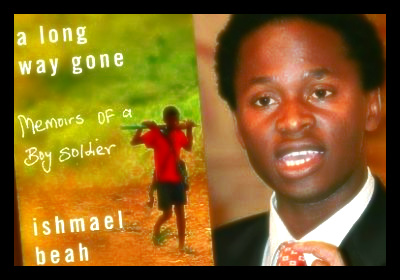
These three African men have used their horrific childhoods as fuel for activism to heal and prevent the abuse of future children.
Ishmael Beah – Author and UN Ambassador
During Sierra Leone’s civil war, which lasted from 1991 to 2002, 12-year-old Beah became separated from his family and wandered the country with a group of other children. The group stumbled across a battalion of anti-rebel soldiers and the children were taken in and taught to kill.
Beah was rescued by UNICEF after living as a soldier for two years, and was taken to a rehab center where he struggled for eight months to remember who he was before the war. When he was 17, Beah was adopted by a member of UNICEF as a means to get out of Sierra Leone and attend school.
It was during his time at Oberlin College in Ohio that he wrote “A Long Way Gone: Memoirs of a Boy Soldier,” which Beah claims he never meant to publish, but wrote to “find a way to give the human context that was missing in the way the issue of child soldiers were discussed.” His book has become a best-seller, and Beah has recently released his second book, “Radiance of Tomorrow.”
Beah is now a UN ambassador for children affected by war, and he travels with UNICEF to work with former-child soldiers. He remembers what it was like to suddenly find himself expected to be a kid again, and he wants former child-soldiers to know that they have options – that they can choose to live a life devoid of war.
Ricky Anywar Richard – Founder of Friends of Orphans (FRO)
At 14, Ricky was forced to watch as his entire family was corralled into their house, locked in, and burned alive. He was then bound into a service of slavery for the Lord’s Resistance Army (LRA) of northern Uganda where he regularly witnessed torture, rape, and murder.
He was one of the few who managed to escape and, after obtaining his degree, he set up Friends of Orphans (FRO), an organization that works to reintegrate former child-soldiers back into village life and provide them with the therapy and education necessary to become peaceful members of society. So far, the organization has helped 25,000 children attend school and learn a trade.
The organization also educates those with HIV/AIDs on how to deal with their disease and prevent further transmission. They have distributed over 100,000 condoms since beginning the program.
FRO has been awarded the John Templeton Foundation ‘Freedom Award’ and Ricky was awarded the ‘World of Children Humanitarian Award’ for his tireless work to provide a life for those who’ve had theirs stolen by war.
Emmanuel Jal – Musician, Activist & Founder of Gua Africa
Growing up in south Sudan, Jal was 7 when his father left to join the Sudan People’s Liberation Army (SPLA), his mother was killed by soldiers and he saw his aunt raped. He was promised an education in Ethiopia as part of a group of kids, but upon arrival they were forced to become soldiers of the SPLA.
After nearly five years living as a soldier, Jal was rescued by British aid worker Emma McCune, who smuggled him into Kenya. When McCune was killed, Jal completed his education and now makes it his life’s work to share his story and is an advocate for the Make Poverty History campaign, the Coalition to Stop the Use of Child Soldiers and the Control Arms campaign.
Jal has made a name for himself as a recording artist, releasing the album ‘War Child’ as well as a film and autobiographical book both under the same name. He travels the world speaking on the global issues that have played a hand in his life, and he’s most recently appeared at the TED Global Conference in Oxford.
Jal stresses that education is the only way to move forward and prevent further genocides, and has founded Gua Africa, a foundation to educate children. After being disappointed with the level of donations he recently embarked to eat only one meal a day, something he says is regular for the people in his country, and he donates the unspent money to his own organization.
-Lydia Caswell
Sources: CNN, Gariwo , Friends of Orphans , Huffington Post , Emmanuel Jal, Gua Africa
Photo: Tallawah Magazine

Human Rights Crusader: International Justice Mission
In light of Bill Gates’ recent letter that predicted the end of poverty, many are in agreement, but in order to see the end of poverty, we are required to see an end to violence.
International Justice Mission (IJM) is a global human rights agency whose mission is to protect the poor from any kind of violence, notably the kind that is not printed in newspapers or spread across the Internet.
Gary A. Haugen, the agency’s founder and president, recently published a new book titled, The Locust Effect, and writes, “The locusts of everyday violence have been allowed to swarm unabated in the developing world. And they are laying waste to the hope of the poor.”
Since 1997, Haugen and International Justice Mission have represented thousands of victims of violence in Africa and Latin America as well as South and Southeast Asia. The people they have helped are victims of rape, slavery, sex trafficking, police brutality, a lack of property rights, and other crimes.
Before founding International Justice Mission, Haugan worked as a lawyer at the United States Department of Justice and as the Investigator in Charge for the United Nations after the Rwandan genocide. He founded the organization to fulfill a need to provide healthcare, education, food and other necessary services to the world’s poor. Haugan realized that many of these individuals were victims of violence as well and that they were not receiving the proper resources and assistance to stop the perpetrators.
Today, International Justice Mission has over 500 lawyers, social workers, investigators and others who help to fulfill the need to protect the impoverished. It has made its duty to combat human violence, or “violence that strips widows and orphans of their property and livelihoods, violence that steals dignity and health from children trafficked into forced prostitution, violence that denies freedom and security to families trapped in slavery.”
This commitment to end violence, in forms of both oppression and injustice, is becoming even more important in regard to seeing an end to poverty. In many of the most impoverished areas of the world, the people who need the most help are not able to receive it because the justice systems in their areas are unable to protect them.
The atrocities that many would consider both tragic and heartbreaking are a common occurrence for those who live in the poorest areas of the world. It is estimated that the world’s poorest 4 billion people are unable to receive protection from their country’s justice system.
Without proper protection, it is even more difficult for those in poverty to have a better life, as they are still subject to violence that can take them out of their homes and forever negatively impact their lives.
This kind of abuse and gross injustice can no longer be ignored and International Justice Mission seeks four outcomes for these victims: victim relief, perpetrator accountability, survivor aftercare, and structural transformation.
In order to end the inequality and poverty around the world, we must first end the violence that has left so many to suffer injustices every day.
– Julie Guacci
Sources: Forbes, The Huffington Post
Photo: wbdcflblog
3 Extraordinary Former Child Soldiers
These three African men have used their horrific childhoods as fuel for activism to heal and prevent the abuse of future children.
Ishmael Beah – Author and UN Ambassador
During Sierra Leone’s civil war, which lasted from 1991 to 2002, 12-year-old Beah became separated from his family and wandered the country with a group of other children. The group stumbled across a battalion of anti-rebel soldiers and the children were taken in and taught to kill.
Beah was rescued by UNICEF after living as a soldier for two years, and was taken to a rehab center where he struggled for eight months to remember who he was before the war. When he was 17, Beah was adopted by a member of UNICEF as a means to get out of Sierra Leone and attend school.
It was during his time at Oberlin College in Ohio that he wrote “A Long Way Gone: Memoirs of a Boy Soldier,” which Beah claims he never meant to publish, but wrote to “find a way to give the human context that was missing in the way the issue of child soldiers were discussed.” His book has become a best-seller, and Beah has recently released his second book, “Radiance of Tomorrow.”
Beah is now a UN ambassador for children affected by war, and he travels with UNICEF to work with former-child soldiers. He remembers what it was like to suddenly find himself expected to be a kid again, and he wants former child-soldiers to know that they have options – that they can choose to live a life devoid of war.
Ricky Anywar Richard – Founder of Friends of Orphans (FRO)
At 14, Ricky was forced to watch as his entire family was corralled into their house, locked in, and burned alive. He was then bound into a service of slavery for the Lord’s Resistance Army (LRA) of northern Uganda where he regularly witnessed torture, rape, and murder.
He was one of the few who managed to escape and, after obtaining his degree, he set up Friends of Orphans (FRO), an organization that works to reintegrate former child-soldiers back into village life and provide them with the therapy and education necessary to become peaceful members of society. So far, the organization has helped 25,000 children attend school and learn a trade.
The organization also educates those with HIV/AIDs on how to deal with their disease and prevent further transmission. They have distributed over 100,000 condoms since beginning the program.
FRO has been awarded the John Templeton Foundation ‘Freedom Award’ and Ricky was awarded the ‘World of Children Humanitarian Award’ for his tireless work to provide a life for those who’ve had theirs stolen by war.
Emmanuel Jal – Musician, Activist & Founder of Gua Africa
Growing up in south Sudan, Jal was 7 when his father left to join the Sudan People’s Liberation Army (SPLA), his mother was killed by soldiers and he saw his aunt raped. He was promised an education in Ethiopia as part of a group of kids, but upon arrival they were forced to become soldiers of the SPLA.
After nearly five years living as a soldier, Jal was rescued by British aid worker Emma McCune, who smuggled him into Kenya. When McCune was killed, Jal completed his education and now makes it his life’s work to share his story and is an advocate for the Make Poverty History campaign, the Coalition to Stop the Use of Child Soldiers and the Control Arms campaign.
Jal has made a name for himself as a recording artist, releasing the album ‘War Child’ as well as a film and autobiographical book both under the same name. He travels the world speaking on the global issues that have played a hand in his life, and he’s most recently appeared at the TED Global Conference in Oxford.
Jal stresses that education is the only way to move forward and prevent further genocides, and has founded Gua Africa, a foundation to educate children. After being disappointed with the level of donations he recently embarked to eat only one meal a day, something he says is regular for the people in his country, and he donates the unspent money to his own organization.
-Lydia Caswell
Sources: CNN, Gariwo , Friends of Orphans , Huffington Post , Emmanuel Jal, Gua Africa
Photo: Tallawah Magazine
Africa’s Sahel Region in Need
In February 2014, the UN pleaded with aid organizations to meet a $2 billion challenge in order to face a food crisis in Africa’s Sahel region that could affect over 20 million people.
Africa’s Sahel region divides the Sahara Desert from the Sudanian Savanna, spanning the width of the African continent, and has, in recent years, been damaged by a process known as desertification. Desertification is caused by poor agricultural practices and natural soil erosion. Additionally, a combination of population growth, drought, and conflict has put the already vulnerable region at risk.
Of the 20 million food insecure inhabitants, 5 million are children at risk of acute malnutrition. Already, nearly 577,000 children die each year of malnutrition in the Sahel.
UN officials are especially concerned about the Sahel because, in 2013, donors only offered about 60% of the requested $1.7 billion. They argue that another shortfall would prove catastrophic for many of the region’s most vulnerable.
The requested $2 billion would fund a three-year development plan that includes the countries of Burkina Faso, Cameroon, Chad, Gambia, Mali, Mauritania, Niger, Nigeria and Senegal. The UN seeks to work with the governments of the Sahel in conjunction with international aid organizations to address the root causes of conflict and famine in the region in order to make the Sahel more food secure.
This is the first multi-year plan for the Sahel, and it represents a shift in the way the UN deals with food security issues.
In September of 2013, the UN Humanitarian Coordinator for the Sahel, Robert Piper, said of the situation, “Business as usual doesn’t cut it . . . One of the problems we have today is that governments tend to want to fund food and nutrition . . .They are much more reluctant to fund, say, agriculture or water and sanitation inputs.”
Piper argued for the development of long-term solutions as the only option for the people of the Sahel.
Many of the food insecure are those who have been displaced by conflict. Violence in the Central African Republic, Sudan and Nigeria has lead to more than 730,000 refugees spilling into the region and some 495,000 displaced internally.
Without a plan to resolve these conflicts and care for the refugees, the continuing costs and caseload will become too great for the UN, Piper claimed.
– Chase Colton
Sources: UN News Centre, New York Times, BBC, UNOCHA Sahel, UNOCHA Piper
Photo: Reuters
Bill Nye, the “Science (Poverty) Guy”
The media’s coverage of the February 4 debate between Bill Nye and Ken Ham overshadowed another important issue Nye highlighted on January 30: global poverty. The 2 minute video features Bill Nye discussing commonly believed myths about poverty.
MYTH #1: The United States spends 25 percent of its budget each year on foreign aid.
Bill Nye compares the federal budget to a dollar bill. Though some people assume that the budget is a quarter, it is actually less than a penny. “You can’t even cut a coin small enough to represent how much money is spent on foreign aid. It’s not that much,” said Nye.
REALITY= The US spends 0.8 percent of its budget each year on foreign aid.
MYTH #2: Wars & natural disasters kill more people than anything else.
“This idea that wars or natural disasters, tsunamis, earthquakes, kill most of the people – that’s wrong. It pales, it’s dwarfed by the number of people killed by preventable diseases,” Bill Nye said.
Children are dying every day. Though progress has been made in global health, there are still deaths all over the world. Those in poverty are at an even higher risk of dying.
Health and economic advancements have allowed people to combat this risk. However, preventable diseases continue to represent 7 out of the 10 leading causes for child mortality. It accounts for 83 percent of child deaths, with non-communicable diseases at 11 percent and injuries at 6 percent. “This is where we can change the world,” said Bill Nye.
REALITY= The leading cause of death for children under the age of 5 is preventable disease (communicable diseases, birth problems, nutrition.)
MYTH #3: U.S. citizens give money to Africa and nothing changes.
“People think that we’ve been sending money to Africa for decades and nothing’s improved; things are as bad as they ever were.” Approximately 10.5 million children under the age of five die every year. In 1970, that number was 17 million.
The most impressive declines occurred in countries that showed considerable economic improvement, making our monetary contributions a positive piece of the puzzle. Foreign aid has helped these people.
REALITY= That money has been making positive changes, like cutting child mortality in half within the past few decades.
“We have a real opportunity to leave the world better than we found it, to dispel these myths and move on to improve the quality of life of people everywhere,” said Bill Nye. “So let’s prevent the diseases. Let’s address a preventable disaster.”
– Samantha Davis
Sources: NPR, YouTube, World Health Organization
Photo: Brandon Hill Photos
Maternal, Newborn & Child Health 101
Maternal and Child Health Definitions
Maternal health refers to the health of women during pregnancy, childbirth and post partum. Neonatal or newborn health refers to the health of infants in their first six months of life child health in this context usually refers to young children in their first six years of life.
Maternal mortality
In the developing world pregnancy and childbirth can often cause severe complications including hemorrhage, infection, unsafe abortions, high blood pressure and obstructed labor. Unfortunately, if untreated maternal complications can lead to death. Every day approximately 800 women die from preventable conditions related to pregnancy and childbirth with 99% of these deaths occurring in the developing world; while this figure is still far too high, maternal mortality has decreased by 50% between 1990 and 2010. In 2010 287,000 women died in pregnancy or childbirth. Eighty percent of deaths are caused by infection or bleeding after childbirth, high blood pressure during pregnancy, or unsafe abortions.
Which Mothers are at Risk?
Adolescents and young women are at a greater risk than older women. The risk of pregnancy increases greatly if the girl is under 15; complications related to childbirth and pregnancy are the leading cause of death among adolescent girls in the developing world. Poor women, rural women, and women with low access to healthcare are the most at risk. Maternal mortality is strongly related to poverty and is a major health inequity. About half of all maternal deaths occur in sub-Saharan Africa and one-third occur in South Asia. In the developing world, the probability that a woman will die from causes related to pregnancy is 1 in 150; in the developed world it is 1 in 3800.
Infant Mortality
Each year 2.3 million babies are stillborn and 2.9 million die in their first year of life; the vast majority of these infants are born in developing countries. Deaths are caused by preterm birth, infections such as sepsis, pneumonia, meningitis and asphyxia during birth (when the baby does not get enough oxygen).
How Can Mothers be Saved?
These conditions are highly preventable and many of these deaths could be prevented if women had access to good and reliable healthcare. Women in poor countries lack access to trained health professionals such as midwifes, doctors or nurses, and this is why complications lead to death. There are low cost, effective treatments for mothers and infants but many women do not receive any medical care, or the healthcare providers do not have access to the tools needed to treat the women and children. With improved access to maternal health care in poor countries many women and children could be saved.
The Bill and Malinda Gates Foundation is working to bring low cost interventions such as antibiotics, sterile blades to cut umbilical cords, and drugs to treat hemorrhaging in mothers and asphyxia in infants to poor communities around the globe.
– Elizabeth Brown
Sources: WHO, The Partnership for Maternal, Newborn, and Child Health, Gates Foundation
Photo: #Y4CARMMA
Refugee Population Down, Worrying Up
The updated 2013 population figures for refugee camps on the Thai-Burmese border show a decrease of 7.1 percent, according to The Border Consortium (TBC), an NGO that works with refugees and displaced people from Burma.
A majority of the departures from the camps, 7,649, consist of refugees leaving for a third country under the UNHCR’s resettlement program, according to the Democratic Voice of Burma.
Sally Thompson, executive director of TBC states, “It is important to note that while there was a net population decrease, new refugees are continuing to arrive in the camps; there were 3,300 new asylum seekers arriving in 2013. In addition, 3,137 children were born in camps…”
Despite the decrease, it does not mean that any less food, shelter, services, health care and protection are needed. There are still 120,000 people living throughout these refugee camps that need protection and humanitarian assistance.
Data from TBC shows that out of the 4,389 people who left the camps to return to Burma, 70 percent of those departures only included one or two people from a household, while the rest of their household stayed in the camps.
In addition to worrying about what is going to happen to their families that are left in the camps, Myanmar refugees located in Fort Wayne, Indiana are worried that a change in U.S. policy will hurt efforts to reunite them with relatives living in the city. The Post-Tribune explains that Fort Wayne is home to more than 4,000 refugees from the area formerly known as Burma.
The major concern according to Minn Myint Nan Tin, the Burmese Advocacy Center leader, is that the State Department has decided to stop accepting resettlement applications from Myanmar refugees living in the nine camps across Thailand. Refugees from Myanmar have been coming to Fort Wayne since 1993 to escape military rule in their homelands.
January 24 marked the end of applications since the State Department began issuing deadlines a year ago for refugees to decide whether or not they wanted to leave the Thai camps for the United States.
Christine Getzler Vaughn, State Department spokeswoman, explains that “The resettlement program will continue until we have completed the processing of every application received by the deadline for each camp, and we expect that to happen over the next two years.”
170 refugees will be relocated to Fort Wayne with approval of the State Department during the 2014 fiscal year.
– Lindsey Lerner
Sources: Post-Tribune, DVB
Photo: South China Morning Post
ECLAC Report of Latin America and the Caribbean
The United Nations Economic Commission for Latin America and the Caribbean (ECLAC) presented a report on the economic and social panorama of the community of Latin American and Caribbean States in Havana at the 2nd Community of Latin American and Caribbean States (CELAC) summit.
The ECLAC report stated that roughly 28.2% of the total population in Latin America and the Caribbean were living in poverty, with 11.3% living in extreme poverty. In numerical terms, this means 164 million people remain in poverty, while 66 million people are still living in conditions of indigence.
The poverty rate in Latin America and the Caribbean fell 1.4% on last year, and 40.5% of children and adolescents in Latin America can be classified as either poor or extremely poor.
Countries such as El Salvador, Honduras, Bolivia, Guatemala, Nicaragua and Peru have the highest level of child poverty, averaging around 72%. In contrast, countries with the least amount of child poverty such as Argentina, Uruguay, Chile, Ecuador, Costa Rica, only 19.5% of children lived in poverty.
The poorest 5% received 5% of the total income, while the wealthiest quintile averaged 47% of total income. The regional average for unemployment fell by .1% on last year to 6.3% in 2013.
The report also highlights the record level of foreign direct investment (FDI) inflows in the region, which hit an all-time high of $174.546 billion. This is a 5.7% increase over 2011 FDI levels and is the third year in a row in which FDI levels have increased.
The greatest increases in FDI over last year occurred in Peru (49%) and Chile (32%). Brazil received the largest absolute FDI inflow, with 38% of the total for the Latin America and Caribbean region. The biggest sector for FDI investment was in services (44%), then manufacturing (30%), and finally natural resource sectors (26%).
The forecast for GDP growth across the entire Latin America region in 2014 is 2.8%, slightly down from the previous estimate of 2.9% and mainly due to sluggish growth and downward revisions in the economic forecasts for Brazil, Paraguay and Venezuela.
Emerging markets continue to brace for the negative impact on growth to come from the tapering of the Federal Reserve’s bond-buying program, which began in January and is expected to hit emerging economies used to the high liquidity available in the global financial system.
– Jeff Meyer
Sources: CEPAL, Independent European Daily Express
Photo: Fox News
Obama Addresses Decline of Opportunity in America
President Barack Obama’s 2014 State of the Union Address highlighted the growing imbalances throughout the world. In recent decades, the U.S. has depended on its military strength as a substitute for diplomacy, but the President specified the need to shift the focus to fighting extreme poverty within Africa, the Americas and the Asia-Pacific.
The President’s agenda is taking on the issue of poverty head-on.
He recognizes that to address the large inequalities we must reverse the decline of social and economic mobility. Currently, 65 percent of Americans born in the bottom fifth of incomes stay in the bottom two-fifths income class while 65 percent of top fifth stay in the top two-fifths.
A major factor that maintains this mobility gap is poverty.
Families from poor backgrounds and low economic status are at a disadvantage right from the start. Just 36 percent of kids born in the poorest households get a strong start in life compared to 70 percent for middle-income kids and 87 percent for the upper class.
With federal programs like Head Start and Race to the Top are putting an emphasis on early child development, it is critical that we create social policy that supports individuals throughout all stages of life. The Brookings Institute has identified five major life stages that we can consciously cultivate in order to increase mobility and opportunity in America.
– Sunny Bhatt
Sources: Brookings Institute, New York Times
Photo: Prague Post
10 Quotes on World Hunger
Scholars have discovered that the issue with world hunger is not a food shortage, but the logistics behind food distribution. We need to improve access to food by looking at production strategies, trade agreements and food aid. Here are 10 quotes on world hunger.
“We know that a peaceful world cannot long exist, one-third rich and two-thirds hungry.” – Jimmy Carter, 39th president of the United States.
“Close to a billion people – one-eighth of the world’s population – still live in hunger. Each year 2 million children die through malnutrition. This is happening at a time when doctors in Britain are warning of the spread of obesity. We are eating too much while others starve.” – Jonathan Sacks, jewish scholar.
“We are a country that prides itself on power and wealth, yet there are millions of children who go hungry every day. It is our responsibility, not only as a nation, but also as individuals, to get involved. So, next time you pass someone on the street who is in need, remember how lucky you are, and don’t turn away.” – Lesley Boone, actress and social activist.
“When you share your last crust of bread with a beggar, you mustn’t behave as if you were throwing a bone to a dog. You must give humbly, and thank him for allowing you to have a part in his hunger.” – Giovanni Guareschi, Italian journalist.
“When people were hungry, Jesus didn’t say, “Now is that political, or social?” He said, “I feed you.” Because the good news to a hungry person is bread.” – Bishop Desmond Tutu, Anglican bishop and social activist.
“It is important for people to realize that we can make progress against world hunger, that world hunger is not hopeless. The worst enemy is apathy.” – Reverend David Beckmann, president of Alliance to End Hunger.
“There are genuinely sufficient resources in the world to ensure that no one, nowhere, at no time, should go hungry.” – Ed Asner, actor and social activist.
“The fact is that there is enough food in the world for everyone. But tragically, much of the world’s food and land resources are tied up in producing beef and other livestock–food for the well off–while millions of children and adults suffer from malnutrition and starvation.” – Dr.Walden Bello, 2003 Right Livelihood Award winner.
“The war against hunger is truly mankind’s war of liberation.” – John F. Kennedy, 35th President of the United States.
“The first essential component of social justice is adequate food for all mankind. Food is the moral right of all who are born into this world.” – Norman Borlaug, biologist and humanitarian.
– Stephanie Lamm
Sources: Bits of Positivity, Do One Thing, Second Harvest Food Bank
3 Initiatives Empowering Middle Eastern Women
General Electric has partnered with Ashoka Changemakers to find initiatives across the Middle East and North Africa who are providing more ecomonic opportunities for women. In the Arab world, women only represent a quarter of the workforce and less than 1 in 7 businesses are owned by women.
Here are 3 initiatives in the Middle East that were recognized by General Electric and Ashoka Changemakers for their efforts to improve working conditions for Middle Eastern women:
1. Roudha Center
Roudha Center is a resource center for women looking for information to help them start their own businesses in Qatar. The center offers business, legal, and financial advice for entrepreneurial women, as well as training and programming services. Roudha focuses on young Middle Eastern women who hope to become entreupeners and encouraging them from a younger age.
On their website they are quoted, “In Qatar the arena is still fresh for women entrepreneurs, especially those who do not have existing family business setups to rely on. In general, the struggle to setup and grow a business is harder for women at this stage. Therefore, Roudha Center saw the niche and potential in helping women in Qatar in fostering their passion to open a business.”
2. Women’s Digital League
The Women’s Digital League is an organization in Pakistan that is owned and operated by women. This organization provides digital services to people who, for a variety of reasons, are unable to work away from home. WDL helps set up the infrastructure and also provides assistance with programs such as wordpress and graphic designing so women can improve marketable skills.
3. Glowork
Based in Saudi Arabia, Glowork is an organization that finds jobs for Middle Eastern women. Nearly 1/3 of Saudi women are unemployed while 75% of those women have college educations. Glowork operates by making jobs that were previously harder for women to find or apply to more accessible.
– Colleen Eckvahl
Sources: Huffington Post, Women’s Digital League, CSR Wire, Roudha.org
Photo: Patheos