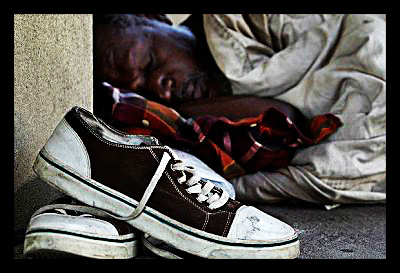
According to a report from the National Center on Family Homelessness, in 2010 there were more than 1.6 million homeless children across the span of the U.S.
Lacking any sort of permanent residency, these children often stay on the streets, in shelters, motels, cars and abandoned buildings.
At the age of five, a young boy by the name of Nicholas Lowinger visited a homeless shelter with his mother. His excitement to show his new light-up sneakers to the other children was apparent, but his mother advised him not to do so.
After interacting with the children at the shelter, Nicholas soon realized that they were living under conditions quite different from his own. Lowinger recalls seeing children whose shoes were tattered, worn, and falling apart. Or there were the extremely unfortunate individuals who had no shoes at all.
Now the age of 15, Nicholas says, “I have been very fortunate to grow up in a family that is able to provide me with whatever I need. A lot of kids here in the U.S don’t have the same opportunities.”
Following this visit Nicholas began to donate his older shoes to local shelters. Although he made an effort, he soon realized that his donations were not as helpful as he had hoped.
Due to the lasting impression that his first visit to a homeless shelter left and his desire to make a difference, at the age of 12, Nicholas began a program that donates new shoes to children who are homeless.
“Homeless children shouldn’t have to worry about how they’ll be accepted or how they’ll fit in,” Nicholas said. “They shouldn’t have to worry about not being able to play sports or go to school because they don’t have a pair of shoes.”
Initially, the program began as a part of a community service project, building up to his bar mitzvah. Noticing the difference that was being made, though, Nicholas wanted to ensure that the program would go on even after his bar mitzvah ceremony ended.
With the assistance of his parents, Nicholas began the Gotta Have Sole Foundation. Since it’s start-up, this organization has provided more than 10,000 children with new footwear, in over 21 states.
“New shoes can make a child feel good about him or herself. They gain confidence; they’re able to do better in school,” Nicholas said.
In the Lowinger family garage, one would find an abundance of new shoes that have been donated by footwear companies, stores, and individuals. Any size or style that they do not already have is acquired through the organizations monetary donations.
Over 1,000 volunteers help with this organization, and Nicholas himself works 15 hours a week on it. Nicholas thoroughly encourages young individuals to not allow their age to get in the way of achieving their dreams.
– Samaria Garrett
Sources: CNN, Gotta Have Sole
Photo: 100k Homes

Shining Brightly: The Diamond Empowerment Fund
Africa is home to some of the world’s largest diamond mines, with 11 countries throughout the continent engaging in diamond extraction industry. The diamond industry has been a major source of wealth for nations like Botswana, South Africa and Angola. Approximately $8.5 billion of the $13 billion in rough diamonds are produced in Africa, while global diamond jewelry sales total $72 billion per year. In recent decades, the industry has been under intense scrutiny for some of the barbaric conditions in which the diamond mines operate.
To gain control of diamond mines, rebel groups, governments, and corporations, have battled each other often engaging in war-like tactics to extract the coveted resource. The Hollywood film “Blood Diamonds” has featured this conflict and helped raise awareness for the millions of Africans who have been killed, injured or displaced throughout the years.
In 2007, in response to this struggle, Hip Hop legend Russell Simmons and leaders of the Diamond and Jewelry industry created the Diamond Empowerment Fund (DEF.) The DEF hopes to transform and empower individuals and societies within the diamond producing countries through education. To accomplish this mission, the Diamond Empowerment Fund will work with partners in the industry to create innovative product designs where sales help support education initiatives.
DEF partners include Dalumi Group, Malca-Amit, Leo Schachter, Exelco Group, and Tiffany & Co. These partners offer diamond jewelry and other products that give customers the satisfaction of contributing to Diamond Empowerment Fund education initiatives.
Three major organizations that serve as beneficiaries for the DEF include CIDA City Campus, the African Leadership Academy (ALA) and Botswana Top Achievers. The DEF has been able to empower 1,800 students through its three beneficiary organizations.
In 2009, the Diamond Empowerment Fund made its first grant available to students at the ALA. The $4.2 million grant funds the DEF Scholars Scholarship Program. 28 students throughout the continent were able to attend universities such as Harvard, Yale, Cornell and Duke, among others. On the Diamond Empowerment Fund website, one can read stories from individual students that have benefited from the charity of the DEF and its partners.
The DEF also sponsors the GOOD Awards, which recognizes individuals and corporations that exemplify outstanding leadership in promoting sustainable development, good corporate citizenship and economic opportunity within Africa. In its third year, the GOOD Awards featured dozens of celebrities and diamond industry executives to raise money in support of the DEF.
As the Diamond Empowerment Fund continues to grow, thousands of children across Africa will get the opportunity to transform into future leaders and help their countries prosper.
– Sunny Bhatt
Sources: World Diamond Council, GOOD Awards, Diamond Empowerment Fund
Photo: DW
Climate Change: A New Corporate Interest
In the past year, 131 climate change bills were introduced in the 113th United States Congress. This total exceeds the number of climate change bills introduced in the entire 112th Congress with another full year still to go. There is a renewed sense of confidence in the fight against climate change and now it seems the corporate world is beginning to react.
Due to increased droughts, flooding and generally unpredictable weather patterns, major corporations are feelings the impact of climate change. The Coca-Cola Company, which relies on sugar cane, sugar beets and other agricultural products from Asia and South America, has had to adjust their strategy and recognize the economic cost of climate change.
Nike Inc., another corporate giant with hundreds of factories around the world, has been forced to adjust to lower cotton yields and commodity price volatility. Many of Nike’s factories are located in South East Asia, a region particularly vulnerable to climate change phenomena.
In 2008, due to floods, Nike had to shut down four factories.
This year, the 2014 World Economic Forum (WEF) held in Davos, Switzerland has climate change on its agenda.
A meeting of corporate leaders and politicians from around the world has designated a full day to guest panels and talks regarding climate change and promoting their respective economic interests. The aim is to build resilience and foster sustainable development through public-private partnerships.
The economic disruption affects companies in various major sectors, from agriculture to energy to manufacturing. During the 2014 WEF meeting, the World Bank Group President Jim Yong Kim declared this year as “the year of action on climate change.” President Kim expressed the urgency of putting a price on carbon while increasing the market for green bonds, a financial tool that seeks to stimulate and coordinate public and private sector activity to combat climate change.
Despite the added support of some corporate leaders, a significant amount of work still remains. Even with this support, it is clear that government action needs to be the main pillar beneath this movement. Climate change denial in politics must be dealt with and American’s will have their opportunity to do so through the November elections.
Just ahead of the elections, the UN will host a meeting of world leaders in New York to discuss climate change in hopes to make progress before the planned 2015 summit in Paris where leaders hope to strike an international deal on cutting carbon emissions. Past meetings and summits have come up empty but the new year brings much needed hope and optimism for everyone fighting for climate change solutions.
– Sunny Bhatt
Sources: New York Times, World Bank Group, The Guardian
Photo: Green Packs
Ethiopia Takes Stand for Education
In September 2012, Secretary General of the United Nations Ban Ki-moon launched the Global Education First Initiative (GEFI.) Operating under the principle that access to education is the number one factor for promoting global development, the Initiative strives to represent the 250 million children worldwide who struggle with some form of illiteracy. The initiative fights for three priorities: placing every child in school, improving the quality of learning and fostering global citizenship.
A key component of achieving these initiatives is appointing “Champion Countries” to spearhead global education. And, on January 29, the GEFI welcomed its newest Champion Country: Ethiopia.
Ethiopia’s progress in promoting education is tremendous. In 1994, roughly three million children were enrolled in primary school throughout the country. By 2009, that number had risen to an astounding 15.5 million. And, as of 2011, 87 percent of children were enrolled in school.
Crucial to the impressive strides made for education is the nation’s financial investment in schooling. Over the past decade, the Ethiopian government has doubled the allotted funds for education in the budget while allowing for more local control over school administration. This combination of financial stability and autonomy has also increased educational opportunities for young girls. As of 2009, 90 percent of school-age girls were enrolled in school.
“The movement to get more children into school is unstoppable,” says Hailemariam Desalegn, Prime Minister of Ethiopia. “Now our big challenge is to give those children the best teaching possible.” With governmental support of education at an all time high in Ethiopia, incentives for teaching are increasing. Although there are still roadblocks to hurdle, Ethiopia’s role as a Champion Country ensures education will continue to be a priority for the nation.
– Taylor Diamond
Sources: ONE, Global Education First
Photo: nationsencyclopedia
Food Crisis in South Sudan
On July 9, 2011, the Republic of South Sudan gained independence from Sudan. Since then, the newly formed nation has been engulfed in internal conflicts, claiming the lives of up to 10,000 people. The violence has caused over 870,000 South Sudanese to flea their homes, of which over 140,000 have escaped to neighboring countries.
The displacement has disrupted the nations already unstable agriculture sector. Markets have been disrupted as the food supply chain is broken and foreign investors try to avoid the conflict. According to United Nations estimates, 3.7 million people were already facing food insecurity, but the new wave of violence that erupted in December of 2013 has raised this figure to almost 7 million. There is a major food crisis in South Sudan.
The timing of the conflict could not have been worse as local farmers are gearing up to plant their crops for the incoming season. Constant relocation is forcing millions to rely on scarce food aid. In some cities like Malakal, desperate populations have begun raiding aid supply stored in warehouses. The UN Food and Agriculture Organization (FAO) warned that if farmers miss the planting season, it would compound food insecurity issues for this year and 2015.
Farmers that remain tied to their land are facing a shortage of agriculture inputs such as seeds and tools to cultivate their crops. The FAO is seeking $77 million to assist the Republic of South Sudan in implementing an emergency response plan. Their aim is to deliver farming tools, seeds and fishing equipment to 545,000 households in some of the more war-torn states of the country. The FAO has collected just 6 percent of its total donation goal.
To complicate matters further, migrant animal herds are now intermingling with displaced human populations and their livestock. These unvaccinated animals have potential to transmit disease and cause further complications for public health and food safety initiatives. To combat the collapse of the vaccine supply chain, the FAO is working to build capacity within local communities and deliver basic health support.
The UN mission in South Sudan is increasing its support with 266 peacekeepers being flown in on February 4, 2014. In total, the UN has over 12,500 peacekeepers and 1,323 police on the ground. The UN through the FAO and the World Food Program have teamed up with ACTED, OXFAM, Save the Children, Concern Worldwide, Mercy Corps, and Joint Aid Management to provide much needed assistance throughout the country.
For anyone seeking to get involved in the food crisis in South Sudan, through volunteering and donations, please visit the World Food Program.
– Sunny Bhat
Sources: New York Times, UN News Center, BBC
Photo: WFT
Poverty in South America
Poverty in South America is considered living on $4 per day.
The northern tip of the continent (the countries closest to Panama) are the countries with the largest headcount of impoverished people in South America; they range from 20 percent to 40 percent of the population. Guyana and Suriname range between 46 percent and 53 percent of the continent’s population living on $4 per day; some live on less than that amount.
The southern half of South America has a much lower percentile of the population living below the poverty line, excluding Bolivia, which is at a steep 48 percent. Chile and Uruguay are at 11 percent and Argentina is at 7 percent.
Poverty in South America has declined within the last two decades. In 1990, 12.2 percent of the population was living on $1.25 per day; that number has dropped to 5.5 percent despite the population’s rising from 422.3 million in 1990 to approximately 581.4 million.
The main target of poverty in South America is the rural population and this is due to the increasingly warm temperatures and global warming’s affect on agricultural areas. 20 million people living in Brazil live in the barren parts of the country. The poorest people in South America are the native people of Ecuador, Bolivia and Peru who live in the mountainous Andes regions.
Many people have moved to large cities in search of employment, but 35 percent of the region’s poorest still live in the rough climate of the Andes Mountains.
Rural poverty is caused not only by the drastic changes brought on by global warming, but also because of the “lack of access to and unequal distribution of productive land, and inadequate access to information and productive assets for smallholder farmers.” Geographically, many living in rural areas have very little access to other people, which can make selling food and obtaining agricultural necessities difficult.
During recent years, governments have adopted policies that have led to a decline in interest and investments for rural farmers, which has been a factor in the increase of rural poverty in South America and the decrease of housing, health providers and education available to smallholder farmers.
– Rebecca Felcon
Sources: Rural Poverty Portal, World Bank
Photo: Merco Press
Poverty in Honduras Taking an Extreme Toll
Poverty in Honduras remains an issue. Honduras is the second-poorest country in Central America. With a population of approximately eight million people, poverty in Honduras affects roughly 60 percent of these individuals.
Out of 187 countries, Honduras ranked 121 on the United Nations Development Programs 2011 Human Development Index. This index is a “comparative measure of life expectancy, literacy, education, and standards of living for countries worldwide.”
Majority of the poverty in Honduras is reserved for the more rural areas. With 36 percent of the population living under conditions of extreme poverty overall, 50 percent of rural individuals live under these terms.
Over 64 percent of Hondurans live below the poverty level of $2 per day, according to Proyecto Mirador, a website that highlights the poverty in Honduras and what can be done about it.
Under- and unemployment rates in Honduras reside at 36 percent. The majority of families lack access to clean water and access to medical care or electricity is slim to none.
Rural Poverty in Honduras
Around 75 percent of the rural population lives in the central hillside areas in the interior highlands; this is also where majority of poverty in Honduras is the most prevalent.
An extremely evident force behind the country’s high level of emigration is the lack of employment opportunities in rural Honduras. With 28 percent of the country being agricultural land, 39 percent of the population is employed by the agricultural sector. However, the terrain in Honduras is extremely susceptible to erosion, causing much of the land to have come eroded over time. As a result of this, productivity has decreased immensely.
Natural disasters, such as hurricanes and floods, also plague Honduras. In 1998, Honduras was the victim of Hurricane Mitch, which destroyed much of the economic and social infrastructure in the country. This set back the economic advancement of Honduras for quite some time.
Subsistence farmers make up 70 percent of farming families. With extremely restricted access to land, these farmers depend on finding off-farm employment or remittances from other family members to support themselves.
Small-scale farmers “have access to more land and generally produce basic food crops, but many are forces to seek off-farm work in order to survive.”
Honduras stands as the country with the most unequal distribution of income in the region, according to the Washington-based Center for Economic and Policy Research. The majority of the wealth in Honduras is controlled by few families and national assets are treated as personal patrimony.
Aside from the extreme poverty that hinders Honduras’s growth, a surge in violence in recent years has resulted in the killings of politicians, human rights advocates, labor activists, journalists, and others. The road to improvement for Honduras is a long and enduring one, but the most important step will begin with socioeconomic equality.
– Samaria Garrett
Sources: Rural Poverty, Proyecto Mirador, LA Times
Photo: Pulitzer
Shoes for the Homeless: Putting Their Best Foot Forward
According to a report from the National Center on Family Homelessness, in 2010 there were more than 1.6 million homeless children across the span of the U.S.
Lacking any sort of permanent residency, these children often stay on the streets, in shelters, motels, cars and abandoned buildings.
At the age of five, a young boy by the name of Nicholas Lowinger visited a homeless shelter with his mother. His excitement to show his new light-up sneakers to the other children was apparent, but his mother advised him not to do so.
After interacting with the children at the shelter, Nicholas soon realized that they were living under conditions quite different from his own. Lowinger recalls seeing children whose shoes were tattered, worn, and falling apart. Or there were the extremely unfortunate individuals who had no shoes at all.
Now the age of 15, Nicholas says, “I have been very fortunate to grow up in a family that is able to provide me with whatever I need. A lot of kids here in the U.S don’t have the same opportunities.”
Following this visit Nicholas began to donate his older shoes to local shelters. Although he made an effort, he soon realized that his donations were not as helpful as he had hoped.
Due to the lasting impression that his first visit to a homeless shelter left and his desire to make a difference, at the age of 12, Nicholas began a program that donates new shoes to children who are homeless.
“Homeless children shouldn’t have to worry about how they’ll be accepted or how they’ll fit in,” Nicholas said. “They shouldn’t have to worry about not being able to play sports or go to school because they don’t have a pair of shoes.”
Initially, the program began as a part of a community service project, building up to his bar mitzvah. Noticing the difference that was being made, though, Nicholas wanted to ensure that the program would go on even after his bar mitzvah ceremony ended.
With the assistance of his parents, Nicholas began the Gotta Have Sole Foundation. Since it’s start-up, this organization has provided more than 10,000 children with new footwear, in over 21 states.
“New shoes can make a child feel good about him or herself. They gain confidence; they’re able to do better in school,” Nicholas said.
In the Lowinger family garage, one would find an abundance of new shoes that have been donated by footwear companies, stores, and individuals. Any size or style that they do not already have is acquired through the organizations monetary donations.
Over 1,000 volunteers help with this organization, and Nicholas himself works 15 hours a week on it. Nicholas thoroughly encourages young individuals to not allow their age to get in the way of achieving their dreams.
– Samaria Garrett
Sources: CNN, Gotta Have Sole
Photo: 100k Homes
Challenges to Development in India
Development in India faces many challenges despite being one of the fastest growing economies in the world. In fact, two-thirds of students in the government public schools in India cannot even read a simple story. To put it into a better perspective, the poverty levels across India can range from anywhere worse than Malawi to better than Mexico, so there is still a large range of development that can happen through foreign aid.
India has spent a large amount of its funds in an attempt to lower infant mortality rates, but has spent more and achieved less than Bangladesh. In 1980, India had much more infrastructure than China and now it has completely reversed, with China leading radically.
It is vital that the fastest growing economy in the world does not leave behind its youth. The majority of young people’s lives in India are hindered from progress by preventable health issues like malnutrition, lack of education about HIV and how to prevent it and restricted access to health care and reproductive/sexual health services. Also, the youth of India struggles with gaining a more influential role in the decision-making process. There are many issues with gender disparity in employment and education; in addition, there is a lack of career guidance for youth.
Development in India faces two main challenges today, the first being it needs to find a way of sustaining rapid growth while spreading its benefits more widely among the entire population. The best way to maintain the rapid growth that has been occurring in India for years is to invest in the infrastructure in order to create more jobs for the lower-class, which is comprised largely of less-educated, semi-skilled workers.
In doing this, policies need to be put into place to empower the poor to be a part of the market, to restore labor regulations, and to improve both infrastructure and agronomic technology.
The other main challenge facing India today is it needs to refine its core public services. It is crucial that the people of India empower their well-being so they can reform and create more operational systems of public sector accountability. By doing so, they can improve their education, power supply, water supply and overall health care. This can be done by producing reliable information for the general public, creating public-private partnerships or decentralizing to local governments.
A great way to kick-start this development in India is to get the news out there and get support. The former first lady of France, Valerie Trierweiler, visited the Dharavi slum in Mumbai, India on January 27. She was there working with the Nutrition Rehabilitation and Research Center and the Action Against Hunger (ACF) to advocate for human rights and combat undernourishment in children. She plans to commit herself to humanitarian work.
– Kenneth W. Kliesner
Sources: Restless Development, The World Bank
Photo: The Wall Street Journal
The Life of Albinos
United Kingdom native, Harry Freeland was inspired to spread awareness of albinism through a film documentary after his first encounter with the condition in Senegal. “A woman approached me in the street, held out her [albino] child and said ‘here, take it back, where it comes from.’ [B]ecause I’m white, she thought the child belonged to me in some way–her husband had left her for having a white child and accused her of sleeping with a white man,” said Freeland.
Albinism, a total lack of pigmentation in hair, skin and eyes, can affect people of every race, but is particularly prevalent in Tanzania and throughout East Africa, where it’s estimated that one in every 2,000 people are affected with it. The condition is passed to a child when both parents carry the gene, regardless of whether the parents have albinism themselves.
The real danger for those with albinism isn’t their heightened vulnerability to the sun, but the stigma that still exists concerning the potentially magical qualities of their body parts in potions and rituals performed by witch doctors. The miseducation and superstition surrounding individuals with Albinism has created a horrific market for their body parts in Eastern Africa. Many regions still believe that spells done with an albino’s hand, foot, breast or genitals will result in great wealth or miraculous healing.
Men with HIV/AIDS have been known to rape albino girls in the hope of curing their disease, and children with albinism are regularly kept home from school for fear that they will be attacked during their walk. Mothers are regularly blamed of sleeping with white men or devils to have produced a white baby, and many women prefer to kill or abandon their albino children rather than face the hardship of living with them.
Freeland’s film, “In the Shadow of the Sun”, follows Josephat Torner, a man with albinism, who has spent his life trying to break through the social stigmas surrounding his condition. Despite faces immense social injustice, Torner received his education, started a family, and climbed Africa’s tallest mountain, Kilimanjaro.
Torner and Freeland believe in fighting the mythologies of albinism by demonstrating to people the truth of the condition. The education and integration of albino children into society as working citizens, as well as the punishing of those who hunt them, is the only way to eradicate this dehumanizing practice.
– Lydia Caswell
Sources: Vice, CNN, UN News Center
Photo: National Geographic
4 Years After Earthquake, Haiti Tries to Rebuild
In January of 2010 Haiti was hit by a devastating earthquake that killed over 100,000 people. There was an immediate outpouring of relief for the beleaguered island nation, with supplies and relief workers pouring in to help rebuild. Four years later there is still a lot of work to be done in the nation and the aid relief that came in 2010 is not available now.
Immediately following the earthquake there were 1.5 million Haitians living in tent cities, and while that number is currently down to 146,000 people the country is hurting to relieve those displaced citizens. There is a sense that the United States and United Nations have failed the Haitian people considering the massive problems that still exist in the country and Haitians face on a daily basis.
Obviously one of the biggest issues facing post-earthquake Haiti was the shortage of safe housing with the million Haitians displaced. According to a Center for Economic and Policy Research (CEPR) study, only 7,515 houses had been built in Haiti out of a planned 15,000. This points to a lack of money gone directly through the Haitian government and being used as efficiently as it could be.
The lack of safe housing has kept many in the refugee camps that were set up for temporary use after the earthquake, but the pressure put on those administering the camps has caused the Haitian government to make some drastic decisions. In December of 2013 at least 54,000 people had been removed from camps in Canaan, a suburb of the capital of Port-Au-Prince, according to a CEPR report. That was the largest example of a series of forced evictions from these camps in 2013. The UN Refugee Agency has not extended Internally Displaced Person (IDP) protections to those in Haiti’s camps, leaving them at the whim of the government.
Part of the problem with the still-standing IDP camps is the risk for spreading disease compacted by unsanitary conditions. Cholera outbreaks have been pandemic over the last few years with thousands falling victim to the disease though it had never been reported in the nation prior to the earthquake. Over 8,000 people have died of cholera in Haiti during that that time, with 65,000 cases being reported in 2013 alone.
Since cholera had never been an issue in Haiti prior to the earthquake, there was no infrastructure to deal with the disease. While agencies and aid groups from other nations have been brought in to deal with these problems as they arise, some Haitians feel that they have just made the cholera crisis worse. In October the Institute for Justice and Democracy in Haiti (IJDH) filed a lawsuit against the United Nations claiming their practices inadvertently caused and exacerbated the epidemic. Over 5,000 Haitians were listed as plaintiffs in the suit.
There is still much work to be done in Haiti, a nation that was in dire straits even before the 2010 earthquake. There are clearly still many Haitians suffering in the aftermath of the quake, and it does not help that outside assistance has been at times hard to come by and misdirected. The situation in Haiti points to the importance of outside assistance and the need to sustain efforts well after an event like the earthquake happens. It goes to show that the events of today have far-reaching consequences and must be kept on aid agendas well after public shock has subsided.
– Eric Gustafsson
Sources: YouTube, Amnesty International, CEPR, Washington Post
Photo: The Washington Post