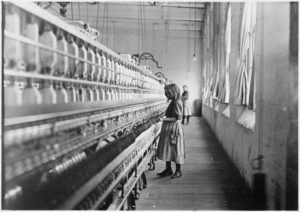
Children have always been a source of cheap labor, and the United States is no exception. This article recounts the history of child labor in the United States, and the steps taken to fight against its practice.
A History of Child Labor in the United States
In the colonial period, child labor was commonplace. Children were expected to assist their parents and work on the family farm. Young boys (ages 10-14) later became apprentices in different trades.
The Industrial Revolution, however, marked a new level of intensity for young workers. Children spent all day in factories with poor and dangerous conditions. Their small size allowed them to climb in and out of old factory machines. In addition to factory work, some employers used children in mines. These young workers were preferred because they were easy to control and direct. Salaries for children were also much less than those for adult workers. The large influx of immigrants into the United States in the mid 1800s led to an additional increase in child labor.
The most common reason for child labor in the United States during the Industrial Revolution was to support the family. Instead of going to school, children went to work in factories. During the nineteenth century some attempts were made to reform child labor laws and improve general working conditions. Education reformers promoted the idea that getting a primary school education was necessary to achieve self-advancement and a stronger nation. As a result, a number of states began to implement minimum wage and school attendance laws. However, they contained many loopholes and were rarely enforced.
American reformers have been actively working to fight child labor in the United States since the early 1900s. In 1904, the National Child Labor Committee was established. Along with smaller state child labor committees, the national chapter adopted a policy of “mass political action”–research reports, investigations by experts, dramatic photographs depicting oppressed children in factories, active lobbying, pamphlets, mass mailings and leaflets. However, progress was slow and often frustrating.
Committees identified state legislatures as the best vehicle to achieve reform. During the Progressive Era, many state laws regulating child labor were passed. Due to resistance from the southern states, federal child labor bills were later passed through Congress in 1916 and 1918. However, the Supreme Court ruled that they were unconstitutional.
Reformers decided to lobby for an amendment that would permit the government to pass a federal child labor law. The proposed amendment was passed through Congress in 1924, but several states failed to ratify it because of the conservative political environment at the time. Once the Great Depression hit America in the 1930s, child labor nearly disappeared as all the jobs went to adults instead of children. The National Industrial Recovery Act further placed regulations on child labor, and the Fair Labor Standards Act set federal minimum wage and maximum work hours. Children under 16 were not permitted to work in the manufacturing and mining sectors.
Due to the advancements in factory technology and the increase in required years of schooling, the issue of child labor has become largely insignificant. Violations of child labor laws still occur today, but the United States has definitely come a long way – “one of the more remarkable changes in the social and economic life of the nation over the last two centuries.”
Given its own struggle with child labor, the United States has taken action to end it abroad through initiatives like the Office of Child Labor, Forced Labor, and Human Trafficking (OCFT) – a division of the U.S. Department of Labor’s Bureau of International Labor Affairs (ILAB). The OCFT was founded in 1993 as part of a congressional request to investigate and report on child labor practices around the world. Using research conducted by the OCFT, ILAB maintains a list of international goods produced by child labor or forced labor: fireworks from China, corn from Bolivia, bricks from Burma, carpets from India, garments from Argentina and more. In addition to publishing reports like “Findings on the Worst Forms of Child Labor,” the OCFT assists with the development of labor legislation and supports relevant projects; so far, more than 270 projects have been funded, benefiting children in over 90 countries. Through the OCFT, the United States hopes to collaborate with other nations in order to strengthen the enforcement of child labor laws and raise global awareness of the issue.
– Kristy Liao
Sources: ContinueToLearn, Department of Labor 1, Department of Labor 2, History
Photo: Flickr

Child Labor in the United States
Children have always been a source of cheap labor, and the United States is no exception. This article recounts the history of child labor in the United States, and the steps taken to fight against its practice.
A History of Child Labor in the United States
In the colonial period, child labor was commonplace. Children were expected to assist their parents and work on the family farm. Young boys (ages 10-14) later became apprentices in different trades.
The Industrial Revolution, however, marked a new level of intensity for young workers. Children spent all day in factories with poor and dangerous conditions. Their small size allowed them to climb in and out of old factory machines. In addition to factory work, some employers used children in mines. These young workers were preferred because they were easy to control and direct. Salaries for children were also much less than those for adult workers. The large influx of immigrants into the United States in the mid 1800s led to an additional increase in child labor.
The most common reason for child labor in the United States during the Industrial Revolution was to support the family. Instead of going to school, children went to work in factories. During the nineteenth century some attempts were made to reform child labor laws and improve general working conditions. Education reformers promoted the idea that getting a primary school education was necessary to achieve self-advancement and a stronger nation. As a result, a number of states began to implement minimum wage and school attendance laws. However, they contained many loopholes and were rarely enforced.
American reformers have been actively working to fight child labor in the United States since the early 1900s. In 1904, the National Child Labor Committee was established. Along with smaller state child labor committees, the national chapter adopted a policy of “mass political action”–research reports, investigations by experts, dramatic photographs depicting oppressed children in factories, active lobbying, pamphlets, mass mailings and leaflets. However, progress was slow and often frustrating.
Committees identified state legislatures as the best vehicle to achieve reform. During the Progressive Era, many state laws regulating child labor were passed. Due to resistance from the southern states, federal child labor bills were later passed through Congress in 1916 and 1918. However, the Supreme Court ruled that they were unconstitutional.
Reformers decided to lobby for an amendment that would permit the government to pass a federal child labor law. The proposed amendment was passed through Congress in 1924, but several states failed to ratify it because of the conservative political environment at the time. Once the Great Depression hit America in the 1930s, child labor nearly disappeared as all the jobs went to adults instead of children. The National Industrial Recovery Act further placed regulations on child labor, and the Fair Labor Standards Act set federal minimum wage and maximum work hours. Children under 16 were not permitted to work in the manufacturing and mining sectors.
Due to the advancements in factory technology and the increase in required years of schooling, the issue of child labor has become largely insignificant. Violations of child labor laws still occur today, but the United States has definitely come a long way – “one of the more remarkable changes in the social and economic life of the nation over the last two centuries.”
Given its own struggle with child labor, the United States has taken action to end it abroad through initiatives like the Office of Child Labor, Forced Labor, and Human Trafficking (OCFT) – a division of the U.S. Department of Labor’s Bureau of International Labor Affairs (ILAB). The OCFT was founded in 1993 as part of a congressional request to investigate and report on child labor practices around the world. Using research conducted by the OCFT, ILAB maintains a list of international goods produced by child labor or forced labor: fireworks from China, corn from Bolivia, bricks from Burma, carpets from India, garments from Argentina and more. In addition to publishing reports like “Findings on the Worst Forms of Child Labor,” the OCFT assists with the development of labor legislation and supports relevant projects; so far, more than 270 projects have been funded, benefiting children in over 90 countries. Through the OCFT, the United States hopes to collaborate with other nations in order to strengthen the enforcement of child labor laws and raise global awareness of the issue.
– Kristy Liao
Sources: ContinueToLearn, Department of Labor 1, Department of Labor 2, History
Photo: Flickr
Samasource: Outsourcing and Poverty
Outsourcing is a controversial topic in the United States, oftentimes discussed alongside the current unemployment rate. The phenomenon has been addressed politically since the emergence of a world market and is especially infamous in the high-tech industry.
It is difficult to take a hard stance on the issue. On one hand, outsourcing is viewed as unfairly stripping Americans of much needed jobs. On the other hand, outsourcing is seen as essential for the success of some businesses, often involving tasks that Americans have little or no desire to do at unreasonable wages and levels of demand.
Perhaps both stances can be fairly arguable under different contexts, but under which context do American voices fight for the needs of the people taking these outsourced jobs? If high-tech is the future of international industry, shouldn’t the leading nations give way for developing countries to enter the new world market?
One company is framing outsourcing in a whole new light. Samasource, an innovative Silicon Valley startup, views outsourcing jobs to developing nations as not only mutually beneficial, but a key element to lifting communities out of extreme poverty (living on less than $1.75 a day).
Samasource is based in San Francisco and partners with pioneering Bay Area tech giants such as LinkedIn, Google and Microsoft. These companies send Samasource large collections of data (referred to as “big data”) which the nonprofit breaks down into simple projects according to their Microwork model.
The work is then given to their overseas employees in one of nine delivery centers in Haiti, India, Kenya and Uganda. Employment is granted to qualified women and young adults who undergo 2-4 weeks of training. Aside from the fact that tasks are as basic as content moderation, photo-tagging and routine data entry, the workplace imagery resonates with a typical First World office environment that many Americans can identify with.
And that’s the point. The people living in extreme poverty are often educated and willing to work but there is the standing assumption that developing nations have a populace who are limited due to lack of education or political stability. However, many have found that these areas simply lack the economic infrastructure to work in advanced industries.
When founder Leilah Janah graduated high school a semester early to volunteer as an English teacher in Ghana she was surprised to see so many educated and capable individuals living in extreme poverty. They could even speak English, but there just wasn’t any work.
Janah has been praised as a Silicon Valley superstar for her individual incentive to work hard domestically to bring jobs to those in need. Embracing the ideology of “sama,” which means “same” in Sanskrit, Janah has adopted the perspective that everyone deserves the agency to help themselves live a dignified lifestyle through employment. To accomplish this, Janah found outsourcing to be the answer.
Currently, 1.4 billion people live on less than $1.75 a day, and Samasource has calculated that 43 million people can benefit from their Microwork model by creating new jobs in the tech market overseas rather than sending them away. Samasource has already lifted 15,000 people out of extreme poverty by providing jobs to 4,100 workers with families to support. Continuing their efforts to help everyone succeed, the nonprofit has recently created their SamaUSA program which teaches City College of San Francisco students high tech skills at no cost.
Samasource isn’t the end-all solution; international aid is still necessary to provide basic needs for people. Once basic needs are met, providing jobs is the next step to helping those in need to help themselves.
– Edward Heinrich
Sources: Forbes, Mission Local, Samasource, The Telegraph
Photo: The Telegraph
Four Feminists From Around the World
With each May comes college graduation, where young women across the United States will enter the period of their lives in which they must begin to consider the future. These women will begin to marry, attain their first real jobs, move away from their families and pursue further education. During this time of transition, many will encounter the realities of gender inequality: reconciling children and career, lower pay, pressure to marry and harassment and discrimination at the workplace.
Here are a few modern feminists to look to for guidance:
1. Sarojini Sahoo – India
Throughout her writings, Dr. Sahoo discusses the idea of feminism as independent of male hegemony. Instead, she advocates for financial liberation and the rejection of double standards in human sexuality. Sahoo, who has a master’s and a doctorate in Oriya Literature as well as a law degree, writes with an undeniable boldness in describing the sexual nature of her characters and addressing the fears of rape and social condemnation. She was named one of the 25 Most Exceptional Women of India by Kindle Magazine, and certainly not without reason.
2. Leila Ahmed – Egypt
The rise of Gamal Abdel Nasser in Egypt brought great change to Dr. Ahmed’s young life. She became the first professor of Women’s Studies in Religion at Harvard, where she wrote Women and Gender in Islam: Historical Roots of a Modern Debate. The book, considered the most comprehensive of its kind, examines the gender stereotypes both within and outside her religion. Ahmed has shared her opposition to Western assumptions about the role of women in Arab society–an issue any feminist would do well to ponder.
3. Dilma Rousseff – Brazil
Few presidents have a history with an underground resistance against military dictatorship, but even fewer are also women. In 1970, Dilma Rousseff spent three years in a prison in which she was tortured. She led the Board of Petrobras before winning the presidential election in October 2010. Since taking office, Rousseff has fought for the reduction of poverty, the improvement of national education and the empowerment of women.
4. Joyce Hilda Banda – Malawi
Serving as the first female president of Malawi – a conservative and male-dominated country – is an accomplishment many said Banda would never achieve. The stubborn Banda refused to resign after taking office upon the sudden death of her successor. In the same manner she refused to stay with an abusive husband or apologize to Madonna. Before having been constitutionally elected vice president, she founded the National Association of Business Women and the Joyce Banda Foundation to help educate children. The Hunger Project awarded her the 1997 Africa Prize for Leadership for the Sustainable End of Hunger. As president, she has decriminalized homosexuality, sold the presidential jet and 60 government limousines and refused to allow the International Criminal Court indicted Sudanese President Omar al-Bashir to enter Malawi as part of an African Union Summit.
Although these women represent only a fraction of the world’s women worthy of admiration, their work can serve to inspire.
– Erica Lignell
Sources: Sarojini Sahoo, About, University of Minnesota, BBC, LA Times, Forbes, Independent
Sources: The Guardian
Top Celebrities at Milken Institute Global Conference
Philanthropist Michael Milken established the Milken Institute in 1990 with a focus on the interaction between education and job growth. The institute’s mission has expanded to include advancing economic and policy solutions to create jobs, widen access to capital and enhance health.
The institute has also expanded its reach. At this year’s Milken Institute Global Conference in Beverly Hills, guests included Matt Damon, will.i.am and Charlize Theron. The 17th annual conference attracted more than 3,500 entrepreneurs, executives, philanthropists, scientists and celebrities.
Co-founder of Water.org, Matt Damon, spoke about the water crisis, in which 780 million people in the world lack access to clean water. Damon and co-founder Gary White created the nonprofit organization to find new solutions, new financing models and real partnerships, with the vision of providing safe water and proper sanitation means for all. Water.org operates in Africa, South Asia and Central America.
Black Eyed Peas singer will.i.am spoke at the conference about his experience teaching disadvantaged children from his former neighborhood in Boyle Heights, Calif. He also spoke about entrepreneurship, presenting his wristwatch phone, which was an idea he designed and created with the help of an engineering team.
Charlize Theron, founder of Charlize Theron Africa Outreach Project, spoke at the conference about fighting AIDS in South Africa. Almost 6 million people in South Africa live with AIDS. Theron, a native of South Africa herself, established the project in 2007 to support African youth in the fight against HIV/AIDS. The youth of Africa are particularly vulnerable to HIV for many reasons including gender inequity, high crime rates, lack of cohesive family units, high incidence of rape, lack of information, chronic unemployment and lack of access to health services. The project focuses on community-based organizations and gives support in the form of grants, networking and building collaborative relationships based on trust and respect.
The Milken Institute Global Conference is organized into more than 160 panels that are grouped into 11 categories, including education, philanthropy, aging, health and environment. Next year’s conference will be held April 26-29.
– Haley Sklut
Sources: Forbes, Look to the Stars, Milken Institute, Water.org
Photo: Fulloma
Carolina Maria de Jesus: Life in Favelas
The book begins: “July 15, 1955. The birthday of my daughter Vera Eunice. I wanted to buy a pair of shoes for her, but the price of food keeps us from realizing our desires. Actually we are slaves to the cost of living.”
Carolina Maria de Jesus’s diaries were edited into a book called “Room of Garbage” (1960), which quickly became one of the most successful books in Brazilian publishing history. In Sao Paulo, 10,000 copies of the book sold out in the first three days and it has since been translated into 13 different languages, becoming an international bestseller. Despite her success, within a few years she would return to living in the favelas and would later die in poverty.
Carolina was born in 1914 to a single mother in Minas Gerais. After attending primary school for two years, she was forced to drop out. She wrote her diary entries while living in the favelas (slums) of Sao Paulo with her three illegitimate children.
After World War II, the number of favelas exploded in major cities such as Rio de Janeiro and Sao Paulo due to mass migrations. Favelas were located on the unwanted lands left behind by urban development, often in the hills surrounding the cities.
A self-confident woman, Carolina refused to conform to social standards. She never married, and she expressed herself aggressively with sometimes racist views. Her diary entries describe her struggle to rise above poverty, living as one of the “discarded” and marginalized.
She collected paper, bottles and cans for coins, held various odds and ends jobs and scavenged in garbage bins for food to feed her children. Her stories, poems and diary entries deal with themes of poverty, loneliness, hopelessness and death. She writes of the racial injustice and discrimination heaped onto the poor and the blacks in the favelas.
She writes about political events and politicians with their empty promises to the urban poor, arguing, “Brazil needs to be led by a person who has known hunger. Hunger is also a teacher. Who has gone hungry learns to think of the future and of the children.” Many readers and critics were surprised that an uneducated black woman from the slums could eloquently write about politics, racism and gender discrimination.
In 1958, Audalio Dantas, a reporter for Diario da Noite, heard Carolina yell at a group of men on a playground, “If you continue mistreating these children, I’m going to put all of your names in my book!” Dantas convinced her to show him her writings and took them to his editor.
Although her book would reach international acclaim, many Brazilians criticized and ostracized her for her refusal to conform to social norms. Today, most Brazilians do not acknowledge her impact, only recognizing her as that “slum dweller who cracked up.” Why is Carolina Maria de Jesus important if her country refuses to remember her?
Her stories humanize poverty and hunger, bringing attention to the human lives behind facts and figures. She describes the pain of hearing her children ask for more food because they are still hungry. She writes about watching restaurants spill acid in the trashcans to prevent looting by the poor. In the favela, she had the “impression she was a useless object destined to be forever in a garbage dump.”
A quick search on the Internet can show you numbers and statistics about the millions of people living below the poverty line in the world, but Carolina’s words showed people “the meaning and the feeling of hunger, degradation and want.” To overcome global poverty and move forward with understanding and empathy, Carolina’s stories and the countless stories of others must not be forgotten.
– Sarah Yan
Sources: Latin American Studies, The Life and Death of Carolina Maria de Jesus, Notable 20th Century Latin American Women
Photo: Omenelick 2 Ato
Bolsa Familia in Brazil
Brazil has created an anti-poverty program, Bolsa Familia “Family Grant,” which gives cash money to mostly women. Since its implementation in 2003, around 11 million families, a quarter of Brazil’s population, have joined the Bolsa Familia program. This program is the largest of its kind and is based on a conditional cash transfer.
If a family earns less than 120 reais ($68) per family member each month, the mothers are given debit cards and up to 95 reais ($35 to $70) each month by the federal government. As part of the program, their children are required to attend school and receive vaccinations. If a family does not meet these conditions, their payments are suspended after several warnings.
Similarly, microfinance programs in Brazil give women loans to empower them and alleviate poverty. Although evidence from several studies supports the idea that microfinance empowers women, these microfinance programs have not succeeded due to their reinforcement of “informality of labor and the creation and persistence of gendered discourse that places greater burden on women.” The microfinance loans, despite the programs’ positive intentions, may place women under greater stress. Instead of pursuing activities that may benefit themselves and their families, these women can become trapped by the programs, and become less independent as a result.
The microfinance programs give loans and credit to primarily women because they believe that females are more reliable than men, and that they will use the money on food, education and family; women will not squander the money on alcohol, drugs and gambling.
However, are women truly more reliable than men? Although researchers argue that women repay loans faster and save more money than men do, this may be due to popular perceptions of the female gender. Women are believed to be more honest, sensitive, caring and nurturing due to their gender and traditional female roles of childrearing and domestic chores.
There are two main concerns about the program. First, corruption and fraud could prevent beneficiaries from receiving 100% of the money. Local officials could also report inaccurate information on eligibility to receive kickbacks. Second, these programs are meant to be a “temporary boost” to aid the poorest families in Brazil. Critics worry that it could turn into a permanent program upon which many families will remain dependent.
While the microfinance programs have failed, Bolsa Familia has seen early success. The program has reduced income inequality across the country, encouraged the growth of small businesses and increased the rate of economic growth. The cash money allows women to be more financially independent from their husbands and to have a larger decision making role in the household. After 10 years of the Bolsa Familia program, researchers have found that the program is empowering women and changing traditional gender roles in Brazil.
– Sarah Yan
Sources: Deseret News National, Economist, Prospect Journal
Photo: Keck Journal
Rising Global Inequality
Everywhere one looks in the news media, the word inequality is beamed into television sets, either through the banter between detached pundits or through the bullhorns of activists storming littered streets.
Brought to the forefront of policy debates after the full force of the Great Recession was being felt, the rising, global inequality between the rich and the poor has stoked the powerful emotions of the disenfranchised.
And now, a French professor, Thomas Piketty, is ratcheting up the debate even further with a massive tome designed to showcase just how vast the gulf between rich and poor has become.
The book is called “Capital in the 21st Century” and in it Piketty attempts to address the reasons behind the trend of rising inequality throughout the world during the past decade.
And people’s ears are perking up; the book reached number one on Amazon.com shortly after its release.
Oxfam recently released a report detailing the harm global inequality is inflicting on the lives of the poor, as well as its effect on governance. Oxfam notes that 85 people in the world collectively own the same amount of wealth as the bottom half of the world’s population.
They note that stocks and corporate profits are continuously climbing, while wages have stagnated. And one of the most prominent concerns among the public is the over-representation of the wealthy’s concerns in governments around the world.
But has there been no progress? Has the state of those inhabiting the poorer regions of the world not changed at all? In reality, many things have changed for the better in the past several decades.
Between 1981 and 2008, the amount of people living on one dollar a day fell by 750 million. That is astronomical progress, but if one looks between countries rather than within, the inequality gap is as big as ever.
So what can be done? Many people have lost faith due to a perceived shift in political power away from the average voter and toward the wealthy and politically connected. Despite voters heading to the polls again and again, politicians routinely implement policies that do nothing to truly address rising inequality.
This happens despite the fact that most people agree great inequality is undesirable; most view its alleviation as a good thing, so long as the policies are sensible and do not harm the overall economy.
Many individuals complain of vast oligarchies setting policy against the average man, but fail to show up at the voting booth (a problem in America especially).
It’s more important to show support for policies and politicians that will actually implement effective and sensible policies to reduce inequality than to simply bemoan the current state of affairs.
Policies such as the expansion of the Earned Income Tax Credit in the United States, and increasing social spending in poor countries to actually reach those in need are just a couple things that can alleviate inequality.
The policies are there. It is simply up to the public to remain informed and active within their respective societies.
– Zachary Lindberg
Sources: Oxfam, The New Yorker, The Guardian
Photo: Salon
Water Rationing in Venezuela Begins
“We are facing the worst drought Venezuela has had in almost 100 years,” said Hugo Chávez, the late Venezuelan President in 2010. The drought problems have not improved, and as the country faces issues from an incredibly dry season, officials on May 6 have implemented water rationing in the capital Caracas and nearby regions. This will leave some six million people without water three days a week.
Venezuela’s dry season has, moreover, extended longer than normal, adding to the drought the country has been facing. There are three water reservoirs surrounding the capital city, and one of them has already reached record lows, falling below minimum capacity. The rationing plan is set to last for four months, lasting until August or September.
Critics are blaming the current president Nicolás Maduro and the socialist government for the severity of the problem though, rather than the weather.
“Instead of waiting for storage ponds to dry, the government should have implemented a less burdensome, water-saving plan months ago,” said Carlos Ocariz, mayor of the capital’s Sucre district. He went on to say that no new reservoirs had been built during the last 15 years, possibly leading to the severity of the problem today.
Other reservoirs, though, still contain enough water for the moment. The Camatagua reservoir can continue providing water for 820 more days, according to the country’s environment minister, Miguel Rodríguez. But even when fully operating, the water supply in the capital is below international standards, only providing enough water for household use and not enough to meet commercial and industrial needs.
The drought has caused other problems for Venezuela. Hydropower provides up to two-thirds of the produced electricity, and with the lack of rainfall, power shortages are a constant worry for citizens in rural areas. According to critics, management and underinvestment are also to blame for the shortages.
Neighboring country Colombia is also suffering from the drought, prompting the country to reduce gas exports to Venezuela. This is to ensure that Colombia has enough fuel to run its own power plants, putting further pressure and reliance onto Venezuelan hydropower.
Furthermore, protests occurring in Venezuela have been occurring for more than two months, fueled by resource shortages, crime and inflation. With a lack of constant access to water and related services, the protests could continue to get worse. Already, the unrest has seen 41 deaths as well as over 700 injured.
As the El Nino weather continues in the region, the country faces a water shortage that could cause many problems across the board for Venezuela. The choice by the government to start rationing the water should help ensure a continued supply for the citizens for now, however. With any luck, and with officials hoping the rationing program will only be needed until August, Venezuelans won’t have to suffer long until the rainy season returns to abate the country’s water shortage.
– Matthew Erickson
Sources: ABC News, BN Americas, New York Times: Venezuela looks to Wind and Nuclear Power, New York Times: Electricity Emergency, Raw Story, Reuters
Photo: Construction Week Online
Why Promoting Education in Maldives is Crucial
Maldives has made significant strides in creating a robust and effective education system for its young students. In 1978, the government of Maldives created a unified state education system. As a direct result, the literacy rate of the nation has increased from 70 percent in 1978 to 98 percent today. Additionally, the literacy rate is now even for men and women while primary education is universal throughout the nation.
However, there are unique challenges in further improving access to education in Maldives. One of the toughest challenges is a matter of geography. There are 192 inhabited islands in Maldives, many of which are isolated and difficult to travel to and from. While secondary and special education is particularly strong in the capital city of Male, 70 percent of students live on islands far away from Male, so access to these institutions is difficult. Furthermore, two-thirds of teachers on these islands are untrained and do not have proper facilities or resources to hold classes. And recruiting teachers from other islands or teachers from abroad is tough.
While Male has flourished as a contemporary cultural center, there is a distinct disconnect between the city and the rural areas of the country. Students from islands deemed too small to even host a secondary school must make costly and time-consuming travel arrangements to schools in larger areas. This leads to families hesitating to send their children off to school. It also creates a gender gap in secondary schooling.
Only 65 percent of the population attends secondary school and only seven percent attend a university. The result is a workforce that is not qualified for an industrial and technological job market that can further improve and diversify the economy of Maldives. And with 35 percent of its population under the age of 18, Maldives will face a significant amount of young people entering the job market as under-qualified.
To combat these issues, organizations such as UNICEF and Microsoft are partnering with the government of Maldives to create innovative solutions. UNICEF is in the process of creating 20 “Teacher Resource Centers,” which will give rural teachers Internet and satellite access to online databases and curriculum. Microsoft is launching the “Coding Your Way to Opportunity” grant program to encourage youth in Maldives to participate in computer programming. These programs are crucial steps in helping Maldives continue to develop a sustainable education system.
– Taylor Diamond
Sources: UNICEF, World Bank, UN Development Program
Photo: EDC Online
Just a Drop: Creating Access to Clean Water
Imagine getting up every morning and walking miles just to get a drink of water. And what if that water, the only source of potable water in the area, was full of infectious bacteria? That is the struggle that Gertrude Namakon faced in Uganda, as do many others the world over. Every 20 seconds, a child dies from a water-related disease, something developed countries with steady access to drinking fountains and faucets do not have to deal with.
However, organizations like Just a Drop are working to fix this. Founded in 1998 by Fiona Jeffery, Just a Drop has a simple goal of providing clean water to people who need it. The international aid charity focuses on funding individual projects around the world to help address water needs worldwide.
Improving access to water is important for a multitude of reasons, such as helping relieve poverty, female equality and education as well as saving the lives of children. Nearly 780 million people like Gertrude do not have access to clean water, and many must travel a significant distance every day to bring that unsafe water back to their homes for cooking, cleaning and sanitation purposes. In rural India, up to 22% of a woman’s day is retrieving water, taking time away from education and time away from making money through business or trade.
Just a Drop wants this to change. “Our main mission is to convey the message that just 1 pound or $2 can give one child clean water for nearly ten years; therefore if each of us gives a little then collectively we can make a huge difference,” says Fiona Jeffery. By raising funds from donations from individuals and businesses, they are able to fund projects to go to these rural areas. The projects are community based, building up both the structures like wells and fountains for the water, and also the maintenance and management structures to help out in the long term.
Just a Drop has helped 31 countries by funding over 130 projects worldwide. These projects in turn have helped nearly 1.5 million people, like Ugandan Gertrude Namakon. By building a well and water pump near her school, Gertrude doesn’t have to walk miles to reach drinkable water. “It will make a big difference to my life,” she says. “It will be wonderful to be able to get clean water from a well without being sick all the time.”
Jeffery says, “Life without water is an endless struggle but with it, so many things are possible.” If a child dies every 20 seconds due to unclean water, they do not get that chance. By both raising awareness about the issue, and funding the projects to fix it, Just a Drop is doing a lot to help out the too many people at risk due to unsafe, hard-to-reach sources of water all over the world.
To volunteer, or to donate, go to JustaDrop.org.
– Matthew Erickson
Sources: Just a Drop: What We Do, Just a Drop: 6 Reasons to Support Just A Drop, Oxford, Water, Travel Research Online
Photo: Red Orbit