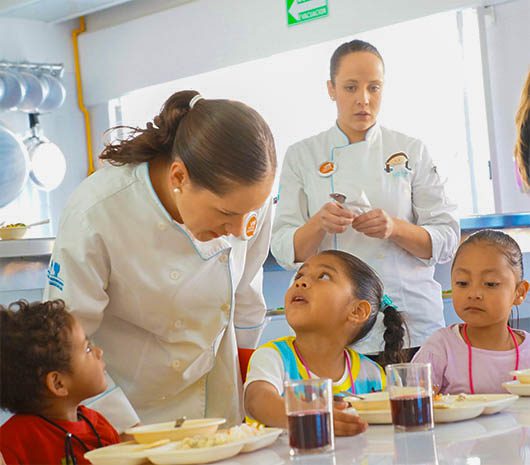
Ending child malnutrition in Mexico is the main goal for the “Va por mi cuenta” (“It’s on me”) movement. They serve more than 20,000 meals per month to children living under vulnerable conditions.
As of today, the “Va por mi cuenta” movement has four “Nuestro Comedor” dining rooms located in the state of Mexico: in Metepec, Chalco and Ecatepec. The fourth dining room is located in Mexico city.
The movement plans to collect a minimum amount of 100 million pesos during a period of 5 years in order to construct ten “Nuestro Comedor” child dining rooms. According to the movement’s website, these dining rooms will provide 2,530,000 meals and feed 2,300 children daily.
“Va por mi cuenta” has the support of different companies, brands, and restaurant chains that, through different mechanics of collection, provide help advance the movement’s prospects.
Some of the brands that collaborate with “Va por mi cuenta” are Alsea, Starbucks, Burger King, Domino’s, PayPal, Flock, X Design, California Pizza Kitchen, Chili’s, and Pei Wei, among others.
Alsea is the responsible for addressing and responding to the concerns and requirements that participants may have. Alsea is also responsible for coordinating the movement’s partnerships.
This foundation canalizes the funds raised by the movement into the construction and operation of “Nuestro Comedor” dining rooms, and it monitors and reports results.
The fast food restaurant chain, Burger King, has also partnered with the “Va por mi cuenta” movement. All Burger King locations in Mexico support the movement by making a donation for every single ice cream cone the restaurant sells.
In 2013, Burger King donated 1 peso for every single ice cream cone that the restaurants sold, and 2 pesos for every double ice cream cone.
Domino’s, the pizza restaurant chain, also contributes to the movement. Domino’s Mexico locations allocate a percentage from the sale of two of their products to the “Va por mi cuenta” movement.
The sale of the restaurant’s “Canelazo Bites” and “Pakecompartas”—a package deal that includes a pizza, chicken strips, and french fries—funds Domino’s donations to “Va por mi cuenta”.
Domino’s also contributes to the movement by encouraging Mexican artists to contribute their own designs for pizza and “Canelazo Bites” boxes. Notable Mexican artists that have contributed to this project and the “Va por mi cuenta” movement are Kari Mayo, Jorge Tellaeche, and amoATO Studio.
The Starbucks coffee chain’s Mexican locations have begun to sell bracelets with the Starbucks and “Va por mi cuenta” insignia written on them in order to contribute to the “Va por mi cuenta” movement. The purpose of the bracelet is to invite children that are most in need to a meal.
By visiting the restaurants that have signed on to help the “Va por mi cuenta” movement, consumers are also becoming a part of the effort by contributing their purchases.
Individuals could also independently contribute to the cause by making donations through Banco Santander, or by contributing an “invite” to meals via PayPal.
The “Va por mi cuenta” movement is fighting to eradicate child malnutrition in Mexico. By constructing “Nuestro Comedor” dining rooms, and with the help of different brands, restaurant chains and corporations, the movement is little by little making a greater impact on Mexican children who suffer from malnutrition.
– Diana Fernanda Leon
Sources: Alsea, Eclecticmex, Dominos, Movimiento va por mi cuenta 1, Movimiento va por mi cuenta 2, Movimiento va por mi cuenta 3
Photo: Movimiento va por mi cuenta

Tunisia’s State of Emergency and International Aid
Just over a week after a terrorist attack on a Tunisian beach, Tunisian President Beji Caid Essebsi declared a state of emergency in Tunisia. The declaration is intended to last no more than 30 days, though it is renewable. The state of emergency gives more rights to Tunisian security forces and political officials, allowing them more leeway in dealing with potential international and domestic terrorist threats.
Continuous threats and an unstable Western border have put the Tunisian economy on the brink of collapse, and Tunisian politicians in a state of panic. The most recent terrorist attack at Sousse, coupled with existing structural issues, have made humanitarian and anti-poverty aid in Tunisia particularly crucial and time-sensitive.
In his address to the nation in which he declared a state of emergency, President Beli Caid Essebsi insisted that economic and social challenges in the interior of the country, supported by extremism and instability elsewhere in North Africa, have created unique security challenges that the nation cannot handle alone. He declared that Tunisia was in “desperate” need of international assistance, both financially and with cooperative counterterrorism measures. Support from the international community—not just in policy, but in real humanitarian aid and crisis relief in the heart of Tunisia— is crucial to promoting the economic prosperity that discourages extremism and radicalism in developing nations.
Tunisia was not immune to the upheaval that spread across the Arab world in 2011, but it was one of the few nations that reacted to the events with real, democratic change. Since a revolt in January 2011, Tunisia has formed a constitution and staged two parliamentary elections. It remains one of the most secular nations in the region. While the nation in many ways progresses toward stability, its moderate government and continued poverty make it a target both for outside terrorists and for home-grown extremism.
Italy was one of the first nations to respond to the attack in Tunisia with a pledge of continued financial support to the Tunisian government and people. Paolo Gentiloni, Italy’s Minister for Foreign Affairs and International Cooperation, tweeted: “Italy stands today with Tunisia more than ever. It was forced to declare a state of emergency in order to address the threat of terrorism and will receive more economic cooperation from Italy and greater assistance on the security level.” Meanwhile, the Italian Senate’s Foreign Policy Commission has encouraged multilateral financial support for Tunisia from the European Union.
While international aid in Northern Africa has generally focused on the needs and challenges faced by refugees and asylum-seekers, recent upheavals and violent episodes across the region—including the recent terrorist attack in Tunisia—have prompted many aid organizations to devote more energy and resources to protection and economic security of the citizens of the region. Until economic prosperity can combine with the nation’s real democratic efforts, violence will continue.
– Melissa Pavlik
Sources: BBC, Middle East Monitor, The New York Times, Public Radio International, UNHCR
Photo: BBC
Africa Almost Polio-Free
In 1988, the Global Polio Eradication Initiative was created. It became the largest public-private public health partnership. Those working on the project include the World Health Initiative (WHO), Rotary International, national governments, the Bill & Melinda Gates Foundation, UNICEF and many others. So far, the program has seen a 99% reduction in the cases of polio. Over 3 billion children have been vaccinated by millions of volunteers.
Now, only three countries remain polio-endemic: Nigeria, Pakistan and Afghanistan. In 2013, only 416 cases were reported.
Most of Africa has been free of polio for years; however, Nigeria has been a trouble spot for the past 20 years. Actually, the leaders and people were very much against vaccinating children. The health organizations had little support, which meant that they lacked the necessary supervision and field staff. At times, the vaccinators were even killed. Currently, the political instability of Northern Nigeria makes monitoring and vaccinating children rather difficult. There could also be cases unreported.
Thankfully, the issues that held people back from vaccinating their children in the past have been solved for the most part. However, in the meantime, many other countries in Africa that were declared polio-free saw outbreaks of polio that were linked directly from Nigeria.
Nigeria saw what will hopefully become the last case of polio back in July of 2014. There have been no cases reported since then. If Nigeria can go a full year without another child contracting polio, then the WHO will remove Nigeria from the list of polio-endemic countries.
While Africa is steps away from being declared polio-free, vaccinating will not end there. As long as Pakistan and Afghanistan continue to report cases, mass global vaccinations will continue to take place to ensure that every child is safe.
– Katherine Hewitt
Sources: NPR, WHO
Photo: Flickr
UN Report Shows Progress on Poverty
This past week, the U.N. released a report on the successes and failures of the Millennium Development Goals (MDGs). The report revealed that more than one billion people have successfully broken out of poverty since 1990. It showed China and India playing key roles in this significant reduction of and progress on poverty.
The report also showed that in addition to a sharp drop in extreme poverty, the MDGs have facilitated other major successes. Presently, just as many girls as boys are enrolled in primary schools around the globe. Simple steps like installing bed nets in parts of the developed world have prevented approximately six billion deaths from malaria.
Experts say that the most important MDG contribution has been the creation of a measuring system that depicts what countries have done for their people, and what issues they have neglected. Concrete measurements of well-being—like how many children are clinically malnourished—provide the most helpful insight on the most pressing needs.
The report stated that the world’s most populous countries, China and India, played a central role in global poverty reduction. Economic progress in China helped the extreme poverty rate in Eastern Asia fall from 61 percent in 1990 to a mere four percent in 2015.
By the same token, development in India helped extreme poverty in Southern Asia decline from 52 percent to 17 percent over the same time period. Additionally, Southern Asia’s rate of poverty reduction has accelerated over the past seven years.
While these remarkable gains should not be understated, there is still much more to be done. In India, an estimated 600 million people still defecate out in the open, which dramatically heightens risk of serious disease, especially for children. Additionally, jobs are still not keeping pace with the country’s population growth.
Despite much progress, certain MDG targets were still missed, including a two-thirds reduction of child mortality and women’s deaths in childbirth. Persisting gender inequality was acknowledged as “one of the starkest failures” in the report, as women are still more likely to be poor than men.
This is not to say that progress has not been made on both fronts, but to encourage an even greater collaborative effort in the future. The MDG target of halving the proportion of people living in extreme poverty was achieved ahead of the 2015 deadline five years ago. This is the kind of efficiency we must continually strive for.
The most recent estimates show that the proportion of people living on less than $1.25 per day fell globally from 36 percent in 1990, to just 15 percent in 2011. As of 2015, projections indicate that the global extreme poverty rate has fallen even further, to 12 percent.
At the launch of the report in Oslo, Secretary-General Ban Ki-moon proudly stated, “The report confirms the global efforts to achieve the goals have saved millions of lives and improved conditions for millions more around the world.” He encouraged the celebration of MDG successes across the global community.
Indeed, the report’s findings most certainly call for worldwide celebration. So too, however, they paint a picture of certain key areas in need of improvement. Looking ahead, findings such as these should help to pave the path for the post-2015 development goals agenda.
– Sarah Bernard
Sources: NY Times, Economic Times
Photo: NY Times
5 Anti-Poverty Organizations with Opportunities for Students
Some say college is the best four years of your life; these anti-poverty organizations are helping to make them some of the most meaningful as well. While some groups only offer internships at their headquarters, here are some anti-poverty organizations with either on-campus opportunities, remote or summer training or volunteer opportunities. These opportunities offer advocacy and leadership experience for college students hoping to raise awareness of global poverty on their own campus.
1. ONE
According to its website, “ONE is an international campaigning and advocacy organization of nearly 7 million taking action to end extreme poverty and preventable disease, particularly in Africa.” There are campus clubs for ONE on campuses across the country. Online, ONE offers resources, ideas and challenges for their student-run campus clubs. For more information, visit its website.
2. Oxfam
Oxfam’s mission is “to create lasting solutions to poverty, hunger, and social injustice.” For college students, Oxfam offers the opportunity to create and sustain an Oxfam club on campus, as well as a training program one must be selected to attend. Oxfam currently has clubs on more than 100 college campuses. To start a club on campus, you can download a “toolkit” from the website and register your university’s club with the organization. Oxfam’s leadership training program, CHANGE, trains 50 students each summer on nonprofit organizations, advocacy and more.
3. RESULTS
RESULTS is a grassroots advocacy group. It is written on its website that “with every hour of their time, volunteers multiply their impact through the enormous power of advocacy—whether it’s helping change policty to support millions of families putting food on the table or helping raise billions of dollars for the world’s most vulnerable children.” RESULTS offers a variety of ways for individuals across the country to get involved. You can listen in on a call where the staff discusses the work of the organization, tips for your own advocacy and how to get involved. Online you can learn about the different RESULTS groups in your area and connect with other people interested in ending poverty. These groups allow people to make an impact in their area by joining together, reaching out to state legislators and planning advocacy events. For more information about how you can get involved visit its website.
4. The Hunger Project
The mission of The Hunger Project is “to end hunger and poverty by pioneering sustainable, grassroots, women-centered strategies and advocating for their widespread adoption throughout the world.” Individuals interested can volunteer bi-annually in The Hunger Project’s global office in New York. Online, volunteer opportunities are posted as available, and those interested in being volunteer activists must follow the steps listed in the “get involved tab” under the “volunteer” section of The Hunger Project’s website.
5. The Borgen Project
The Borgen Project aims to raise awareness of global poverty and the issues that it creates. Through advocacy and campaigning, The Borgen Project forces the nation’s leaders to take notice of this global issue and encourages action to address it in U.S. foreign policy. The Borgen Project not only has volunteer and internship positions in Seattle and remotely, but also provides advocacy tips on its website.
– Rachelle Kredentser
Sources: ONE, ,Oxfam, RESULTS, The Hunger Project, The Borgen Project
Fighting Ebola with Liberty and Justice
When the Ebola virus attacks the human body, the symptoms include muscle pain, vomit, fever and unexplained hemorrhage. While these symptoms are tragic and often fatal, there are no surprises when it comes to the virus itself—we know what it looks like and we can visibly see the damage it leaves in its wake. When the Ebola virus attacks an economy, however, as it did in Liberia in 2014, we know little about the exact symptoms and even less about the treatments available to combat it.
Until 2014, Chid Liberty, the founder of fair trade clothing manufacturer Liberty and Justice, had run his operations out of his native Liberia with ease. This changed almost overnight with the Ebola outbreaks of 2014.
“We had built the company up to a 500,000 orders per month and in a flash we were out of business,” Liberty said in an interview with Madame Noir. “The Ebola epidemic left us and the hundreds of workers and families that were depending on us stranded without income.”
Our economies are just as vulnerable as our immune systems, and can succumb to Ebola just as easily. It is estimated by the World Bank Group that nearly 50 percent of working adults in Liberia lost their jobs after the outbreak. However, Liberty refused to close his doors at the behest of the disease. Instead he turned his ingenuity into a tonic for the symptoms of Ebola and founded UNIFORM, a company based in Liberia dedicated to making affordable school uniforms for children who had been forced to leave school due to Ebola.
Liberia already has one of the lowest rates of primary education enrollment rates in Africa. According to The Global Economy website, an average of only 53.85 percent children reported having completed primary school between 1978 and 2011.
School attendance often incurs costs far beyond those of just tuition—the prices of books, the inability to work a salaried job, and even the cost of the mandatory uniform act as considerable deterrents to struggling families. The uniforms especially act as barriers to school attendance. Abdul Latif Jameel confirmed this in his 2009 study in Kenya, in which he discovered that providing children with free uniforms reduced school absenteeism by 44 percent and decreased dropout rates (particularly among girls) by a third.
Liberty’s UNIFORM brand has embraced the challenge of mollifying the effects of Ebola on the education of Liberia’s children. Their kick starter campaign, which has $174,760, has already given away 7,000 new school uniforms, all of which are being manufactured by small factories throughout Liberia (Madame Noir).
“I am very proud to be working on such a project,” said Ms. Annie Blamo to the UN Ebola Response team. Blamo is a worker in the Monrovian Liberty and Justice factory who has been manufacturing uniforms for the N.V. Massaquoi school, Blamo’s eight-hour days paid off when her son returned to school in early May. “We are so happy for what this factory has done for the children at the N.V. Massaquoi school and their name will be forever remembered.”
UNIFORM’s kick starter campaign will continue to accept donations until July 16, 2015.
– Emma Betuel
Sources: Ebola Response, Madame Noire, Poverty Action Lab, Time Dotcom
Photo: New York Post
“Va por mi cuenta” Movement
Ending child malnutrition in Mexico is the main goal for the “Va por mi cuenta” (“It’s on me”) movement. They serve more than 20,000 meals per month to children living under vulnerable conditions.
As of today, the “Va por mi cuenta” movement has four “Nuestro Comedor” dining rooms located in the state of Mexico: in Metepec, Chalco and Ecatepec. The fourth dining room is located in Mexico city.
The movement plans to collect a minimum amount of 100 million pesos during a period of 5 years in order to construct ten “Nuestro Comedor” child dining rooms. According to the movement’s website, these dining rooms will provide 2,530,000 meals and feed 2,300 children daily.
“Va por mi cuenta” has the support of different companies, brands, and restaurant chains that, through different mechanics of collection, provide help advance the movement’s prospects.
Some of the brands that collaborate with “Va por mi cuenta” are Alsea, Starbucks, Burger King, Domino’s, PayPal, Flock, X Design, California Pizza Kitchen, Chili’s, and Pei Wei, among others.
Alsea is the responsible for addressing and responding to the concerns and requirements that participants may have. Alsea is also responsible for coordinating the movement’s partnerships.
This foundation canalizes the funds raised by the movement into the construction and operation of “Nuestro Comedor” dining rooms, and it monitors and reports results.
The fast food restaurant chain, Burger King, has also partnered with the “Va por mi cuenta” movement. All Burger King locations in Mexico support the movement by making a donation for every single ice cream cone the restaurant sells.
In 2013, Burger King donated 1 peso for every single ice cream cone that the restaurants sold, and 2 pesos for every double ice cream cone.
Domino’s, the pizza restaurant chain, also contributes to the movement. Domino’s Mexico locations allocate a percentage from the sale of two of their products to the “Va por mi cuenta” movement.
The sale of the restaurant’s “Canelazo Bites” and “Pakecompartas”—a package deal that includes a pizza, chicken strips, and french fries—funds Domino’s donations to “Va por mi cuenta”.
Domino’s also contributes to the movement by encouraging Mexican artists to contribute their own designs for pizza and “Canelazo Bites” boxes. Notable Mexican artists that have contributed to this project and the “Va por mi cuenta” movement are Kari Mayo, Jorge Tellaeche, and amoATO Studio.
The Starbucks coffee chain’s Mexican locations have begun to sell bracelets with the Starbucks and “Va por mi cuenta” insignia written on them in order to contribute to the “Va por mi cuenta” movement. The purpose of the bracelet is to invite children that are most in need to a meal.
By visiting the restaurants that have signed on to help the “Va por mi cuenta” movement, consumers are also becoming a part of the effort by contributing their purchases.
Individuals could also independently contribute to the cause by making donations through Banco Santander, or by contributing an “invite” to meals via PayPal.
The “Va por mi cuenta” movement is fighting to eradicate child malnutrition in Mexico. By constructing “Nuestro Comedor” dining rooms, and with the help of different brands, restaurant chains and corporations, the movement is little by little making a greater impact on Mexican children who suffer from malnutrition.
– Diana Fernanda Leon
Sources: Alsea, Eclecticmex, Dominos, Movimiento va por mi cuenta 1, Movimiento va por mi cuenta 2, Movimiento va por mi cuenta 3
Photo: Movimiento va por mi cuenta
UN Peacekeepers Sexually Abuse Haitian Women and Girls
The United Nations has recently come under fire due to a report of sexual transactions between peacekeepers and Haitian women and girls. According to a report, U.N. peacekeepers in Haiti regularly exchange materials like laptops, food and medicine for sex.
Although the U.N. bans peacekeepers from exchanging employment and money for sex, many have disregarded this rule.
Since 2010, peacekeepers have maintained a ‘friendly’ presence on the island. Their main mission was to assist Haiti in both the cleanup after the earthquake as well as the rejuvenation of the country.
However, many have called into question how much progress they could have made, since many were exploiting the people they were supposed to be helping.
While this revelation is horrific, there is little prosecution for the peacekeepers committing these offenses. Typically, peacekeepers have immunity in countries in which they are serving.
This is not the first time the U.N. has come under fire for the sexual exploitation of country natives. In 2012, Kathryn Bolkovac published her remembrances of her trip to Bosnia in 1999.
In an interview with a reporter from The Telegraph, she spoke about how U.N. officers had exploited Bosnian prostitutes.
Because of the proximity of the release of the Red Cross Haiti scandal, many are questioning the Western presence in Haiti.
Is the West truly helping Haiti, or are they making the country’s economic and social situation worse?
– Erin Logan
Sources: The Telegraph, Al Jazeera, RT,
Photo: Women Under Siege
Chinese Woman Receives Global Recognition For Education
On July 2, Dr. Betty Chan Po-king received her third honorary degree in Bath, United Kingdom, from the University of Bath, granting her global recognition for education efforts from three continents.
At the summer graduation ceremony for the University of Bath, an honorary graduate award was presented to Po-king for Doctor of Laws. After her fifteen-year relationship with the university, the accolade was given to her for her commitment to providing and stimulating education, cultural diversity, and leadership.
This honor is one of three given to Po-king in the span of five years. Po-king initially earned an honorary doctorate in Humane Letters from the University of Illinois at Urbana-Champaign, U.S., her first intercontinental accomplishment in her professional career.
Four years later, she received a second award in China, Asia. The Honorary Fellowship by the Hong Kong Institute of Education was presented to Po-king in acknowledgement of her grand involvement in education in Hong Kong and beyond.
The University of Bath facilitated her third academic accolade in Europe. Honorary degrees are the most esteemed awards given by this university and are set aside for people of noticeable excellence.
Po-king originally earned her doctorate at The Union Institute and University in Vermont in 1985 and went on to acquire experience for teaching. She then became the Director of Yew Chung International Schools in China and California, which was founded by her mother, Madam Tsang Chor-hang.
In addition to her several doctorate degrees, Po-king has also served in numerous leadership positions for her educational efforts.
She has served as the Treasurer of the Pacific Early Childhood Education Research Association, the Chairperson of Child Education and Community Services Discipline Board of Vocational Training Council and the adviser of the Center for Child Development.
Po-king has served as a Member of Standing Committee on Language Education Research, a member of the Education and Manpower Bureau and a member of Appeals Board (Education) in Hong Kong, as well. She was also appointed as a Hong Kong Convention Ambassador of the Hong Kong Tourism Board and the Advisory Committee on Teacher Education and Qualifications.
Po-king’s educational ability has also presented her with unique opportunities as a Chinese female educator.
She became a member of one of the first groups of female life members of Phi Delta Kappa Educational Foundation. In addition, she was the first Chinese Keynote Speaker at the 2004 Alliance for International Education Conference in Dusseldorf, Germany.
Po-king has traveled all around the world for her educational experience. According to China Education Development, where she is a founder, “she has integrated the essence of the Eastern and Western education and has accumulated rich experience in teachers’ training.”
With her extensive knowledge of education, Po-king could very well earn additional award in another continent, but for now, her global recognition in Europe, the U.S., and Asia will continue to propel her career and enhance global education.
– Fallon Lineberger
Sources: China Education Development, PR Newswire, University of Bath 1, University of Bath 2, Yew Chung International School, Yew Wah Education Management
Photo: South China Morning Post
How the World Bank is Changing the Way We Measure Poverty
Currently, poverty is considered apparent when someone lives on less than $1.25 a day, but some question the reliability of this simplistic measurement. Therefore, the World Bank has announced that a new commission will propose revisions to the International Poverty Line to account for the many components of poverty in every country.
It turns out that the way we have been thinking about poverty is in over-generalized terms. When the United Nations announced its post-2015 Sustainable Development Goals, first on the list was the eradication of poverty “in all forms.” The notion that global poverty is multi-faceted is becoming universally accepted, and is acknowledged by the Bank’s chief economist, Kaushik Basu, who said, “The Global Commission will advise us on other dimensions of poverty that the Bank should collect data on, track, analyze and make available to policymakers for evidence-based decisions.”
A more data-driven reason for revising the way we measure poverty comes from a 2011 price survey from the International Comparison Program, which analyzes economic activity and poverty in almost every country. But evaluating the data gets complicated; depending on how the data is used, the results vary greatly, showing either a dramatic decrease in poverty or little decrease. Prices and exchange rates are changing, so the $1.25 a day standard must account for this.
Another problem with the current International Poverty Line occurs when a country’s poverty level decreases; it can be dropped from the list of countries averaged to set the IPL, resulting in a skewed measurement of progress. In addition, economic comparisons among countries include the exchange of all goods, while assessing only some goods is significant for impoverished communities.
The commission advising the Bank will consist of 24 leading international economists, and the report will be finished by April 2016. The World Bank hopes that a revised IPL will increase the possibility of attaining its two goals; the first goal is to bring the number of impoverished people to less than 3 percent of the global population by 2030, and the second is to increase per capita income of the poorest 40 percent of each country’s population.
Alterations in the International Poverty Line will change the way we define poverty in the first place, impacting philanthropy everywhere. Basu said, “We expect the Commission report to be influential not only for our own work on poverty but also in shaping global research and policymaking on this most important challenge of our times.”
– Jordan Reabold
Sources: Devpolicy, World Bank 1, World Bank 2
Photo: Give A Billion
Malala Opens Girls School for Syrian Refugees
The Malala Yousafzai All-Girls School opened on July 12 to Syrian refugees—for girls who have fallen victims to displacement. Malala Yousafzai opened the school on behalf of the 28 million children who are kept from classrooms because of armed conflict. The event also marked Malala Yousafzai’s 18th birthday, of which she was proud.
Malala Yousafzai is no stranger to armed conflict, as she was attacked in her native Pakistan in 2012 because of her support and efforts to campaign for girls’ rights and education. For this brave act, Malala was in fact awarded the Nobel Peace Prize in 2014.
Yousafzai currently believes that world leaders are failing Syria’s children. At the opening of the school she stated, “On this day, I have a message for the leaders of this country, this region and the world: you are failing the Syrian people, especially Syria’s children. This is a heart-breaking tragedy — the world’s worst refugee crisis in decades.”
That is why this school is one small step on Yousafzai’s part to help the children of the war-torn country. This effort is applauded by Antonio Guterres, the UN High Commissioner for Refugees. He stated, “We are really heartened by Malala’s ardent support for the education of refugee girls whose aspirations have already been so cruelly cut short by war. These children are the future of Syria; we must not jeopardize that by denying them the basic right to education while they are in exile”.
The newly opened school will serve around 200 Syrian girls living in refugee camps in the Bekaa Valley region along the Lebanese border, to which many Syrians have fled.
This school will stand as a testament to the perseverance and strength of the Syrian children and hopefully become inspiration to the similar creation of future schools.
– Alysha Biemolt
Sources: Look to the Stars, UNHCR, PBS, Voanews
Photo: Sampsonia Way