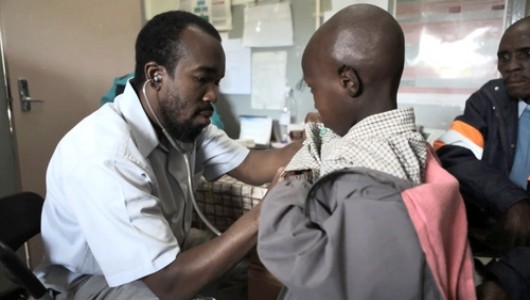
Surrounded on all sides by its neighbor South Africa, the little country of Lesotho is the largest enclave in the world; larger than its only rivals Monaco, San Marino and Vatican City.
Essentially a landlocked island amidst African highlands, Lesotho also features the lowest point of any country in the world, measured at 1400 meters or 4,953 feet. However, it has another, less fortunate distinction; it places third on the list of countries with the highest HIV/AIDS prevalence.
In total, nearly one-quarter of the population lives with HIV, which accounts for 360,000 people. Close to 26,000 new HIV infections and 14,000 AIDS deaths were recorded in 2011. Of these infections, 40,000 are in children while around 60 percent of adults with HIV are women. On top of these harrowing figures, 42 percent who need treatment cannot access it.
Lesotho’s first reported incidence of HIV occurred in 1986 and accelerated rapidly into a national epidemic. While the government made attempts to monitor and treat the illness, the proved insufficient due to poor finances and infrastructure. Just six years later, in 1992, 3.2 percent of pregnant women between the ages of 20 and 24 had HIV. By 1996, the figures had exploded; in just four years, a quarter of the same demographic was living with HIV.
The sheer extent of this illness has had a detrimental impact on the development of Lesotho. The most productive age group in the country is also the most infected. This has compromised their ability to work and sustain themselves and their families.
For the Basotho people, family is vital. For centuries, extended relatives have supported one another through any hardship. However, AIDS/HIV has eroded this support system by orphaning 220,000 children. This has left children as the head of families in which the working generations are debilitated or have died.
One can notice the extent of the AIDS epidemic by looking at the data. It has significantly shortened the life span of the average Basotho to just 48.3 years from nearly 60 years in 1990.
Moreover, the two main statistics most indicative of development, GDP and the Under Five Mortality Rate have worsened. Since 1990, the Under Five Mortality rate has risen from 85 in 1000 to 100 in 1000. While from 1970 to 1990 the average annual growth rate of Lesotho stood at 3 percent, it fallen to 2.6 from 1990 to 2012.
With such a widespread influence throughout Lesotho, the nation’s government, along with international aid groups has made efforts to tackle the AIDS crisis. The first step was to provide universal testing for the entire country. Beginning in 2004, the program called “Know Your Status” involved training thousands of health care workers to perform swift HIV testing. However, the government has only trained one-quarter of the required workers, failing to meet its objective of universal coverage.
Besides testing, the government has implemented a variety of campaigns to confront the epidemic, but with mixed results. It introduced HIV/AIDS awareness to the curriculums of both primary and secondary schools. A ‘road show’ was also planned to inform communities about AIDS/HIV while providing both entertainment and HIV testing. Despite the efforts, only 29 percent of 15 to 24-year-old males and 29 percent of females from the same demographic had an understanding of HIV prevention.
Unlike awareness efforts, the distribution of cheap condoms has also served as an effective mainstay of HIV intervention in Lesotho. In 2001 affordable condoms began selling throughout communities. The sales spiked, with the number of distributors tripling and the number of condoms bought doubling.
In order to help those already infected with AIDS, the government has worked to provide better access to antiretroviral treatments. Since 2004 the government of Lesotho has sought to make antiretroviral treatment free to those in need. With only 89 trained medical professionals in the whole country, the program lagged behind at first. But since expansion in 2008 coverage has expanded to around 86,000 people, or close to 60 percent of those needing treatment. Still, only a quarter of children in need receive antiretroviral treatment.
While Lesotho has become closer to controlling its AIDS epidemic it has come at the cost of the nation’s development. Despite its aspirations, the country’s inadequate infrastructure, health care and budget have hindered its efforts. With more foreign assistance, Lesotho has the capacity to get back on its feet.
– Andrew Logan
Sources: Avert, CIA, PEPFAR, UNDP, UNICEF 1, UNICEF 2
Photo: NY Times

For China’s Nomads: Forced Settlement and Poverty
Nomads of China’s Western regions are the latest subjects of the government’s restrictive policies. Over the past fifteen years, the government has relocated over 1.2 million herders whose ancestors roamed the plains of Inner Mongolia for thousands of years. Many of these herders and their families have been relocated to cities in Qinghai Province, where, according to the government, they will have improved access to schools, electricity, and medical care.
This policy is not as ideal as it is portrayed. Many herders are forced to sell their livestock and are resettled in isolated towns on the edges of the countryside. In towns such as Xinlinhot in Inner Mongolia, illiterate former herders are unable to acquire the skills necessary to work at mills and factories and are left in unemployment and desolation. The annual government stipend of $925- good for only five years- allows them to feed and clothe their children, but leaves little room for anything else. Government-provided milk cows, native to Australia, are not adapted for the brutal winters of Inner Mongolia and often do not produce milk for their owners’ profit. After the stipend runs out, these unemployed, unskilled, displaced families don’t know where they will turn. Uprooted from their lives, these nomad families have to adjust to life in a cash economy while simultaneously profiting from it.
In these grim, shoddy townships, many homes lack toilets and running water and are often hastily built with leaky roofs. Anthropologists who study such relocation communities cite unemployment, alcoholism, and alienation from a new way of life as outcomes of the government’s projects to relocate an entire indigenous culture.
The government claims its efforts are meant to restore the fragile status of the frayed grasslands that make up more than 40 percent of China. The government claims overgrazing of grasslands threatens the water sources that supply the Yellow, Yangtze and Mekong Rivers that serve the entire country. Chinese scientists disagree, however.
Li Wenjun, professor of environmental management at Peking University, has said that these relocation programs have exacerbated poverty and worsened water accessibility. Indeed, residents of the major coastal cities, Beijing and Shanghai, earn nearly double their counterparts in the Western provinces. Li further argues that traditional grazing practices, which require little water compared to modern lifestyles, actually support grassland growth.
Certainly, this governmental change has kindled widespread social unrest. Nearly every week, herders protest in their new cities, carrying posters reading “We Want to Return Home” and “We want survival”. Seventeen herders were arrested last month alone.
Since the beginning of consolidated Chinese rule, the Western hinterlands have attracted fear and confusion. Populated by ethnic minorities such as the Uighurs, Kazakhs and Manchus, these groups have resisted assimilation and heavy-handed rule for decades.
Other government attempts at Western assimilation have been their “Go West” program, which encouraged the Han majority to move West and provided funding to build up the infrastructure of western provinces. Many suspect this new relocation is an effort not to economically support the rural West, but instead force its dependence on the eastern coastal cities for welfare.
Meanwhile, millions of herders and their families lie in anxious wait of what will come next. Forced into a new way of life dependent on a cash economy and far from the independence of the plains, they have little knowledge on how to alleviate the poverty they are living. “This is not a place fit for human beings,” said one. Until change is enacted, they will continue on in their impoverished houses on the outskirts of the lands and lives that helped them thrive.
– Jenny Wheeler
Sources: New York Times, Human Rights Watch
Photo: Flickr
ANDENI Aiding Orphans and Adoptive Families
In September of 1997, Gloria Nieto and her husband, Angel, adopted a baby girl from China. They already had a 4-year-old biological daughter and wanted a second child. Adoption from a developing country seemed like a great option.
Adopting baby Irene was an arduous process—more than they believed it should have been. One big legal issue was that the Spanish government did not understand that the adopted children would have to become Spanish citizens.
When Gloria and Angel came back to their home in Spain, they met with other adoptive parents and decided to start a non-governmental organization that would help future Spanish adoptions from China. The group of adoptive families met in Madrid and made the NGO official. ANDENI translates into English as the National Association for Defense of Children.
There are two avenues for foreign adoption in Spain. One is through the government, the other is with private adoption agencies. ANDENI helps families adopting through the government.
The organization has a central office in Madrid. A small number of administrative people work there for a salary. The remaining workers are volunteers. Each part of Spain has its own leader that serves as a spokesperson and a source of guidance for families. Instead of having to contact the government for help, parents can contact their section leader.
Parents who begin the process of adopting from China join ANDENI by donating every three months or so to the organization. Donations are based on what the family decides it can pay—there is no obligatory donation amount.
The organization provides families with adoption assistance for every step of the journey. They learn what has to be done in Spain before they go to get their child as well as what has to be done in China. The organization helps parents fill out adoption papers, prepares them for their trip to China and provides them with a translator and a safe travel agency.
After parents successfully adopt their child, they become a part of the ANDENI community of adoptive families. The group supports each other and their adoptive children as they grow up. Both of Gloria and Angel’s daughters, Aida and Irene, now work with grown adopted children. Irene counsels teenagers on how being adopted affects their identity.
In its 18 years, ANDENI has helped 4,500 families. Spain is second to the U.S. in the number of children adopted from China. Proportionally, they are #1. Spain is currently home to 18,000 adopted Chinese children.
In recent years, Chinese adoptions have been slowing worldwide. There are fewer children in orphanages and the Chinese government gives priority to national adoptions. People that began the adoption process in 2006, are just now starting to get their children.
This is great news for orphans in China and suggests a positive outlook for poverty levels there. Yet for ANDENI, it means fewer families are joining and fewer volunteers are needed. Volunteer numbers have fallen from 2,100 at its peak to just 1,600. Many families have stopped paying since they have lost their jobs due to the Spanish economy.
To adapt, ANDENI began to focus on orphans and people living in poverty in China. They started collecting money to send to Chinese orphanages to pay for amenities like washing machines, air conditions, food, clothing, etc. One of the poorest providences in China, Yunnan, received enough money from ANDENI to build four schools and hospitals.
In total, ANDENI has raised and sent one million dollars to China. The organization collaborates with the Chinese government to ensure that the funds are doled out appropriately.
As for the future of ANDENI, Gloria’s family sees it collaborating with other NGOs helping orphans and others in need living in third-world countries such as Sierra Leone in Africa.
– Lillian Sickler
Sources: ANDENI, ANDENI Valencia
Photo: Flickr
Lauren Conrad at The Little Market
The Little Market is making a big difference. A fair trade project based in Los Angeles, the online company works with artisans around the world, making handcrafted goods available to all and supplying a living wage to the artisans that create them.
Co-founded by fashion designer Lauren Conrad and Human Rights Watch member Hannah Skvarla in 2013, the Little Market “seeks to empower women artisans to rise above poverty and support their families”. The company is committed to building self-sufficient, economically independent women in impoverished countries around the world.
The Little Market sells a variety of handmade goods, from home décor and kitchen necessities to backpacks and bracelets. Conrad and Skvarla visit local markets in countries such as Kenya, Bolivia, India and Peru to gain inspiration, insight and appreciation for the talent, time and treasures provided by the artisans.
In order to benefit the artisans and themselves, the company searches for items with the potential to succeed in the U.S. market.
This month, The Little Market began selling olive wood products from Le Souk Olivique, an olive wood studio in Tunisia. Founded in 2013, Le Souk provides finely crafted wooden kitchen tools, including basic utensils, salad bowls and cutting boards.
The Tunisian company treats its artisans very well, setting payment above minimum wage and providing healthcare and social security payments. Le Souk will soon receive Tunisia’s Fair Trade certification.
The beautifully handcrafted kitchen tools sell at The Little Market for $12 to $44, depending on the type and size of the object. They are all made with olive wood.
Making olive wood products, however, is an intricate and time-consuming process. The raw wood must initially dry outside for a year before cutting and sanding the pieces to create a wood product fit for a kitchen.
Conrad and Skvarla expressed excitement about carrying this new line of products, available now on the company website. The Little Market has served as a catalyst in the sale of handmade goods from around the world, including those of Le Souk. As website sales increase, the demand for more products also increases, resulting in a need for more employees and thus creating more jobs for more artisans around the world, lifting many out of poverty.
– Sarah Sheppard
Sources: LA Times, The Little Market 1, The Little Market 2
Photo: Style News
The AIDS Crisis in Lesotho
Surrounded on all sides by its neighbor South Africa, the little country of Lesotho is the largest enclave in the world; larger than its only rivals Monaco, San Marino and Vatican City.
Essentially a landlocked island amidst African highlands, Lesotho also features the lowest point of any country in the world, measured at 1400 meters or 4,953 feet. However, it has another, less fortunate distinction; it places third on the list of countries with the highest HIV/AIDS prevalence.
In total, nearly one-quarter of the population lives with HIV, which accounts for 360,000 people. Close to 26,000 new HIV infections and 14,000 AIDS deaths were recorded in 2011. Of these infections, 40,000 are in children while around 60 percent of adults with HIV are women. On top of these harrowing figures, 42 percent who need treatment cannot access it.
Lesotho’s first reported incidence of HIV occurred in 1986 and accelerated rapidly into a national epidemic. While the government made attempts to monitor and treat the illness, the proved insufficient due to poor finances and infrastructure. Just six years later, in 1992, 3.2 percent of pregnant women between the ages of 20 and 24 had HIV. By 1996, the figures had exploded; in just four years, a quarter of the same demographic was living with HIV.
The sheer extent of this illness has had a detrimental impact on the development of Lesotho. The most productive age group in the country is also the most infected. This has compromised their ability to work and sustain themselves and their families.
For the Basotho people, family is vital. For centuries, extended relatives have supported one another through any hardship. However, AIDS/HIV has eroded this support system by orphaning 220,000 children. This has left children as the head of families in which the working generations are debilitated or have died.
One can notice the extent of the AIDS epidemic by looking at the data. It has significantly shortened the life span of the average Basotho to just 48.3 years from nearly 60 years in 1990.
Moreover, the two main statistics most indicative of development, GDP and the Under Five Mortality Rate have worsened. Since 1990, the Under Five Mortality rate has risen from 85 in 1000 to 100 in 1000. While from 1970 to 1990 the average annual growth rate of Lesotho stood at 3 percent, it fallen to 2.6 from 1990 to 2012.
With such a widespread influence throughout Lesotho, the nation’s government, along with international aid groups has made efforts to tackle the AIDS crisis. The first step was to provide universal testing for the entire country. Beginning in 2004, the program called “Know Your Status” involved training thousands of health care workers to perform swift HIV testing. However, the government has only trained one-quarter of the required workers, failing to meet its objective of universal coverage.
Besides testing, the government has implemented a variety of campaigns to confront the epidemic, but with mixed results. It introduced HIV/AIDS awareness to the curriculums of both primary and secondary schools. A ‘road show’ was also planned to inform communities about AIDS/HIV while providing both entertainment and HIV testing. Despite the efforts, only 29 percent of 15 to 24-year-old males and 29 percent of females from the same demographic had an understanding of HIV prevention.
Unlike awareness efforts, the distribution of cheap condoms has also served as an effective mainstay of HIV intervention in Lesotho. In 2001 affordable condoms began selling throughout communities. The sales spiked, with the number of distributors tripling and the number of condoms bought doubling.
In order to help those already infected with AIDS, the government has worked to provide better access to antiretroviral treatments. Since 2004 the government of Lesotho has sought to make antiretroviral treatment free to those in need. With only 89 trained medical professionals in the whole country, the program lagged behind at first. But since expansion in 2008 coverage has expanded to around 86,000 people, or close to 60 percent of those needing treatment. Still, only a quarter of children in need receive antiretroviral treatment.
While Lesotho has become closer to controlling its AIDS epidemic it has come at the cost of the nation’s development. Despite its aspirations, the country’s inadequate infrastructure, health care and budget have hindered its efforts. With more foreign assistance, Lesotho has the capacity to get back on its feet.
– Andrew Logan
Sources: Avert, CIA, PEPFAR, UNDP, UNICEF 1, UNICEF 2
Photo: NY Times
How Transparency Leads to Sustainable Development
Ever wondered where that money you donated went? The U.S. government, in partnership with USAID, has made a commitment to track international aid to more closely monitor sources of aid abroad and hold international leaders accountable for development. Up-to-date, truthful data about where international funds are going helps governments, civil service organizations and private sponsors track their money and increase the efficacy of donations.
The government recently signed on to the International Aid Transparency Initiative (IATI), an international organization that encourages NGOs, governments and international aid organizations to report data on foreign aid spending. This group estimates that $4.8 billion of EU-given aid, $2.8 billion U.S.-given aid and $13.8 billion in international donor aid was not visible. The initiative aims to have 80 percent of aid be visible; this amount, it estimates, will make the aid useful. This makes development easier to track and organizations more transparent in how they use their funds. It will encourage further donations and trust in the work of these organizations. Furthermore, IATI has developed a tool to compare spending by different aid groups and the amount of money going to different countries.
Anyone with Internet connection can now track the U.S. government’s aid efforts by country, sector and year on www.foreignassistance.gov.
Through this initiative, USAID has made a commitment to increasing its transparency in regards to foreign aid spending. Through developing a cost management plan, the organization upped its accountability and made it clear to donors where their money goes. As a result of this, USAID’s Aid Transparency Review jumped 20 points in the last year, from the “fair” category to the “good” one. The organization predicts improved donor understanding and confidence in its future projects and improvement in international development through its and other organizations’ efforts at increased accountability.
Progress does not end at transparency, however. USAID hopes to improve the knowledge base of its donors so that they can better understand the organization’s international efforts, understand where funds are going and hold governments, both those donating and accepting aid, accountable.
Through initiatives like these, international aid can become more sustainable, efficient and successful.
– Jenny Wheeler
Sources: USAID, Road To 2015
Photo: The Spectator
E-Library Program to Improve Literacy in South Africa
For centuries libraries have functioned as centers of knowledge and learning. Today, with information and communication technology (ICT) developments and ever-growing Internet access, people are turning to e-libraries as the next literacy-promotion frontier.
In partnership, Vodacom, Huawei Technologies, the Department of Basic Education and the Nelson Mandela Foundation have created an e-libraries program that will span 61 Vodacom ICT resource centers across South Africa.
This program will provide 400 tablets, courtesy of Huawei Technologies, loaded with content spanning a variety of subjects, including business and entrepreneurship, African literature and history, in addition to fictional e-books. The vast array of reading material will be available in all 11 official languages of South Africa, ensuring unbiased access.
Each resource center will be equipped with at least six tablets preloaded with e-book content that are also Web-accessible, enabling users to download materials from the Internet. Vodacom promises to supply Wi-Fi to students and members of the communities serviced by the e-library tablets.
The e-libraries initiative offers an efficient means of keeping learning materials up-to-date, as Vodacom’s Mthobeli Thengimfene explained: “We are able to continuously update the content remotely without having to go to the centers and people will be able to download the books they are interested in.”
Although South Africa ranks higher than Sub-Saharan countries for simple literacy, some 5 million South African adults’ education does not even extend to completion of the seventh grade.
In order to ensure that South Africa’s population achieves true literacy, including the ability to comprehend the meaning of written material, supplemental instruction and resources become important factors. Unfortunately, there is a shortage of these resources.
“Access to reading material is a major challenge in South Africa,” said Vodacom Group CEO, Shameel Joosub. A large number of the country’s students are unable to utilize traditional library resources or reading material, Joosub went on to explain.
However, many South Africans have access to smartphones and the savvy to engage with ICT devices. The e-library program seeks to build on this affinity to engage more people in literacy programs.
“We want to encourage learning. It’s not only about the books but it is also about forming reading clubs around each of the centers,” Thengimfene said.
The e-libraries initiative is just a small part of Vodacom’s Mobile Education Program, a seven-aspect plan that focuses on teacher-development. However, the solid partnership behind the e-libraries initiative gives it an extra edge. It is clear that all the organizations are passionate about literacy and the new equity they hope it will promote.
“Between 2015 and 2030 we do not only speak about quality education,” said Enver Surty, Deputy Minister of Basic Education, “but about quality education that is a human right and that is a public good and a public interest.”
– Emma-Claire LaSaine
Sources: IT News Africa, IT Web Africa
Photo: E-book Creators
Economic Incentives for Empowering Women in Developing Nations
In 2009, Bill Gates visited Saudi Arabia and was asked how Saudi Arabia could attain its goal of becoming one of the top countries in the world. In response, Gates said, “Well, if you’re not fully utilizing half the talent in the country, you’re not going to get too close to the Top 10.” Women deserve equal rights and treatment, but for many men in cultures that have yet to embrace this fact, this reality may not be enough to change minds. Enter money—what are the monetary incentives to help women contribute to the well-being of their own countries?
Women across the world represent about 40% of the world’s workforce. This is a huge figure and exemplifies the need for allowing this 40% to gain proper education to increase human capital potential, besides the obvious rights to education that any young girl or boy should possess. A study found that each year of education of women correlated with a decrease in child mortality by 9.5%. That’s a heavy figure to consider; it should be criminal for a developing country not to invest in women. The International Monetary Fund estimates that if women were able to access the same resources for agriculture, food production could increase by 2.5 to 4%. If that wasn’t enough reason to begin to treat women as equals in developing nations, then consider the fact that women make up a disproportionate figure of 70% of the world’s poor.
Allowing women to have equal rights and treatment in developing countries has a variety of benefits. Less workplace discrimination means more women can work instead of being outsiders to the economy of a country. Increasing the career opportunities and general rights for women could also usher in more investment from developed countries who may find more cultural connection with the developing nation. Studies have also shown that women are better at spending money in ways that benefit children than men, but, currently, women are earning significantly less than men across the world.
By empowering women in developing nations, poverty rates could be slashed, businesses could be started, existing industries could be revitalized and greater human capital resources could be fully realized. Gates said it best, and with elegance. The question really just becomes: why waste half of the talent you have?
– Martin Yim
Sources: New York Times, International Monetary Fund, The Guardian, United Nations
Photo: Water Encyclopedia
South Sudanese Refugees Warmly Welcomed by Uganda
Refugees who travel to Uganda for asylum are met with an abundance of economic and social opportunities upon their arrival. Unlike many other nations currently experiencing heightened influxes of refugees due to the persistence of several regional conflicts, Uganda does not place newly arrived migrants into refugee camps operated by the United Nations and other foreign aid organizations.
Instead, refugees who successfully escape their conflict-ravaged homelands for the peace and security of Uganda are presented with the opportunity to move into permanent settlements where they are provided with their own plot of land. Additionally, various U.N. agencies provide access to food, water and home construction resources for newly arrived refugees. Localized primary schools and health clinics are commonly accessible in these areas of Uganda and are responsible for providing valuable resources to newly settled migrant populations.
Titus Jogo, refugee desk officer for the Adjumani District in Northern Uganda, stated in a recent interview regarding the legal statuses of South Sudanese refugees seeking asylum that “They have all the rights that are attributed to any human being, irrespective of their status as refugees.”
The conflict within South Sudan, the newest nation in the world after its founding in 2012, was initially caused by political disputes between President Salva Kiir and his former Deputy Minister, Riek Machar. The conflict has largely consisted of multiple tribal factions, including the Neur Tribe (loyal to Machar), and the Dinka group (loyal to President Kiir); both of these tribal groups have been accused by international monitoring groups of committing war crimes and human rights violations, including ethnically-targeted massacres and sexual assaults.
The most recent report provided by the UNHCR estimates that more than 730,000 people have fled the conflict in South Sudan to neighboring nations such as Uganda, Sudan, Ethiopia and Kenya. This report also estimates that an additional 1.5 million South Sudanese civilians are currently suffering from internal displacement due to the escalation in ethnic violence. Many of these displaced civilians experience frequent relocations to areas known as “protection-of-civilians” sites. These sites are coordinated by the U.N. Mission in South Sudan and provide secure refugee camps for civilians who have fled their homes.
Secretary General of the United Nations Ban Ki-moon recently explained in a statement regarding conditions within South Sudan, “The violence that has ravaged South Sudan over the past 18 months proves that there can never be a military solution to this conflict. I therefore call on all leaders of South Sudan – particularly President Kiir and former Vice-President Riek Machar–to prove their leadership by investing in a political solution and immediately concluding a comprehensive peace agreement. At the same time, the international community must take decisive steps to help end the fighting.”
The UNHCR recently released an international appeal for increased foreign aid designated for the current mission within South Sudan, noting the mounting number of refugees traveling to neighboring countries has depleted financial resources. While the organization estimates that $99 million is necessary to continue funding this operation, only nine percent of this goal has been raised to date.
The report explained that “Current resources remain insufficient to provide vital life-saving assistance and services, particularly in the areas of health, education and livelihoods and environment. Many South Sudanese refugee children, their country’s hope for the future, face key barriers to education including overcrowding in classrooms, a lack of teachers, and a lack of recreational activities to support constructive social engagement.”
– James Miller Thornton
Sources: The Guardian, Shanghai Daily, UN
Photo: Flickr
Breeding Superbugs
Superbugs are defined as “strains of bacteria that have changed (or mutated) after coming into contact with an antibiotic. Once this happens, these bacteria are ‘resistant’ to the antibiotic to which they have been exposed, which means the antibiotic can’t kill the bacteria or stop them from multiplying.”
Many individuals may suggest going back to a doctor and receiving a new prescription for a different antibiotic. But in the developing world, many individuals cannot afford the co-pays for multiple doctor visits, let alone the cost of multiple antibiotic prescriptions.
With the rising costs of prescriptions, many individuals are turning to informal or black markets for their prescriptions. The pills that they buy from black markets may be lower quality, prescribed inappropriately or dosed incorrectly. All of these factors can lead to the spread of superbugs.
According to an analysis of data from 47 countries published in the Lancet Infectious Disease Journal, the amount people spend out-of-pocket on healthcare has turned out to be a better predictor of antibiotic resistance than poverty, sanitation or livestock production.
In the first major report last year, the World Health Organization (WHO) has called antibiotic resistance “a growing public health threat.” This report, which tallied the level of antibiotic resistance in each country, warned that “many of the available treatment options for common infections in some settings are becoming ineffective.”
According to the Centers for Disease Control, each year superbugs cause 2 million people in the United States to become sick, killing 23,000. With the advanced healthcare available in the United States, what effects do superbugs have on the developing world?
With the WHO report in mind, researchers from Stanford University in California and Gandhi Medical College & Hospital in India set out to determine whether the levels of resistance in low and middle income countries were linked to the direct healthcare costs that patients pay.
The researchers found that in countries where patients paid a higher share of healthcare costs, there was a higher level of antibiotic resistance. But this was also only evident in countries that charge co-payments for prescriptions.
While this data does not prove that higher prescription costs cause greater antibiotic resistance, it does show that the two are linked.
Co-payments are usually used to discourage people from seeking unnecessary healthcare but are currently having the opposite effect. With higher co-payments, patients that cannot afford the cost must look elsewhere for their prescriptions: the black market.
Not only are patients endangering themselves with unknown prescriptions and doses, but they are also enabling antibiotic resistance. There needs to be a change so that patients are able to receive needed antibiotics at a reasonable price. If not, antibiotic resistance will become a major problem in the future.
– Kerri Szulak
Sources: ABC Health & Wellbeing, Bloomberg Business
Photo: Live Science
Mozambikes: Bringing Transportation to Rural Mozambique
50 percent of people in Mozambique live below the poverty line and mortality rates are highly exacerbated by lack of transportation.
Lauren Thomas and Rui Mesquita set out to solve this issue with Mozambikes, a for-profit social interest company that sells bicycles to locals at highly subsidized prices.
“It began as an idea, though we knew it had the potential to have a tremendous impact on the lives of rural Mozambicans. However, the first step was to import a container of bicycles and test the market. Given the risk implicit at such an early stage, Mozambikes started entirely with shareholder funding,” explains founder Lauren Thomas, a former New York City investment banker, to How We Made it In Africa.
It is a sustainable business model. Advertisers buy ad space on the bicycles, exposing a relatively secluded consumer base to brands or ideas that these rural Mozambicans would not otherwise see. The advertisements highly subsidize the price of the bicycles for the rural residents of Mozambique.
Companies can also purchase the bicycles directly, paint on their advertisements and logos, then sell them to local residents at lower prices as “promotional marketing” or “corporate social responsibility” explains How We Made it In Africa.
“Our most successful marketing has been our 7,000 bicycles on the roads in the country. When a company sees Mozambikes branded with another organisation, they want to know – who made those? Therefore, word of mouth has been very effective in getting sales over the last few years, now that we have a presence in the market. Mozambique is still a traditional market and we have also been successful with aggressive direct marketing – emails and phone calls to arrange meetings with target clients,” says Thomas.
Mozambikes has the potential to stimulate the local economy in a variety of ways. Bikes do not only open the door to health-related treatment options, education and more, but bicycles also enable Mozambicans to reach their jobs, and perhaps even obtain better jobs.
And the bikes are assembled by local Mozambiquians, generating jobs and income for residents. Locals also assemble bike accessories like accompanying trailers and bike ambulances.
“Our first donation event gave bicycles to 20 rural women in southern Mozambique. When we arrived, they began to clap and sing, and when they received the bicycles they were crying and singing. A bicycle may seem like such a small item to many, but it is quite literally life-changing in rural Africa. It means access to clean water. It means mothers can bring their babies to the clinic when they are sick. It means that they can return home from their farming plots in time to make their children dinner at night,” explains Thomas.
– Aaron Andree
Sources: Mozambikes, How We Made It In Africa, Inclusive Business Hub
Photo: Wikimedia Commons