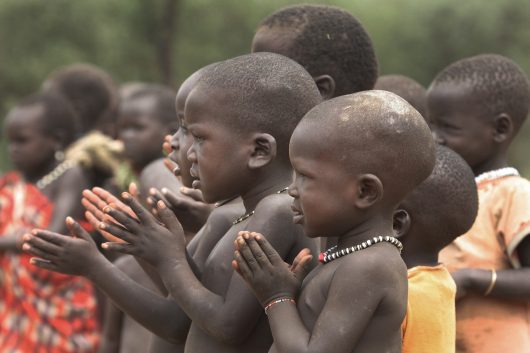
 Since 2013, political unrest in South Sudan has created a wave of violence, forcing millions from their homes to seek refuge elsewhere. According to the International Rescue Committee, the violence has left approximately 10,000 dead and displaced more than two million South Sudanese people, or one in three.
Among the displaced, about 65 percent are children under the age of 18. About 19,000 children were recruited into militias, according to a UNICEF press release. The enduring violence has disrupted the economy, education system and healthcare and has caused severe malnutrition in South Sudan.
According to the UNICEF press release, more than one million children, which is more than half of the youth population in South Sudan, suffer from acute malnourishment. With no real progress in sight, malnutrition is expected to worsen in the coming year.
“In early 2018, half of the population will be reliant on emergency food aid. The next lean season beginning in March is likely again to see famine conditions in several locations across the country,” said the Emergency Relief Coordinator for the United Nations Office for the Coordination of Humanitarian Affairs (OCHA) Mark Lowcock to the OCHA security council.
Causes of Malnutrition in South Sudan
Besides flooding, which has displaced more than 100,000 people, the primary suspect causing malnutrition in South Sudan is the ongoing conflict. Destroying villages and separating families, the violence has created devastating consequences for the citizens of the African nation.
The threat of being killed or recruited into militias has forced millions from their homes and away from their farms. Now living in crowded refugee camps, and with a decrease in crop production, thousands of people are almost entirely reliant on humanitarian aid.
Not only does the violence cause millions to seek refuge and halt crop production, it also prevents humanitarian aid from reaching much-needed parts of South Sudan that suffer from food insecurity. According to OCHA, humanitarian aid will not be entirely successful until the conflict ends and allows organizations like UNICEF and the International Rescue Committee access to the malnourished people of South Sudan.
Thus far, 95 aid workers killed in South Sudan, 25 of which were killed in 2017. These unfortunate acts are the ones that hinder NGOs and other organizations’ abilities to send aid.
Aid Contributions
UNICEF has treated more than 600,000 people in South Sudan for malnutrition and aims to give about $183 million in aid during 2018. Furthermore, the World Bank’s South Sudan Emergency Food and Nutrition Security Project plans on giving about $50 million to help supply food and assist farmers in increasing their crop yield. Finally, the International Rescue Committee has helped in South Sudan by establishing clinics focused on addressing health-related issues, including malnutrition.
While these organizations and others are fighting malnutrition in South Sudan, violence has greatly affected their ability to assist. Constant warfare has left villages and farms deteriorated and has strained the already limited amount of food.
Filippo Grandi, the U.N. High Commissioner for Refugees, voiced his concern for the future of South Sudan when he and Lowcock initiated an appeal for an additional $1.5 billion in funding to combat the worsening conditions in South Sudan.
“The conflict is purging South Sudan of the people who should be the greatest resource of a young nation. They should be building the country, not fleeing it,” Grandi said. “For as long as the people of South Sudan await peace, the world must come to their aid.”
– Austin Stoltzfus
Photo: Flickr

Addressing the Causes of Poverty in South America
Current events such as protests and political upheavals in Venezuela and Brazil have drawn attention to problems plaguing South America. Some of those problems, having been left unaddressed, have caused higher rates of poverty in Latin and South America. Below are several factors considered to be major causes of poverty in South America at present.
In much of South America, particularly in well-known tourist countries, run-down slums exist next to wealthy urban areas in part due to unequal distribution of economic success. According to the Economic Commission for Latin America and the Caribbean, Latin and South America are the most unequal regions in the world in terms of wealth. Corporations, politicians and unequal opportunities contribute in part to high poverty rates among the majority of the population.In Brazil, wealth being hoarded by the top one or two percent of citizens has contributed to a high number of children living and earning money on the streets because their parents can no longer support them. Despite helpful tourism revenue, poverty rates in certain popular areas of South America rise steadily because of wealth inequality.
In South and Latin America, poverty can become a generational epidemic because of leftover institutions and sentiments from the Casta system. Casta was a complex system of written rules based on racial segregation similar to the Hindu Caste, where people were separated into societal classes based on appearance and ethnic makeup that determined where they could live, who they could marry, what jobs they could work and more. The system was popularized by early white colonialists in the region and the lingering effects of it have been among the causes of poverty in South America.
Honduras, Venezuela, Brazil, Argentina and others have undergone major changes in political leadership in recent months and years, and the lack of clear democratic process in a lot of these countries has been among the causes of poverty in South America. According to the Economist, Brazil and Colombia are set to elect new presidents in the coming months, but “they will do so amongst rising public anger over corruption, amid a plethora of corruption scandals across the region in recent years that have in many cases implicated high-level politicians.”In Peru, for example, President Pedro Pablo Kuczynski narrowly avoided impeachment after it was discovered he had ties to corrupt Brazilian construction company Odebrecht, which has admitted to paying bribes to governments. As has been proven multiple times, corrupt or destabilized governments often prove disastrous for the economies of the countries they oversee, which can only have a negative effect on the poverty level in the country.
In South America, the education gap mirrors the income gap between rich and poor. According to WorldFund, “74 million South Americans (about 12.4 percent of the region’s population) live on less than $2 per day. Over half of them are children. Children in the bottom income quintile complete an average of eight years of school versus over ten years completed by children in the top income quintile.” Access to quality education in South America for those living below the poverty line is incredibly rare and difficult to achieve. WorldFund states that “education investments are inadequate, poorly directed and favor high-income students.”
While conditions in South America are improving, progress in certain areas is slow. Those living in poverty in South America are often directly affected by the factors above. The introduction of more efficient and generous international aid programs to people in the region that need it is becoming more and more essential to help combat some of the causes of poverty in South America.
– Arianna Smith
Photo: Flickr
Forging the Fight Against Malnutrition in South Sudan
Among the displaced, about 65 percent are children under the age of 18. About 19,000 children were recruited into militias, according to a UNICEF press release. The enduring violence has disrupted the economy, education system and healthcare and has caused severe malnutrition in South Sudan.
According to the UNICEF press release, more than one million children, which is more than half of the youth population in South Sudan, suffer from acute malnourishment. With no real progress in sight, malnutrition is expected to worsen in the coming year.
“In early 2018, half of the population will be reliant on emergency food aid. The next lean season beginning in March is likely again to see famine conditions in several locations across the country,” said the Emergency Relief Coordinator for the United Nations Office for the Coordination of Humanitarian Affairs (OCHA) Mark Lowcock to the OCHA security council.
Causes of Malnutrition in South Sudan
Besides flooding, which has displaced more than 100,000 people, the primary suspect causing malnutrition in South Sudan is the ongoing conflict. Destroying villages and separating families, the violence has created devastating consequences for the citizens of the African nation.
The threat of being killed or recruited into militias has forced millions from their homes and away from their farms. Now living in crowded refugee camps, and with a decrease in crop production, thousands of people are almost entirely reliant on humanitarian aid.
Not only does the violence cause millions to seek refuge and halt crop production, it also prevents humanitarian aid from reaching much-needed parts of South Sudan that suffer from food insecurity. According to OCHA, humanitarian aid will not be entirely successful until the conflict ends and allows organizations like UNICEF and the International Rescue Committee access to the malnourished people of South Sudan.
Thus far, 95 aid workers killed in South Sudan, 25 of which were killed in 2017. These unfortunate acts are the ones that hinder NGOs and other organizations’ abilities to send aid.
Aid Contributions
UNICEF has treated more than 600,000 people in South Sudan for malnutrition and aims to give about $183 million in aid during 2018. Furthermore, the World Bank’s South Sudan Emergency Food and Nutrition Security Project plans on giving about $50 million to help supply food and assist farmers in increasing their crop yield. Finally, the International Rescue Committee has helped in South Sudan by establishing clinics focused on addressing health-related issues, including malnutrition.
While these organizations and others are fighting malnutrition in South Sudan, violence has greatly affected their ability to assist. Constant warfare has left villages and farms deteriorated and has strained the already limited amount of food.
Filippo Grandi, the U.N. High Commissioner for Refugees, voiced his concern for the future of South Sudan when he and Lowcock initiated an appeal for an additional $1.5 billion in funding to combat the worsening conditions in South Sudan.
“The conflict is purging South Sudan of the people who should be the greatest resource of a young nation. They should be building the country, not fleeing it,” Grandi said. “For as long as the people of South Sudan await peace, the world must come to their aid.”
– Austin Stoltzfus
Photo: Flickr
Swat Valley School Improves Education for Girls in Pakistan
Farah Mohamed, CEO of the Malala Fund, and Mariam Al Hammadi, the Director of the Big Heart Foundation, signed an agreement regarding the school in Oxford, London. In attendance at the signing was Malala Yousafzai and Sheikh Sultan bin Ahmed Al Qasimi, the Big Heart Foundation’s Humanitarian Envoy.
Financing for the School
The Big Heart Foundation donated $70,000 to the school and agreed to pay for the school’s operational needs such as medical, security expenses, transportation, uniforms, staff salary and books. The Big Heart Foundation plans to finance the school’s first two years with these funds. The school will be located in Swat Valley, which is the hometown of Malala Yousafzai, the founder of the Malala Fund.
Malala Yousafzai commented on the donation, saying, “I overwhelming thank the Big Heart Foundation for believing in my dream of a world where girls can choose their own future path. With their support, the Malala Fund can provide education for girls in my hometown, Swat Valley in Pakistan.”
Pakistan’s Education System
The creation of this school is a small but essential step in improving tragically low literacy and education levels in Pakistan’s lagging school system. As of 2015, there were about 3,309,514 young girls not enrolled in school. This does not include the other 2,902,032 adolescent women who were also not enrolled. In 2014, the illiterate population for women who were 15 and older was over 32,000,000.
Pakistan’s primary education school has been characterized as one of the most underdeveloped programs. Only 60 percent of its children complete their education through the fifth grade, while the others drop out for various reasons. Additionally, only 8 percent of Pakistan’s population has the qualifying grades to receive a tertiary education.
The Contributors
The Big Heart Foundation was created in May of 2015 by Her Highness Sheikha Jawaher bin Mohammed Al Qasimi. The organization’s goal is to provide needed humanitarian support from the United Arab Emirates (UAE). Its primary aim is to help vulnerable families and children who live outside of the UAE, such as Jordan, Iraq, Syria, Lebanon and others. It hopes to provide safe and secure environments to families and children in need, help increase the cooperation between local and regional government and help improve financial support.
The Malala Fund was founded in 2013 by Malala Yousafzai along with her father. This organization campaigns the idea that every girl has the right to 12 years of free and safe education. It believes that “girls are the best investment in future peace and prosperity of our world.”
Thanks to these two important organizations, in the near future, education for girls in Pakistan will finally be provided. Though education for girls in Pakistan is in dire need of improvement, this school is a vital, beneficial and necessary step.
– Cassidy Dyce
Photo: Flickr
The Hidden Reality of Poverty in Japan
As the nation with the third largest economy in the world, it is easy to assume that poverty in Japan does not exist. However, one in six Japanese people is living in relative poverty. Many believe this is due to incomes dropping and the number of single-mother households increasing, which often consists of low-paying and sporadic employment. In 2014, child poverty rates in Japan hit a record high. Poverty within the country needs to be addressed, even if it’s less extreme than in other areas.
Children’s Cafeterias
In early 2017, the number of children living in poverty in Japan was estimated to be around 3.5 million. With such numbers rising, a children’s cafeteria named Kawaguchi was created in Tokyo as a place for children to socialize and have what is often times their only proper meal of the day. Kawaguchi survives strictly on cash donations from local businesses, and the food is donated by farmers and some participating families. There are around 50 children who eat there monthly, and about a third of them come from struggling single-parent households.
Like Kawaguchi, hundreds of similar cafeterias have been created throughout Japan to help with poverty issues. Although a law was passed in 2013 in regards to child poverty, sources say programs helping these children lack funding and support.
A proven difficulty in Japan is taking the poverty issue seriously, and the realities of poverty are often hidden for fear of being seen as disadvantaged. With social expectations in Japan, families often make extreme efforts to get their children everything they need to participate in expensive school activities and ensure they look well dressed. In doing this, the families often have to cut down on food.
Finding Children in Need
In addition to cafeterias for children, Japanese nonprofits have created interest-free loans for students who need extra help. An organization called The Nippon Foundation opened a facility where up to 20 children at an elementary age can go between 2 p.m. and 9 p.m. to relax, study and have a hot meal. The foundation plans to expand to allow 100 children by 2020.
Because poverty in Japan proves to be somewhat of a taboo, The Nippon Foundation understands that people may not ask for help, even when they desperately need it. So, the foundation focuses a lot of its efforts on outreach and finding children who need this kind of help.
With Japan being such a successful and economically advanced nation, poverty within its boundaries is often overlooked and misunderstood. Because of this, it is essential to understand that aid projects need to be put in place, just like in other struggling countries. Japan is a prime example that poverty can exist in wealthy countries. Assistance programs like children cafeterias and nonprofits not only help alleviate poverty in Japan, but they also spread the message that more needs to be done to help these people, especially children, who are living in poverty.
– McCall Robison
Photo: Flickr
Credit Access in Belarus
The Belarus economy struggles primarily with financial inclusion. This means that although the Belarusian economy has the financial infrastructure in place to offer people financial products, many people do not take advantage of them. Surveys have indicated that this is primarily due to low levels of financial literacy in Belarus, as well as the financial system’s inability to reach people in rural areas as easily as their urban counterparts. However, some of the results have indicated that Belarusian banks just do not lend liberally enough to ensure full credit access in Belarus.
International Involvement
This is where the international community can and does step in. Belarus is a country that stands to benefit from greater access to microloans, which are often provided by international actors such as the U.S. Agency for International Development (USAID) and the European Union.
The European Investment Bank (EIB) is currently contemplating a major contribution to improving credit access in Belarus. The EIB is considering providing the equivalent of a $100 million credit line for small and medium-sized enterprises. This line of credit will be used in conjunction with loans provided by Belarusian banks. The EIB funds are to be used to provide half of the financing requested by borrowers, with the World Bank, the European Bank for Reconstruction and Development, or local banks covering the rest. The EIB loans also come with a five year grace period during which no payments are due on the principal of the loan.
Making this financing available will greatly improve credit access in Belarus for would-be business owners and will enable many more people to start their own businesses. This project is notable because it will prioritize making capital available to those wishing to use it for projects that will promote broader economic development.
Financial History
Steps are also being taken to improve financial literacy along with credit access in Belarus. USAID is working with local nonprofits who provide microloans to organize training for borrowers to ensure that they understand the terms of their loans and are able to pay them back.
Additionally, the Belarusian credit registry has recently moved to give all Belarusians access to their credit reports via the internet. Previously, this information was only available to customers of one particular bank. Now, any Belarusian is entitled to view their credit report once a year free of charge. People can view their report additional times for a nominal fee.
Giving people greater access to their credit history is a major accomplishment and has the potential to promote greater credit access in Belarus. It can encourage more people to engage with the financial system and give them a clearer picture of where they stand, enabling them to make informed decisions about their finances. With increased financial knowledge, people could potentially be encouraged to take out loans they previously would not have thought themselves eligible for. All of this, in turn, will generate more economic activity.
Belarus is an emerging market that will benefit greatly from improved credit access. Ensuring full credit access is an easy way to promote economic development and improve quality of life. Thanks to both local and international actors, Belarus is making major strides in this area.
– Michaela Downey
Photo: Flickr
US Benefits from Foreign Aid to Colombia
For more than 50 years, Colombia was ravaged by war and struggled to reach an agreement of peace that suited both warring parties. This caused the country to be caught in ongoing and seemingly never-ending turmoil. The war impacted millions of citizens in the country and took the lives of more than 220,000 people.
Plan Colombia
In 2016, the U.S. helped Colombia reach a peace agreement with the country’s largest guerrilla group, the Revolutionary Armed Forces of Colombia (FARC). The peace treaty was a culmination of years of hard work for both Colombia and the U.S., who has been working with Colombia to strengthen its military since 2000. The peace agreement has led to nearly 6,900 members of FARC putting down their guns and relocating to the demobilization zones put in place by the U.N. for the former soldiers in the war.
The peace agreement was known as “Plan Colombia,” and it resulted in many U.S. benefits from foreign aid to Colombia. The plan increased U.S. military and diplomatic support from the citizens of the country.
Colombian Agency for Reintegration
The U.S. has helped Colombia garner peace, increasing military support in the U.S. in the process. The end of the war has prompted the Colombian government, with the help of the U.S., to start an Agency for Reintegration (ACR) in the country. The program is for the millions of people displaced by the war, as well as the soldiers that fought.
The ACR’s efforts include providing healthcare, employment opportunities, education and vocational training for the former soldiers as they transition back into society. Counting the soldiers and their families, almost 30,000 Colombians are in need of assistance and are receiving aid from the ACR.
Giving aid to foreign countries can reflect positively on the U.S. and can help other countries in need. With support from the U.S., Colombia has ended its civil war and has begun to reintegrate members of the war into society. In response to the aid given to Colombia, the U.S. benefits from raised support for the military and increased diplomatic support.
– Simone Williams
Photo: Flickr
Addressing the Lack of Sustainable Agriculture in Togo
Togo’s small sub-Saharan economy is dependent on both commercial and subsistence agriculture, with cocoa, coffee and cotton generating about 40 percent of export earnings. Additional products include beans, cassava, fish, livestock, maize, millet, rice, sorghum and yams. Of the nation’s total land area, 44 percent is used for cultivated crops and two percent for permanent crops like fruit- and nut-bearing trees.
The organization Fly for Life is a nonprofit with the mission to promote sustainable tourism and organic farming by improving the environment, education and incomes of farming communities. Jeremies Pimzi, a social entrepreneur, founded Fly for Life. With help from eco-volunteers, the organization has been able to successfully provide more sustainability in Togo, such as training programs in organic methods, sustainability education and financial management.
Eco-volunteers provide skills and training on increasing sustainable tourism and organic farming. In exchange, the volunteers gain firsthand knowledge about the local customs and culture and develop close relationships with the Togolese. Some of the funding from volunteers has also supported education in the small farming communities of Havu and Soumdina Mountain Village, helping families afford school for their children.
Over 90 percent of the small communities that Fly for Life engages with are dependent on agriculture for their livelihoods. Environmental issues in Togo include deforestation due to slash-and-burn agriculture, the use of wood for fuel and water pollution. The nonprofit aims to transition the nation from unsustainable farming practices to organic methods.
Another key project that addressed sustainable agriculture in Togo was USAID WAFP, or West Africa Fertilizer Program, which occurred from 2012-2017. The project was meant to improve the supply and distribution of appropriate and affordable fertilizers in West Africa. The project broadened its reach to have regional impact across the West Africa sub-region, benefiting 15 ECOWAS (Economic Community of West African States) countries as well as Mauritania and Chad.
To accomplish its goal, WAFP focused on creating a conducive policy for increased investment in the fertilizer business. It facilitated access to business, investment and financing information that allowed the private sector to deliver quality and affordable fertilizers to farmers.
Because of the work of organizations and the implementation of eco-friendly ideas and practices, there can be better, more sustainable agriculture in Togo.
– Julia Lee
Photo: Flickr
How Book Aid International is Fostering Academic Growth in Africa
Education for All
One of the major U.N. Millenium Development goals was to have all school children complete primary level education by 2015. Although this was not achieved universally, there have still been several accomplishments in the sphere of education, and there are more children in schools now than ever before.
The U.N. reports that, from 2000 to 2015, enrollment in primary education rose from 83 percent to 91 percent. Additionally, the literacy rate among youth aged 15 to 24 skyrocketed from 83 percent to 91 percent between 1990 and 2015. One nonprofit located in the U.K., Book Aid International, can be accredited for helping the U.N. achieve these goals.
The Gateway to Knowledge
Book Aid International is a firm believer that the gateway to knowledge is through reading. Access to information can prevent children from falling into poverty, increase future job opportunities and improve their life expectancy past the age of five by 50 percent. As a result, Book Aid International has developed a program revolved around the power of books called Inspiring Readers.
Inspiring Readers donates books to schools in Africa where resource scarcity is a major issue. Through this program, schools receive a library of 1,250 new books and selected teachers from the schools receive specialized training to ensure that the books will be well utilized. Inspiring Readers also ensures that each school gets further resources and assistance by partnering up with a local library.
The program has already seen success. One particular Kenyan school that partnered with Book Aid International has received recognition from the community for improved student academic performance. The school stated in 2017 that students’ test scores have improved from 48 percent to 54 percent in Kiswahili, 48 percent to 50 percent in English and 45 percent to 52 percent in science.
Fostering Academic Growth in Africa
Overall, Inspiring Readers has brought 63,710 books to 50 schools around Africa. The organization has also trained 150 teachers and 20 librarians. Consequently, 31,343 children have been impacted by this program. However, Book Aid International does not want to stop there. Its goal is to reach 250,000 children by 2020.
Book Aid International estimates that it needs £2,600 per school to achieve this goal. There are many ways to help the nonprofit meet this goal, but it relies mostly on donations for funding. Small amounts of money can make a huge difference, as Book Aid International indicates it only costs £2 to send one book to a partnering school. The organization also accepts donations of new books.
Book Aid International has already made huge strides forward in fostering academic growth in Africa, nurturing children’s interests in reading as well as training teachers to become better motivators and instructors. This will only lead children to success and will ultimately help the U.N. in accomplishing its goal of education for all.
– Mary McCarthy
Photo: Flickr
Credit Access in Cuba: Cuentapropistas Are in Need
There are over half a million legally registered cuentapropistas in Cuba and the numbers are still rising. These Meso, Small and Micro Enterprises (MSMEs) are an important economic asset to both Cubans and travelers, providing them with a wide variety of goods and services, creating employment and generating income.
Although microfinance lending has widened, it is still very limited. Statistics collected from the Central Bank of Cuba showed that in the wake of the government banking reform in 2011, 378,011 people received financing worth $135 million between the years 2012 and 2014. Only 34 percent of lending went to sole farmers and small enterprises, while micro enterprises accounted for about 2.6 percent. 63 percent of the loans that were lent went toward financing the construction of homes and renovating businesses.
Microcredit has been available in Cuba solely through local banks, as opposed to international banks or NGOs, which has presented a number of disadvantages to its success. Many Cubans lack a credit history, which has ruined the credibility and creditworthiness of borrowers. Another obstacle hindering credit access in Cuba is the lack of knowledge of the usage of credit among business owners primarily due to the many years of the nation’s state-owned and-operated political and economic system.
However, this has not stopped Credit4Cuba, a nonprofit foundation established in the year 2015 in the Netherlands by Marije Oosterhek and Dennis Schmidt. This organization is making a difference for cuentapropistas by supporting small and growing enterprise development in Cuba. Credit4Cuba works closely with existing groups in Cuba by providing the proper practical training and coaching assistance to entrepreneurs hoping to enter the world of cuentapropistas in order to expand their existing business.
Aside from offering training and coaching, Credit4Cuba aims to set up a social impact hub in Havana. It hopes to create a social community where entrepreneurs can meet to interchange experiences and collaborate on ideas in order to create opportunities and join efforts toward developing their businesses. In the near future, Credit4Cuba will work to connect cuentapropistas with social investors, entrepreneurs and trainers worldwide, provided that all participants will contribute toward the Sustainable Development Goals and work to create a positive influence in Cuba.
Microfinance organizations similar to Credit4Cuba, like the Grameen Bank and Kiva, are not only helping the economy for developing countries to prosper, but they are also contributing to the reduction of poverty. Credit access in Cuba for small business owners is slowly moving in the right direction.
– Zainab Adebayo
Photo: Pixabay
Addressing the Success of Humanitarian Aid to Timor-Leste
Timor-Leste, also known as East Timor and officially known as The Democratic Republic of Timor-Leste, is a sovereign state made up of a small cluster of islands in maritime Southeast Asia. After gaining independence from Portugal in 1975, Timor-Leste struggled through a quarter of a century under occupation, mass conflict and United Nations transition before finally being granted full independence in 2002.
As a result of the struggle Timor-Leste faced while gaining independence, the country was left with little infrastructure, an unstable economy and widespread poverty. Due to the country’s high instability, Timor-Leste is one of the most malnourished countries in the world. This results in a lack of food security, lack of hygiene and sanitation and an increase in poverty.
Despite receiving an abundance of humanitarian and transition relief since gaining its independence in 2002, Timor-Leste is still considered one of the poorest and least developed countries in the world. However, in the past five years, there has been a resurgence in the success of humanitarian aid to Timor-Leste. The main donor to Timor-Leste is the nation of Australia.
In 2014, the Humanitarian Aid Relief Trust (HART) began sending regular humanitarian aid to Timor-Leste. HART is a small aid organization originally founded by the United Kingdom but has since branched out into Australia and the United States. The aid organization focuses on working with communities in conflict zones, post-war zones or areas were people are exploited for cultural or political reasons.
On World Food Day 2014, HART released a detailed briefing on malnutrition and its consequences in Timor-Leste, such as high infant and child mortality rates. Shortly after releasing this briefing, HART worked with its partner, HAIM Health, to create programs and teaching centers to better educate the Timorese on proper nutrition. Programs focus on understanding nutrition, a balanced diet, preparing and cooking food and healthy sanitation practices. HAIM Health also follows up with the families enrolled in its education programs and has an 80 percent success rate of children gaining or sustaining weight.
Humanitarian aid to Timor-Leste does not stop with HART and HAIM Health. The Department of Foreign Affairs and Trade (DFAT) of the Australian government signed the East Timor Strategic Planning Agreement for Development in 2011, which establishes a shared vision of economic stability and growth between Australia and Timor-Leste. Since the signing of this agreement, Timor-Leste has seen many improvements in its development and further success toward a stable economy. In 2017-18 alone, Australia is expected to give approximately $96 million in humanitarian aid to Timor-Leste.
Thanks to Australia’s humanitarian aid to Timor-Leste, the Timorese have already seen positive results, including more than 40,000 people being provided the education and skill set needed to join the growing workforce. Also, over 21 thousand people now have access to clean water and hygiene programs and over 90 percent of primary schools now have a new and innovative curriculum, geared toward giving the students the skills they need to succeed.
Despite these improvements from humanitarian aid to Timor-Leste, the country still has a lot of room for improvement. The poverty rate in 2014 was 41.8 percent, which is still very high. With this groundwork laid, the Timorese will be able to build a brighter and more stable future.
– Courtney Wallace
Photo: Flickr