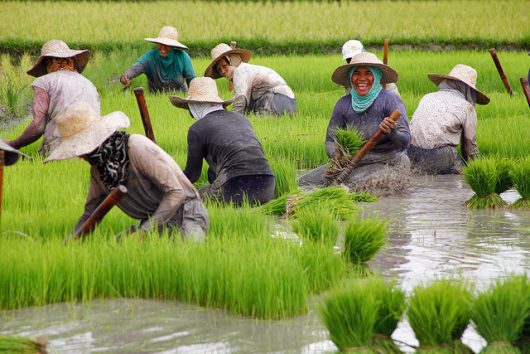
Biotechnology in the Philippines is so important that a new biotechnology center is being built to support the Philippine Department of Agriculture. The project is being funded mainly by the U.S. Agricultural Trade Development and Assistance Act, Public Law 480. Agriculture makes up 20 percent of the Philippine’s GDP, yet Filipinos dependent on agriculture as their main source of income are some of the poorest in the nation.
Biotechnology in the Philippines
Biotechnology is a science that allows farmers to be more efficient and environmentally conscious by growing more crops resistant to pests and diseases on less land. This scientific advancement is essential in the nation, as almost half of Filipinos work in agriculture and the country is experiencing significant population growth.
Rice is a staple in Filipino culture, but it is not the most nutritious of foods. Biotechnology in the Philippines is helping researchers develop Golden Rice, which is genetically modified rice that contains Vitamin A — a vital nutrient for human health. Just by increasing food production, biotechnology works to assist an ever-changing world facing overpopulation, starvation and climate change. Climate change is changing the way people farm, as droughts and deforestation alter the amount of water that can be used for farming.
“The goal of constructing this center is to generate improved technologies, increase productivity, and enhance commercial value of DA’s priority crops such as rice, abaca, coconut, white and yellow corn, cotton, cassava, sweet potato, yam, tomato, and eggplant,” Dr. Roel R. Suralta, head of DA’s Crop Biotechnology Center.
Producing more crops more rapidly means more money in Filipino farmer’s pockets, and creating pest-resistant crops with the help of biotechnology will increase the likelihood that crops will be lucrative once harvested.
The Philippine Rice Research Institute
The Philippine Rice Research Institute (PhilRice) is the other main partner for the new biotechnology building in the Philippines. The organization was created in 1985 by the Filipino Department of Agriculture to ensure that the production of rice in the Philippines could feed all Filipinos. PhilRice’s mission is simple: produce quality rice to make sustainable and environmentally sound profits.
Biotechnology and plant breeding help rice crops stay pest-resistant in economically sound and sustainable ways. PhilRice also researches the creation of new, more nutrient-dense and water-efficient soil, and genetic modification of rice strains works to make the most cost-effective, pest-resistant breeds.
While the Rice Chemistry and Food Science Division analyzes the progress of these new technologies, the Rice Engineering and Mechanization Division looks to develop farm machinery for pre- and post-production to modernize rice farming operations. Such efforts have been met with policy support to ensure such new technologies and practices are successfully put into practice.
A communication team has also been put in place to educate and bring awareness to farmers and the general public on Rice Science for Development (RS4D). Training and education of new technologies and methods are projected to increase productivity and income for farmers.
Future Growth
In 1954, President Eisenhower enacted PL 480 in the United States to ensure that the U.S. provides food assistance abroad. Aside from continued research, the new building and continued efforts in the Philippines will uphold this 70 year-old promise, and educate and train people to utilize biotechnology for international good.
Biotechnology in the Philippines increased the agriculture market by $642 million, and 14 climate change resistant rice strains have been created in recent years. The strains in-use now only take 5 to 7 years to breed as opposed to 10 to 12, and such results provide international hope for feeding ever-growing populations and combating a changing climate. For these reasons, it’s essential for U.S. foreign aid to continue and for biotechnology in the Philippines to remain active in agriculture.
– Hope Kelly
Photo: Flickr

Importance of US Foreign Aid: Biotechnology in the Philippines
Biotechnology in the Philippines is so important that a new biotechnology center is being built to support the Philippine Department of Agriculture. The project is being funded mainly by the U.S. Agricultural Trade Development and Assistance Act, Public Law 480. Agriculture makes up 20 percent of the Philippine’s GDP, yet Filipinos dependent on agriculture as their main source of income are some of the poorest in the nation.
Biotechnology in the Philippines
Biotechnology is a science that allows farmers to be more efficient and environmentally conscious by growing more crops resistant to pests and diseases on less land. This scientific advancement is essential in the nation, as almost half of Filipinos work in agriculture and the country is experiencing significant population growth.
Rice is a staple in Filipino culture, but it is not the most nutritious of foods. Biotechnology in the Philippines is helping researchers develop Golden Rice, which is genetically modified rice that contains Vitamin A — a vital nutrient for human health. Just by increasing food production, biotechnology works to assist an ever-changing world facing overpopulation, starvation and climate change. Climate change is changing the way people farm, as droughts and deforestation alter the amount of water that can be used for farming.
“The goal of constructing this center is to generate improved technologies, increase productivity, and enhance commercial value of DA’s priority crops such as rice, abaca, coconut, white and yellow corn, cotton, cassava, sweet potato, yam, tomato, and eggplant,” Dr. Roel R. Suralta, head of DA’s Crop Biotechnology Center.
Producing more crops more rapidly means more money in Filipino farmer’s pockets, and creating pest-resistant crops with the help of biotechnology will increase the likelihood that crops will be lucrative once harvested.
The Philippine Rice Research Institute
The Philippine Rice Research Institute (PhilRice) is the other main partner for the new biotechnology building in the Philippines. The organization was created in 1985 by the Filipino Department of Agriculture to ensure that the production of rice in the Philippines could feed all Filipinos. PhilRice’s mission is simple: produce quality rice to make sustainable and environmentally sound profits.
Biotechnology and plant breeding help rice crops stay pest-resistant in economically sound and sustainable ways. PhilRice also researches the creation of new, more nutrient-dense and water-efficient soil, and genetic modification of rice strains works to make the most cost-effective, pest-resistant breeds.
While the Rice Chemistry and Food Science Division analyzes the progress of these new technologies, the Rice Engineering and Mechanization Division looks to develop farm machinery for pre- and post-production to modernize rice farming operations. Such efforts have been met with policy support to ensure such new technologies and practices are successfully put into practice.
A communication team has also been put in place to educate and bring awareness to farmers and the general public on Rice Science for Development (RS4D). Training and education of new technologies and methods are projected to increase productivity and income for farmers.
Future Growth
In 1954, President Eisenhower enacted PL 480 in the United States to ensure that the U.S. provides food assistance abroad. Aside from continued research, the new building and continued efforts in the Philippines will uphold this 70 year-old promise, and educate and train people to utilize biotechnology for international good.
Biotechnology in the Philippines increased the agriculture market by $642 million, and 14 climate change resistant rice strains have been created in recent years. The strains in-use now only take 5 to 7 years to breed as opposed to 10 to 12, and such results provide international hope for feeding ever-growing populations and combating a changing climate. For these reasons, it’s essential for U.S. foreign aid to continue and for biotechnology in the Philippines to remain active in agriculture.
– Hope Kelly
Photo: Flickr
10 Key Facts About Poverty in Algeria
Despite its rich oil resources, Algeria faces long-term challenges from a lack of diversity in the economy, a relatively high unemployment rate — especially among youth and women — and regional inequalities. These 10 facts about poverty in Algeria will recount the recent ups and downs of the upper middle income country.
Top 10 Facts About Poverty in Algeria
A New Direction
Algeria is in need of economic transformations, and has to figure out how to address its low domestic productivity effectively. An economic blueprint that is more community-based and under public supervision should be adopted in place of the currently stagnating attempts at adjustment.
– Feng Ye
Photo: Flickr
Younger Generation Helps Save the World by Planting Trees
Felix Finkbeiner, a German 19-year-old, has created a global youth movement, Plant For The Planet, in hopes of saving communities all over the world and eventually building a suitable place for everyone to live. Younger generation helps protect the world with the ambitious Finkbeiner, and they show how little actions can make huge differences for the better.
The Younger Generation Cares About the World
At nine years old, Felix Finkbeiner had the goal of protecting land by increasing the number of trees. Finkbeiner successfully motivated 75,000 children to become climate ambassadors with Plant For The Planet, and over 15 billion saplings have been planted.
Finkbeiner spoke at the United Nations and European Parliament. Due to his hard work, Finkbeiner has gained traction for Plant for the Planet from the World Wildlife Fund. Since 2006, about 15.2 billion trees were planted by individual people, governments and businesses.
The movement’s founder is prepared to reach his goal of helping save the world by being knowledgeable about what matters. Through research, he found that there is enough land in the world to plant 589 billion mature trees harmlessly.
Finkbeiner explains, “We need to plant at least a trillion trees to get 600 billion, since many will not survive. Additionally, we must protect the 170 billion trees in imminent risk of destruction.” Younger generation helps contribute to positive changes in the world following the example of Finkbeiner.
The Positive Impact of Planting More Trees
Plant for the Planet has planted trees in 200 countries including:
Plant for the Planet bought a 33,359-acre ranch near Cancun, Mexico in 2014 that employs 78 people. The ranch strives to plant ten million trees on the land by 2020 because its land was deforested.
More Trees, Less Global Issues
The following countries are supportive of planting more trees to help with the reforestation of saving land all over the world: Ethiopia, Niger, Mali many other African countries and Latin American countries. Plant for The Planet has planted more than 14 billion trees in more than 130 nations and set the goal of planting one trillion trees in the next thirty years, with the Trillion Tree Campaign.
More trees can help solve many global issues by providing a healthier living environment for people. In fact, the planting of one trillion trees can collect an extra ten billion tons of carbon dioxide yearly.
The younger generation helps to make the world a better place by involving themselves in solving global issues. This population knows that there is not much time to stop these global problems from getting worse for their children, so Finkbeiner and the younger generation are taking action-oriented steps to help alleviate global poverty — one tree at a time.
– Kelly Kipfer
Photo: Flickr
Challenges and Changes for Education in Eritrea
Make It Rain! Cloud Seeding Benefits and Concerns
The World Wildlife Fund predicts that in 7 years, two-thirds of the world’s population will face a water shortage. This hypothesis is due to a number of reasons such as higher birth rates and longer lives as a result of improved healthcare, pollution as a result of oil, chemicals, trash disposal and fecal waste, poor management of resources and conflict.
Human Trajectory
Such an outcome is further exasperated by changes in climate, particularly in the form of an increase in the number of droughts and the melting of glacial mountains. If this continues, humanity will face a number of issues. For starters, health will decline and disease susceptibility will increase as more individuals lose access to clean drinking water and proper sanitation.
If these changes occur, then the financial security as individuals will also be affected as people become unable to function properly for work and school. Overall, the efforts of poverty reduction will be for naught if climate change continues to deplete water resources. In order to help combat these effects of climate change, scientists have been working towards enhancing a process called cloud seeding.
Cloud Seeding
Cloud seeding is the process of adding chemicals — like dry ice, silver iodide, etc. — to clouds to increase rainfall. Typically, these chemicals are shot or released into the sky by machines or small jets. Since its discovery in the 1940s, this system has been used to generate snow, and to try to stop hurricanes, or extend monsoon seasons. However, it wasn’t until 2017 that the hypothesis for the methodology was confirmed to be true and, thanks to this significant finding, scientists determined a range of potential effects/uses of cloud seeding.
Of these proposals, the potential effect cloud seeding can have on agriculture and the food security problem is one of the most notable. Cloud seeding is believed to support healthy growing seasons as it has the potential to combat droughts by boosting the amount of precipitation in a given area by 5 to 15 percent.
If cloud seeding is implemented, there will be increased harvesting and more food available from a wide variety of crops for the ever-growing human population. The process also has the potential to improve biomes, allow for more fertility and create more farming land and land that could be used to build better homes. Such effects can then indirectly create jobs and contribute to financial security for people living in poverty-stricken countries.
Realistic Expectations
Due to the potential benefits, many developing countries are starting to fund their own cloud seeding program, but without considering the potential drawbacks. Some of the downsides of this technology include the safety of continued exposure to silver iodide and other chemicals, which some studies have reported can cause skin discoloration and be carcinogenic.
Another setback is the economic and technological availability. There are countries like Dubai and China where they have the economic sufficiency but lack the technology and basic geographical set up to manage the precipitation. The amount and length of precipitation is also difficult to control, as can be seen in 2009 Beijing and the 2017 flooding in Dubai.
The bottom-line is: cloud seeding is uncharted waters. There are variables that need to be taken into consideration before introducing nationwide cloud seeding programs in developing countries, especially in the case of long-term use. However, once addressed, cloud seeding has the potential to bring the seemingly achievable dream of eradicating global poverty a step closer to reality.
– Stephanie Singh
Photo: Flickr
Action Rather than Reaction: Girls’ Education in Mozambique
Mozambique, a recently independent and developing nation, is solidifying its identity as a stable environment for education and growth. After its independence from Portugal, many struggled to deal with the changing government, rapid growth and hazardous climate. However, amongst such change and development, a plan for education has begun to empower future generations into action rather than reaction. Organizations like the Gender and Education in Mozambique project focus specifically on girls’ education in Mozambique .
The Gender and Education in Mozambique Project
The Gender and Education in Mozambique project began in 1997 and works to provide all children — regardless of gender — with the right to access education and equal opportunities. Not only does the Gender and Education in Mozambique project work to prioritize girls’ education in Mozambique, but it also works to assure that all members of the country understand and promote a learning environment in which girls are praised for their attendance — not made pariahs because they are not at home. The project used to work closely with UNICEF, but they’ve moved more towards protecting all genders’ rights to education.
Another affiliate of the program, Promoting Advancement of Girls’ Education in Mozambique, works to create organizations within schools that provide a support system for girls in school and encourage school involvement.
The aim is to provide educational support in the form of school supplies, and empowerment via scholarships for secondary education. Along with academic support comes emotional support, providing girls with the opportunity to report abuse and harassment and giving an outlet instead of forcing young people to bottle up pain and bullying.
Redefining Girls’ Education in Mozambique
Girls’ education in Mozambique is becoming more of a priority as a topic of education, not just as a focus for the government. PLAN International — a group focused on promoting equal education and more in depth education — has created clubs in which students learn about rights, societal issues and taboo subjects such as sex education.
Both boys and girls are able to join these clubs as they focus on political, social and academic equality. PLAN International also focuses on the need for women to finish their education rather than becoming teenage mothers through a program called the Better Opportunities for Girls project, also known as the AMOR project.
The AMOR Project aims to lower the number of child marriages and teenage pregnancies, which should then allow more girls to complete their high school education and potentially continue on into further schooling. The correlation found between larger areas of poverty and a greater number of child marriages often works to keep girls out of schools and forces them into domestic roles at home.
Action Rather Than Reaction
Mozambique has made significant progress since their independence in 1975 and civil war in 1992, and used their national drive to inspire change, creation and growth. However, there is always more that can be done to end the poverty of a nation.
A starting position for a country like Mozambique is to develop their education, which will in turn, allow women to stream into the workforce and generate revenue. The building blocks for development are in place – now it is time to promote and grow girls’ education in Mozambique.
– Kayleigh Mattoon
Photo: Flickr
Puralytics: The Eco-Friendly Water Solution
Water is necessary for life, and the poor quality of just one water reserve can undermine the health of farmers’ crops and the people in a whole community. To counteract the spread of harmful chemicals and preventable diseases, Puralytics has brought water purifying innovation to developing countries. Through LilyPads that float on pond surfaces to get rid of farm waste, and SolarBags that bring clean drinking water to households, the company’s impact will go global as they expand production.
Puralytics’ Global Impact
Puralytics’ products are known for harnessing the power of natural light to rid water of pollutants and pathogens. It’s all done by the mesh covering that disinfects water so bacteria and viruses cannot transfer to the people drinking it. Other water treatments concentrate farm run-off and pesticides, but with Puralytics, these contaminants are destroyed. Heavy metals combined with molecules of these broken-down chemicals adhere to the mesh material, and thus clean water in a way that’s kind to the environment.
This company’s products are sustainable and, unlike other water treatment technology, do not use Mercury lamps that can break and put out more hazardous waste. The company doesn’t use chemicals in the purification process either; all they need is an occasional cartridge replacement. In particular, the LilyPad reduces water usage by providing farmers with more efficient watering methods.
SolarBags and LilyPads
SolarBags brought clean water to 114 people in the Southern Moshi region of Tanzania for a case study. After interviewing some of the community members, 79 percent of respondents said they enjoyed the water’s taste while the rest were neutral. Some community members even reported less sickness caused by waterborne diseases.
SolarBags were also highly effective in Tesoco, Mexico where desire for them grew beyond the case study group. Soda, also a contributor to obesity, commonly replaced water due to lack of sanitation. After introducing the bags, participants drank between 50 to 100 percent more water and cut back on the sugary beverages.
The LilyPads have also already begun to show promise for a better future. In fact, there has been an 80 percent reduction of chemicals and pathogens in water reserves using this product — a LilyPad that’s one square meter can treat one cubic meter of pond water in a day. Plus, their sleek design is non-intrusive and only takes up one percent of the space on a farm.
LilyPads affect more people than just agricultural communities. Some farmers sell their produce through international markets, extending the positive effects of clean water to other countries. During the 2015 Global Forum in Agriculture, Mark Owen, founder and CEO of Puralytics, discussed his company’s partnership with Aneberries. This distributor based in Mexico has then used LilyPads on their farm plots and help provide half the berries shipped to the United States.
Treat Water, Treat the World
Puralytics’ LilyPad was named one of USAID’s 17 award-winning innovations through the Securing Water for Food Grand Challenge for Development program. As a result, the company will receive a grant to help fund their efforts of expanding production and finding more partnerships across Latin America.
So many factors depend on clean water: crops, livestock, community members, people in other countries, the environment and more. Owen told forum participants that when people treat one water source, it’s also treating the entire world, and no truer words could be said.
– Sabrina Dubbert
Photo: Flickr
10 Empowering Facts About Girls’ Education in Egypt
Education can do wonders for anyone around the world. In many nations, however, there are young girls who are never given the opportunity to learn how to read, write and communicate.
In Egypt, women are on the lower end of the literacy scale — 65 percent of women are literate compared to 82 percent of men. Interestingly, though, Egypt on the world scale ranks 78 in the “best country for women” and 44 for “best country for education.” Although, Egypt isn’t immune to progress, here are 10 facts about girls’ education in Egypt and how far the nation has come.
10 Facts About Girls’ Education in Egypt
Increasing Access to Education
These facts about girls’ education in Egypt demonstrate how the fight for equality is still progressing. Girls crave knowledge just as much as boys do, and thankfully there are many ways other boys, girls, men and women can get involved in helping support girls in developing countries receive the proper education.
One easy way to support access to education to girls in Egypt and those in other developing countries is supporting the Protecting Girls’ Access to Education in Vulnerable Settings Act and getting government officials to support this act as well.
– Victoria Fowler
Photo: Flickr
Four Important Facts to Know About Infrastructure in the Philippines
Amidst the 7,107 western Pacific islands known as the Philippines, poverty is uniquely endemic. A country of scattered landmass, the Philippines is ranked the third most disaster-prone country in the world, as its close proximity to the equator encourages destructive weather such as earthquakes and storms. Natural disasters disproportionately and recurrently hit the poorest regions of the country, coursing them into higher levels of poverty.
This, along with uncontrolled population growth, exacerbates the reality of poverty within this collection of islands. Fortunately, there are significant plans in the works that focus on kicking such insufficiency to the curb, solutions that include the advancement of infrastructure in the Philippines.
Historically, insufficient infrastructure development has stunted both economic growth and poverty reduction, but there is an active movement toward improvement. Within the past couple of years, proposals have been met with action to pave the way for a change. The following are four important facts regarding infrastructure in the Philippines.
Four Facts About Infrastructure in the Philippines
The sizeable collection of Filipino islands has an undying potential to continue reducing poverty through its infrastructure advancement efforts. Although an extremely complex process, both the booming Filipino economy and government project initiatives are projected to gradually alleviate cyclical Filipino poverty. The future of infrastructure in the Philippines is looking bright.
– Mary Grace Miller
Photo: Flickr
Impacting Tomorrow: Poverty Reduction in Southeast Asia
With all the global news that flies around day-to-day, progress in the fight against poverty can get lost in the shuffle. Poverty reduction in Southeast Asia has been a major goal for years. With over 230 million people — or 11 percent of its total population — undernourished, the nation still has major food security issues. Additionally, 15.1 percent of all people in the region experience poverty, living on less than $2 a day.
Combatting Extreme Poverty in Southeast Asia
So, one may ask: what is being done to combat these issues? There are several different ways that this kind of extreme poverty is being combatted, with efforts stemming from individuals, organizations and governments.
One company doing great work in Malaysia is Epic Homes, which builds houses for indigenous people, the Orang Asli. Taking donations from both private donors and corporate clients, the company has built more than 100 houses worth around $12,500 apiece. Founded by John-Son Oei, Epic Homes trains community members and builds homes with a combination of residents and volunteers.
John-son Oei is proud of the work his company does, stating how “the community is involved in the building of their own homes, so there is a sense of ownership, a sense that this is not just an act of charity.”
Creating a Home in Southeast Asia
Oei’s company is not the only one doing good work on poverty reduction in Southeast Asia. Social venture Doh Eain, which means ‘Our Home’ is based out of Myanmar’s largest city, Yangon. Using crowdfunding and donations, the company has restored over a dozen colonial homes and cleaned up half a dozen back alleys. These alleys — which are usually used for dumping trash — have been converted into green spaces where residents and children gather.
According to Doh Eain’s founder, Emilie Roell, “Yangon has very few public spaces that people can use. Having access to their own back alleys and safe spaces has led to greater social cohesion, and a change in behavior.”
Government Involvement
Moving past individuals, governments are also doing their part in poverty reduction in Southeast Asia. The multi-government association called First China-South Asia Cooperation Forum (CSACF) concluded successfully in mid-June this year. The CSACF, according to Chinese official Li Jiming, Director-General of the Foreign Affairs Office of Yunnan Provincial People’s Government, bred interconnectivity and opened a dialogue between nations that haven’t interacted much in the past. According to Li, the forum fostered the “cooperation atmosphere of candid exchange, mutual assistance, and shared development has been created.”
China has been the regional leader for awhile, with the 12th ASEAN-China Forum on Social Development and Poverty Reduction held in Manila through Friday. Conferences like these demonstrate how poverty reduction in Southeast Asia is at work, as 25.2 percent of the population in the Philippines below the poverty line in 2012 decreased to 21.6 percent in 2015 — a reduction of 21.9 million.
Reducing the world’s poverty takes time, especially in places such as Southeast Asia. However, thanks to the work of individuals and governments, people in a variety of countries are gaining an increasingly higher standard of living.
– Dylan Redman
Photo: Flickr