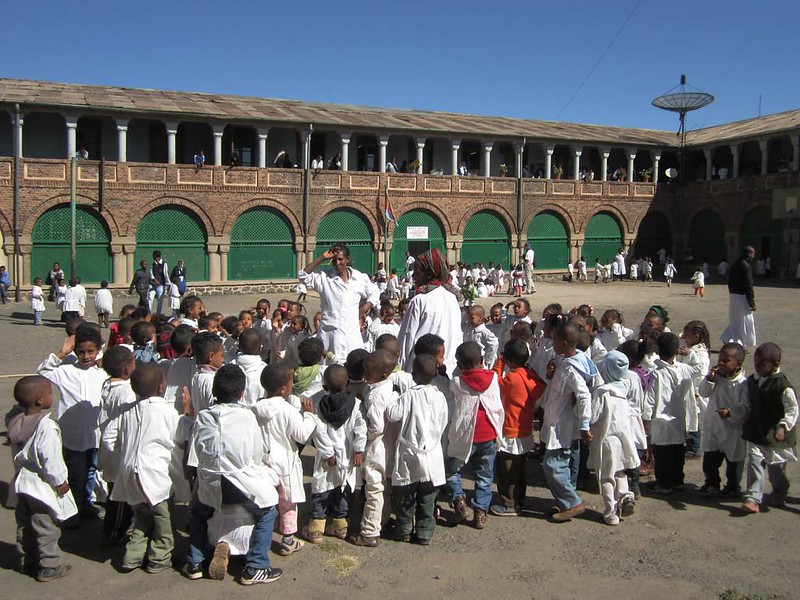
The cloister of the Catholic Cathedral in Asmara hosts a large school. Seven decades on, the Italian influence in still strong in Eritrea.
Eritrea is a tiny East African country on the Red Sea, between Djibouti and Sudan, with an extended southern border with Ethiopia. At one time under Italian colonial control, the U.N. established Eritrea as an autonomous region within the Ethiopian federation in 1952. Annexation by Ethiopia 10 years later led to a 30-year conflict that ended with Eritrean independence in 1993. A two-and-a-half-year border war with Ethiopia ended under U.N. auspices in 2000, eventually leading to rapprochement between the two countries.
One of the poorest African nations, Eritrea’s population of over six million is concentrated around two cities in the country’s center, but is agriculturally dependent. Unfortunately, although almost two-thirds of the land is agricultural, less than 6% is arable. The country also has a significant mining sector.
Education in Eritrea
Primary and secondary education is compulsory and free for Eritrean children from ages 7 to 13. Opportunities for further education are available at vocational training centers, as well as smaller educational colleges, technical schools and two universities.
In June 2025, the Ministry of Education reported a 900% increase in the number of schools, kindergarten through high school, over the past three decades. Substantial investment had increased the number of schools from 214 in 1991-92 to 1,926 in 2022-23. The number of teachers rose from a little over 5,000 to more than 23,000, with the largest increase at the kindergarten level.
Learning Poverty
The learning poverty rate, a metric initiated in 2019 by the World Bank and the UNESCO Institute for Statistics, measures the proportion of children who are unable to read a simple text with comprehension by age 10, and considers both schooling and learning. Schooling deprivation, learning deprivation and learning poverty are all related and are an early indication of risks to the overall quality of education.
In 2024, UNESCO reported that Eritrea was facing a learning crisis. Data for the learning poverty rate were not available for Eritrea, but UNESCO reported primary level school completion for girls and boys, respectively, to be 52% and 60%, lower secondary completion to be 52% and 50%, and tertiary enrollment to be only 3% and 4%. The most recent literacy rate is for 2018, reported to be 77%.
Demographic Challenges
- Nomads. Eritrea acknowledges that nomadic and other hard-to-reach populations have historically been educationally underserved. Their needs are now being addressed through mobile schools, boarding facilities in remote areas and adaption of school calendars to correspond to migratory patterns and lifestyles.
- Disabled. Children with hearing and visual impairments can be educated in programs dedicated to their support, and mainstream schools include special classrooms for children who are developmentally challenged.
- Gender Gap. The unique challenges faced by girls and their access to education are being addressed in several ways: Laws prohibiting child, early and forced marriage have been enacted and community-based awareness programs have been initiated. There are boarding schools for girls, especially in rural areas. In addition, the National Union of Eritrean Women and the National Union of Eritrean Youth and Students provide tutorial and academic support programs for girls in middle and secondary schools, at no cost to the students.
- Mother Tongue Education. A current Ministry of Education program provides free primary textbooks in the mother tongue, along with training local teachers. There are nine instructional languages of Eritrea, and the textbooks are an intervention supporting Eritrea’s principle of social justice. UNESCO has indicated that a key factor for inclusion is mother tongue education, which can improve academic performance and learning.
- The Challenge of Conscription. Eritrea requires national service for an indefinite term, which includes assignment as a teacher. One consequence is that many teachers have no interest in being teachers, in addition to having no choice as to where or what they teach. So, while the number of teachers in the education system has increased, the quality of instruction may be challenged by the conscription requirement.
International Support
The mission of the Global Partnership for Education (GPE) is to “mobilize partnerships and investments that transform education systems in lower-income countries, leaving no one behind.” GPE brings together donors, multilateral agencies, civil society organizations, private foundations and the private sector to work with the government education sector.
Eritrea joined GPE in 2013 and, for fiscal year 2024, the country was classified as a partner country affected by fragility and conflict. As of August 2025, Eritrea had received nine GPE grants, totaling almost $58 million. Three active grants are focused on program implementation, system transformation and system capacity.
Partnership Compact
In 2023, the Ministry of Education published the Eritrea 2023-2027 Partnership Compact: Pursuing an Inclusive and Transformative Reform Agenda for Quality Learning for all Girls and Boys in Eritrea. Members of the Education Working Group included UNICEF staff, with GPE as a source of current and potential funding support. This compact, a Knowledge and Innovation Exchange (KIX) Partnership Compact, is to address pre-primary enrollment, teacher qualifications, gender disparities, infrastructure and data systems. Desired outcomes are improved school readiness, improved foundational literacy and numeracy and enhanced equity-focused efficiency and leadership in the education sector.
A Positive Trajectory
The education of Eritrea’s children certainly faces challenges. But they are challenges recognized by the government and are the target of both government policy and national and international funding directed to the achievement of equitable and effective education for Eritrean children.
– Staff Reports
Photo: Flickr
