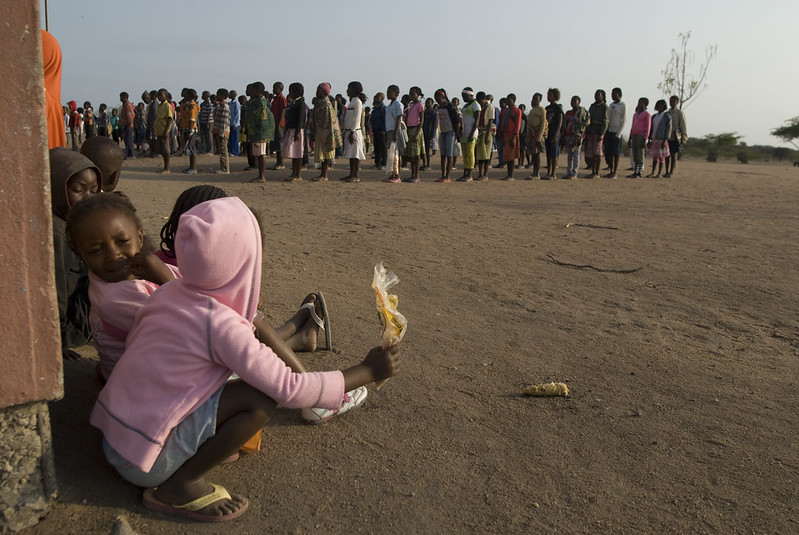
Mozambique, a country of more than 30 million people in southeastern Africa, has expanded access to schooling since the end of its civil war and the abolition of primary school fees in the early 2000s. However, the education system still faces a persistent outcome gap: most children enroll in primary school, but far fewer complete school with strong reading, numeracy and job-ready skills.
Here are seven things to know about education in Mozambique:
- Mozambique has made major gains in access. The Global Partnership for Education reports that the country’s net primary school enrollment rate is 99%. Access has not translated into completion though, as GPE notes that less than half of students complete primary education. This is the key challenge facing Mozambique. As UNICEF and partners stated in 2024, “almost all children in Mozambique enroll in primary education,” but 4 out of 10 school-aged children ages 6–17 do not complete primary education, and 1 in 4 complete secondary-level education.
- Mozambique’s education crisis is increasingly understood as a learning crisis. UNICEF disclosed in 2024 that 4.9% of children acquire basic literacy skills and 7.7% acquire basic numeracy skills at the Grade 3 level. The World Bank has made a similar point, revealing that less than 5% of children are able to read a simple text at the end of Grade 3. This means that many children spend years in school without mastering foundational skills.
- Poverty remains one of the strongest barriers to education. Even when schooling is officially free, families still face costs for uniforms, supplies, transportation and lost child labor. UNICEF’s 2024 education statement emphasized that Mozambique’s children need “inclusive and equitable quality education” to break cycles of poverty and vulnerability. Absenteeism is another consequence of poverty and fragile household conditions. A 2019 UNESCO Global Education Monitoring study discovered that primary students attended school about 49% of the time on average, while teachers said nearly 10% of students attended infrequently or almost never.
- Girls’ education is heavily affected by early marriage and pregnancy. UNICEF describes Mozambique as having “one of the highest rates of child marriage in the world,” affecting half of all girls. Child marriage is closely tied to school dropout because married girls often leave school permanently to assume domestic and childcare responsibilities. A 2024 UNICEF/WFP story put a human face on the data. Vanessa, a 17-year-old survivor of child marriage in Zambézia, said: “I managed to study up to the 5th grade, but then I was married as a child, became pregnant, and had to leave school.”
- Mozambique’s classrooms remain crowded, and teacher supply is a major issue. Under the 2020–2029 Education Sector Plan, the government plans to recruit 62,515 additional teachers, including 10,913 at the primary level and 51,606 at the secondary level. Even with that recruitment, the primary pupil-teacher ratio was projected to fall from 66:1 to 55:1, still a difficult environment for individualized instruction.
- Early childhood education is one of Mozambique’s largest gaps. In 2024, 4% of preschool-aged children ages 3 to 5 participated in formal early learning. This matters because children who arrive at Grade 1 without early literacy, language and social development support are more likely to fall behind. There are signs of progress. UNICEF’s 2024 Mozambique Annual Report states that the Accelerated School Readiness Programme reached 16,995 children under 6, about 90% of its target, with girls making up roughly half of participants. These programs are important because they target children before learning gaps become harder to reverse.
- Mozambique’s government and international partners are now focusing more directly on learning outcomes. The country’s Education Strategic Plan 2020–2029 aims to bolster equity, inclusion and learning quality. The World Bank’s Ending Learning Poverty in Mozambique project focuses on improving reading in Grades 1–3 and increasing girls’ retention in upper primary and lower secondary school. Finally, GPE has supported school grants and textbooks with the goal of strengthening both access and classroom quality.
Overall, Mozambique’s education system has made undeniable progress: nearly all children now enroll in primary school, and teacher qualification rates have improved. But the next stage of reform must focus on outcomes. Children need to attend consistently, learn to read early, stay in school through secondary level and enter adulthood with usable skills. Without that shift from enrollment to learning, education will struggle to break Mozambique’s cycle of poverty.
– Jeff Zhou
Photo: Flickr
