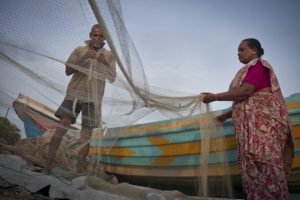
 The Indian Ocean tsunami tore through Sri Lanka’s coast in 2004, destroying not only boats and nets but also the very social safety nets that kept the economy afloat. During the loss, women in fisheries in Sri Lanka stepped up. They organized a framework to provide mutual aid circles that transformed into cooperatives that process dried fish, market shellfish and advocate for the waters that feed their families.
Only two decades later, many of these groups are now stable, central businesses that have become anchors in the community. These women didn’t just survive; they changed who held power in coastal life. According to Sri Lanka’s Secretary of the Ministry of Disaster Management, S.S. Miyanawala, “Therefore, it is necessary to change the way we ‘invest.’ We need to focus not only on addressing the consequences of disasters but on reducing the underlying causes of vulnerabilities and enhancing the preparedness and resilience of people and communities.”
Mutual Aid To Market Power
In the early days of Sri Lanka, women traditionally leveraged skills such as salting, sun-drying and selling items to support household incomes. A comparative study from Ambalangoda shows households with women in fisheries in Sri Lanka differed significantly from those who chose not to, showing increased income and access to credit.
By formalizing into cooperatives, these networks evolved into small enterprises and some partnered with NGOs to reach better markets. After the war and tsunami, initiatives in Jaffna educated widows, showing them how to produce higher-quality dried fish for fair-trade outlets, turning a coping strategy into dignified work with a generous return. Today, dried fish remains a crucial, affordable protein for low-income households, stabilizing local demand while co-ops experiment with better processing and quality control.
Measurable Advances in Gender Equity
Women in fisheries in Sri Lanka have become symbols of economic resilience and their leadership has brought new skills, leverage and measurable gains in gender equity. WorldFish’s synthesis on women’s empowerment in small-scale fisheries outlines four pathways: embedding gender in every innovation stage, strengthening agency and leadership, improving resource access and transforming norms through collective action. These are the levers Sri Lankan co-ops pull, from leadership training to negotiating landing-site space and prices.
Sri Lanka’s dried-fish sector adds a vital dimension: well-being. Women’s control over processing and trade shapes income, social dignity, mobility and decision-making. Outcomes ripple into children’s education and household resilience. In a system still marked by informality and gendered barriers, collective organizing is the difference between uncertainty and progress. These cooperatives aren’t only about sales and personal growth.
They’re also about cultivating and repairing reefs, lagoons and mangroves. In Puttalam District and beyond, women’s groups tied micro-enterprises to ecosystem repair, focused on replanting mangroves, monitoring nurseries and campaigning for local protections. That work reduces storm surge, improves water quality and shelters juvenile fish, all classic “nature as infrastructure” benefits that make both catches and communities more resilient to the next shock.
Why It Matters Now
With supply chains evolving and climate extremes intensifying, Sri Lanka offers a living lab for community-first recovery. U.N. and national analyses of post-tsunami reconstruction emphasize community decision-making and moving recovery efforts locally. Women’s cooperatives became durable nodes in that local governance fabric because they knit income, care work and conservation.
International guidance has caught up with what these fishers practiced out of necessity. The FAO’s handbook on gender-equitable small-scale fisheries governance urges countries to center women in rules, markets and services. This approach is reflected in Sri Lankan co-ops that negotiate access to space, credit and training while advocating for better post-harvest infrastructure and quality standards.
What Success Looks Like
On the ground, success is pragmatic, not flashy. In Sri-Lanka, this success looks like predictable cash from a cooperative drying shed, a microloan that upgrades a smoker or a daughter who stays in school because fees are paid on time. Success also looks like a mangrove belt that blunts the next cyclone or a woman who chairs the meeting where the landing schedule is set. In places where formal jobs are scarce, these wins matter.
And the women who succeed scale their rewards out to the community. When collectives share methods such as pricing, grading, hygiene, bookkeeping and performance spreads horizontally. Partnerships with groups like the Small Fishers Federation (Sudeesa), international NGOs and university programs bring training and research to community doorsteps. At the same time, co-ops carry data and lived expertise back up the chain to policy tables. That two-way flow is how “pilot projects” become norms.
The Unfinished Work
Though there has been much progress, such as improved access to cold storage, challenges remain, including exposure to price shocks, credit terms that penalize informality and co-op bylaws that can still marginalize women at the harvest end of the chain. However, the evidence base is clear and growing: when women organize across the fish value chain, households diversify their income, nutrition improves and communities invest in the ecosystems that sustain them.
This policy isn’t charity; it funds what already works, including women’s collective enterprise tied to coastal stewardship. The lesson from Sri Lanka’s shores is simple: resilience is built locally by the people with the most at stake. When those people are women in fisheries who run the books, manage the drying racks, negotiate prices and plant mangroves, the result is more than just recovery. It’s a fairer, more durable coastal economy.
– Nicole Fernandez
Nicole is based in Reno, NV, USA and focuses on Business and Technology for The Borgen Project.
Photo: Wikimedia Commons

Low-Cost Satellite Internet in Remote Areas
Starlink and Project Kuiper: Bridging the Digital Divide
SpaceX operates Starlink and “utilizes a constellation of low-Earth orbit satellites to provide service worldwide.” It is designed to deliver “faster speeds and lower latency.” Its key purpose is to provide satellite internet to remote areas where accessibility is a constant barrier to connectivity.
While the operation seems promising, it is at a higher price than other rural internet providers due to the required purchase or lease of proprietary equipment. Another drawback is that the service tends to be affected by extreme weather conditions, common in remote areas with unpredictable climates.
Amazon Project Kuiper is an upcoming satellite internet service that provides high-speed internet to remote and underserved areas. Amazon plans to provide “widespread coverage which includes hard-to-reach rural communities.” However, prices are not yet available to the public, making it difficult to assess the potential success of this new project. Despite this uncertainty, it is expected to be competitive with other satellite internet providers.
Benefits of Satellites
Unlike most other satellite services, there is no required reliance on telephone lines. Amazon plans to “deploy thousands of satellites in low-Earth orbit linked to a global network of antennas, fiber and internet connection points.” These satellites orbit closer to Earth than traditional ones, reducing signal delay and improving speed. The satellites will communicate with a network of ground stations, including antennas, fiber-optic cables and internet hubs, that connect to the broader internet.
Satellites beam data to and from user terminals (like dishes or receivers) and route it through ground infrastructure to reach the internet. Unlike older satellite services, this enables Amazon to provide broadband access in rural, underserved regions without phone lines.
Amazon Project Kuiper plans to “bridge a digital divide” and offer direct support, such as customer service, to ensure technology integration. Although the performance metrics are not yet known until actual deployment, Amazon’s inclusion of a direct support team appears promising.
GSMA: Driving Mobile Innovation
GMSA is a global organization unifying the mobile ecosystem to provide innovative solutions for businesses and to encourage societal change. Its vision is to “unlock the full power of connectivity so that people, industry and society thrive.” It shapes mobile-related policies, supports technology that keeps mobile networks running and creates significant events to target global problems. Events such as MWC and M360 mobilize mobile industry leaders to share ideas and collaborate.
Millions of people depend on connectivity for their livelihoods and basic needs. “In 2022, 36 countries with the largest mobile coverage gap hosted 46% of internally displaced people and 18% of refugees.” Low-cost satellite services could be the answer to target the weaker areas of infrastructure in developing countries, particularly in health care, education and humanitarian protection.
Connectivity for Refugees Initiative
However, there are barriers to usage due to “lack of affordability of devices and data, lack of literacy and language or social barriers.” Due to this accessibility problem, a coalition of organizations and governments, including the UNHCR, International Telecommunication Union (ITU), GSMA and the Government of Luxembourg, created the Connectivity for Refugees initiative in 2023.
The initiative aims to connect 20 million displaced people and their hosts by 2030, helping them stay connected, access global services and build a livelihood. It will involve the private sector, governments, international organizations and forcibly displaced communities to ensure connectivity in underserved areas. Consequently, this will “open pathways for greater access to information, education and livelihoods and enhanced humanitarian protection.”
Connecting Rwanda
The Rwandan government has created the Kigali Innovation City initiative, focusing on “expanding connectivity” through government-led efforts to “develop robust digital infrastructure and initiatives.”
According to GSMA research, “MTN Rwanda has the widest network coverage in the country, with coverage available in remote areas and refugee camps.” Mobile phones are widely used in Rwanda, with “31% of the population reported to be using a mobile money account.”
There are four active mobile money services in operation: MTN Mobile Money, Airtel Tigo, Dau Pesa and MCash. Through a partnership with KCB Bank, MTN Mobile Money users can access loans and savings products. This partnership also provides additional benefits, including access to health care and educational platforms.
In addition, NGOs such as UNHCR and the U.N. Refugee Agency are supporting connectivity projects in refugee camps like Mahama and Kiziba. These projects establish “community centers with internet access, mobile charging stations, digital literacy programmes and solar power solutions,” helping expand digital access in underserved communities.
Low-cost satellite connectivity is not just access; it’s a lifeline for resilience and opportunity.
– Gabriela E Silva
Photo: Pixabay
Women in Fisheries in Sri Lanka: From Wreckage to Renewal
Only two decades later, many of these groups are now stable, central businesses that have become anchors in the community. These women didn’t just survive; they changed who held power in coastal life. According to Sri Lanka’s Secretary of the Ministry of Disaster Management, S.S. Miyanawala, “Therefore, it is necessary to change the way we ‘invest.’ We need to focus not only on addressing the consequences of disasters but on reducing the underlying causes of vulnerabilities and enhancing the preparedness and resilience of people and communities.”
Mutual Aid To Market Power
In the early days of Sri Lanka, women traditionally leveraged skills such as salting, sun-drying and selling items to support household incomes. A comparative study from Ambalangoda shows households with women in fisheries in Sri Lanka differed significantly from those who chose not to, showing increased income and access to credit.
By formalizing into cooperatives, these networks evolved into small enterprises and some partnered with NGOs to reach better markets. After the war and tsunami, initiatives in Jaffna educated widows, showing them how to produce higher-quality dried fish for fair-trade outlets, turning a coping strategy into dignified work with a generous return. Today, dried fish remains a crucial, affordable protein for low-income households, stabilizing local demand while co-ops experiment with better processing and quality control.
Measurable Advances in Gender Equity
Women in fisheries in Sri Lanka have become symbols of economic resilience and their leadership has brought new skills, leverage and measurable gains in gender equity. WorldFish’s synthesis on women’s empowerment in small-scale fisheries outlines four pathways: embedding gender in every innovation stage, strengthening agency and leadership, improving resource access and transforming norms through collective action. These are the levers Sri Lankan co-ops pull, from leadership training to negotiating landing-site space and prices.
Sri Lanka’s dried-fish sector adds a vital dimension: well-being. Women’s control over processing and trade shapes income, social dignity, mobility and decision-making. Outcomes ripple into children’s education and household resilience. In a system still marked by informality and gendered barriers, collective organizing is the difference between uncertainty and progress. These cooperatives aren’t only about sales and personal growth.
They’re also about cultivating and repairing reefs, lagoons and mangroves. In Puttalam District and beyond, women’s groups tied micro-enterprises to ecosystem repair, focused on replanting mangroves, monitoring nurseries and campaigning for local protections. That work reduces storm surge, improves water quality and shelters juvenile fish, all classic “nature as infrastructure” benefits that make both catches and communities more resilient to the next shock.
Why It Matters Now
With supply chains evolving and climate extremes intensifying, Sri Lanka offers a living lab for community-first recovery. U.N. and national analyses of post-tsunami reconstruction emphasize community decision-making and moving recovery efforts locally. Women’s cooperatives became durable nodes in that local governance fabric because they knit income, care work and conservation.
International guidance has caught up with what these fishers practiced out of necessity. The FAO’s handbook on gender-equitable small-scale fisheries governance urges countries to center women in rules, markets and services. This approach is reflected in Sri Lankan co-ops that negotiate access to space, credit and training while advocating for better post-harvest infrastructure and quality standards.
What Success Looks Like
On the ground, success is pragmatic, not flashy. In Sri-Lanka, this success looks like predictable cash from a cooperative drying shed, a microloan that upgrades a smoker or a daughter who stays in school because fees are paid on time. Success also looks like a mangrove belt that blunts the next cyclone or a woman who chairs the meeting where the landing schedule is set. In places where formal jobs are scarce, these wins matter.
And the women who succeed scale their rewards out to the community. When collectives share methods such as pricing, grading, hygiene, bookkeeping and performance spreads horizontally. Partnerships with groups like the Small Fishers Federation (Sudeesa), international NGOs and university programs bring training and research to community doorsteps. At the same time, co-ops carry data and lived expertise back up the chain to policy tables. That two-way flow is how “pilot projects” become norms.
The Unfinished Work
Though there has been much progress, such as improved access to cold storage, challenges remain, including exposure to price shocks, credit terms that penalize informality and co-op bylaws that can still marginalize women at the harvest end of the chain. However, the evidence base is clear and growing: when women organize across the fish value chain, households diversify their income, nutrition improves and communities invest in the ecosystems that sustain them.
This policy isn’t charity; it funds what already works, including women’s collective enterprise tied to coastal stewardship. The lesson from Sri Lanka’s shores is simple: resilience is built locally by the people with the most at stake. When those people are women in fisheries who run the books, manage the drying racks, negotiate prices and plant mangroves, the result is more than just recovery. It’s a fairer, more durable coastal economy.
– Nicole Fernandez
Photo: Wikimedia Commons
Fighting Poverty through Radio Education in Sierra Leone
Background
Thousands of children grow up unable to read and write because school is inaccessible for them: perhaps the journey is too long, or their families require them to work. Crises only deepen the gap. During emergencies- health crises, natural disasters or conflict-schools often have to close, and families face displacement.
Yet from these forced closures emerged an unexpected opportunity. During the Ebola outbreak, radio education in Sierra Leone kept children learning at home. When COVID-19 hit, this innovation returned stronger than before- expanding across the country and making education more accessible than ever before.
During school closures, radio education initiatives became a lifeline and, seeing their effectiveness, the nation made a decision to continue running them as a means of combating illiteracy rates, particularly benefiting those children who are unable to attend school. Here are two such radio education initiatives in Sierra Leone.
Rising On Air
In 2020, Rising Academy Network launched Rising on Air (ROA), a free educational resource aiming to keep education alive in places where school access is fragile or interrupted. Foreign donors and international nonprofits provide funding for it, and it operates under a Creative Commons license, allowing partner organizations to freely use, adapt and broadcast its curricula via radio or phone, UNESCO reports. For families who do not own either a phone or a radio, ROA broadcasts the content on radios in local community centres.
ROA serves learners aged 3-23, covering early childhood, primary and secondary levels across subjects like literacy, mathematics, arts and health education. ROA content is modular and it delivers it in 20-week units, designing it to reach youths who struggle with marginalization the most in traditional schooling systems: women and girls, refugees and young people from rural communities, according to UNESCO.
Development Modules
ROA does not ignore the needs of teachers: it includes professional development modules for educators delivered in audio format. Importantly, ROA built the program deliberately for settings where reliable internet is weak or absent and digital infrastructure is scarce. Additionally, the scripts and audio lessons that ROA provides can be adapted, rerecorded in local languages and used flexibly.
The initiative operates at an extremely low cost-around $0.03 per learner annually, making it a scalable model for reaching children in crisis or hard-to-reach communities. Despite ROA’s several challenges (program awareness and reaching extremely rural areas), this adaptive, low-cost model is evolving and equipping Sierra Leone’s youth with vital literacy and numeracy skills.
Every Adolescent Girl Empowered and Resilient
In Sierra Leone, young girls are much more likely than boys to drop out of school, or never attend in the first place. Funded by the U.K.’s Foreign, Commonwealth and Development Office, the Every Adolescent Girl Empowered and Resilient (EAGER) initiative is helping to transform the lives of out-of-school girls aged 13-17 who face barriers to education such as early marriage, teenage pregnancy and gender-based violence.
At the heart of the project is Wae Gyal Pikin Tinap (“When the Girl Child Stands”), a weekly radio program. Launched in 2020 and broadcast in the Krio language, the show aims to challenge negative attitudes that prevent girls from accessing, or remaining in, education. It educates young girls on sex, menstrual hygiene and family planning and encourages the belief that education is a pathway to opportunity.
The Story of Aminata
One episode shared the journey of Aminata, a young woman who uses a wheelchair and has built a thriving business selling toiletries and hygiene products. Hearing personal stories of accomplishment from girls their age in similar situations inspires and motivates the girls. Stories like Aminata’s have resonated across communities and sparked family discussions about girls’ education and potential.
EAGER believes that it is vital to teach young girls that they are deserving of opportunity and by encouraging them to tap into their talents and learn new skills, their self-belief becomes the foundation for success. Their message is simple but powerful: when girls stand tall, entire communities rise with them.
The Future
Across Sierra Leone, initiatives like Rising on Air and EAGER demonstrate how a simple, household item can become a powerful engine for change. By delivering free, accessible education to children and adolescents who might otherwise be excluded, these programmes equip young people with the skills needed to pursue employment and generate income.
Beyond that, EAGER demonstrates the ability to transform community attitudes: encouraging parents to value education, empowering girls to delay early marriage and inspiring families to invest in learning as a path to stability. Radio education in Sierra Leone has the potential to break the cycle of poverty by widening opportunity. In places where poverty once silenced potential, radio waves now carry a new sound of hope and possibility.
– Elysha Din
Photo: Flickr
How Lush Is Fighting Global Poverty One Soap at a Time
A Small but Mighty Hand Cream
One of the cornerstone products in Lush’s fight against global poverty has been its Charity Pots, a vanilla and floral-scented hand and body lotion. This product was created to raise money for grassroots groups, campaigns and nonprofits doing humanitarian groundwork protecting human rights and ensuring environmental justice. In 2024, Lush made more than $130 million in charitable donations since the launch of its giving initiatives back in 2007. The Charity Pot made up 75% of these donations.
Despite recently removing the product from its shelves, Lush remains committed to campaigning. The organization has produced a new line of Giving Products, which allows it greater flexibility in targeting and responding to global emergencies, directing money to where it is needed. Lush’s Charity Pots proved to be a small but mighty force in the fight against global poverty.
Lush’s Giving Products
Replacing the Charity Pots, Lush’s Giving Products hit the shelves with the Watermelon Slice soap as the first launch. Originally a regular product, it was turned into a Giving Product after a staff member highlighted the symbol’s significance in the movement to support a free Palestine. With each sale, 75% of the proceeds are donated to childhood mental health and medical services in Gaza, including charities providing prosthetic limb support to adults and children.
Since launching the Watermelon Slice soap, Lush has used its Giving Products to support various causes. These include aiding Indigenous volunteer fire brigades in the Amazon, backing lawyers and human rights activists in Mexico and supporting “She Should Run,” an organization working to increase diverse political participation.
The Use of Fairtrade Ingredients
One of the main selling points for Lush products is its use of Fairtrade ingredients. The Fairtrade Foundation seeks to address the root causes of poverty directly by ensuring farmers and workers in developing countries receive better prices, working conditions and more power over their products. Cheap products often come at the exploitation of those who grow them.
So by ensuring a minimum price, the Fairtrade Foundation ensures that farmers and workers can cover the costs of sustainable production and have a safety net for when the market falls below a sustainable level. Farmers whose products are Fairtrade certified also receive a Fairtrade Premium, a lump sum which members of Producer Organizations democratically decide how to spend. This money is typically invested in community development.
By choosing Fairtrade products, Lush is helping to break the cycle of poverty in developing countries, enhance the well-being and resilience of these communities and enable individuals a greater level of dignity.
Uplifting Communities Through Knot Wraps
Lush’s venture into reusable packaging has also proved significant in fighting global poverty. While sifting through bundles of vintage scarves, the Lush buying team discovered an abundant supply. In 2009, the company began stocking more than 40,000 wraps as part of its shift to knot wrapping, a sustainable, reusable packaging alternative.
From there, Lush began partnering with re-wrap, a nonprofit organization in India that produces 100% organic cotton knot wraps. Crafted by highly skilled female artisans, re-wrap makes a range of products, including tote bags, gift wraps, pouches and aprons and is dedicated to uplifting rural women and farming communities.
During production, local women are trained in the skills needed to make these wraps, enabling them to earn an income and empowering them to leave unsafe relationships. By working directly with re-wrap, Lush ensures that producers receive fair wages, further helping to alleviate poverty in rural communities.
A Lush Future
From its Watermelon Soap funding aid in Gaza to partnering with organizations that empower women in India through artisanal skills, Lush is building an impressive track record of fighting global poverty. Its unwavering advocacy and campaigning should serve as a blueprint for other companies. We can only hope this vital work continues and that others follow.
– Libby Foxwell
Photo: Flickr
HIV in Zimbabwe
Zimbabwe’s population is about 17 million, with the average age of a citizen being 18. The political system is a constitutional democracy and most of its population practices Christianity. Despite its vast size, natural beauty and rich cultural heritage, HIV in Zimbabwe remains a significant public health challenge.
The Prevalence of HIV
HIV in Zimbabwe is becoming an increasingly serious problem. In 2024, about 1.3 million people were living with the virus, most of whom were adults. Notably, women made up a significantly larger share of those affected, with 740,000 cases compared to 490,000 among men.
Despite the progress made in prevention and treatment, economic instability and limited public health funding continue to threaten the country’s response to HIV. The national currency’s devaluation and rising inflation have reduced health care budgets and led to shortages of medicines in some regions.
In early 2025, cuts and freezes in international funding, including a temporary suspension of economic support, took effect. As a result, several HIV clinics closed and the ARV supply was interrupted, leaving thousands without help. Experts and health organizations have warned that such disruptions could reverse years of progress in HIV control and treatment adherence.
Key Populations
In Zimbabwe, key populations, especially female sex workers, bear a substantially higher burden of HIV than the general population. About half of female sex workers have HIV in Zimbabwe. The prevention is difficult because many in the key population don’t even know their HIV status, spreading the illness further.
Women and girls, despite progress in some areas of education, remain underrepresented in formal employment and are more exposed to poverty. Many women rely on the informal sector for income, such as street vending and odd jobs, which often yield irregular earnings, making it difficult to afford health care, clinic transport or consistent treatment. In some cases, the urgency to provide for dependents leads to “survival sex” or informal transactional relationships.
Fighting HIV
Zimbabwe has made significant progress in combating HIV, with strong backing from the Global Fund, PEPFAR, UNDP and local civil society groups. According to recent reports, about 93% of people living with HIV in Zimbabwe know their status, 98% of those diagnosed are receiving antiretroviral therapy (ART) and 95% of those on ART have achieved viral suppression. However, sustaining these gains remains a challenge.
Despite substantial external support, Zimbabwe faces a funding gap of about $133 million in 2024 to fully meet the resource needs outlined in its strategic HIV plan. Recent freezes and reductions in donor funding, including from USAID, have raised serious concerns about maintaining services, clinics, ART supply and outreach, particularly for vulnerable and marginalized groups.
With continued, focused commitment from international partners and increased domestic investment, Zimbabwe aims to maintain and strengthen HIV prevention and treatment services. Key elements include expanding local funding sources, ensuring that services for key populations remain prioritized, sustaining supply chains for ART and scaling up testing, prevention and care innovations.
– Julia Skowrońska
Photo: Flickr
Lifting Hands International: Aiding Refugees from Afghanistan
Afghanistan Refugee Crisis
Afghanistan has a long history of conflict; however, that is not the only cause of the refugee crisis, but just one contributing factor. UNHCR states that other causes of the prolonged crisis are ‘natural disasters, chronic poverty, food insecurity, COVID-19 pandemic, and most recently a changeover in government authorities’. The complex and intertwined causes of the displacement of Afghans can, therefore, account for the scale of the crisis. The U.N. reported that 10.3 million Afghans are still facing displacement both within their country and globally, with 5.8 million Afghans displaced around the world.
Iran and Pakistan
The Islamic Republic of Iran and Pakistan are the two countries with the largest number of Afghan refugees, with Iran hosting 3.5 million and Pakistan hosting 1.6 million, according to UNHCR. However, whilst these countries have accommodated displaced Afghans over the decades-long period of violence and instability, the recent efforts by the UNHCR in Iran and Pakistan, aiming to aid refugees from Afghanistan by enabling them to return home voluntarily, saw the number of Afghan refugees decrease by 10% at the end of last year.
However, as the World Bank reported in April this year, despite Afghanistan’s economy increasing by 2.5% in 2024, the return of refugees has increased the strain on an already fragile economy. Afghanistan’s high unemployment rates have led to increased food insecurity, with 14.8 million people suffering food shortages. Therefore, whilst aiding refugees from Afghanistan in returning home is important work, it is also key to continue to focus on supporting refugees in their host country as not to contribute to instability in Afghanistan.
Lifting Hands International
Lifting Hands International is a charity that has been providing aid to refugees around the world since 2016. After the Taliban took over Afghanistan in 2021, the U.S. government launched the program, Operation Allies Welcome, to resettle Afghan refugees in the U.S. However, the housing items needed for Afghans to transition into residential housing, if not donated, comes out of their small stipend. Therefore, Lifting Hands International partnered with the International Rescue Committee (IRC) to support their resettlement, providing groceries, school supplies, beds, and handmade quilts.
Furthermore, in addition to aiding refugees from Afghanistan in the U.S., Lifting Hands International also provides vital support to those suffering displacement within Afghanistan who often have to travel long distances to get water and suffer severe food insecurity as well. Lifting Hands International tackles this crisis by distributing essential aid supplies to the internally displaced, with a total of 9,045,218 aid items distributed across all of their programs.
Looking Forward
Whilst the refugee crisis is incredibly concerning, the many initiatives and charities dedicated to aiding refugees from Afghanistan are doing incredible work at eradicating the suffering of those displaced both within the country and globally. Continued advocacy and support for these charities is, therefore, essential in tackling the crisis.
– Victoria Adrados
Photo: Flickr
Fighting Poverty in Timor-Leste
The Numbers
More than half of Timor-Leste’s population is multidimensionally poor, and an additional 26.8% is on the cusp of extreme poverty. Despite the country’s past efforts to ameliorate conflict within communities, Timor-Leste ranks 104th out of 124 countries on the Global Hunger Index.
Childhood stunting is an unfortunate commonality among the families and children of Timor-Leste; more than half of the children under 5 struggle with stunting. Along with this, one in 24 children will die before the age of 5, and 38% of children under 5 are underweight, according to UNICEF.
In Timor-Leste, the most popular occupations that also generate the most income are crop farming, livestock rearing, fishing, formal employment and small scale businesses. Eighty-four percent of households rely on these occupations as a source of income and 63% of households rely solely on natural resource based livelihoods as a main source of income, making fisheries an important part of how Timor-Leste fights poverty.
How WorldFish is Making a Difference
WorldFish is a key component in helping the country of Timor-Leste fight poverty. WorldFish uses science to prioritize aquatic foods as a main source of nutrition. It aims to end hunger by 2030, and advance sustainable living for the whole planet. Timor-Leste’s WorldFish program is utilizing aquatic foods to change the trajectory of Timor’s food systems, in hopes to meet the nutritional needs of the country. WorldFish is currently working on two initiatives that rely on the sea to transform food systems.
Developed in 1988 as a part of a breeding program to create adaptable food sources, Genetically Improved Farm Tilapia (GIFT) has been wildly successful in its intention of increasing income and feeding local businesses, with Timor-Leste now cultivating its 14th generation of GIFT.
The second initiative is the development of Peskas, a digital monitoring platform. There was a lack of necessary information about where coastal fishers went and what they caught, and this led to government officials and policy change makers not knowing how to improve food insecurity in Timor-Leste.
Peskas uses GPS trackers to capture data about where fishers go, and document all that happened on their journey. That data is then seen on a public online dashboard, and this helps policymakers make more effective decisions about sustainability management. Peskas is not only the official fisheries monitoring system but Timor-Leste is being praised as an example in many other countries around the world.
Along these two, the Fish in Schools Meals pilot program from July 2023 aims to improve the consumption of fish in communities that are predominantly rural. The government has concentrated on developing sustainable fisheries and aquaculture sectors, which have successfully contributed to the influx of nutrition security.
Moving Forward
Since Timor-Leste’s independence in 2002, the country has seen extreme progress in maintaining stability as the youngest nation in Asia. As a country that is coming out of a recent conflict, they have managed to strengthen institutions and has benefited from economic growth.
This research highlights that the fisheries sector remains the most promising solution for how Timor-Leste fights poverty and could boost the well-being for the rural poor who live near the coast.
– Arielle Telfort
Photo: Flickr
Addressing South Africa’s Housing Crisis
Climate Instability in South Africa
Starting with South Africa’s efforts to combat climate hazards, a recent Sustainable Development Report ranked the country 111th out of 167. This ranking measures progress toward the Sustainable Development Goals (SDGs), a set of targets adopted by the U.N. in 2015 to address climate change and other global challenges.
The report outlines that sustainable housing in South Africa has “major challenges remaining.” This suggests that South Africa is a long way from being considered a green country and that significant strides need to be made in sustainable housing.
Housing Crisis in South Africa
Moving on to South Africa’s housing crisis, there are once again hurdles that the country needs to clear. First, South Africa works on a contract-based system, where the government issues contracts for people needing houses. The South African government adopted this model in 1994, which was successful at the onset. According to an article by The Guardian, from 1998 to 1999, South Africa’s government built more than 235,000 houses a year.
However, due to budget cuts and the pandemic, in 2022-2023, that number has dropped to 34,000, even though the municipality’s housing needs register lists more than 375,000 applicants. The article goes on to talk about how many people have died on the waiting list to get a house. This evidence makes it clear that there is a need for a solution to this sustainable housing crisis in South Africa.
Potential Solution for Sustainable Housing in South Africa
A recent study by Alireza Moghayedi and Bankole Osita Awuzie proposes a framework that would, in theory, build low-cost, sustainable housing for low-income citizens in South Africa. Indeed, the study suggests that South Africa could focus on net-zero housing concepts, which are housing models that generate as much renewable energy as they consume through things like solar panels. This model could ensure that new houses don’t add to South Africa’s carbon footprint, bringing it closer to achieving the Sustainable Development Goals.
In addition, the article states that constructing these Low-Income Net Zero Energy Houses (LINZEH) takes only three days to complete, compared to 12 for a conventional low-income housing unit. This efficiency could allow the government to reduce the backlog of people on the waiting list and provide homes for those who desperately need them.
Finally, due to budget cuts in South Africa, these housing units would need to cost less to justify their implementation. According to the article, a conventional low-income house costs $31,555, whereas the proposed LINZEH costs $17,244. To summarize, the proposed LINZEH model for sustainable housing in South Africa would be better for the environment, take less time to construct and cost about half as much as a conventional low-income housing unit.
Conclusion
South Africa’s housing crisis, was brought on by a backlog of people who needed homes and the pandemic, resulted in a budget cuts. A proposed LINZEH housing model would not only greatly assist the government in South Africa by providing energy-efficient, cost-effective and streamlined housing. It would also provide a roof over the heads of thousands of South Africans who need it.
– Charlie Means
Photo: Flickr
FH Cambodia: Combatting Malnutrition
Furthermore, assistance to combat hunger is disproportionate, with urban areas improving significantly faster than rural areas, creating greater inequality. Food for the Hungry Cambodia (FH Cambodia) is one of the leading organizations working to bridge the gap and create communities that are sustainable and resilient.
FH Cambodia
FH’s initial mission was relief: aiding refugees and providing immediate support during civil unrest after the Vietnam war. By 1992, FH Cambodia shifted strategy: from temporary relief to partnering with marginalized communities in southern Cambodia (Kampot Province) to improve living conditions over the long term. Over time, FH expanded north, adopting decade-long community development models that address education, health, economic security, and leadership.
In 2024, FH Cambodia reached more than 211 communities and served 188,925 individuals. Out of the individuals, 66,472 were children. Young children, from 6-23 months, have a minimum dietary diversity, minimizing the risk that they are malnourished. FH was successful in combating malnutrition by partnering with local health care centers that measure the health status of the child.
Improving Education
In addition to combating malnutrition by aiding children and starving households, the organization created long term benefits, such as mobilizing churches and providing educational resources to schools. Specifically, the education program brought 625 children, 285 of which are girls, into primary education. Furthermore, FH Cambodia assisted in renovating five digital libraries in a district, allowing for interactive online learning. As a result, school absences of children aged 7–15 decreased by 17.9%, and 86.4% of children the same age are proficient in reading.
Pregnancy
FH Cambodia’s aggregate impact demonstrates the effectiveness of community-based programs focusing on long-term sustainability. However, the improvement in individual lives can be best seen through the stories of those directly aided. Mrs Khuon Sinan is a 27-year-old woman who lost three pregnancies, suffering miscarriages.
With help from community health workers partnered with FH Cambodia, Mrs Sinan received the care and observation of a midwife at a health center. There, Mrs Sinan changed her diet to have more diverse foods such as local greens and fruit, to satisfy nutritional requirements for a healthy pregnancy.
In addition, she also attended community health awareness programs and support groups to better understand how to take care of one’s wellbeing. At the end of the pregnancy, Mrs Sinan successfully gave birth to a healthy girl, and is able to provide for her newborn by breastfeeding and learning to cook nutritious meals.
The Future
Mrs Sinan’s story, after numerous tragic failures, is a testament to the impact FH Cambodia’s program on individuals. Even though hunger and poverty remain great problems in Cambodia, combating malnutrition and hunger as a whole is imperative. The work of organizations such as FH Cambodia ensures that communities cannot face the same devastation as decades prior and that everyone is on the path to a sustainable future.
– Owen Wu
Photo: Flickr
COPD Underdiagnosis in Latin America: Challenges and Solutions
COPD is caused by damage to the lungs. It can be a consequence of smoking or exposure to air pollutants from biomass fuels. According to the World Health Organization (WHO), the overwhelming majority of deaths of people aged 70 and younger from COPD take place in low- and middle-income nations.
Who Is at Risk?
In Puno, Peru, on the shore of Lake Titicaca, women’s risk of developing respiratory issues due to daily use of biomass fuels is 55%. In Colombia, older men who smoked or were exposed to wood smoke for more than 10 years were more likely to develop COPD. The findings of the 2016 PUMA study, which focused on primary care in Argentina, Colombia, Venezuela and Paraguay, revealed underdiagnosis of COPD in more than 70% of cases. The most affected group included younger men with low educational levels and no prior testing.
Consequences of COPD Underdiagnosis in Latin America
The burden created by the underdiagnosis of COPD in Latin American countries can turn into an even heavier burden that those already struggling with poverty cannot afford:
The Challenges
In a survey by Vital Strategies and Umane, up to 62.3% of Brazilians did not seek medical attention due to several reasons. The surveyees stated long wait times, difficulties accessing specialists or underestimating the health issue. Up to 40.5% of those who did attempt to visit a doctor could not, due to extensive waiting times, lack of available doctors or proper equipment.
However, starting in 2024, the Breathe Well South America program has a plan to investigate access to primary care for people with COPD. It is being funded by the National Institute for Health and Care Research (NIHR). It’s driven by the work of the Institute for Clinical Effectiveness and Health Policy (IECS) in Argentina and several international universities.
Diagnostic Tools
Spirometers are a vital tool for the diagnosis of COPD. The test measures airflow and volume. In Latin America, it is often underused by primary care providers because of limited access to spirometers, short appointment windows and insufficient training to perform and interpret tests.
Throughout 2022 and 2023, the Brazilian Ministry of Health, in conjunction with the Hospital das Clínicas of the Federal University of Minas Gerais, began putting into place the Telespirometry System Brazil (TS-BR). The initiative aims to provide training and spirometers to specialists. As of 2024, 147 municipalities had participated in the program.
Pharmaceutical giant AstraZeneca launched Smart Spiros in Panama to improve the rate of diagnosis of COPD. Around 7,500 tests are expected to be performed by the end of 2025, which could help diagnose nearly 50% of COPD cases.
Increasing Awareness
The survey by Vital Strategies discovered that 34.6% of Brazilians questioned avoided seeking care because they assumed their health issue wasn’t serious enough to merit a visit. To combat this, World COPD Day takes place worldwide on the third Wednesday in November. It encourages health organizations to educate people about symptoms and possible treatments regularly.
In 2017, Paraguay’s Health Ministry dedicated an entire week to training, education and testing patients. This work is important because early diagnosis is crucial to preventing exacerbations that can result in costly, lengthy hospital stays.
From Underdiagnosis to Action
As of 2024, COPD was the fourth-leading cause of death globally. COPD underdiagnosis in Latin America has been a major issue that national and international organizations are working to quantify and resolve. For people living in poverty, illness and loss of income can become a crippling situation that further diminishes their earning capacity or entirely prevents them from earning a livelihood.
Despite challenges, such as a lack of education, spirometers and trained professionals, universities, international organizations and governments have come together to put into motion programs that bring much-needed solutions to the public.
– Johanna Lorena Arredondo Gonzalez
Photo: Pexels