• Link to X
  • Link to Facebook
  • Link to Instagram
  • Link to TikTok
  • Link to Youtube
  • About
    • About Us
      • President
      • Board of Directors
      • Board of Advisors
      • Financials
      • Our Methodology
      • Success Tracker
      • Contact
  • Act Now
    • 30 Ways to Help
      • Email Congress
      • Call Congress
      • Volunteer
      • Courses & Certificates
      • Be a Donor
    • Internships
      • In-Office Internships
      • Remote Internships
    • Legislation
      • Politics 101
  • The Blog
  • The Podcast
  • Magazine
  • Donate
  • Click to open the search input field Click to open the search input field Search
  • Menu Menu

Tag Archive for: United States

Posts

Foreign Aid, Foreign Policy

3 Quotes from Donald Trump About Foreign Aid

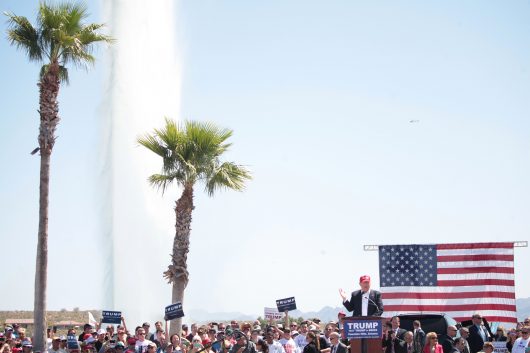
TrumpU.S. foreign policy is not just a hot topic issue that presidential candidates debate on TV. The president’s foreign policy can affect a broad spectrum of issues, including global poverty and instability.

With the Democratic and Republican National Conventions coming up in July, now is a crucial time for voters concerned with U.S. foreign aid to review the candidates’ platforms.

Republican presidential candidate Donald Trump has voiced a spread of controversial beliefs about many issues during his presidential campaign. According to Impact 2016, a non-partisan initiative of the USGLC, Trump’s foreign policy platform is currently small.

He is a self-proclaimed master of the “art of the deal” who claims to hold the ability to negotiate from international business experience. Some of his major foreign policy points have been his concern with creating a stronger military and deterring Mexicans and Syrian refugees from immigrating to the U.S.

In regard to foreign aid, Impact 2016 reports that Trump has emphasized domestic development over global development during his candidacy and in past statements. Considering this fact, here are three thought-provoking quotes from Donald Trump about what he thinks of the U.S. giving foreign aid to developing nations.

  1. “With Afghanistan, I want to build our country. You know in Afghanistan, they build a road. At the end of this beautiful road, they build a school. They blow up the school; they blow up the road; we then start all over again. And in New Orleans and in Alabama we can’t build schools. I want to rebuild the United States.”In a 2011 television interview with Bill O’Reilly, Trump expressed more interest in investing in domestic infrastructure than giving global aid. Any willingness he had to invest in struggling nations was qualified with some kind of reciprocity from the recipients of the aid. Although the discussion of Afghanistan concerned U.S. occupation, the statement reflects Trump’s general belief that domestic development is a more fruitful investment for the U.S. than long-term investment.
  2. In his speech announcing his presidential campaign, Trump declared that the U.S. should “stop sending foreign aid to countries that hate us.”Trump asserted again in his June 2016 speech that he wanted to invest in domestic infrastructure, such as building roads and bridges in the U.S., rather than give aid to countries that “hate us.” He was not in favor of investing in these developing countries and did not see aid as a positive investment for the U.S. His statement implies an attempt to decrease the amount of money allotted in the budget for foreign aid if he is elected president.
  3. When a young man asked Trump if he would help to double the number of people receiving HIV/AID treatment through the U. S. President’s Emergency Plan for AIDS Relief (PEPFAR) by 2020, Trump responded, “Yes, I believe so strongly in that, and we’re going to lead the way.”Trump’s comment might surprise those who are familiar with his criticisms of U.S. global involvement. His response to an audience member at the No Labels Conference in October of 2015 shows that he is indeed open to supporting certain humanitarian projects. Briefly citing Alzheimer’s as another disease he would like to fight, Trump acknowledged the progress that PEPFAR has made and pledged to support its mission.

Trump’s vision seems to be overwhelming against increasing U.S. foreign aid. Even so, perhaps some of his comments, such as the one about PEPFAR, show that he is willing to promote certain government humanitarian organizations in select cases.

Hopefully, Trump’s comments about foreign aid listed here and elsewhere are informative and helpful to voters as they decide which candidate will best address global poverty and the stability of the world.

For more quotes from Donald Trump on foreign aid, please see this article from The Borgen Project.

– Addie Pazzynski

Photo: Flickr
July 4, 2016
https://borgenproject.org/wp-content/uploads/borgen-project-logo.svg 0 0 Borgen Project https://borgenproject.org/wp-content/uploads/borgen-project-logo.svg Borgen Project2016-07-04 01:30:072024-12-13 17:54:453 Quotes from Donald Trump About Foreign Aid
Global Poverty

How Many Members of Congress Are There?

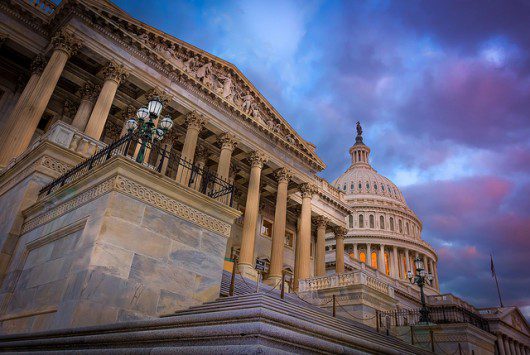
How many Members of CongressHow many Members of Congress are there? Five hundred and thirty five. In the United States, the government consists of three equally powerful branches that are intended to check one another to ensure that no one branch exceeds its purview. These branches are the judicial, the executive and the legislative branches. The legislative branch is the branch that houses the totality of Congress, both the Senate and the House of Representatives.
The legislative branch is responsible for drafting and passing bills that are then sent to the President of the United States, or the executive branch, for signage and finalization. Although the Senate and the House work together under the auspices of Congress, on a day-to-day basis, they function separately from one another.

How Many Members of Congress Are in Each Chamber?

The Senate consists of 100 members, two from each state in the United States determined relatively in a straightforward way. The only possible change in the size of the Senate could come from the admission of a new state into the union, according to VoteTocracy.

A senatorial term is six years in length with approximately “one-third of the total membership of the Senate” elected every two years, according to the United States Senate website.

The number of members in the House of Representatives, on the other hand, is a more complex determination. Although the number of members of the House is stably 435, the power and jurisdiction that these members hold is subject to change and is often in flux.

The 435 members of the House represent the 435 congressional districts of the United States. According to the Constitution, these “political subdivisions have about equal populations, to maintain the ‘one person, one vote’ standard.”

Aside from the simple standard of approximately equal population distribution, there are difficult political contests involved in drawing the definitive lines of these districts and this process, termed gerrymandering, which are responsible for constant congressional battles.

In addition to the members of Congress who represent the 50 states, there is a delegate sent from the District of Columbia who holds minimal to no voting privilege.

The segments of Congress total 535 members with voting privileges and an additional delegate from the District of Columbia. In order for the legislative body of our nation to run smoothly, each and every member must dutifully serve his role.

– Liz Pudel

Photo: Flickr

April 13, 2016
https://borgenproject.org/wp-content/uploads/borgen-project-logo.svg 0 0 Borgen Project https://borgenproject.org/wp-content/uploads/borgen-project-logo.svg Borgen Project2016-04-13 01:30:582024-12-13 17:54:14How Many Members of Congress Are There?
Global Poverty

Presidential Candidates Need Global Strategies

2016 Presidential Candidates
In the first 22 presidential primary debates, the 2016 presidential candidates have answered 1,087 questions posed by moderators. However, only 315 of these questions related to foreign policy and national security, with not a single one addressing America’s strategy for global development and international aid.

These numbers come from an analysis conducted by ONE, a global policy and advocacy organization co-founded by Bono. Researchers at ONE reviewed the transcripts of five Democratic debates, nine Republican “main” debates and seven Republican “undercard” debates, counting the number of foreign policy and national security questions posed.

ONE also analyzed each candidate’s answers to these questions, summing up the number of words they used. In total, candidates discussed foreign policy and national security using about 88,000 words. Out of these, only 0.26 percent, or to 232 words, were related to America’s global development strategy.

Discussing Foreign Aid in Presidential Debates

The topic came up during the Democratic candidates’ debate in Des Moines, Iowa on Nov. 14, 2015. Both Martin O’Malley and Hillary Clinton briefly mentioned investments in sustainable development meant to tackle the root causes of instability. Clinton also lauded the efforts of aid workers operating abroad.

Despite the lack of current discussion among the 2016 presidential candidates about global development, in 2011 Hillary Clinton gave a speech in Washington, DC at the U.S. Global Leadership (USGLC) Conference, stating: “The growth of the developing world presents a major economic opportunity for American business today and a thousand opportunities tomorrow.”

She pointed to South Korea as an example of how global development can benefit the American economy. “We provided $6 billion in aid and loans to South Korea from the end of World War II through the Korean War to the mid-1970s. That would be roughly $35 billion in today’s dollars. Today, we export more than $40 billion to Korea each year, and we are poised to export even more under the new free trade agreement.”

Former National Security Advisor to President Obama, General James L. Jones, USMC (Ret.), has spoken of the security benefits of investing in international development. In a statement regarding the U.N.’s Global Goals for Sustainable Development, General Jones said: “Support for development is a vital component of America’s national security strategy, and has been since the end of World War II. In today’s complex environment, development, plus security and good governance equals stability.”

Past Political Rhetoric About Foreign Funding

Former Secretary of State Colin Powell made similar remarks to General Jones back in 2002. According to an article published by the Council on Foreign Relations, Powell told the World Economic Forum in New York: “Terrorism really flourishes in areas of poverty, despair and hopelessness, where people see no future. We have to show people who might move in the direction of terrorism that there is a better way.” The Bush administration integrated international development as a key element of their anti-terrorism strategy.

In an op-ed published in USA Today, the North American Executive Director for ONE, Tom Hart, argued that the 2016 presidential candidates must adjust their proposed foreign policy plans to include a strategy for global development.

Hart concludes his op-ed with a strong statement, asserting that “No one should get to be president of the United States without publicly demonstrating an understanding and appreciation for the essential role that fighting poverty and stopping disease plays in securing America.”

– Clara Wang

Sources: USA Today, OneVote 16, People-Press, UCSB, State.gov, CFR
Photo: Flickr

April 7, 2016
https://borgenproject.org/wp-content/uploads/borgen-project-logo.svg 0 0 Borgen Project https://borgenproject.org/wp-content/uploads/borgen-project-logo.svg Borgen Project2016-04-07 01:30:562024-05-27 09:33:23Presidential Candidates Need Global Strategies
Foreign Aid, Foreign Policy, Global Poverty

Types of Foreign Aid

Types of Foreign Aid

America’s foreign aid budget for 2016 is expected to be around $37.9 billion. The goals of American foreign aid involve a mixture of strategic and humanitarian efforts. Therefore, the types of foreign aid the government administers are aimed at addressing a variety of issues.

Various initiatives are represented by five different categories, as outlined by Congressional Research Service:

  1. Bilateral Aid is aid given by the U.S. government directly to another country. According to the Congressional Research Service, it is designed to “foster sustainable broad-based economic progress and social stability in developing countries.” In other words, bilateral aid focuses on long-term development that fosters human rights and political and economic freedoms.
  2. Economic Aid Supporting U.S. Military and Political Objectives’ primary purpose is to meet U.S. economic, political or security interests. Funds provided under this category can be used for development projects or as cash transfers to help a recipient country stabilize its economy and service foreign debt. By helping nations fund development projects and stabilize their economies, the U.S. government hopes to achieve greater success in addressing national security issues such as terrorism, weapons proliferation and drug trafficking.
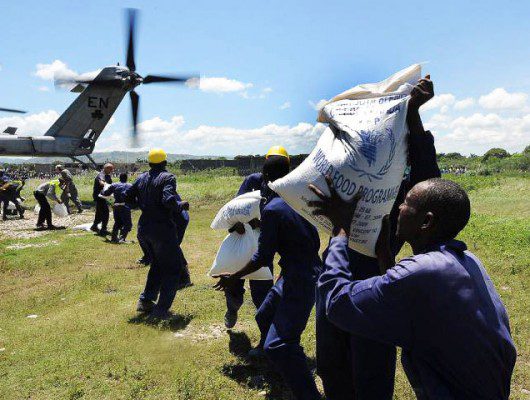
  3. Humanitarian Assistance is given in response to natural disasters and problems resulting from conflict zones in failing states. Unlike development assistance programs, which are often viewed as long-term efforts, humanitarian aid programs are generally devoted to addressing emergencies. For example, humanitarian aid includes providing protection and assistance to refugees and internally displaced persons and the delivery of emergency food aid.
  4. Multilateral Aid, although less common from the U.S., combines aid from multiple donor nations to finance multidimensional development projects. These initiatives are implemented by international organizations, like UNICEF or the World Bank.
  5. Military Assistance aims to help U.S. allies to acquire American military equipment and training. An example of one of these programs, administered by the Department of State, is Foreign Military Financing. This grant program enables governments to receive American military equipment. Two major recipients of this FMF grant are Israel and Egypt.

While the types of foreign aid are varied, the most important part of any U.S. foreign aid program, as Texas Representative Kay Granger appropriately noted, is that it be “carefully guided and targeted at a specific issue…it can and must be effective.”

– Taylor Resteghini

Sources: Borgen Project, Center for Global Development, Congressional Research Service, U.S. Foreign Assistance
Photo: Global News

March 11, 2016
https://borgenproject.org/wp-content/uploads/borgen-project-logo.svg 0 0 Borgen Project https://borgenproject.org/wp-content/uploads/borgen-project-logo.svg Borgen Project2016-03-11 01:30:102024-12-13 17:51:26Types of Foreign Aid
Global Poverty

What is the Job of a Senator?

Important Job of a Senator

The job of a senator is to act on behalf of the American people in legislative sessions to ensure the voice of the common citizen is heard. Each of the 50 U.S. states has two Senate representatives. Discussed below are the most important aspects of the job of a senator.


The Job of a Senator: Key Aspects


Represent Constituents
The most important job of a senator is to represent the people. A senator speaks with citizens about problems, concerns or suggestions they have for their district.

People elect their senators with the expectation that they will fight for legislation that is in the best interest of the average citizen.

Senators’ offices take phone calls and emails from citizens who want to share their opinions. They then review the information they receive to find out the stances of their constituents on various issues.


Inform the Public
In addition to gathering information from members of the community, a state senator shares information with the public.

A senator must be proactive and diplomatic. They may make many visits to schools, clubs and other organizations that want to learn more about the legislative process.

Senators also hold press conferences, give speeches and speak with the media in order to educate people on current issues and inform them of current legislation.

Additionally, if a constituent is having difficulty working with a government agency, they can contact their state senator to help facilitate interaction and strengthen their voice.


Serve on Committees
Senators are required to serve on Senate committees. Each committee has a different focus such as health, education, business or national security.

At each scheduled committee meeting, members listen to presentations from lobbyists, organizations and other interested parties on important topics. Afterward, senators debate new bills and propose amendments to the existing legislation.


Introduce Legislation
A senator also uses constituent feedback to identify new laws that need to be passed. Senators work with their staff to research topics, identify issues and propose laws to protect citizens.

An important part of the job of a senator is to be active and vocal in order to get as much publicity and support for a bill as possible. They consistently network with fellow Senate members and organizations to convince others why supporting their bill is important and just.

A finalized bill will pass through several committees on its way to the Senate floor for a full vote.

If said bill originated in the Senate, it is passed on to the House of Representatives for approval by Congress. If approved by Congress, the bill goes to the president to be signed into law or vetoed.


So what are the differences between the Senate and Congress?

The Senate and the Congress share the responsibility of drafting and passing legislature for the law. However, each body has differing structures and powers.

According to AllGov’s website, the Senate is known as a “continuing body,” because its members are only up for reelection every six years, whereas members of Congress are reelected every two years. Additionally, while the rules of procedure for Congress are re-adopted for every new session, the rules of the Senate have remained continuous since 1789.

The Senate also has the sole power to approve or reject nominations by the president and treaties with foreign governments by a two-thirds vote.

– Taylor Resteghini

Sources: AllGov, United States Senate, United States House of Representatives
Photo: Flickr

March 10, 2016
https://borgenproject.org/wp-content/uploads/borgen-project-logo.svg 0 0 Borgen Project https://borgenproject.org/wp-content/uploads/borgen-project-logo.svg Borgen Project2016-03-10 01:30:492020-06-20 09:42:02What is the Job of a Senator?
Foreign Aid, Global Poverty

Rubio Supports US Soft Power to End Global Poverty

Rubio
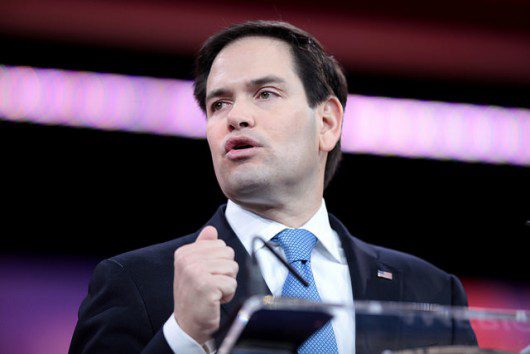
Ending global poverty is an issue that has largely escaped the 2016 presidential campaign. Inequality, terrorism, immigration, trade agreements and social issues have taken center stage. Yet many candidates support foreign aid as a key component of U.S. policy and believe that ending global poverty is in the best interest of the United States. Marco Rubio is one such candidate.

Rubio is unique in a way, in that his parents are immigrants who suffered under poverty in Cuba. In a 2014 press release, Rubio describes their situation. “My mother was one of seven girls whose parents often went to bed hungry so their children wouldn’t. My father lost his mother when he was nine. He left school and went to work at a local restaurant at about the same age of my youngest son now.”

Recognizing that his parents were not at fault for their hardship, Rubio says, “My parents, like most people that have ever lived, were raised in a country where they were trapped by the circumstances of their birth.” Poverty traps billions of people all over the globe and by linking his parents to “most people that have ever lived,” Rubio clearly empathizes with the world’s poor.

Therefore, it comes as no surprise that, when asked, Rubio expresses support for U.S. foreign aid. At a November campaign stop, Tom Hardy of Global Citizen/Humanosphere asked Rubio about his views on international development and aid. His response was short and succinct.

“In countries where there is real and robust economic development, there is less radicalization. Soft power is a real element and it’s in our national interest, and part of it is because it is the right thing to do.” Rubio identifies two key elements of why the U.S. should assist other countries. One is that development and strong rule of law help suppress terrorism. The other is that helping others and doing the right thing is a core piece of America’s identity.

Rubio believes that the United States “has been blessed for what it has done for the world.” He also pointed out that “[foreign aid] is only a small percentage of the federal budget.” This last sentence is crucial, as it rebuffs a common misperception about foreign aid.

A major reason why candidates, including Rubio, fail to mention their support for aid is that the public grossly overestimates the generosity of the United States. A Borgen Project article from 2014 reported that a Kaiser Family Foundation study found the average U.S. citizen believes 28 percent of the U.S. budget goes to aid. In reality, that number is less than one percent. Due to this discrepancy, the same report found that nearly half of Americans favor large cuts in foreign aid.

Supporting increases in aid is, therefore, politically challenging but Rubio has taken the risk. In the last year, he lent his support to the Reach Every Mother and Child Act and the Global Food Security Act as a co-sponsor. Both of these bills are supported by The Borgen Project and by many pro-development groups. Rubio has not only talked the talk but walked the walk.

To retain America’s position as a leader among nations, it is important that whoever is elected in 2016 understands that influence comes not only through military might but also through the soft power of aid and development.

As Rubio said in a 2012 speech, “We don’t have a national debt because of foreign aid. If you zeroed out foreign aid it would do nothing for the debt, but would be devastating, not just to the world but to America’s role in it.”

As a person, a senator and a presidential candidate, Marco Rubio’s commitment to ending global poverty is unquestionable.

– Dennis Sawyers

Sources: Global Citizen, Humanosphere, Marco Rubio Official Site, The Borgen Project
Photo: Flickr

February 25, 2016
https://borgenproject.org/wp-content/uploads/borgen-project-logo.svg 0 0 Borgen Project https://borgenproject.org/wp-content/uploads/borgen-project-logo.svg Borgen Project2016-02-25 01:30:442024-12-13 18:05:44Rubio Supports US Soft Power to End Global Poverty
Global Poverty

4 Steps for Refugee Resettlement in the US

Refugee Resettlement Process
The U.S. first opened its doors to refugees in 1948 following World War II, when over 200,000 Europeans fled from Nazi persecution. The 1948 Displaced Persons Act granted these refugees permanent residence and the right to employment in the U.S. Later, the Refugee Act of 1980 standardized the process of refugee resettlement in the U.S. by defining official refugee status and becoming the legal framework for today’s U.S. Refugee Admissions Program.

Refugee Resettlement Process


Qualifying as a Refugee

U.S. Citizenship and Immigration Services (USCIS) defines refugees as “people who have been persecuted or fear they will be persecuted on account of race, religion, nationality, and/or membership in a particular social group or political opinion.” In the past, this has included people fleeing Nazi persecution or Communist regimes.

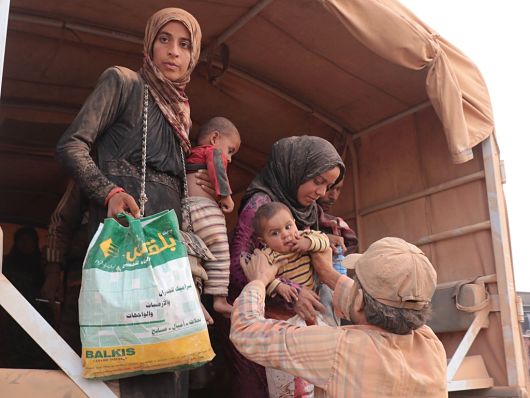
Today, thousands are fleeing Central America to avoid escalating violence as well as Syria to avoid what has been referred to as “the worst humanitarian crisis of our time.” The process by which refugees can enter the U.S. can only begin if a person is considered an official refugee under U.S. immigration law. If a person qualifies as a refugee, they must then be admitted to the U.S. Resettlement Program (USRP).

Being admitted to the U.S. Resettlement Program (USRP)

If a person qualifies as a refugee, they must then be admitted to the U.S. Resettlement Program (USRP) through a referral from the U.N. Refugee Agency (UNHCR), a U.S. Embassy, the U.S. Department of State or a family member already in the U.S. seeking to reunite. Nine Resettlement Support Centers (RSCs) around the world receive these referrals and assemble eligible applications for further consideration.

These centers are largely faith-based nonprofit organizations approved by the U.S. government to ensure utmost security when recommending an applicant for resettlement. Part of the application process requires a security screening (handled by the Department of Homeland Security and USCIS) and a health screening to ensure that applicants with a security concern or an infectious disease do not enter the U.S.

This process, on average, takes between 18 and 24 months.

Refugee Resettlement in the U.S.

If all is cleared, a refugee is paired with a sponsorship program, such as Sponsors Organized to Assist Refugees (SOAR) or Immigrant Connect, which provide new immigrants with counseling, translation and interpretation services, cultural orientation, English tutoring, financial stability during their transition to the U.S. and job search help.

Organizations like SOAR depend on community involvement in sponsoring or co-sponsoring a refugee and donating necessities such as clothing, bedding, lamps, dishes, diapers and toiletries. Volunteers help new immigrants navigate the public transit system, pick up their social security cards, obtain health services, and register for school. Refugees do not pay out of pocket for the initial cost of transitioning to the US.

Many sponsors receive grants from non-profit organizations that enable them to cover the first month’s rent and food for refugees so that newcomers may focus their energy on assimilating into the American way of life. Refugees are placed in the U.S. primarily according to connections they may have in a particular state.

A State Department spokesperson, speaking about refugees resettling in the U.S., explains, “We try very hard to get refugees close to people that they know because we think that they have a better chance of success if they have [a] support network when they first arrive, aside from just the volunteers.” Other factors include easy access to healthcare depending on personal medical conditions, fluency in English, and job prospects.

Assimilation and building a new life

After the initial chaos and novelty of entering a new country subsides, new immigrants seek to build a new life. They must acquire the appropriate credentials sanctioned by U.S. standards to continue in a field such as medicine or teaching. As a result, many immigrants find themselves at first in low-skilled jobs.

Though refugees do not pay out of pocket for any of their costs at the time of their resettlement, they must begin repaying their travel loan 6 months after arrival.

Though they receive up to three month’s rent, they do not enter subsidized housing, and therefore must find a job shortly after resettling in the U.S. In addition, U.S. agencies, such as Catholic Charities USA, are set up to help refugees apply for jobs and find education and training for their trade.

Just like any American citizen, they are free to relocate as they wish. Local organizations are set up in many cities to continue giving support to refugees.

– Mary Furth

Sources: Refugees, State.gov, UWB, USCIS, US News
Photo: Googgle Images

January 28, 2016
https://borgenproject.org/wp-content/uploads/borgen-project-logo.svg 0 0 Borgen Project https://borgenproject.org/wp-content/uploads/borgen-project-logo.svg Borgen Project2016-01-28 01:30:172024-05-27 09:28:484 Steps for Refugee Resettlement in the US
Advocacy, Global Poverty, Refugees and Displaced Persons

Former Vietnamese Refugees Reach Out to Fleeing Syrians

Vietnamese_Refugees
As Syria’s civil war worsens, thousands of Syrians are compelled to abandon their lives and relocate to other countries. Their journeys often include the daunting task of crossing oceans in small vessels that are barely sea-worthy. However, safety does not always await them on the other side.

The mass exodus from Syria has caused no small amount of strife among political leaders as they discuss how to accommodate so many refugees.

Working citizens eye the situation warily, anticipating the incoming Syrians as a threat to their livelihoods. Settling in can be very difficult for refugees when their new community is unwelcoming. Such situations can result in refugees living in squalor and becoming a burden to their new country.

The U.S. agreed to take in 10,000 Syrians in the upcoming year, but the Vietnamese American population has decided that more can be done to ensure the newcomers receive a hospitable welcome. After all, only a few short decades separate the Vietnamese from their own experience as refugees.

When the Vietnam War ended in 1975, roughly 125,000 Vietnamese refugees entered the U.S. by boat, much like the Syrians. If they were lucky, they found housing and a source of income. The unlucky spent years in refugee camps or searched the country for separated loved ones.

Now, as they see their own history playing out before their eyes, Vietnamese Americans strive to generate compassion for the fleeing Syrians.

In California, home to the largest population of former Vietnamese refugees, individuals have organized a 4-mile walk-a-thon to raise money for refugee accommodation. A Twitter campaign has also been established to allow U.S. citizens to voice their support for the Syrian refugees.

Other ways that U.S. citizens can assist in the accommodation and acculturalization of refugees are by volunteering at local resettlement agencies, donating funds and household items, becoming an English tutor and spreading the word about refugee aid.

“I want to see what we can do to help the Syrians because that is us,” says Tom Q. Nguyen, who lost his mother and sister when his family fled Vietnam in the 80’s.

Nguyen and fellow campaigners hope that their efforts will inspire others to take part as well. Perhaps the actions of these former Vietnamese refugees mark a new outlook on refugee accommodation.

According to the UNHCR’s 2015 report, nearly 60 million forcibly displaced persons exist in the world today. Half of these are victims of the turmoil in Syria, Afghanistan and Somalia, and all are in need of a new home.

– Sarah Prellwitz

Sources: Migration Policy 1, Migration Policy 2, NY Daily News, Rescue
Photo: Google Image

October 8, 2015
https://borgenproject.org/wp-content/uploads/borgen-project-logo.svg 0 0 Borgen Project https://borgenproject.org/wp-content/uploads/borgen-project-logo.svg Borgen Project2015-10-08 05:33:082024-05-27 09:28:10Former Vietnamese Refugees Reach Out to Fleeing Syrians
Aid, Refugees and Displaced Persons

Should We be Accepting Refugees in America?

Accepting_Refugees_in America
As Europe continues to struggle with a steady stream of refugees from Syria, Iraq and beyond, the United States is still debating a proper policy response to the crisis. It begs the question – what are the implications for accepting refugees in America on a large scale?

White House discussions regarding U.S. refugee policy have been held in recent weeks, but it still seems that the Obama administration is far from making a concrete decision.

President Obama has stated that the U.S. will accept around 10,000 Syrian refugees over the next year, but more longstanding U.S. involvement has yet to be confirmed.

In a recent op-ed for the New York Times, director of migration and refugee services of the United States Conference of Catholic Bishops William Canny laid out some key ways that genuine U.S. involvement could greatly aid Syrian refugees.

“In addition, the United States can resettle a much larger number of the 4 million Syrian refugees than the 1,600 we have to date,” Canny says. “The U.S. refugee program could absorb as many as 100,000 Syrian refugees if the political will to do so existed. Security checks are in place to ensure that those resettled are not a threat to us.”

According to the UN, 7.6 million Syrians have been internally displaced since the beginning of the conflict in 2011, and an additional 4.1 million have been displaced outside of the country altogether. The need for increased U.S. response is growing rapidly.

“A robust U.S. commitment to the resettlement of Syrian refugees would encourage other reluctant nations, especially those in Europe, to accept more and to keep their doors open until this horrific conflict can be ended,” Canny continues. “It also would show that the United States is not indifferent to human suffering and remains, as always, a beacon of hope to the world.”

– Alexander Jones

Sources: New York Times, US News, Washington Post
Photo: Google Images

September 20, 2015
https://borgenproject.org/wp-content/uploads/borgen-project-logo.svg 0 0 Borgen Project https://borgenproject.org/wp-content/uploads/borgen-project-logo.svg Borgen Project2015-09-20 14:17:122024-12-13 18:05:07Should We be Accepting Refugees in America?
Education, Global Poverty

How Education Affects Wealth and Prosperity in the United States

united_states
Fifteen-years-ago, education was a golden ticket to a good secure job in the United States. The idea was to go to school, get a four-year degree and land a good career. College education was just that: education. Disciplines did not matter as much as the actual degree.

Times have changed. Increased pressure from other countries has created strong competition and graduating Americans are not given preference over other people anymore. Employers are looking for the skill sets necessary to complete the job and they are not afraid to outsource to get it.

Specialization has become more and more trendy and two-year degrees and specific training courses have surged in popularity. A May 2015 study from Georgetown University suggests that college graduates will earn $1 million more than high school graduates.

This is not new as it has been widely known for a while. The kicker though, the highest paying majors earn $3.4 million more that those with the lowest paying majors.

The study suggested that STEM related fields heavily out paid social sciences. For example, a bachelor’s degree in engineering or architecture earns an average of $83k annually over the course of their career, while a graduate degree holder in education earns $60k over their career on average.

The relationship is quite complex. Another influencing factor was whether graduates worked in the for-profit, nonprofit or public sector; which industry they worked for; and whether they participated in professional development after they had started their careers. Educators working business jobs, for example, would make more than an engineer working as a teacher.

As time has gone by, humanity studies have declined and business and STEM degrees are on the rise in America. This is heavily influenced by what is in demand in the labor market. Business degrees make up 26 percent of college-educated workers. Although humanity majors are down, liberal arts and humanity class enrollment has gone up due to more rigorous general education requirements.

Attainment is another major finding in the study. Among the 15 major groups, biology and life sciences majors are most likely to earn a graduate degree, while communications and journalism majors are the least likely to earn a graduate degree. Fifty-eight percent of biology and life sciences majors earn a graduate degree, compared to 21 percent of communications and journalism majors.

Better counseling and mentorship programs are needed to help future students become fully educated about the degrees they decide to pursue before enrolling. An August 2015 study from the Federal Reserve Bank of St. Louis looked at how college degrees affected a person’s income and ability to manage financial hardships such as the recession. They analyzed data from 1992 to 2013 to determine trends, reporting wealth and income correlations with racial and ethnic groups.

They found that regardless of skin color or ethnicity, the median net worth of families headed by someone with a four-year degree was 3.6 to 9.8 times larger than families headed by less-educated persons. However, when it came to race, the landscape looked a lot different in terms of handling recessions.

Asians and Caucasians who had four year degrees withstood economic recessions better than their uneducated counterparts and typically accumulated more wealth over the long run. Blacks and Hispanics fared worse. The study concluded that Hispanic and black families with degrees typically fared “significantly worse” than those without degrees. College-educated Hispanic and black families experienced declines in wealth during and after the economic collapse of 2008.

The higher education system in the United States has been continuously scrutinized for not doing enough to provide opportunities for minorities. This is an easy narrative to blame for all the problems. The reality is much more complex. Racism does affect mental health and has led to many problems in society that affect economics and social welfare but there is still much unknown according to the study.

The U.S. must fund more studies and strategize better on how to deal with these imbalances. Further research is needed to understand why there are such disparities in wealth among racial and ethnic groups.

– Adnan Khalid

Sources: Center on Education and the Workforce, Federal Reserve Bank of St. Louis
Photo: Rainbow Educational Consulting

September 5, 2015
https://borgenproject.org/wp-content/uploads/borgen-project-logo.svg 0 0 Borgen Project https://borgenproject.org/wp-content/uploads/borgen-project-logo.svg Borgen Project2015-09-05 11:34:072024-12-13 18:04:56How Education Affects Wealth and Prosperity in the United States
Page 12 of 17«‹1011121314›»

Get Smarter

  • Global Poverty 101
  • Global Poverty… The Good News
  • Global Poverty & U.S. Jobs
  • Global Poverty and National Security
  • Innovative Solutions to Poverty
  • Global Poverty & Aid FAQ’s
Search Search

Take Action

  • Call Congress
  • Email Congress
  • Donate
  • 30 Ways to Help
  • Volunteer Ops
  • Internships
  • Courses & Certificates
  • The Podcast
Borgen Project

“The Borgen Project is an incredible nonprofit organization that is addressing poverty and hunger and working towards ending them.”

-The Huffington Post

Inside The Borgen Project

  • Contact
  • About
  • Financials
  • President
  • Board of Directors
  • Board of Advisors

International Links

  • UK Email Parliament
  • UK Donate
  • Canada Email Parliament

Get Smarter

  • Global Poverty 101
  • Global Poverty… The Good News
  • Global Poverty & U.S. Jobs
  • Global Poverty and National Security
  • Innovative Solutions to Poverty
  • Global Poverty & Aid FAQ’s

Ways to Help

  • Call Congress
  • Email Congress
  • Donate
  • 30 Ways to Help
  • Volunteer Ops
  • Internships
  • Courses & Certificates
  • The Podcast
Scroll to top Scroll to top Scroll to top