• Link to X
  • Link to Facebook
  • Link to Instagram
  • Link to TikTok
  • Link to Youtube
  • About
    • About Us
      • President
      • Board of Directors
      • Board of Advisors
      • Financials
      • Our Methodology
      • Success Tracker
      • Contact
  • Act Now
    • 30 Ways to Help
      • Email Congress
      • Call Congress
      • Volunteer
      • Courses & Certificates
      • Be a Donor
    • Internships
      • In-Office Internships
      • Remote Internships
    • Legislation
      • Politics 101
  • The Blog
  • The Podcast
  • Magazine
  • Donate
  • Click to open the search input field Click to open the search input field Search
  • Menu Menu

Archive for category: United Nations

Information and stories about United Nations.

Aid, Global Poverty, Humanitarian Aid, United Nations

UN introduces ‘Humanitarian Data Exchange’ Platform

UN introduces 'Humanitarian Data Exchange' Platform
United Nations Office for the Coordination of Humanitarian Affairs, or OCHA, has developed an open digital platform for data sharing, called the Humanitarian Data Exchange, or HDX. In collaboration with Frog Design, the new system combines state of the art data collection with data dispersal to provide current data access to crisis zones.

In rapid response to any humanitarian crisis, whether it is violence or a natural disaster, it is imperative to have instant availability to any relevant data sets. Frog Design created the technology with the intention of universal usage. Optimal viewing capabilities and premium user interface technology are also key components for rapid mass data absorption. Everyone from ordinary public citizens to data scientists to relief workers in the field are able to gather and analyze the HDX’s information.

The HDX provides easy access to a profile breakdown of almost every country in the world. Important information such as population density, total land area and GDP is provided. There are three key components that enable this data platform, data standardization, analytics and repository.

Revolutionizing data access provides an invaluable resource for relief and aid efforts to handle any disaster or crisis. Relief workers are able to make informed decisions instantly thanks to the new platform. The new technology also helps NGOs and governments to adapt to any evolving requirements or necessities that may occur.

The HDX was first utilized during the apex of the West African Ebola epidemic. The World Health Organization was able to share crucial information. Data sets, such as the total number of West African cases, cumulative deaths, treatment centers and countries experiencing outbreaks were quickly made available. The World Food Programme was able to share its data of food market prices in West African countries as well. This data helped the people properly predict their rations and assess their finances to cope during the crisis.

“It is of paramount importance that food security and food assistance information is regularly collected and widely disseminated..this partnership with OCHA on HDX is an important aspect of WFP’s broader initiative on Open Data and transparency,” says Arif Husain the Chief Economist of the WFP and the Head of Food Security Analysis Service.

Husain goes on to say, “We believe that our partnership with OCHA HDX is a major milestone in improving peoples’ access to credible and timely information for the design and implementation of national food security programs, policies and projects.”

Such a monumental breakthrough in technological usability and exchange has already proven effective through the health crisis in West Africa. It appears HDX is set to revolutionize data sharing and humanitarian relief efforts worldwide.

– The Borgen Project

Sources: World Food Programme, Frog Design

July 21, 2015
https://borgenproject.org/wp-content/uploads/borgen-project-logo.svg 0 0 Borgen Project https://borgenproject.org/wp-content/uploads/borgen-project-logo.svg Borgen Project2015-07-21 08:00:482022-01-19 00:41:17UN introduces ‘Humanitarian Data Exchange’ Platform
Global Poverty, Refugees and Displaced Persons, United Nations

Angelina Jolie and Daughter Visit Turkey for World Refugee Day

Angelina-Jolie-and-Shiloh-World-Refugee-DayAccording to the UN Refugee Agency, Turkey is the top refugee-hosting country in the world with just under 2 million asylum seekers. A vast majority of the refugees are Syrians, Kurds and Iraqis fleeing the violence of the Syrian Civil War and ongoing crisis involving the Islamic State.

In an effort to bring awareness to one of the largest refugee crises in history, Angelina Jolie embarked on a UN tour of the affected region. The movie star and long-time humanitarian was joined by her daughter, Shiloh, and stopped at the Midyat Refugee Camp in Turkey on June 20th to commemorate World Refugee Day. Jolie was also accompanied by UN Special Envoy Antonio Guterres. The group met with Turkish officials, including President Recep Tayyip Erdoğan to discuss the challenges that Turkey faces given an unprecedented number of refugees.

Jolie issued a statement at the camp in which she calls on the world to act. She said, “We are here for a simple reason: This region is at the epicenter of a global crisis. Nearly 60 million people are displaced from their homes. That is one in every 122 people on our planet. Our world has never been richer or healthier or more advanced. Yet never before have so many people been dispossessed and stripped of their basic human rights.”

Later in her speech Jolie stressed the impact that refugee camps have on the people that house them. While providing more security than war torn cities and villages, the camps more often than not make the poor even worse off. Jolie stated, “Families like the six young people I met yesterday, living in Lebanon without parents, on half food rations and paying US$100 a month to live in a tent because UNHCR does not have the funds or capability to take full care of everyone.” Already with limited resources and away from home, refugees have the burden of coming up with funds to keep their temporary shelter even though, as refugees, they “cannot legally work in their host-countries.”

There is hope, however. Jolie made her speech on a key day, a day dedicated to bringing light to the very issues at the core of her delivery. Her celebrity status will ensure that more people listen to her message, and in turn act to help. Jolie and other media figures have even inspired governments to act. Jolie thanked the governments of Turkey and other refugee hosting nations for taking in millions. To finish, the actress wished all the families she spoke to, and by extension the refugee families across the globe, a good Ramadan with “Ramadan Kareem.”

– Joe Kitaj

Sources: UNHCR, US Magazine
Photo: Flickr

July 15, 2015
https://borgenproject.org/wp-content/uploads/borgen-project-logo.svg 0 0 Borgen Project https://borgenproject.org/wp-content/uploads/borgen-project-logo.svg Borgen Project2015-07-15 11:00:082024-12-13 17:51:55Angelina Jolie and Daughter Visit Turkey for World Refugee Day
Activism, Global Poverty, United Nations

How You Can Celebrate International Youth Day 2015

International-Youth-Day

August 12, 2015 marks the fifteenth commemoration of the United Nations International Youth Day. The annual celebration draws together young people from around the world to work as agents of change.

Each year, the U.N. highlights a particular issue that affects the world’s young people. This year’s recently announced theme, “Youth Civic Engagement,” will draw international attention to the importance of youth involvement in political, economic and social affairs. The U.N. asserts that youth participation in public life is necessary to achieve global sustainable development.

This August 12, young people around the world will join the U.N.’s movement to get involved in civic activities. Here is how you can be a part of the International Youth Day 2015 celebrations:

Use Social media

The U.N.’s Inter-Agency Network on Youth Development wants to hear from you! Use social media platforms like Twitter, Facebook and Instagram to spread the word about the importance of civic engagement. Use the hashtag #YouthDay to connect with young people across the globe.

Advocate

While youth advocacy is always an important part of International Youth Day celebrations, this year’s theme emphasizes youth involvement in public life more strongly than ever. Civic engagement means taking action, so choose a cause that means something to you and get started!

You can raise awareness by creating info sheets or flyers and placing them at local schools, libraries and community centers. You can also contact local media outlets and ask them to run a feature on your issue. The more publicity your issue gets, the better.

Call or email your congressional leaders and ask them to support your cause. Gather a group of friends to lobby your local officials on or around August 12.

With all the work you put into your specific cause, do not forget to call attention to the limited opportunities for youth engagement in many areas of society. Talk with leaders in your school, faith community and local organizations, and ask them to strengthen programs that promote involving youth in civic activities.

Plan an event

Organizing a community event to promote International Youth Day is a great way to raise awareness and funds for a cause of your choice. You can host a concert and invite local musicians to play, or plan a festival or block party and invite a distinguished individual to speak. You can even organize an exhibit featuring art from young people in your community.

Share your engagement

If you decide to plan an event for International Youth Day 2015, do not forget to document it and share photos with youth@un.org. If you share your event with youth@un.org, the organization will post the information to its global map of International Youth Day activities. Your events could inspire others to advocate for youth civic engagement.

The most creative photo submissions will be displayed at the U.N. Headquarters, shared online via official U.N. social media and used in the World Youth Report 2015. Be sure to include this copyright release form so the U.N. can share your photo. The deadline for submissions is July 23.

– Caitlin Harrison

Sources: UN 1, Department of Economical and Social Affairs 1, Department of Economical and Social Affairs 2, UN 2
Photo: Nam News Network

July 12, 2015
https://borgenproject.org/wp-content/uploads/borgen-project-logo.svg 0 0 Borgen Project https://borgenproject.org/wp-content/uploads/borgen-project-logo.svg Borgen Project2015-07-12 11:19:202024-05-27 09:25:41How You Can Celebrate International Youth Day 2015
Global Poverty, Sustainable Development Goals, United Nations

United Nations Sets Sustainable Development Goals to End Global Poverty

sustainable_development_goals
The United Nations released the first draft of their Sustainable Development Goals this month in preparation for the expiration of the Millennium Development Goals, which were established in 2000.

In 17 simple steps, the Sustainable Development Goals (SDGs) aim to eliminate poverty, grow economies, increase equality and promote sustainable industry.

The overall goals, as defined in the official draft of the United Nations Development Agenda, are:

1) End poverty and hunger

This specifically aims to “end poverty in all forms everywhere.” According to an article published by The Guardian, Goal 1 seeks to reduce global poverty by at least half by 2030. The drafted plan calls for establishing equal access to economic resources, equal rights of ownership, and the creation of a firm policy framework at all levels in order to promote sustainable and accelerated economic growth.

2) Secure education, health and basic services for all

Goal 2 seeks to eliminate global food insecurity and promote sustainable agriculture. Again by 2030, the United Nations hopes to establish sustainable and year-round access to nutritious food, especially for the most poor and vulnerable. The goal is to establish sustainable agriculture and encourage investment in rural areas. The details of Goal 2 also include measures to address inequality among markets and trade restrictions, and to ensure the proper operation of food markets.

3) Achieve gender equality and empower all women and girls

This goal is to “ensure healthy lives and promote well-being for all at all ages.” This goal broadly encompasses many aspects of health and well-being across society. These aspects include reducing maternal mortality and the preventable deaths of newborns and infants, ending epidemics caused by communicable diseases, achieving universal healthcare coverage and more.

4) Combat inequalities within and between countries

5) Foster inclusive economic growth, shared prosperity and sustainable lifestyles for all

Goal 4 and 5 address access to education and gender equality. These goals include guaranteeing free and quality primary and secondary education for all children, providing equal educational opportunities to both boys and girls, eliminating violence against women and undertaking reform to ensure equal economic opportunity for women. The fifth goal goes further and calls for the creation of enforceable policies to protect the rights of women.

6) Promote safe and inclusive cities and human settlements

7) Protect the planet, fight climate change, use natural resources sustainably and safeguard our ocean

The remaining goals outline plans to create and maintain sustainability in multiple sectors. These goals include sustainable energy, sustainable agriculture and industry, sustainable use of the environment and sustainable economic structures. Some of the goals also specifically address the idea of “sustainable societies” and outline measures to reduce violence, increase equality between nations and promote global connections.

Although the initial response to the United Nations’ plan has been mixed, and some, according to another article by The Guardian, have warned that the plan has some serious holes, the ambitious set of goals sets a precedent for efforts to end global poverty and will serve as a benchmark for future endeavors.

– Gina Lecher

Sources: Sustainable Development, The Guardian 1, The Guardian 2
Photo: Flickr

July 10, 2015
https://borgenproject.org/wp-content/uploads/borgen-project-logo.svg 0 0 Borgen Project https://borgenproject.org/wp-content/uploads/borgen-project-logo.svg Borgen Project2015-07-10 09:00:082024-05-27 09:25:31United Nations Sets Sustainable Development Goals to End Global Poverty
Aid Effectiveness & Reform, Children, Development, Education, Global Health, Global Poverty, United Nations

What Have the Millennium Development Goals Achieved?

What Have the Millennium Development Goals Achieved?

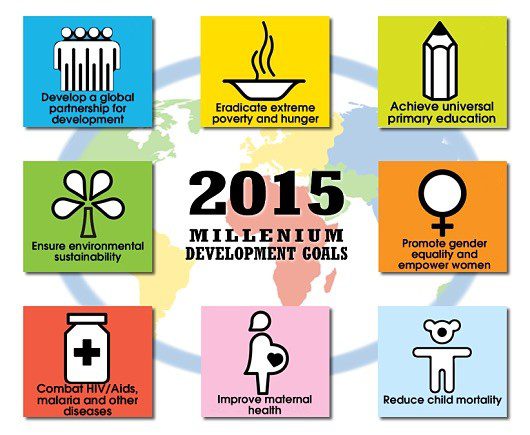
What Have the Millennium Development Goals Achieved? In 2000, the United Nations set out on a clearly defined mission to end global poverty by means of tackling eight core areas of need. Now we are looking back, 15 years later, and seeing how successful the UN was in meeting their goals-and where the new Sustainability Goals will need to take up the slack.

The Millennium Development Goals were designed as a framework for developing impoverished nations by addressing the most critical needs of the society, like reliable food sources, access to education, and adequate health care.
Each goal had specific targets which the United Nations hoped they would meet by 2015. Some goals had more success than others.

The UN’s goal of halving global poverty was met with resounding success, as the number of people living on less than one dollar and 25 cents a day dropped from one point nine billion in 1990, to 836 million in 2015. An estimated 14 percent of the global population are living in extreme poverty today, down from nearly half in 1990.

The reduction in the proportion of undernourished people globally narrowly missed its target, coming within two percent of the 50 percent reduction goal. Though narrowly missing their target, given the exponential human population growth over the last three two decades, it is still a considerable success.

The goals suffered two more near misses in their attempts to increase educational opportunities for all, including establishing gender equality in schools. An estimated 10 percent of children are not receiving any formal education, and only about two -thirds of developing countries have achieved gender equality in the classroom.

Goals four and five of the Millennium Goals, which addressed child and maternal mortality, respectively, both failed to meet their targets. While both the mortality rate of children under five and maternal deaths were reduced by over half, both failed to reach the two-thirds reduction target.

Goal six, stop and reverse the spread of HIV/AIDs, malaria, and other diseases was similarly not met in the given 15 year time frame. Although the rate of new HIV/AIDS infections has fallen by around 40 percent, an estimated two point one million people are still being infected annually. The fight against malaria and other diseases prevalent in developing areas has seen more success however, with an estimated six point two million malaria deaths averted between 2000 and 2015.

The final two goals of the 2000 Millennium Development Goals tackled strengthening infrastructure, sustainable development, and international partnership. While both goals are still on-going endeavors, over the last decade, two point six billion people have gained access to improved drinking water and official development assistance to developing nations has risen by nearly seven percent.

Overall, the United Nations has experienced great success in their struggle to address the needs of the poor around the world, but they are the first to admit that more work is needed. In the official Millennium Development Goals report, released earlier this month, Wu Hongbo Under-Secretary-General for Economic and Social Affairs admitted that success has been uneven across developing nations. “Millions of people are being left behind, especially the poorest and those disadvantaged because of their sex, age, disability, ethnicity or geographic location. Targeted efforts will be needed to reach the most vulnerable people,” said Hongbo.

The Quick and Dirty of Hits and Misses:
Goal #1: Target goal met and exceeded
Goal #2: Target goal nearly achieved
Goal #3: Not met
Goal #4: Not met
Goal #5: Not met
Goal #6: Not met
Goal #7: Target achieved ahead of schedule
Goal #8: No target specified, on-going action

The Sustainable Development Goals of 2015 will pick up where the Millennium Goals left off and continue to guide the United Nations as they work to eradicate global poverty.

– Gina Lehner

Sources: The Guardian, UN
Photo: Global Classrooms

July 9, 2015
https://borgenproject.org/wp-content/uploads/borgen-project-logo.svg 0 0 Borgen Project https://borgenproject.org/wp-content/uploads/borgen-project-logo.svg Borgen Project2015-07-09 15:02:462020-07-10 12:53:34What Have the Millennium Development Goals Achieved?
Children, Education, Gender Equality, Global Poverty, Inequality, United Nations

Effects of Gender Relations in Textbooks

Gender-Relations

The effort to educate the world’s poor is making strides with the United Nation’s new commitment to education, as well as the resourcefulness of people who see a need for their communities. The U.N. proposes that 90% of children have been reached. However, the majority of students are boys and many children who do not attend school are girls.

Getting to school is not the only challenge for girls. Part of the problem are the curricula’s textbooks that depict gender inequality. This is evident in countries like Thailand, Pakistan, Bengal and Kenya.

The stories, images or examples either do not include women or describe them in submissive, traditional roles like cleaning, cooking and serving men. The men are depicted as the ones who hold positions as political leaders, drivers, teachers or doctors. Often, history books leave out influential women in history or do not accurately portray the lives of women. For example, a Thai book shows only a man receiving a land title, when in reality a large portion of the women hold their own land titles. While these biases are subtle, studies have shown that they still reinforce negative stereotypes of women.

Rae Blumberg, who has done extensive research on gender relations in textbooks, insists that “When girls don’t see themselves in textbooks, they’re less likely to envision themselves doing great things.” There are already low percentages of women working in government and leadership positions in these poor nations. The textbooks only “reinforce, legitimate and reproduce patriarchal gender systems” that keep women out of these positions.

The lack of accurate portrayals of women in these positions can discourage young girls from getting an education or trying hard in class. However, educating women and young girls is the key to raising communities out of poverty. For instance, by keeping young girls in school, child marriage can be reduced. There are links between education and lower birth rates and birth mortality. Education can also protect children from diseases and malnutrition through the provision of health information, such as prevention techniques. With an education, girls can make a living and be positive contributors to their community, the economy and their family.

It is important to keep young girls in school. While changing cultural norms that prevent girls from attending school will take time, addressing bias in textbooks is a reasonable start. By replacing the textbooks or having conversations about the bias, more girls can succeed in getting an education that will hopefully eliminate gender biases.

– Katherine Hewitt

Sources: The Guardian, Manushi-India.org NPR, UNESCO Reuters Blogs
Photo: Fabius Maximus

July 9, 2015
https://borgenproject.org/wp-content/uploads/borgen-project-logo.svg 0 0 Borgen Project https://borgenproject.org/wp-content/uploads/borgen-project-logo.svg Borgen Project2015-07-09 08:03:052024-06-05 03:00:37Effects of Gender Relations in Textbooks
Children, United Nations

Collaborating on Early Childhood Development

early_childhood_development
The United Nations Messenger of Peace, Lang Lang, recently spent all day at a school in Beijing playing with kindergarten children. There, he shot a public service announcement with Cookie Monster from Sesame Street. All of this activity arose out of Lang Lang’s commitment to UNICEF’s early childhood development campaign.

UNICEF is advocating for worldwide early childhood development to be prioritized in the post-2015 international development agenda. Early childhood development is a key area of focus that could help bring improvements to countless other sectors.

Lang Lang is also a renowned pianist. By spending time with the children, Lang Lang was able to see firsthand how this Chinese model has used a combination of music, as well as creative art and play, to teach children ages 6 to 10.

Lang Lang compared the earliest years of a child’s life to early morning piano practice. It is easiest to remember a piano score first thing in the morning, with a fresh brain. In the same way, for young children, the early years are when learning first begins taking place. With time, the child’s worldview begins to take shape.

An estimated one in three children under the age of five in low- and middle-income countries are not reaching their full development. Evidence has shown that the quality of one’s early childhood is critical in shaping one’s lifetime development and happiness.

There are long-term consequences of early childhood development or the lack thereof. Chen Xuefeng, UNICEF China’s Early Childhood Development Specialist, points out that focusing on early childhood developmental improvements could help to break the cycle of poverty and build a more stable society.

The estimated returns on investment in early childhood care and education for disadvantaged children can be as high as 1:17. These numbers show that concentrated effort in this particular area is one of the most cost-effective strategies for reducing economic disparity.

China recently participated in a global meeting in South Korea called the World Education Forum. At this international meeting, the Declaration on Education 2030 was adopted, symbolizing the country’s commitment to make education a major focus in the 2015 agenda.

As September gets closer and the new Sustainable Development Goals must be set, the agenda focuses on areas that should be brought to the head of the discussion table. In order to successfully tackle the bigger issue of poverty, problems in areas like education, health and governance must first be solved.

International cooperation will be absolutely necessary in order to achieve the ultimate anti-poverty goal. Even more importantly, it is through action alone that change can be made. While pledges to purge the world of poverty are noble and not without impact, actions undoubtedly always speak louder than words.

– Sarah Bernard

Sources: Look to the Stars, UNICEF
Photo: BBC News

July 8, 2015
https://borgenproject.org/wp-content/uploads/borgen-project-logo.svg 0 0 Borgen Project https://borgenproject.org/wp-content/uploads/borgen-project-logo.svg Borgen Project2015-07-08 08:12:052024-05-27 09:25:19Collaborating on Early Childhood Development
Development, Foreign Aid, United Nations

Foreign Aid Successes and the Millennium Development Goals

foreign_aid_successes
Tracking foreign aid successes is essential to understanding how state actions affect the world’s poorest places, as well as dispelling myths about the ineffectiveness of aid. Aid works, and there have been dramatic improvements in education, health and the basic quality of life in the developing world because of it.

The Millennium Development Goals (MDGs) were established and adopted by all members of the United Nations in 2000. Some of these goals include reducing child mortality, combating HIV/AIDS rates and severely curbing extreme poverty by 2015. While not all of these goals have been met, there has been remarkable progress in others. Tracking progress toward these goals thus far can help fill in knowledge gaps about which aspects of global poverty need to be addressed the most.

For example, the rate of extreme poverty since 2000 has been cut in half (extreme poverty being defined as living on less than $1.25 per day). In about a decade, nearly half a billion people were pulled out of extreme poverty, especially in China and India. Poverty rates in Africa are also expected to fall below 40% this year. A Brookings Institute report estimates that this halving of extreme poverty rates took place as early as 2008, a full seven years before the deadline, and continued despite the global recession.

Foreign aid has also had a huge impact on global health. Another one of the MDGs was to reduce under-five child mortality by two-thirds by 2015. This goal was met in Rwanda, a country which only two decades ago was engulfed in a violent civil war; additionally, child mortality was reduced by one- to two-thirds in the last decade in some of the top U.S. aid recipients, such as Ethiopia. Globally, this amounts to a 10% reduction in infant mortality between 2005 and 2013.

Another oft-overlooked example of foreign aid successes are the health services and products that the United States Agency for International Development (USAID) provides to millions of people in the developing world. These products and services, among other things, have led to a total eradication of smallpox. One specific example of the effectiveness of USAID health programs is that U.S. foreign aid saves 3 million lives annually in the developing world through immunizations. USAID was also instrumental in providing 1.3 billion people with safe drinking water, and 750 million others with sanitation by supporting the United Nations Drinking Water Supply and Sanitation Decade.

Millennium Development Goal 6 calls to combat HIV/AIDS and other diseases. The U.S. leads the way in HIV/AIDS treatment and prevention, having established the U.S. President’s Emergency Plan for AIDS Relief (PEPFAR). Since its inception, this program has, according to the National Academies Institute of Medicine, saved millions of lives by providing antiretroviral drugs to affected regions. Additionally, the program has served as a proof-of-concept that HIV/AIDS prevention and treatment services can be effectively implemented on a large scale, something that was thought to be impossible only a few decades ago.

USAID has also helped affect change in education in the developing world. Since 1950, the rate of enrollment for children in primary school has gone from less than half to about 90% globally. Consequently, literacy rates have increased by a third in the last 25 years. Two of the Millennium Development Goals were to achieve universal primary education as well as promote gender equality. USAID is pursuing these two goals by promoting robust programs that expand access to education for women in countries like Liberia and Mali.

There are many reasons to be optimistic about the efficacy of foreign aid. Aid programs should be subject to scrutiny and review so that they may be made more efficient and target the populations that most need them. However, it is also important to take into account the many foreign aid successes that USAID and other donors have had in the developing world. Acknowledging that aid works is the first step in achieving the Millennium Development Goals.

– Derek Marion

Sources: Washington Post, Brookings Institute USAID, World Bank Foreign Affairs, IOM
Photo: International Institute for Sustainable Development

July 6, 2015
https://borgenproject.org/wp-content/uploads/borgen-project-logo.svg 0 0 Borgen Project https://borgenproject.org/wp-content/uploads/borgen-project-logo.svg Borgen Project2015-07-06 06:15:342024-12-13 17:51:39Foreign Aid Successes and the Millennium Development Goals
Global Poverty, United Nations

United Nations Reduces Global Poverty

United-Nations-Reduces-Global-PovertyEradicating global poverty is an undeniably massive and difficult task. From lack of food and shelter to ineffective medications and governments, it seems almost entirely impossible for an ordinary person to provide any help for developing countries with such circumstances. Bring in a group of ordinary people, however, and a solution is attainable.

The United Nations set a goal to reduce global poverty and did – overwhelmingly so. In 2000, 191 countries of the U.N. created the Millennium Development Goals, a set of eight goals that sought to cut extreme poverty in half by 2015.

Since then, the Goals have helped 700 million people overcome extreme poverty. From 1990 to 2010, the efforts of the U.N. reduced global poverty by half, five years before the target date. Today, the amount of undernourished people in developing countries has decreased from 23 percent in 1990-92 to 14 percent.

Furthermore, the U.N. wanted to see universal primary education. By 2010, enrollment in primary school had reached 90 percent, an eight percent increase from 1999. By 2012, the number of children not attending school had declined by two million.

Such successes have been achieved not only through foreign aid but also through several programs that teach impoverished communities to lead sustainable lives.

This September, the U.N. will meet again to develop new goals and advance old ones for international development through 2030. The global goals, called the Sustainable Development Goals​, are shaped to end extreme global poverty, fight gender inequalities and address climate change. One objective for the next 15 years is to lift another 1.2 billion people out of poverty.

Additionally, the new set of goals will address the 842 million people that remain hungry, as well as the unfortunately high number of children that are not receiving a proper education. Though the number of children in school today is at its highest, 126 million youth between the ages of 15 and 24 remain illiterate.

Unquestionably, the U.N. has made a significantly positive difference in the reduction of global poverty since 1990, having met or exceeded several criteria from the Millennium Development Goals. However, the fight against global poverty is not over, and the U.N. will continue to fight until it is completely eradicated.

– Sarah Sheppard

Sources: UN MDGs, SF Chronicle, The Global Goals
Photo: Child Fund

July 2, 2015
https://borgenproject.org/wp-content/uploads/borgen-project-logo.svg 0 0 Borgen Project https://borgenproject.org/wp-content/uploads/borgen-project-logo.svg Borgen Project2015-07-02 15:47:182024-05-25 00:19:03United Nations Reduces Global Poverty
Global Poverty, Politics and Political Attention, United Nations

US Congressman Calls for Cuts to United Nations Funding

United Nations Funding
Earlier this month, U.S. Representative Matt Salmon of Arizona introduced a bill to prohibit any government agency from contributing to the United Nations Population Fund (UNFPA) on the grounds that the organization isn’t in line with America’s policy agenda.

The bill, H.R. 2678, is the fourth bill introduced by Salmon as a part of his “Shrink Our Spending Initiative,” a budget plan to cut what Salmon has deemed “wasteful taxpayer-funded programs.” It is also the second bill of its kind to go before Congress in the last 5 years.

“Taxpayers shouldn’t be forced to fund activities that aren’t in line with our national priorities,” said Salmon, calling the UNFPA a “pro-abortion organization,” according to a SonoranNews.com report.

But according to the United Nations Population Fund FAQ page, the UNFPA does not promote abortion as a method of family planning. Rather, it works to promote family planning measures such as the use of condoms and female birth control. However, the organization does work to address the impact of abortions on women’s health, and to assure that in nations where abortions are legal, it is safe and accessible.


Learn why the military is requesting that Congress better fund efforts to combat extreme poverty.


The UNFPA operates as a subsidiary of the United Nations General Assembly to address population and development issues. Started in 1969, the United Nations Population Fund now operates in 150 countries, and has been instrumental in reducing the complications of pregnancy and childbirth in developing nations.

Sexual and reproductive health problems are the leading cause of death and disability for women in developing nations, and according to the UNFPA, some 225 million women lack access to family planning measures.

The goal of the United Nations Population Fund is to assure that all women have access to safe and effective family planning measures and safe deliveries and to make sure that every pregnancy is wanted.

In 2013, the United States was among the top 10 core donors to the United Nations Population Fund, contributing nearly three percent of the UNFPA’s total contributions for the year. If H.R. 2678 passes, it will eliminate all government contributions to that total.

The bill regarding United Nations funding was first introduced on June 4, 2015, and has been referred to the House Committee on Foreign affairs. According to a Huffington Post report, the Committee has already approved a $150 million cut to family planning and reproductive health programs. Such program cuts may jeopardize the health of an estimated 225 million women in developing countries who lack access to safe family planning, according to the Huffington Post.

– Gina Lecher

Sources: UNFPA, Congress.gov, Sonoran News, Huffington Post
Photo: Hill Heat

June 29, 2015
https://borgenproject.org/wp-content/uploads/borgen-project-logo.svg 0 0 Borgen Project https://borgenproject.org/wp-content/uploads/borgen-project-logo.svg Borgen Project2015-06-29 08:32:532020-07-14 18:27:40US Congressman Calls for Cuts to United Nations Funding
Page 25 of 35«‹2324252627›»

Get Smarter

  • Global Poverty 101
  • Global Poverty… The Good News
  • Global Poverty & U.S. Jobs
  • Global Poverty and National Security
  • Innovative Solutions to Poverty
  • Global Poverty & Aid FAQ’s
Search Search

Take Action

  • Call Congress
  • Email Congress
  • Donate
  • 30 Ways to Help
  • Volunteer Ops
  • Internships
  • Courses & Certificates
  • The Podcast
Borgen Project

“The Borgen Project is an incredible nonprofit organization that is addressing poverty and hunger and working towards ending them.”

-The Huffington Post

Inside The Borgen Project

  • Contact
  • About
  • Financials
  • President
  • Board of Directors
  • Board of Advisors

International Links

  • UK Email Parliament
  • UK Donate
  • Canada Email Parliament

Get Smarter

  • Global Poverty 101
  • Global Poverty… The Good News
  • Global Poverty & U.S. Jobs
  • Global Poverty and National Security
  • Innovative Solutions to Poverty
  • Global Poverty & Aid FAQ’s

Ways to Help

  • Call Congress
  • Email Congress
  • Donate
  • 30 Ways to Help
  • Volunteer Ops
  • Internships
  • Courses & Certificates
  • The Podcast
Scroll to top Scroll to top Scroll to top