• Link to X
  • Link to Facebook
  • Link to Instagram
  • Link to TikTok
  • Link to Youtube
  • About
    • About Us
      • President
      • Board of Directors
      • Board of Advisors
      • Financials
      • Our Methodology
      • Success Tracker
      • Contact
  • Act Now
    • 30 Ways to Help
      • Email Congress
      • Call Congress
      • Volunteer
      • Courses & Certificates
      • Be a Donor
    • Internships
      • In-Office Internships
      • Remote Internships
    • Legislation
      • Politics 101
  • The Blog
  • The Podcast
  • Magazine
  • Donate
  • Click to open the search input field Click to open the search input field Search
  • Menu Menu

Archive for category: Advocacy

Information and news on advocacy.

Advocacy, Children, Global Poverty

Protecting Our Future: Save the Children

Save the Children
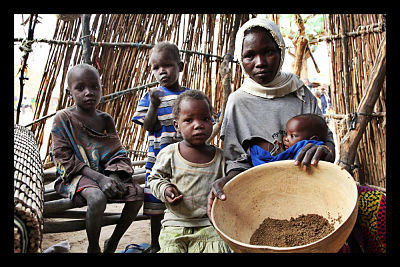
The dedicated workers of Save the Children have been affecting positive, lasting change in children’s lives for the past 81 years with no signs of slowing down. They partner with local governments and organizations in vulnerable communities to offer children support and protection from neglect, exploitation, violence, poverty, malnutrition, inferior medical care and education, and much more.

With offices spread across 120 countries, the organization has helped millions of children in Africa, Asia, America, the Middle East, Europe, Latin America, and the Caribbean. In 2012 alone, they helped more than 125 million children overcome obstacles including poverty, illiteracy, obesity, and abuse.

Save the Children focuses on the following key areas:

  • Child protection – Save the Children fosters child protection programs such as child trafficking awareness campaigns, and advocates for policy and services improvement to protect children affected by disasters, conflict, or development setting.
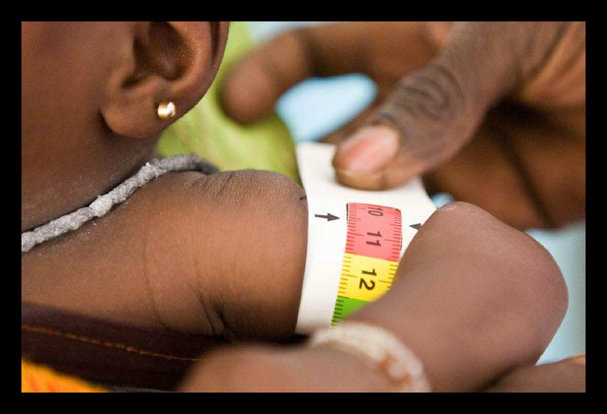
  • Newborn and child survival – Each year, close to 7 million children die before their 5th birthday. Save the Children works to prevent senseless deaths by training health workers to deliver inexpensive medical interventions.
  • Education – the organization coaches educators in effective teaching techniques, offer opportunities to continue education beyond the classroom, and ensures learning continues in times of crisis.
  • Emergency response – In times of natural disaster or civil conflict, the organization provides food, medical care, education, and support throughout the recovery process.
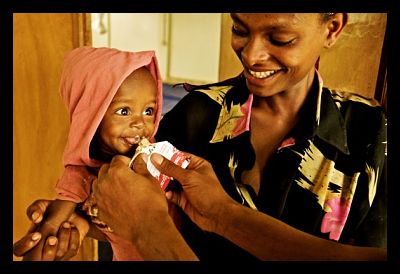
  • Health and nutrition – Save the Children works to make quality maternal and reproductive healthcare, newborn and child healthcare, nutrition education, adolescent sexual and reproductive healthcare, and emergency healthcare available to impoverished communities.
  • HIV/AIDS – the organization offers prevention education programs to stop the spread of AIDS beyond the 3.4 million children currently living with the disease. They also offer protection programs to children orphaned by the disease.
  • Hunger and livelihoods – its hunger and livelihood programs focus on increasing food supply, educating farmers to produce higher yields, teaching parents the benefits of a varied diet, and teaching children how to manage money and find work.

The organization is recognized by regulatory services as a leader among nonprofit organizations; The American Institute of Philanthropy (AIP) awarded it an A+ rating. The BBB Wise Giving Alliance has determined that Save the Children meets all of the standards for charity accountability. Charity Navigator awarded Save the Children their 11th consecutive overall 4 out of 4 stars rating in 2012. The Forbes 200 Largest U.S. Charities List rated the organization’s fundraising efficiency at 92%, and their charitable commitment at 91%. Great Nonprofits named them the recipient of a 2012 Top-Rated Award. And America’s Greatest Brands featured Save the Children as one of the strongest and most trusted humanitarian relief and development philanthropies.

The amazing work being done by Save the Children can be multiplied even further by charitable contributions to their Global Action Fund. To make a donation, please visit the Global Action Fund webpage.

– Dana Johnson

Source: Save the Children, Global Action Fund
June 22, 2013
https://borgenproject.org/wp-content/uploads/borgen-project-logo.svg 0 0 Borgen Project https://borgenproject.org/wp-content/uploads/borgen-project-logo.svg Borgen Project2013-06-22 05:30:452024-06-05 01:53:31Protecting Our Future: Save the Children
Advocacy, Food & Hunger, Poverty Reduction

Hunger in Rwanda: The Good and the Bad

Hunger in Rwanda: The Good and the Bad
In Rwanda, poverty and hunger continue to pose a major challenge for the rapidly developing country. Based on the UNDP Human Development Index for 2011, the country ranks 166 out of 187 while maintaining one of the highest population densities in Africa. The large population puts a strain on proper healthcare as well as the already limited natural resources of the country. Although the government of Rwanda, together with the World Food Program, has found that nutrition levels and food security have been improving over the last seven years, the situation is still far from optimal.

Some of the major challenges Rwanda faces with regard to poverty and hunger could be solved by foreign aid investments or direct cash donors from developed nations and foreign aid organizations. 83.7% of the population survives on $2 a day or less, and without proper disposable income, it is impossible to support families with proper food, water, and nutrition.

Up to 90% of the population engages in subsistence agriculture. This, combined with the extreme crowding and limited access to land, makes subsistence farming inefficient.

WFP’s country director for Rwanda, Jan Delbaere, weighs in on the topic, explaining that “during 2012, WFP bought 23,000 metric tons of food in Rwanda, mostly for operations in neighboring countries. This is a clear sign that Rwanda is more than self-sufficient for its staple crops. However, households with only a small area of land for cultivation simply cannot afford to access enough nutritious food to live healthy, active lives or to provide for their basic needs from their land alone.”

The WFP remains committed to supporting the government in Rwanda to increase food security and food production programs, and the country itself has chosen to sign the “Comprehensive Africa Agriculture Development Program (CAADP) compact and to secure funding, thus confirming malnutrition and food insecurity as one of the government’s key priorities.” In spite of its food insecurity, Rwanda’s GDP has been growing by 7.2% annually since 2010. With proper investment and aid, these issues can be solved, and the country set further on the right track to stability.

– Sarah Rybak

Source: WFP,Hope in Action
Photo: ESB Blog

June 20, 2013
https://borgenproject.org/wp-content/uploads/borgen-project-logo.svg 0 0 Borgen Project https://borgenproject.org/wp-content/uploads/borgen-project-logo.svg Borgen Project2013-06-20 08:28:292024-05-24 23:56:42Hunger in Rwanda: The Good and the Bad
Advocacy, Aid Effectiveness & Reform

7,000 Miles Saved with Food Aid Reform

7,000 Miles Saved with Food Aid Reform
Food Aid Reform is a big topic as lawmakers are working hard to get the bill passed through Congress. The reform will modernize policy that is outdated in the current global marketplace.  The food aid reform will enable USAID to purchase more locally grown food in emergency situations rather than shipping food from US suppliers. This change will save time, money, and improve local economies and the livelihoods of local farmers.

The Food Aid Reform Act would eliminate requirements that food must be purchased from the US and sent on US ships. It would enable food to be delivered quicker and reach an estimated 2 to 4 million more people. The increased flexibility would allow on the ground organizations more freedom to make decisions and meet needs quicker. In addition to increased efficiency, the reform would lower shipping costs significantly.

Right now, USAID spends 50% of it’s food aid budget on shipping. If food is purchased in the mid-west of US, it is transported to a US port, put on a ship, and sailed 7,000 miles around the world where it is unload and transported by land to the emergency area. This does not seem like the most profitable use of government funds when food is available in many of these economies for purchase. This will allow USAID to save the 7,000 mile trek it must send food on currently. The food aid reform would also help to stimulate local economies.

Now is an excellent time to call your Congressional Representative and ask them to support the Food Aid Reform Act. Find their information here.

– Amanda Kloeppel
Source: Independent Daily European Express
Photo: House Committee on Foreign Affairs

June 20, 2013
https://borgenproject.org/wp-content/uploads/borgen-project-logo.svg 0 0 Borgen Project https://borgenproject.org/wp-content/uploads/borgen-project-logo.svg Borgen Project2013-06-20 04:00:172020-07-03 00:24:247,000 Miles Saved with Food Aid Reform
Advocacy, Aid Effectiveness & Reform, Global Poverty

Anti-Hunger Rally in London Precedes G8 Summit

billgates
Over the weekend, a rally in London attended by thousands sought to raise awareness around the issue of global hunger and encourage leaders, before the G8 summit later this month, to make ending hunger a top priority. The rally was in London’s famous Hyde Park. It was hosted by the “Enough Food for Everyone – IF” campaign and boasted the likes of Bill Gates and “Slumdog Millionaire” director Danny Boyle.

Prime Minister David Cameron hosted talks on malnutrition and led the discussion around the fight against global hunger. Boyle believes we can end hunger and that is necessary to do so.  Boyle hopes in a day when no countries which participate in the Olympics will have children dying of hunger. It’s a high goal, but a realistic one according to supporters at the rally.

The G8 summit is set to be held in Northern Ireland on June 17-18 and the rally hoped to put malnutrition on the radar of governments, NGOs, businesses, and nonprofits attending the summit. Cameron discussed the topic with Vice President of Brazil Michel Temer and received a pledge of $4.15 billion by 2020 and a renewed commitment to fight against hunger and malnutrition.  Also in attendance were representatives from 19 African countries, numerous donor countries such at the US and Japan, the EU, the World Bank, the World Health Organisation, and UNICEF.

A rally bringing together some of the global leaders in the fight against poverty and hunger is sure to make waves and spread awareness, which is what the Prime Minister hoped to do. Leaders are encouraging those at the G8 summit to focus priorities on hunger and malnutrition. Such action is another important step in the creation of the next generation of development goals.

–  Amanda Kloeppel

Source: The News
Photo: The Guardian

June 19, 2013
https://borgenproject.org/wp-content/uploads/borgen-project-logo.svg 0 0 Borgen Project https://borgenproject.org/wp-content/uploads/borgen-project-logo.svg Borgen Project2013-06-19 04:01:392016-04-15 16:21:34Anti-Hunger Rally in London Precedes G8 Summit
Advocacy

Eco-Art: From Trash to Treasure

ecoart-uganda_environmental_ruganzo_bruno_global_poverty_opt
Eco-art, also known as contemporary environmental art, is art that is concerned with local and global environmental situations. It strives to strengthen human relationships with the natural world by expressing the development of new, creative ways for humans to co-exist with nature.

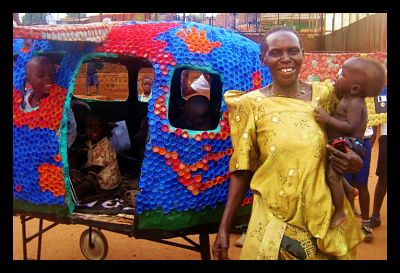
In the context of Ugandan artist Ruganzu Bruno’s newly-constructed amusement park, eco-art takes on two purposes. The 30-year-old artist and community organizer found a way to handle Kampala’s Kireka neighborhood’s acute waste management problem while engaging and empowering children through the act of play. Using a variety of recycled materials collected by the community, Bruno and his team constructed this amusement park for the children living in Kampala’s congested slums. Completed last September, the eco-park contains a myriad of exciting structures that include recycled swings and life-size board games made from plastic bottles.

However, according to Bruno, the value in the amusement park comes not only from the park itself but also from the lessons it will continue to teach the people of Kireka for generations to come. In what Bruno hopes to be an important step toward sustainability, the children and parents were taught how to make repairs to the park during its construction. Bruno, who was orphaned as a child, places particular importance upon the positive impact on children’s education that the new project promises to keep bringing.

“The attention of children in class is improved; the number of children who are dropping out [is falling] because now they have something to keep them busy there,” Bruno says, adding that the project is helping students to express themselves.

Four years ago, when Bruno was still a student at the Kyambogo University Fine Arts School, the personal goals for his work evolved from mere self-expression to wanting to make a positive impact on his community. He teamed up with a few of his fellow eco-artists to create “The Hand That Speaks,” a gigantic structure made of recycled materials in the shape of a hand. This was the first of its kind in Kampala. It was intended to serve as a reminder of how human hands can impact the environment in negative and positive ways; the same hand that throws garbage on the ground can also collect it.

The next year, in 2010, Bruno founded Eco Art Uganda, a collective of artists dedicated to the promotion of environmental awareness within their communities. They focus on transforming any waste they find – from broken electronics to scrap metal – into functional art that inspires changes in attitudes toward the environment. In April of last year, Bruno was awarded the world’s first City 2.0 Award at the TEDx summit in Doha, Qatar for the eco-park project. Currently, he is using the $10,000 prize money to fund a loan program designed to help local eco-artists in Kireka. In a continuing effort to serve his community’s needs, the young artist’s goal is to recreate “as many as 100” new eco-parks in Uganda.

Bruno’s community work is just one example of how eco-art is helping to engage communities all over the world while also keeping them clean and litter-free. The functional form of art is a promising step toward alleviating two of the world’s biggest problems; the disenchantment of the developing world’s youth and the litter that surrounds them.

– Kathryn Cassibry

Source: CNN
Photo: Ruganzu Bruno

June 19, 2013
https://borgenproject.org/wp-content/uploads/borgen-project-logo.svg 0 0 Borgen Project https://borgenproject.org/wp-content/uploads/borgen-project-logo.svg Borgen Project2013-06-19 03:49:422015-02-02 14:09:08Eco-Art: From Trash to Treasure
Advocacy, Children, Developing Countries, Food & Hunger

Nutrition for Growth Summit Combats Hunger

malnutrition
United Nations officials met with key country leaders at the Nutrition for Growth summit held in London last week to discuss pledged funds and political agreements in the fight against global hunger.  Millions of infants and pregnant women are at risk for stunting and deaths from malnutrition; the Nutrition for Growth summit was a key step in securing hope and help in the fight against malnutrition. UN Secretary-General Ban Ki-moon sent a video message confirming the organization’s commitment to ending hunger and malnutrition in all forms worldwide.

One in four children will grow up stunted by chronic malnutrition. In today’s world, this number must be reversed. There is no reason for children to suffer from malnutrition. Commitments of funds and political support will help millions of children and boost the economies of some of the world’s most vulnerable countries. The UN is committed to do whatever it takes to see the goals reached and hunger ended.

The Nutrition for Growth summit brought together leaders from governments, the private, and non-profit sector. It was hosted by the governments from Brazil and the United Kingdom as well as the Children’s Investment Fund Foundation (CIFF). The event resulted in renewed commitments to continue to fight stunting and malnutrition worldwide. Funds pledged at the event exceeded $4 billion.

Stunting in children robs them of their health and their ability to grow up to be productive, contributing citizens. The summit focused on eliminating that prognosis for children. UNICEF also strengthened its desire to invest in fighting malnutrition and to continue to support programs working in over 65 countries to combat malnutrition.

Also signed at the summit was the Global Nutrition for Growth Compact which formalizes commitments to make nutrition a top political and socio-economic priority for donors and countries. It will focus on scientific knowledge, innovation to nutrition, and transparency and monitoring of results. Strong nutrition is key for individuals, nations, and economies to grow and become successful and the Nutrition for Growth summit is another step towards the elimination of global hunger and malnutrition.

– Amanda Kloeppel

Source: UN News Centre

June 18, 2013
https://borgenproject.org/wp-content/uploads/borgen-project-logo.svg 0 0 Borgen Project https://borgenproject.org/wp-content/uploads/borgen-project-logo.svg Borgen Project2013-06-18 07:19:072024-06-10 03:29:02Nutrition for Growth Summit Combats Hunger
Advocacy

5 Ways to Become a Digital Volunteer

volunteer-digital-programs
Giving back can be a hassle, but with the digital revolution there are more and more opportunities to volunteer from your home. The organizations that have been thriving in this day and age are those that take advantage of technology. These are a few organizations that have great digital volunteer programs:

1. American Red Cross

The Red Cross trains individuals in using social media including Twitter, Facebook, and Instagram to communicate to victims during times of natural disaster. Volunteers help victims find information, direct them to where they can get help, and provide comfort.

2. The United Nations

The UN offers volunteer opportunities in all fields ranging from environment and health to region specific positions. These positions allows people to make a difference anywhere in the world from their computer. The time commitments range from 1-5 hours to 11-20 hours a week.

3. Code Corps

Code Corps links public and private organizations to work together during times of natural disaster. It originated in the aftermath of Hurricane Sandy and helped many in the New York area rebuild the city government through technology and digital tools. Currently this is only available to organizations in the NYC area, but other non-profits interested in linking their organization you can apply online.

4. All For Good

The All For Good database shows virtual volunteer opportunities in different areas. It offers a range of positions in non-profits and grassroots organizations.

5. Volunteer Match

Volunteer Match is another database that allows interested members to add more filters based on field of interest as well as location. The sophisticated level of filtering allows people to find the best match for their volunteering work.

And finally let’s not forget about The Borgen Project, which has volunteers who work virtually from all over the country. The Borgen Project’s goal is to have volunteers in all 435 congressional districts, and it is on its way to reaching that goal. If you are interested in becoming a virtual volunteer for The Borgen Project check out the “Act Now” page of the website.

– Catherine Ulrich

Source: Huffington Post
Source: American Red Cross

June 18, 2013
https://borgenproject.org/wp-content/uploads/borgen-project-logo.svg 0 0 Borgen Project https://borgenproject.org/wp-content/uploads/borgen-project-logo.svg Borgen Project2013-06-18 06:43:362013-06-18 09:01:435 Ways to Become a Digital Volunteer
Advocacy, Children, Women and Female Empowerment

Four Steps to Ending Child Marriage

end-child-marriage

Ending the practice of child marriage is an important step in eradicating global poverty and improving global health. Countries that have a high rate of documented child marriages also rank high in infant and maternal mortality as well as perpetual poverty. Here are some key steps to ending the practice:

  1. Transform cultural norms; In many places, child marriages are considered acceptable no matter the age or age difference between prospective spouses.
  2. Establish community-based programs; Often, the groups that are the most effective in combating such issues are already rooted in the affected communities. Such grassroots efforts, when combined with enforced national laws and policies that prohibit child marriage can greatly decrease them.
  3. Increase education; Girls who have access to education are less likely to marry early than those with minimal or no schooling. Even girls who are married, however, should be to encourage their education. This will help to make them more qualified for any economic opportunities that may come their way.
  4. Provide economic opportunity; Many girls enter into marriage at a young age because of the dowry given to their family by their prospective groom. Young women are also sometimes forced into marriage by their families when they can no longer afford to take care of them, or when it appears that the groom’s family will be able to better provide for her. Thus, practices such as micro-lending, savings clubs, and job placement programs can provide other options.

– Samantha Mauney

Source: ICRW
Photo: Sulekha

June 17, 2013
https://borgenproject.org/wp-content/uploads/borgen-project-logo.svg 0 0 Borgen Project https://borgenproject.org/wp-content/uploads/borgen-project-logo.svg Borgen Project2013-06-17 08:40:092021-06-21 17:26:11Four Steps to Ending Child Marriage
Advocacy, Aid Effectiveness & Reform, Developing Countries, Development, Foreign Aid

The Listening Project

the-listening-project-international-aid
The Listening Project began as an attempt to capture the side of international developmental aid that we don’t often get to hear. It’s conductors, Mary B. Anderson, Dayna Brown and Isabella Jean, wanted to collect the experiences of those who receive aid, so as to better outline their expectations and understand their realities.

The project’s main objective is to highlight the importance of critical feedback from those whose lives it affects most deeply. They discovered that there was an overwhelmingly popular opinion among the 6,000 people interviewed that the notion of aid is good, but its implementation is increasingly bad.

They found that those receiving international assistance generally held expectations that it would contribute not only to the economic betterment of their country but also to its increased political and social conditions. Ultimately, they hoped that the support they received would garner a relationship with the international community based on solidarity.

Almost every interview began along the lines of: “We very much appreciate the assistance… but…” The “but” was nearly always followed by a personal example of a negative externality produced by their country’s growing dependence on foreign aid. The interviewees agreed that their reality does not meet their expectations. While the stories concerning aid were all very cheerful in the short-term, they grew to be disheartening in the long-term.

The chief negative effect identified in the interviews typically involved an increase in the general sentiment of powerlessness and dependency. Those interviewed said that, at times, international actors bring projects that wind up perpetuating the need for more projects and more assistance. Additionally, the influx of public funds often leads actors within the country to create policies and projects that assume these funds will always be available. These practices establish an endless cycle of dependency.

Interviewees also noted how aid can increase tension between groups. Often this is brought on by a sense of relative deprivation caused by specific targeting of aid of one group and not of another. Because foreign agencies sometimes assign aid along ethnic or religious lines- divisions that may have caused violent conflict in the past- there runs a danger of reigniting long-standing prejudices.

Finally, interviewees say that the solidarity they hoped would come from aid has instead lead to a sense of mistrust toward aid agencies. The main suggestion of a great number of those interviewed was that there should be an increase in consultation. Aid agencies need to observe more closely the local social dynamics that play out in different cultural contexts before administering to the people.

On a more uplifting note, many observed an increasingly positive impact on the status of women. Many international programs focus on the improvement of the lives of women, and a great number have been successful at helping women become empowered. These programs often serve two purposes: to increase the capabilities of women and to force men to realize how this increase can contribute to the betterment of their community as a whole.

Before the project, the researchers wanted to emphasize that they in no way disagreed with the potential foreign assistance holds to bring positive impacts to the billions of people living in poverty worldwide. Their take on the issues of aid revolves around problems of implementation, not motivation.

They state in their book Time to Listen: Hearing People on the Receiving End of International Aid that the main problems stem from the historical focus on disaster response instead of prevention. They suggest that a proactive approach to humanitarian issues is the most helpful in the long-term. They also cite certain aid agencies’ adoption of business principles and mechanisms as a prevalent issue. Aid agencies sometimes adhere too closely to the interests of their profit-seeking donors while failing to respond appropriately to the needs of aid recipients.

Additionally, when local partners are used as “middle men,” it creates a wider disconnect between donor and recipient. This can provide an opportunity for the diversion of funds and most certainly breeds “competition instead of collaboration.”

The Listening Project aims to bring these contradictions between expectations and realities to light. Since its beginnings in 2005, the project has influenced multiple aid agencies to adopt policies that can better address the issues raised by the aid recipients. As the voices of these people are heard, the awareness of the need for changes in the way foreign assistance is provided also increases.

– Kathryn Cassibry

Source: The Listening Project
Photo: Global Humanitarian Assistance

June 17, 2013
https://borgenproject.org/wp-content/uploads/borgen-project-logo.svg 0 0 Borgen Project https://borgenproject.org/wp-content/uploads/borgen-project-logo.svg Borgen Project2013-06-17 06:34:002024-06-04 01:03:12The Listening Project
Advocacy, Global Poverty

The Evolution of the Millennium Development Goals

millenium-development-goals-end-poverty
With the deadline for the Millennium Development Goals set at the end of this year, the final results will be mixed. Some targets have been met, while others have fallen short. Regardless, having the development goals in place has undoubtedly led to tangible progress on all fronts.

A U.N. panel, co-chaired by British prime minister David Cameron and the presidents of Indonesia and Liberia, last week released a report outlining a set of new goals with a target of the year 2030. These goals are based on the original Millennium Development Goals, and are listed as follows:

  1. End poverty
  2. Empower girls and women and achieve gender equality
  3. Provide quality education and lifelong learning
  4. Ensure healthy lives
  5. Ensure food security and good nutrition
  6. Achieve universal access to water and sanitation
  7. Secure sustainable energy
  8. Create jobs, sustainable livelihoods, and equitable growth
  9. Manage natural resource assets sustainably
  10. Ensure good governance and effective institutions
  11. Ensure stable and peaceful societies
  12. Create a global enabling environment and catalyze long term finance

There are certain ‘absolute’ goals, including the elimination of poverty and universal access to water and sanitation. With the previous target of halving extreme poverty successfully reached ahead of schedule, the goal now is to eliminate that remaining 20% of the world living below the line.

One conspicuous absence from the goals is a specific commitment to addressing economic inequality. Even as extreme poverty is being reduced globally, the gap between the richest and poorest citizens of the world is widening. Consumption by the lowest billion amounts to 1% of global figures, while the richest billion account for 72%. With this gap constantly widening, it’s doubtful whether goals to eliminate poverty can ever truly be met. Wealth redistribution would an effective tool at addressing the poorest parts of society.

These revised development goals will be presented by the panel at the U.N. General Assembly in September, with the intention of agreeing on a clear yet ambitious framework and allowing time for its implementation by the beginning of 2016.

– David Wilson

Source: The Guardian,UN

June 16, 2013
https://borgenproject.org/wp-content/uploads/borgen-project-logo.svg 0 0 Borgen Project https://borgenproject.org/wp-content/uploads/borgen-project-logo.svg Borgen Project2013-06-16 11:14:162021-06-21 17:13:45The Evolution of the Millennium Development Goals
Page 71 of 77«‹6970717273›»

Get Smarter

  • Global Poverty 101
  • Global Poverty… The Good News
  • Global Poverty & U.S. Jobs
  • Global Poverty and National Security
  • Innovative Solutions to Poverty
  • Global Poverty & Aid FAQ’s
Search Search

Take Action

  • Call Congress
  • Email Congress
  • Donate
  • 30 Ways to Help
  • Volunteer Ops
  • Internships
  • Courses & Certificates
  • The Podcast
Borgen Project

“The Borgen Project is an incredible nonprofit organization that is addressing poverty and hunger and working towards ending them.”

-The Huffington Post

Inside The Borgen Project

  • Contact
  • About
  • Financials
  • President
  • Board of Directors
  • Board of Advisors

International Links

  • UK Email Parliament
  • UK Donate
  • Canada Email Parliament

Get Smarter

  • Global Poverty 101
  • Global Poverty… The Good News
  • Global Poverty & U.S. Jobs
  • Global Poverty and National Security
  • Innovative Solutions to Poverty
  • Global Poverty & Aid FAQ’s

Ways to Help

  • Call Congress
  • Email Congress
  • Donate
  • 30 Ways to Help
  • Volunteer Ops
  • Internships
  • Courses & Certificates
  • The Podcast
Scroll to top Scroll to top Scroll to top