• Link to X
  • Link to Facebook
  • Link to Instagram
  • Link to TikTok
  • Link to Youtube
  • About
    • About Us
      • President
      • Board of Directors
      • Board of Advisors
      • Financials
      • Our Methodology
      • Success Tracker
      • Contact
  • Act Now
    • 30 Ways to Help
      • Email Congress
      • Call Congress
      • Volunteer
      • Courses & Certificates
      • Be a Donor
    • Internships
      • In-Office Internships
      • Remote Internships
    • Legislation
      • Politics 101
  • The Blog
  • The Podcast
  • Magazine
  • Donate
  • Click to open the search input field Click to open the search input field Search
  • Menu Menu

Archive for category: Advocacy

Information and news on advocacy.

Activism, Advocacy, Global Poverty, Nonprofit Organizations and NGOs, Philanthropy

5 Groups in the U.S. Addressing Climate Change

Climate_Change
A growing movement is spreading throughout the international community in regards to addressing the prevalence of climate change. Accordingly, thousands of organizations on a global scale have mobilized to spread awareness, understand key issues and articulate solutions.

In the United States alone, there are a plethora of organizations that have been able to make strides in addressing the issue. Here is a list of 5 prominent environmental organizations that are fighting climate change and reaching success.

1. 350.org: The influential global movement headed by author Bill McKibben works across nearly 200 countries. Much of their work specifically targets carbon emissions as the number 350 itself refers to the amount of atmospheric carbon (in parts per million) needed for a stable climate.

Currently, the number is nearly at 400 parts per million, which is quite overwhelming. In order to reduce the number on an international scale, 350 works on campaigns widely ranging from stopping the Keystone XL pipeline in the United States to fighting the development of coal power plants in India.

2. Chesapeake Climate Action Network: Focusing specifically on the Atlantic coast of the United States, the Chesapeake Climate Action (CCAN) is the first organization to address climate change impacts in the Maryland/Virginia region. The area is highly vulnerable as it is home to dozens of defense facilities, while also being low-lying and densely populated.

CCAN works at the grassroots level to spread awareness, introduce the general public into the political process and influence environmental legislation. More recently, their work has been focusing on making use of Virginia’s vast renewable energy potential in offshore wind and solar energy.

3. Sierra Club: As one of the oldest, largest and influential environmental organizations in the United States, the Sierra Club has been focusing on various environmental issues for the past century. They now have 64 local chapters nationwide, a network of 2.1 million supporters and an extremely dedicated team of individuals.

In the past, The Sierra Club was influential in the implementation of the Clean Air Act, Clean Water Act and Endangered Species Act. Currently, they are focused on leading the world towards a clean energy economy and away from the heavy reliance on the fossil fuel industry.

4. Climate Reality Project: Both founded and chaired by Al Gore, the former Vice President and Nobel Laureate has led a growing global network of over 5 million individuals. The Climate Reality Project focuses heavily on spreading awareness by introducing the international scientific consensus on climate change to the general public.

Some of their promising initiatives are centered on revealing the truth behind the climate denial movement, providing information on the costs of carbon pollution and training climate reality leaders to have the skills to mobilize communities for action.

5. Energy Action Coalition: With student activism on the steep rise, organizations form and collaborate to be as effective as possible. The Energy Action Coalition is a group of 30 youth led organizations that address current environmental issues. With their level of diversity and broad organizational inclusion, the Energy Action Coalition is able to reach success in mobilizing campus communities.

The combined efforts of students across America have been successful in organizing national Power Shift Summits and campaigns to stop the development of the Keystone XL pipeline.

However, one of their prominent successes is embedded within their commitment to establishing carbon neutral college campuses. Ultimately, the Energy Action Coalition has been able to solidify almost 700 campus commitments to carbon neutrality up to 2012.

– Jugal Patel

Sources: 350.org, Chesapeake Climate Action Network, Sierra Club, The Climate Reality Project, Sierra Club, Energy Action Coalition
Photo: Scientific American

January 30, 2014
https://borgenproject.org/wp-content/uploads/borgen-project-logo.svg 0 0 Borgen Project https://borgenproject.org/wp-content/uploads/borgen-project-logo.svg Borgen Project2014-01-30 04:00:542020-07-02 12:31:155 Groups in the U.S. Addressing Climate Change
Activism, Advocacy, Global Poverty, Philanthropy

5 Motivational Bill Gates Quotes

Bill_Gates
As one of the richest men on the planet, a philanthropist extraordinaire with his own multi-million dollar fund and a proponent for the human race, billionaire Bill Gates shouldn’t only be perceived as the father of Microsoft — he’s a prominent source of inspiration and hope.

Following are five advocative quotes by the legendary man, certain to motivate and incite toward action:

1. “I believe that if you show people the problems and you show them the solutions they will be moved to act.”

2. “I’m a great believer that any tool that enhances communication has profound effects in terms of how people can learn from each other, and how they can achieve the kind of freedoms that they’re interested in.”

3. “People always fear change. People feared electricity when it was invented, didn’t they? People feared coal, they feared gas-powered engines… There will always be ignorance, and ignorance leads to fear. But with time, people will come to accept their silicon masters.”

4. “At Microsoft there are lots of brilliant ideas but the image is that they all come from the top – I’m afraid that’s not quite right.”

5. “The general idea of the rich helping the poor, I think, is important.”

What’s truly important to keep in mind here is that Mr. Gates, no matter how successful, is only human—much like everyone else. Due to his accomplishments, there probably isn’t a single person unfamiliar with his name in the modern day world.

However, Bill Gates himself pays attention to those in need; he donates money and funds research that is helping to alleviate global poverty.

These hand-picked quotes are only a sample of the reflective thoughts he produces; the encouraging simple truths they present should function as incentives for hard work.

– Natalia Isaeva

Sources: BrainyQuote, The Gates Notes
Photo: CNN

January 30, 2014
https://borgenproject.org/wp-content/uploads/borgen-project-logo.svg 0 0 Borgen Project https://borgenproject.org/wp-content/uploads/borgen-project-logo.svg Borgen Project2014-01-30 04:00:362020-07-02 12:31:325 Motivational Bill Gates Quotes
Advocacy, Global Health

Global Health Corps, Creating Global Leaders

Global_Leaders
For individuals who are passionate about improving worldwide living conditions and gaining the skills necessary to further oneself in the field of global health, internships are fraught with worthwhile and unique opportunities to gain knowledge and hands-on experience. With the plethora of diverse internships, the Global Health Corps (GHC) initiative, established in 2009, has stood out as an enriching opportunity for passionate young individuals. The Global Health Corp was engendered by the belief that adequate health is not only a privilege, but also a right for every human across the globe.

GHC aligns interns with top-notch organizations so both parties are able to collaborate-mutually benefiting each other in order to improve global health. According to the GHC, many opportunities to improve global health are not available for individuals who have not already established themselves in the medical field. Thus, another goal of the Corp is to provide opportunities for young people, especially individuals from diverse roots, to achieve their potential and make an impact on worldwide healthcare.

The program offers summer internships at the GHC headquarters in New York City. Furthermore, fellows can also be placed in locales such as Burundi, Rwanda, Uganda and Zambia. The internship provides unique opportunities such as aiding the enhancement of the GHC program, raising money through fundraising, and improving communications support.

According to the Corp, there are a series of six steps taken throughout the internship project. First, fellows are chosen, then they are paired with a host organization and partnered with a participating organization. Additionally, fellows are able to develop their unique skill-sets, establish an educated community and continue to promote global health initiatives long after the internship expires.

The Corp also provides opportunities for interns to work for global change through three key goals. Interns will be able to help increase the impact of prominent organizations by working with such organizations. Additionally, the GHC provides excellent training for aspiring future leaders by engaging interns in a wide-range of developmental activities. Furthermore, interns are able to engage in constructing an international community for change that will continue to flourish even after the yearly internships have been brought to a successful end.

– Phoebe Pradhan

Sources: Global Health Corps, Huffington Post
Photo: Wize Hive

January 29, 2014
https://borgenproject.org/wp-content/uploads/borgen-project-logo.svg 0 0 Borgen Project https://borgenproject.org/wp-content/uploads/borgen-project-logo.svg Borgen Project2014-01-29 20:01:012024-05-26 23:07:16Global Health Corps, Creating Global Leaders
Activism, Advocacy, Global Poverty, Nonprofit Organizations and NGOs, Philanthropy, Volunteer

Nonprofit Careers

L_africa_children_doctors_smile
For many people the nonprofit sector, also known as the “third sector,” can offer an exciting and rewarding career. With the exception of where the funding comes from, nonprofit organizations often are run very similarly to for-profit organizations. They also have to adhere to the same policies and may even hire similarly qualified people. This article will provide an overview of the types of jobs available in the nonprofit sector as well as some of the things to consider when looking for a non-profit job.

Development

The development department is one of the largest and highest paying job categories in the nonprofit sector. Development professionals work on gathering the resources that fund the programs and initiatives run by the organization. These jobs are needed in order for the organization to stay alive thus affording the position to pay well and stay in the position of not likely to be cut. Jobs in development also tend to be less competitive than jobs in other departments. Such jobs here can include:

– Director of Development
– Fundraiser
– Proposal Writer
– Communication Professional

Program

Being part of the program department is exciting and rewarding, especially since those who work in this department get to put their organization’s mission into action. These are the people who will be developing and implementing disaster relief plans in developing countries, or providing services to people with mental health challenges. Unfortunately program careers are very competitive and have a high burn out. These jobs include:

– Program Manager
– Program Assistant
– Policy Analyst
– Technical Advisor

Administrative

Just like private sector companies, nonprofit sectors also need an administrative team to help organizations keep on their feet and run smoothly. These jobs are also good stepping-stones into programs careers or management level jobs.

– Human Resources
– Office Manager
– Receptionist

Important Things to Consider About Careers in the Nonprofit Sector

1. You’ll have to wear many hats – Nonprofits don’t always have the funds to hire a large staff, this means you may have to be the graphic designer, the social media coordinator and the grant writer.

2. You need to be passionate about the cause – Employers aren’t just looking for talented qualified workers, they are also looking for people who are passionate about the cause and will work hard to achieve the organization’s goals.

3. You’ll probably make less money – Nonprofits have less resources, this means your office may be less plush and your salary smaller.

4. Volunteer first – It’s important to volunteer or intern at a nonprofit to see if you like the culture and are actually passionate about the job. This also proves your commitment to an employer and can open up job opportunities.

5. Nonprofits are run like any other business – Managing finances and being cost effective are just as important to nonprofits as they are to businesses.

– Elizabeth Brown

Sources: Miami University, US News, Forbes
Gif: Borgen Project

January 29, 2014
https://borgenproject.org/wp-content/uploads/borgen-project-logo.svg 0 0 Borgen Project https://borgenproject.org/wp-content/uploads/borgen-project-logo.svg Borgen Project2014-01-29 04:00:222024-12-13 17:53:48Nonprofit Careers
Advocacy, Global Poverty, Philanthropy

Zach Braff’s Wish I Was Here

“I can’t do this all on my own” are the familiar musical lyrics that introduced each episode of “Scrubs” during it’s nine season run.  Though “Scrubs“ turned actor Zach Braff into a television and indie star, his new film project certainly shows how Braff cannot achieve his artistic goals “on [his] own.”

“Wish I Was Here” is a film written, directed and starring Zach Braff, picking up on the themes he first explored in his well-received debut film “Garden State” back in 2004.  The film follows a thirty-something actor, played by Braff, searching for a purpose in life and struggling to make ends meet for his two young children.

Other actors featured in the film include Kate Hudson, Anna Kendrick, Jim Parsons and “Scrubs” co-star Donald Faison. The film premiered to a standing ovation at the 2014 Sundance Film Festival.

What makes “Wish I Was Here” unique, however, is the fact that fans independently financed the film.  Braff, moreover, launched a Kickstarter campaign with a stated goal of $2 million since, according to the film’s Kickstarter page, Braff rejected traditional funding methods to avoid “signing away all artistic control.”

Braff also saw an opportunity for his fans to have a direct impact on the filmmaking process.

Incentives for donating to the film range from a production diary at $10 and a meet and greet with Braff for $600 to being cast in the film as a featured extra for $7,500.  These incentives, matched with the originality of the fundraiser, led to a final total of $3,105,473 donated by 46,520 individuals.

Though a $10 donation to Zach Braff’s film garners a production diary, 80% of the world’s population live off of less than $10 a day, with 660 million living on less than $2 a day.

What could you buy for the fight against global poverty with a $10 donation?

With $3, you could buy a bed net to protect one of the 18,000 children who die daily from mosquitos carrying deadly diseases while for $8.50, you could feed an entire family in a developing nation.  Though Braff’s film is no doubt an artistic achievement, it is easy to wonder what kind of impact his 46,520 backers could have made for global development.

– Taylor Diamond

Sources: Kickstarter, UNICEF, Global Issues
Photo: Bustle

January 28, 2014
https://borgenproject.org/wp-content/uploads/borgen-project-logo.svg 0 0 Borgen Project https://borgenproject.org/wp-content/uploads/borgen-project-logo.svg Borgen Project2014-01-28 18:43:372024-05-26 23:08:47Zach Braff’s Wish I Was Here
Activism, Advocacy, Charity, Global Poverty, Human Rights, Philanthropy

Martin Luther King Quotes on Poverty

Dr. Martin Luther King Jr will forever hold a place in the hearts of millions of people around the world. The immediate need for freedom from racism, discrimination and flat out brutality toward African Americans will forever be King’s message. However, Dr. King also used his platform to shed light on global poverty.

He expressed the need for poverty to be abolished and the need for nations to come together to combat this growing problem. Here are excerpts of Dr. King’s written documents concerning the dire need to end poverty.

Excerpts from Dr. King’s Nobel Peace Prize address in 1964:
“A second evil which plagues the modern world is that of poverty. Like a monstrous octopus, it projects it’s nagging, prehensile tentacles in lands and villages all over the world. Almost two thirds of the peoples of the world go to bed hungry at night. They are undernourished, ill-housed, and shabbily clad. Many of them have no houses or beds to sleep in. Their only beds are the sidewalks of the cities and the dusty roads of the villages. Most of these poverty-stricken children of God have never seen a physician or a dentist.”

“So it is obvious that if a man is to redeem his spiritual and moral ‘lag,’ he must go all out to bridge the social and economic gulf between the ‘haves’ and ‘have not’s’ of the world. Poverty is one of the most urgent items on the agenda of modern life.”

“There is nothing new about poverty. What is new, however, is that we have the resources to get rid of it.”

“The time has come for an all- out world war against poverty.”

“The rich nations must use their vast resources of wealth to develop the underdeveloped, school the unschooled, and feed the unfed. Ultimately a great nation is a compassionate nation. No individual or nation can be great if it does not have a concern for ‘the least of these.'”

Excerpts from Dr. King’s “Let My People Go” speech. Human Rights Day December 10, 1965:
“Africa does have spectacular savages and brutes today, but they are not black. They are the sophisticated white rulers of South Africa who profess to be cultured, religious and civilized, but whose conduct and philosophy stamp them unmistakably as modern-day barbarians.

We are in an era in which the issue of human rights is the central question confronting all nations. In this complex struggle an obvious but little appreciated fact has gained attention-the large majority of the human race is non-white-yet it is that large majority which lives in hideous poverty. While millions enjoy an unexampled opulence in developed nations, ten thousand people die of hunger each and every day of the year in the undeveloped world.”

An excerpt from “Where do we go from Here: Chaos or Community” written in 1967:
Sadly this is Dr. King’s last book before he was tragically assassinated.

“I am now convinced that the simplest approach will prove to be the most effective – the solution to poverty is to abolish it directly by a now widely discussed matter: the guaranteed income.”

“The curse of poverty has no justification in our age. It is socially as cruel and blind as the practice of cannibalism at the dawn of civilization, when men ate each other because they had not yet learned to take food from the soil or to consume the abundant animal life around them. The time has come for us to civilize ourselves by the total, direct and immediate abolition of poverty.”

Nearly fifty years after these words were breathed, they still reign true; especially since poverty continues to be a problem for millions of people in 2013. Let us not allow Dr. King‘s words to remain in the past. We must give them life again and continue to make this world a better place, as Dr. Martin Luther King did nearly fifty years ago.

– Amy Robinson

Sources: Nobleprize, RFKSA Film, Progress,
Photo: BAR Photography

January 28, 2014
https://borgenproject.org/wp-content/uploads/borgen-project-logo.svg 0 0 Borgen Project https://borgenproject.org/wp-content/uploads/borgen-project-logo.svg Borgen Project2014-01-28 09:15:452024-06-04 03:01:14Martin Luther King Quotes on Poverty
Activism, Advocacy, Global Poverty, Migration, USAID

Importance of Citizenship in the Dominican Republic

citizenship_dominican_republic_protests
The Constitutional Court of the Dominican Republic has decided to strip thousands of Dominicans of Haitian descent of their citizenship, causing unruly behavior both inside and outside the country.

Latin American human rights groups are speaking out against the ruling and citing international and regional human rights models, believing the ruling to be fundamentally racist and inhuman, according to Al Jazeera.

Not only is the ruling causing issues in the Dominican Republic, but there have even been protests in New York City.  New Yorkers are, furthermore, not supportive of the annulment of citizenship of anyone born in the country to noncitizens after 1929. The New York Times reports that this decision is applicable to many as 200,000 people, mostly of Haitian decent.

Many have said that the ruling emphasized a history of racial prejudice in the country against not only Haitians, but their descendants as well.

Edward Paulino, assistant professor of history at John Jay College of Criminal Justice in Manhattan, who is Dominican-American, explains that, “Anything that’s seen as a criticism is seen as treasonous.”

Several years ago, two United Nations human rights experts described in a report a “profound and entrenched problem of racism and discrimination” against Haitians in particular, throughout the Dominican Republic.

The Dominican Republic has fought with criticism for its treatment of Haitian migrants and this ruling has brought shame upon people within the country as well as internationally. The residents are already struggling with poverty and social exclusion and it is not beneficial in any way for them to be denounced.

Throughout the ruling the United States has signed an agreement worth 184 million to improve citizen safety and promote economic growth according to Dominican Today. The agreement accompanies the new strategy by the U.S. Agency for International Development (USAID) that is working to provide assistance to support the growth of small Dominican business and get them out of extreme poverty.

The businesses are primarily in the rural sector and USAID assists them by identifying new market opportunities.  They are also providing training and technology transfers to help such businesses produce quality products and services.

Despite this assistance, people throughout the Dominican Republic are focused on the issue of citizenship. There are tens of thousands of lives hanging in the balance and inaction is no longer an option. They are working to get out of poverty and the issue surrounding citizenship is distracting from finding the correct solutions.

– Lindsey Lerner

Sources: Al Jazeera, New York Times, Dominican Today
Photo: Crowd Voice

January 26, 2014
https://borgenproject.org/wp-content/uploads/borgen-project-logo.svg 0 0 Borgen Project https://borgenproject.org/wp-content/uploads/borgen-project-logo.svg Borgen Project2014-01-26 04:00:592024-12-13 17:49:56Importance of Citizenship in the Dominican Republic
Activism, Advocacy, Charity, Food & Hunger, Food Aid, Global Health, Global Poverty, Health, Hunger, Philanthropy, Technology

Saving Calories & Lives

In recent years, technology and applications have had an increasingly philanthropic purpose. The latest of these technologies is the Share Your Calories application. The app was designed by Catherine Jones, a well-known author of nutrition cookbooks, Elaine Trujillo, a leader in nutrition, and Stop Hunger Now, an international agency aimed to end hunger across the globe.

The app can be used to help people lose weight while simultaneously providing food to people harmed by natural disasters. By adding a philanthropic purpose, the designers of the application aimed to give users another goal as well as more motivation to eat healthier. Studies also show that spending on others makes us happier than spending on ourselves, so the application, in and of itself, allows users to feel lasting happiness.

The application allows users to monitor their daily activities and food intake through a calorie bank determined by bio-data. If they do not consume all the calories in their calorie bank, the user has the option to convert the extra calories into monies. Once they have accumulated $12, the user has the option to donate to Stop Hunger Now.

Each Stop Hunger now high-protein dehydrated meal is equivalent to 250 calories and 25 cents.

The financial contributions from the Share Your Calories App go toward Stop Hunger Now meal packaging events. Each of these meals contains rice, dehydrated soy and vegetables as well as a vitamin-mineral pack. These meals are easy to store and have a shelf-life of 2 years.

These meals are currently distributed through host-organizations, but the funds from this application will also allow smaller groups and businesses to participate.

This application hopes to bring in $95,000 to build an android app, provide basic nutrition information, translate the app into different languages, etc. The Stop Hunger Now effort is supported by the Medical Science Foundation, TruBios Communications, iSO-FORM, The Ohio State University Food Innovation Center and the Experiment.

– Lienna Feleke-Eshete

Sources: IndieGoGo, FoodTank
Photo: Irish Red Cross

January 25, 2014
https://borgenproject.org/wp-content/uploads/borgen-project-logo.svg 0 0 Borgen Project https://borgenproject.org/wp-content/uploads/borgen-project-logo.svg Borgen Project2014-01-25 21:17:472024-05-26 23:04:12Saving Calories & Lives
Advocacy, Global Poverty, Nonprofit Organizations and NGOs

Poverty Advocacy, ONE Way

Poverty Advocacy
With a staggering amount of global poverty, ONE.org was established as a nonpartisan, nonprofit organization striving  to help lend a strong hand in the battle against destitution. Co-founded by U2 front-man Bono in May 16, 2004, the ONE Campaign strives to end extreme poverty and reduce the prevalence of preventable diseases, especially in Africa.

The roots of the ONE campaign lie in a previous organization created by Bono called DATA (Debt, Aids, Trade, Africa), which also strove to raise awareness about AIDS and other social issues in Africa. However, in 2008, DATA and ONE united simply as the ONE Campaign. Since its engenderment, ONE has already garnered the support of 3.5 million advocates.

The methods that ONE employs to fulfill its mission of eradicating global poverty and disease involve educating the public about such issues, raising awareness among politicians to push global poverty to the top of political agendas and collaborating with African policymakers rather than simply directing them. By raising awareness about global poverty among the general public and among politicians and policymakers, ONE makes global poverty more relevant and urgent in the eyes of individuals who may not have previously been concerned with such global issues.

Although ONE headquarters are currently located in Washington, D.C., London, Johannesburg, Brussels, Berlin and Paris, the message of the campaign permeates through any global boundaries, bringing the organization closer and closer to fulfilling their goal of assuaging poverty. Due to support of volunteers, ONE has been able to help reduce extreme poverty and preventable diseases.

For instance, over 7.5 million African residents today are able to gain access to AIDS medication whereas in 2005, only a paltry 50,000 Africans were able to access such life-saving treatments. Additionally, malaria has also been reduced by a staggering 75% within the past decade – no doubt with lobbying and contributions from the ONE Campaign.

– Phoebe Pradhan

Sources: ONE, Look to the Stars

January 25, 2014
https://borgenproject.org/wp-content/uploads/borgen-project-logo.svg 0 0 Borgen Project https://borgenproject.org/wp-content/uploads/borgen-project-logo.svg Borgen Project2014-01-25 04:00:502017-03-07 12:55:40Poverty Advocacy, ONE Way
Activism, Advocacy, Charity, Education, Foreign Aid, Global Health, Global Poverty, Health, Nonprofit Organizations and NGOs, Philanthropy

4 Impassioned Humanitarian Leaders

Gates_Humanitarian_Leaders
Below is a list of four impassioned humanitarian leaders who are fighting to make the world a better place.

1. George Soros

George Soros has given billions of dollars over the years to humanitarian organizations. He is the financier and founder of the Open Society Foundation, an international foundation that promotes the expansion of human rights and democracy throughout the third world.

Founded in 1998, the group funds and has helped institute health and educational programs while also being driven to provide “greater fairness in political, legal and economic systems” throughout the world. The program touts initiatives such as the Burma Project, which promotes freedom of expression, as well as helping suppressed minority and political groups communicate their human right grievances in the political repressive nation of Burma.

The foundations has various programs throughout countless countries promoting freedom of expression and basic human rights.

2. Jon Hunstman

Jon Hunstman Sr. began his humanitarian activities after being diagnosed with prostate cancer in 1993. Founder of the successful Huntsman Corporation, his donations have accounted for billions of dollars. He founded the Hunstman Cancer institute, a non-profit research company that builds hospitals and develops new cancer fighting techniques.

The Hunstman Corporation regularly donates money to education institutions as well.

For example, the foundation donated 26 million dollars to Utah State University to help expand the Jon M. Huntsman School of Business. They donated another 2 million dollars to enact the Hunstman Awards for Excellence in Education that reward exceptional school teachers and volunteers.

The foundation believes a strong domestic educational system will help enact significant positive change in America.

3. Tegla Laroupe

Female Kenyan runner Tegla Laroupe came to prominence in 2003 after winning 2 interntional half-marathons, attaining multiple world marathon records, and countless other titles. After retiring from marathon running, she devoted all her time to affect change in devastated communities throughout the world.

In 2003, she established the Tegla Lorupe Peace Foundation, an organization based around helping housing projects and educating children orphaned by political violence. The foundation has built schools throughout Ethiopia, Kenya, Uganda and Southern Sudan.

The organization raises money through various programs, such as the Peace Races. The Moroto-Uganda Peace Race was held in the Moroto district of Uganda and helped raise money for orphaned children in the volatile region plagued by an unstable political situation and “banditry.”

4. Bill Gates

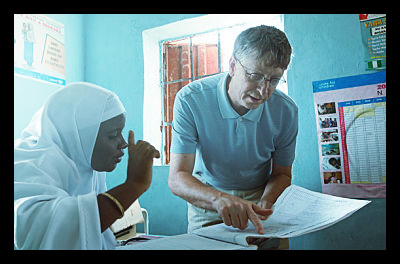
Bill Gates, founder of computer software powerhouse Microsoft, has spent his days of retirement giving back. He founded the Bill and Melinda Gates Foundation, which spends most of their efforts fighting poverty and health risks such as malaria. The organization tackles grave crises through 4 major program initiatives.

The Global Development Division deals with food insecurity throughout impoverished communities, as well as sanitation and housing. The Global Health Division, furthermore, promotes technological and scientific studies such as vaccines and medical treatments throughout the developing world.

Their foundation also tackles domestic issues through the United States Division through supporting higher level education and high school.

The Global Policy & Advocacy Division is, in fact, the strategic portion of the Bill and Melinda Gates Foundation, which works to help advance their policies through national and international frameworks.

– Joseph Abay

Sources: Open Society Foundations (OSF), Huntsman Corporation, Tegla Loroupe Peace Foundation, Bill and Melinda Gates Foundation
Photo: Channels

January 24, 2014
https://borgenproject.org/wp-content/uploads/borgen-project-logo.svg 0 0 Borgen Project https://borgenproject.org/wp-content/uploads/borgen-project-logo.svg Borgen Project2014-01-24 13:57:052017-12-04 12:33:444 Impassioned Humanitarian Leaders
Page 61 of 77«‹5960616263›»

Get Smarter

  • Global Poverty 101
  • Global Poverty… The Good News
  • Global Poverty & U.S. Jobs
  • Global Poverty and National Security
  • Innovative Solutions to Poverty
  • Global Poverty & Aid FAQ’s
Search Search

Take Action

  • Call Congress
  • Email Congress
  • Donate
  • 30 Ways to Help
  • Volunteer Ops
  • Internships
  • Courses & Certificates
  • The Podcast
Borgen Project

“The Borgen Project is an incredible nonprofit organization that is addressing poverty and hunger and working towards ending them.”

-The Huffington Post

Inside The Borgen Project

  • Contact
  • About
  • Financials
  • President
  • Board of Directors
  • Board of Advisors

International Links

  • UK Email Parliament
  • UK Donate
  • Canada Email Parliament

Get Smarter

  • Global Poverty 101
  • Global Poverty… The Good News
  • Global Poverty & U.S. Jobs
  • Global Poverty and National Security
  • Innovative Solutions to Poverty
  • Global Poverty & Aid FAQ’s

Ways to Help

  • Call Congress
  • Email Congress
  • Donate
  • 30 Ways to Help
  • Volunteer Ops
  • Internships
  • Courses & Certificates
  • The Podcast
Scroll to top Scroll to top Scroll to top