Before Kennedy was even President, he had a vision for a stronger America through understanding the struggle of developing nations and peace building around the world. His speech at the University of Michigan formed the origin of the Peace Corps. From the first deployment of 51 volunteers to Accra, Ghana, in 1961, Americans have engaged in critical projects of building wells, schools, and clinics. They distribute information about AIDS/HIV prevention and environmental preservation. They strengthen capacity and resilience of crop and livestock by working with locals and their intimate knowledge of their needs and resources.
Over 52 years, the Peace Corps has engaged over 210,000 American volunteers in 139 countries and thousands of projects. Volunteers are asked to serve “under conditions of hardship” to help accomplish the mutual goal of improved livelihoods and welfare.
From the start, the Peace Corps was hugely popular with American citizens and partner countries. In the first few years of the Peace Corps, the number of volunteers expanded exponentially. Starting out with only 51 volunteers in March of 1961, by December the organization had more than 500 volunteers serving and 200 more training in the US. By 1962 there were 28 countries participating and nearly 3,000 volunteers. By 1966 the number of volunteers jumped to 15,000 volunteers and trainees. Former president Jimmy Carter’s mother volunteered in 1966 as a public health worker in India. By the early 1970s, Peace Corps volunteers were being elected to the House of Representatives in the US Congress and the first female and first African American was appointed to Peace Corps Director. 9,000 serving volunteers in 1970 is the record for most serving volunteers.
In 1981 the Peace Corps, which had been a congressional mandate, became an independent federal agency. In 1985 the Peace Corps was the subject of the John Candy, Tom Hanks, and Rita Wilson movie “Volunteers.” This was not the Peace Corps’ debut in pop-culture. References to the Peace Corps have also been made in “the ‘Pink Panther’ (1963), ‘Animal House’ (1978), ‘Airplane!’ (1980), ‘Dirty Dancing (1987), ‘Mr. and Mrs. Smith’ (2005), ‘The Simpsons’, and ‘Family Guy.’” The number of women serving as Peace Corps volunteers jumped past the number of men serving in 1985.
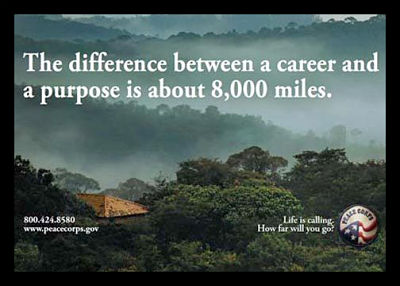
When the Berlin Wall fell in 1989, for the first time volunteers were sent to eastern and central Europe starting in 1990. 1993 saw the first volunteers go to China as English teachers. 1993 also marked a divergence of Peace Corps Directors as appointed from outside the organization. Since Carol Bellamy, director from 1993-1995, and a returned volunteer, all the directors have been former volunteers. Started in 1995, the Peace Corps now also sends volunteers on short-term missions to respond to humanitarian crises caused by natural disasters; this included responses to Katrina in New Orleans. When the apartheid ended in South Africa, the Peace Corps sent the first group of 33 volunteers in 1997. The 2003 ad campaign was aimed at refreshing the image of the Peace Corps in the American mind. The new slogan read: “Life is calling. How far will you go?”
The next year the Peace Corps received the largest appropriation from Congress in the history of the Peace Corps: $400 million. The budget expansion coincided with a “40-year high in numbers of volunteers”—8,655 volunteers in 77 countries.
Who are volunteers? They are mothers, children, fathers, astronauts, scientists, members of Congress, and ambassadors. They are descedants of an organization born in the campaign of President Kennedy and shaped by the demanding needs of people suffering the indignity of poverty and underdevelopment and hard work of thousands of American citizens.
“The Peace Corps represents some, if not all, of the best virtues in this society. It stands for everything that America has ever stood for. It stands for everything we believe in and hope to achieve in the world”- Sargent Shriver.
– Katherine Zobre
Source:
Photo:

History of the UNFPA
The UNFPA was originally introduced as the UN Fund for Population Activities. The fund began as a trust fund in July of 1967. Its administration was entrusted to the United Nations Development Program. In 1972 the program was placed under the General Assembly’s authority and the UNDP Governing Council was named as its governing body. In 1987, the name was changed to the United Nations Population Fund.
The UNFPA has a unique role within the UN system. It is responsible for addressing population and development issues. They emphasize reproductive health and gender equality. Much of the fund’s construction stems from the ICPD Programme of Action as well as the Millennium Development Goals. The fund receives policy guidance from the General Assembly and the Economic and Social Council, also known as ECOSOC. The fund works closely with other developmental organizations such as the WHO, UNICEF, UNDP, and UNAIDS.
The UNFPA touts five main goals: achieving universal access to sexual and reproductive health, promoting reproductive rights, reducing maternal mortality, and accelerating progress on the ICPD agenda and MGD’s. Additionally, they advocate for human rights and gender equality. The UNFPA helps governments conduct countrywide censuses, population and development-related research, and analysis on topics such as migration, aging, climate change, and urbanization.
The UNFPA works with governments, other UN agencies, local communities, NGOs, foundations, and the private sector to raise awareness and mobilize support and resources to achieve its mission. In 2007, the UNFPA decentralized its operations and became a more field centered, efficient and strategic partner, executing real and important work on the ground.
In 2011, the UNFPA restructured again. The center of their plan was based on advancing the right to sexual and reproductive health by accelerating progress towards the MGD aimed at improving maternal health. They have recently placed their emphasis on reducing maternal deaths and achieving universal access to reproductive health, including family planning and access to family planning methods for women. At this time, the UNFPA is striving to improve the lives of underserved populations, especially women and young people. They are working towards this through their expertise in population dynamics, human rights, and gender equality.
– Caitlin Zusy
Source UNFPA
The Effect Global Poverty has on Wildlife
The debilitating effects of extreme poverty on the citizens of afflicted countries are well-documented. Poverty leads to illness, shame, violence, and overpopulation. Yet poverty is not only detrimental to the human populations of the countries in which it exists, but also the animal populations which coexist alongside it.
It is well known that the earth cannot produce the resources to adequately sustain the current human population, much less at its current rate of growth. We are currently stripping our planet of all its available resources, with little room to maintain ourselves, much less wildlife. The situation is at its most dire in poor, rural villages where people are caught in an uncomfortable co-existence with native wildlife.
Those who still survive by a hunter-gathered lifestyle get food, clothing, and medicine from their surroundings. A research paper by the Department for International Development’s Wildlife and Advisory Group states: “We estimate that wildlife plays a significant role in the lives of up to 150 million poor people. Of the estimated 1.2 billion people who live on less than the equivalent of one dollar a day, about 250 million live in agriculturally marginal areas, and a further 350 million live in or near forests. Wildlife plays some role in the lives of many of these people, and is thought to be a primary livelihood asset in the lives of up to one-eighth of them. Where wildlife is declining or access to wildlife is denied, poor people adapt, but often at a cost to their livelihoods in terms of reduced income, fewer diversification opportunities and increased vulnerability.”
Resources are not the only problem, but also direct competition. Many are often forced into destruction of wildlife, not for a willful hatred of animals themselves or for recreational purposes, but out of sheer necessity. Tigers in India are often killed by rural communities which fear losing irreplaceable livestock. Poaching is a result of a desperate need for money, as ivory and other endangered animal parts often fetch handsome prices. Better education and greater opportunities for the individuals committing these acts would be far more effective than punishing a crime that the current system inevitably forces them to commit.
What this means is that the existence of poverty and conservation of our wildlife are mutually exclusive. One, by necessity, prevents the other. To conserve wildlife is to rob poor communities of the few resources they have, and to not intervene means the inevitable destruction of our environment and the creatures in it. We have created a system where, if we do not act, we are choosing to destroy either our fellow humans or our fellow creatures. We cannot currently sustain both.
– Farahnaz Mohammed
Sources: Wildlife and Poverty Study
Photo: Jukani
Niger Villagers gather to vow against FGM
In discussions about female genital mutilation (FGM), the communities which traditionally engage in the practice are often depicted as unwilling to end it, or unaware of the dangers of it.
Yet recently, in a heartening display of commitment to progress, nearly 14,000 villagers from various communities in Niger gathered to publicly vow to end the tradition. In the ceremony, a pit was dug in the village square and participants threw knives, scissors and blades into it before it was symbolically filled in.
Though Niger officially outlawed FGM in 2003, it remained common in certain communities.
A health issue as well as a social one, FGM leaves women with a myriad of medical problems including infertility, incontinence, pain, cysts, and infections. It is nearly always done on young girls, before the age of 15. It has been decried by the WHO as a practice which “violates a person’s rights to health, security and physical integrity, the right to be free from torture and cruel, inhuman or degrading treatment, and the right to life when the procedure results in death.”
The issue of FGM is not merely an issue of the practice itself, but is inextricably tied to the status of women within the communities. To ensure success in stopping FGM, women must be elevated through education and increased access to their rights.
While the rate of the practice has decreased – slipping from 5% to 2% of girls in Niger, according to UNICEF – it has proved very difficult to eradicate entirely. It has deep roots and a strong cultural presence, with many seeing it as the proper way to raise a young girl and discourage promiscuity. It also falls in line with local ideas of femininity and chastity, with certain parts of the female anatomy seen as “male” and “dirty”, with removal becoming a necessity. There is also the simple but powerful social pressure of subscribing to tradition.
These are all attitudes which need to be changed within the local communities, rather than coming from international intervention. The very public display of support from ordinary citizens is a great step forward for seeing the end of this primitive practice against the communities’ most vulnerable members.
– Farahnaz Mohammed
Source: Yahoo News
Photo: Tribe
UNICEF’s First Celebrity Ambassador, Danny Kaye
“I believe deeply that children are more powerful than oil, more beautiful than rivers, more precious than any other natural resource a country can have. I feel that the most rewarding thing I have ever done in my life is to be associated with UNICEF ” – Danny Kaye.
Celebrities tend to get a bad rap. They make oodles of cash and then most of them use it to live extravagant, self-absorbed lifestyles. But some of Hollywood’s most recognizable names have chosen instead to use their fame for good. Audrey Hepburn, Selena Gomez, and Laurence Fishburne just to name a few, have been UNICEF celebrity ambassadors. These celebrities travel the globe and bring awareness to the incredible work that UNICEF does everyday. And it all started with actor and comedian, Danny Kaye.
Danny Kaye was born David Daniel Kaminsky on January 18, 1913 in Brooklyn, New York. He was the youngest of three sons born to Ukrainian Jewish Immigrants Jacob and Clara Kaminsky. From a young age Danny seemed destined to become an entertainer. At 13 he boldly dropped out of high school to pursue a career in show business. He soon returned to Brooklyn to work a string of odd jobs, none of which lasted very long, and eventually returned to his first love, acting.
During his career Danny wore many hats. He had starring roles in film, theater, and television. The beloved actor appeared in the family classic “White Christmas” alongside Bing Crosby and got the whole country laughing with his role in “The Court Jester”. His zany comedic style and heartwarming attitude won him fans the world over. Then, at the height of his career in 1954, he embarked on a whole new journey, becoming the first ever UNICEF Goodwill Ambassador, a role he would hold until his death in 1987.
As an ambassador for UNICEF, Danny was the first celebrity to publicly advocate for a global cause. He was vocal about his belief that the world’s children held the key to the future and in an interview he said, “Any organization that perhaps creates a better understanding for the children would in some measure contribute to the security and the health and the peace of the world”.
Danny worked tirelessly to use his fame to bring the plight of the children he cared for so dearly to the attention of the world. He gave countless interviews, starred in a few UNICEF public service announcements, and provided much needed laughter and entertainment for kids around the world. In 1979, he even earned himself a spot in The Guinness Book of Records by flying a jet to 65 cities in 5 days to greet thousands of UNICEF volunteers for the annual Halloween Trick-or-Treat for UNICEF campaign. Kaye continued his mission to educate the world about the lifesaving work of UNICEF until his death in 1987.
Danny Kaye is gone but not forgotten. The legacy he created by using his stardom for good paved the way for countless celebrities to follow in his footsteps. Since 1954, UNICEF has had over 40 international Goodwill Ambassadors.
– Erin N. Ponsonby
Source: UNICEF
The Just Give Money Theory
For many, the eradication of global poverty seems an insurmountable goal, and foreign aid processes can be long-winded and complex. It is important to realize, however, that the solution to this important issue may be right under our noses, not to mention incredibly simple. The idea laid out in the book Just Give Money to the Poor: The Development Revolution from the Global South, is to give aid as cash directly to those in need of it, rather than through temporary security measures.
“A quiet revolution is taking place based on the realization that you cannot pull yourself up by your bootstraps if you have no boots,” the book says. “And giving ‘boots’ to people with little money does not make them lazy or reluctant to work; rather, just the opposite happens. A small guaranteed income provides a foundation that enables people to transform their own lives.”
While many are skeptical about this approach, the results of this direct aid can be seen in countries around the world. Brazil, South Africa, Mexico, India, and Ethiopia are only a few examples shown in the book – the methods range from grants for those who have children in schools, those who are the poorest, or those who are elderly or children. In each case, there is significant change following these grants: child malnutrition decreases, school registration increases, and general health improvement and growth of local farms and markets ensue.
This method seems to be fairly effective, although it cannot solve the problem of global poverty alone. In addition to these grants, there must be some other methods of government intervention along the lines of investments in education, infrastructure, and health. The notion that the poor are to blame for their position in society is turned upside down by the positive results of these grants, and the money given will only continue to be put to good use in the fight against poverty.
– Sarah Rybak
Source: Pacific Standard
Photo: Fast CoExist
Jeopardy’s Bob Harris Writes About Microlending
For many fans of Jeopardy, the name Bob Harris is synonymous with knowing things. Because he’s a thirteen-time champion of the game show and general outspokenness, many respect his opinions. Thus, his new book is making waves in the literary community and may initiate some important dialogue about how to deal with international poverty.
It all began when Harris, a writer and radio commentator by trade, was given the opportunity by ForbesTraveler.com to review some of the world’s finest luxury hotels. However, instead of simply pocketing the earnings, Harris decided to lend the money via kiva.org while continuing to travel around the world to take a look at all the lives that the money had affected. His experiences were compiled into a book titled The International Book of Bob. The book, in addition to shining a light on microlending, shows the juxtaposition of the world’s wealthiest and poorest people. Harris writes of ATM machines that emit gold ingots and Asian construction workers who live like indentured servants in Dubai for the chance to send money back to their families.
In an interview, Harris explains the fundamentals of microlending:
“Microlending was pioneered more than 30 years ago by, among others, Muhammad Yunus and the Grameen Bank in Bangladesh. Charity certainly has its place in poverty alleviation, obviously — when there’s been a disaster, or when there’s epic need — but in many places, the people have small enterprises, and they know what they can do to solve their own problems. They’re in the middle of their businesses and they simply need a small loan.
But if you’re a fisherman, and you simply need to patch a hole in your rowboat, you can’t go to Citibank for a bridge loan in Cambodia. So who do you go to? Prior to microlending, your alternative would be maybe leaning on your family or villagers, or going to black-market money lenders, and paying an exorbitant interest rate. When you go to kiva.org, the vast majority of donors are finding people on the website to whom they can put $25 toward a loan; that money goes overseas to a local lender and the recipients pay the loan back, then you get paid back.”
Speaking once again about kiva.org, Harris says “Now there’s this place on the Internet — where total strangers go, to be nice with other total strangers so they can all collectively be generous to yet more total strangers whom they will never meet — and somehow my name is in the middle of that. That’s magical.”
– Samantha Mauney
Source: Huffington Post
Photo: Telegraph
6 Reasons Why Humanosphere Rocks!
The independent, nonprofit news organization Humanoshpere has been devoted to covering and analyzing the most important issues in global health, development, and aid since its founding in 2010. The organization aims to expand the relatively meager and overly broad media coverage of humanitarian issues while better outlining the role that aid and development efforts play in their alleviation. If this isn’t a sufficient reason to believe that Humanosphere rocks, here are 6 more.
1. Tom Paulson is one funny man: In addition to being terrifically intelligent and an incredible journalist, the founder and editor of Humanosphere have a wit that is unheard of in the somewhat stiff world of humanitarian journalism He deems his news coverage as “often irreverent” in its coverage of humanitarian issues and admits that global poverty just really “ticks him off.” He also claims that he and a childhood friend invented Earth Day. So there’s that.
2. In with the warm, out with the fuzzy: The language surrounding humanitarianism is tinged with a sort of hopefulness that is often overly ambiguous. Humanosphere attempts to maintain the warm characteristics while refraining from the fuzziness. They aim to clearly define the issues while promoting dialogue rather than simply declaring simplistic solutions.
3. 3. They’re based in Seattle: Often called the humanitarian center of the United States, there is no better place for the headquarters of an independent news organization trying to make the world a better place. Bolstered by the National Public Radio and other local affiliates, their “moss-backed bias” that poverty is a negative thing in need of alleviation is well supported in a city that is the nation’s leader in global health, aid, and development.
4. They’re deadly serious, but not deadly boring: Poverty, injustice and suffering are by no means light-hearted matters, and Humanosphere does not approach them as such. However, while Humanosphere is devoted to raising awareness about these international issues, they do not wish to do so in a hum-drum manner. Instead, they post articles with engaging titles such as “Feed the World: Bugs” and “On the West’s awkward relationship with Kenya,” and keep their rhetoric understandable and approachable.
5. They don’t beat around the bush: In the words of Tom Paulson, “We’re journalists. We like the difficult, politically charged and awkward.” The writers at Humanosphere delve directly into the issues that matter most at any given moment. They aren’t afraid to call out any news or governmental organization that fails to do the same. They simply don’t shy away from the discomfort that inevitably arises from shedding light on the issues of poverty and injustice.
6. They are a refreshing step in the right direction: Perhaps most importantly, Humanosphere is representative of the positive direction that the humanitarian journalism field is working toward. Aside from having the entirely admirable mission of making the world a better place, their coverage tactics are better aimed at reaching their modern readership base than most existing news organizations.
Does anyone need any more convincing? Ok, here’s a video of Tom Paulson himself performing Psy’s “Gangnam Style.” (He uploaded this himself. Like I said, he’s one funny man.)
Source: Humanosphere
Photo: Humanosphere Facebook
History of the Peace Corps
Before Kennedy was even President, he had a vision for a stronger America through understanding the struggle of developing nations and peace building around the world. His speech at the University of Michigan formed the origin of the Peace Corps. From the first deployment of 51 volunteers to Accra, Ghana, in 1961, Americans have engaged in critical projects of building wells, schools, and clinics. They distribute information about AIDS/HIV prevention and environmental preservation. They strengthen capacity and resilience of crop and livestock by working with locals and their intimate knowledge of their needs and resources.
Over 52 years, the Peace Corps has engaged over 210,000 American volunteers in 139 countries and thousands of projects. Volunteers are asked to serve “under conditions of hardship” to help accomplish the mutual goal of improved livelihoods and welfare.
From the start, the Peace Corps was hugely popular with American citizens and partner countries. In the first few years of the Peace Corps, the number of volunteers expanded exponentially. Starting out with only 51 volunteers in March of 1961, by December the organization had more than 500 volunteers serving and 200 more training in the US. By 1962 there were 28 countries participating and nearly 3,000 volunteers. By 1966 the number of volunteers jumped to 15,000 volunteers and trainees. Former president Jimmy Carter’s mother volunteered in 1966 as a public health worker in India. By the early 1970s, Peace Corps volunteers were being elected to the House of Representatives in the US Congress and the first female and first African American was appointed to Peace Corps Director. 9,000 serving volunteers in 1970 is the record for most serving volunteers.
In 1981 the Peace Corps, which had been a congressional mandate, became an independent federal agency. In 1985 the Peace Corps was the subject of the John Candy, Tom Hanks, and Rita Wilson movie “Volunteers.” This was not the Peace Corps’ debut in pop-culture. References to the Peace Corps have also been made in “the ‘Pink Panther’ (1963), ‘Animal House’ (1978), ‘Airplane!’ (1980), ‘Dirty Dancing (1987), ‘Mr. and Mrs. Smith’ (2005), ‘The Simpsons’, and ‘Family Guy.’” The number of women serving as Peace Corps volunteers jumped past the number of men serving in 1985.
When the Berlin Wall fell in 1989, for the first time volunteers were sent to eastern and central Europe starting in 1990. 1993 saw the first volunteers go to China as English teachers. 1993 also marked a divergence of Peace Corps Directors as appointed from outside the organization. Since Carol Bellamy, director from 1993-1995, and a returned volunteer, all the directors have been former volunteers. Started in 1995, the Peace Corps now also sends volunteers on short-term missions to respond to humanitarian crises caused by natural disasters; this included responses to Katrina in New Orleans. When the apartheid ended in South Africa, the Peace Corps sent the first group of 33 volunteers in 1997. The 2003 ad campaign was aimed at refreshing the image of the Peace Corps in the American mind. The new slogan read: “Life is calling. How far will you go?”
The next year the Peace Corps received the largest appropriation from Congress in the history of the Peace Corps: $400 million. The budget expansion coincided with a “40-year high in numbers of volunteers”—8,655 volunteers in 77 countries.
Who are volunteers? They are mothers, children, fathers, astronauts, scientists, members of Congress, and ambassadors. They are descedants of an organization born in the campaign of President Kennedy and shaped by the demanding needs of people suffering the indignity of poverty and underdevelopment and hard work of thousands of American citizens.
“The Peace Corps represents some, if not all, of the best virtues in this society. It stands for everything that America has ever stood for. It stands for everything we believe in and hope to achieve in the world”- Sargent Shriver.
– Katherine Zobre
Source:
Photo:
Gender Inequality Runs Rampant in India
In New Delhi, there are 13 times more toilets for men than there are for women. Specifically, there are 3,712 male public toilets, and a mere 269 female toilets. Women sometimes must resort to defecating in the open, which besides the obvious privacy violation, poses a significant risk of rape and violence.
Public Toilets in New Delhi are just one example of discrimination against women in India; it starts before women are even born, and continues throughout their entire life. Girls can be perceived as a financial burden in parts of India, as a result of their limited income opportunities and costly dowries; 500,000 Indian girls have died as a result of pre-natal sex selection and infanticide over the last 20 years.
If a bride can’t fulfill her dowry, she faces the risk of torture and death at the hands of her in-laws. In 2005, nearly 7,000 Indian women were killed for being unable to meet the financial requirements of their dowries, some of them as young as 15 years old.
Indian women are humiliated, abused, and killed every day. Before they are even born, their opportunities and experiences are decided for them. They will face violence and inequality at almost every turn; and even something as simple as access to public restrooms is not guaranteed for them.
There are ways to encourage gender equality in India, though they may be easier said than done. Laws that discriminate against women need to be amended; girls need to be educated to level the intellectual playing field, and India’s practice of perceiving men above women, needs to be addressed for change to last.
– Dana Johnson
Sources: Trust, Advocates for Youth, Brookings
Photo: Asia News
Early Warning Systems are Not Just for Earthquakes
When political crises happen or human rights are being destroyed, the use of smart phones and other technology to spread the word is critical. What about when natural disasters strike? When a family has minutes to evacuate before a tsunami wipes out their village, do they take a picture or tweet about it? No. But the World Health Organization, in cooperation with national and local governments, and by demand of citizens in crisis and an outcry for better preventative measures, is working on building better early warning systems for post-disaster epidemics. The technology? A boat, a bike, your boots. Also needed: a pencil, paper, and your determination.
Recently in the Solomon Islands the immense destructive forces of the 6 February 2013 8.0 magnitude earthquake and pursuant 3m tsunami left thousands of people without homes and brought down the health care system.
The Solomon Islands consist of 1,000 islands off the South Pacific and are home to 550,000 people. The destructive power of the February earthquake left thousands vulnerable to diseases due to the broken health care system. 5500 residents required temporary living shelters. These shelters are often plagued by poor sanitation due to lack of resources and cramped living quarters. Poor sanitation leads to a plethora of preventable diseases—most of which associated with diarrhea.
Taking a queue from the early warning systems set up to warn of impending natural disaster, the World Health Organization worked with the Ministry of Health of the Solomon Islands to set up an early warning system to identify outbreaks, unusual outbreak patterns, and the number of people affected. This is a critical step towards disaster recovery and decreasing the vulnerability of those affected.
Developing the surveillance system presented logistical challenges of connecting vulnerable people to health clinics. Five clinics were set up around Santa Cruz, the main island that was affected. The head nurses, “doubled as boat captains,” connected patients to clinics. Traveling from surveillance sites to the clinics is risky. Poor weather, no lights on the boats, dangerous landing sites and navigational skill are all impediments to the surveillance system. For Solomon Islanders, these risks are necessarily overcome because full coverage is absolutely necessary for the system to work.
The WHO works with the clinics to make sure all the information necessary to identifying and preventing large-scale outbreaks is included in an accessible way. The successful system, now fully functional, has collected data, identified risky areas, and has quickly responded to problems.
The WHO initiative in the Solomon Islands is not unique and neither is their geography. There are 52 developing island nations in the world. These nations carry a disproportionate risk imposed by earthquakes and tsunamis and break down of health systems. Early warning health systems are a part of a larger global strategy to minimize post-natural disaster vulnerability. The WHO works with governments to create a Global Risk and Response system. The main activities include working with governments to set up early warning systems and develop laboratory capacities to handle large amounts of biological material—all of which requires bio-security to keep potential diseases from escaping. Training for and building response strategy plans is also a main function of the WHO’s Global Alert and Response (GAR) system. Seasonally, the GAR supports governments in climate related disease preparedness and creates standardized approaches to climate related diseases such as influenza and malaria.
– Katherine Zobre
Sources: Wikipedia, WHO , WHO