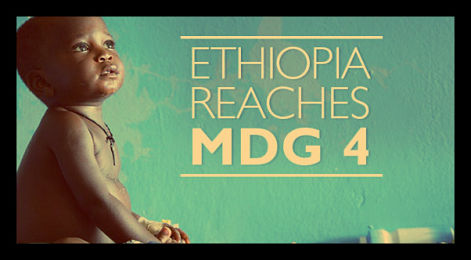
It seems that time and time again, all we hear regarding the Millennium Development Goals (MDGs) is how so many countries may not meet them by 2015. Poverty rates in Country A are actually rising. The illiteracy rate in Country B is unfortunately stagnant. The international community isn’t doing enough to make certain goals achievable.
But for some developing nations, there is a light at the end of the tunnel. For these nations, reaching the MDGs may not be too far away. In some cases, it has already been achieved. The East African nation of Ethiopia is one country that has succeeded.
As a country that used to make headlines for heart-wrenching stories of hunger and famine, Ethiopia is quickly making itself a leader in the development of African nations, and it is only beginning with its commitment to the reduction of the child mortality rate.
According to a recent report funded by UNICEF, the World Health Organization (WHO), and the World Bank, Ethiopia has recently become one of the handful of developing countries to succeed in cutting its mortality rate for children under the age of five years prior to the 2015 cutoff date. The data shows that Ethiopia has reduced child deaths by more than two thirds over the past two decades, taking the rate from 204 children in every 1,000 births that died before reaching the age of five to 68 per 1000 births.
Ethiopia’s progress in this area can be attributed to the government’s commitment to achieving the MDGs as well as its fervent allocation of resources towards healthcare programs. Poverty and fertility rates are down, and the number of children enrolled in school has doubled. The progress is not solely limited to urban areas, but rural and remote parts of the country are seeing a decrease in child mortality rates as well.
Ethiopia’s Minister off Health, Dr. Kesetebirhan Admasu, credits the country’s progress to a mixture of government policies as well as the UNICEF-trained and supported 38,000 community health workers the Government brought in and placed throughout 15,000 health posts all across Ethiopia. Dr. Kesete believes the community health workers have led the way to achieving major reductions in child and maternal mortality. He also alluded to how much of an impact an involved government and community can make on a poor country.
“With commitments of governments and the community, it is really possible to make a difference and to save the lives of millions of children and mothers across Africa,” Kesete said.
Dr. Peter Salama, UNICEF country representative for Ethiopia, agreed, praising the ongoing commitment that the Ethiopian government has had towards the development of the country. Salama added that the government-implemented programs will lead to a more sustainable Ethiopia, seeing as they are government-funded rather than donor-supported.
“The government has set some very bold and extremely ambitious targets. It has then backed them up with real resources and real commitment sustained over the last 10 years,” Salama said.
Ethiopia’s progress is a model for other African nations showing that success in reducing poverty and increasing development is possible. With Ethiopia as a leader, other African governments have come forward and pledged their commitments to increasing child survival in their respective nations, as well as taking control of their countries’ development rather than leaving it to donors.
To this end, Ethiopian leaders have been working on developing country-led roadmaps that incorporate potential policies to end preventable deaths among children under five by 2035, as well as decrease the mortality rate for children under five to under 20 for every 1000 births in all African countries.
– Elisha-Kim Desmangles
Feature Writer
Sources: The Guardian, UNICEF
Photo: USAID

The Elma Foundation
The foundation of ending global poverty begins with building a future for the coming generations. The ELMA Group of Foundations, founded in 2005, has seen the potential in youth and grown into one of the world’s largest private foundations focused exclusively on the children of Africa and selected groups in the United States and the United Kingdom.
ELMA’s mission is to improve lives through sustainable efforts to relieve poverty, advance education and promote health. They achieve this by utilizing grant making and investment, and supporting grassroots, community-based and large scale regional, national and international initiatives as catalysts for systematic change for people around the globe.
The group of foundations is made up of four major services arms: the ELMA Foundation, ELMA Relief, ELMA South Africa and ELMA Music. They are located in New York, Cape Town, and Dar es Salaam.
The ELMA Relief Foundation provides humanitarian relief to help people affected by disasters in any region of the world. They pay special attention to the needs of children, who often suffer more in the aftermath of environmental tragedies. They support successful disaster risk reduction activities and work to strengthen the strategic development behind it.
Some of their active grants include Global Fund for Children, Medecins Sans Frontieres UK and Oxfam America. These and other grants have provided support for disaster victims in countries like Nigeria, South Africa, Haiti, Mozambique and Ethiopia.
The ELMA Foundation has a particular focus in South Africa where they provide assistance to both children and adults. These include a Legal Resources Centre which aims to renew ongoing social justice programs with focus on children’s rights and the University of Pretoria, a community-orientated nursing education program for women and child health.
The ELMA Music foundation works mainly in the U.S. and UK. They offer financial assistance to musicians and musical performs, and to established programs seeking to assist the problem of substance abuse and addiction in the music industry. ELMA also supports opportunities for underprivileged children and youth to study and create music.
All in all, ELMA has a large and diverse outreach that tackles social injustice and pushes for relief and education all around the world.
– Janki Kaswala
Sources: Elma, Idealist
Photo: Berkeley
Literate Women Improve Development
One in every six adults worldwide is illiterate. Most of the world’s illiterate are women, meaning that they are 15 or older and unable to read or write. Literate women add to their country’s development. This is accomplished through their participation in business, government and culture. Moreover, they are more likely to ensure that their children, especially the girls, attend school, guaranteeing a subsequent generation of literate women.
United Nations Secretary-General Ban Ki-moon stated, “Every literate woman marks a victory over poverty.” Literate women strengthen the development of their country by reducing mortality rates, increasing child and maternal health and ensuring ongoing literacy for girls.
Therefore, governments, donors and non-governmental organizations (NGOs) have been encouraged to increase the funding and advocacy to improve literacy rates among the world’s women.
Africa is the only continent where most adults are not able to read or write. According to the United Nations Educational, Scientific and Cultural Organization (UNESCO), the adult literacy rates are below 50 percent in Benin, Burkina Faso, Chad, Ethiopia, Guinea, Mali, Niger, Senegal, Sierra Leone and The Gambia. Due to gender inequality, the literacy rates in these countries are even lower for women.
Below are the literacy rates for the women in some of these countries:
With a poverty rate of 43 percent, Mali is one of the world’s poorest countries. Life expectancy is 54 years and girls’ education rate is only up to 7 years old. For these women and girls living in poverty, gaining an education is essential for survival. Through educating women and girls in Mali, HIV infection rates will decrease, incidents of human trafficking will diminish and women will marry and have children later in life. Women will also instill a value for education in their children and will gain more input in their family functioning.
Through increased funding and advocacy to educate the women of the world, global poverty will be diminished.
– Caressa Kruth
Sources: UN News Centre, UNICEF, UNESCO, CIA, The World Bank, World Education
Photo: The Blessing Basket
Hermione Granger and the Fight for Equality
Emma Watson has accomplished more than the average twenty-three year old woman. Watson has starred in the widely successful Harry Potter series, and has gone on to play leading roles in other film productions. Her portrayal of Hermione Granger, the lead heroine character in the Harry Potter series, was magnificent, and she has received many accolades for her acting. Hermione Granger is the epitome of standing up for beliefs, fighting for the better cause and improving the livelihood of all beings in the wizarding world of Harry Potter. The character of Hermione Granger was embraced by wizard fans worldwide, and her ways of seeking the greater good are well revered.
Hermione Granger stood out in a peculiar way. Whereas her fictional partners in crime, Harry Potter and Ron Weasley, were more laid back, Hermione routinely took charge. She was constantly fighting for the greater cause, and pushing her fellow classmates to join her in the quest for brilliance.
Hermione always had the lookout for those less fortunate than her, and throughout the Harry Potter series she was consistently helping others. Hermione’s shining moments came in her fight to free the house-elves, a group of mythical creatures destined to clean and cook for richer families and organizations. The house-elves were a race that accepted their fate; they were content with the life they lived. However, Hermione pursued their freedom because many of them had never understood the concept of freedom.
Hermione faced much criticism during her quest to enlighten the house-elves about freedom. Many students attempted to dissuade her, yet she persisted because she believed in the fight for the greater good. She constantly reminded others that they accepted their life because they had never had freedom before. Whereas her attempts to free the elves fell on many deaf ears, she continued to fight for what she knew was the right cause.
The way Hermione refused to adhere to the criticism of her peers is an important lesson. Hermione stood out because of her beliefs that life could be equal for all. This same mindset can be used to fight worldwide poverty. Many Americans turn a blind eye to these struggling third-world nations, too timid to speak out or take actions. However, characters such as Hermione do exist in the real world, and they are the people who strive to make a difference for those less fortunate then themselves.
Should more people face the issue of poverty in a manner similar to Hermione’s stand against house-elf inequality, the results could be momentous. Her drive and perseverance to accept nothing but civil rights equality is admirable. The potential for poverty diminishment could expand exponentially if more individuals take a “Hermione Granger” stand against it.
– Zachary Wright
Sources: Accio Quotes, Goodreads
Photo: MTV
How Diseases Lead to Poverty
What causes poverty? When looking at the factors that can lead to poverty in a region, there are many things that could be highlighted. One can look at the government, at conflict, at the lack of natural resources, or at the shortage of quality education in a region. However, poverty in a region is not only caused by conflict or inadequate education, but also by diseases. Increasing health in a region can significantly reduce global poverty, in effective and unexpected ways.
People in developing countries face challenges due to diseases that those in developed nations do not. For instance, in a developing country, someone who gets sick may have to sell their possessions to pay for medicine. Parents, not expecting their children to survive, have more children and spend less on education. Tropical diseases, and other health risks specific to a region limit tourism and foreign direct investment, affecting the potential prosperity of a nation.
According to research done in 2011 by The Foundation for AIDS Research (amfAR), more than two-thirds of all people living with AIDS (23 million) lived in sub-Saharan Africa. An estimated 1.2 million people died from the disease, accounting for 71 percent of all the AIDS related deaths in the world. Not surprisingly, sub-Saharan Africa is also one of the poorest regions in the world.
But while the problem of AIDS – and the poverty it causes – might seem insurmountable, it only takes around $100 a year to save one AIDS victim. To put this amount in perspective: the United States spends roughly $600 billion annually on its military, nearly twice as much as the second highest spender, China. How different would the world be if the United States decided to trim the amount it spends on its military, and use that to help other countries eradicate diseases?
People from poor countries need help to get healthier. Unfortunately, most developing countries simply do not have the resources to provide healthcare for their people. The richer nations need to make an involved effort in helping these countries eradicate diseases such as AIDS and malaria. By increasing the amount of aid that the United States and other developed nations give to combat diseases, the world will see a decrease in death from preventable diseases, and, as a result, a decrease in global poverty.
– Travis Whinery
Sources: WHO, UN AIDS, Economist
Photo: China Daily
Thousands of Migrant Workers Expected to Die in Qatar
The 2022 FIFA World Cup will be hosted in Qatar and the construction on hotels and stadiums has already begun. This internationally-renowned sporting event will boost Qatari infrastructure, economy, and national spirit. However, groups like the International Trade Union Confederation (ITUC) claim that thousands of migrant workers will die before construction is finished, and have called for policies that will prevent the exploitation of these workers.
Many migrant workers from countries like India, Nepal and Sri Lanka have been entering Qatar for employment, joining the already 1.2 million migrant workers present in this country. Although many migrant workers are needed to prepare Qatar for the World Cup, the current system of employment may mean that many of these workers will never return home.
Unless reforms are made, 600 migrant workers a year could die on building sites due to harsh working conditions and lack of safety protocols.
Recently, 30 migrant workers fled to the Nepalese Embassy in Doha, Qatar to escape these conditions. They reported having their passports withheld in order to prevent them from fleeing, being denied water and a salary, and being forced to work in intolerable heat. Some equated such hardships with modern-day slavery. In addition, workers have been found living in unsanitary and crowded conditions, resulting in illness.
Employees that complain are often fired, with no means of returning home or finding more work. With passports and salary withheld, most migrant workers have no choice but to continue to work in such conditions.
Nepalese migrant workers aren’t the only workers turning to their embassy for help. Thousands more have complained to the Indian embassy in Qatar. According to the Indian ambassador, more than 700 Indian workers have already lost their lives in these deleterious working conditions.
The ITUC stresses the need for significant changes in workplace sanitation and safety. Otherwise, the organization estimates that at least 4,000 migrant workers will lose their lives by the 2022 World Cup.
These working conditions come as a surprise to many, as Qatar is the world’s richest nation in regards to income per capita. The country is expected to spend over $100 billion on infrastructure, hotels, and other facilities for the World Cup alone.
The ITUC has also commented on the need for FIFA to send a strong message to the Qatari government on how this system of modern-day slavery is unacceptable.
– Rahul Shah
Sources: Middle East Online, Opposing Views, The Guardian
Photo: BBC
5 Republican Foreign Aid Quotes
Not all Republicans are opposed to foreign aid, and even those who are, have much to say regarding its usage in the American budget. The following are five quotes from various Republican politicians regarding their views on foreign aid.
1. “It has been hard to muster the resources to support fledgling democracies–or to help the world’s most desperate… yet this assistance–together with the compassionate works of private charities–people of conscience and people of faith–has shown the soul of our country.” – Former Secretary of State Condoleeza Rice (2012 Republican Convention)
2. “But too often our passion for charity is tempered by our sense that our aid is not always effective. We see stories of cases where American aid has been diverted to corrupt governments. We wonder why years of aid and relief seem never to extinguish the hardship, why the suffering persists decade after decade. Perhaps some of our disappointments are due to our failure to recognize just how much the developing world has changed. Many of our foreign aid efforts were designed at a time when government development assistance accounted for roughly 70 percent of all resources flowing to developing nations. Today, 82 percent of the resources flowing into the developing world come from the private sector. If foreign aid can leverage this massive investment by private enterprise, it may exponentially expand the ability to not only care for those who suffer, but also to change lives.” – 2012 Presidential Candidate Mitt Romney (in an address to the Clinton Global Initiative, 2012)
3. “For development to play its full role in our national security structure, the U.S. Agency for International Development (USAID) must be a strong agency with the resources to accomplish the missions we give it. But during the last two decades, decision-makers have not made it easy for USAID to perform its vital function. Even as we have rediscovered the importance of foreign assistance, we find ourselves with a frail foundation to support a robust development strategy. I believe the starting point for any future design of our assistance programs and organization should not be the status quo, but rather the period in which we had a well functioning and well-resourced aid agency.” – Senator Dick Lugar (Statement on Foreign Assistance Revitalization and Accountability Act, 2009)
4. “Foreign aid is also an important part of America’s foreign policy leadership. While we certainly must be careful about spending money on foreign aid, the reality is that it is not the reason we have a growing debt problem.” – Senator Marco Rubio (Foreign Policy address at the Jesse Helms Center, 2011)
5. “But I would just tell my fellow citizens and people from South Carolina, I want to shape the world the best we can rather than just follow the world and if you don’t believe military force is the answer to every problem, which I don’t, then we need an engagement strategy, and sometimes investing in a country at the right time can pay dividends.” – Senator Lindsey Graham (in a hearing, 2008)
– Samantha Davis
Read global poverty quotes
Sources: Wall Street Journal, Vote Smart, USGLC
Photo: Flickr
Slum Rising Offers Shift in Thought about Slums
Slums, the vast range of informal housing settlements in developing countries, are largely the result of rapid urbanization, weak housing institutions, and increasing urban poverty. Though often marked by harsh living conditions, lack of sanitation, and no clean water or electricity, popular perceptions of slums tend to reflect misconceptions about and prejudices against the urban poor.
Abby Higgins, a travel writer and journalist, is working to change this one sided discussion on urban slums and their dwellers. After living in Kibera, Kenya’s largest slum, for two years, Higgins was moved by the way her pre-conceived ideas about Kibera vastly differed from its reality. In Kibera, she found a thriving, unified community, rich culture and strong innovative techniques used to negate the constraints of living in a slum.
Her three-part series, Slum Rising, attempts to shift the conversation about slums from “objects of pity to complex parts of a global economy.” Brought to life through a combination of writing and photography, Kibera’s stories are told in three parts. Part one tells the tale of Higgins’s introduction to Kibera and ends with reflection on outsider perceptions versus realities in today’s slums. Part two highlights slums as centers of innovation and creation. Part three tells the stories of unsuccessful government housing plans and helpful alternatives to relocation.
Slum Rising has been featured in the Seattle Times, One’s blog and Good Magazine. You can read the series and experience the movement here.
– Tara Young
Sources: UN Habitat, World Vision, Share the World’s Resources, Seattle Globalist
Photo: Kickstarter
Serengetee Shirts: Fighting Poverty in Style
What happens when activism and fashion unite? Serengetee, an apparel company with a good-humored name, was created last year by five college students with an innovative goal in mind.
The company’s tagline, “Wear the world,” certainly rings true. Serengetee currently has 32 partners to whom it donates 13 percent of its proceeds for every shirt or pair of shorts sold. Each piece of clothing comes with a unique pattern representative of the country it benefits, juxtaposing the clothings’ all-American style.
For instance, sales of “Azul Calavera,” which feature smiling decorative skulls amid a floral backdrop, go toward Soles4Souls, which collects and distributes shoes to impoverished people around the world.
“Kruger,” meanwhile, showcases sunset hues and adorable sketches of elephants, tribal warriors, and gazelles, and benefits the TLC Children’s Home—an organization that provides free care and support to abandoned South African children.
Other buyers can purchase “Managua,” a popular rainbow-striped pattern inspired by the natural scenery in Nicaragua, which benefits Pencils of Promise, a non-profit group dedicated to improving access to worldwide education.
The Future of Serengetee
Since its recent beginnings, the company has donated over $30,000 to causes in over 28 developing countries. The company has even been briefly overwhelmed from the support it has received – following immense social media buzz, orders were backlogged earlier this spring.
Serengetee founders are now prepared for future surges in sales as their public profile continues to rise. They have reached back to their undergraduate roots by employing college representatives from campuses nationwide to promote the Serengentee vision.
With a plethora of trend-setting designs and charitable causes to choose from, it is hard not be charmed by the idea of making the fight against global poverty a primary fashion statement.
– Melrose Huang
Sources: Serengetee, Forbes, Yahoo
Photo: Serengetee
Was Karl Marx Correct?
Was Karl Marx correct? Considered one of the fathers of modern communism, Karl Marx is not exactly a celebrated figure in western culture. Nor is he well understood. It is not possible to provide an adequate summary of his political or economic theories in this space, but a general discussion of some of his ideas may prove beneficial to understanding the current global economic crisis and the growing crisis of income inequality. Whatever our preconceived notions about Marx may be, one cannot deny the thought-provoking nature of his ideas.
Marx envisioned history as a kind of evolution in the modes of production, each mode being defined or characterized by class struggle. Marx theorized that the capitalist mode of production relies on profits that are generated by the exploitation of workers’ time and labor. The desires of the workers–higher wages and better working conditions–will always be pitted against that of the capitalist, who seeks only to maximize profits.
Naturally, this idea is not popular in western societies where “free markets” and “capitalism” are considered canon. But Marx’s theories may need to be revisited. Since 2008, the world’s economies have experienced sluggish growth, stagnant incomes and widening gaps in income inequality. As a result, there is an increasing tension between the rich and working classes as evidenced by movements such as Occupy Wall Street and the fast-food workers’ strike in the United States and the garment workers’ protests in Bangladesh. Though these events garner little mainstream media attention, they are worth exploring and understanding.
If there is one Marxist idea that is particularly relevant today, it is this–capitalism will impoverish the working masses and concentrate wealth in the hands of a very small but very powerful class of über-rich individuals. According to a study by the Economics Policy Institute, between 1983 and 2010, 74 percent of the gains in wealth in the U.S. went to the richest 5 percent while the bottom 60 percent suffered a decline. There are plenty of troubling statistics like these that evidence a crisis of wealth inequality in the United States and across the world.
Marx wrote, “Accumulation of wealth at one pole is at the same time accumulation of misery, agony of toil, slavery, ignorance, brutality, mental degradation, at the opposite pole.” Any objective view of global economics today can see how this statement makes practical sense.
This is not to say that Marx developed a perfect worldview or flawless economic theory. But perhaps the critical question is not whether Karl Marx was correct, but whether western policymakers are (at best) the victims of dogmatic groupthink or (at worst) well-compensated puppets of the über-rich.
To change current economic trends, people everywhere will need to come together to generate new ideas and begin thinking about alternatives to capitalism. Marx might be a good place to start.
– Daniel Bonasso
Sources: Time, Economic Policy Institute, Stanford Encyclopedia of Philosophy
Photo: Critical Theory
Ethiopia Slashes Child Mortality Rate, Meets MDG
It seems that time and time again, all we hear regarding the Millennium Development Goals (MDGs) is how so many countries may not meet them by 2015. Poverty rates in Country A are actually rising. The illiteracy rate in Country B is unfortunately stagnant. The international community isn’t doing enough to make certain goals achievable.
But for some developing nations, there is a light at the end of the tunnel. For these nations, reaching the MDGs may not be too far away. In some cases, it has already been achieved. The East African nation of Ethiopia is one country that has succeeded.
As a country that used to make headlines for heart-wrenching stories of hunger and famine, Ethiopia is quickly making itself a leader in the development of African nations, and it is only beginning with its commitment to the reduction of the child mortality rate.
According to a recent report funded by UNICEF, the World Health Organization (WHO), and the World Bank, Ethiopia has recently become one of the handful of developing countries to succeed in cutting its mortality rate for children under the age of five years prior to the 2015 cutoff date. The data shows that Ethiopia has reduced child deaths by more than two thirds over the past two decades, taking the rate from 204 children in every 1,000 births that died before reaching the age of five to 68 per 1000 births.
Ethiopia’s progress in this area can be attributed to the government’s commitment to achieving the MDGs as well as its fervent allocation of resources towards healthcare programs. Poverty and fertility rates are down, and the number of children enrolled in school has doubled. The progress is not solely limited to urban areas, but rural and remote parts of the country are seeing a decrease in child mortality rates as well.
Ethiopia’s Minister off Health, Dr. Kesetebirhan Admasu, credits the country’s progress to a mixture of government policies as well as the UNICEF-trained and supported 38,000 community health workers the Government brought in and placed throughout 15,000 health posts all across Ethiopia. Dr. Kesete believes the community health workers have led the way to achieving major reductions in child and maternal mortality. He also alluded to how much of an impact an involved government and community can make on a poor country.
“With commitments of governments and the community, it is really possible to make a difference and to save the lives of millions of children and mothers across Africa,” Kesete said.
Dr. Peter Salama, UNICEF country representative for Ethiopia, agreed, praising the ongoing commitment that the Ethiopian government has had towards the development of the country. Salama added that the government-implemented programs will lead to a more sustainable Ethiopia, seeing as they are government-funded rather than donor-supported.
“The government has set some very bold and extremely ambitious targets. It has then backed them up with real resources and real commitment sustained over the last 10 years,” Salama said.
Ethiopia’s progress is a model for other African nations showing that success in reducing poverty and increasing development is possible. With Ethiopia as a leader, other African governments have come forward and pledged their commitments to increasing child survival in their respective nations, as well as taking control of their countries’ development rather than leaving it to donors.
To this end, Ethiopian leaders have been working on developing country-led roadmaps that incorporate potential policies to end preventable deaths among children under five by 2035, as well as decrease the mortality rate for children under five to under 20 for every 1000 births in all African countries.
Feature Writer
Sources: The Guardian, UNICEF
Photo: USAID