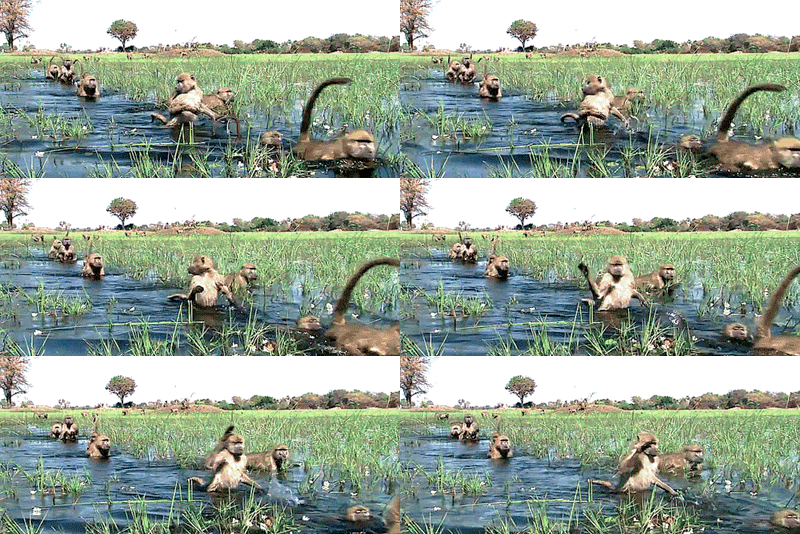
Myanmar makes strides towards reclaiming the title of being the primary source of rice exports, so named the “Asian Rice Bowl,” by doubling its rice production and export.
In fact, Myanmar aims to ship 2.5 million metric tons of rice between 2014-2015 with a targeted increase of 4.8 million tons between the years 2019-2020. In comparison, Myanmar shipped approximately 690,000 tons last year, ranking 9th in the world.
Among Myanmar’s competitors are its neighboring countries: Thailand, Cambodia and Vietnam. In its favor, Myanmar holds vast arable land, a large water supply and labor force, as well as low production costs.
Myanmar’s primary beneficiaries include Russia, as well as a number of other European and African countries. Half of Myanmar’s rice shipment goes towards its largest shipper: China.
However, a key hindrance to Myanmar’s growth concerns the remnants of its past military regime. Myanmar was the largest exporter of rice between 1961-1963.
More importantly, Myanmar’s prime deterrent in reestablishing itself as a large rice exporter is its infrastructure. With almost five decades run by a military junta, Myanmar has since seen little development in mechanization, basic electricity, telephone networks, and facilities such as governmental buildings are severely lacking in computers. From processing and shipment to transport, Myanmar is also lacking in the quality of its ports.
As the nation shrugs off 49 years of dictatorship rule, Myanmar is ready to show the world, particularly foreign investors, that the rules will change. In 2010, pro-democracy and Nobel Peace Prize winner Aung San Suu Kyi was released. Since then, many more political prisoners have been released. Political parties formed and participated in parliamentary elections in 2012 and in the same year, privately owned newspapers were allowed into the country.
Results have come about. Previous economic sanctions by the United States and the European Union have been lifted. The Asian Development Bank, in a bid to jump start the fledgling regime’s economic and social institutions, granted loans to Myanmar. Furthermore, Myanmar recently regained its position in the Association of Southeast Asian Nations (ASEAN).
Despite a history of human rights abuses and ethnic and religious conflicts occurring, Myanmar is implementing necessary changes, starting with rice.
In regards to its citizens, Myanmar’s working sector is heavily tied to the rice industry in which an estimated 70% of the population partakes. Additionally, 13% of Myanmar’s gross domestic product is in the rice industry.
In order to truly be the Asian Rice Bowl, Myanmar must continue to cultivate and foster its existing industry towards creating a surplus of opportunity for its citizens.
– Miles Abadilla
Sources: BBC: Increase in Rice Exports, BBC: Reforms in Burma, Bloomberg, Thomson Reuters: Analysis, Thomson Reuters: ASEAN Chair
Photo: Giphy.com

Venezuelan Economic Spiral
Eudomar Tovar is the Central Bank President in Venezuela and has taken the spotlight most recently for blaming a nation-wide blackout on sabotage. Accusations have been made that the Central Bank has been using their gold supply in a deal with Goldman Sachs and Bank of America to increase hard currency.
Tovar vehemently denies that the Central Bank is doing any sort of business with either Goldman Sachs or Bank of America. Henrique Capriles, an opposition leader, claims that Central Bank was involved in a value swap with Goldman Sachs for the equivalent of $2 billion dollars (USD) in gold ounces. Central Bank has also been accused of dealing with Bank of America to pay off debts owed to foreign governments. Tovar denied any such deals and claimed they were unofficial proposals, but did not elaborate or further explain the Bank’s position in regards to these claims.
The main problem is that Venezuela is experiencing a shortage of basic goods, and could potentially use its huge reserves of gold to procure a loan from such companies such as Goldman Sachs or Bank of America. Main Central Bank officials have complained that they are due a huge amount of hard currency from Washington, and that the red tape and delay in receiving this currency is causing inflation and product shortages.
Furthermore, a decrease in oil supply has caused tension on the dollar value, making some think that Venezuela is in desperate need of cash. The value of gold has decreased as well, putting a dent in the net worth of the country’s enormous gold reserves. As it stands, only government channels have access to the dollar due to harsh capital requirements, which often causes delays and bottlenecks day-to-day cash flow.
Leaders of the South American nation do not believe in free market capitalism and have tightly controlled the cash flow for decades. Consequently, the country falls more deeply into poverty every year, while the tyrannical government is not improving the situation.
President Maduro replaced the recently deceased President Chavez, who had a reputation for spending funds that could not be liquidated. Shortages have increased, inflation has risen to 55% and an inside Bank official claimed that Venezuela was indeed conversing with Wall Street. However, all three parties involved had no comment to offer on these claims. The economy is in a downward spiral, encouraged by the fact that stores cannot buy new inventory due to the cost of goods being higher than the retail price.
Questions are circulating about methods of intervention and whether American aid is appropriate, as well as questions regarding the depth of corruption in the Venezuelan government. Basic economics further show that public spending is good for the economy, when business have the right to compete with each other for capital gain.
The absence of a free market suggests that if Bank of America or Goldman Sachs loaned Venezuela the cash they need, it would just be reinvested into a corrupt system and exacerbate the problem. Solutions must involve correcting the dishonest practices of the government and its leaders so that the citizens will not continue to suffer, but instead thrive.
– Kaitlin Sutherby
Sources: Reuters, The Wall Street Journal: The Pope, State and Venezuela, The Wall Street Journal: Blackout
Photo: Vintage 3D
Tendulkar and UNICEF: Hygiene and Sanitation
UNICEF signs Tendulkar as Goodwill Ambassador: “Thanks for allowing me to start this wonderful second innings of my life. I’m looking forward to being an ambassador for UNICEF and serve to the best of my ability. This is an innings that is really important to me, so I will try my best,” – Tendulkar.
Recently, the well-known Cricket star Sachin Tendulkar (AKA Master Blaster) and UNICEF joined forces. Tendulkar is now the UNICEF Ambassador for South Asia and will focus primarily on hygiene and sanitation needs.
“I humbly accept the responsibility for being Ambassador for UNICEF in South Asia. I look forward to working with children and communities in the region, urging them to use toilets and wash their hands. Following simple practices can contribute to a hygienic lifestyle which is important for the good health of children and women across the world,” stated Tendulkar during a signing ceremony in November.
UNICEF hopes that Tendulkar will be able to raise an incredible amount of awareness for these issues through his successful career as a Cricket star. Tendulkar is newly retired from India’s team but not before he was able to become the first cricket player to ever bat a double hundred in a one a day international.
With his far reaching reputation as being the greatest cricketer pushing South Asians toward better sanitation practices should have a large impact. South Asia is number two when it comes to the highest number of underage five deaths. It is also an area where the largest amounts of people do not have access to toilets.
There is definitely a connection between these issues and child mortality rates. Besides Tendulkar’s newest partnership with UNICEF, in past years he has made many contributions to the well-being of others. Tendulkar has definitely offered his share of good deeds throughout his career, although the deeds have been kept mostly out of the public eye until now. Starting next year Tendulkar will begin his journey with UNICEF by visiting several countries to spread the word about Sanitation.
– Amy Robinson
Sources: UNICEF
Photo: Giphy.com
Myanmar to Reclaim Title “Asian Rice Bowl”
Myanmar makes strides towards reclaiming the title of being the primary source of rice exports, so named the “Asian Rice Bowl,” by doubling its rice production and export.
In fact, Myanmar aims to ship 2.5 million metric tons of rice between 2014-2015 with a targeted increase of 4.8 million tons between the years 2019-2020. In comparison, Myanmar shipped approximately 690,000 tons last year, ranking 9th in the world.
Among Myanmar’s competitors are its neighboring countries: Thailand, Cambodia and Vietnam. In its favor, Myanmar holds vast arable land, a large water supply and labor force, as well as low production costs.
Myanmar’s primary beneficiaries include Russia, as well as a number of other European and African countries. Half of Myanmar’s rice shipment goes towards its largest shipper: China.
However, a key hindrance to Myanmar’s growth concerns the remnants of its past military regime. Myanmar was the largest exporter of rice between 1961-1963.
More importantly, Myanmar’s prime deterrent in reestablishing itself as a large rice exporter is its infrastructure. With almost five decades run by a military junta, Myanmar has since seen little development in mechanization, basic electricity, telephone networks, and facilities such as governmental buildings are severely lacking in computers. From processing and shipment to transport, Myanmar is also lacking in the quality of its ports.
As the nation shrugs off 49 years of dictatorship rule, Myanmar is ready to show the world, particularly foreign investors, that the rules will change. In 2010, pro-democracy and Nobel Peace Prize winner Aung San Suu Kyi was released. Since then, many more political prisoners have been released. Political parties formed and participated in parliamentary elections in 2012 and in the same year, privately owned newspapers were allowed into the country.
Results have come about. Previous economic sanctions by the United States and the European Union have been lifted. The Asian Development Bank, in a bid to jump start the fledgling regime’s economic and social institutions, granted loans to Myanmar. Furthermore, Myanmar recently regained its position in the Association of Southeast Asian Nations (ASEAN).
Despite a history of human rights abuses and ethnic and religious conflicts occurring, Myanmar is implementing necessary changes, starting with rice.
In regards to its citizens, Myanmar’s working sector is heavily tied to the rice industry in which an estimated 70% of the population partakes. Additionally, 13% of Myanmar’s gross domestic product is in the rice industry.
In order to truly be the Asian Rice Bowl, Myanmar must continue to cultivate and foster its existing industry towards creating a surplus of opportunity for its citizens.
– Miles Abadilla
Sources: BBC: Increase in Rice Exports, BBC: Reforms in Burma, Bloomberg, Thomson Reuters: Analysis, Thomson Reuters: ASEAN Chair
Photo: Giphy.com
A Congress of Millionaires
As Congress debated extending unemployment benefits, like Medicare and Social Security disability benefits, a report regarding other benefits was released. The Center for Responsive Politics found that, for the first time in history, more than half of the Congressional members are worth more than $1 million.
The report, released in early January, finds that at least 268 out of the 534 current members of Congress have an average net worth of more than $1 million. The numbers are based on personal disclosures filed in 2013, regarding the 2012 fiscal year. To calculate net worth, the Center added together the members’ assets, such as corporate bonds and stocks, and subtracted liabilities such as credit card loans and mortgage debt.
Overall, Senators are wealthier than House members while Democrats are slightly wealthier than Republicans.
The fact and knowledge that Congressional members are much wealthier than the average Americans they represent is not new. Intuitively, politicians need large sums of money to run campaigns, and are more likely to have access to influential donors if they themselves are wealthy.
However, this is the first time in history that we have a Congress of millionaires, where over half of Congress is worth more than $1 million. That fact is somewhat ironic, as it is Congress who determines unemployment benefits, food stamps and the minimum wage, as well as legislation to overhaul the tax code.
Josh Bivens, director of research at the Economic Policy Institute, was quoted in the New York Times as saying, “Congress not only seems more responsive to policy desires of the very rich, but increasingly they are the very rich.
These findings also come at a time when wealth disparity within the United States of America is becoming a political focus. During the summer of 2013, Obama decried the “inequality of opportunity” while Pope Francis recently drew attention to growing economic inequalities – a message that Congress supported.
These issues of inequality are likely to weigh heavily on the 2016 election. Whether or not the pressure will result in a more economically diverse group of representatives remains to be seen.
– Claire Karban
Sources: Open Secrets, New York Times, LA Times, Time, New York Times Blogs
Photo: Nation of Change
Sanitation and Poverty
Two and a half billion people – over a third of the entire world’s population – have no access to adequate sanitation facilities, which leads to the rapid spread of disease and heightened child mortality rates. Most commonly, poor sanitation practices lead to diarrhea: little more than an annoying byproduct of bad hygiene practices for first-world residents, it is often fatal in developing countries. In fact, it is estimated that 5,000 children die daily from complications related to the ailment. Consequently, one person dies every minute due to the lack of basic sanitation.
Why is the lack of well-formulated means of sanitation such a large problem in modern times, when technology has reached such an advanced stage? One reason is the negative stigma associated with it: the discussion of toilets simply feels dirty or inappropriate and is not as popular nor does it appear at first glance as urgent as, for example, the issue of access to drinking water. However, the two are related and equally pressing; disease control is an impossible goal without proper sanitation adjustments. In many places around the third world, toilet stalls are completely nonexistent. Essentially, this means that people are forced to defecate in public, populated areas, leaving waste behind which will remain on the ground spreading disease. Just a gram of human feces may contain as much as ten million viruses and a hundred parasite eggs.
Besides the obvious health benefits, according to the World Health Organization (WHO,) improved sanitation in developing countries would provide $9 economic benefit per $1 spent. The year of 2008 was dubbed by WHO as the International Year of Sanitation. Through various conferences and seminars, five key principles of sanitation were determined: 1. Sanitation is vital for human health. 2. It generates economic benefits. 3. It contributes to dignity and social development. 4. It helps the environment, and most importantly. 5. It IS achievable. South-East Asia and Sub-Saharan Africa are two regions most affected by poor sanitation practices. Coincidentally, they are also the two areas with the highest death rates from various diseases. It is especially prevalent in rural areas, where open defecation is six times more likely and use of unimproved sanitation is four times higher than in urban areas. Being one of the 2015 Millennium Goals, improved sanitation should not be taken for granted. To heighten the quality of sanitation is to improve the quality of life as well as economic efficiency for millions of individuals worldwide. In this day and age, no one should have to defecate publicly; not only for reasons of dignity and civility, but also due to personal awareness and dedication towards reducing of the spread of deadly disease.
– Natalia Isaeva
Sources: The Global Poverty Project, World Health Organization: International Year of Sanitation, UNICEF: Progress on Drinking Water and Sanitation
Toilets in Nigeria, Human Waste links to Diseases
The small town of Kyuzhi in Nigeria is now giving fines to those who do not use toilets and defecate in the open, all of which is part of a water protection initiative to stop the dangers of human waste in small communities. Locals, furthermore, have the opportunity to take toilet education workshops where they learn the dangers of exposed human waste.
According to UNICEF, over 45 million Nigerians defecate in the open, an action stated as being the primary cause of high infant mortality in the country. When children are undernourished, diseases such as cholera or even parasitic infections can become deadly.
It has been over a year since members of the Kyuzhi community began to understand the problem with open defecation. By coming together and following a plan to improve community hygiene, an environmental task team was formed. They now fine 2,000 Naira or $13, to those violating the agreement and since last year only 3 have been caught defecating in the open.
Workshops in the community, moreover, allow locals to see how human waste and disease are linked.
Community leaders, women and youth take participants to an open defecation site in the forest and explain how crucial it is to stop this behavior. Mothers are now teaching their children the proper way to go to the restroom and if they see other children in non-designated sites, they seek out and speak to the children’s mothers. Several agree that this is the best way to keep the community clean and though some remain emotional about this confrontation, they are now using toilets.
More toilets and defecation sites have been set up for the locals of Kyuzhi and in due time local diseases will diminish, setting up an exemplary model for other developing communities.
– Maybelline Martez
Sources: UNICEF, DW.DE
Photo: Deutsche Welle
Lack of Media Coverage For Syrian Refugees
Syrians have recently become the highest population of refugees on the planet at nearly 2.4 million people strong. The UN has, in fact, labeled the Syrian refugee crisis as “the greatest humanitarian crisis in modern history.” However, media throughout the world is strangely quiet about their monumental struggle.
In nearly every host country that Syrian refugees have been forced to flee into, they have been met with indifference, hatred or open hostility. Many have even chosen to go back to their Syrian homeland despite the overwhelming violence, deciding it best, if die they must, to die in their homeland. The international community has also been negligent to their needs while the aid that is being given lags far behind what the dire situation calls for.
This is only part of their plight, so why is there such silence in the media considering the scale of the issue? A simple reason may be reflective of the refugees’ inability to articulate for themselves; according to Nancy Baron, a UN psychologist who provides mental health to Syrian refugees in Egypt, “the Syrians don’t have a voice.”
Rattled by warfare and hostility in a foreign land, Syrian refugees are doing their best simply to stay alive. Most find it hard to talk about what they have been through, and even if they did want to talk, few (if any) are willing to listen. The international community seems to still be trying to figure out exactly what is going on in Syria. Most are eager for the peace talks scheduled for January 22 to begin both as a respite from the civil warfare as well as for a chance to hear both sides of the story and garner a better picture of the situation.
Furthermore, a great deal of the problem with attaining media coverage involves the lack of proper reportage. This dearth is caused by several issues, not least of which is the difficulty of finding a ‘fixer,’ a person who can provide interviewees, translations and safe passages to areas of interest. Due to this scarcity, many media outlets are forced to use the same fixers, and therefore have less to report, leading to empty and sometimes sensationalized news stories.
Moreover, if international media continues to be reticent in interceding on behalf of the Syrians, media outlets within host countries may become anxious to condemn the new Syrian presence. In Egypt, for example, TV presenters affiliated with the Muslim Brotherhood have accused Syrians of undermining their country’s well-being and have threatened violence upon the refugees.
Compelling stories have helped the United States and other countries rally on behalf of refugees in the past. There are stories waiting to be told, stories that need to be told. Hopefully, for the sake of millions of innocent lives, they will be.
– Jordan Schunk
Sources: FIDH, The Interpreter, Reuters
Photo: Religious Action Center
Top 5 International Affairs Internships
Looking for a little bit of extra motivation for finishing that college degree? Need a little more incentive to pursue graduate study? The perks of a well-rounded academic background in foreign policy are many.
However, lectures and papers can only inspire so much excitement. If you are interested in a dynamic and interactive experience to set you on the path of being a global advocate, here are five of the top organizations that offer International Affairs internships.
1. Council on Foreign Relations
Take your pick between a yearlong experience in New York or a semester’s worth of study in Washington, D.C. In the Big Apple, the Council on Foreign Relations offers an editorial internship for those interested in pursuing advocacy-based journalism as a potential field. In the capital, students have the opportunity to help with the council’s board and development strategies. Also in Washington, students interested in Middle Eastern Affairs have two unique internship opportunities to further develop policy and advocacy in that area.
2. Senate Foreign Relations Committee
What better way to influence United States global policy than by interning with Congress? This intern will have the ability to attend meetings both on and off Capitol Hill, follow and influence congressional legislation and cultivate research projects for the committee.
3. USAID
USAID is the government agency responsible for executing U.S. policy concerning global development. An internship with USAID entails working at USAID headquarters in Washington and supporting international agriculture programs, immunization initiatives, hunger programs, and much more. Internships with the USAID vary between paid and unpaid as well.
4. United Nations, Social Policy and Development Division
Not only does an internship with the U.N. offer all of the prestige and influence of the world’s most collaborative decision-making body, it also gives students a wonderful opportunity to intern abroad. Whether you are interested in working on development programs from the New York office or promoting HIV/AIDS research in Geneva or Humanitarian Affairs in Nairobi, Kenya, the U.N.’s vastness is a resource waiting to be used.
5. The Borgen Project
Interested in writing for a broad readership? Fascinated by the idea of working for a true non-profit? Are you a self-motivated and independent worker? Then the Borgen Project could be the internship for you! Borgen allows you the creative freedom to find your own niche within the advocacy world and express it to a diverse audience through either writing and/or editing internships as well as front line regional advocates.
– Taylor Diamond
Sources: UN Social Policy and Development Division, Council on Foreign Affairs
Photo:
Acumen Fund and Bank Alfalah Team Up
Jacqueline Novogratz, head of the Acumen Fund held a press conference to announce the implementation of ‘Eradicating Poverty through Entrepreneurship in Pakistan.’ The Acumen Fund is teaming up with Bank Alfalah to launch a 40,000 dollar loan program to establish sustainable businesses within Pakistan.
The Acumen Fund provides long term loans to try to establish sustainable infrastructure within a region through entrepreneurship. Acumen rejects the old idea of just giving a lump sum of money to a foreign government and telling them how it needs to be spent. Instead, Acumen raises funds and invests money in local enterprises that can be expanded to benefit the owner as well as the community. Since its beginning, Acumen has invested millions of dollars in countries all over the world to improve overall health and quality of life.
Bank Alfalah comes into this project by implementing its ‘Beyond Philanthropy’ initiative. The bank aims to invest in business while keeping the greater good of the community in mind. With Acumen’s experience in investing to alleviate poverty and Bank Alfalah’s firsthand knowledge of the community, this pairing is expected to be a successful one.
Alfalah CEO Atif Bajwa says, “Given Acumen’s demonstrated expertise in the fields of entrepreneurship and poverty alleviation, we are confident that this program will help us play a small part in creating an ecosystem which seeks to address chronic socio-economic issues in the country.”
The Acumen Fund and Bank Alfalah are investing money into several companies including Pharmegen, a company that is devoted to bringing clean drinking water to urban cities. Another company that received investment money is called Microdrip, a company that distributes water conserving drip irrigation equipment to communities dependent on farming. The program is expected to be implemented in a multistep process over several years.
So far Acumen has invested over 14 million dollars in infrastructure in Pakistan. It is estimated that businesses funded by Acumen have positively impacted over four million Pakistani lives. The investments have also created and supported over 3,500 jobs which helps improve the overall livelihood of people in the region.
– Colleen Eckvahl
Sources: Acumen: Pakistan, Acumen: Bank al Falah, Dawn
Photo: Giphy.com
Giving Aid Through Chickenjoy
In response to the ravaged regions of Typhoon Haiyan, Jollibee, the flagship Filipino fast food chain of Jollibee Foods Corporation (JFC), donates towards relief efforts.
Initially established in 1975 as an ice cream parlor, Jollibee is now among the largest fast food chains in the Philippines, known for their trademark fried chicken meal “Chickenjoy.” Included in the JFC conglomerate are national fast food chains Greenwhich pizza, Chinese-themed Chowking, chicken-based Mang Inasal and Philippine Burger King.
With numerous sites in North America, Jollibee is an ever-expanding franchise with sites in Kuwait, Qatar, Saudi Arabia, Brunei, Vietnam and Hong Kong. Currently there are 2,761 stores worldwide. Future sites aim towards Indonesia and Canada.
Jollibee is one of the largest employers in the Philippines, and through its Jollibee Foundation, is known for its philanthropic measures.
In 2009, the Jollibee Franchises Association donated roughly $400,000 (USD) to programs and projects. The beneficiaries were able to care for the welfare of underprivileged children throughout the Philippines via eight separate children’s organizations.
JFC’s Food Aid program deployed mobile soup kitchens to over 9,000 individuals in the Visayan region of the Philippines, the focal point of the storm. Additionally, 12,800 relief packs and 5,700 hot meals were distributed. These packs included an estimated 600 sacks of rice, bottled water, canned goods and instant noodles.
Along with coin banks in local Jollibee stores nationwide, JFC raised over $900,000 (USD) in combination with donations and donors.
Through further initiatives, JFC plans to aid farmers’ lives, reconstruct local schools and support local youth through scholarships.
As a large conglomerate, all hands are on deck in order to assist amidst one of the largest typhoons recorded in Southeast Asia. The Jollibee Foods Corporation is doing their part via the way they know best: food.
– Miles Abadilla
Sources: ABS-CBN News, The Inquirer, The Inquirer, Jollibee Foods Corporation, Philippine News, The Philippine Star
Photo: Giphy.com