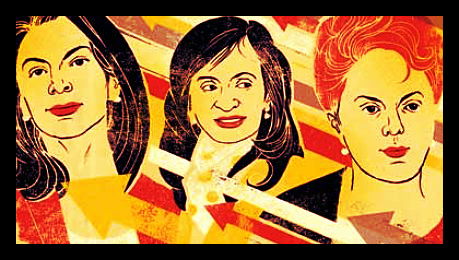
Chileans are choosing between a former president who aims to increase accessibility to higher education and a right wing politician wanting to keep taxes low are the candidates in the December 2013 presidential election. What is secondary, but notable, about these candidates is that both are also women.
The Chilean election is indicative of a larger trend in Latin America and the Caribbean of the ascension of female political leaders.
Eight of roughly 29 female presidents worldwide since the 1970s have headed countries in Latin America and the Caribbean, with half elected in the last eight years.
Quotas for women in government explain part of this progress. Argentina pioneered the quota system in the early 1990s with a law requiring that 30 percent of legislative candidates be women. As of 2006, 50 countries have adopted the quota system, including many in Latin America.
In Costa Rica, Ecuador, and Bolivia, every other candidate on a party’s election list is required to be a woman.
In North and South America, with the noteworthy exception of the United States, women are being elected to the highest offices of government.
In Latin America’s largest nation of Brazil, Dilma Rousseff was elected president in 2010 and will run again in 2014. She previously held the position of energy minister and was ranked #20 in Forbes’ Most Powerful People list in 2013 and second on its list of Most Powerful Women.
Argentina’s Cristina Fernández de Kirchner is serving her second term as the country’s first elected female president, and Laura Chinchilla is Costa Rica’s first female president.
Jamaica’s Prime Minister Portia Simpson-Miller is the island nation’s first female Prime Minister and has fought for full rights for LGBT Jamaicans. Time Magazine put her on the 100 World’s Most Influential People List in 2012, and U.S. Congresswoman Yvette D. Clarke has said that Simpson-Miller is “inspiring a new generation of women, particularly from the Caribbean diaspora, to get involved in public service and make a difference.”
Also in the Caribbean region is Kamla Persad-Bissessar, Trinidad and Tobago’s first female Prime Minister.
According to polls, a substantial shift is taking place in the minds of people in Latin America. Roughly 80 percent of people in the region now believe that women should participate in politics. That figure contrasts sharply to the 30% who believed this in the 1990s.
Progress for women in some parts of Latin American politics has been relatively recent, with El Salvador allowing women to run for office only since 1961 and Paraguay’s constitution giving women the right to vote that same year.
Despite women rising to the highest levels of government, participation in parliaments is still low even in countries with female heads of state.
Latin America nonetheless boasts the second highest average number of women in the lower houses of congress with 24 percent, only less than Scandinavian and Nordic countries, which both have 42 percent.
Rwanda is the only country in the world where more women than men serve in the lower house of parliament, with Andorra coming in second at 50 percent. In Latin America, Nicaragua has the highest number of female politicians in the lower house at 40 percent.
While these numbers are promising, no country in the region has therefore achieved gender parity, and experts worry that progress for women in government could be reversed. Ingrained sexism, income gaps between the sexes and male dominance in corporations still persist.
In Chile, the income gap between men and women has gotten greater in recent years, with men earning $1,172 per month compared to women’s $811.
Each region and country in the world struggles to bring about political, social, and economic equality of the sexes, but Farida Jalalzai, a gender politics scholar at the University of Missouri-St. Louis asserts, “Latin America is really ahead of the pack. This is interesting because it had seemed to stall by the early 2000s, but no more.”
– Kaylie Cordingley
Sources: New York Times, Time Magazine, Forbes, The Quota Project, The Guardian
Photo: AARP

South Africa After Mandela
Nelson Mandela’s legacy looms large over South Africa. Everyone agrees that his death will mean something significant to the country, but few agree on what that will be. Mandela’s death on December 5 left behind a country still rife with painful inequalities, an African National Congress no longer bolstered by their famed leader and a new generation of “born frees” who have never known the pain of apartheid though they live its aftermath every day.
South Africa’s Persistent Inequalities
Though it has made huge strides since the end of apartheid, South Africa continues to be plagued by massive racial inequalities.
Between 2001 and 2011, the annual income of black households nearly tripled while percentages of the adult black population who have completed high school have grown and are continuing to do so. There has even been an increasing, if only by a tiny amount, segment of the black population going to college. These numbers seem to represent real progress, until they are compared to the statistics for whites. In 2001, white households earned an average of $17,000 more than black households, a disparity that grew to $30,000 by 2011. And while a national increase in high school education for blacks certainly represents some positive change, this is a barrier most whites, who have also attended college at higher rates than blacks since apartheid ended, will never face. Unemployment among young black people is, furthermore, at an all time high. Such statistics make it clear that there is much more work to be done.
ANC at the Polls
With the loss of its most beloved leader, the ANC may be facing its most competitive election yet. The party, which came to power in 1994 with Mandela’s election, has lost its “biggest link to its glorious past,” says William Gumede, the author of numerous articles and a book concerning the ANC.
Despite his retirement from politics, many believed Mandela to still be involved in the decision-making of the party which allowed the ANC to enjoy the electoral bump that the legend provided for many years. Now, without him, the party is forced to confront the staggering economic and social inequalities that they have done little to eradicate. Not only are allegations of corruption abound, but the party has been unable to both alleviate unemployment and reduce crime rates.
Moreover, it is likely than many disillusioned ANC supporters will accept how far the party has fallen from its revolutionist ideals now that Mandela has died. Some predict that the weakened party will splinter and fall out of favor. As the ANC is proving, in many ways, to be an inadequate leader of South African democracy, perhaps a change is necessary.
Born Frees: The Next Generation of South Africans
The “born frees,” as the generation born at the end or after apartheid are called, make up about 40% of South Africa’s population according to census data. As one of the largest population segments, their views on the future of the country have the potential to change much of it.
Many born frees feel that the best way to honor Mandela is to focus on the future of South Africa instead of dwelling in the past. They often resent the frequent references to apartheid from their elders, wanting instead to address the problems currently facing the country. Such focus tends to cause tension with older generations, who often feel born frees are too distanced from the harsh realities of apartheid to fully understand the importance of political involvement.
“It’s not a matter of not understanding apartheid; it’s just a matter of us having different challenges,” Akhumzi Jezile, a 24-year-old producer, television personality and speaker, told the New York Times. Jezile cited youth-run efforts to reduce drug use, crime and HIV rates as evidence of changing priorities.
A 2012 Reconciliation Barometer report revealed changes in the born free generation that may hint at a changing social and political landscape for South Africa. The report found that born frees were more likely than older generations to be friends and socialize with people of a different race. The report also found that they were less likely to trust political leaders.
– Sarah Morrison
Sources: The Guardian, New York Times: A Test at the Polls, New York Times, New York Times,Real Truth
Displaced People
There many conflicts, persecution, land grabs and disasters that take place across the worlds which cause people to relocate elsewhere. This is currently a worldwide problem with nearly every continent with displaced people of its own. The typhoon that hit the central Philippines is case and point where millions are homeless and displaced.
It means it is a problem that is beyond conflicts thus efforts to help as seen from the aid pouring into the Philippines is necessary. There is an estimated 35 million displaced people in the world. This is the entire population of Canada. In the last decade, while the number of refugees has been slowly declining, the number of displaced people has greatly increased. There are various reasons for this trend. This is due to lack of willingness to welcome refuges and costs of resettlements.
Displaced people are usually left with little means to sustain themselves. They are instead thrown into the unknown conundrum of poverty where survival is an ever present challenge. Internally Displaced Persons are persons or groups of persons who have been forced or obliged to flee or to leave their homes or places of habitual residence, in particular as a result of or in order to avoid the effects of armed conflict, situations of generalized violence, violations of human rights or natural or human-made disasters and who have not crossed an internationally recognized State border according to the United Nations High Commissioner for Refugees. Throughout Somalia, an estimated 350,000 of the country’s 7,000,000 inhabitants are internally displaced persons who, as a result of protracted conflict, droughts and insecurity.
The majority of people who are displaced fall into one of two categories: refugees or internally displaced people (also called “IDPs”). Refugees are people who, in order to escape conflict or persecution, have fled across an international border. Internally displaced people chose to stay within their country.
Africa is home to more displaced people than all other continents put together. People fleeing from long-standing conflicts in Uganda, Sudan, the eastern Democratic Republic of the Congo, and West Africa make for the majority of Africa’s displaced. The war in Colombia has forced out nearly three million people, and there are still tens of thousands of people displaced from the wars in the Balkans, even almost 10 years later. The United States has traditionally resettled more refugees each year than all other countries in the world combined. As a result of the program, American citizens themselves benefit enormously from the chance to learn from and work or go to school with people from all over the world, with vastly different life experiences – a key cornerstone of the American story.
— Alan Chanda
Sources: Internal Displacement Monitoring Center, Relief Web
Photo: Vintage 3D
What U.S. Foreign Aid Does for Education
The money the United States gives out in foreign aid is usually focused in areas of direct impact, such as food to famine-stricken countries or in disaster relief efforts. Some of the lesser-known impacts are in the field of education. In particular, scholarships in foreign aid have allowed students to attend universities throughout the United States which provide more opportunities than would schools in their home countries.
This form of foreign aid is, however, not unique in the Western world. In fact, just as the United States lags behind in the overall standings for foreign aid, it falls behind its Western allies in funding for foreign scholarships as well. France leads all nations in foreign scholarship aid with 18% ($1.36 billion) of its foreign aid going to education, with Germany ranking second, at 13% ($1.05 billion), according to University World News. The U.S., on the other hand, only gives about 3.5% ($805 million) of its own foreign aid to scholarships.
U.S. foreign aid is directed to a number of other areas, but the one area that outshines all others is foreign military assistance. As it stands, roughly 38% ($14 billion) of the U.S. foreign aid budget goes to foreign military assistance. Comparing this to the budget given to foreign scholarships shows where the aims of U.S. foreign policy lie, as they push their military agendas overseas.
The military agenda of the United States looks toward the promotion of friendly democracies in places that the United States does not currently have allies. This can be seen in the United States invasions of Afghanistan and Iraq, as well as support given to rebels in Syria and Libya. In hopes of achieving these goals, the United States pumps dollars towards friendly foreign militaries in hopes that they will create functioning democracies, with informed and supportive citizens.
In a recent Seattle Times Article, columnist Thomas L. Friedman took aim at this disparity by comparing the figures of foreign military aid for Egypt ($1.3 billion) and foreign scholarships for Jordan ($13.5 million). Friedman wrote that, “merit-based college scholarship program promote(s) tolerance, gender and social equality and critical thinking.”
These qualities of ideal democratic citizens that the United States is hoping to instill in foreigners would be much better fostered through foreign education aid, according to the first-hand observer, Friedman. While Egypt remained in a state of flux during 2013, Jordan has dedicated itself to working towards a state of democracy. The comparison put forward by Friedman is an informative one for a casual observer, as one can see the benefits that current education aid gives and the potential of what the United States could do.
– Eric Gustafsson
Sources: National Priorities Project, University World News, Seattle Times
Photo: Giphy.com
ASOMI: An Organization for Hope
One of India’s leading do-good organizations is ASOMI, a micro-finance institution focused on transforming the lives of thousands of individuals. ASOMI provides credit services to those in need of loans to improve their small businesses. Their focus on the disadvantaged section has paved the way for new opportunities for those in need by changing the attitudes of several impoverished communities. Moreover, ASOMI believes that micro-finance is the solution to current socio-political issues.
Some of the loans currently being offered range from individual loans to dairy and agricultural transportation loans, which have helped several families in both rural and urban areas of Assam. The rate of interest for most of these loans is 10%, requiring an initial deposit of 10% of the loan amount. These terms are feasible for many and as of today, ASOMI has made 17,503 loans, covering 26,456 families financially. Urban microcredits are also offered for small shopkeepers with daily payback collections instead of the larger monthly payments.
In these ways, ASOMI’s Microcredit Program has enabled several businesses to reach success, evident in the brand Sorbhog Marka Noodles. When a group of women hoped to manufacture noodles in Sorbhog they needed loans which ASOMI provided. They not only received money for their start-up but were also taught the rules and regulations for manufacturing in the Sorbhog area.
Aside from offering loans, ASOMI also provides a certificate course in management development for each of their existing employees and new loan applicants. This course allows individuals to develop a range of skills including credit management, record keeping and corporate governance. Sorbhog Marka Noodles is, however, just one success story among thousands. By combining loan opportunities with business mentoring, both men and women are able to become micro-entrepreneurs.
ASOMI currently has over 53 branches, an amazing feat considering the organization only began 9 years ago. The organization has support from private Indian finance institutions and government organizations including the Central Bank of India and State Bank of India. This accredited organization hopes to foster sustainable employment opportunities and with over 200 employees working hard on this mission, there is no doubt that it will continue to have tremendous impact for those in Assam.
– Maybelline Martez
Sources: ASOMI
Photo: Giphy.com
Motivation is Everything
Motivation is what causes people to act in certain given circumstances. For example, motivation causes children to stand up to bullies or causes citizens to stand up to a dictator. Motivation is extremely important in daily life. Motivation can be either internal or external. Internal motivation comes from within and external motivation comes from the external environment such as from money or compliments. If people are internally motivated, they will not easily lose focus of their goals. On the other hand, if people are externally motivated, they are more likely to lose their focus when the external motivational factors are removed.
To eradicate global poverty, intrinsic motivation is extremely important. Intrinsic motivation is the combination of activation, persistence, and intensity.
The activation component helps people recognizing the need to reduce global poverty because reducing poverty means having more equality, better environment and a better world. In addition, people are social creatures and they want to help other. This instinct is built inside each and every one to ensure the survival of the human race.
The persistence component involves people keeping focus on the goal ahead – erasing global poverty. Global poverty is a big issue and it is impossible to erase it in a short amount of time. Persistence is essential. Understanding the time and effort it takes to end global poverty, one must prepare and devote oneself, because it is a life time commitment.
The last and most important component is intensity. Intensity allows people to act aggressively to go above and beyond to ensure the success of the goal. This component pushes people to realize their full potential. Intensity about eradicating global poverty is contagious. People will listen and follow the examples and ideals that are given to them and embrace it even more.
Anyone can be intrinsically motivated to take good actions to reduce global poverty. The job of the representative in ending poverty is to activate the motivation sleeping deep inside others and bring it to the surface.
– Phong Pham
Sources: About.com Psychology, Sparknotes
Photo: Giphy.com
Digital Green and Nutrition Education
In 2006, a non-governmental organization called Digital Green was created as a spin-off from Microsoft Research India’s Technology for Emerging Markets Team. Digital Green operates with the purpose of “integrat[ing] innovative technology with global development efforts to improve human well being.” Teams of trained mediators are assembled in various target villages in order to educate community members on locally relevant health and agricultural practices using low cost and adaptive equipment.
Digital Green has already produced over 2,600 videos and has shared these videos with more than 150,000 households in India and throughout Africa. Each video is content and context specific, based on the community’s individual needs. Digital Green’s efforts have noticeably improved agricultural development efforts in these areas.
Due to the success of the video project, Digital Green is teaming up with Strengthening Partnerships, Results, and Innovations in Nutrition Globally (SPRING) – USAID’s global nutrition project – to try to use similar methods in a new project. The initiative includes using videos to endorse maternal, infant and child nutrition and hygiene practices.
Digital Green, SPRING and other partners have already made 10 videos designed to educate on nutrition and hygiene techniques in developing communities. The videos are shown at small women’s groups on a projector. Participants are encouraged to give feedback, exchange ideas and engage in discourse to improve conditions based on the experiences of others.
SPRING hosted a webinar on December 17, 2013 to highlight and examine Digital Green’s video methods. Through nutrition education, the process is a testament to how the collaboration between technological innovation and the ability of communities to work together improve quality of life for developing regions.
The Digital Green and SPRING collaborative videos on nutrition can be found at the following links:
Digital Green, Collection of Maternal and Child Nutrition Videos
SPRING Webinar, “Seeds of Change: Leveraging Community Video for Agriculture and Nutrition Behavior Change in South Asia and Sub-Saharan Africa”
– Daren Gottlieb
Sources: USAID Blog, Digital Green, SPRING Nutrition
Photo: Vintage 3D
5 Initiatives Fighting Illiteracy
Technology has, over the years, come to run our lives. We rely upon it for anything ranging from healthcare innovation to entertainment. Even now, you are reading this article that was composed on a computer for you to read on the Internet. No paper newsletter for you.
It is precisely because technology is so all-encompassing for us that the following statistic is so shocking: 1 billion adults worldwide are illiterate. Equaling 26% of the world’s total adult population, there are 1 billion people who cannot partake in the reading of this article, which you may be taking for granted.
Technology may have made reading and writing even more accessible in our sphere but in lesser-developed areas, such advancements are not seen. According to UNESCO, the entire continent of Africa has a literacy rate of less than 60%. Compare that to the 99% literacy rate in the United States.
However, there is hope.
Numerous organizations are dedicated to eradicating illiteracy. Here are five of the top literacy initiatives worldwide.
1. ProLiteracy
The mission statement of ProLiteracy is a perfect articulation of why literacy should be on the forefront of global advocacy: “…when individuals the world over learn to read, write, do basic math and use computers, the more likely they are to lift themselves out of poverty.” The organization makes literacy for women in developing nations as a top action addressed by their donations and programs.
2. UNESCO Institute for Lifelong Learning
UNESCO hosts a “LitBase” website, which chronicles programs worldwide that have been successful in combating illiteracy. In doing so, UNESCO hopes to have a go-to source for advocates interested in starting or joining the cause.
3. World Literacy Foundation
The World Literacy Foundation was founded in 2003 to promote awareness of illiteracy by bringing together various government organizations and NGOs. Some of the programs championed by the Foundation include the Write On English writing competition in Azerbaijan, founding the Centre of Hope computer center in Uganda and the USAID-supported Fantastic Phonics computer program.
4. Global Literacy Project
A key program of the Global Literacy Project is the shipment of books and basic educational supplies throughout Africa, Asia and the Caribbean. The Walk-for-Literacy fundraiser housed at Rutgers University is run through the Global Literacy Project as well.
5. Literacy.org
Founded at the University of Pennsylvania through a partnership with UNESCO, literacy.org (formerly the Literacy Research Center) has been training teachers and advocates of literacy since 1983. Literacy.org also hosted a summer intensive workshop in Philadelphia for mid-career professionals interested in promoting literacy in developing countries.
– Taylor Diamond
Sources: ProLiteracy, UNESCO LitBase, World Literacy Project, Global Literacy Project, Literacy.org
Photo: Vintage 3D
Why PISA Scores are Deceptive
For many nations, the recent revelation of the Program for International Student Assessment (PISA) results were a call for celebration. For others, they were a sign that their nation might be falling behind—and, perhaps, cause for outright embarrassment.
PISA is a standardized test designed to evaluate the scholastic performance of 15-year-old students in math, reading and science. Ideally, nations will be able to use these results in order to develop better, more comprehensive curricula and learning strategies.
However, this program is not without its flaws, critics claim.
While the results speak to the scholastic achievement, it fails to account for other educational outcomes. Critics suggest that not only are PISA results not enough to determine the quality of education reliably, some argue that such a task might not even be possible.
Svein Sjøberg of the University of Oslo believes that PISA is comparing apples and oranges in most cases. For Sjøberg, the contextual differences between nations trouble PISA’s fundamental assumption: it is possible to create a universal test that validly measures student achievement across the borders of language, culture and curriculum.
As far as problems go, he argues, this is the tip of the iceberg. A perhaps even more important concern lies within how these scores are interpreted—how they might be used to express the success or failure of an entire system that might have other larger problems.
In Vietnam, for instance, there can be little doubt that their recent ranking was an immense success. Vietnam was ranked 17th overall out of 65 nations, beating many larger industrialized nations.
However, Christian Bodewig of the World Bank has called into question the validity of such scores. He argues that there is other relevant data that PISA largely ignores.
Bodewig says that while many of the students participating in the PISA evaluations did perform well, their performance is not a perfect reflection of the state of education in a given nation. The primary reason for this is that enrollment numbers between nations vary enormously and, in poorer nations in particular, this sort of tabulation can be misleading.
In the case of Vietnam, only some 65 percent of school age children are actually enrolled in school. Compare that with the nearly 90% enrollment rate of the US and the picture of Vietnamese education becomes a bit fuzzier.
The Economist reports that the problems for Vietnamese education are legion, ranging from corruption to homogeneity.
So, what do PISA rankings actually tell us?
Professor Svend Kreiner from the University of Copenhagen in Demark, argues that they don’t tell us that much. In fact, his analysis of the PISA testing model suggests that rankings are largely arbitrary and based on what amounts to luck of the draw.
Depending on which questions a particular set of students receive, their global ranking can fluctuate dramatically.
Still, the Organization for Economic Co-operation and Development (OECD) stands by their methodology as the best and most accurate measure of global scholastic achievement available.
It is also clear that participating nations continue to see the value in PISA. Despite its flaws, PISA still helps nations make decisions with regard to the robustness of their systems of education—even if it doesn’t paint a complete picture.
– M. Chase
Sources: The Economist, Sjoberg, Tes Connect, OECD
Photo: Vintage 3D
Female Politicians Lead Pack in Latin America
Chileans are choosing between a former president who aims to increase accessibility to higher education and a right wing politician wanting to keep taxes low are the candidates in the December 2013 presidential election. What is secondary, but notable, about these candidates is that both are also women.
The Chilean election is indicative of a larger trend in Latin America and the Caribbean of the ascension of female political leaders.
Eight of roughly 29 female presidents worldwide since the 1970s have headed countries in Latin America and the Caribbean, with half elected in the last eight years.
Quotas for women in government explain part of this progress. Argentina pioneered the quota system in the early 1990s with a law requiring that 30 percent of legislative candidates be women. As of 2006, 50 countries have adopted the quota system, including many in Latin America.
In Costa Rica, Ecuador, and Bolivia, every other candidate on a party’s election list is required to be a woman.
In North and South America, with the noteworthy exception of the United States, women are being elected to the highest offices of government.
In Latin America’s largest nation of Brazil, Dilma Rousseff was elected president in 2010 and will run again in 2014. She previously held the position of energy minister and was ranked #20 in Forbes’ Most Powerful People list in 2013 and second on its list of Most Powerful Women.
Argentina’s Cristina Fernández de Kirchner is serving her second term as the country’s first elected female president, and Laura Chinchilla is Costa Rica’s first female president.
Jamaica’s Prime Minister Portia Simpson-Miller is the island nation’s first female Prime Minister and has fought for full rights for LGBT Jamaicans. Time Magazine put her on the 100 World’s Most Influential People List in 2012, and U.S. Congresswoman Yvette D. Clarke has said that Simpson-Miller is “inspiring a new generation of women, particularly from the Caribbean diaspora, to get involved in public service and make a difference.”
Also in the Caribbean region is Kamla Persad-Bissessar, Trinidad and Tobago’s first female Prime Minister.
According to polls, a substantial shift is taking place in the minds of people in Latin America. Roughly 80 percent of people in the region now believe that women should participate in politics. That figure contrasts sharply to the 30% who believed this in the 1990s.
Progress for women in some parts of Latin American politics has been relatively recent, with El Salvador allowing women to run for office only since 1961 and Paraguay’s constitution giving women the right to vote that same year.
Despite women rising to the highest levels of government, participation in parliaments is still low even in countries with female heads of state.
Latin America nonetheless boasts the second highest average number of women in the lower houses of congress with 24 percent, only less than Scandinavian and Nordic countries, which both have 42 percent.
Rwanda is the only country in the world where more women than men serve in the lower house of parliament, with Andorra coming in second at 50 percent. In Latin America, Nicaragua has the highest number of female politicians in the lower house at 40 percent.
While these numbers are promising, no country in the region has therefore achieved gender parity, and experts worry that progress for women in government could be reversed. Ingrained sexism, income gaps between the sexes and male dominance in corporations still persist.
In Chile, the income gap between men and women has gotten greater in recent years, with men earning $1,172 per month compared to women’s $811.
Each region and country in the world struggles to bring about political, social, and economic equality of the sexes, but Farida Jalalzai, a gender politics scholar at the University of Missouri-St. Louis asserts, “Latin America is really ahead of the pack. This is interesting because it had seemed to stall by the early 2000s, but no more.”
– Kaylie Cordingley
Sources: New York Times, Time Magazine, Forbes, The Quota Project, The Guardian
Photo: AARP
For Agencies, Foreign Aid Transparency is Key
The Obama Administration released data on United States foreign aid earlier this week while Congress is pushing legislation that will make such transparency law. These efforts seek to make aid more effective and to create a more open government. This is by no means, a recent occurrence.
For the past decade, the U.S. has moved toward making foreign aid accountable and transparent, which was started in 2004 with the creation of the Millennium Challenge Corporation. Initiated during the Bush Administration, it sought to generate publicly available data on foreign aid and selected which countries to give aid grants to based on how well they do in areas such as rule of law, trade policy and civil liberties.
USAID is revamping a self-audit program that seeks, in addition to being extensive and impartial, for the evaluations to be a spring of learning that the agency can build from. In this vein, they have named their first major series of evaluations USAID Forward.
The benefits of this transparency are multifold, but one of the major boons is that citizens have the ability to become better informed on what the government is doing to combat global poverty. This could do untold good since the majority of Americans vastly overestimate the amount that the United States contributes to foreign aid. The general public believes the U.S. spends 25 percent of the Federal Budget on international aid, when, in actuality, expenditure is only a paltry 0.2 percent.
In the Philippines, the Department of Budget and Management launched the Foreign Aid Transparency Hub, anagrammed as FAiTH, which provides information on what is being done with the aid received in the aftermath of Typhoon Haiyan. This is likely in response to allegations of corruption scandals in relation to foreign aid.
The accountability of aid is a high priority, and Benigno Aquino III, President of the Philippines, says that this accountability stems from gratitude: “Ultimately, FAiTH is more than a hub of information: it is an expression of appreciation for the kindness of those who stand in solidarity with our countrymen.” The pair of accountability and appreciation seems a strong one in winning further donations.
With 3,976 people dead, 1,600 missing, and another 4 million displaced and in need of basic amenities, there is great need for aid. More than $270 million has been donated thus far, and FAiTH is helping ensure further aid does not diminish amid the graft. An oft-used excuse for not donating is that the money never makes its way to those in need. Transparency is an active foe to this pernicious way of thinking, and one that is dramatically making ground.
– Jordan Schunk
Sources: Brookings, Ingram and Adams, Huffington Post, Inquirer News