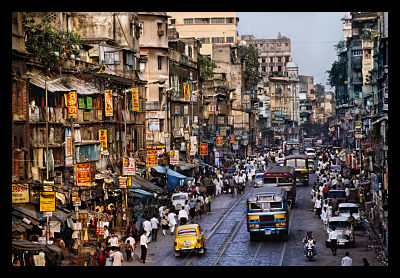
Calcutta is a region that is rich with history, culture and destitution. Calcutta was the former capital of British India, and is one of India’s largest cities and ports, for it is located on the east bank of the Hugli River. Calcutta proves to be the dominant urban center of Eastern India, as it acts as a point of commerce, transport and manufacture. The city holds a diverse range of people, as multiple Hindus, Muslims, Christians, Sikhs, Jains and Buddhists resides in this city.
Languages spoken In Calcutta range from Bengali, Urdu and Oriya to Tamil and Punjabi. Due to the wide range of people and activities, the population density is extremely high with over 4.5 million people, thus overcrowding is an immediate issue. The conflict in Bangladesh during the 1970s has also contributed to refugee colonies in the northern and southern suburbs. Migrants from less urban areas have migrated to Calcutta in search of employment as well, as it is a major export center for tea, petroleum, jute, coal, iron and manganese. Unfortunately, poverty in Calcutta is a huge problem and severe unemployment has been an issue since the early 1950s.
Calcutta has a housing shortage, and approximately one-third of the city’s population lives in poverty-ridden neighborhoods composed of a collection of huts standing on a plot of land that is at least one-sixth of an acre. These dwellings are often not ventilated, single-story rooms with few sanitary facilities, and very little open space.
India is growing into a substantial open-market economy; however, the economy includes a wide range of modern industries and services, including village farming, modern agriculture and handicrafts. The economic downturn in 2011 affected poverty significantly, and the inflation and high interest rates have yet to be alleviated. Furthermore, problems such as corruption, environmental degradation, overpopulation and increasing economic development contribute to the perpetuation of poverty while decreasing the capacity of the government to significantly alleviate any one problem.
According to USAID, “One-third of its population still lives on less than $1.25 per day. Projected to become the world’s most populous country by 2030, India faces tremendous energy, education, health, water and sanitation challenges. India is an important U.S. partner in maintaining regional stability, deepening trade ties and addressing development challenges in India and globally.”
The impact of overcrowding, displacement by natural disasters and lack of sustainable urban policies contribute to the marginalization of Calcutta’s poor; there is simply a lack of means for the homeless to progress and gain material wealth.
The importance of education and farmer organizations is critical for the alleviation of poverty in Calcutta.
– Neti Gupta
Sources: Encyclopedia Brittanica, News Action, USAID
Photo: Steve McCurry

Top 4 Reasons Education in Bolivia Lags
1. Classes are mainly taught in Spanish, but some children learned to speak Quechua and Aymara at home. Many children, especially those from rural areas, cannot understand what is being taught. Being taught a second language in school is also not typical. It is easy to see why kids would become discouraged and decide to drop-out.
2. Due to widespread poverty and not prioritizing education, schools can be very run-down with little to no proper classroom materials. While there is a lack of resources in Bolivia in general, schools are ranked at the bottom when it comes to addressing the country’s needs.
3. The poverty in Bolivia also affects the teachers—they often go on strike to protest for higher wages and other related issues. This leaves children without teachers for sometimes days or even weeks at a time.
4. The primary reason for a child not being in school and the shrinking literacy rate in Bolivia is poverty. Children in urban areas are able to go to school on average for 9.4 years, while those in rural locations only make it on average for 4.2 years. Many children have to work and help support their impoverished family rather than go to school.
Some changes to education in Bolivia have been made, however, with the help of nonprofits. Many organizations have helped provide classrooms and classroom materials in decent condition. One organization, the Foundation for Sustainable Development, helps provide training, tutoring, childcare and workshops to assist Bolivians with their educational needs. When given support and better learning conditions, children typically stay in school and even begin to learn at higher levels than their peers who are not given that support.
If their educational needs are met, they are more likely to succeed. Bolivian children should receive the education they need to thrive.
– Melissa Binns
Sources: Bolivia Bella, Foundation for Sustainable Development
Photo: Netpublikationer
World Concern Makes an Impact
World Concern is a nonprofit organization devoted to transforming the lives of deeply impoverished people. Founded by pharmacist Jim McCoy and Doctor Wilbert Saunders in 1955, the organization was intended to provide resources to hospitals and clinics overseas.
In 1976, the functions of World Concern shifted dramatically when they realized that sending medicines and medical supplies was not enough to aid countries affected by a variety of crisis. They began sending passionate volunteers and expert to work on the ground with people living in the targeted community.
In addition to long-term support, they offer emergency relief support to countries that have experienced earth quakes and tsunamis among other situations. Their most recent contribution to relief was after the devastating earthquake.
World Concern is revolutionary because they work in some of the world’s most diseased and dangerous places. Some of these locations include Darfur, Myanmar, Somalia, Ethiopia and Rwanda. In some of the countries World Concern works, literacy rates are as low as 25 percent. A committed staff of approximately 900 people work on behalf of World Concern’s mission to aid poor communities.
In addition, 90 percent of the donations World Concern receives go to their programs abroad. They are transparent with their fiscal information to ensure that money is being maximized where it is most effective. Fundraising takes up only 5.2 percent of all expenses and promotions. 4.7 percent goes to management and general administrative duties.
World Concern is devoted to providing clean water to communities. Clean water is pertinent to maintaining the health of the people living in the community. They bring in wells and latrines to facilitate better hygiene and access to clean water.
Another service they provide is bettering children’s access to education. Many children in these poor communities have to walk for miles and the classes are usually held is sub standard conditions either outside or in very informal settings.
In poor communities of developing countries the way that most people earn a living is through farming. These forms of subsistence living are vulnerable to food insecurity; reliance on environmental conditions and floods and drought greatly affect the income stability.
World Concern is devoted to the long-term solutions to working out solutions in some of the world’s poorest communities. They foster a sense of hope through providing access to education and clean water.
– Maxine Gordon
Sources: CRISTA Ministries, World Concern
Photo: World Concern
Bethany Christian Services Global Brings Families Together
Due in large part to the consequences of poverty, 150 million children around the world are considered orphans. Institutionalized care such as orphanages have been found to be anywhere from 20 times to 100 times more expensive than community-provided care. This community-provided care is available for some children who are taken in by extended family members, but these family members do not always have the resources to care properly for the children due the poverty rampant in their communities. This makes institutionalized care the usual and sometimes only option. In addition, children raised in orphanages are not likely to receive the individual care that children with families receive.
As the number of orphans has only increased with time, Bethany Christian Services Global has made it a priority to place children with foster families around the world. By partnering with organizations in vulnerable countries, Bethany Christian Services Global helped 100,761 children—including the potentially disenfranchised such as children with special needs— find loving and nurturing environments last year. Starting in 1944 for finding homes for U.S. orphans, the organization expanded their reach to up to 14 countries in 1980. They have even introduced the concept of adoption to countries where adoption was not originally considered an option due to their culture and traditions.
Bethany Christian Services Global advocates for the welfare of children in multiple ways by providing culturally-sensitive education and financial assistance to families willing to take care of an orphaned child in their community. They are one of the few (if not the only) U.S.-based adoption organizations that are allowed to bring together families internationally. From Albania to Uganda, the organization believes that a child can truly prosper when given a structured and loving family environment.
Not only is community-based care considered a better option fiscally and for a child’s welfare, Bethany Christian Services Global follows through by providing services for a family post-adoption, giving support to the families and adopted children for years to come. Every child deserves not just to have their basic needs met, but also a group of people who love and care for them. When a child is given this love and care, he or she can benefit them for a lifetime.
– Melissa Binns
Sources:Bethany Global, Better Care Network
Photo: Our Quiet Hope
Threat of Hunger, Violence in Azerbaijan
As the world’s eyes turn to the ongoing struggle and possible ceasefire in Ukraine, another simmering conflict in Russia’s backyard seems to be flaring up. The long contested Nagorno-Karabakh region, which lies in Azerbaijan but which is a self-declared independent nation and comprised of ethnic Armenians, has seen an increase in violence in 2014 and 2015.
The region devolved into a bloody war immediately preceding the fall of the Soviet Union that killed almost 30,000 people and displaced millions more. A ceasefire brokered by the Russians in 1994 left Karabakh and surrounding territories in the hands of Armenians but legally enveloped by Azerbaijan, which lost 14 percent of its territory in the deal.
Since the collapse of the Soviet Union in 1991, Azerbaijan has made great strides in socio-economic indicators including hunger, malnourishment, poverty, GDP per capita and the under-five mortality rate. While improvements can still be made, the country is squarely in the Upper-Middle Income country group and has met or is on its way to meeting all of its Millennium Development Goals, or MDGs. Without diversification, however, the economy, which has seen a lot of growth since the early 2000s, may become unstable and create additional social problems.
In its relative state of peace since the turn of the century, Azerbaijan’s poverty rate has dropped from 46.7 percent in 2002 to 8.4 percent in 2011. The economy grew as people felt safe to invest in the country. Hunger very nearly has disappeared from most regions and other indicators are well on their way to the same status. But a rise in violence around the Nagorno-Karabakh region could reverse this progress.
Azerbaijan, claiming a double standard in the West’s handling of Crimea in Ukraine compared to the Nagorno-Karabakh region, has increased its annual defense budget from $177 million in 2003 to $3.4 billion in 2013. It has purchased weapons from Israel, Turkey and Russia. Extra dollars mean not only a militarization in conflict areas, but also an economic focus shift from development to power.
The increased militarization of the Nagorno-Karabakh region and the Armenian-Azerbaijani border, coupled with a penchant for violence on both sides, creates “the risk of a war by accident” according to the director of the Regional Studies Center, Richard Giragosian. War in the region could prove to be just as disastrous as last time, forcing millions to flee their homes without promise of return and killing thousands more.
The humanitarian crisis created by war between the two countries could be devastating. Rampant hunger, poverty, displacement and violence among neighboring ethnic groups could reverse the progress made by Azerbaijan in the last two decades. While the threat of open war is relatively low, any increase in violence stokes tensions anew, pushing the region further from peace.
– Caitlin Huber
Sources: Economist, BBC, UNDP, Knoema
Photo: The Guardian
Malnutrition in Kazakhstan Region
Malnutrition in Kazakhstan? In the heart of Central Asia, a region known for issues with health, Kazakhstan stands as a possible success story in the well being of its people. With child malnutrition rates below five percent, lower than the Central Asian average and well below the rates for some of its neighbors, the Kazakh government and aid organizations working in the country have made improvements in malnutrition efforts worthy of praise.
Born in the post-Soviet world, Kazakhstan is still a relatively new state. Made up of ethnic Kazakhs as well as a large population of ethnic Russians, Kazakhstan is the largest country to come out of the USSR other than Russia itself. It dwarfs its neighbors of Turkmenistan, Uzbekistan, Tajikistan and Kyrgyzstan, spanning across almost three million square miles of continent but remaining landlocked. It is the biggest economy in Central Asia and is currently going through an economic diversification process that the government hopes will stabilize and lengthen growth.
Almost all indicators of malnutrition have improved in Kazakhstan in the last decade. From 2004 to 2014, the prevalence of food inadequacy declined from 10.1 percent to 5.9 percent. The percent of children who are stunted declined from 17.5 percent in 2006 to 13.1 percent just four years later.
The prevalence of anaemia in children, which is characterized by fatigue and decreased work output, decreased from 35.4 percent in 2004 to 30 percent in 2011. However, the overall presence of undernourishment had almost no change from 2004 to 2007, leaving 800,000 people vulnerable to undernourishment.
Central Asia as a region has an ongoing battle with undernourishment and malnutrition. Common demarcations of this are anaemia, which is a decrease in the amount of red blood cells in the blood, iodine deficiency, iron deficiency and Vitamin A deficiency.
Kazakhstan preformed well in all of these categories. Iodine deficiency, which was a huge problem after the collapse of the Soviet Union, has been almost completely eradicated in Kazakhstan by iodizing all salt consumed in the country. Anaemia levels are lower in the country than in most of its neighbors. Regional averages for iron deficiencies and vitamin A deficiencies hover around 50-60 percent for women and children.
While by no means in the clear with malnutrition, especially for children, Kazakhstan has continued to improve in most indicators. It is working towards a more stable, diversified economy that will hopefully keep food prices low and unchanging.
– Caitlin Huber
Sources: CIA, Knoema, IRIN
Photo: Inter Press Service News Agency
Violence Exacerbating Malnutrition in CAR
Last year, clashes in the Central African Republic, or CAR, between Christian and Islamic militants claimed the lives 2,116 civilians. The CAR is fast becoming home to a ghastly humanitarian crisis, in which violence is exacerbating malnutrition.
In the capital city of Bangui, the number of children facing life-threatening malnutrition has tripled since violence began escalating in December of 2013. Their situation is being complicated by the brutal course that the conflict has taken.
Action Against Hunger collected over 1,000 case studies of parents of malnourished children in the CAR between July 2013 and March 2014, and found that 75 percent presented symptoms of PTSD.
PTSD can significantly impair a mother’s ability to nurse a child. Nurses in health centers around Bangui have reported that some traumatized mothers become convinced that they cannot produce milk. Others simply do not respond to their child’s needs—some have even attempted suicide and infanticide. PTSD in children can also play a role in malnourishment, as traumatized children may refuse to eat.
The conflict in the Central African Republic is not only causing malnutrition—it is also exporting it.
Over the past year, conflict in Nigeria and the Central African Republic has displaced some 1.2 million people. These migrants typically seek refuge in neighboring countries like Chad, Niger and Cameroon, further straining the resources of countries already dealing with rampant malnourishment.
On Feb. 12, the U.N. requested $2 billion in aid for people across Africa’s Sahel belt—a semi-arid strip of land south of the Sahara Desert that stretches from the Atlantic Ocean to the Red Sea.
“The violence and conflict has a devastating effect, it is casting a shadow across the region,” said Robert Piper, U.N. regional humanitarian coordinator for the Sahel.
– Parker Carroll
Sources: Eyewitness News, The Guardian 1, The Guardian 2, The Guardian 3
Photo: Africa Up Close
Poverty in Cairo
Cairo is a city of history and architecture, but the city is also struggling with extreme poverty.
Over 40 percent of Egyptians are living below the poverty line, according to the World Bank, and as war and conflict spread through the area, that number is expected to increase. Poverty in Cairo has forced many families to put off marriage and children, or to put their young children straight to work. Many are stuck in Cairo because they simply can’t afford to live anywhere else or climb the economic ladder.
The unstable government has also contributed to the increase in poverty, but many Egyptians hope to see an established government body in the near future that offers democracy to the public.
According to the Department of Developmental Studies, or DDS, the poverty in Cairo is severely underestimated. In an essay by Sarah Sabry of the DDS, she writes that the “poverty lines are set too low in relation to the costs of the most basic of needs in the city and because census data…under-count the people living in Cairo.”
Like many countries suffering from increasing poverty, the children of the region seem to be hit the hardest. Most children do not have a well-balanced diet, which leads to growth and educational problems in the future. Many children do not attend school or educational programs either because their parents cannot afford it or the children are sent to work during the day.
Greater Cairo has eight informal settlements, and all eight have a large population living below the established poverty line. Education is poor, malnutrition rates are high and health conditions are often unsanitary. Poverty-stricken areas, known as slums, are becoming overcrowded, which causes diseases to easily spread, particularly among young or weak children.
Egypt relies heavily on tourism, which brought in approximately $13 billion in 2010. However, an impoverished Cairo is seeing less tourism and, in turn, less profit.
The future is unpredictable for the Land of the Pharaohs.
– Alaina Grote
Sources: Alarabitya, IRIN News, Sagepub
Photo: Flickr
Alleviating Poverty in Calcutta, India
Calcutta is a region that is rich with history, culture and destitution. Calcutta was the former capital of British India, and is one of India’s largest cities and ports, for it is located on the east bank of the Hugli River. Calcutta proves to be the dominant urban center of Eastern India, as it acts as a point of commerce, transport and manufacture. The city holds a diverse range of people, as multiple Hindus, Muslims, Christians, Sikhs, Jains and Buddhists resides in this city.
Languages spoken In Calcutta range from Bengali, Urdu and Oriya to Tamil and Punjabi. Due to the wide range of people and activities, the population density is extremely high with over 4.5 million people, thus overcrowding is an immediate issue. The conflict in Bangladesh during the 1970s has also contributed to refugee colonies in the northern and southern suburbs. Migrants from less urban areas have migrated to Calcutta in search of employment as well, as it is a major export center for tea, petroleum, jute, coal, iron and manganese. Unfortunately, poverty in Calcutta is a huge problem and severe unemployment has been an issue since the early 1950s.
Calcutta has a housing shortage, and approximately one-third of the city’s population lives in poverty-ridden neighborhoods composed of a collection of huts standing on a plot of land that is at least one-sixth of an acre. These dwellings are often not ventilated, single-story rooms with few sanitary facilities, and very little open space.
India is growing into a substantial open-market economy; however, the economy includes a wide range of modern industries and services, including village farming, modern agriculture and handicrafts. The economic downturn in 2011 affected poverty significantly, and the inflation and high interest rates have yet to be alleviated. Furthermore, problems such as corruption, environmental degradation, overpopulation and increasing economic development contribute to the perpetuation of poverty while decreasing the capacity of the government to significantly alleviate any one problem.
According to USAID, “One-third of its population still lives on less than $1.25 per day. Projected to become the world’s most populous country by 2030, India faces tremendous energy, education, health, water and sanitation challenges. India is an important U.S. partner in maintaining regional stability, deepening trade ties and addressing development challenges in India and globally.”
The impact of overcrowding, displacement by natural disasters and lack of sustainable urban policies contribute to the marginalization of Calcutta’s poor; there is simply a lack of means for the homeless to progress and gain material wealth.
The importance of education and farmer organizations is critical for the alleviation of poverty in Calcutta.
– Neti Gupta
Sources: Encyclopedia Brittanica, News Action, USAID
Photo: Steve McCurry
Progress in Poverty Alleviation in Dhaka
Bangladesh is a densely populated country in south-central Asia that encompasses a predominantly Muslim population. Dhaka is the capital of Bangladesh and is characterized by not only a dense population, but also social and economic diversity. It is one of the most industrialized cities in Bangladesh, with major industries specialized in leather goods, ceramics and electronic products.
Bangladesh is in a position to reach its Millennium Development Goals; however, it remains a low-income country with substantial inequality, deprivation and poverty. With over 45 million people in Bangladesh, approximately one third of the population lives below the poverty line with a majority living in extreme poverty. Poverty in rural areas is more severe, with 36 percent of the population in poverty whereas the urban centers are estimated at 28 percent. Plagued with an inadequate diet and massive food shortages, over half of the rural children are chronically malnourished and 14 percent suffer from acute malnutrition.
A large source of this poverty is due to a lack of economic opportunity and a reliance on farming. Agriculture accounts for less than 20 percent of the GDP; however, the farm sector is the lifeline of over 40 percent of the labor force. Due to urbanization and industrialization, the amount and availability of farmland is decreasing, and the land itself is less cultivable. A lack of technology and access to open bodies of water has affected the fisheries of Bangladesh as well.
A large source of poverty in Bangladesh has accumulated by overpopulation and climate change. Population density has placed significant pressure on the country’s natural resources, yet the urban and rural industries are unable to provide jobs for all Bangladeshi people; many citizens have been forced to seek work abroad. The impact of climate change has increased Bangladesh’s vulnerability, for it is one of the most flood-prone countries in the world. Severe flooding causes detrimental damage to crops, property and livelihoods. Monsoon floods, cyclones and storms significantly impact the rural poor, for their housing is less adequate than the urban centers, and the re-building process is longer, harder and increasingly difficult.
The World Bank released a poverty assessment of Bangladesh studying from 2000-2010 in June of 2013, and concluded with some striking results. The conclusion stated that the development gap ought to be addressed between the East and the West through increasing the economic opportunities for those in both regions. While Dhaka and several other eastern divisions have experienced growth, their Western counterparts have remained primarily stagnant and destitute. The growth of Bangladesh is occurring in an uneven fashion, and the impact of remittances, inadequate electricity, roads and access to markets further contributes to the unequal distribution to goods and resources.
The Borgen Project offers a variety of methods to contribute to poverty alleviation, albeit allowing all people to contribute to poverty alleviation in Dhaka, Bangladesh, as well as any other region that necessitates global attention.
– Neti Gupta
Sources: Encyclopedia Brittanica, Rural Poverty Portal, World Bank
Photo: MIT News Office
10 Interesting Facts About MLK
As the single most influential individual associated with the Civil Rights Movement, Martin Luther King Jr. lived life under a spotlight. His legacy continues to be praised to this day for his courage, passion for justice and his devotion to civil equality. An advocate for nonviolence, Martin Luther King Jr. brought masses together in his time to fight against oppression with words and peaceful demonstration rather than brutality, violence and war.
His birthday, now a national holiday, celebrates and teaches many of the major highlights in his life, and resulted in a nation well-versed in his incredible life, justice goals and untimely, his martyred death.
For a man so inspiring, every day words that he spoke became inspirations to the public. Speeches and statements he gave lit a flame in the hearts of people who craved social justice and equality. In honor of Black History Month, here are 10 interesting facts about MLK, one of the most profound and inspiring American heroes:
1. Originally, Martin was not his first name—it was actually Michael. His father, Martin Luther King Sr.’s, name was also originally Michael but after a trip to Germany, he changed both Michaels to Martin in homage to the historic German, Martin Luther.
2. He and his wife, Coretta Scott, had four children named Yolanda Denise, Martin, Dexter and Bernice Albertine.
3. He graduated with a Ph.D. in Systematic Theology in 1955.
4. He was arrested on Jan. 26, 1956, for driving 30 mph in a 25 mph zone.
5. Just four days later on Jan. 30, his house was bombed.
6. In 1957, it is estimated that MLK traveled more than 780,000 miles and made 208 speeches.
7. MLK had a lifelong admiration for Gandhi and visited India in 1959—crediting Gandhi’s passive resistance techniques for his civil rights successes.
8. The first national celebration of MLK’s birthday was not until 1986.
9. It is estimated that more than 700 streets in the U.S. are named after Dr. Martin Luther King Jr.
10. At 35, King was the youngest man to have won the Nobel Peace Prize. All of his monetary winnings from the award were put toward furthering the issue of civil rights and towards civil rights movements.
– Eastin Shipman
Sources: Nobel Prize, The Seattle Times
Photo: Biography