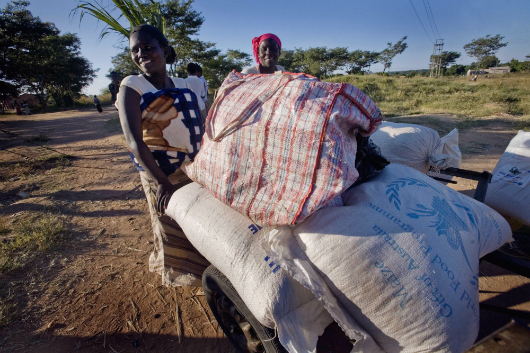
What is International Aid? International aid is any form of needed assistance by one country, or multilateral institution, to another.
Aid is most commonly provided as official developmental assistance (ODA), which targets poverty reduction and the promotion of public welfare and economic development. The World Food Programme and the United Nations are examples of international organizations that provide significant amounts of aid to developing countries.
Investing in foreign aid is a just cause. The leading U.S. Government agency, USAID, alone saves more than 3 million lives each year through immunization programs. Over 850,000 people are educated about HIV prevention annually through USAID, and 40,000 have been trained to protect their countries for the long-term. Other forms of lasting education strategies include USAID’s population program, which serves more than 50 million couples worldwide, and USAID land cultivation training in Honduras that helps 21,000 families to practice subsistence farming and has reduced soil erosion by 70,000 tons.
Foreign aid is not just giving away money and resources; it means making a concerted attempt to restructure sectors in need of improvement. USAID invested $15 million in technical assistance for developing countries’ energy sectors, which created a $50 billion annual market for private power.
With all this good, would it surprise you that U.S. foreign assistance uses less than 1% of the total federal budget?
Less than 1% of the U.S. total federal budget values to about $50 billion. In comparison, the U.S. military defense budget totals to about $663 billion. To put this in per capita terms, The Guardian calculated that the U.S. spends $73 per person on aid and $1,763 per person on defense.
In 1970, The U.S. joined the ranks of many other wealthy nations with plans to give 0.7% of their gross national income as ODA. Of the twenty-three players, only five succeeded in 2011,and the U.S. was not one of them.
The U.S. gave 0.2% of their net ODA.
But why is this even a problem?
Other countries with fewer capabilities are doing more than their part while the U.S. is falling short. Public perception plays a huge role in how the budget is made and, subsequently, the degree of U.S. involvement in global aid. Americans, on average, estimated 28% of the federal budget is spent on foreign aid. Four in ten Americans also believe aid is given remotely, allowing the recipient to use it as they see fit. As a result, few people vote for budget increases.
In actuality, most U.S. foreign aid is issued to a specific issue and program with clear endpoints.
Most commonly, Americans believe foreign aid to be a waste of resources. Who does the money help and in what ways? In fact, it helps both the recipient and donor.
International aid strengthens national security, garners international support and establishes diplomatic ties between the donor and recipient countries.
Today, the donor-consumer relationship is far more influential than ever because developing countries and economies are in transition. Africa’s net growth momentum, for example, is expected to continue to rise with GDP growth increasing from 4.6% in 2015 to 4.9% in 2016. Home to five of the world’s twelve fastest growing economies, the supercontinent hosts a growing middle class and large youth population. While Africa’s political and economic history promises a challenge, its potential is enormous.
– Lin Sabones
Sources: Encyclopaedia Britannica, UN, The Guardian, OECD, USAID, CNBC
Photo: Flickr

Affordable Housing Solution in Chile
In 2004 in Iquique, Chile, the for-profit architectural company Elemental designed and built social housing units for 100 impoverished families. The company’s innovative and inexpensive design enabled this low-income community to remain in the city center, retaining access to jobs, healthcare, education and transportation, rather than being forcibly relocated to peripheral zones.
Since the 1960s, the community of 100 families had been illegally settled in slum housing. The living situation was “precarious,” a “maze without any security” with “delinquency problems,” said architect Alejandro Aravena.
In 2003 the Chilean government asked Elemental “to settle the 100 families in the 5,000-square meter-site” according to Archdaily. The government also provided a budget of 7,500 dollars per housing unit.
One and a quarter acres is needed to accommodate 100 families, so Aravena immediately rejected various common social housing models. “Neither the 1 story isolated house nor the two story house or the block were a solution to the question we had to answer” explained Aravena in a video created by Coti Donoso, courtesy of the Chile-Barrio program.
Elemental’s solution was a spin off the common row house design: each housing unit borders an equally sized empty space that the individual family designs and decorates over time. The families’ ability to have freedom and control is critical to the success of the design; they do not feel a Western-constructed design is imposed on them. Rather, they transform their own living space into a home that meets their needs and desires.
Due to the budget constraints, Elemental decided to build parts of the housing units that locals would not be able to build themselves. Each unit was “stabilized for seismic durability and equipped with the barest of basics: plumbing but no fittings for kitchen and bathroom, an access stair, and openings for doorways. Once the modular outlines were completed, residents moved in and began finishing and customizing their spaces at their own expense and at a pace that their incomes allowed, adding color, texture, and vitality,” explained MoMA’s highlight of the design on their website.
“Due to the fact that 50 percent of each unit’s volume, will eventually be self-built, the building had to be porous enough to allow each unit to expand within its structure. The initial building must therefore provide a supporting, (rather than a constraining) framework in order to avoid any negative effects of self-construction on the urban environment over time, but also to facilitate the expansion process,” said Archdaily.
The size of the interior housing unit doubled in square meters for a cost of 1,000 U.S. dollars per household. On his website, Arevena said that, five years after the project was executed, each unit was valued at “over $20,000.”
Because of Elemental’s success in Iquique, the company has built over a thousand similar units throughout Latin America and plans to create more in the future.
– Margaret Anderson
Sources: Alejandro Aravena, Arch Daily MOMA
Photo: Flickr
Top 5 Barriers to Education Access in Honduras
Globally, between 1999 and 2011, the total number of children not attending school decreased from 106 million to 57 million. Programs to encourage school attendance and improve the quality of education in developing countries are working.
Nevertheless, there is a country in Central America that retains the title of the second most impoverished nation in the Western Hemisphere. Honduras’ children continue to face many barriers to education. There is still much work to be done.
Top 5 Barriers to Education Access in Honduras:
1. Lack of physical school buildings
2. Lack of school supplies (desks, chalkboards, clean water)
3. Shortage of adequate teachers
4. Gang epidemic pulls young boys from school
5. Lack of proper toilets and sanitation at schools dissuades young girls from attending school
The good news is that it is very possible to breakdown these barriers so that children may be able attend school.
Students Helping Honduras, a nonprofit organization that recruits college students to build schools, is addressing each of these barriers. The nonprofit was started by Shin Fujiyama when he was a college student, and he has since been named a 2009 CNN Hero. Their goal is to build 1,000 schools in Honduras by 2020. Over 3,000 college student volunteers have worked in Honduras and the program is expanding.
In addition to the schools under construction, the organization also currently runs a bilingual elementary school, 2 homes for orphaned and abandoned children, a scholarship project and a villa project.
One of the strongest barriers to education access in Honduras is related to the gang epidemic spreading throughout the country. Young boys are persuaded to join gangs such as MS13 or Mara 18 with the proposal of protection from older boys. When the prospects for their education seem low in the first place, some boys will not attend school at all.
SHH works with boys in the community of Villa Soleada and offers them the opportunity to gain an education. Villa Soleada serves as an alternative form of protection to gang life.
With a commitment to local empowerment, community members work together with student volunteers. SHH is building schools one at a time to help decrease the 66.2% of Hondurans who currently live in poverty. When these barriers are addressed, children can receive an education that will help them secure jobs and support their families and communities.
— Iliana Lang
Sources: Students Helping Honduras, Save the Children Care Plancanada
Photo: Project Trust
World Health Assembly Passes Resolutions
Among the resolutions passed at the gathering of delegates for the World Health Assembly on May 25, the most critical to the development of sustainable health for nations involved were resolutions that focused on the growing problem of antimicrobial resistance and low immunization rates.
The World Health Assembly (WHA) marked its sixty-eighth year last month, May 2015, with an annual meeting, lasting nine days in Geneva, Switzerland. Whilst a number of important pieces on global health were shared, WHA attendees from 194 member states also determined what should be done to advance the global health agenda.
WHA attendees agreed on resolutions that focused on microorganisms’ growing resistance to antimicrobial drugs as well as antibiotic resistance around the world, which jeopardize healthcare providers’ ability to effectively treat infectious diseases. As a result, a part of the resolutions drafted included a plan of action for member states, which they could utilize to combat this growing threat.
The World Health Organization outlined the five objectives of this plan:
WHA delegates encouraged the adopting member states to customize and enact this global plan by May 2017.
Additionally, there were also resolutions passed in regards to scaling up immunizations in low and middle income countries, which tend to suffer some of the highest immunization costs.
Though the WHA enacted the Global Vaccine Action Plan in 2012, due to extremely slow and irregular progress, the World Health Organization states that the “resolution calls on WHO to coordinate efforts to address gaps in progress. It urges Member States to increase transparency around vaccine pricing and explore pooling the procurement of vaccines.”
Not only will decreasing the costs of vaccines potentially shape the way nations deal with health crises, it will also save thousands, if not millions, of lives. This effort will drastically reduce the number of deaths among children and greatly improve their ability to fight infections, both minor and life threatening.
In an effort to bring better vaccination programs to low and middle income countries, the WHA secretariat, met with representatives of participating countries to discuss what could be done to improve vaccination accessibility.
Both antimicrobial resistance and suitable access to vaccinations are issues that every nation must contend with, as they represent a threat to the health and safety of citizens everywhere. Combating a problem begins with awareness, and hopefully, we will see more development in awareness campaigns regarding these important global health issues in the coming months.
– Candice Hughes
Sources: International Business Times, The New York Times World Health Organization World Health Organization
Photo: Flickr
Life in the World’s Poorest Country
Imagine being lulled to sleep by the constant sound of bullets ricocheting off trees in the forests beyond your home. For many living in the Democratic Republic of the Congo (DRC), this horror story is reality. Located in the heart of Africa, the DRC has been named the world’s poorest country, but its massive amount of available resources has it set up to eventually become one of the wealthiest.
The major issue that stands between this nation and a successful future is the rampant instability of government and daily life. Existing in a much more antiquated state than that of our own, 83 percent of all Congolese citizens live in rural villages and lack access to clean water and steady supplies of food. This means that around 125 out of every 1,000 babies die within three weeks of birth due to malnutrition. This instability has allowed the region to become a breeding ground for war. Roughly 5.4 million people have been killed during the war in the Congo, a death rate second only to that of the Second World War, leaving millions of orphans as a result of death by fighting and the spread of the AIDS virus. Of these millions of children, many are left starving with no certain way of getting access to food every day, leaving malnutrition as another leading cause of death in the region. The only sense of stability these children have known is the constant of war. Many are drawn to large militant groups because they provide a family-like structure and are a constant source of food and power. However, as the world’s leading powers have begun to catch wind of the atrocities being carried out in the Congo, it looks like all of this is about to change.
The heart of the Congo is home to the equatorial rainforest, making it rich in many natural resources of which companies pay millions of dollars per year to extract. The main issue that has risen during this process stems from companies attempting to take these resources free of charge, giving rise to more civil wars in the area. However, as more NGO’s begin to put boots on the ground in an attempt to bring this to a halt, many rural communities are starting to see a future in which they can succeed. The key to changing a life is giving someone a way to change their own. By teaching local citizens how to harvest resources and develop businesses to sell said resources, many communities have begun to rise from the ashes of war. Many organizations are practicing micro-lending in an attempt to create business and a sense of worth within communities. The Congo has the possibility to become a great nation where people are happy and well-fed, the government is stable and life is like a tropical vacation in a rainforest.
Although there is a long road ahead, every reaction has a catalyst and by bringing communities up one by one, we can create a difference beyond our best hopes.
– Sumita Tellakat
Sources: African Volunteer, The Atlantic, Our Africa
Photo: Flickr
Tom Emmer Shows Foreign Aid Need Not Be a Partisan Issue
It’s not often that one hears a Tea Party conservative publicly supporting the use of the United States’ Federal Budget on foreign development aid. That’s what makes Rep. Tom Emmer’s, R-M.N., newfound support for the program both promising and surprising.
During a live online Q & A session held on May 12, Rep. Tom Emmer – whose conservative voting record includes challenges to Minnesota’s minimum wage and efforts to nullify the Affordable Care Act – described the ways in which his recent visit with recipients of U.S. foreign aid in Eldoret, Kenya influenced his perspective on the program.
“I have made the statement in the past that a dollar that we are spending for instance in Africa, in Kenya, is a dollar that we could probably be using at home to build a road or a bridge,” Emmer said. “Well, it’s not that simple.”
During his time in Eldoret, Emmer met with two dairy farmers who, with funding from USAID, improved their operation to such an extent that their increased income allowed them to accumulate enough money to send their three children to boarding school. “That bodes well for the future,” Emmer said, “and I guess I look at it this way: a dollar spent on that is a dollar that we won’t have to spend on additional bombs and bullets and God-forbid boots on the ground in the future.”
This sentiment is consistent with an argument commonly made by proponents of foreign development aid: investing in a greater quality of life for the world’s poor prevents them from looking for it in the form of violent extremist groups like ISIS or al-Shabaab.
The congressman also noted the potential benefits global poverty reduction holds for the U.S. economy. “Well, we need to have trading partners, both here within our boundaries, our borders, but [also] outside of our borders, because remember, 90% of the world’s future customers actually live outside of the United States,” Emmer stated. “We need to make sure that we’re constantly growing those markets so that we can realize a return of value, a valuable return on [our] products.”
Emmer’s change of heart is particularly encouraging given the staunch opposition to foreign aid among many leading Republicans, including presidential aspirant Rand Paul, who in 2012 argued the United States ought to eliminate foreign aid entirely. Indeed, this new stance is consistent with his recent deviation from the standard voting line of far right Republicans, a move that has earned him criticism from a number of his constituents.
That Rep. Emmer’s newfound attitude toward foreign aid so radically differs from that of more moderate Republicans like Paul shows that foreign aid doesn’t need to be an issue that is determined simply – and superficially – by party affiliation. A U.S. presence in impoverished nations, defined by effective economic assistance, creates opportunities for American companies abroad and increases the security of the United States by improving the lives of those whom extremist groups strive to recruit. These are outcomes that should appeal to Republicans and Democrats alike.
– Zach VeShancey
Sources: Think Progress, Business Week Think Progress Think Progress MPR News
Photo: University of Alaska Fairbanks
Poverty in Nagoya, Japan
Japan has held the title of the one of world’s largest economies for over 40 years and although seemingly prosperous, an “invisible” problem has emerged. CNN reports “an astonishing one in six [people in Japan], or more than 21 million people in a country of 128 million” are living below the poverty line. The majority of these people are single women, the unemployed, the elderly and children. This staggering change in perspective for one of the more prosperous nations can be realized in the nation’s lack for a proper public assistance and public welfare program.
The current social welfare system that is in place by the Japanese Diet focuses not on the economic and social stress of the poor but instead on dispersing pensions and health care to the “middle class.” This system carries over from the previous economic height of Japan, or “Bubble Period,” from approximately 1960-1990 when lifetime employment was commonplace and the majority of Japanese were “middle class.” This boom in economic sustainability thus became norm and has not realized the changing times where Japan is starting to accumulate debt and seek alternatives within the workplace.
An article from The Tokyo Foundation, which focuses on developing policy for a better Japan, states that, after the prolonged period, the illusion that all Japanese people belong to the middle class was created. They go on to state that this is characterized by the myth that Japanese-style employment is based on mass hiring of new graduates, lifetime employment, seniority-based promotion and copious benefits. Coupled with “traditional” gender roles the Japanese people became entrenched in the belief that this system worked and thus did not need to be changed. However, with the collapse of the economy at the end of the 1990s and a global economy change, “businesses actively sought to replace regular with non-regular employees in an effort to affect a recovery in their performance by reducing personnel costs to generate higher profits, or in other words, a ‘jobless recovery.’”
Nagoya is one of Japan’s major cities with a population of more than 2 million people – statistically speaking that means around 378,000 individuals are living in poverty within the city. The unfortunate result of the current system has lead to a sharp increase in the number of people living outside the protection of the businesses, companies and family welfare that accompanied it. The majority of these people have become a class of working, poverty-stricken people living in squalor.
Although there is a lack of traditional “slum” neighborhoods that you might see in more Westernized countries, these “working-poor” citizens of Nagoya, much like every other major Japanese city, live in areas with cheap hostels that have one room for all functions of living, except for hygiene. One bathing/hygiene area is usually shared with all residents of a hostel, numbering 20 or more.
Those few living in the hostels are the lucky ones however as there are still those who cannot afford even basic shelter and are documented living in tents and shacks. Although this number was documented to be only 758 individuals in 2000, it has only grown with those undocumented as the “working poor.”
Even though the “hidden” poverty problem can be found throughout Japan, in few places does the disparity between the rich and poor show more than in Nagoya. The traditional and persistent attitude of the public is to view the homeless to be idle, antipathetic to living with others, and “dirty and dangerous.” They are often harassed and sometimes killed by citizen groups, particularly youngsters. Such public stigma has also prompted many local authorities to forcibly evict homeless people from public space.
There was a case in 1993 in Nagoya in which a member of the working poor, Mr. K. Hayashi, filed a case against the Nagoya City Hall. Due to the prolonged recession he became homeless, and he could not find a job because of his age and medical issues. So he applied for the public assistance measures for livelihood and housing. However the city approved the medical assistance only. The city’s decision was in line with the ministerial policy that practically denied the entitlement of the homeless to the welfare measures just because they had no residence.
Interpretations on legislation coupled with negative opinion on the situation has led to an institutional irony that prevent people, like Mr. K. Hayashi, from escaping poverty. It unfortunately has become rather a customary practice of local authorities not to extend such measures unless an established residence is proved, and hostels do not count as they are temporary housing.
Although the overall issue of poverty has been addressed – on April 2, 2015, current Prime Minister Shinzo Abe revealed plans to set up a fund to help alleviate child poverty – this issue is only recently gaining traction within the Japanese government and has not yet had any significant change.
– Alysha Biemolt
Sources: Travel CNN, Daily Times Tokyo Foundation The State of the Urban Poor in Japan City of Nagoya
Photo: Flickr
How Cellphones are Fighting HIV/AIDS in Africa
For the 23.8 million people living with HIV/AIDS in Africa, there are two realities. The first is the reality of the disease, which kills over one million people in Africa per year and requires treatment. The second is the stigma surrounding the disease, which itself creates a major social barrier to treatment. This stigma creates the need for patients to be able to seek treatment while protecting their privacy.
Cellphones provide a great opportunity to fill this need.
Mobile health, or mHealth, is the term used to describe the growing number of health services offered on cell phones. mHealth platforms have been particularly common in Africa due to a demand for services and Africa’s status as the fastest growing mobile phone market in the world.
mHealth has been shown to be effective in a variety of contexts. For HIV/AIDS patients, it can be greatly effective due to the variety of services offered to both patients and health care providers.
South Africa’s HIV Confidant, developed by Dimagi, is one such service. According to Dimagi’s website, the service seeks to provide “confidential distribution of the results of HIV testing” in South Africa. This a particularly difficult to accomplish in rural regions.
Along with securely distributing results of testing, HIV Confidant also allows patients to receive counseling on their infection status without sending in a second sample.
With studies finding that over 80 percent of patients are comfortable using mobile devices to manage their HIV treatment, services such as HIV Confidant provide a valuable service to patients concerned with anonymity and the stigma surrounding infection.
Programs focusing on HIV/AIDS prevention education are valuable in engaging communities. In addition to focusing on data collection and treatment adherence, Uganda’s eMOCHA program focuses intently on education, allowing it to address contributing trends to HIV/AIDS such as IV drug use.
Though mHealth symptoms are valuable tools in managing HIV/AIDS in Africa, they are not without their faults. The programs have been criticized by some as unlikely to reach certain at-risk groups, such as drug users, who are significantly less likely to own a cell phone. In addition, the cost of airtime currently makes the engagement of these programs difficult for patients living in poverty.
Despite these limiting factors, the growth of mobile phones in Africa creates hope that mHealth could become an important tool in the battle against AIDS. Perhaps the greatest challenge for mHealth platforms going forward then is ensuring that these valuable tools of defense against HIV/AIDS are available for those most at risk.
– Andrew Michaels
Sources: UNAIDS, DoSomething.org, IRIN, oAfrica, Johns Hopkins Center for Clinical Global Health Education, Dimagi
Photo: mHealth Blog
What is International Aid & Why Should We Care?
What is International Aid? International aid is any form of needed assistance by one country, or multilateral institution, to another.
Aid is most commonly provided as official developmental assistance (ODA), which targets poverty reduction and the promotion of public welfare and economic development. The World Food Programme and the United Nations are examples of international organizations that provide significant amounts of aid to developing countries.
Investing in foreign aid is a just cause. The leading U.S. Government agency, USAID, alone saves more than 3 million lives each year through immunization programs. Over 850,000 people are educated about HIV prevention annually through USAID, and 40,000 have been trained to protect their countries for the long-term. Other forms of lasting education strategies include USAID’s population program, which serves more than 50 million couples worldwide, and USAID land cultivation training in Honduras that helps 21,000 families to practice subsistence farming and has reduced soil erosion by 70,000 tons.
Foreign aid is not just giving away money and resources; it means making a concerted attempt to restructure sectors in need of improvement. USAID invested $15 million in technical assistance for developing countries’ energy sectors, which created a $50 billion annual market for private power.
With all this good, would it surprise you that U.S. foreign assistance uses less than 1% of the total federal budget?
Less than 1% of the U.S. total federal budget values to about $50 billion. In comparison, the U.S. military defense budget totals to about $663 billion. To put this in per capita terms, The Guardian calculated that the U.S. spends $73 per person on aid and $1,763 per person on defense.
In 1970, The U.S. joined the ranks of many other wealthy nations with plans to give 0.7% of their gross national income as ODA. Of the twenty-three players, only five succeeded in 2011,and the U.S. was not one of them.
The U.S. gave 0.2% of their net ODA.
But why is this even a problem?
Other countries with fewer capabilities are doing more than their part while the U.S. is falling short. Public perception plays a huge role in how the budget is made and, subsequently, the degree of U.S. involvement in global aid. Americans, on average, estimated 28% of the federal budget is spent on foreign aid. Four in ten Americans also believe aid is given remotely, allowing the recipient to use it as they see fit. As a result, few people vote for budget increases.
In actuality, most U.S. foreign aid is issued to a specific issue and program with clear endpoints.
Most commonly, Americans believe foreign aid to be a waste of resources. Who does the money help and in what ways? In fact, it helps both the recipient and donor.
International aid strengthens national security, garners international support and establishes diplomatic ties between the donor and recipient countries.
Today, the donor-consumer relationship is far more influential than ever because developing countries and economies are in transition. Africa’s net growth momentum, for example, is expected to continue to rise with GDP growth increasing from 4.6% in 2015 to 4.9% in 2016. Home to five of the world’s twelve fastest growing economies, the supercontinent hosts a growing middle class and large youth population. While Africa’s political and economic history promises a challenge, its potential is enormous.
– Lin Sabones
Sources: Encyclopaedia Britannica, UN, The Guardian, OECD, USAID, CNBC
Photo: Flickr
Sand Dam Construction Brings Water to Driest Areas
Dryland ecosystems are classified as having long periods of drought with very short seasons of intense, heavy rainfall. They cover approximately 40 percent of the earth’s surface, particularly in developing countries, where 1/3 of the global population lives.
Drylands have extremely limited access to clean drinking water. However, there has been a recent surge in the construction of sand dams, currently the most cost-effective technology in water collection.
Sand dams combine ancient rainwater collecting techniques, everyday building materials and local manpower to collect clean water that would otherwise become runoff, carrying away fertile topsoil essential to subsistence farming. A moderately sized dam can supply over 1,000 people with a consistent supply of filtered water, even during the year’s driest seasons.
According to reporter and producer Russell Beard, “A sand dam is a reinforced concrete wall built across a seasonal riverbed. Over three or four rainy seasons, sand is washed downstream and deposited in the reservoir behind the dam wall, which stores up to 40 percent of its volume as water. The sand slows evaporation, filters the water, and protects it from contamination by livestock or disease-carrying mosquitoes.”
Timber, rocks, cement, sand and water are the only raw materials needed to build a sand dam, all of which are supplied by donor funding. Local community members work together to build the dam structures and the women and girls are usually deemed responsible for water collection.
Excellent Development, a UK based nonprofit organization, has devoted its entire efforts to distributing sand dam technology to dryland areas, in hopes of providing stable water security to poor, rural populations all over Africa.
Excellent Development published a report, Sand Dams: The World’s Most Cost-Effective Method of Conserving Rainwater, which outlines the desperate need for sand dam construction.
The report states, “Drylands cover approximately 40% of the world’s land area and support 80% of the world’s poorest people, mostly in the rural areas of Africa and Asia. Approximately 10% of drylands display symptoms of land degradation: Water scarcity, sparse vegetation, soil erosion and nutrient depletion; further diminishing the ability of ecosystems to absorb and store rainwater.”
Sand dam construction not only provides clean drinking water, but also replenishes local ecosystems, increases food security and promotes community cooperation.
Executive Director of Excellent Development Simon Maddrell said, “Sand dams are the most cost-effective method of rainwater harvesting known. They have the potential to provide communities living in dryland areas with a clean local water supply for life, even during periods of drought. We know how much this is needed, especially in dryland areas of the world – where 80% of the world’s poorest people live. We also know that access to water in these areas is likely to worsen: Climate change is already altering rain patterns, creating more droughts, more floods and shorter, more intense rains.”
To date, Excellent Development has pioneered the construction of 838 sand dams, planted 935,000 trees, dug 1.5 million meters of terraces, built 43 community seed banks, built 51 school water tanks and brought fresh, filtered water to nearly one million people.
– Hanna Darroll
Sources: UNDP, The Water Project, Excellent Development
Photo: Excellent Development
Educating Girls on Feminine Hygiene
Women face challenges everyday across the globe, from discrimination to sexual harassment. However, their biggest obstacle comes once a month from their own bodies. Women and girls in developing countries find it hard to feel confident and practice proper hygiene. When girls are menstruating, they choose to stay home to prevent embarrassment from leaking. The Huffington Post found that some girls would go days without food or water sitting on cardboard until their period was over.
Women and girls in poor countries do not have easy access to sanitary pads, therefore the impact menstruation has on them affects their everyday lives. Indra, from Nepal says “I asked the neighbors to borrow some cloth, and I had to use it for five days without any chance to wash it,” according to Water Aid. In developing countries clean water and private bathroom facilities are another challenge girls face. When girls do not feel comfortable attending school and women refrain working in fields, it sets them back from achieving their full potential.
An important aspect of feminine hygiene is education. “One study found that nearly 70 percent of girls had no idea what was happening to them the first time they menstruated,” according to the Gates Foundation. This means their mothers lacked in educating their daughters on their bodies. With proper sexual education STD’s can be prevented and early pregnancy can be avoided. Girls can also learn to keep track of their cycle and prepare for their period.
Although women and girls face challenges with their bodies, the organization Days for Girls International is fighting to improve the lives of women across the world. Days for Girls sells affordable sanitary kits with reusable pads, travel soaps, panties, and a Ziploc bag for soiled items. The social business Ruby Cup, has innovated a reusable silicon menstrual cup lasting up to 10 years and can be used up to 12 hours.
Every day girls get their period and the struggles girls face in poor countries are sometimes over looked. Businesses making this issue a primary focus will create better lives for girls who are losing a chance at education or income. By 2022, Days for Girls wishes to see every girl around the world access hygiene and education. If women and girls can continue to work in school and on the fields, the world can come closer to ending poverty with their constant efforts.
– Kimberly Quitzon
Sources: Huffington Post, Water Aid, Impatient Optimists, Days For Girls
Photo: Too Little Children