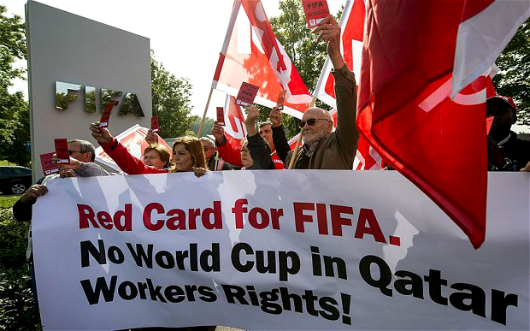
Qatar has an estimated budget of 62 billion pounds for the hotels, infrastructure, stadiums and other buildings that it needs for the 2022 World Cup. Qatar has relied on migrant workers from countries such as India, Nepal and Sri Lanka to complete these building projects. However, the work for migrant workers is extremely difficult and many are dying, most likely as a consequence of the harsh conditions that they are forced to live and work in.
Since 2013, Qatar has been under investigations by groups such as Amnesty International and the Human Rights Watch, who are worried that Qatar’s migrant workforce is being treated as modern-day slaves. According to a 2013 report from the Guardian, over 4,000 workers will die as a result of the conditions that they are subjected to while they prepare for the World Cup. From June 4 to August 8 in the same year, 44 Nepalese workers died, and half of those deaths were related to heart failure or workplace accidents.
Heart failure and heat strokes are common, since many workers are forced to slave away in extremely hot temperatures—up to 122 degrees Fahrenheit—and are sometimes not given access to free drinking water. This has led to many complaints from workers. More than 80 workers from India died from January to May 2013, and 1,460 complained to the embassy about problems related to labor conditions.
While it may seem like the best solution is for workers to go home, unfortunately, it is not that simple. Qatar and other Gulf Cooperation Council countries, such as Bahrain, Kuwait, Oman, Saudi Arabia, and the UAE, have instituted the kafala system—a system of sponsorship in which migrant workers are not allowed to change jobs or leave the country without a sponsor’s permission. Many sponsors hold the passports of migrant workers, making it impossible for them to leave. Workers are also often jilted out of the money that they were promised, and contracts are sometimes in English or other languages foreign to migrant workers, meaning that workers are forced to sign contracts that they do not understand.
Qatar promised that they would reform the kafala system after the deaths of migrant workers were bought to light. However, as The Guardian states, the system that Qatar plans to replace the kafala with will still ensure that employees are tied to their employers for the length of their contract, which can last for as long as five years.
An estimated 1,200 workers have died since Qatar began to construct its stadiums for the World Cup. However, this week, Qatar’s state news agency has issued a statement claiming that no workers have died during construction for the World Cup. They claim that no workers died while at work, and therefore argue that the assumption that the deaths of migrant workers are work related, is incorrect.
While it is most likely true that not all the deaths of migrant workers are work related, the fact remains that many of the deaths probably are a result of the poor living and working conditions that migrants are forced to face. Qatar is also hesitant to let reporters research the conditions of migrant workers in the country. In May of 2015, they arrested a group of BBC reporters who attempted to do so.
The problems with workers for the FIFA World Cup are representative of larger socioeconomic problems in Qatar. Qatar is the world’s richest country by income per capita. Its growing industry and infrastructure attract migrant workers determined to improve their living conditions by moving to such a rich country. However, migrant workers are treated extremely poorly. They are crammed into overcrowded living conditions of six to eight men in a room, and up to 40 men have to share a kitchen. The living conditions are unhygienic and bathrooms and washers are so dirty that some men are forced to use buckets of water to wash instead.
There are over 1.2 million migrant workers making up the workforce in Qatar. These workers are subjected to physical, verbal and sexual abuse. It is especially difficult for migrant workers who work in domestic situations. As the Human Rights Watch states, these workers are normally women, and they are especially vulnerable to sexual and physical abuse, as they are sometimes locked in the homes where they work and are not given protection under Qatari Labor Law.
The poor treatment of migrant workers might be an attempt by Qatar to keep its population under control. After all, over 80 percent of the Qatari population is now composed of migrant workers, meaning that 20 percent of the population actually benefits from the riches of Qatar, while the rest are forced to suffer. As one Nepalese migrant worker states, “No one respects our feelings, we are just labor, all people hate us.” Unless Qatar changes its laws and issues drastic reforms, it risks becoming a country where modern day slavery becomes more and more prevalent, and the gap between the rich and the poor continues to widen.
— Ashrita Rau
Sources: BBC, BBC, BBC, Business Insider, Human Rights Watch, Human Rights Watch, Migration News, The Guardian, The Guardian, The Guardian
Photo: The Telegraph

Poison, Poverty, and Cocaine in Colombia
The International Agency for Research on Cancer, or IARC, a research arm of the World Health Organization, published a report on March 20, 2015 categorizing glyphosate as “probably carcinogenic to humans.” Glyphosate is the most widely used herbicide in the world by volume, so its new label has created turbulence across science and industry. While experts, governments and industry groups debate the study’s merits, poor farmers in Colombia may experience the most drastic fallout from the IARC report. Meanwhile, cocaine in Colombia receives a break from U.S. production curbing strategy.
Quickly following IARC’s declaration, the Colombian government suspended the aerial spraying of glyphosate. Since 1994, aerial spraying has been part of the U.S. strategy for curbing the production of cocaine in Colombia. In the last 20 years, 4.34 million acres have been sprayed, costing U.S. taxpayers roughly $2 billion.
Although defying U.S. interests, the U.S. Department of State is recognizing Colombia’s sovereignty to implement its decision. How this will affect anti-drug campaigns in the country remains to be seen.
Glyphosate Spraying and Cocaine in Colombia
Vanda Felbab-Brown, a global security specialist with the Brookings Institution, believes “Aerial spraying is politically controversial, costly and causes a tremendous amount of counterproductive side effects such as destroying legal crops, negative environmental effects as the chemical washes into streams, and alienating coca farmers from government authorities.”
A large cost has also been borne by farmers in regions where coca, the main ingredient in cocaine, is grown. From 2001 to 2012, the Colombian government processed 7,800 claims of crop damage as a result from aerial spraying. For the moment, the department handling these claims will have a break, and poor farmers in Colombia’s rural regions will experience less crop damage and a healthier environment.
Colombia’s decision to change tactics will open the door for alternative drug fighting policies and development strategies. These must fill the void that experts believe will be created by the termination of the spraying program. The incentives to grow coca are still strongly in place: the U.N. Office on Drugs and Crime figured that cocaine was fetching roughly $2,500 per kilo back in 2013.
Alternative drug policies exist and are effective. The Washington Office on Latin America, which promotes human rights, democracy and social and economic justice in Latin America and the Caribbean, has outlined factors that need to complement an anti-drug campaign. Among these factors, the existence of alternative livelihoods plays a central role. Without other options, eradication programs will push farmers deeper into poverty. Implementing alternative and sustainable income generating activities makes coca production less attractive to farmers and shields them from a business decision that is subject to the whims of global drug policy.
The moratorium on glyphosate spraying comes as a relief to those living in targeted areas and provides an opportunity for sustainable development in the region.
– John Wachter
Sources: Al Jazeera, Brookings Institution, International Agency for Research on Cancer, LA Times, Nature, NY Times 1, NY Times 2, US Embassy, Washington Office on Latin America, Washington Office on Latin America
Photo: MercoPress
FIFA, Qatar and the Kafala System
The recent scandal surrounding corruption at FIFA has made headlines around the world. But could it affect the controversial 2022 World Cup in Qatar?
That remained in question Friday as FIFA re-elected Sepp Blatter as its president. The election comes on the heels of a massive corruption investigation involving the top brass of soccer’s governing body. The U.S. Department of Justice indicted 14 of the organization’s executives on dozens of separate charges this week. They are accused of “brazen corruption” in their dealings with sports marketing companies which generate billions for the organization.
FIFA is also accused of dishonesty in its selection process for the 2018 and 2022 World Cups, awarded to Russia and Qatar, respectively. The Office of the Attorney General of Switzerland announced Wednesday that it would investigate “criminal mismanagement and money laundering” suspected to have taken place during the bidding process.
Though both selections raised eyebrows among soccer fans, the 2022 World Cup in Qatar has proven to be the most controversial. The Gulf state has been widely accused of human rights abuses in its preparation for the event.
Migrant laborers seeking work in Qatar submit to a labor scheme, known as the kafala system, through which host companies “sponsor” foreign laborers. Upon arrival, many workers find their documentation confiscated and their rights severely limited. They sometimes work twelve hour days, seven days a week.
According to the International Labor Organization, the scheme is tantamount to slavery. An investigation by The Guardian found Nepalese workers in Qatar were dying at a rate of one every two days in 2014. Documents produced by that report list worker deaths caused by crushing and electrocution.
Without documentation papers, workers are prevented from ever leaving. Employers also withhold pay to suppress dissent.
Migrant workers play an enormous role in the economy of Qatar. Almost 90 percent of the country’s population is foreign-born and 99 percent of the private sector is foreign. Though human rights organizations and governments have complained, little has been done to address these issues.
Much of the work being conducted in this manner is in preparation for the 2022 World Cup, with contractors using the cheap labor to build facilities for the event.
If the current FIFA crisis continues, it will almost certainly jeopardize Qatar’s hosting opportunity. Sponsors have already begun to re-evaluate their relations with the organization and it is likely many will drop out.
As for the 2018 World Cup in Moscow, Blatter received a stamp of approval from another controversial president: Vladimir Putin. On Thursday, Putin said the investigation was an attempt to thwart Blatter’s re-election. The Russian leader, who was a champion of the 2014 Sochi Olympics, called the investigation “a grave violation of principles of international organization.”
– Kevin McLaughlin
Sources: Department of Justice, The Guardian, Human Rights Watch, Swiss Attorney General
Photo: Zee News
What is the 152 account?
Foreign aid is one of the most controversial issues in the U.S., but many people who are against increasing foreign aid fail to realize that only less than 1 percent of the U.S. annual budget is devoted to foreign aid. Most of the people who want to cut foreign aid estimate that the U.S. spends up to 30 times more on foreign aid than it actually does.
The aid that the U.S. gives is divided into two subcategories — the 151 account and the 152 account. As the Center for Global Development states, while the 151 account deals with international development and humanitarian assistance, the 152 account is concerned with international security assistance. The U.S. Agency for International Development and the State Department are the two groups that provide the most money for international aid. In 2010, the 152 account — international security assistance — was given 10.38 billion dollars in aid.
This money for security assistance is utilized in several different ways, and the programs are administered by the Department of Defense and the State Department. One of the most widely known programs that uses this security assistance is International Military Education and Training (IMET). IMET uses the money in order to provide training to foreign troops using U.S. military doctrines, tactics and equipment when necessary. An example of IMET in action is the security assistance that the U.S. has provided to Lebanon. Since 1985, the U.S. has had more than 1,000 Lebanese military students come to the U.S. for training and education.
In 2007, the U.S. spent $10,581 million on the 152 account, $16,287 million on the 151 account and a total of $68,408 million on their international affairs budget. While this may seem like a lot of money, in the same year, the U.S. spent $625,850 million on its national defense budget.
The 152 account is important because it provides security assistance to groups that need tactical training and weapons. It helps to ensure that the three core security objectives of the U.S. – enhancing U.S. security, bolstering America’s economic prosperity and promoting democracy abroad — are carried out. The security assistance training programs, such as IMET, are supposed to improve the relations between the U.S. and other countries and promote self-sufficiency.
– Ashrita Rau
Sources: CGD, Oxfam America Princeton The White House The White House FAS FPC GPO Congressional Research Service
Photo: American Foreign Relations
Hunger in Tuvalu
Hunger has been a problem for Tuvalu in recent year due to the environment and the economy. This article will examine the country of Tuvalu, the problem of hunger, and some possible solutions to this issue.
THE COUNTRY OF TUVALU
Tuvalu is a small country in the southwest Pacific Ocean made of up nine islands. By land area, this country is the fourth smallest country in the world and it is inhabited by 11,636 people. Most of the islands are less than fifteen feet above sea level. Subsistence fishing and subsistence farming primarily drive the economy. The climate is typically hot and rainy.
HUNGER AND DROUGHT
Tuvalu experienced extreme droughts from 2010 to 2011 due in part to La Niña and exacerbated by climate change
During this time, most residents could not get clean water and many were concerned about food security. A lack of rain spelled trouble for farmers and contributed to hunger in Tuvalu.
HUNGER AND CLIMATE CHANGE
Climate change has had an immense impact on hunger in Tuvalu. Subsistence fishing is the most common trade on the islands and most people of Tuvalu have a heavy diet of fish, but it has become harder for Tuvaluans to catch and eat fish.
Even the fish that many fishermen catch have been noticeably smaller. Fishermen have to fish farther from shore and for longer periods to catch enough fish to feed their families.
This is because the habitats of the reef fish are being threatened. The warmer sea waters cause the coral reefs to bleach and die. This, in turn, means that reef fish will die because they no longer have a thriving habitat.
Additionally, rising sea levels have made the soil more salty, which has made it harder for farmers to grow food. Consequently, more subsistence farmers are having trouble feeding their families.
HUNGER AND THE ECONOMY
In recent years, Tuvalu has experienced high levels of unemployment and few opportunities for employment.
As the climate of the globe has changed, the farmers and fishermen of Tuvalu have faced economic problems because they are used to being self-sufficient. Now Tuvalu must import much of its food, but many families cannot afford to.
SOLUTIONS
The solutions to the problem of hunger have to consider both economic and environmental factors that contribute to this problem.
In 1998, the Government of Tuvalu allocated funds called the Special Development Expenditures to help diversify the economy. This has been successful. More people in Tuvalu are owning private businesses, and more people are becoming commercial fishermen.
However, the problem of climate change puts more responsibility from other countries around the globe because other countries contribute to climate change that greatly affects Tuvalu, especially because of its low-lying islands. Other countries must take responsibility to combat climate change to alleviate the problem of hunger in Tuvalu.
– Ella Cady
Sources: Tuvalu Millenium Development Goals, The Guardian The Hunger Site Tuvalu Islands
Photo: Flickr
What is the Richest Country in the World?
With an alphabet soup of measurements available to analyze global wealth, identifying the world’s richest country becomes a confusing task. Perhaps the most prevalent method used to assess the relative wealth of nations is Gross Domestic Product (GDP) per capita; in other words, a country’s GDP divided by the number of people living in that country.
If we accept this statistic as the most useful in discussing a nation’s overall prosperity, then the richest country in the world is one smaller than the state of Connecticut: the oil-rich nation of Qatar. Qatar has the world’s highest GDP per capita, estimated to be $105,091 in 2013 and likely on the rise.
Independent since 1971, Qatar is home to 1.4 million residents, of whom only 15 percent are actually citizens. The rest are foreign workers – Western financiers, energy executives, temporary laborers from India, etc. This makes Qatar’s exact population difficult to calculate as it is in constant flux. The U.N. estimates that 500 new immigrants arrive every day. Only 1.5 percent of the population is over the age of 65, and there are nearly two males to every female. It goes without saying that living in the world’s richest country comes with extensive benefits; the people of Qatar enjoy free electricity and free healthcare, among other perks.
Qatar’s capital city of Doha is regarded as exceedingly opulent, and its luxury is often compared to that of Dubai. The major difference between Doha and Dubai, however, is that Dubai is finished. Qatar remains a country in transition. The country’s leaders look to the future, purporting a “2030 vision” that pledges a world-class infrastructure, a large part of which is an extensive metro network that recently had its ground-breaking ceremony. In 2022, Qatar will be the host of the World Cup, the pageantry of which will likely reflect the country’s progress.
To put the GDP per capita of Qatar in perspective, the 2013 estimate for the same statistic in the U.S. was $51,248. At the complete other end of the spectrum is the Democratic Republic of the Congo, whose GDP per capita was estimated to be a meager $394.
Not everyone in Qatar is bathing in gold, however. The country’s economic prosperity is marked by a vast income gap between the very rich and the very poor. The head of the Al Thani ruling family, Sheikh Hamad, is worth $2 billion himself, but the richest Qataris like the Sheikh make over 13 times what the poorest do.
This statistic comes from a measure known as the GINI Index, a commonly used method of assessing income inequality. One might argue that this measure is more reflective of a country’s overall wealth because it takes into account income distribution – GDP per capita oversimplifies the issue. Others might suggest that a country’s overall GDP is the most useful in identifying the richest countries in the world. The answer to the question of world’s richest country changes depending on what statistic is employed.
Perhaps most important, what the GINI Index suggests in comparison to GDP per capita is that even in the world’s statistically richest countries, there are people in poverty whose struggle cannot be disguised by a vague number.
– Katie Pickle
Sources: It’s GR9, Global Finance
Photo: Conferenza GNL
Dutch Government Encourages Development
The Dutch government has given entrepreneurs a way to do business in developing countries, without jumping through hoops to do so. The Dutch Good Growth Fund offers a source of financing for development-related businesses to improve the economies of developing countries, create jobs and increase production capacity locally.
The Dutch Good Growth Fund (DGGF) is seeking win-win situations: helping locally and fixing globally. The DGGF is divided into three subsections:
This Netherlands based loan fund is comprised of 700 million Euros from the Ministry of Foreign Affairs. Out of the total loans, 20 percent of the funding goes towards businesses in fragile states, and another 20 percent goes to women entrepreneurs. The funding applies to 66 countries throughout the globe, all of which have emerging markets and low incomes.
The program was launched in 2014, and has yet to make any significant progress. The idea is promising—helping us while helping others—but it does not seem to be working as efficiently as the Ministry of Foreign Affairs had hoped. By targeting small businesses, the waves of success are inherently smaller.
These small waves of success, however, could amount to something big. The Dutch Good Fun Program is still only in its second year and it has already reached out to over 66 countries, helping their own local economy and boosting the morale of small business entrepreneurs. This is a program to watch out for.
– Hannah Resnick
Sources: Agripro Focus, Berenschot, Centre of Research on Multinational Corporations, Government of Netherlands
Photo: GNBCC
Cholera Outbreak Among Burundian Refugees Contained
A cholera outbreak in Tanzania that claimed the lives of 30 Burundian refugees and local Tanzanians has been curbed.
The epidemic occurred in western Tanzania near Lake Tanganyika, in a remote village that is overcrowded with refugees. Authorities estimate refugees consumed contaminated lake water, which facilitated the spread of cholera. A total of 4,408 cases have been reported.
A UN Refugee Agency (UNHCR) spokesman, Adrian Edwards, said that no new deaths have been reported since last Thursday, and the number of new daily cases has fallen from around 915 per day at the height of the outbreak on May 18 to less than one hundred per day. According to Edwards, the situation is improving but it still could take several weeks to see cholera completely eradicated among this population.
The majority of the cholera victims are refugees of Burundi who are fleeing to avoid violence stemming from a failed political coup in Burundi’s capital, Bujumbura.
The influx of refugees from Burundi to surrounding countries has not stopped. The UNHCR estimates that over 100,000 Burundian refugees have escaped, leaving over 64,000 Burundians in Tanzania, and the remaining in Rwanda, Uganda and the Democratic Republic of the Congo. About 100 Burundians per day arrive to each of these surrounding countries.
The refugees that arrive in Tanzania must walk four hours through the mountains to reach the border. Some immediately are bussed to the camp called Nyarugusu, and some wait for boats that will take them to a camp called Kigoma. Tens of thousands wait by Lake Tanganyika, a tiny beach area that is only 800 meters by 500 meters. The overcrowding and high density of refugees on the move has facilitated the quick spread of cholera.
Many refugees are being moved from Lake Tanganyika because it is overcrowded and unsanitary. Kahindo Maina, a public health officer of the UNHCR, said, ”Our priority is to get all the refugees out of Kagunga because the situation is dire. We have built latrines and brought supplies to provide clean water but the terrain and the crowded situation does not allow for a good sanitary situation there.”
Refugees have been moved to the Tanganyika stadium in Kigoma where there are better facilities, and cleaner water and sanitation. Tanzanian health authorities, the UNHCR, the World Health Organization and other partners have helped stem the spread of cholera by the promotion of hygiene, treatment of patients, implementation of effective prevention measures and the creation of access to sanitation and safe water.
Other preventative measures provided by the Ministry of Health, the UN and NGO partners include airlifting medicine and providing medical supplies and protective gear. UNHCR spokesman Edwards explained that “together with the government and our UN and NGO partners, we are providing oral rehydration solutions, soap and water purification tablets, and increasing hand-washing facilities.”
Around 30,000 refugees have also been moved from the lake area to Nyarugusu. Here, they receive vaccinations for childhood illnesses, get dewormed and have nutritional assessments done. New latrine and sanitation facilities are being built.
– Margaret Anderson
Sources: AllAfrica, Humanosphere, UNHCR 1, UNHCR 2
Photo: UNHCR
China-Canada Mining Partnerships
Business deals between companies headquartered at opposite ends of the earth have become the rule, rather than the exception. These deals may make headlines for their magnitude, but not for their intercontinental nature. But recently, two such deals caught this writer’s attention. Though they received little coverage in the press, these deals exemplify the benefits of poverty reduction and development not only in countries experiencing development, but also in developed and undeveloped countries alike.
Both deals concern Zijin Mining Group Co., a Chinese firm, which late last month purchased large shares of two mines owned by Canadian firms. According to Bloomberg, Zijin bought a 50 percent share of the Porgera mine in Papua New Guinea from Toronto-based Barrick Gold Corp. and a 49.5 percent share of Kamoa mine in the Democratic Republic of the Congo from Vancouver-based Ivanhoe Mines Ltd. These deals infuse Canadian physical capital with Chinese financial capital, all while helping Papua New Guinea and the DR Congo grow their exports.
For Barrick and Ivanhoe, these deals amount to a crucial injection of capital. Both companies have faced financial difficulties recently: Barrick aims cut $3 billion of its $10 billion net debt by year’s end, while Ivanhoe declared bankruptcy at the beginning of this month after negotiations with creditors fell through. Both firms are expected to pursue expanded mining partnerships with Zijin in the coming years, so as to keep themselves solvent. For Western firms like Barrick and Ivanhoe, capital-rich corporations based in the developing world represent invaluable allies as global competition grows stiffer.
For Zijin, these deals not only offer a chance to get some cash off its hands, they also represent the culmination of decades-long poverty reduction efforts in China. Fifty years ago, a business like Zijin would have been unthinkable in China or any other low-development country; had China been a capitalist economy, foreign firms would have likely dominated its primary sector. But as China’s domestic industrial capacity grew, poverty rates in China plummeted. Firms like Zijin have turned poor countries into middle-income countries. Now, these countries are poised for a new stage of development as domestic firms go global by partnering with Western businesses.
Last but not least, these deals symbolize an opportunity for development and poverty reduction in Papua New Guinea and the Congo, where the mines in question are located. By aiding struggling Western firms, Zijin ensures that locals will remain employed and that transit infrastructure is well maintained. Employment and infrastructure are not only useful in and of themselves, they also give other businesses a chance to proliferate and make poverty reduction efforts simpler. Furthermore, these deals underscore what happens when a country outgrows its poverty—it begins trading intensively with other countries, many of which it helps to develop in the process.
Zijin, Barrick and Ivanhoe are not household names, and may never become household names. Nevertheless, these three firms exemplify how poverty reduction pays dividends for developed countries, developing countries and countries that have yet to develop. American firms take heed, partnerships with companies in the developing world help all countries, not just your bottom line.
– Leo Zucker
Sources: Barron’s Asia, Bloomberg, Financial Times, The Globe and Mail, The Northern Miner, The Wall Street Journal, Yahoo! Finance
Photo: Demanjo
Community Service Ideas for High School Students
In order to fully comprehend poverty on a global scale, one first must understand how it affects his or her own backyard.
The only way to do that is to go out into a community, talk to members of that community and volunteer. Local volunteer work serves as the stepping stone to understanding the root causes of poverty at home and around the world.
Stacie Nevadomski Berdan and husband Marshall Berdan, authors of the book “Raising Global Children,” highlight the importance of introducing American teenagers to the world of service.
According to their book, the local service teenagers perform allows them to “develop key life skills such as empathy, compassion, negotiation skills, teambuilding and communication.” Similar skills are needed to work with people across all cultures in different situations.
There are some nationally-renowned organizations in the United States that are always searching for volunteers, especially from the middle and high school demographics. Participating in the local chapters of some of these organizations can be a springboard to completing international service trips, mission trips or even internships with NGOs.
Habitat for Humanity – With more than 1,400 chapters around the U.S., Habitat for Humanity is one of the largest nonprofit organizations in the country. For high school students, it means there are a plethora of opportunities close to home to help build a home for someone in need. Habitat also has a presence in more than 70 countries around the globe, making this organization a nice transition for students who want to do service abroad with an organization they recognize.
Girl Up – The United Nations Foundation created this campaign in order to equip and empower young women to fight for the rights of other women around the world. There are 750 Girl Up clubs across thirty-five states and forty-five countries. Anyone can start a club using the Girl Up guide, begin to advocate for women’s rights, educate about the plight of women around the world and fundraise for U.N. projects and their partners.
Boys and Girls Club of America – The BCGA was founded to provide after-school activities, tutoring, leadership training and life skills programs to students who come from impoverished areas of the U.S. without a safe place to go when the final bell rings. There are 4,000 clubs around the country with opportunities to mentor young students, to tutor or to help run camps and other activities.
Feeding America – This organization is the leader in alleviating hunger in the U.S. It is a network of food pantries that help feed more than 46 million Americans who suffer from varying degrees of hunger. The Feeding America website has an easy-to-use navigation system to find the closest food pantry. Volunteer opportunities are not limited to serving meals or packaging. Volunteers also help deliver meals, work “farmers’ markets” and grocery stores, and tutor.
Salvation Army – The Salvation Army touches upon almost every kind of service. They work with veterans, freed prisoners looking to get back on their feet and families without homes or food. They, too, have an international component. Volunteers can choose to sponsor Salvation Army projects and kids in need around the world.
By participating in service on a regular basis, high school students can expand their world view and begin to grasp what poverty must be like outside of the wealthiest country in the world. This profound realization will make them want to help not just those within their neighborhood, but also fellow human beings.
– Morgan Abate
Sources: The Salvation Army, Feeding America, Boys and Girls Club of America, Girl Up, Habitat for Humanity
Photo:Flickr
FIFA World Cup Scandal: Migrant workers Dead in Qatar
Qatar has an estimated budget of 62 billion pounds for the hotels, infrastructure, stadiums and other buildings that it needs for the 2022 World Cup. Qatar has relied on migrant workers from countries such as India, Nepal and Sri Lanka to complete these building projects. However, the work for migrant workers is extremely difficult and many are dying, most likely as a consequence of the harsh conditions that they are forced to live and work in.
Since 2013, Qatar has been under investigations by groups such as Amnesty International and the Human Rights Watch, who are worried that Qatar’s migrant workforce is being treated as modern-day slaves. According to a 2013 report from the Guardian, over 4,000 workers will die as a result of the conditions that they are subjected to while they prepare for the World Cup. From June 4 to August 8 in the same year, 44 Nepalese workers died, and half of those deaths were related to heart failure or workplace accidents.
Heart failure and heat strokes are common, since many workers are forced to slave away in extremely hot temperatures—up to 122 degrees Fahrenheit—and are sometimes not given access to free drinking water. This has led to many complaints from workers. More than 80 workers from India died from January to May 2013, and 1,460 complained to the embassy about problems related to labor conditions.
While it may seem like the best solution is for workers to go home, unfortunately, it is not that simple. Qatar and other Gulf Cooperation Council countries, such as Bahrain, Kuwait, Oman, Saudi Arabia, and the UAE, have instituted the kafala system—a system of sponsorship in which migrant workers are not allowed to change jobs or leave the country without a sponsor’s permission. Many sponsors hold the passports of migrant workers, making it impossible for them to leave. Workers are also often jilted out of the money that they were promised, and contracts are sometimes in English or other languages foreign to migrant workers, meaning that workers are forced to sign contracts that they do not understand.
Qatar promised that they would reform the kafala system after the deaths of migrant workers were bought to light. However, as The Guardian states, the system that Qatar plans to replace the kafala with will still ensure that employees are tied to their employers for the length of their contract, which can last for as long as five years.
An estimated 1,200 workers have died since Qatar began to construct its stadiums for the World Cup. However, this week, Qatar’s state news agency has issued a statement claiming that no workers have died during construction for the World Cup. They claim that no workers died while at work, and therefore argue that the assumption that the deaths of migrant workers are work related, is incorrect.
While it is most likely true that not all the deaths of migrant workers are work related, the fact remains that many of the deaths probably are a result of the poor living and working conditions that migrants are forced to face. Qatar is also hesitant to let reporters research the conditions of migrant workers in the country. In May of 2015, they arrested a group of BBC reporters who attempted to do so.
The problems with workers for the FIFA World Cup are representative of larger socioeconomic problems in Qatar. Qatar is the world’s richest country by income per capita. Its growing industry and infrastructure attract migrant workers determined to improve their living conditions by moving to such a rich country. However, migrant workers are treated extremely poorly. They are crammed into overcrowded living conditions of six to eight men in a room, and up to 40 men have to share a kitchen. The living conditions are unhygienic and bathrooms and washers are so dirty that some men are forced to use buckets of water to wash instead.
There are over 1.2 million migrant workers making up the workforce in Qatar. These workers are subjected to physical, verbal and sexual abuse. It is especially difficult for migrant workers who work in domestic situations. As the Human Rights Watch states, these workers are normally women, and they are especially vulnerable to sexual and physical abuse, as they are sometimes locked in the homes where they work and are not given protection under Qatari Labor Law.
The poor treatment of migrant workers might be an attempt by Qatar to keep its population under control. After all, over 80 percent of the Qatari population is now composed of migrant workers, meaning that 20 percent of the population actually benefits from the riches of Qatar, while the rest are forced to suffer. As one Nepalese migrant worker states, “No one respects our feelings, we are just labor, all people hate us.” Unless Qatar changes its laws and issues drastic reforms, it risks becoming a country where modern day slavery becomes more and more prevalent, and the gap between the rich and the poor continues to widen.
— Ashrita Rau
Sources: BBC, BBC, BBC, Business Insider, Human Rights Watch, Human Rights Watch, Migration News, The Guardian, The Guardian, The Guardian
Photo: The Telegraph