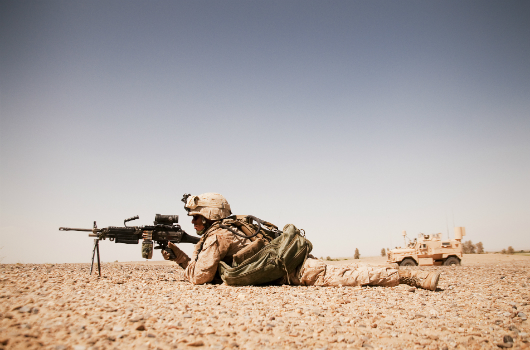
The way war is operated and fought constantly changes. The goals for war differ depending on situations and needs, but in the 21st century, a trend is becoming apparent about the wars we are fighting and what needs to be accomplished by them.
We are not fighting wars between kingdoms or with outstretched swords like what was once done. Some of the current wars are still being fought over land, religion and borders, but many now are over terrorism, oil and the economy.
In recent years, wars have begun with the intention of shutting specific terrorist groups down, but in the process, have destroyed the livelihood and homes of innocent bystanders. This is, regrettably, one of the side effects of war.
However, war does not have to be left at that. Too many people misconceive that the goal of war is “winning”, regardless of what that winning entails. While, of course, losing is certainly not the goal, the goal of the wars we are commonly fighting is much greater than simply winning.
In places like Afghanistan and Iraq, there is potential to do more than take down Al-Qaeda, the Taliban, or any associated forces.
These terrorist forces should be a main focus of any war where they are the concern, but ensuring they do not regroup, or that others similar to them do not arise, is equally important in war efforts against terrorism.
A striking fact about terrorism is that it is easier for terrorist groups to form and prosper in impoverished or developing nations. Dissolving Al-Qaeda, the Taliban or ISIS are vital steps in eradicating terrorism; however, leaving the struggling nations to fend for themselves afterwards only opens up the possibility for new, more dangerous groups that could form in the wake of destruction and transformation.
Dr. Joseph Gerson, the Director of Programs of the American Friends Service Committee, recognized that to make true change with terrorism, “we must address the root causes of the attacks.”
By working to improve situations in troubled areas, problems such as terrorism can be eliminated at their roots.
From the outside, the entire nation that terrorist groups originate from are often criminalized and grouped into the same category as terrorist. This, of course, is not the case for citizens of those nations.
The Revolutionary Association of the Women of Afghanistan proved that when they urged for the “Taliban [to] be overthrown by the uprising of the Afghan nation” rather than by “a vast aggression on our country [that] will shed the blood of numerous women, men, children, young and old of our country.”
Working from the inside out is precisely what RAWA was calling for, because of their understanding that permanent change cannot be accomplished until interior progression is made.
This is not to say that troops should remain in previous war zone areas past the amount of time that is needed, or that no war efforts should be made at all. Rather, once the initial needs of war are accomplished, such as eradicating the current terrorist threats, troops should continue to aid the rebuilding of the nation so that it can become strong and dominant against any future terrorist threats.
According to The Guardian, “with more displaced people than at any time since the second world war,” helping those people and their nations that are weaker and more prone to threats is the most promising answer to achieving lasting results.
We must fight in order to protect ourselves and those around us, but ensuring that the world continues to be safe after the initial threat is gone is equally important.
“Politicians are taking the easy option of failing to understand the wider world” that is at stake if impoverished individuals and nations do not receive the aid needed.
When it is decided to step in and take action in the form of war, winning is not the only goal that should be on our minds. Improving the livelihood of those in impoverished communities and nations so that threats and issues do not reappear should also be a goal.
– Katherine Wyant
Sources: Common Dreams, The Guardian, Revolutionary Association of the Women of Afghanistan
Photo: Flickr

Work Reforms for Garment and Textile Industry in Bangladesh
In Bangladesh, there has been a trending migration from the Ganges Delta region into the cities. Governmental research teams estimate that around 1.5 million of Dhaka’s 5 million inhabitants have moved north from the Bay of Bengal delta region. The absence of agricultural work has forced Bangladeshis to relocate into the cities in search of factory and industry jobs.
Both domestic and foreign industries have taken notice of this in state migration and have made efforts to diversify and broaden Bangladesh’s economy. The intensified demand for factory jobs has caused an increase in competition and a desperation for work. Influxes of other ventures have made a significant impact on the Bangladesh economy. One global market that has benefited from these conditions is the textile and garment industry. Such businesses now command 80 percent of exports, 45 percent of the industrial workforce and 15 percent of the GDP in the country.
A recent phenomenon in the global garment industry is “fast fashion,” which utilizes cheap materials and labor to maximize production and minimize costs. In order to achieve these results, the industry is outsourced to foreign countries. There are currently over 4 million Bangladeshis working in textile and garment factories. Workers typically make less than $40 U.S. per month and are often subjected to overcrowded working conditions and long hours. Routinely considered modern slavery, destitute Bangladeshis are often underrepresented and easily taken advantage of in textile factories.
Since 2005, there have been over 2,000 deaths related to garment factory accidents. In April 2013, the Rana Plaza factory collapsed, killing over 1,100 workers. The factory was built on swampy marshland, completely unfit for any structure of its size. Investigations revealed that the foundation of the eight-story building was cracking and in need of serious repairs. Additionally, it appears that the top three stories were added illegally. Unfortunately, most garment factories in Bangladesh are in similar condition to the Rana Plaza factory.
While the Rana disaster was certainly not the first garment factory accident, its magnitude has garnered worldwide attention. Activists from 75 different countries have joined together to create “Fashion Revolution,” a group focused on providing resources for retailers, brands and consumers to educate themselves about the state of textile workers. The organization has worked to make the anniversary of the Rana Plaza collapse, April 24, “Fashion Revolution Day.” On this day each year, world citizens are asked to wear their clothes inside out in an effort to recognize the origin of their garments.
Global retailers and brands, such as H&M, Walmart and Gap have called on Bangladesh to overhaul the industry. They have advocated for the institution of reforms and oversight procedures on factories and the workers’ rights. In response, the Bangladeshi government has received global recognition for their realignment efforts. The International Labor Organization (ILO) in Bangladesh has taken the initiative to set up a global fundraising campaign for the victims and families affected by the tragedy. In total, $21.5 million has been raised as compensation.
Additionally, the ILO has implemented governmental measures to streamline the initiation and registration of workers unions. In 2012 there were just over 100 worker unions, and there are currently under 500. The government has also instituted mandatory inspections of the 3,500 factories exporting clothing. So far, 35 factories have been shut down for violations ranging from building safety to working conditions.
Recently, the Bangladeshi law enforcement also pressed combination charges of murder and construction violations against Sohel Rana, the owner of the Plaza, and 41 others. This is a significant development, as garment factory owners in the past have been untouchable because of their influence economically. These efforts and changes made domestically and internationally could hopefully signal a new era of accountability and protection for the textile workers of Bangladesh.
– The Borgen Project
Sources: The Guardian 1, The Guardian 2, The Guardian 3, Business Insider, Ecouterre
Photo: Inquirer
Why We Should Value Biodiversity
The loss of biodiversity around the globe is an imminent problem that poses a serious danger to the health and livelihoods of many people.
A report from the World Health Organization identifies poor water quality, air pollution and climate change as central causes to the decline in biodiversity, the variety of plants and animals on the planet.
Biodiversity is important for:
Today, the central problems related to food and nutrition security are the inequitable distribution of food and the lack of diversification of crops grown. According to the World Farmer’s Organization, “over 2 billion people… suffer from a lack of essential micro-nutrients such as vitamin A and iron”. With the agricultural focus on quantity of staple crops such as millet, corn, and wheat, the value of crop diversity for nutrient sources has been dismissed.
The loss of biodiversity also has implications for the extinction of plants that are currently used in medical practices, or that may have potential to cure diseases in the future. When habitats are changed or over-harvested, plant species are vulnerable to extinction. The Convention on Biological diversity states that, “an estimated 60,000 species are used for their medicinal, nutritional, and aromatic properties”. The trade of these species also has a high economic value that should be considered.
Human health is impacted by a lack of nutrition security and medicinal development associated with loss of biodiversity. In addition, poor water quality from the destruction of wetlands, that filter water, can negatively impact health.
Lastly, many people sustain their livelihoods directly from the land and the biodiversity that it provides. Biodiversity is critical to the health of the environment, and with its destruction there will be an inevitable economic cost.
The good news is that is not too late to preserve biodiversity. If we can understand why biodiversity has an intrinsic value, more resources will be devoted to protecting the environment. While some connections may seem less direct, every person relies on the environment for health and economic growth. It is in everyone’s best interest to protect biodiversity.
– Iliana Lang
Sources: Convention on Biological Diversity, World Farmers’ Organization
Photo: Good Housekeeping
Protests in Honduras May be First Step in Improving Rule of Law
For the fifth consecutive Friday, thousands of protesters in the Honduran Capital have marched, torches in hand, calling for their President and other leaders to resign on charges of corruption. In fact, their demands go beyond what many see as simply political theater in having high ranking officials resign. The protesters are seeking systemic change by having an international observing and prosecuting body investigate and fight corruption and impunity in the struggling Central American Nation.
This international commission, which exists only as an idea, is coming to be called CICIH, the International Commission Against Impunity in Honduras. The inspiration for such a sagacious demand by protesters seems to be the success of the CICIG, the International Commission Against Impunity in Guatemala, in enforcing the rule of law and subverting corruption in Honduras’s neighboring state.
The CICIG’s recently renewed mandate to operate in Guatemala was welcomed by the State Department and presented as an effective model for curbing violence, unlocking growth and reducing poverty in the Northern Triangle countries of Guatemala, El Salvador and Honduras, in an earlier Borgen Blog post.
The grievances behind the recent protests in Honduras serve as a great example of how corruption undermines growth. An estimated $120 million was “fraudulently misspent” by the Honduran Social Security Institute, a large proportion of which went to fund President Juan Orlando Hernandéz’s 2013 campaign. Mismanagement of public funds, not to mention poor investment climates and the struggles of doing business, are some ways in which corruption impedes poverty reduction. In 2005, corruption was estimated to cost the world $1 trillion.
Leading the world in murders per capita, and Latin America in income inequality, life is difficult in Honduras.
At least 32.6 percent of Hondurans live in extreme poverty, reports the World Bank, and the the number of people below the national poverty line continues to climb. Rocked by a drug war, hyperactive and omnipresent gang activity and intense violence from law enforcement, the symptoms of corrupt and unstable institutions consistently make headlines in what The Economist warned was fast becoming a “failed state.”
The issues facing Honduras are not entirely endogenous and are incredibly complex. For starters, their geographic location is favored by narco-traffickers aiming to get products to markets in the U.S. They are still reeling from a 2009 coup. Impunity among state security forces is rampant, something that has been blamed for their out of control killings and targeted assassinations.
Among the many things that Honduras needs, are dependable and capable institutions, which are difficult to cultivate in the environment in which Honduras finds itself. Thankfully, the unique model provided by the work of CICIG in Guatemala lends itself perfectly to their situation, and the people of Honduras are ready for it.
– John Wachter
Sources: Al Jazeera, Carnegie Endowment for International Peace , CNN Español, The Economist, The Guardian, Huffington Post, La Prensa, Tico Times 1, Tico Times 2, World Bank 1, World Bank 2
Photo: Flickr
Computer Game Educates Players About Global Issues
Five years ago, a group of students from the Philippines created the computer game “Wildfire” to win the Microsoft Imagine Cup Game Design Competition, one of five major categories in the annual contest. The theme of the contest was, “Imagine a world where technology helps solve the toughest problems.”
The technology competition brings together students from all around the world with the goal of helping solve the globe’s biggest issues. Overall, the 2010 contest saw over 300,000 students from more than 100 countries go head-to-head.
The five creators of “Wildfire,” a mix of college students and graduates, call themselves By Implication. The group of friends decided to enter the contest after Typhoon Ketsana brought devastation to Manila, the capital of the Philippines, in 2009.
On its website, By Implication stresses that worldwide problems must be tackled head on, as they cannot be overcome by using magic or potions.
“Wildfire,” which is free and can be played an unlimited number of times, demonstrates just this. The computer game educates players about global health issues and how they can help solve them.
Designed and created with a virtually nonexistent budget, the game permits users to navigate their own city in an attempt to defeat the health issues, known as the “bad guys.”
Players are on their own until they collect “inspiration points,” which they can then use to obtain the assistance of volunteers around them. This teaches that a player is powerless if he or she is alone. Transition to the real world, and this idea illustrates that by working together, people have the ability to do something great.
In addition, the computer game educates players with informative buttons. A player can encounter the buttons, which contain short facts about crises including poverty and water quality, while navigating his or her own city. In the end, if players and volunteers can defeat not only the problems they encounter, but also the time limit, their city will thrive.
For the creators of “Wildfire,” they hope that by learning about certain issues, those who play the game will become motivated to help solve them.
– Matt Wotus
Sources: ABC News, Imagine Cup, Imagine Cup Wildfire by Implication
Photo:Neogaf
How Yuwa Empowers Girls in India Through Football
India currently has the highest number of child brides on the planet, with 47 percent of girls married before they turn 18. The practice is more common in rural areas. In some states, the number reaches 69 percent. The rate of marriages is increasing for girls between the ages of 15 and 18.
There are many factors that account for this high number of child brides. Oppressive gender roles in India’s patriarchal society make it difficult for girls to pursue other options. They are typically expected to be mothers and care for the entire household. Girls often receive little schooling and have lower rates of literacy. It can be difficult for them to find work and become financially independent, so they have no choice but to marry young and depend on their husband while being burdened with domestic responsibilities. Families may also push girls to get married young out of concern for their safety and “honor.”
Child brides face risks to their mental, physical, and emotional health. Since many become pregnant at a young age, they are more likely to die in childbirth. They also have a greater chance of contracting HIV. They suffer more domestic violence: Indian child brides are twice as likely to be abused than girls who marry after 18. They also face higher rates of sexual abuse, and often exhibit symptoms of Post Traumatic Stress Disorder such as hopelessness and depression.
The Yuwa organization, an NGO based in the state of Jharkhand, is dedicated to using football (soccer) as a means to promote social development and discourage child marriage. Citizens of Jharkhand struggle with poverty and illiteracy, and it is a dangerous place for young women to grow up. Yuwa was founded in 2009, and since the program began, it has had 600 members. Currently, 250 girls participate in the program, with 150 practicing on a daily basis.
Through Yuwa, girls can organize new football teams or join an already existing team. Players collectively choose a team captain, who is responsible for tracking attendance. If a girl suddenly drops out or shows up less and less, her teammates can contact her to help her through whatever is keeping her from practice.
Yuwa’s program goes beyond football. They also work to educate girls so they can strive for a future beyond child marriage. Girls can attend their academic bridge program, which provides classes in math, science, and English, and computers. They also provide summer school and personal tutoring, and assist with transferring girls to better schools. Furthermore, Yuwa holds hour-long weekly workshops that focus on teaching life skills. These workshops are run by local female staff or other Yuwa girls, and they cover topics such as health, gender, gender-based violence, sexuality, self-esteem, and basic finances.
Yuwa’s primary objective is to inspire girls to take their futures into their own hands so they can fight child marriage, illiteracy, and human trafficking. Girls and their coaches can meet with their families to discuss options beyond marriage. Although some parents are not understanding at first, and want their daughters to follow the conventional path, many change their minds and begin to push for better futures for their daughters.
The Yuwa girls have seen success on and off the field. In 2013, a Yuwa team placed 4th in an under-14 tournament in Spain, and in 2014, they were invited to Schwan’s USA cup. Although football is not enough to undo all of the inequalities that Indian women struggle with on a daily basis, Yuwa’s girls are helping change attitudes and inspire girls to strive for new opportunities.
– Jane Harkness
Sources: Foundation for Sustainable Development, Girls Not Brides, The Guardian, International Center for Research on Women, Yuwa
Photo: Yuwa
Green Space Lessens Gap Between Rich and Poor
Having access to healthy green recreational areas has, for years, been known to improve mental health and well-being in communities. Contact with nature is said to be therapeutic for those who are stressed or fatigued. A new study, published in the American Journal of Preventative Medicine, suggests that this same access could conceivably reduce socioeconomic inequalities.
“Researchers looked at data that covered more than 21,000 urban residents from 34 nations recorded in the 2012 European Quality of Life Survey.” This research accounted for general demographic information among other data, and the results showed that those with reliable access to green space had a 40 percent lower socioeconomic gap than those that did not.
According to a similar study performed by the University of Glasgow, “green places are not only good for our health and well-being, but could also play an equalizing role in our cities.” This makes sense because green spaces do require a kind of maintenance, which opens up many jobs and volunteer opportunities in their communities.
“The research does not prove the strength of the relationship between individual neighborhood services and well-being, but does show that well-being gaps are smaller where services are better.” However, the research does show that green space has the largest bearing on the reduction of those gaps.
One example of a green space that is highly beneficial to its community is Lexington, Kentucky’s Gratz Park. This park borders Transylvania University, is used as a venue for local artists and performers during events, and is an accessible area for college students. Those who work to maintain Gratz Park are well-respected, and students that network there during events have been known to be much more at ease. Inhabitants also take great pride in the park’s historical significance as it was established in 1781.
– Anna Brailow
Sources: Fast Coexist, Optimist World, National Park Service
Photo: The Conservancy
E-Libraries Bridge Digital Divide Across Sri Lanka
The Sri Lankan government installed e-library computer centers in hundreds of community centers and places of worship across Sri Lanka to combat the country’s digital divide, increase digital literacy and stimulate the economy in rural areas.
The Program, e-Library Nenasala (eLNP), is completely free to the public, no matter what background a person comes from. “The eLibray Nenasalas have literally opened the gateway to wisdom and knowledge in rural Sri Lanka,” explains Nenasala’s website.
The program originally began in an environment of despair and desparation— the tsunami in the Indian Ocean of December 26, 2004. A total of 35,000 Sri Lankans died that day. Family members and friends urgently needed access to communication and information, and both were facilitated by the e-library program.
The computer centers across Sri Lanka have increased the country’s computer usage and technological literacy rate from below 10 percent in 2004, to nearly 40 percent today.
Computers and internet access have given communities access to life-changing services and information. Children can stream videos on learning the English language; women can learn about nutrition, breast-feeding, sanitation and vaccinations. Farmers can learn how to increase their crop yields, and entrepreneurs have access to information on how to start a business. Migrant workers staying in Sri Lanka can also Skype with family members in far-away countries.
Community members, thanks to their access to computers, now have access to assistance with how to write a resume or conduct a job search. Adults can fill out important applications online such as passports or driver’s licenses; they can also take government examinations.
The Nenasala computer centers also bring the community together; teens are trained in computer skills, and then volunteer to teach older community members.
“Without a doubt, the e-Library Nenasala Program is making a real and lasting impact on the lives of poor rural residents throughout Sri Lanka. People are getting locally relevant information and hands-on experience in the subject areas that matter most to them. Community members have a real investment in these centers, which promotes their longevity and sustainability for many years to come,” explained Deborah Jacobs, who directs the global libraries initiative at the Gates Foundation.
So far, 283 e-Library computer centers have been built. When the program first began, the government “knew that the low-income, rural residents it was targeting wouldn’t necessarily flock to the Nenasalas, or ‘wisdom centers.’ Fear, distrust, or just plain unfamiliarity would likely keep them away” explained Impatient Optimists, The Gates Foundation’s website.
For this reason, the e-library computer centers are based in some of the most trustworthy places of all— places of worship. This unconventional cultural adaptation has been critical in the success of the E-Library Program. “These institutions are seen as community centers and places of learning. They are familiar, welcoming, and trusted,” said Impatient Optimists.
E-Libraries can be found in Muslim Mosques, Buddhist Temples, Christian churches and Hindu Kovils across Sri Lanka.
Temples have been an especially effective location for the e-libraries because of their traditional, ancient association with learning as well as their role as the center of the village. The temples of Sri Lanka are also open to all people, no matter the race, gender, age or even religion. Small donations from the community help to keep the e-libraries functioning and up-to-date.
The eLNP program has been so effective that it received the Gates Foundation’s Access to Learning Award, a one million dollar value. The award began 15 years ago to promote providing the world’s poor with access to technology.
The organization plans to use the money to upgrade hardware at various locations. eLNP also plans to begin a new program where community members can temporarily rent tablets and install education software for children where there is not ample access to schooling.
The Sri Lankan government hopes to increase computer literacy and usage rates through the Nenasala computer centers to 75 percent by 2016.
– Aaron Andree
Sources: Bill & Melinda Gates Foundation, Impatient Optimists, Philanthropy News Digest
Hope for Reducing Hunger in Iran
Causes of Hunger in Iran
Steps to Reduce Hunger
The Future of Food Security in Iran
Food security is a major concern for Iran, but the country has significant agricultural potential. Enhancing crop yields is essential to ensure a reliable food supply and fully harness this potential. This can be achieved by minimizing water waste and addressing the impacts of climate change. Collaboration between the government and the international community is crucial for success.
To address the challenges of undernourishment and nutritional deficiencies, collaboration with organizations such as UNICEF and the World Food Program (WFP) can offer the Iranian government essential support, technology and resources and help improve the situation. Such efforts will help ensure a food-secure future for all citizens.
– Rebecca Malachowski and Maria Waleed
Photo: Wikipedia
Updated: October 31, 2024
War: Why Winning Should Not be the Only Goal
The way war is operated and fought constantly changes. The goals for war differ depending on situations and needs, but in the 21st century, a trend is becoming apparent about the wars we are fighting and what needs to be accomplished by them.
We are not fighting wars between kingdoms or with outstretched swords like what was once done. Some of the current wars are still being fought over land, religion and borders, but many now are over terrorism, oil and the economy.
In recent years, wars have begun with the intention of shutting specific terrorist groups down, but in the process, have destroyed the livelihood and homes of innocent bystanders. This is, regrettably, one of the side effects of war.
However, war does not have to be left at that. Too many people misconceive that the goal of war is “winning”, regardless of what that winning entails. While, of course, losing is certainly not the goal, the goal of the wars we are commonly fighting is much greater than simply winning.
In places like Afghanistan and Iraq, there is potential to do more than take down Al-Qaeda, the Taliban, or any associated forces.
These terrorist forces should be a main focus of any war where they are the concern, but ensuring they do not regroup, or that others similar to them do not arise, is equally important in war efforts against terrorism.
A striking fact about terrorism is that it is easier for terrorist groups to form and prosper in impoverished or developing nations. Dissolving Al-Qaeda, the Taliban or ISIS are vital steps in eradicating terrorism; however, leaving the struggling nations to fend for themselves afterwards only opens up the possibility for new, more dangerous groups that could form in the wake of destruction and transformation.
Dr. Joseph Gerson, the Director of Programs of the American Friends Service Committee, recognized that to make true change with terrorism, “we must address the root causes of the attacks.”
By working to improve situations in troubled areas, problems such as terrorism can be eliminated at their roots.
From the outside, the entire nation that terrorist groups originate from are often criminalized and grouped into the same category as terrorist. This, of course, is not the case for citizens of those nations.
The Revolutionary Association of the Women of Afghanistan proved that when they urged for the “Taliban [to] be overthrown by the uprising of the Afghan nation” rather than by “a vast aggression on our country [that] will shed the blood of numerous women, men, children, young and old of our country.”
Working from the inside out is precisely what RAWA was calling for, because of their understanding that permanent change cannot be accomplished until interior progression is made.
This is not to say that troops should remain in previous war zone areas past the amount of time that is needed, or that no war efforts should be made at all. Rather, once the initial needs of war are accomplished, such as eradicating the current terrorist threats, troops should continue to aid the rebuilding of the nation so that it can become strong and dominant against any future terrorist threats.
According to The Guardian, “with more displaced people than at any time since the second world war,” helping those people and their nations that are weaker and more prone to threats is the most promising answer to achieving lasting results.
We must fight in order to protect ourselves and those around us, but ensuring that the world continues to be safe after the initial threat is gone is equally important.
“Politicians are taking the easy option of failing to understand the wider world” that is at stake if impoverished individuals and nations do not receive the aid needed.
When it is decided to step in and take action in the form of war, winning is not the only goal that should be on our minds. Improving the livelihood of those in impoverished communities and nations so that threats and issues do not reappear should also be a goal.
– Katherine Wyant
Sources: Common Dreams, The Guardian, Revolutionary Association of the Women of Afghanistan
Photo: Flickr
Why is Disability in Africa Increasing?
The World Report on Disability estimates that 15 percent of the world population lives with disabilities. The disabled are the world’s most underprivileged minority, and are considered the poorest of the poor.
Disability in Africa is very high, with approximately 80 million African people living with disabilities, according to the United Nations.
It is believed that the number of those with physical and mental impairments will only increase with time. Disability is caused by many factors, such as birth defects, environmental hazards, industrial accidents, war and other conflicts. Some of the factors are easily preventable, such as malnutrition and diseases.
Even walking and playing can be dangerous. According to Rehabilitation International, between 250-500 disabilities are caused simply due to encounters with landmines.
Many people with physical disabilities do not have access to wheelchairs or crutches. Instead, they resort to makeshift items that do not offer quality mobility or comfort.
Because being disabled impacts your ability to work, disabled Africans struggle to support themselves and their families. In most cases, the disabled resort to begging outside of churches and on the streets.
In the poorest parts of Africa, the percentage of disabled children who receive an education are as low as 1 to 3 percent. They are denied education because there are no special facilities to accommodate them. Furthermore, there are cultural attitudes, such as shame and fear, associated with having a disability.
Sunit Bagree says, “…traditional and religious beliefs can make people believe that having a disabled child is a form of punishment, related to the concept of sin.”
This negative stigma is often how disability is viewed by others, and it impacts every opportunity they have.
“Disabled young people all over the world face unfair inequality of opportunities, but in parts of Africa, conditions can be unimaginably hard,” says Damon Hill, Patron of Disability Africa, an organization that strives to improve the lives of disabled Africans.
To improve the lives of the disabled, legislation and organizations strive to change the stigma associated with disability.
In February 2014, the first ever African Leaders Forum on Disability was held in Malawi. At the event, leaders challenged the stigmas and inequalities associated with disability. Ultimately, the goal was to achieve awareness to spark equality and empowerment for people with disabilities in Africa.
“There is something about the plight that faces individuals with disabilities, including those with intellectual disabilities, that is compounded by an entrenched stigma that has endured, unjustly, for centuries and centuries,” says Joyce Banda, President of Malawi.
Determined to finally change the stigma associated with disability, President Malawi passed a Disability Act which created equal rights and inclusion policies for everyone with disabilities in Malawi.
Although many African countries have passed their own disability policies, there is still much more that can be implemented, believes Special Olympics Chairman, Tim Shriver.
President Banda declares, “No region of the world is doing enough for people with intellectual disabilities. Africa, with its emphasis on community and its peoples’ deep understanding of discrimination and deprivation, can be a leader in ensuring human rights, social services and inclusion for people with intellectual disabilities.”
– Kelsey Parrotte
Sources: United Nations, African Studies Centre Leiden, Disabled World, UNICEF, WHO
Photo: The Salvation Army