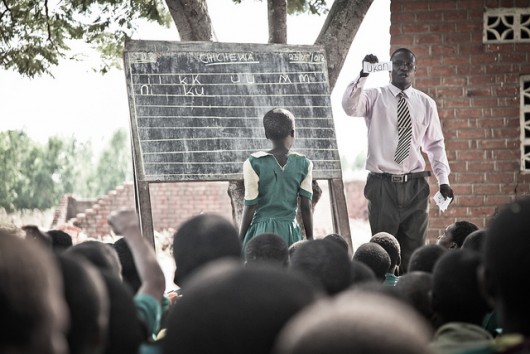
To foster growth in developing countries, there has to be a focus on global education. Many children and adolescents are out of school worldwide, often due to poverty, conflict or financial deprivation. Approximately 24 million children globally will never see the inside of a classroom, according to the UNESCO Institute for Statistics.
Five international aid organizations have stepped up to expand worldwide access to educational opportunities: The World Bank, Global Partnership for Education, United Nations Children’s Emergency Fund, Global Education First Initiative and the United Nations Educational Scientific and Cultural Organization.
The World Bank currently plays a significant role in providing educational access across the globe. Since its creation in 1944, the organization has invested $69 billion globally in more than 1,500 educational projects.
Recently, the World Bank laid out the “Learning for All” plan, an education strategy focused on ensuring that all children and youth receive learning opportunities by 2020. The organization plans to double its investment in global public education by 2020, spending approximately $5 billion to improve education in developing nations
“The truth is that most educational systems are not serving the poorest children well,” World Bank President Jim Yong Kim said in an interview with Reuters. “With nearly a billion people remaining trapped in extreme poverty today, sustained efforts to improve learning for children will unlock huge amounts of human potential for years to come.”
The Global Partnership for Education works to develop effective and sustainable education systems across the globe by collaborating with national governments and development partners.
“The Global Partnership for Education supports developing countries to ensure that every child receives a quality basic education, prioritizing the poorest, most vulnerable and those living in fragile and conflict-affected countries,” the organization’s website states.
If all students in developing countries received basic reading skills, 171 million people worldwide could be lifted out of poverty, according to the organization.
Created in 2012 by U.N. Secretary General Ban Ki-moon, the Global Education First Initiative aims to strengthen global education through political advocacy.
The initiative works to reach three priority goals: ensuring that every child is in school, improving the quality of learning worldwide and fostering global citizenship through education.
“Without universal education, in other words, winning the war against illiteracy and ignorance, we cannot also win the war against disease, squalor, and unemployment. Without universal and high standard education we can only go so far but not far enough in breaking the cycle of poverty,” U.N. Special Envoy for Education Gordon Brown said in a statement on the organization’s website.
The United Nations Educational, Scientific and Cultural Organization (UNESCO) was established in 1945 to foster peace, poverty eradication, lasting development and intercultural dialogue across the globe. Education is one of the primary ways the organization aims to reach its goals.
“As a human right in itself, education is also fundamental to realizing other rights, and an enabler for reaching all the Millennium Development Goals. It plays an essential role in reducing mortality and morbidity rates; eradicating poverty and hunger; strengthening resilience to natural hazards and ending abuse, violence and armed conflict,” Olav Seim, Director of the Education for All Global Partnerships Team said in a UNESCO press release.
With headquarters in Paris and 52 other field offices, including regional bureaus in Bangkok, Beirut, Dakar and Santiago, the organization works worldwide to foster educational opportunities.
The United Nations Children’s Emergency Fund (UNICEF) is a U.N. program that aims to provide long-term humanitarian and developmental assistance to children in developing countries.
Founded in 1946, the organization aims to ensure that children have access to quality education opportunities regardless of their gender, ethnicity or life circumstances.
UNICEF works to get children back to school after emergency situations or disasters and provides educational initiatives to give children in remote areas, as well as children with disabilities or those facing social exclusion, access to education.
The organization recently launched the “Let Us Learn” campaign, with the aim of bringing educational opportunities to the world’s most vulnerable children, focusing on Afghanistan, Bangladesh, Liberia, Madagascar and Nepal.
– Lauren Lewis
Sources: Global Partnership for Education 1, Global Partnership for Education 2, Global Partnership for Education 3, Reuters, U.N. Global Education First Initiative, UNESCO 1, UNICEF 1, UNICEF 2, UNICEF 3, UNESCO 2, UNESCO 3, UNESCO 4, UNESCO Institute for Statistics, World Bank 1, World Bank 2, World Bank 3
Photo: Flickr

What Gender Means for World Peace
The evidence clearly suggests that world peace and gender equality go hand-in-hand. According to Foreign Policy, “there is a strong and highly significant link between the state’s and women’s security…the best predictor of a state’s peacefulness is not its level of wealth, its level of democracy, or its ethno-religious identity; the best predictor of a state’s peacefulness is how well its women are treated.”
In their investigative book “Sex and World Peace,” four scholars found out that the larger the gender gap with respect to the treatment of men and women in a population, the more probable it is for a country to get involved in interstate issues as well as have higher levels of violence.
Regarding economic growth, national wealth, corruption and social welfare, the best prognosticators are those which manifest the situation of women. According to Foreign Policy, “what happens to women affects the stability, prosperity, bellicosity, corruption, health, regime type and power of state.”
The empirical results are abundant. WomanStats database rated countries based on numerous sections respecting women’s security from 0 (best) to 4 (worst). In this categorical system, no country received a 0, in regards to the physical security of women.
The world average was 3.04, “attesting to the widespread and persistent violence perpetrated against women worldwide, even among the most developed countries,” announced Foreign Policy. The United States received a 2.0 due to the predominance of rape and domestic violence.
Gender-based assault is sadly intrinsic in many cultures and it remains rooted in the countries associated with underdevelopment.
The fundamental objective facing the 21st century is to eradicate violence against women and remove barriers that prevent them from development and empowerment.
“The countries of the world must try a different path, one that we have every empirical reason to believe will lead to greater well-being, prosperity and security for the entire international system. Sex and world peace, then, with no question mark,” said Foreign Policy.
– Isabella Rölz
Sources: Foreign Policy, Woman Stats, Columbia University Press (2016) Sex and World Peace,
Four Reasons to be Excited About Nanosatellites
Recently, there has been a lot of hype surrounding nanosatellites. These satellites are an emerging technology in space development and offer the potential for more developing countries to reap the benefits of traditional satellites without the hefty costs associated with them.
Nanosatellites are small satellites weighing between 1kg and 10kg. CubeSats are box-shaped versions of nanosatellites and are currently one of the most widely-used forms. They are very light compared to traditional satellites, which can weigh up to several tons.
Why are nanosatellites so exciting? The reasons range from their cost and convenience to unique benefits that they can bring to the table. Here are four of the main reasons:
1. They are cheap and convenient. Compared to traditional satellites, nanosatellites retain the same or similar capabilities, while costing significantly less. According to the online publication The Conversation, while the cost of traditional satellites can be hundreds of millions of dollars, a CubeSat can be built for around $100,000 and can be launched for many of the same missions that their traditional counterparts can. “Including the launch, a nanosat of CubeSat dimensions might cost $150,000-1m, rather than $200m-1 billion for a full-sized one,” an article in the Economist corroborates.
Furthermore, nanosatellites are more convenient to build. According to the Economist, due to their low cost and less stringent standards of regulation, they can be built faster. Nanosatellites also have a relatively short lifespan of perhaps no more than a year or two in low-Earth orbit before re-entering the atmosphere and burning up. This allows for less risk-management during the building and launch phases.
2. They will help the space programs of developing countries. Funding is often a big problem for these programs; they are constrained by the high cost of traditional satellites and supporting infrastructure. The low costs of nanosatellites, however, offer a solution.
“From being cheaper to build and launch into space, they provide a cost-effective platform for training and research, especially for countries where heavy investment in a space industry has to be weighed against more immediate needs such as health and welfare,” the article on The Conversation says.
In addition, nanosatellites will encourage more youth to enter the space industry. Speaking about Africa, the Conversation notes that young people are entering careers in STEM at low rates. Nanosatellites, though, can be integrated into training at a lower cost and will thus give young people more first-hand exposure to the technology. They also have a “cool” factor: “Combining the vibrant ingenuity and creativity of this generation with an equally ingenious and cool space technology can no doubt have a profoundly positive socioeconomic impact on Africa,” says the Conversation.
3. They are closely integrated with modern, advanced technology. According to the Economist, small satellites benefit from the constant improvements in price and performance being achieved by the consumer-electronics industry, particularly in smartphone technology.
A modern phone is equipped with technologies such as an accelerometer to measure how fast it is moving, a magnetometer to detect magnetic fields and provide a compass reading, a gyroscope to measure its position, a barometer to detect pressure and much more. These technologies provide nanosatellites with a wealth of resources to work with.
4. They provide unique benefits. Though traditional satellites are able to certain complex tasks that nanosatellites cannot, nanosats have their own unique advantages.
According to the Conversation, because they are low cost, multiple nanosatellites can be launched into low-Earth orbit. The satellites in these constellations pass over a specific geographic area more frequently than single, big-satellite missions. This allows nanosatellites to be used for rapid responses to disasters or to gather timely information relating to telemedicine, environmental management and asset tracking.
The unique potential of nanosatellites is also being seen in other projects. According to the online publication Inverse, the company SkyFi is working on creating a nanosatellite network to provide the entire world with free internet access. The cheap costs and flexibility of nanosatellites would allow them to circumvent the problems preventing traditional satellites from providing reliable wifi.
“The high flexibility of our nanosatellites and the ability to provide multiple services to different customers enables us to offer free internet access to the whole planet in the same manner as GPS services are free. We think this has the potential to bridge great divides and give everyone worldwide a part in the great global connected community,” Raz Itzhaki Tamir, Co-Founder and CEO of SkyFi, said in a press release.
– Anton Li
Sources: The Conversation, The Economist, Inverse, PRWeb
Photo: Kirtland Air Force Base
Why the Global Food Security Act of 2016 is Important
Global poverty touches the lives of millions of people. Currently, close to 3 billion people lack access to toilets and 1 billion lack access to clean drinking water. In addition, 2.7 million newborns worldwide die within their first month of life.
Seven countries are home to 58 percent of the world’s hungry: India, China, Pakistan, Ethiopia, Bangladesh, Indonesia, and Tanzania.
The U.N. Food and Agriculture Organization states that 795 million people suffer from chronic hunger. It is clear that there is much work to do in confronting the problems associated with ending global poverty.
The Global Food Security Act aims to address these problems head-on. The bill is a “comprehensive strategic approach for U.S. foreign assistance to developing countries” according to the text of the bill and hopes ‘to reduce global poverty and hunger, achieve food and nutrition security, promote inclusive, sustainable, agricultural-led economic growth, improve nutritional outcomes” among other objectives.
First introduced in March of last year, The Global Food Security Act has carried much bipartisan support due to its proposed benefits. According to InternAction, a group of non-governmental agencies in Washington D.C, a program launched due to the Act, Feed the Future, Initiative, “improved the nutrition of 12.5 million children and assisted nearly 7 million farmers and producers in improving their use of technology and land management practices.”
On March 10, 2016, the Global Food Security Act (S.1252) moved from the Senate floor to committee. The bill, which was introduced by Senator Robert “Bob” Casey Jr. from Pennsylvania, gained three new cosponsors in February, Senator Benjamin Cardin [D-MD], Senator Bob Corker [R-TN] and Senator Daniel Coats [R-IN]. The new additions bring the total number of cosponsors to 13, seven republicans and six democrats.
The House version of the bill (H.R.1567) that has been in committee since April of last year, also has three recent cosponsors, consisting of Congressman Steve Womack [R-AR3], Congressman Lacy Clay [D-MO1] and Congressman Lee Zeldin [R-NY1] which brings the total number to 123, 82 democrats and 42 republicans.
The Global Food Security Act can have huge potential benefits. The World Bank indicates, “that growth in agriculture is on average at least twice as effective in reducing poverty as growth outside agriculture… Agricultural growth reduces poverty directly, by raising farm incomes, and indirectly, through generating employment and reducing food prices.” By passing the Global Food Security Act, the United States can take decisive action in reducing global poverty.
– Michael Clark
Sources: The Borgen Project, GovTrack 1, GovTrack 2, GovTrack 3, InterAction, Bread for the World, World Bank
Photo: Flickr
Higher Number of Women Landowners Relieves Poverty
As the number of women landowners grows, the overall condition of their communities improves drastically. This topic was recently covered at the World Bank Land and Poverty Conference 2016, the 17th annual conference, earlier this month.
The conference, “Scaling up Responsible Land Governance,” brought together many experts from many fields from around the globe to talk about land strategy.
A large portion of this year’s conference highlighted the work of researchers focusing on the empowerment of women in developing countries through land ownership. Perhaps one of the greatest benefits of increasing women landowners is the link to fewer cases of domestic violence.
With greater access to land ownership for women, the need for young daughters to marry diminishes and households have more access to resources. According to Klaus Deininger, an economist for the World Bank and conference organizer, women with greater land rights typically have more personal wealth, leading to lower levels of domestic violence.
“If women have stronger bargaining power, they actually can resist,” Deininger says in an article by Reuters. “Their husbands will think twice before beating them.”
The conference tackled questions on how to enhance women’s awareness of their legal rights and how to ensure women’s rights in land interventions. The Landesa Rural Development Institute is an organization that seeks to provide solutions to these questions by securing greater access for potential women landowners in developing countries.
Laws and policies often dilute or deny women’s rights to land. Even when laws enshrine such rights, loopholes, low implementation and enforcement and sex-discriminatory practices often undercut these formal guarantees.
Landesa’s Center for Women’s Land Rights has programing in both India and Rwanda to combat those challenges. In partnership with West Bengal’s Department of Women and Child Development, the Security for Girls Through Land Project provides vocational training and skills to adolescent girls in order to improve their health and nutrition. The curriculum is based on land rights, asset creation and land-based livelihoods.
The project creates “girls groups” which are peer-facilitated meetings in which girls are given lessons to educate them about land rights and the positive benefits associated with control over land. Girls are taught to start “kitchen gardens” to grow produce for the family or to sell. As the girls begin to earn money, often for the first time, families begin to think of girls as an asset rather than a burden.
The project, beginning in 2010, has already reached 40,000 girls in over 1,000 villages in West Bengal. In addition to engaging with girls in local communities, the project reaches out to boys in local schools in an effort to change the mindset that young women are an economic burden.
The U.N. Food and Agriculture Organization reports that women make up half of the world’s agriculture workforce. As these women have greater access to land, the ripple effect, according to Landesa, includes better nutrition for families, improved family health, educational gains and reduced domestic violence.
– Michael A. Clark
Sources: Landesa, Reuters, World Bank
Photo: Flickr
International Aid Organizations Improve Global Education
To foster growth in developing countries, there has to be a focus on global education. Many children and adolescents are out of school worldwide, often due to poverty, conflict or financial deprivation. Approximately 24 million children globally will never see the inside of a classroom, according to the UNESCO Institute for Statistics.
Five international aid organizations have stepped up to expand worldwide access to educational opportunities: The World Bank, Global Partnership for Education, United Nations Children’s Emergency Fund, Global Education First Initiative and the United Nations Educational Scientific and Cultural Organization.
The World Bank currently plays a significant role in providing educational access across the globe. Since its creation in 1944, the organization has invested $69 billion globally in more than 1,500 educational projects.
Recently, the World Bank laid out the “Learning for All” plan, an education strategy focused on ensuring that all children and youth receive learning opportunities by 2020. The organization plans to double its investment in global public education by 2020, spending approximately $5 billion to improve education in developing nations
“The truth is that most educational systems are not serving the poorest children well,” World Bank President Jim Yong Kim said in an interview with Reuters. “With nearly a billion people remaining trapped in extreme poverty today, sustained efforts to improve learning for children will unlock huge amounts of human potential for years to come.”
The Global Partnership for Education works to develop effective and sustainable education systems across the globe by collaborating with national governments and development partners.
“The Global Partnership for Education supports developing countries to ensure that every child receives a quality basic education, prioritizing the poorest, most vulnerable and those living in fragile and conflict-affected countries,” the organization’s website states.
If all students in developing countries received basic reading skills, 171 million people worldwide could be lifted out of poverty, according to the organization.
Created in 2012 by U.N. Secretary General Ban Ki-moon, the Global Education First Initiative aims to strengthen global education through political advocacy.
The initiative works to reach three priority goals: ensuring that every child is in school, improving the quality of learning worldwide and fostering global citizenship through education.
“Without universal education, in other words, winning the war against illiteracy and ignorance, we cannot also win the war against disease, squalor, and unemployment. Without universal and high standard education we can only go so far but not far enough in breaking the cycle of poverty,” U.N. Special Envoy for Education Gordon Brown said in a statement on the organization’s website.
The United Nations Educational, Scientific and Cultural Organization (UNESCO) was established in 1945 to foster peace, poverty eradication, lasting development and intercultural dialogue across the globe. Education is one of the primary ways the organization aims to reach its goals.
“As a human right in itself, education is also fundamental to realizing other rights, and an enabler for reaching all the Millennium Development Goals. It plays an essential role in reducing mortality and morbidity rates; eradicating poverty and hunger; strengthening resilience to natural hazards and ending abuse, violence and armed conflict,” Olav Seim, Director of the Education for All Global Partnerships Team said in a UNESCO press release.
With headquarters in Paris and 52 other field offices, including regional bureaus in Bangkok, Beirut, Dakar and Santiago, the organization works worldwide to foster educational opportunities.
The United Nations Children’s Emergency Fund (UNICEF) is a U.N. program that aims to provide long-term humanitarian and developmental assistance to children in developing countries.
Founded in 1946, the organization aims to ensure that children have access to quality education opportunities regardless of their gender, ethnicity or life circumstances.
UNICEF works to get children back to school after emergency situations or disasters and provides educational initiatives to give children in remote areas, as well as children with disabilities or those facing social exclusion, access to education.
The organization recently launched the “Let Us Learn” campaign, with the aim of bringing educational opportunities to the world’s most vulnerable children, focusing on Afghanistan, Bangladesh, Liberia, Madagascar and Nepal.
– Lauren Lewis
Sources: Global Partnership for Education 1, Global Partnership for Education 2, Global Partnership for Education 3, Reuters, U.N. Global Education First Initiative, UNESCO 1, UNICEF 1, UNICEF 2, UNICEF 3, UNESCO 2, UNESCO 3, UNESCO 4, UNESCO Institute for Statistics, World Bank 1, World Bank 2, World Bank 3
Photo: Flickr
Highlighting the Benefits of Cash Transfers
According to a report by the Center for Global Development (CGD), cash transfers may come in the form of “an envelope of cash, a plastic card, or an electronic money transfer to a mobile phone, with which [recipients] can buy food, pay rent and purchase what they need locally.”
This report also suggests that these transfers should be complemented by services such as immunization and sanitation, where cash transfers may not be sufficient.
Other benefits through transfers include the transparency provided. They allow precise measurement of how much aid is arriving to the desired target population.
Receivers are granted the benefit of being able to choose what the aid is spent on. This decision making process further empowers communities and allows them to receive what they really need.
Despite the benefits, the CGD states that cash transfers are still often overlooked in favor of other forms of assistance. Today, cash payments make up only six percent of aid. Evidence from global crises, in Ethiopia, for instance, has proven that “cash was more effective than food aid by 25-30 percent,” says the CGD.
There are also challenges in the distribution of cash transfers. According to the World Bank, one challenge is ensuring that cash directly reaches needy recipients, avoiding corrupt processes and opportunistic elites.
Overall, cash transfers are practical. They can also reduce administration and operating costs. Respected nonprofits such as Give Well assert that unconditional cash transfers help the poor begin to create a better life on their own terms.
Giving the impoverished the freedom to utilize cash payments means they have the ability to meet individual needs and accelerate progress in their developing countries.
– Mayra Vega
Sources: Center For Global Development, World Bank, The New York Times
Photo: Flickr
Dr. Bjorn Lomborg on Tackling Poverty in Bangladesh
The government of Bangladesh recently dedicated itself to pulling more than six million people out of extreme poverty by 2020. Dr. Bjorn Lomborg, the director of the Copenhagen Consensus Center wrote an article for the Daily Star, an independent newspaper in Bangladesh, on the most efficient ways to tackle poverty in the country.
Bjorn Lomborg is also the author of several books, including “How to Spend $75 Billion to Make the World a Better Place” and has been ranked one of the world’s 100 most influential people by Time magazine.
In this article, he writes that poverty is one of the most crucial challenges that Bangladesh faces. There is much work to do to solve the problem, with 20 million Bangladeshis considered extremely poor.
Bjorn Lomborg is a part of the Bangladesh Priorities project, which works with stakeholders across Bangladesh to find, analyze, rank and publicize the best solutions for the country. Two of the project’s economists, Munshi Sulaiman of BRAC International and Farzana Misha of Erasmus University Rotterdam, have analyzed three of the most important ways to end extreme poverty in Bangladesh.
The first way to tackle poverty is through cash transfers. Bjorn Lomborg writes that this method has proven to be popular in Kenya and Uganda. According to research, the most efficient method is providing no-condition transfers (no conditions on how the money can be used).
However, Bjorn Lomborg notes that the benefits of cash transfers diminish over time. “A one-time stipend for someone in extreme poverty may help for a little while, but the effect is fleeting.”
The second strategy is developing “livelihood programs.” These programs essentially give a livelihood boost to those living in poverty so that they can eventually thrive on their own. Programs include agronomic training and growing inputs. Lomborg says the return on spending is one-to-one in programs of this kind.
The third way out of poverty, the one Lomborg calls “the most promising,” is graduation programs. In these programs, ultra-poor participants first receive a small gift of food or cash, which allows them to meet basic needs and start saving.
Then participants receive an asset, such as a cow, as well as technical and financial education. They also receive healthcare support so they can weather emergencies and not be forced to sell all of their assets. Lastly, participants get social training, which Lomborg notes is an important factor that is overlooked in escaping poverty.
“The assistance in the form of money, assets, and financial and social support allows participants to ‘graduate’ out of extreme poverty over a set timeframe,” he says.
“Graduation programs would increase recipients’ incomes by at least one-third,” he continues. “And it’s likely that household benefits are somewhat understated because the analysis has only estimated the income benefit but not the improved nutrition status of children.”
Although this approach is expensive, Lomborg says the rewards are worth it.
– Kerri Whelan
Sources: The Daily Star, Copenhagen Consensus, Lomborg
Photo: Flickr
The Hewlett Foundation: Helping Locally and Globally
The Hewlett Foundation was established by Hewlett-Packard co-founder William Hewlett and his wife Flora in 1966. Since its creation, the foundation has become one of the largest in the nation, with assets totaling $9 billion.
The Hewlett Foundation headquarters are located in Menlo Park, California, in a building that reflects the foundation’s pledge toward social and environmental change. It was certified Gold-level under the U.S. Green Building Council’s Leadership in Energy and Environmental Design (LEED) rating system, becoming the fifth building in the country to ever do so.
The foundation focuses on local issues such as education reform for the state of California as well as global poverty reduction. It also focuses on limiting the consequences of climate change, improving reproductive health in the developing world and advancing the field of philanthropy.
The Hewlett Foundation partners with grantee institutions, such as nonprofit organizations and government entities to reach their five programs’ goals.
The Education Program offers grants in order to increase economic and civic engagement through “deeper learning” education.
“We focus on a couple of really important leadership skills like ‘collaborate productively,’ critical thinking, ‘communicate powerfully’ and ‘complete projects effectively.’ Along with making sure students are keeping up with the content, they are getting these life skills that they’ll need to be successful in college and the workplace,” said Rahil Maharaj, a student of Impact Academy of Arts and Technology in Hayward, California that focuses on deeper learning skills.
According to the Chronicle of Philanthropy, the Hewlett Foundation donated $113 million to the University of California, Berkeley in 2007 — the largest private donation a university had ever seen at that time.
The funds were used to create 100 new endowed professorships at the college and provide financial help to graduate students.
Three-year general operating grants are presented to organizations that work in research and analysis, communications, community organizing, advocacy or technical assistance to improve conditions for state policymaking in education.
The Environment Program works to conserve the ecological integrity of the North American West and to reduce greenhouse gas emissions to minimize the impact of global climate change.
The Hewlett Foundation donated over $9 million to the Instituto de Energia e Meio Ambiente of Brazil in grants from 2007 to 2012 to fund projects promoting clean air and sustainable transportation policies in Brazil.
The Global Development and Population Program was created to help people around the globe develop their capabilities as successful members of society.
Grants offered by this program are used to promote responsible governance across the globe, to create sound policy in developing countries, to improve the quality of education and children’s learning overseas, to ensure international and domestic access to family planning and reproductive healthcare and to reduce teen pregnancy.
$3 million was donated by the Hewlett Foundation for building the capacity of African policymakers for reproductive health issues between 2010 and 2013.
The Performing Arts Program is unique to the San Francisco Bay Area, with grants that ensure a wide range of artistic disciplines are offered to people in order to ensure continuity and engagement in the arts.
These grants also provide California students with equal access to an arts education and help the state provide proper infrastructure for effective work. The Hewlett Foundation has donated over $255 million in grants over the last 15 years to reach these goals.
The Effective Philanthropy Group provides grants in order to increase and improve the information available to donors about nonprofit performance and to develop strategic philanthropy.
The Hewlett Foundation is a good example of an organization that is making a difference both on a local level and a global level.
– Kelsey Lay
Sources: Hewlett Foundation 1, Hewlett Foundation 2, Hewlett Foundation 3, Hewlett Foundation 4, Hewlett Foundation 5, Hewlett Foundation 6, Hewlett Foundation 7, The Chronicle of Philanthropy
Photo: Flickr
Opportunities Open Up for Girls in South Sudan
The Global Partnership for Education, an organization that builds education systems in developing and war-torn countries, is collaborating with USAID to focus on education for girls in South Sudan.
Educational opportunities are extremely limited for girls due to a combination of cultural biases and armed conflict.
“The situation is especially alarming since women and girls in South Sudan are more likely to die during childbirth than complete primary education,” according to the Education National Statistics Booklet 2012 and the South Sudan Statistical Yearbook.
The world’s newest country, South Sudan, is in a time of crisis. Not only are basic services such as education fragmented but children are at risk of forced labor, extreme poverty and are subjected to the violence around them.
A six-year program funded by the British government, Girls’ Education South Sudan (GESS), operates on the belief that educating girls is an important aspect of relieving severe poverty in communities. It began in April 2013 and will continue until September 2018 to raise awareness about the issue, provide financial support and work with policymakers.
With the support of organizations like GESS, Global Partnership seeks to build 25 girl-friendly schools in South Sudan’s neediest regions. Out of 10,000 anticipated students, 3,000 are expected to be girls.
In order to remedy the cultural aspects that serve as a barrier to girls’ education, separate wash facilities will be provided for them and teachers will receive training to foster a gender-sensitive environment. In addition, the national curriculum will be revised and new textbooks provided.
“A focus on education in these countries promotes peacebuilding and conflict mitigation, and can foster economic growth,” explained Global Partnership.
Since joining the Global Partnership in 2012, South Sudan has received a $36.1 million grant for the education program that is implemented by UNICEF South Sudan. Additionally, a $66 million grant was provided by USAID. Establishing education systems is helping to provide a sense of stability and hope for the future for South Sudan.
– Emily Ednoff
Sources: Global Partnership for Education, GESS
Photo: Flickr
Lendwithcare: A New Kind of Microfinance
Next time you need to give someone a gift, why not give the gift of giving? That is the idea behind Lendwithcare, a microfinance program established by CARE International UK. The idea is simple: you give someone a gift voucher that they can use to help the less fortunate.
At a minimum of £15, Lendwithcare vouchers enable people eager to give to provide loans for entrepreneurs in developing countries that lack access to financial services and institutions.
Entrepreneurs can fold themselves into the program by applying to local microfinance institutions (MFIs) partnered with Lendwithcare. If the MFI is confident in the entrepreneur, they give them their stamp of approval and put them in touch with Lendwithcare, which makes a profile for the entrepreneur on its website.
Lendwithcare lenders can go online, read about the entrepreneurs and their ambitions and choose which one they would like to support. After that, the entrepreneur’s activities, setbacks and successes can be tracked on the Lendwithcare website. Their profiles will be regularly updated.
Once the loans are repaid, the lender can either withdraw or find another entrepreneur to finance. It’s the gift that keeps on giving.
Since its founding in 2010, Lendwithcare has partnered up with MFIs in Benin, Bosnia and Herzegovina, Cambodia, Ecuador, the Philippines, Togo and Vietnam. According to the Guardian, by 2013, they had processed over 74,000 loans totaling £2.7 million to 4,600 entrepreneurs worldwide.
Best of all, the loans are not cut down by administrative charges. Everything goes to the entrepreneur. Lenders do not have to worry about not getting their money back. Lendwithcare’s default rate is “virtually zero,” says the Guardian.
For over two decades, according to their website, CARE has used microfinance to serve people who otherwise would not be able to find loans to support their businesses and households. Microfinance also helps entrepreneurs avoid loan sharks who prey on low-income areas.
CARE views microfinance “as a long-term and more sustainable approach to helping poor people” than simpler aid provisions. Microfinance encourages and supports self-sufficiency.
Despite the increasing popularity of the method, CARE believes that “the real potential of microfinance is still to be realized.”
Lendwithcare is the next step toward reaching that potential. Rather than restricting lending opportunities to professional institutions, the program allows regular people to get involved with financially supporting entrepreneurs in developing countries, many of whom come from isolated rural areas, according to Lendwithcare’s website.
Guided by its “strong social development mission,” Lendwithcare encourages loans which “create employment opportunities for the very poor, promote sustainable agriculture, recycling and renewable energy and energy efficiency.” It also refuses to promote loans that “involve poor animal welfare.”
Not only do loans help underprivileged entrepreneurs and the communities they live and work in but they also give do-gooders a chance to enjoy a new kind of gift.
BBC Three’s Stacey Dooley, an eager lender herself, wrote a moving article for Huffington Post about meeting the people she supports in Bosnia and Herzegovina. Lendwithcare vouchers are different from charity gifts, Dooley says, “because they keep on giving, year-in and year-out.”
With its skyrocketing success, Lendwithcare has demonstrated that its model works and that other companies can use this revolutionary idea to make development more personal and sustainable.
– Joe D’Amore
Sources: Huffington Post, Lendwithcare, The Guardian
Photo: Care International