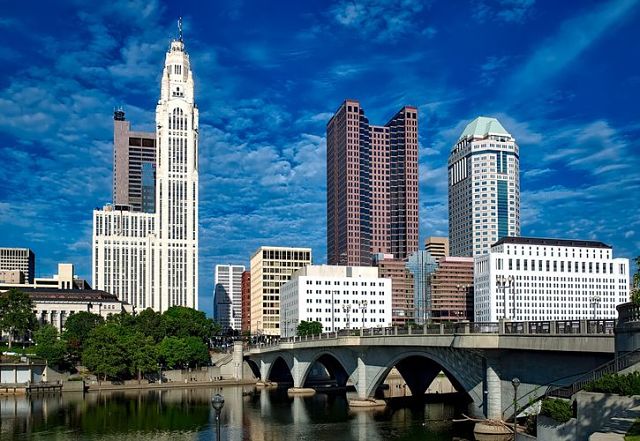
 Youssef Farhat spoke energetically about his life and the experiences of refugees and immigrants in Dayton, OH, in an impeccably organized office at the University of Dayton’s Human Rights Center. The charismatic 27-year-old graduate student from Lebanon is known around campus for his personable demeanor and palpable enthusiasm.
Farhat wants to immigrate to Dayton and hopes to use his talents to contribute to the U.S. Dayton certainly wants him; the Southwest Ohio city has implemented policies that encourage the population growth of refugees and immigrants.
However, President Donald Trump’s administration has implemented reforms that have affected many of these immigrant-friendly initiatives, making it more difficult for Dayton to attract an international population.
In 2011, the city established “Welcome Dayton,” a coordinated effort among the local government, nonprofits and the private sector to transform Dayton into a “Welcome City.” The community-based initiative has achieved great success. According to its website, naturalization among Dayton’s immigrant population increased by 41 percent between 2011 and 2013.
Refugees and immigrants in Dayton come from more than 100 countries, and the city received an “Outstanding Achievement” designation from the U.S. Conference of Mayors for “Welcome Dayton.”
While the native-born population of Dayton decreased by 15 percent from 2000 to 2010, the foreign-born population has more than doubled since the mid-2000s, helping to stem the population exodus.
Dayton is not a sanctuary city, but it has historically assisted with the relocation of refugees. The city hosts a community of 2,000-3,000 Ahiska Turks who fled persecution in their homeland. Dayton Mayor Nan Whaley also signaled the city’s intent to help in the relocation of Syrian refugees in September 2015.
Despite this, things are changing. Michael Murphy, the program director of refugee resettlement for Catholic Social Services (CSS) of the Miami Valley, said there has been a 15 percent decrease in refugees directly coming to Dayton, individuals referred to as initial arrivals. For fiscal year 2018, CSS is assisting 130 initial arrivals.
This local phenomenon reflects the Trump administration’s decision to allow only 45,000 refugees to resettle in the U.S., the lowest cap in decades.
Nevertheless, Murphy also reported a 20 to 30 percent increase in secondary migrants, refugees who initially resided elsewhere in the U.S., settling in Dayton. Murphy said this shows Dayton is achieving success in creating a diverse and welcoming community.
Farhat agrees Dayton is a welcoming city but also says social changes since the 2016 election are adversely affecting refugees and immigrants in Dayton.
“Not many employers are willing to invest in the talents of international students,” Farhat said. If he doesn’t find a job, his only option is to return to Lebanon. His student visa expires after he graduates.
Though federal reforms have affected refugees and immigrants in Dayton, community organizations remain committed to supporting the burgeoning international population of Dayton by assisting new arrivals and resettled individuals and families. Through their efforts, Dayton continues to be a “Welcome City,” regardless of the presidential administration.
– Sean Newhouse
Photo: Google

5 Development Projects in Angola
Due to the creation of these projects, Angola is moving forward and sparking development within the country. Angola is usually dependent on its oil, but as demand for oil changes so too does Angola’s market. With these development projects in Angola, the country can decrease the poverty faced by citizens.
– Dezanii Lewis
Photo: Flickr
Education in Tibet
The education of ethnic Tibetans is subsidized by the central government in People’s Republic of China. In the Tibet Autonomous Region, compulsory education in primary and secondary schools is executed in which the average educational period for individuals is 8.6 years, while preferential policies encourage young Tibetans to seek higher and more advanced education in and out of the autonomous region.
The distinguished achievements of education in the Tibet Autonomous Region of China comprises of several aspects. Kindergarten and preliminary schools are fast developing where the attendance of kids aged three to six had reached 52 percent until the end of 2013. Besides the great results from compulsory education in Tibet, education in high schools has been expanding and the scales of schools are continuously enlarging. The fast-development of high school education in Tibet is highly reliable on scientific planning, rational mapping, and have an active construction of education funds and reasonable allocations of teaching resources.
The autonomous regional government in Tibet also takes high concerns on sharing equal opportunities to children with disabilities, where schools with special support are given priority to these kids. In addition, the policy of covering all expenses on study and accommodations for children of herdsmen in Tibet are gradually improving while related treatments are continuously being enhanced since 1985.
However, despite the brilliant accomplishment of educational development in Tibet, due to various external difficulties and constraints, some apparent problems and barriers still exist and can be enumerated as follows:
First, the natural conditions in Tibet are harsh and this results in higher educational costs. Tibet is located in the roof of the world, with wide areas and sparse populations. It lacks oxygen in the plateau where the climate varies drastically with vast temperature differences between day and night. The construction and operational costs of schools are relatively high, as the budgets for schools in rural and pastoral areas are three to five times higher than the schools in the Mainland.
Second, the economic foundation and industrial development in Tibet are quite poor. Due to the smaller levels of revenue and resources, there is generally a gap in financial and social progress in Tibet. It is quite difficult for the majority of herdsmen in Tibet to increase their incomes. Hence, with respect to such kind of fiscal status, it would be difficult for Tibet itself to allocate sufficient funds to develop education.
In some areas of Tibet, the education concepts have placed constraints on the consolidation of development on compulsory education. There is also insufficient capacity of senior high school education which is becoming more and more prominent, and this will come back to have an impact on the future popularization, consolidation, and improvement of compulsory education in Tibet.
The third issue is related on the structural defects of training students in advanced education. It is rather hard to accumulate a large number of highly educated personnel in Tibet as for most areas, attracting and retaining talented professionals of all kinds are everlasting problems. This leads to an overall scarcity of high-end talents. Furthermore, the existing problems such as equality and quality of education, welfare towards poor families, and efficiency of education in Tibet also require intensive attention.
In early 2017, more than ten policy files were signed in Tibet on accelerating the reform and development of education in the Tibet autonomous region. These official documents clarified the tasks, policies and measures for the specific tasks on Tibet’s education progress in the 13th Five-Year Plan. Complementary education in addition to college enrolment will be prioritized for recorded poor families in Tibet. It is expected that penetration of bilingual education, as well as math and science curriculums with experimental classes will achieve 100 percent coverage in the compulsory teaching system. Technical schools in Tibet will also have to reach that goal. The five-year development plan aims to promote the healthy and rapid growth of education in Tibet.
Coming through the bottleneck and weaknesses of development, education in Tibet is improving in the current decade. Students of the next generation in Tibet are embracing a brand-new future.
– Xin Gao
Photo: Flickr
Perceptions of Water Quality in South Korea Today
Perceptions Today
According to The Korea Herald, in 2013, the Environmental Ministry conducted a survey of 12,000 South Koreans, and only 10 percent responded that they drank tap water, whether boiled or not. Meanwhile, 55 percent said they only drank tap water after boiling it.
This is despite experts’ opinions that Korean tap water is some of the best in the world. A 2003 United Nations report ranked water quality in South Korea as the eighth highest in the world, ahead of that in the United States (twelfth highest). Incidentally, in 2013, 82 percent of Americans surveyed indicated that they drank tap water.
Why the Disconnect?
Koreans, at least as of 2013, seem to be living in the past on this issue. According to The Korea Herald, 30 percent of those surveyed cited concerns about old water tanks and pipes for their wariness toward tap water, and 28 percent were worried about reservoir sanitation.
Indeed, those were once major issues. The World Bank reports that, in Korea, in “the late 1980s, accelerated urbanization took its toll, and surface and underground water bodies became polluted.”
Then, in the 1990s, the chemical phenol was leaked into the water supply, which caused severe illness to those who drank it. Meanwhile, several reported cases of ‘red water’ increased awareness of aging, rusting underground pipes.
But today, the same concerns are nonissues. Korea’s water and wastewater service are very nearly universal. The Korean government continually monitors tap water quality against a minimum of 59 criteria, including pH levels. Old public pipes have been replaced with new, rust-proof ones, and city governments have offered subsidies for people who want to replace pipes in their private residences.
The water is clean, say the experts. Pain can leave muscle memory, but in time even that fades. If Koreans continue to come together to demand only the highest standards from those they charge with regulating their water systems, they should have nothing to worry about when it comes to drinking tap water.
– Chuck Hasenauer
Photo: Flickr
Malawi’s Vaccination Promise
By 2020, the Immunization Alliance of partners plans to immunize 300 million children across the globe, in turn saving five to six million lives. AMP Health works with Ministries of Health to create better leaders and managers through skills training and will act as a foundation for guiding the progression of Malawi’s vaccination plan. Through AMP Health, the partners will help coordinate Malawi’s vaccination plan, as well as train staff and improve the performance of the immunization program.
The Center for Disease Control and Prevention (CDC), has also been working on strengthening the health system in Malawi and improving the efficiency and strategies of the system. In turn, more people can be vaccinated to prevent certain diseases, something that everyone around the world should have access to.
The main reasons why children in developing countries die are because of sicknesses like pneumonia, diarrhea, malaria, measles, HIV/AIDS and malnutrition. This is because in developing countries they are not able to have routine immunization, due to its unaffordability. Immunizations are the key to preventing premature death in developing countries like Malawi.
Vaccinations protect children from illnesses that can often result in amputation or even death. Vaccinations are safe and effective. If a child is not vaccinated they can spread diseases to other children that may be too young to be vaccinated, or have weakened immune systems. People who are more susceptible to contracting diseases could have serious complications or even death. The plan to vaccinate those living in Malawi is crucial to the health and well being of those living in and around the country.
– Chloe Turner
Photo: Flickr
Is the Discovery of Oil in Kenya Good or Bad News?
However, many people in Turkana do not see the oil in Kenya to be a glimmer of hope; rather, they fear that the new wells will contribute to conflicts over scarce pasture and water resources. Turkana is home to millions of pastoral animals that now have no access to pasture due to the oil rig installations, and they must be herded long distances to find drinkable water and a specific type of grass.
The oil in Kenya has also been said to be killing goats in the county and has caused a stench problem throughout some families’ homes, making it hard to live. The Kenyan government must address the consequences of the oil as well as Turkana residents’ feelings toward the oil to avoid intense conflict, violence or even a civil war.
Turkana, as a county, has been struggling with poverty and human development for many years. Turkana County has the highest maternal and infant mortality rate in the country, the lowest rates of education enrollment and the lowest life expectancy in Kenya. Turkana also suffers the worst of all the counties in Kenya from the ongoing drought that has now been recognized as a national disaster.
Furthermore, the United Nations and Kenyan government estimate that 2.7 million people in Kenya as a whole are facing a food shortage. With all of these struggles that both the country and Turkana County have been facing, it is easy to see why many people feel the oil in Kenya is a sign of hope for a better future. With regards to the infamous possibilities that could be Turkana’s future, as well as Kenya’s, it is important for the government to have regard for the animals, farmers and land.
– Chloe Turner
Photo: Flickr
10 Important Facts About the Crisis of Poverty in Zimbabwe
Following Zimbabwe’s independence, the economy, which was mainly supported by the agricultural industry, fell on tough times. In 2000, the government chose to instigate a policy of land redistribution from whites to native Africans. This reorganization placed the fate of the country’s economy in the hands of comparatively inexperienced farmers.
Cash crop production, once a huge contributor to the Gross Net Product, was nearly lost as a result of unyielding droughts. Additionally, those farmers who produced the dietary staple maize faced further difficulty in production, due to the government’s lack of support in areas such as water management.
To further demonstrate the severity of the country’s situation, look no further than the 72.3 percent of the population living in poverty in Zimbabwe.
10 facts to clarify the state of poverty in Zimbabwe
The question now is whether or not Zimbabwe will be able to improve its situation in the coming years. Unfortunately, with the economic growth rate dropping to just 0.5 percent between 2015 and 2016, there may be a need for an increase in external development aid if there is any hope of reversing the effects of poverty in Zimbabwe.
-Katarina Schrag
Photo: Flickr
Five Major Development Projects Reshaping Colombia
However, the Colombian government and other investors are attempting to reverse this situation, developing new projects in order to help the country’s economy to grow. New highways, ports, as well as advanced infrastructure and stylish developments in several Colombian cities will attempt to improve economy over the next 10 years. Here are the five development projects in Colombia that are changing the nation’s face.
The Colombian government has invested $230 million in modernization for the Alfonso Bonilla airport. The remodeled facility will have a new international terminal and six new boarding bridges. In addition, the old terminal was redesigned and new public spaces were added. In total, the airport located in Cali, one of the most important cities in Colombia, will be around 55,000 square meters. In Bogota, a $200 million investment has improved El Dorado airport’s landing zones and infrastructure. Now, it has better logistics that allows aircraft traffic to move faster.
In July 2017, the Colombian government approved an investment of $93 million for the Cartagena port. With this contribution, it is expected that the port will triple its cargo capacity thanks to the new infrastructure, better operation and giant cranes that can receive bigger vessels. President Santos defined the Cartagena port as the most important in the Colombian Caribbean, as in 2016, it moved around 201 million tons of cargo containers.
The new convention center, located in the capital city of Bogota, is the third biggest center in South America in terms of capacity and the most modern on the continent. In October 2017, the building held its first massive meeting for the United Nations First Young World; this left an economic impact of 14 million pesos for Colombia. Conventions and meetings generate 27 percent of Colombian tourism economy. The Agora project cost 414 million pesos and created 15,000 jobs in its construction.
Among all transportation development projects in Colombia, this particular one is essential. The new elevated railway is a local public transportation project that has been in planning for almost 15 years in Bogota. The first construction attempt was in 2000, but multiple government branches failed to reach an agreement. However, this year, President Santos’ administration and Bogota’s authorities revealed the construction will begin in 2018 and that the trains will be electric. It is expected that 35,000 Colombians will use the railway every hour. Authorities commented that the elevated railway construction will finish in 2024 and will be the first development of this kind in the country’s capital.
The 4G project is the most ambitious road infrastructure project in Colombia. The four generation plan will connect the entire country, making mobility easier and faster for citizens. More than 7,000 kilometers of roadway will be constructed and rehabilitated over the next several years with an investment of $50 billion. In addition, this project will work on bridges and tunnels that link the cities and towns over the mountains of the country. Projects such as Conexion Pacifico 3 and Girardort-Honda-Puerto Salgas have already begun.
These development projects in Colombia will positively affect the country’s future, improving the lives of Colombians as well as the Colombian economy. Although some projects are still in development, within the next 10 years, the Colombia will certainly be one of the most developed nations in South America.
– Dario Ledesma
Photo: Flickr
Women’s Empowerment in Libya
2011 was an inspiring time for Libyans. With the conclusion of Gaddafi’s rule, it was an opportune time to make changes to the political environment. The National Transitional Council, which was the first government authority after the Libyan Civil War, was comprised of 96 percent men and four percent women. There was also no representation of women in city councils at this time.
In 2014, the number of females elected to parliament was 16 percent, which it remains at to this day. Each city council was also mandated to elect at least one woman as one of their six members. However, the Zintan and Jadou councils have explicitly denied women representation.
The United Nations (U.N.) is taking action to increase women’s empowerment in Libya as well. The U.N. has made calls to force Libya to adopt a quota of 30 percent female representation within its current government, the Government of National Accord (GNA). As of March 2017, only six percent of the GNA were women. Hopefully, Libya will take these calls seriously and increase women’s representation in the government.
Along with increasing their political influence, Libyan women are focusing on becoming a more vocal force in the economic system of Libya. In October 2013, the Libya Women Economic Empowerment (LWEE) project was started to work towards providing women roles in the economy. Over the past four years, 200 women attended business development training and 300 women entrepreneurs were given specific training on business skills.
Not only did they teach women how to start their business, but they held a competition among women entrepreneurs. The 20 winners received grants that enabled them to start a brand new business or to expand an existing business. The LWEE also held events where female business owners and managers were able to network with each other and establish connections that would lead to future business partnerships and support.
It has been difficult for women to make a name for themselves in the business world. Since the implementation of the LWEE project, women entrepreneurs have been able to take full credit for the work they have done. This is such an important step since, in many cultures and societies, men are given credit for the accomplishments that women make. Women’s empowerment in Libya is on the rise and it will continue to do so for the foreseeable future.
– Scott Kesselring
Photo: Flickr
Refugees and Immigrants in Dayton, OH
Farhat wants to immigrate to Dayton and hopes to use his talents to contribute to the U.S. Dayton certainly wants him; the Southwest Ohio city has implemented policies that encourage the population growth of refugees and immigrants.
However, President Donald Trump’s administration has implemented reforms that have affected many of these immigrant-friendly initiatives, making it more difficult for Dayton to attract an international population.
In 2011, the city established “Welcome Dayton,” a coordinated effort among the local government, nonprofits and the private sector to transform Dayton into a “Welcome City.” The community-based initiative has achieved great success. According to its website, naturalization among Dayton’s immigrant population increased by 41 percent between 2011 and 2013.
Refugees and immigrants in Dayton come from more than 100 countries, and the city received an “Outstanding Achievement” designation from the U.S. Conference of Mayors for “Welcome Dayton.”
While the native-born population of Dayton decreased by 15 percent from 2000 to 2010, the foreign-born population has more than doubled since the mid-2000s, helping to stem the population exodus.
Dayton is not a sanctuary city, but it has historically assisted with the relocation of refugees. The city hosts a community of 2,000-3,000 Ahiska Turks who fled persecution in their homeland. Dayton Mayor Nan Whaley also signaled the city’s intent to help in the relocation of Syrian refugees in September 2015.
Despite this, things are changing. Michael Murphy, the program director of refugee resettlement for Catholic Social Services (CSS) of the Miami Valley, said there has been a 15 percent decrease in refugees directly coming to Dayton, individuals referred to as initial arrivals. For fiscal year 2018, CSS is assisting 130 initial arrivals.
This local phenomenon reflects the Trump administration’s decision to allow only 45,000 refugees to resettle in the U.S., the lowest cap in decades.
Nevertheless, Murphy also reported a 20 to 30 percent increase in secondary migrants, refugees who initially resided elsewhere in the U.S., settling in Dayton. Murphy said this shows Dayton is achieving success in creating a diverse and welcoming community.
Farhat agrees Dayton is a welcoming city but also says social changes since the 2016 election are adversely affecting refugees and immigrants in Dayton.
“Not many employers are willing to invest in the talents of international students,” Farhat said. If he doesn’t find a job, his only option is to return to Lebanon. His student visa expires after he graduates.
Though federal reforms have affected refugees and immigrants in Dayton, community organizations remain committed to supporting the burgeoning international population of Dayton by assisting new arrivals and resettled individuals and families. Through their efforts, Dayton continues to be a “Welcome City,” regardless of the presidential administration.
– Sean Newhouse
Photo: Google
Sierra Irrigation Project for Peru: Good News for Farmers
In 2010, the largest share of household income in the Sierra came from agriculture. There exists strong evidence that agriculture growth is more effective in reducing poverty than growth in other sectors. The Sierra Irrigation Project for Peru was implemented in order to bolster agricultural production and productivity in targeted areas of the Sierra with the ultimate goal of improving the financial capacity of impoverished farmers. The project is multifaceted, focusing on:
Since being established in 2010, the Sierra Irrigation Project for Peru has made significant contributions to the growing agricultural sector. The project successfully increased irrigation water flow and frequency and irrigation efficiency. Irrigation efficiency in the Peruvian Sierra in 2010 averaged about 22 percent, however, by 2016 that number was increased to 72 percent thanks largely to the Sierra Irrigation Project for Peru.
Modernization and rehabilitation efforts for collective irrigation systems expanded the reach of 87 water user organizations that improved their irrigation service delivery to 18,758 farmers. Those 18,758 farmers then irrigated 14,770 hectares of land. These numbers turn into a significant increase in water tariffs collections, improving financial capacity in the Peruvian Sierra; 80 percent of farmers paid water tariffs in 2016, compared to just 50 percent in 2011. Improved irrigation also allows farmers to increase the value and quality of their productions. A significant number of farmers who increased their irrigation capacity also began to farm high-value crops.
The Sierra Irrigation Project for Peru was successful with each of its goals and targeted beneficiaries. The priority was to most significantly benefit farmers by improving their access to markets and their capacity to produce high-value crops. The project was also able to benefit water user organizations at regional and local levels. The Ministry of Agriculture and Irrigation intends to develop a follow-up operation to scale up the results of the Sierra Irrigation Project for Peru.
– Jamie Enright
Photo: Flickr