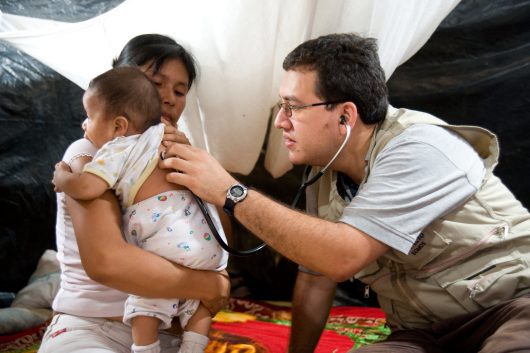
Citizens that live in poverty suffer from a multitude of diseases, but they do not have enough money or even the means of transportation to receive proper treatment. This makes the need for healthcare in Peru a top priority for missionaries and non-profit organizations.
Peru’s economy has been booming since the global financial crisis years back, but their government does not spend enough of its money on health care. Government spending on healthcare in Peru is about 5.5 percent, which is much lower than the United States at 17.1 percent, according to Healthcare Economist.
Healthcare In Peru
Peru is a country with approximately 31 million people, but MedLife reports that one-third of the population does not have access to basic health care. In rural parts of the country where poverty is more prominent, healthcare is even more inaccessible. The city of Cusco, which is the main destination for tourists, does not provide adequate healthcare services for citizens, so people are forced to travel to neighboring towns.
Peru Health reported that the leading cause of death among citizens in Peru is respiratory disease resulting from influenza and pneumonia with an average of 17,399 deaths per year. Most of the time these ailments are easily curable, but because of lack of access to proper healthcare, citizens in Peru are more vulnerable to these types of diseases.
HIV/AIDS is the fifth cause of death in Peru. It is estimated that there are 74,000 citizens in Peru currently living with HIV/AIDS and an estimated 5,046 people die from the disease each year. Tuberculosis is also a major threat to Peruvians, causing about 2,300 deaths a year, according to Peru Health. Because of high contagion rates, hospitals are likely to turn away patients if there are not enough safe rooms available.
Peru has one of the highest death rates for pregnant women in the Americas, according to Amnesty International. Indigenous pregnant women, who are living in poverty, are being denied access to basic healthcare. They don’t have access to emergency care or information about maternal healthcare, and there are not enough medical doctors who speak native indigenous languages making it even more of a challenge to receive healthcare in Peru.
Volunteers Around the World
Volunteers Around the World (VAW) is a non-profit organization that strives to provide medical and dental treatment, clean water and health education to citizens living in poverty in different countries around the world. VAW opened its medical outreach chapter in 2015 to serve the need for healthcare in Peru.
Senior at Augusta University, Zach Sweatman, went on a medical mission trip with Volunteers Around the World to Urcos, Peru. Sweatman and the other volunteers set up a clinic every day with an intake, vitals, consultation and pharmacy section in order to help with the need for healthcare in Peru. Sweatman said that the team provided free healthcare and pharmaceuticals to 100 patients every day for two weeks.
According to Sweatman, Urcos is a small farming and mining town about an hour and a half away from Cusco, where the closest hospital is. Citizens don’t have enough money for transportation to get medical assistance when they fall ill, so they have to either fight it off with their immune system or, in severe cases, die. Sweatman also added that sanitary conditions in the area are a large part of the problem because of the parasites and other bacteria in the water.
Even though Peru is mostly a middle-class nation, the parts of the country that are still poverty-stricken suffer from inaccessible healthcare. Missionaries like Sweatman and Volunteers Around the World travel to Peru each year to help improve the healthcare conditions in the country.
– McKenzie Hamby
Photo: Flickr

Five Eco-Friendly Measures Combat Poverty
A common complaint about pro-environment actions is the cost they pose to the economy. But worldwide, eco-friendly measures combat poverty in new and sustainable ways. A clear link exists between environmental degradation and poverty, as a feedback loop is created between the two circumstances: by focusing on the environment, the world’s poor can also benefit. Several strategies have already been implemented with proven results that demonstrate that environmentalism can benefit the impoverished.
Five Ways Environmentalism Fights Poverty
Green energy provides new jobs and opens up markets that were previously not beneficial. Additionally, according to The World Bank, pollution “stunts economic growth and exacerbates poverty and inequality in both urban and rural areas.” Poor people often feel the effects of pollution most severely since they cannot afford measures to protect themselves. Green energy lessens pollution and can provide relief to suffering communities.
More than 1 billion people worldwide depend, to some extent, on forest-based assets for their livelihood. Low-income countries feel the effects of environmental problems more intensely, as environment-based wealth accounts for 25 percent of total wealth in such areas. In the Democratic Republic of the Congo, warring parties depleted natural resources so that, according to the U.N. Security Counsel’s 2001 discussion, “The only loser in this huge business venture is the Congolese people.” Eco-friendly measures combat poverty in these cases by ensuring a community’s source of income does not disappear.
Globally, cooperatives have arisen that have produced organic food for markets everywhere and “revitalized traditional agricultural systems with new technologies.” Low-income communities producing organic and fair-trade coffee like this have created a rapidly growing niche market that is both sustainable and environmentally conscious. Additionally, many industries can create sustainable jobs for lower-income individuals by focusing on the environment. A Madagascar shrimp processing company created 1,200 permanent new jobs and focuses on keeping those jobs long-term by ensuring that the shrimp population in the area remains healthy. Such policies benefit all parties involved: the company, the environment and the impoverished.
A substantial concern in impoverished countries is developing ways to reuse scarce resources such as water. 99 percent of the time, death due to not enough water or unsafe water takes place in developing countries. In India, the company Banka BioLoo is placing more than 300,000 eco-friendly toilets in low-income areas, which creates jobs and eliminates harmful waste while providing desperately needed sanitation. The by-products of their system include water for gardening and methane gas for fuel. This innovative design is just one of many examples of how eco-friendly measures combat poverty and can improve human health.
Governments can play a big role in combating poverty and protecting the environment with just one action. Corruption can often lead to inter-country conflict, which harms both the environment and the poor. Access to information and legal frameworks, as well as sanctions imposed by organizations like the U.N., can improve the situation in areas plagued by corruption.
These efforts require the non-poor and poor to work together. Since the non-poor have higher consumption levels, the degradation of the environment by poor people is often “due to the poor being denied their rights to natural resources by wealthier elites and, in many cases, being pushed onto marginal lands more prone to degradation.” However, the situation promises hope for the future; by working together, wealthier people have the ability to reduce environmental threats, and poor people often have the technical ability to manage resources. Together, these eco-friendly measures combat poverty.
– Grace Gay
Photo: Flickr
How the Media Misrepresents Bulgaria
Whenever Bulgaria is mentioned in the media, coverage is generally skewed towards poverty and corruption, depicting it as one of the EU’s most troubled members. However, a closer look at the facts and figures of life in Bulgaria proves that how the media misrepresents Bulgaria does not entirely reflect reality.
Bulgaria and the EU
Bulgaria is the poorest member of the EU. This fact has not escaped the notice of the rest of Europe, and Bulgaria’s media representation has suffered for it. A 1984 study performed by Weaver and shows that the poorer a country is, the less coverage it is likely to gain in any given news outlet, and the more negative that coverage is liable to be. In contrast, richer countries such as the U.S. are much more likely to receive positive media attention, overshadowing poorer nations like Bulgaria.
Bulgaria in the Media
When the media mentions Bulgaria, it paints it as a corrupt Eastern European country that the rest of the EU wants nothing to do with. Media biases against Bulgaria frequently stem from the fact that Bulgaria was once part of the Soviet Bloc. After the collapse of the Soviet Union in 1991, Bulgarians struggled to adjust to the fact that their country was no longer Communist, and it was not uncommon for Bulgarians to migrate west to try for a fresh start. However, they were often met with fear from their new neighbors, mostly due to their status as ex-Communists whose government was still somewhat corrupt and were subsequently dehumanized by many Western European nations. For example, Bulgaria has repeatedly been denied admission to the Schengen Zone, which would permit Bulgarians to work and travel freely in fellow Schengen countries within the EU. This, combined with the country’s comparatively low GDP, has led to media depictions in which they are given the same derogatory treatment that migrants are typically given by news outlets.
Bulgaria and the Rest of the World
How the media misrepresents Bulgaria becomes apparent when examining the economic and political conditions in Bulgaria. For starters, Bulgaria’s GDP is currently $18,900, having risen from $8.400 in 1991. Although this is, in fact, fairly low by EU standards, it is not low when thought of in the context of the rest of the world. The world is split into four income groups, ranging from Group One (extreme poverty) to Group Four (the U.S. standard). Bulgaria falls into Group Three (upper middle income); most of its people can afford decent beds, bikes, and maybe cheap cars, but not annual vacations or spacious houses. The average person is getting about 6570 kilowatt-hours of electricity, 48 percent of them have Internet access, and 99.4 percent have access to clean drinking water. In fact, as of 2014, no one in Bulgaria is living in extreme poverty. Meanwhile, the rest of the EU’s citizens are scattered throughout Groups 3 and 4.
Corruption in Bulgaria is also not as abundant as the media portrays it. For example, the Inequality Index (Gini) rated Bulgaria around 40, which is in the middle of the scale. Their first elections took place in 1990, and their current democracy score is 9 out of 10.
Overall, things are looking much better in Bulgaria than the media lets on. While the media would let its consumers believe that Bulgaria is a hopeless case of corruption and poverty, it is actually a free nation with a thriving economy. If one looks hard enough, one will find that how the media misrepresents Bulgaria is a true misrepresentation and nothing more.
– Cassie Parvaz
Photo: Flickr
Delving Deep: 10 Facts About Human Rights in Colombia
Colombia has various laws to prevent human rights violations; unfortunately, these laws often go ignored and are broken. Colombia is commonly referred to as the country with the ‘worst human rights record in the western hemisphere,’ but there’s always more to a story than popular taglines. Here are 10 facts about human rights in Columbia.
10 Facts about Human Rights in Columbia
A Brighter Future
Colombia has one of the worst human rights violations records in the western hemisphere. Despite such a reputation, the situation has improved since the end of the civil war, and the government is continuing to work towards a better future for the country.
– Amelia Merchant
Photo: Flickr
The Fight for Improved Maternal Healthcare in Mexico
Eight years ago, The Economist, a British business publication, described maternal healthcare in Mexico as “a perilous journey.” Although deaths in labor had decreased by over a third in the past 20 years, they still remained among the highest in Latin America. Preventable complications were common among women, especially those of indigenous descent, largely as a result of infrastructural and social challenges.
Maternal Mortality
Since then, substantial effort has been put into solving this problem, especially in anticipation of the 2015 Millennial Development Goals. Globally, maternal mortality is often the result of wider social problems related to extreme poverty. It especially affects poor rural women who lack access to modern medical facilities. Solving maternal mortality in Mexico requires implementing a wider health infrastructure that serves these disenfranchised groups.
In Mexico, one of the groups most vulnerable to labor complications is girls under fifteen years old. This is not a generational issue, but rather a result of the dangers of underdeveloped girls giving birth. Twenty percent of Mexican births annually are a result of teenage pregnancy. Half of the sexually active teenage girls in Mexico become pregnant and 11,000 of Mexico’s births each year are to mothers between 10 and 14 years old.
While a proportion of these teenage pregnancies are the result of consensual encounters, some of them are the result of chronic child sexual abuse. One study found that a third of Mexican girls (and about a fifth of Mexican boys) had experienced sexual assault. Unfortunately, comprehensive statistics on the sexual abuse of children are relatively rare for developing countries, but it is likely that these high rates contribute to the phenomena of teenage pregnancy in Mexico.
Teenage Pregnancy and Healthcare Improvements
Ultimately, the key to achieving better maternal healthcare in Mexico lies in preventing teenage pregnancy and providing healthcare infrastructure. On the latter, the Mexican government has already established several programs targeting the country’s rural poor such as the Oportunidades (Opportunities) program, and additional support from the Mexican social security program. Specific programs, such as PRONTO, train hospital staff to intervene in dangerous labors and have shown to help reduce maternal mortality.
However, the Mexican government has taken little action against ending teenage pregnancy. This represents a major blindspot in the path towards achieving improved maternal healthcare in Mexico.
Maternal mortality and labor complications are especially common among young mothers; mothers under 15 are twice as likely to die in labor as older mothers. Their babies are more likely to die as well. Many of these teenage pregnancies could be prevented with education and awareness programs, but most of Mexico’s initiatives are geared towards older girls.
Supporting Maternal Healthcare
Several NGOs have taken initiative in reducing Mexican maternal mortality both by tackling infrastructure issues and generational sexual abuse. Conferences such as this year’s International Best Practices Meeting bring together experts from various fields and international organizations to discuss the issue.
Specifically, the role of midwives in the prevention of labor complications has also been reinforced in Mexican society. Such a prioritization could increase women’s access to maternal healthcare in Mexico, especially in rural areas.
Ultimately, despite the challenges facing Mexican mothers, there is hope that the danger of pregnancy in the country can be further reduced. Improved maternal healthcare in Mexico can be achieved with infrastructure and education, factors that also help combat extreme poverty in the country; only then, can Mexico truly achieve its development goals.
– Lydia Cardwell
Photo: Flickr
What Exactly is Hunger?
Hunger is an easy enough concept to imagine. Most people in the world have experienced it at some level or maybe even gone an entire day without food. But what is hunger at a global level? When starvation and malnutrition are discussed, there is a major gap between the conception of hunger and how those without access to food experience it. In the end, hunger is a systemic problem in people’s lives; those who suffer from it are unable to consistently achieve proper nutrition and face food insecurity.
Facts and Figures
Hunger still affects more than 800 million world citizens. This number reflects about one in every nine people worldwide. Starvation and malnutrition are most common in developing countries, where 12.9 percent of the population suffers from undernourishment. The continent of Asia contains the highest number of hungry people, while Sub-Saharan Africa has the highest prevalence of malnutrition – one person in every four faces undernourishment.
Famine: Extreme Hunger
The most extreme cases of hunger on a public scale are famines, where an excess of deaths occurs as a result of starvation or hunger-induced diseases. These diseases are often preventable with a proper diet, but although there is an excess of food worldwide, starvation and malnutrition originate in that food being inaccessible. Lack of access is often caused by a insufficient funding and war within an area, as seen in the South Sudan famine declared by the U.N. in February of 2017.
In daily life for undernourished people, hunger takes the form of reduced meals. In 2011, a drought in a Kenyan herding community caused sickly animals. As a result of not being able to afford enough to eat, one woman’s family was forced to cut back to just one or two meals per day as opposed to three. They also could no longer afford “luxuries” like milk. Even with access to water, there is no money to buy food if crops and animals cannot produce.
The Costs of Hunger
New research shows that generations down the line will also be impacted by the costs of starvation. While it is well-known that young children are often the most vulnerable to malnutrition, Columbia University’s 2014 study of genes in roundworms after an initial starved generation found that small changes in an organism’s molecular makeup due to its health can be passed on. This means that even after hunger has been reduced, future generations may still see its effects in their own lives.
Combating Hunger
Fortunately, famine and malnutrition rates have decreased. The Global Goals of Sustainable Development include ending starvation and creating food security and sustainable farming as its number two goal, set to be achieved by 2030. The best strategies for ending hunger are supporting small farmers, targeting infant nutrition and utilizing biotechnology in crop creation.
Additionally, legislative action in the United States Congress is working toward alleviating starvation worldwide. The Food for Peace Modernization currently seeks to make the Food for Peace program more efficient – at no cost to taxpayers – so that it can provide food to nearly nine million more people. Understanding what hunger is can create measures like this worldwide and offer new chances for those suffering from hunger to find relief.
– Grace Gay
Photo: Flickr
The Need for Healthcare in Peru
Citizens that live in poverty suffer from a multitude of diseases, but they do not have enough money or even the means of transportation to receive proper treatment. This makes the need for healthcare in Peru a top priority for missionaries and non-profit organizations.
Peru’s economy has been booming since the global financial crisis years back, but their government does not spend enough of its money on health care. Government spending on healthcare in Peru is about 5.5 percent, which is much lower than the United States at 17.1 percent, according to Healthcare Economist.
Healthcare In Peru
Peru is a country with approximately 31 million people, but MedLife reports that one-third of the population does not have access to basic health care. In rural parts of the country where poverty is more prominent, healthcare is even more inaccessible. The city of Cusco, which is the main destination for tourists, does not provide adequate healthcare services for citizens, so people are forced to travel to neighboring towns.
Peru Health reported that the leading cause of death among citizens in Peru is respiratory disease resulting from influenza and pneumonia with an average of 17,399 deaths per year. Most of the time these ailments are easily curable, but because of lack of access to proper healthcare, citizens in Peru are more vulnerable to these types of diseases.
HIV/AIDS is the fifth cause of death in Peru. It is estimated that there are 74,000 citizens in Peru currently living with HIV/AIDS and an estimated 5,046 people die from the disease each year. Tuberculosis is also a major threat to Peruvians, causing about 2,300 deaths a year, according to Peru Health. Because of high contagion rates, hospitals are likely to turn away patients if there are not enough safe rooms available.
Peru has one of the highest death rates for pregnant women in the Americas, according to Amnesty International. Indigenous pregnant women, who are living in poverty, are being denied access to basic healthcare. They don’t have access to emergency care or information about maternal healthcare, and there are not enough medical doctors who speak native indigenous languages making it even more of a challenge to receive healthcare in Peru.
Volunteers Around the World
Volunteers Around the World (VAW) is a non-profit organization that strives to provide medical and dental treatment, clean water and health education to citizens living in poverty in different countries around the world. VAW opened its medical outreach chapter in 2015 to serve the need for healthcare in Peru.
Senior at Augusta University, Zach Sweatman, went on a medical mission trip with Volunteers Around the World to Urcos, Peru. Sweatman and the other volunteers set up a clinic every day with an intake, vitals, consultation and pharmacy section in order to help with the need for healthcare in Peru. Sweatman said that the team provided free healthcare and pharmaceuticals to 100 patients every day for two weeks.
According to Sweatman, Urcos is a small farming and mining town about an hour and a half away from Cusco, where the closest hospital is. Citizens don’t have enough money for transportation to get medical assistance when they fall ill, so they have to either fight it off with their immune system or, in severe cases, die. Sweatman also added that sanitary conditions in the area are a large part of the problem because of the parasites and other bacteria in the water.
Even though Peru is mostly a middle-class nation, the parts of the country that are still poverty-stricken suffer from inaccessible healthcare. Missionaries like Sweatman and Volunteers Around the World travel to Peru each year to help improve the healthcare conditions in the country.
– McKenzie Hamby
Photo: Flickr
10 Crucial Facts About Human Rights in Thailand
Thailand, a country in Southeast Asia with a population of approximately 68.8 million, is undergoing a human rights crisis. In May 2014, a military coup d`état occurred, signaling additional political instability and human rights violations within the nation. Here are top 10 facts about human rights in Thailand.
10 Facts About Human Rights in Thailand
Thai Progress in Human Rights
The Thai government agreed to ratify the Optional Protocol to the Convention against torture. This agreement was recorded by the Universal Period Review. The agreement is a step in the right direction.
Although the top 10 facts about human rights in Thailand are of great concern, future improvements can be seen through Thailand’s acknowledgment of recommendations by the Universal Period Review. In addition, Thailand’s poverty headcount ratio has since declined from 42.3 percent in 2000 to 10.5 percent in 2014, a fact geared towards a more optimistic future.
– Christine Leung
Photo: Flickr
How an Individual’s Impact on Poverty Reduction Can Make a Difference
The Borgen Project was started with one person who wanted to make a difference. Clint Borgen started his endeavor to create The Borgen Project after seeing the poverty and conflict during the genocide in Kosovo. When he returned, he moved to Alaska to join a fishing expedition in order to make money to start his organization. The Borgen Project started with one person’s bold ideas and passionate heart setting to eradicate global poverty. There are many other ambitious individuals, like Clint Borgen, that have started organizations focusing on reducing poverty. The following organizations show how an individual’s impact on poverty reduction can generate a movement leading to organizations that work toward a world with less poverty.
These organizations, founded by only one or two people, represent how an individual’s impact on poverty reduction by ordinary people can generate change in the world. Clint Borgen, Bono, Bobby Shriver, John and Kay O’Loughlin-Kennedy and Mildred Robbins Leet exemplify the possibility of how one person can make a huge impact. These individuals are a testament to grassroots movements and why each person should feel empowered to make a difference.
– Jenna Walmer
Photo: Flickr
Top 10 Facts about Human Rights in Mexico
Mexico has been in a state of violence for the past couple of years. Since former Mexican president Felipe Calderón initiated Mexico’s war on drugs, there have been considerable violations committed by soldiers and police. Many of these operations involved extrajudicial executions by the military. These 10 facts about human rights in Mexico will be informative about the degree of human rights violations people in Mexico have been experiencing in the past couple of years.
10 Facts About Human Rights in Mexico
These facts about human rights in Mexico serve to give a closer look at the variety of violations committed against its citizens. Besides the facts listed above. The government has made small strides in the prosecution process of holding accountable those responsible for the various crimes that violate human rights. In 2016, the U.S. Secretary of State confirmed that Mexico had made improvements in protecting human rights, earning its Mérida aid of nearly $155 million.
– Alyssa Hannam
Photo: Flickr
Top 10 Facts about Poverty in Greece
Although Greece may be known for its crystal clear blue waters, luxurious islands and fascinating ancient architecture, it is currently going through one of its greatest economic crises in Greek history. Here are the top 10 facts about poverty in Greece:
Top 10 Facts about Poverty in Greece
These top 10 facts about poverty in Greece are important to know in order to understand the impact economic crises has on its citizens. Although Greece is starting to recover from its crisis, they still have a long way to go.
Photo: Flickr
– Ariane Komyati