Water is one of the most vital ingredients for all life, yet many people across the globe still live without the assurance of safe & clean water. Here are the five most water-scarce countries, and five groups working to help them.
Yemen
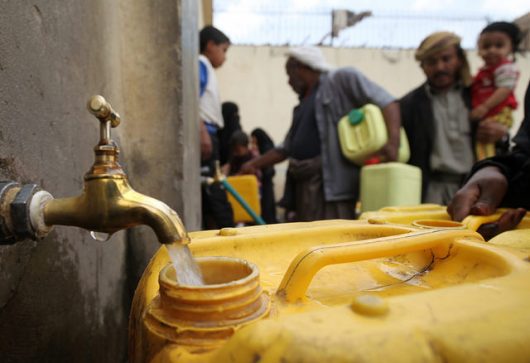
As conflict in Yemen has escalated to bombings, ground fighting and fuel shortages, 19.3 million citizens have been left without access to water. This has caused an outbreak of diseases such as cholera and Acute Watery Diarrhea, especially in the country’s capital, Sana’a. As people continue to be cut off from basic necessities by the conflict, the need for water becomes increasingly dire.
Who’s Helping: UNICEF.
In response to the crisis in Yemen, UNICEF has increased its efforts within the country’s borders. The organization has provided fuel to local water corporations in order to reestablish the water reserve. Additionally, UNICEF is also providing fuel to assist in ridding the streets of waste and creating more sanitary cities. If that were not enough, toilets and water points have also been repaired at over 300 schools. Water tanks and temporary toilets have been constructed in the most rural areas of Yemen, giving communities and numerous displaced families the vital resources they so desperately need.
Libya
As a nation consumed by the desert, water in Libya is continually scarce making it one of the most water-scarce countries in the world. The country sees very little rainfall each year and is forced to rely on an ever-dwindling supply of groundwater to both irrigate the land and nourish citizens.
As demand for water grows, groundwater supplies cannot last, especially as many coastal aquifers are infiltrated by seawater and become salinized.
Who’s Helping: The Great Man-Made River Project.
To combat this problem, the Libyan government launched The Great Man-Made River Project in 1984. This endeavor is an enormous engineering project designed to supply water from desert aquifers to more populated coastal regions. Although construction is ongoing, the project has already had a massive impact on the country as people in need can now access water. However, the life of the project is unknowable (as it depends entirely on how quickly the water is pumped) and the aquifer is a non-renewable source of water.
Jordan
It is no surprise that Jordan is one of the most water-scarce countries on the planet, as it has one of the lowest levels of water availability on earth.
The nation has struggled for years to provide water to its citizens, and as the Syrian crisis has now caused an influx of refugees, there is not enough water to sustain the dramatically enlarged population. As an agrarian society, the lack of water causes all aspects of life in Jordan to come to a screeching halt.
Who’s Helping: USAID in partnership with the government of Jordan.
Since 2000, USAID has invested over $700 million towards restoring Jordan’s water supply. The initiatives put in place assist the Jordanian government in developing a more advanced water infrastructure, decreasing water loss and conserving the little water available.
Western Sahara
Situated on the northwest coast of Africa, Western Sahara is officially considered a non-self governing territory, though Morocco has laid claim to the land. The hot, dry desert land sees infrequent rainfall, and water is increasingly sparse.
Due to the fact that the land is continually plagued with sovereignty issues and Western Sahara is not an established nation, there is little infrastructure that would improve water supply.
Who’s Helping: The Mission for a Referendum in Western Sahara (MINURSO).
MINURSO was established in April of 1991 with a purpose of monitoring a ceasefire with Morocco and allowing Western Sahara to choose to be integrated into Morocco or become independent. Western Sahara and Morocco have failed to come to an agreement yet, but MINURSO still persists.
The group has implemented various measures to improve water and sanitation in the area and continues to monitor the security of the region. However, as conflict between natives and Moroccans persist, safety concerns keep other organizations that can help from entering the territory.
Djibouti
Djibouti is another one of the most water-scarce countries in the world and — not unlike the other countries on this list — is an arid desert. With only 0.3 cubic kilometers of renewable water resources in the entire country, Djibouti is unable to irrigate the majority of the land or provide adequately for citizens.
Ironically, the country also suffers from severe flooding that has caused millions of dollars in damages. What little structure the country has for maintaining water supplies is destroyed by the intense floods.
Who’s Helping: World Bank and the Global Facility for Disaster Reduction and Recovery (GDFRR).
Since 2007, both the World Bank and GDFRR have helped Djibouti create and sustain a water infrastructure. A donation of $3 million was used to establish a project that manages water resources in rural areas. Additionally, the groups seek to help Djibouti better prepare for disasters by improving weather monitoring systems, updating emergency plans and establishing early warning systems for both floods and droughts.
As the most water-scarce countries on the planet continue to fight for a basic necessity, these five groups will continue to make lives better through the power of clean water.
– Sarah Dean
Photo: Flickr

Five Creative Ways to Fight Human Trafficking
When one mentions the word ‘slavery,’ many people think back to the darker days of American history; they lament this tragedy and sigh with relief that slavery is over. But in reality, an estimated 27 million people are still enslaved today — this number surpasses the total number of slaves transported during 400 years of the trans-Atlantic slave trade. Human traffickers today coerce people of all shapes and sizes, men, women, and children, into all different types of slavery. To help end this ever-present problem, here are five creative ways to fight human trafficking.
Get educated with the book “Sold” by Patricia McCormick.
“Sold” by Patricia McCormick is the fictional story of a 13-year-old Nepali girl named Lakshmi who is sold by her family into sex slavery. McCormick captures both Lakshmi’s innocence and the horror of her circumstance in a beautifully written, verse novel. Despite the book’s heavy content, it is considered a children’s novel (recommended for ages 12 and up) as McCormick’s desire was to activate and inspire the next generation to act rather than scar.
Easy to understand, well-researched and heartbreaking, “Sold” is the perfect novel to read to better comprehend and empathize with victims of human trafficking.
Be an advocate for change with your political representatives.
Despite what many Americans believe, reaching out to political leaders is incredibly simple, and representatives really do want to hear from their constituents. Speak up and advocate on behalf of those who cannot for themselves by letting delegates know that they should fight against human trafficking and make it a priority.
Give them a call, send an email or schedule a meeting to show just how important this issue is and why it should be important to them.
Use social media to inform your circle of influence.
One of the simpler creative ways to fight human trafficking is to simply post on social media. Whether it be Facebook, Instagram, Twitter or any other myriad of social media outlets, sharing a helpful Ted Talk, graphic or simply reiterating some of the facts can get others involved.
Everyone has a sphere of influence, so utilize one of the best ways to connect with them by taking to social media.
Make a conscious decision to avoid products by some of the biggest companies in America.
Some of America’s biggest brands benefit from and exploit the use of slave labor in making their products. Nestle, Hershey’s, Walmart and H&M are all massive companies and some of the most notorious offenders. What will get the attention of these big businesses?
Stop using their products and frequenting their stores. Hit these companies where it will hurt the most – their profits. In a society that thrives in a competitive marketplace, consumers can demand ethical practices by simply refusing to buy anything from corporations that benefit from human trafficking.
Stay positive.
It is all too easy to become discouraged when fighting a human rights violation as widespread and horrific as human trafficking. Do not give up. As people continue to implement these small changes and make it clear that this kind of unethical behavior will not be tolerated, change will come. Look for the changes that are already happening and focus on what can be controlled and done to create change.
As the battle to end slavery rages on, these five creative ways to fight human trafficking can help make small, constructive changes for the good of others.
– Sarah Dean
Photo: Flickr
10 Facts About Poverty in Laos That Everyone Should Know
Laos, officially known as the Lao People’s Democratic, is the only landlocked country in Southeast Asia. Ranked as one of the most corrupt countries in the world by Transparency International, Laos also suffers from major poverty. To get a better understanding of the daily struggle in Laos, below are 10 facts about poverty in Laos.
10 Facts About Poverty in Laos
Hardship and Progress
These top 10 facts about poverty in Laos illustrate the struggles and hardships that Laos people face daily. However, despite being one of the poorest countries in Southeast Asia and the entire world, about half a million of Laos people have been lifted out of poverty thus far.
Fortunately, the United States and Laos continue to rebuild a relationship with each other with a goal of saving lives and rebuilding a better country for the Laos people.
– Kristen Uedoi
Photo: Flickr
Facts About Advancements in Agriculture in India
For decades, agriculture has played a key role in India’s socioeconomic growth. India is the second largest contributor of agriculture in the world with around 50 percent of people in India making their living from farming. But recently, farming has started to become less attractive, and more people are moving to big cities for different job opportunities. A decrease in water levels and poor crop yields have made it difficult to promote the growth of agriculture in India. Several organizations are stepping up to help turn things around and create new advancements in agriculture in India.
Advancements in Agriculture in India
Because of companies such as DuPont India and NSL, agriculture in India is able to continue to grow and be one of the largest farming contributors in the world. The entirety of India’s population is reliant on having a cohesive system of agriculture, whether it is their source of income or not. In fact, the whole world benefits from the advancements in agriculture in India; therefore, being educated in innovative, new technologies and changes in the field is incredibly important.
– Allisa Rumreich
Photo: Flickr
How FGM/C and Poverty Are Clearly Connected
Female Genital Mutilation/Cutting (FGM/C) is a practice that has occurred for generations — a female, often in childhood, is subjected to some form of cutting to her genitalia in the promotion of religious following and the detraction of desire for sexual interaction. Its purpose is to reduce sexual desire in women, thereby making them less likely to be interested in intercourse outside of marriage. It is also highly symbolic to many groups of people who practice it as a religious necessity; however, there is no known religion that demands this practice.
FGM/C and Poverty
FGM/C and poverty are connected in developing countries as the girls who undergo FGM/C are often from poor families who are then married as children, never continue their education and subsequently repeat the cycle of poverty. Recently, there has been a decline in FGM/C practitioners, which should lead to lower levels of extreme poverty on an individual basis.
Countries such as Burkina Faso, Egypt, Kenya, Liberia and Togo have experienced a decline in FGM/C prevalence, with Egypt reducing prevalence from 69 percent to 55 percent between ages of 2005 and 2014. As the correlation with lower education becomes more well-known, it can be inferred that the decline in FGM/C victims has led to a higher attendance rate for girls at school, which can, in turn, affect the poverty in the region.
Millennium Development Goals
The Millennium Development Goals (MDGs), a program designed to create social equality throughout the world, works to end poverty in developing countries. A primary focus of the organization is to work to end FGM/C and poverty because the list of side effects and results of the practice leave women often unable to contribute in their society because they are traumatized, physically incapacitated, unable to maintain strength and nutrition, and in some cases, do not survive the procedure.
When injuries or death result, the cost of caring for these women or paying for their funeral causes strain on family members and communities. Such a responsibility can, in turn, increase the poverty issues already at play. Disability due to the trauma from FGM/C can also lead to a woman’s decreased productivity level, thereby bringing in less money for the family and continuing the cycle of poverty.
The Beginning of the End
The decline of the practice is increasing in developing countries, with more people wanting FGM/C to end. In 2010, a Burkina Faso survey determined that 90.6 percent of women wanted FGM/C to end, a staggering increase from 75.1 percent in 1999. With such a trend beginning, countries should encourage education, discourage FGM/C and lower the poverty levels by introducing a new way of thinking.
FGM/C and poverty are both declining, but it can be agreed that the decline is not occurring quickly enough. More must be done to protect young girls from the sexual alterations that are often completed without consent.
By not cutting into perfectly healthy and innocent girls, developing nations can promote a stronger and healthier workforce. FGM/C and poverty are connected, and one cannot be reduced in isolation — it is imperative that both be tackled to end the other.
– Kayleigh Mattoon
Photo: Flickr
What is Poverty? Difficult and Complex
The task of defining poverty, multidimensional and complex, requires an evaluation of factors relating to a person’s access to basic human necessities. ‘Poverty’ is a widely interpreted term, and attempting to create a universal, encompassing definition remains a topic of debate for many leading experts in the field.
Defining Poverty
What is poverty? Poverty is not knowing where your next meal will come from, or if there will be the next meal. Poverty is a lack of education, not knowing how to read or write. Poverty is being sick and not having access to medical care, or knowing that your child will likely die due to lack of medication and proper treatment. Poverty is being unemployed, fearing what comes next and fearing the future.
Poverty’s many faces rear their heads in every aspect of life. Poverty is something from which one yearns to escape, and the range of experiences with poverty vary by location and place in time.
For these reasons, The Borgen Project’s approach to advocating for the global poor delves into wide-ranging topics from many different angles. Pervasive and convoluted, poverty affects people on more than an economic level. Lack of income and infrastructure in a nation leads to insufficient medical care, education, nutrition and other quality of life deficits.
The Cycle of Poverty
Poverty also functions as a cycle and continues generationally. Once an individual, family or community falls below a level of resource-access, events continue like dominoes to perpetuate their situation: “progressively lower levels of education and training leading to lack of employment opportunities, leading to criminal activity for survival, leading to addiction, shattered health, early death, and breakup of family, leading to even bleaker future for the next generation…. and so on.”
Someone, or something, must intervene and structurally change the systems to interrupt the cyclical nature of poverty. The common phrase perpetuated by American Dream ideology of “pulling yourself up by your bootstraps” is impossible when institutional structures ingrained in many societies prohibit those caught in this cycle from breaking out.
Poverty and Foreign Aid
Many U.S. citizens criticize provision of foreign aid, arguing that there are impoverished citizens within the U.S. that deserve support more than those abroad. This argument is valid; however, many Americans believe that 20 percent of the U.S. budget goes to foreign aid, which is blatantly false.
In fact, less than 1 percent goes to help the global poor, which is far less than many countries contribute. In addition, helping the world’s impoverished strengthens global stability and improves trade, which, in turn, benefits Americans. Poverty is relative; an American living in Appalachia who has classified as impoverished lives a much different lifestyle than one living in rural Romania in a hut without running water, electricity or access to nutritious food.
The fact that poverty exists and permeates groups so deeply is a call to action for every single person across the globe. It is the reason that advocacy organizations like The Borgen Project exist: so that one day, hopefully in the near future, every citizen of this planet will have access to basic necessities like having enough to eat, a roof over their heads, a place to learn, healthcare, protection from violent conflict and a voice that is heard in their communities.
Fighting Poverty
We can change the world for the better. A few small actions can cause waves of difference that will reshape the lives of many, and this influential process starts by calling on the U.S. government to change their foreign policy and provide more aid to countries with severe poverty. Calling and emailing your representatives may seem intimidating, but it is easier than you think.
Asking governmental officials to support bills like the International Affairs Budget, the Global Food Security Reauthorization Act, the Build Act and the Food for Peace Modernization Act can have an enormous impact. Phone calls and emails from constituents are simple, small actions that do make a difference. Contact Congress and make a difference to fight poverty today.
– Jilly Fox
Photo: Unsplash
The Growing Markets in Lagos, Nigeria
Nigeria is often associated with a stagnant economy riddled with corruption; however, Lagos, the country’s largest city, hosts business opportunities that are continually growing, making it one of Africa’s largest rising economies. Lagos is currently Africa’s seventh largest economy, and its rapid rise in GDP and population have the city projected to become the continent’s second largest market by 2035. The growing markets in Lagos have boosted Nigeria’s economy and have set an example in a continent full of market opportunities.
Economy and Population in Lagos
The GDP and population growth of Lagos, Nigeria are the most indicative factors of the rapidly growing market opportunities in the city. Economic growth first began in Lagos after the government moved the capital to Abuja in 1991, and then continued on after the government invested money in the growing oil industry in the area.
In addition to the oil industry, Lagos has also economically benefitted from Nigerian policy reforms that improve privatization of businesses. Many newly privatized companies are centralized in the Yaba district of Lagos, which has been financially supported by the state government, and infrastructure projects are constantly underway to reflect the rapid growth of the city.
This economic growth has led to a state output of $136 billion in 2017, comprising more than a third of Nigeria’s GDP. The strong economy of Lagos is projected to continue growing with a 4.5 percent GDP growth per year in 2035, a figure that rests significantly above the current global average of 2.9 percent.
Lagos’s growing economy and infrastructure largely work to support a rapidly increasing population. By 2035, the population is expected to reach 28.5 million people – significantly higher than the 2012 census population of just over 8 million people. Governor Akinwunmi Ambode claims that the population is a significant factor of the growing markets in Lagos, adding that the city has “the population and rise of an emerging class” and is “a new market, a new frontier to consider.”
New Businesses in Lagos
New business opportunities have shown off the increasingly prosperous markets in Lagos, and many successful Nigerian startups now have their offices in the city. Finance/technology, consulting, retail companies and startups like PayLater and Yellow Brick Road have historically dominated the economic environment of Lagos, and continue to host numerous companies that have caught investors’ attention.
Investment opportunities in Lagos are also important to the city’s markets and are some of the largest in all of Africa. According to the World Bank, an estimated $93 billion in investments in Africa is required annually, and Lagos requires at least a quarter of these investments.
Continued Expansion
Market opportunities in Africa continue to expand with economic growth, and these opportunities are only emphasized in Lagos, Nigeria. The city has become a thriving music, fashion and film hub throughout Africa, and growing markets in Lagos develop along with GDP and population.
Africa has immense economic potential, and Lagos is only one of several cities on the continent that showcases these realized business opportunities. With continued attention and proper investment, both the city and the nation should see a bright fiscal future.
–Matthew Cline
Photo: Flickr
Five Most Water-Scarce Countries in the World
Water is one of the most vital ingredients for all life, yet many people across the globe still live without the assurance of safe & clean water. Here are the five most water-scarce countries, and five groups working to help them.
Yemen
As conflict in Yemen has escalated to bombings, ground fighting and fuel shortages, 19.3 million citizens have been left without access to water. This has caused an outbreak of diseases such as cholera and Acute Watery Diarrhea, especially in the country’s capital, Sana’a. As people continue to be cut off from basic necessities by the conflict, the need for water becomes increasingly dire.
Who’s Helping: UNICEF.
In response to the crisis in Yemen, UNICEF has increased its efforts within the country’s borders. The organization has provided fuel to local water corporations in order to reestablish the water reserve. Additionally, UNICEF is also providing fuel to assist in ridding the streets of waste and creating more sanitary cities. If that were not enough, toilets and water points have also been repaired at over 300 schools. Water tanks and temporary toilets have been constructed in the most rural areas of Yemen, giving communities and numerous displaced families the vital resources they so desperately need.
Libya
As a nation consumed by the desert, water in Libya is continually scarce making it one of the most water-scarce countries in the world. The country sees very little rainfall each year and is forced to rely on an ever-dwindling supply of groundwater to both irrigate the land and nourish citizens.
As demand for water grows, groundwater supplies cannot last, especially as many coastal aquifers are infiltrated by seawater and become salinized.
Who’s Helping: The Great Man-Made River Project.
To combat this problem, the Libyan government launched The Great Man-Made River Project in 1984. This endeavor is an enormous engineering project designed to supply water from desert aquifers to more populated coastal regions. Although construction is ongoing, the project has already had a massive impact on the country as people in need can now access water. However, the life of the project is unknowable (as it depends entirely on how quickly the water is pumped) and the aquifer is a non-renewable source of water.
Jordan
It is no surprise that Jordan is one of the most water-scarce countries on the planet, as it has one of the lowest levels of water availability on earth.
The nation has struggled for years to provide water to its citizens, and as the Syrian crisis has now caused an influx of refugees, there is not enough water to sustain the dramatically enlarged population. As an agrarian society, the lack of water causes all aspects of life in Jordan to come to a screeching halt.
Who’s Helping: USAID in partnership with the government of Jordan.
Since 2000, USAID has invested over $700 million towards restoring Jordan’s water supply. The initiatives put in place assist the Jordanian government in developing a more advanced water infrastructure, decreasing water loss and conserving the little water available.
Western Sahara
Situated on the northwest coast of Africa, Western Sahara is officially considered a non-self governing territory, though Morocco has laid claim to the land. The hot, dry desert land sees infrequent rainfall, and water is increasingly sparse.
Due to the fact that the land is continually plagued with sovereignty issues and Western Sahara is not an established nation, there is little infrastructure that would improve water supply.
Who’s Helping: The Mission for a Referendum in Western Sahara (MINURSO).
MINURSO was established in April of 1991 with a purpose of monitoring a ceasefire with Morocco and allowing Western Sahara to choose to be integrated into Morocco or become independent. Western Sahara and Morocco have failed to come to an agreement yet, but MINURSO still persists.
The group has implemented various measures to improve water and sanitation in the area and continues to monitor the security of the region. However, as conflict between natives and Moroccans persist, safety concerns keep other organizations that can help from entering the territory.
Djibouti
Djibouti is another one of the most water-scarce countries in the world and — not unlike the other countries on this list — is an arid desert. With only 0.3 cubic kilometers of renewable water resources in the entire country, Djibouti is unable to irrigate the majority of the land or provide adequately for citizens.
Ironically, the country also suffers from severe flooding that has caused millions of dollars in damages. What little structure the country has for maintaining water supplies is destroyed by the intense floods.
Who’s Helping: World Bank and the Global Facility for Disaster Reduction and Recovery (GDFRR).
Since 2007, both the World Bank and GDFRR have helped Djibouti create and sustain a water infrastructure. A donation of $3 million was used to establish a project that manages water resources in rural areas. Additionally, the groups seek to help Djibouti better prepare for disasters by improving weather monitoring systems, updating emergency plans and establishing early warning systems for both floods and droughts.
As the most water-scarce countries on the planet continue to fight for a basic necessity, these five groups will continue to make lives better through the power of clean water.
– Sarah Dean
Photo: Flickr
A New View: How the Media Misrepresents Papua New Guinea
Western media often sensationalizes the unknown, and the country of Papua New Guinea – just over 90 miles north of Australia – has undoubtedly fallen victim of media sensationalism and stereotyping. The media misrepresents Papua New Guinea as a country with no development, little civilization and stereotypes the entire country as primitive and poor.
While a majority of the country is rural, Papua New Guinea is a developing economy with a steadily growing urban population, and the diverse population of the country is working to create a different image of Papua New Guinea in Western media.
Economic Growth
The economy of Papua New Guinea is heavily dependent on industry, mining and agriculture, notably timber, fish, coffee, cocoa and rubber. Agriculture currently accounts for 25 percent of GDP and supports more than 80 percent of the population. The media often disregards Papua New Guinea as a country with extremely little economic growth.
However, this is a misrepresentation of the country since the economy is continuing to develop and offer more people the opportunity to make more money. In addition, export opportunities from increased mineral and energy extraction have offered more trade and economic influx in the country.
The GDP of Papua New Guinea has experienced some of the highest growth in the world, largely due to energy extraction sector developments. In 2015, the GDP experienced 10.5 percent growth and has continued to steadily increase at a rate of two percent since then. The media misrepresents Papua New Guinea by stereotyping the country to have no real economic change; in reality, Papua New Guinea is beginning to develop more rapidly.
Urbanization
The media misrepresents Papua New Guinea as being stuck in the forest with little desire and opportunity to urbanize. While urbanization has been a challenge in Papua New Guinea due to the extremely dense forest and lack of infrastructure, this developing economy has led to more attention to urbanization.
The media, though, does not discuss such large strides towards infrastructure development. The World Bank’s Road Maintenance and Rehabilitation Project has restored more than 800 kilometers of national roads and plans to continue with its reparations. In addition, rehabilitated and replaced bridges have benefitted an estimated 1.3 million people, or about 27 percent of the population.
While a majority of the population lives in rural areas of the country, globalization and the development of cities like Lae and the capital Port Moresby have led to an increase in urbanized population in Papua New Guinea. In 1960, only 3.75 percent of the population lived in urban areas of the country; contrastingly, approximately 13 percent of the population lived in urbanized areas in 2016.
Diversity
The media misrepresents Papua New Guinea as a nation lacking diversity and constantly at war between a handful of tribes. In reality, the country is extremely ethnically, culturally and linguistically diverse. Although only 7 million people live in Papua New Guinea, the country’s 820 languages spoken give it the world’s highest level of language diversity.
In addition to language isolates, English and English-based languages like Hiri Motu and Tok Pisin are commonly spoken between people throughout the country. Tok Pisin, an English Creole, is understood by over 50 percent of the population, and English is a lingua franca.
While there are thousands of tribes in Papua New Guinea, the media misrepresents the ways in which tribes interact with one another. Most tribes actually work together and are peaceful with each other, and showcase this annually through gatherings that emphasize the nation’s diversity called Sing Sings.
During Sing Sings, like in Mount Hagen or Goroka, as many as 100 different tribal groups come together to practice their different cultures, and the custom has continued for more than 60 years as a way to promote peaceful interactions between tribes.
A New Perspective
Although Papua New Guinea is a poor and largely undeveloped country, the media misrepresents and misconstrues the country as a lawless, tribal jungle with little economic growth and even less diversity. Despite this common perception, the economy of Papua New Guinea continues to grow — they’ve experienced a remarkable improvement in GDP, urbanization and globalization have catalyzed development within even rural areas of the country, and tribes in the country are largely peaceful and extremely diverse.
As a country whose motto is “Unity and Diversity,” Papua New Guineans have utilized their diverse cultural and physical landscape to make positive changes in their country. Now, it’s up to the media and the world to truly understand all that Papa New Guinea is and can be.
– Matthew Cline
Photo: Flickr
How the World Health Organization Ensures a Healthier Future
The World Health Organization (WHO) is a worldwide company first launched in April of 1948. WHO was established as a specialized agency of the United Nations, created to focus on improving the health of our society.
Now employing more than 7000 people in 150 countries around the world, WHO strives to ensure that everyone has access to the most basic needs everyone deserves. The World Health Organization focuses on several important areas, including noncommunicable and communicable diseases, health systems and promoting health through the life course.
Smallpox and Polio
The WHO’s campaigns against two deadly diseases of smallpox and polio were extremely notable. Thanks to the WHO’s multimillion-dollar vaccination campaign, the smallpox vaccine became available around the world in 1967. The campaign was successful, and by 1980, the world was free from the disease.
In 1988, the World Health Organization once again created a vaccine campaign, but this time for polio. Polio was once a disease that affected people all over the world, but thanks to the efforts of the WHO, it is now confined to South Asia and Africa.
The Eliminate Yellow Fever Epidemics Campaign
In April of 2018, WHO announced it would be collaborating with several organizations — including Gavi the Vaccine Alliance, UNICEF and many others — to vaccinate close to one billion people in Africa against yellow fever. The hope is to have reached this goal by 2026.
This campaign is called the Eliminate Yellow Fever Epidemics, and was launched by Dr. Tedros Adhanom Ghebreyesus, who stated, “With one injection we can protect a person for life against this dangerous pathogen.” This is just one of many comprehensive strategies created by this organization to combat the outbreak of deadly diseases across the globe.
The World Health Organization, along with Gavi The Vaccine Alliance and many other organizations, have made an incredible amount of vaccines available all over the world. They have collaborated to provide vaccines for things such as tuberculosis, measles and hepatitis b.
Partnerships of Improvement
January of 2018 also sparked a new collaboration between WHO and U.N. Environment. This new agreement will increase joint action between the two organizations in the effort to increase action on topics such as air pollution, water quality and food and nutrition issues.
These organizations have recognized that the environments in developing countries cause hundreds of thousands of deaths per year, because of pollution and contaminated drinking water. With these two major organizations working closely to implement new programs, the hope is to tackle these major issues and see growth each year. The two organizations will meet annually to discuss strategies and plans for reaching these goals.
Changing Lives, Eliminating Disease
For 70 years, the World Health Organization has been a leader in strategic planning and implementation of new programs around the globe. Hundreds of thousands of people in developing countries contract diseases and suffer from malnourishment each year, but WHO is working with leaders all over the world to ensure everyone is able to access lifesaving vaccines, clean water and shelter.
Working in over 150 countries around the world and raising millions of dollars each year, the World Health Organization strives to end diseases globally, and provide support to countries in need. With the support of world leader and donor countries, the WHO is changing the outcome of countless lives.
– Allisa Rumreich
Photo: Flickr
Genocide Prevention Through Education, Awareness & Action
One of the worst occurrences in humankind is genocide — the killing of an entire group of people. The website titled Genocide Watch has a goal of predicting, preventing, stopping and punishing genocide and other forms of mass murder if/when they occur. In fact, this website even went so far as to develop a code for people at risk of genocide:
Genocide Watch, Warning and Emergency
Currently, Burundi is coded Genocide Watch; Turkey is coded as a Genocide Warning. However, nine countries are signified with a Genocide Emergency: Yemen, Iraq, Myanmar, Nigeria, Central African Republic, Somalia, South Sudan, Sudan and Syria. This extensive list of countries in conflict demonstrates why genocide prevention efforts are crucial to stopping a genocide in its tracks.
Organizations Combatting Genocide
Numerous efforts are being made across the globe to make genocides an action of the past, and the following is a few of the groups making a profound change on the prevention and combat of genocides today.
Preventative Efforts
When considering genocide prevention, it is important to address the stages of genocide and the importance of early intervention. Knowing signs of classification, symbolization, discrimination, dehumanization, organization, polarization and preparation and educational efforts are crucial to preventing genocide prior to persecution, extermination and denial.
For an example of such preemptive behavior, Myanmar is under a Genocide Emergency. Three major stages of this status that occurred were discrimination, dehumanization and polarization of the Rohingya Muslims. By identifying these stages and how they occur in society, the international community can better prevent genocide.
Awareness and Activism
Such organizations focus their work on preventing genocide through bringing awareness to the public, educating and mobilizing policymakers, and taking action when needed. Projects that work toward preventing genocide not only reduce or stop massive conflict in its tracks, but also work to alleviate poverty worldwide.
These key tools of education, awareness and action are also important when alleviating communities of extreme poverty. These global issues are interwoven and by addressing poverty and addressing genocide simultaneously, the global community can live in a better world.
– Jenna Walmer
Photo: Flickr