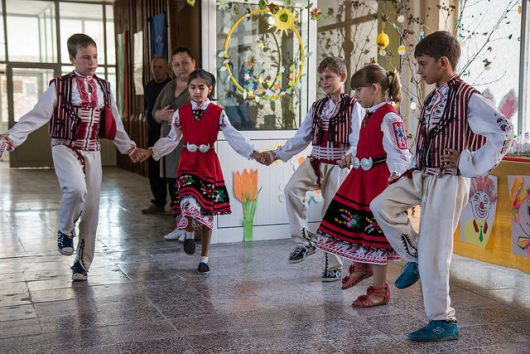
The Republic of Bulgaria is an upper-middle-income southeastern European country on the Black Sea. In 1946, Bulgaria became a People’s Republic, with Communist domination remaining until 1990. Its population of almost 6.8 million is evenly disbursed across the country, with larger populations in the urban areas (76.7%).
Education System
Between ages 7 and 16, education in Bulgaria is compulsory and is free in state-owned and municipal schools. Primary education comprises four years, followed by four years of middle, or junior high school, education. There are two options for subsequent secondary education: comprehensive high school or vocational school. Specialized high schools, colleges and universities offer higher education.
Education Outcomes by Gender
- Secondary School Completion Rates. The lower secondary school completion rate (through middle school) is virtually the same for girls (95.2%) and boys (96.8%). Adult literacy is very high in Bulgaria and is virtually identical for women and men: 98.2%, females and 98.7%, males.
- Tertiary Education and Job Outcome. There is a gender difference in the higher education attainment rate, with women completing at a significantly higher rate (43% for women as compared to 29% for men). This gap is similar to the average for women in OECD countries. The gap is reversed, however, when looking at the employment of women as compared to men. The employment rate for those with a tertiary qualification is almost the same for men (92%) and women (88%). But men with less than an upper secondary education (i.e., high school) are employed at twice the rate (63%) of women (31%). There is also a wage differential between women and men. Young women who have completed higher education earn 78% of the wage of their male peers.
Impact of Gender Quotas
Dating back to the 1960s, Bulgaria has aimed for 50/50 gender quotas in its school system, aiming for classroom gender balance. Initially, the intention was to increase the number of girls entering STEM fields (science, technology, engineering and math), which are typically dominated by men. Critics have recently suggested, however, that the quota system is restricting the entrance of qualified girls into top high schools. It is alleged that admissions officers may feel pressured to admit boys, even those with lower scores than girls, to balance gender representation. This, even though girls make up 56% of the student population.
One subsequent result of the quota system may be that women are forced into female-dominated careers (e.g., health care, teaching, sales) with typically lower salaries than male-dominated sectors such as IT and engineering. Still, women hold 29% of IT positions in Bulgaria, the highest male-to-female ratio in Europe. One conclusion is that “while quotas can help with educational access, they may not be enough to address broader social inequities.”
Education and Roma Girls
Referred to disparagingly as Gypsies, Roma are the often persecuted, largest ethnic minority in Eastern Europe. The Bulgarian Roma population is reported to be 4.1%, but since official statistics often underestimate their count, the population may be as high as 9-11%.
Systemic barriers to Roma education in Bulgaria include economic challenges (63.2% of the Roma were below the poverty line in 2022), discrimination, high mobility (which disrupts continuity of schooling) and infrastructure deficits, especially the lack of secondary schools in some rural areas. Because of early marriage and traditional gender roles, Romani girls are a further marginalized group, and nearly 70% of them are not engaged in education, employment or training. An additional barrier for rural girls is cultural; their families’ fears of “behavioral issues” when girls are no longer under family supervision.
In June 2025, the Global Forum of Communities Discriminated on Work and Descent (GFoD) published The Case of Roma Women in Bulgaria. The GFoD report noted education as one of five key areas of systemic exclusion of Roma women. This exclusion is related to high dropout rates, early marriage pressures and segregation, although there are differences by region. In the Montana region, for example, families prioritize girls’ education with results comparable to the national average. In Sliven, on the other hand, early marriage is practiced along with high dropout rates. The report concludes, “To enhance Romani girls’ access to education, it is vital to address both structural inequalities and community-specific social norms. . . . In so doing, Romani girls will be better positioned to pursue their education and fully realise their potential.”
GFoD suggests addressing the root causes of low school attendance with supportive interventions, rather than punitive measures/sanctions against families for noncompliance, noting the need for localized, tailored community-based interventions. Also referenced is the National Development Program Bulgaria 2030, which includes an implementation plan with specific measures for inclusive education.
Continuing Challenges for Girls’ Education
Two continuing challenges in Bulgaria’s education of girls remain. One is the need to review the impact of the gender quota system to determine whether there may be a more effective and equitable way to achieve the system’s original goal. The second is to address the inequities inherent in the education process for Roma girls.
– Staff Reports
Photo: Flickr

Girls’ Education in Bulgaria Requires Much Improvement
The Republic of Bulgaria is an upper-middle-income southeastern European country on the Black Sea. In 1946, Bulgaria became a People’s Republic, with Communist domination remaining until 1990. Its population of almost 6.8 million is evenly disbursed across the country, with larger populations in the urban areas (76.7%).
Education System
Between ages 7 and 16, education in Bulgaria is compulsory and is free in state-owned and municipal schools. Primary education comprises four years, followed by four years of middle, or junior high school, education. There are two options for subsequent secondary education: comprehensive high school or vocational school. Specialized high schools, colleges and universities offer higher education.
Education Outcomes by Gender
Impact of Gender Quotas
Dating back to the 1960s, Bulgaria has aimed for 50/50 gender quotas in its school system, aiming for classroom gender balance. Initially, the intention was to increase the number of girls entering STEM fields (science, technology, engineering and math), which are typically dominated by men. Critics have recently suggested, however, that the quota system is restricting the entrance of qualified girls into top high schools. It is alleged that admissions officers may feel pressured to admit boys, even those with lower scores than girls, to balance gender representation. This, even though girls make up 56% of the student population.
One subsequent result of the quota system may be that women are forced into female-dominated careers (e.g., health care, teaching, sales) with typically lower salaries than male-dominated sectors such as IT and engineering. Still, women hold 29% of IT positions in Bulgaria, the highest male-to-female ratio in Europe. One conclusion is that “while quotas can help with educational access, they may not be enough to address broader social inequities.”
Education and Roma Girls
Referred to disparagingly as Gypsies, Roma are the often persecuted, largest ethnic minority in Eastern Europe. The Bulgarian Roma population is reported to be 4.1%, but since official statistics often underestimate their count, the population may be as high as 9-11%.
Systemic barriers to Roma education in Bulgaria include economic challenges (63.2% of the Roma were below the poverty line in 2022), discrimination, high mobility (which disrupts continuity of schooling) and infrastructure deficits, especially the lack of secondary schools in some rural areas. Because of early marriage and traditional gender roles, Romani girls are a further marginalized group, and nearly 70% of them are not engaged in education, employment or training. An additional barrier for rural girls is cultural; their families’ fears of “behavioral issues” when girls are no longer under family supervision.
In June 2025, the Global Forum of Communities Discriminated on Work and Descent (GFoD) published The Case of Roma Women in Bulgaria. The GFoD report noted education as one of five key areas of systemic exclusion of Roma women. This exclusion is related to high dropout rates, early marriage pressures and segregation, although there are differences by region. In the Montana region, for example, families prioritize girls’ education with results comparable to the national average. In Sliven, on the other hand, early marriage is practiced along with high dropout rates. The report concludes, “To enhance Romani girls’ access to education, it is vital to address both structural inequalities and community-specific social norms. . . . In so doing, Romani girls will be better positioned to pursue their education and fully realise their potential.”
GFoD suggests addressing the root causes of low school attendance with supportive interventions, rather than punitive measures/sanctions against families for noncompliance, noting the need for localized, tailored community-based interventions. Also referenced is the National Development Program Bulgaria 2030, which includes an implementation plan with specific measures for inclusive education.
Continuing Challenges for Girls’ Education
Two continuing challenges in Bulgaria’s education of girls remain. One is the need to review the impact of the gender quota system to determine whether there may be a more effective and equitable way to achieve the system’s original goal. The second is to address the inequities inherent in the education process for Roma girls.
– Staff Reports
Photo: Flickr
Human Rights in Morocco
Morocco gained independence in 1956 and now works under a monarchy. Today, Morocco has a population of more than 36 million and is known to many to be a beautiful and vibrant country with a rich history. However, there is much about the social culture of this country that people do not know. Morocco has long had political and social turmoil due to the lack of ability for people to protest the government. Here are three facts about human rights in Morocco and what is being done to improve the situation.
3 Facts About Human Rights in Morocco
While there are many areas in which Morocco needs to work on their goals to implement stronger human rights policies, there are many organizations that are working every day to strengthen Moroccan people.
3 Organizations Working To Promote Human Rights in Morocco
Morocco has undergone a significant transition in the recent years making human rights a forefront focus. There has been a transition. While there is much still to be done, Morocco has made changes that should and will improve its future.
– Kayleigh Mattoon
Photo: Flickr
Top 10 Facts About Human Rights in Liberia
The Republic of Liberia, a small nation on the West Coast of Africa, began as a settlement for American freed slaves and free-born blacks in 1822. In 1847, Liberia proclaimed its independence and became Africa’s first independent republic. Like many nations, it has struggled with human rights throughout its history, but it has also made major progress. Here are the top 10 facts about human rights in Liberia.
Facts About Human Rights in Liberia
These facts about human rights in Liberia show that Liberia has made some important advances in improving human rights; however, there is still much progress to be made. Foreign aid, including from the United States, could play a crucial role in helping Liberia improve its respect, protection and actualization of human rights.
– Laura Turner
Photo: Flickr
Six Facts About Healthcare in Honduras
In a nation that suffers from high levels of poverty, adequate healthcare and access to medical services have taken a hit. Honduras has long suffered from frequent maternal and infant mortality, and an estimated 1.5 million people are unable to receive healthcare at all. Why is healthcare so insufficient in Honduras? And what is being done to help?
Six Facts About Healthcare in Honduras
Although the social audits have certainly helped many rural communities, the Honduran government still has room for improvement to make sure that everyone has equal access to healthcare in Honduras. Healthy citizens are able to better contribute to society and economic growth making healthcare an important and relevant issue.
– Alexandra Eppenauer
Photo: Flickr
Heat-Stable Carbetocin Could Stop Postpartum Hemorrhaging
In the advanced world, a postpartum hemorrhage is a very manageable and preventable condition; however, postpartum hemorrhaging is a leading cause of maternal mortality. A staggering 99 percent of all deaths resulting from postpartum hemorrhaging occur in lower income countries. Postpartum hemorrhaging is responsible for 59 percent of maternal deaths in Burkina Faso, 43 percent in Indonesia and 52 percent in the Philippines.
Why Postpartum Hemorrhaging Is Common
In these developing countries, the increased frequency of postpartum hemorrhages is due to a lack of experienced obstetricians and caregivers who can properly treat the condition. There is also a lack of access to proper medications as well as care for those medications.
Oxytocin is currently the most common drug prescribed for preventing postpartum hemorrhages. The World Health Organization recommends that oxytocin be routinely administered and actively managed; however, oxytocin must be stored and transported at two to eight degrees Celsius, two conditions of which developing countries cannot accommodate.
A Possible Solution
A rival drug has been in the works to be as efficient as oxytocin in preventing excessive bleeding post childbirth as well as be more manageable in the living conditions of developing countries. The drug is a heat-stable carbetocin. This type of drug does not need refrigeration and can maintain its efficacy for at least three years when stored at 30 degrees Celsius. These requirements are far more realistic and achievable in developing communities.
The World Health Organization conducted a comparative study between the heat-stable carbetocin and oxytocin for prevention of postpartum hemorrhages. Approximately 30,000 women were sampled and given either drug to study the effects each had on prevention. It was concluded that the heat-stable carbetocin was not inferior to oxytocin.
Saving Mothers’ Lives
With such a high rate of deaths from postpartum hemorrhaging in developing countries due to the strict requirements for oxytocin that cannot be met, the heat-stable carbetocin will drastically improve the mortality rates. The new drug will be readily available and easily managed where it was once not.
Permitting the usage of the heat-stable carbetocin has many benefits that will better developing countries in a multitude of ways. If used widely, the drug could very possibly put an end to this tragically common occurrence.
– Samantha Harward
Photo: Flickr
The Positive Impact of Mass Media in Developing Countries
Radio, newspapers, television, Internet, social media, etc., all of these are forms of mass media. Each of these outlets has the capability of bringing information to thousands of people with one device. While in some communities it is easy to take advantage of these communication outlets such as television and Internet access, not everyone has access to such outlets.
Radio is one of the most common forms of mass media in developing countries because it’s affordable and uses less electricity than many other forms of mass media, but only approximately 75 percent of people in developing countries have access to a radio, and roughly 77 percent of people in rural areas have access to electricity.
For developing countries that have implemented forms of mass media in their communities, there have been numerous positive outcomes.
Top 5 positive impacts of mass media in developing countries
As it is seen, having access to different media outlets is vital for those in developing countries. Here are three ways that those in developing countries can implement mass media to help their people and communities.
Whether through radio or cell phones, forms of mass media are constantly being used to inform, educate and strengthen people all over the world whether they be in urban or rural communities.
One easy way to help gain access to mass media in developing countries is to reach out to government officials in the United States. Click here to email U.S. Senators about The Digital GAP Act and ask them to give first-time access to mobile or broadband Internet to 1.5 million people in developing countries by 2020.
– Victoria Fowler
Photo: Flickr
Five Important Poverty Nonprofits to Pay Attention To
The world is full of people trying to do good, some of whom are well known and acknowledged for the work they do. Many change-makers, however, fly under the radar and do not receive the recognition they deserve for the profound changes they have generated. Some important poverty nonprofits have been working to mitigate poverty and disease worldwide for years, and they are the ones who could benefit greatly from volunteers. The following are five groups whose efforts should not go unnoticed by the world.
Five Important Poverty Nonprofits
These five are just a few of many important poverty nonprofits that work to make a positive change in the world, no matter how small. Contributions to groups like these have the ability to create a ripple effect in the lives and communities of those who truly need it. Getting involved can come in any form from promoting the causes online to volunteering time to help with projects. When it comes to making a change, there is no contribution too small.
– Amelia Merchant
Photo: Flickr
A Look at Mayan Oppression in Guatemala
According to the Irish political party Eirigie, “All imperialism is underpinned by a philosophy that deems the colonized in some way inferior to the colonizer. Racism, discrimination, and exploitation are intrinsically linked to a policy which justifies the right of one people to dominate and exploit another.”
A Violent History
Centuries ago, Guatemala was the central hub of the ancient Mayan kingdom. The year 1524 then brought Spaniards, conquest and dictatorship. Central America’s longest armed conflict between government and rebels occurred from 1960 to 1996, Guatemala’s thirty-six-year civil war.
This tyrannical outburst, backed by the American government, revealed dangerous issues of political and military strategy between government and leftist rebels and led to hundreds of thousands of deaths, the majority of which were innocent civilians and indigenous Mayans. The gateway to Mayan oppression in Guatemala had been opened.
Spanish occupation severed existing Mayan socioeconomic order and gave life to ethnic turmoil and exclusion. Indigenous Maya viewed the leftist guerrilla warfare as the last hope for restoring the deep-seeded marginalization of indigenous communities. To the government, however, the collaboration and relationship between the Maya and the guerrilla movement insinuated the Maya to be natural allies of the revolution, and thus enemies of the state.
Inequality in Employment
A decades-old historical reality, the Mayan population – 80 percent of the country’s makeup – has endured harsh oppression. It is a rarity within the employment sector for the indigenous person to be paid the equal wage of the mestizos, a person of mixed ancestry. When interviewed, more than half of business owners admitted that despite indigenous workers and mestizo workers performing the same labor, they were not paid equal wages.
An IPS News Agency survey, conducted among hundreds of business owners in greater Guatemala City, found that “on average, only 12 percent of workers in small and micro-enterprises are indigenous people, while the workforce of medium and large businesses is made up of 20 percent native people.” Meager wages alongside oppression allow poverty to burgeon.
Avivara Empowers Guatemalans
Without equality, development halts. An organization named Avivara uses education as a way to provide relief for the oppressed in Guatemala, a country that has endured myriad human rights offenses. Access to quality education allows citizens to learn how to adapt to change and ultimately secure higher-paying jobs.
Better education provides access to resources, services, social protection and social rights. In regards to women and Mayan culture, education is empowering. It helps to expunge systemic poverty, illiteracy and inequality. By providing greater educational opportunities, Avivara is establishing a foundation within communities that will provide essential skills, such as the ability to address conflicts in a rational and non-violent manner.
The Work of CoEd and Other Organizations
Around 70 percent of people in rural Guatemala live in poverty. 95 percent of poor, rural students never graduate from high school. 40 percent of indigenous adults cannot read or write. The Cooperative for Education, or CoEd, provides solutions. CoEd helps break the deep-seeded cycle of poverty through the most powerful resource: education, a pathway out of poverty. Educational opportunities are provided for schoolchildren at every step of the way, empowering them to someday give the same opportunities back to the world. Education is the one-way ticket out of Mayan oppression in Guatemala.
Moreover, the Pan-Mayan Mobilization in Guatemala prompted the internationally-recognized Peace Accords of 1996. In an effort to unite the indigenous population and acquire more political influence, the Accords include both general Human Rights clauses as well as those on the identity and rights of indigenous peoples.
Efforts to heal the horrendous wounds of Mayan oppression in Guatemala are strong but take time. To assist the process, the Office for Indigenous Peoples and Interculturality has been created. The United Nations reports that this review board establishes proposals for both human rights defenses and policy reform, based on the Agreement on the Identity and Rights of the Indigenous Peoples from the 1996 Peace Accords. Emerging from a place of oppression and fear to a place of equality and peace is complex and multifaceted, but change is in the works.
– Mary Grace Miller
Photo: Flickr
Innovation in Safe Drinking Water
Over the course of the last 25 years, Somalia has suffered a series of devastating droughts. In the most recent one, spanning through 2016 and 2017 there was an absence of rain for three seasons in a row. This drought was particularly devastating in its effects: food scarcity, malnutrition, and the spread of cholera and other diseases.
In 2017 alone, approximately 1.2 million people were acutely malnourished, 80,000 children could no longer attend school and 120,000 children were at risk of dropping out. The crisis in Somalia highlights how the effects of drought and inaccessibility to safe drinking water affects all facets of society.
Access to Safe Drinking Water
Lack of access to safe water is a striking feature in almost all parts of Somalia. Only 45% of Somalis have access to improved water sources and this fact increases the risk of outbreaks of waterborne diseases. Cholera is endemic and claims hundreds of lives annually, particularly in densely populated areas. Increasing access to safe water must be accompanied by efforts to ensure the quality of drinking water. Water quality monitoring and house-water treatment, as well as safe storage, are critical in reducing the risk of contamination of water supplies.
Addressing the Problem
Fortunately, a solution is in sight. The International Organization for Migration (IOM) in Somalia is using a coagulant called Polyglu to treat drinking water in Somalia and to assist those affected by the recent drought. IOM helps to protect migrants, refugees and those displaced within their country.
From November 2016 to March 2017, over 600,000 people were displaced within Somalia. Many were forced to leave their homes and livelihoods behind in search of food and water. A startling 8,000 people are being displaced every day. Since safe drinking water is at the center of their displacement, Polyglu offers an effective and innovative solution that could help hundreds of thousands of people, in Somalia but in other countries as well.
About Polyglu
Polyglu is a powder, primarily composed of a coagulant made from fermented soybeans, which serves to quicken the clotting of impurities found in water. Polyglu is unique in that is a safe and environmentally friendly purifying agent that has been successfully applied in the food and industrial equipment industries.
One gram of the Polyglu powder is capable of treating up to five liters of polluted water, which makes this powder very effective. It has been successfully deployed in India, Bangladesh, Somalia and Tanzania. In collaboration with IOM and the Internally Displaced Person camps in Mogadishu Somalia has used Polyglu to address water-borne diseases and water scarcity. According to locals in Mogadishu, Polyglu has contributed to lowering the rate of diarrhea and other illnesses among Somali children plagued by all kinds of shortages and war.
Moving Forward
While Polyglu has made significant strides in combating water scarcity and water-borne disease in developing countries, much can still be done to ensure safe drinking water in these regions. Although Polyglu can remove many of the pollutants found in water, it cannot completely purify waste water. Thus, it is imperative to allocate more resources to affordable and accessible means of purifying water.
As droughts continue to plague developing countries, Polyglu is just one tool that can be used to ensure access to safe drinking water.
– McAfee Sheehan
Photo: Flickr
Top 10 Facts About Education in Iraq
Conflict and totalitarianism have plagued Iraq for decades. This has had a negative impact upon the Iraqi education system in many ways.
Here are the Top 10 Facts about Education in Iraq
Education in Iraq has not always been problematic. Respective conflicts and moments of peace have created a void that had left the education system demolished by conflict. With organizations like UNICEF and UNESCO on the ground, the goal is to return Iraq to where it was during The Islamic Golden Age when Baghdad was the epicenter of global intellectualism. Much work is to be done to bring education back to its former glory.
– Daniel Lehewych
Photo: Flickr