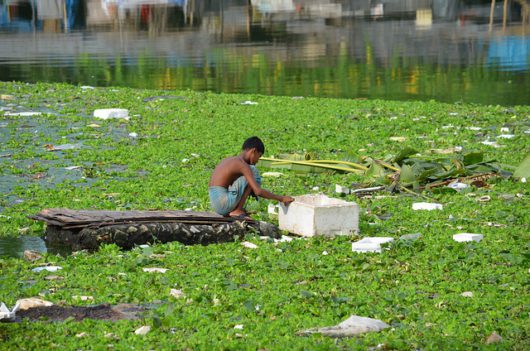
Over the past few decades, sanitation in Bangladesh has improved significantly. However, the nation still has a long way to go. As of 2016, approximately half of Bangladesh’s drinking water was deemed unsafe and sewer systems were defined as scarce. In an effort to address these issues, different organizations like the World Bank, UNICEF, WHO and Water.org have been creating and supporting programs that will improve sanitation and access to safe water in Bangladesh.
Bangladesh Sanitation Problems
With an average of 2,639 people per square mile, Bangladesh is one of the most densely populated countries in the world. In rural areas, the population is less dense, but many rural residents do not have access to piped water and are without a system for sewage disposal and treatment, creating insufficient sanitation and an increased risk of disease. Waterborne diseases, including cholera, diarrhea, dysentery and typhoid, are particularly prevalent throughout the nation and cause the deaths of 50,000 children every year.
Urban areas, however, are truly dense, and the close proximity of residents creates many sanitation and health problems. The capital city of Dhaka is the only place in Bangladesh with a sewer system, but this system encompasses less than 20 percent of the city. As a result, approximately 60 percent of sewage in the city is untreated and gets into the waterways.
The population of Dhaka is approximately 15 million and is expected to grow to 20 million by 2020, as thousands of people each year migrate from rural areas in search of better life opportunities. The slums of Dhaka, that often represent houses for many of these poor migrants, are particularly unsanitary as four million of those who live in slums are not legally entitled to toilets and safe water. Without serious improvements both within Dhaka and throughout Bangladesh, water access and sanitation will continue to be deficient.
The World Bank Programs
The World Bank supports a number of initiatives dedicated to improving sanitation in Bangladesh, including the Bangladesh Rural Water Supply and Sanitation Project, the Chittagong Water Supply Improvement and Sanitation Project and the Dhaka Water Supply and Sanitation Project. In total, the World Bank has contributed over $250 million to abovementioned projects.
The Bangladesh Rural Supply and Sanitation Project has benefited approximately 950,000 people since 2012 by providing them with hygienic latrines and better water options. In Chittagong, the second largest city in Bangladesh, the Chittagong Water Supply Improvement and Sanitation Project is building a water treatment plant expected to serve 150,000 people. The Dhaka Water Supply and Sanitation Project fixed 12 canals and built large stormwater pumping stations and the impact of this program reached 3.5 million city inhabitants. While these efforts have not ended Bangladesh’s sanitation crisis, they have made a significant difference for millions.
UNICEF Aid
UNICEF has also been working on improving sanitation in Bangladesh through their Rural Sanitation, Hygiene and Water Supply Project. With the support of nongovernmental organizations and Bangladesh’s Department of Public Health Engineering, this project implements water and sanitation committees within local governments, helping the community engage with these issues.
Additionally, UNICEF focuses its efforts on primary schools, ensuring that children understand good sanitation and hygiene. They then encourage these children to tell their families and communities what they have learned. If more people are educated about sanitation and hygiene, then ideally they will be willing to adopt more hygienic practices.
Water Safety Plans
The World Health Organization focuses on the waterborne diseases that are spread through unsanitary conditions and unsafe drinking water, developing Water Safety Plans (WSPs), which help guide water suppliers on what needs to be done to improve water quality. They believe in working directly with those who have control over water quality, rather than initiating change from the national government.
The development of WSPs included engineers and mechanics, in addition to health professionals, all of whom possess the knowledge necessary to improving water quality and sanitation in Bangladesh. WSPs outline potential hazards, as well as what water suppliers should do every day in order to prevent them from occurring.
Water.org Efforts
On an individual and community level, Water.org provides loans to people who lack safe water and sanitation. Water.org works with Bangladesh’s microfinance sector to provide these loans, known as WaterCredit, which fund the building of infrastructure that will improve the safety of their water and decrease sanitation risks. More than 837,000 people have been impacted by Water.org’s efforts.
Mitu, a 23-year-old in central Bangladesh, used one of these loans to build a tube well for her family in 2014, allowing them to access fresh water. Prior to this construction, the nearest public water source was a 20-minute walk away. She noted that once her family had the well, their medical costs decreased by 95 percent.
Efforts to improve sanitation in Bangladesh are needed at all levels, and the World Bank, UNICEF, WHO, and Water.org are all working to make improvements that will impact millions. These initiatives need to both continue and expand in order to ensure ongoing progress and improvements.
– Sara Olk
Photo: Flickr

Solutions For Nigeria’s Water Quality Challenges
Access to safe water, sanitation and hygiene is a core necessity for human survival that a large portion of the world, especially developing countries, still struggle to meet.
In Nigeria, UNICEF reported that close to 70 million people, out of the total population of 171 million, lacked access to clean water, while 110 million lacked access to sanitation in 2013. The impact of this shortage is dire as 124,000 children under the age of five die because of diarrhea that is mainly caused by unsafe water, bad sanitation and bad hygiene. Moreover, it decreases school enrollment and disproportionately affects girls who bare the responsibility of carrying water. Finding the solution for Nigeria’s water quality is, therefore, a pressing issue that requires all responsible parties to participate.
Obstacles In Meeting Water Quality Standards
Gbenga Ashiru, the producer of Question Time, a Nigerian news program that profiles the activities and accountability portfolio of office holders, discussed the reasons behind Africa’s largest economy reaching a peak in a shortage of potable water. He dissected what he states is the “mystery” behind the Nigerian government’s, led by the Minister of Water Resources, inability to meet water demands. Ashiru highlighted the extreme water shortage and listed the shocking statistics of potable water and sanitation coverage at 7 percent and 29 percent, respectively.
Four months ago, the Nigerian government launched the Nigerian Standard for Drinking Water Quality to revitalize the access to safe drinking water throughout the nation to achieve goal number six of the Sustainable Development Goals. At the launching ceremony, Suleiman Adamu, the Minister of Water Resources, asserted that finding the solution for Nigeria’s water quality issue is the current focus of President Muhammadu Buhari’s administration.
Nigeria’s Water Act
According to UNICEF, Nigeria has indeed taken the steps to improve this pertinent issue through the development of various policies and strategies. However, a deterioration in water quality and access portrayed by a 25 percent drop of pipe borne water supply since 1990, reveals the difficulty of translating the solution to Nigeria’s water quality issues into action.
Nigeria’s Water Act states that the Federal government of Nigeria funds 30 percent, local government funds 10 percent, while state government covers 60 percent of the funding of water projects along with the full responsibility of operation. Suleiman Adamu, in his interview with Ashiru, argues that the Water Act is neither feasible nor effective policy in meeting water and sanitation demands and calls for an amendment of this legislation as well as the gradual privatization of this sector.
Fostering Synergy and Collaboration
Suleiman Adamu holds the state government responsible for not meeting their end of the bargain. He explains that even in cases where the federal government went beyond the 30 percent of the funding and invested in water treatment facilities, the states failed to carry out the operations. He argues that this happens due to state government officials neglecting pressing water demands that require long periods of gestation and focus on short-term projects to show results during re-election. Therefore, the solution for Nigeria’s water quality issues lies in finding the amendment of this policy that has created obstacles for the synergy in the federal, regional and local governments.
Since water projects are a primary responsibility of state government, bringing progress at a national scale requires synergy in state and federal government. The Minister explains that the federal government will work on achieving this collaboration through advocacy and offering supervision rather than simply giving funding without aligned priorities.
–Bilen Kassie
Photo: Flickr
International Organizations Work to Improve Sanitation in Bangladesh
Over the past few decades, sanitation in Bangladesh has improved significantly. However, the nation still has a long way to go. As of 2016, approximately half of Bangladesh’s drinking water was deemed unsafe and sewer systems were defined as scarce. In an effort to address these issues, different organizations like the World Bank, UNICEF, WHO and Water.org have been creating and supporting programs that will improve sanitation and access to safe water in Bangladesh.
Bangladesh Sanitation Problems
With an average of 2,639 people per square mile, Bangladesh is one of the most densely populated countries in the world. In rural areas, the population is less dense, but many rural residents do not have access to piped water and are without a system for sewage disposal and treatment, creating insufficient sanitation and an increased risk of disease. Waterborne diseases, including cholera, diarrhea, dysentery and typhoid, are particularly prevalent throughout the nation and cause the deaths of 50,000 children every year.
Urban areas, however, are truly dense, and the close proximity of residents creates many sanitation and health problems. The capital city of Dhaka is the only place in Bangladesh with a sewer system, but this system encompasses less than 20 percent of the city. As a result, approximately 60 percent of sewage in the city is untreated and gets into the waterways.
The population of Dhaka is approximately 15 million and is expected to grow to 20 million by 2020, as thousands of people each year migrate from rural areas in search of better life opportunities. The slums of Dhaka, that often represent houses for many of these poor migrants, are particularly unsanitary as four million of those who live in slums are not legally entitled to toilets and safe water. Without serious improvements both within Dhaka and throughout Bangladesh, water access and sanitation will continue to be deficient.
The World Bank Programs
The World Bank supports a number of initiatives dedicated to improving sanitation in Bangladesh, including the Bangladesh Rural Water Supply and Sanitation Project, the Chittagong Water Supply Improvement and Sanitation Project and the Dhaka Water Supply and Sanitation Project. In total, the World Bank has contributed over $250 million to abovementioned projects.
The Bangladesh Rural Supply and Sanitation Project has benefited approximately 950,000 people since 2012 by providing them with hygienic latrines and better water options. In Chittagong, the second largest city in Bangladesh, the Chittagong Water Supply Improvement and Sanitation Project is building a water treatment plant expected to serve 150,000 people. The Dhaka Water Supply and Sanitation Project fixed 12 canals and built large stormwater pumping stations and the impact of this program reached 3.5 million city inhabitants. While these efforts have not ended Bangladesh’s sanitation crisis, they have made a significant difference for millions.
UNICEF Aid
UNICEF has also been working on improving sanitation in Bangladesh through their Rural Sanitation, Hygiene and Water Supply Project. With the support of nongovernmental organizations and Bangladesh’s Department of Public Health Engineering, this project implements water and sanitation committees within local governments, helping the community engage with these issues.
Additionally, UNICEF focuses its efforts on primary schools, ensuring that children understand good sanitation and hygiene. They then encourage these children to tell their families and communities what they have learned. If more people are educated about sanitation and hygiene, then ideally they will be willing to adopt more hygienic practices.
Water Safety Plans
The World Health Organization focuses on the waterborne diseases that are spread through unsanitary conditions and unsafe drinking water, developing Water Safety Plans (WSPs), which help guide water suppliers on what needs to be done to improve water quality. They believe in working directly with those who have control over water quality, rather than initiating change from the national government.
The development of WSPs included engineers and mechanics, in addition to health professionals, all of whom possess the knowledge necessary to improving water quality and sanitation in Bangladesh. WSPs outline potential hazards, as well as what water suppliers should do every day in order to prevent them from occurring.
Water.org Efforts
On an individual and community level, Water.org provides loans to people who lack safe water and sanitation. Water.org works with Bangladesh’s microfinance sector to provide these loans, known as WaterCredit, which fund the building of infrastructure that will improve the safety of their water and decrease sanitation risks. More than 837,000 people have been impacted by Water.org’s efforts.
Mitu, a 23-year-old in central Bangladesh, used one of these loans to build a tube well for her family in 2014, allowing them to access fresh water. Prior to this construction, the nearest public water source was a 20-minute walk away. She noted that once her family had the well, their medical costs decreased by 95 percent.
Efforts to improve sanitation in Bangladesh are needed at all levels, and the World Bank, UNICEF, WHO, and Water.org are all working to make improvements that will impact millions. These initiatives need to both continue and expand in order to ensure ongoing progress and improvements.
– Sara Olk
Photo: Flickr
10 Facts About the Cycle of Poverty
Poverty and homelessness spread throughout the world, despite efforts being made to alleviate these issues. Social psychology studies explain factors that contribute to the cycle of poverty, as well as what to focus to prevent them. Below are 10 facts about the cycle of poverty for consideration.
10 Facts About the Cycle of Poverty
These 10 facts about the cycle of poverty can improve understanding of this important issue. It is important to understand humans unconscious bias of dehumanization towards impoverished people so that they can consciously change it.
In order to reduce poverty, solutions must focus on the multi-dimensional causes of poverty. It is also vital to examine examples of people who have escaped the poverty cycle. Projects like HPA are facilitating much positive change by increasing accessible health services and reducing poverty in countries around the world. With a greater focus on sustainable living and more funding for programs like HPA, organizations can combat the global poverty cycle.
Anna Power
Photo: Flickr
The Trampoline House: A Solution for Refugees in Denmark
In 2017, Denmark received 3,479 applications for asylum. This was the lowest number of applications in the past nine years. The chance for refugees to gain asylum also decreased. In 2015, 85 percent of applicants received asylum and three years later, that number is 58 percent.
Asylum seekers and refugees are also facing a harder time in Denmark than in past years. However, there are several nongovernmental organizations working to help asylum seekers and refugees find a path to residency. One of these organizations is known as the Trampolinehuset (Trampoline House).
The Trampoline House
Founded in 2010, the Trampoline House provides a variety of services for asylum seekers and refugees in Denmark to help them with the process of integrating, navigating the process of gaining residency and providing them with a community and space to relax from the stress that comes from the asylum seeking process. However, those who seek the help of the Trampoline House are expected to help contribute to maintaining the house and help build a community for themselves and other asylum seekers.
The Trampoline House aims to create a community of Danish citizens, refugees, asylum seekers, and everybody else who calls Denmark home. This requires an effort from all parties involved to participate in maintaining a community. The staff is made up of both Danish citizens and migrants, and community meetings are held frequently so that members can share their thoughts and concerns.
Specific resources that the Trampoline House provides include child care, language classes, cooking, a women’s group, medical and legal counseling, art exhibitions and dance parties. Some of these programs are run or were proposed by refugees themselves.
Refugees Problems
The Trampoline House mainly focuses on providing help to asylum seekers and refugees because there is a large number of these people that remain in asylum camps across Denmark. In January 2018, 5,000 people were in centers. A majority of them still had cases pending from immigration services. However, 16 percent of them were rejected and remained living in deportation centers.
People who have been denied by the state remain in these centers until they can leave, but many of them do not even have the opportunity to do so. In the deportation centers, asylum seekers and refugees are not allowed to cook, have inadequate health care and are located in desolate areas where it is hard for them to travel anywhere. Essentially, the camps are designed to make people leave, but people cannot do this due to political oppression or violence in their home countries.
Trampoline House Services
Trampoline House offers services specifically to refugees and asylum seekers that are denied. For example, doctors will volunteer to have check-ups for members of the house and provide them with the medical care they might need. Currently, medical services are restrictive in detention centers and only allowed for urgent cases.
As mentioned earlier there is a kitchen for members to cook in, since they are not allowed to make food for themselves in the camp. The food that they are served in camps is barely edible and is not diversified, meaning it is mostly consisted out of Danish dishes.
The Trampoline House also aims to raise awareness about the migration crisis and migrant rights in Denmark through the Center for Art on Migration Politics (CAMP) program. The program hosts exhibitions, education programs and releases publications about migration and the struggles that migrants face in Denmark.
While the number of refugees and asylum seekers that are arriving in Denmark is declining, it is important to ensure all of them have services to help guide them through the immigration process and a community where they can feel welcomed.
Trampoline House is one of the many nongovernmental organization working to provide them with a sense of belonging and comfort in what can be a stressful and confusing process.
– Drew Garbe
Photo: Flickr
EARTH University: Students Alleviating Poverty
Escuela de Agricultura de la Región Tropical Húmeda, otherwise known by its acronym EARTH University, is located in the Limon province of Costa Rica. Situated in the middle of beautiful, sprawling jungles, the university focuses on teaching sustainable development and entrepreneurship for students to apply in their communities. EARTH University’s vision statement reads: “Our actions are mission-driven to alleviate poverty, promote social justice and build a future where our communities achieve sustainable and shared prosperity.” Their aim is to alleviate global poverty one person at a time. Below are 5 facts about EARTH University, the work they do and the innovative students changing the world.
5 Facts About EARTH University
EARTH University is responsible for creating a new generation of environmental entrepreneurs who are able to apply their new skills where needed. When students are able to implement their skills in their own communities, whether these communities are disadvantaged or not, prosperity is created. Through their students, EARTH University is contributing to the downsizing of poverty. This type of structure has been proven time and again as students’ innovative ideas and skills spread, decreasing poverty.
– Trelawny Robinson
Photo: Flickr
Treatment of Disabled Children in Kenya
One in ten Kenyans under the age of 21 is disabled. In Kenya, several women feel the pressure from their communities and family members to either kill or give away their disabled children. Disabled Rights International interviewed several mothers of disabled children who claimed that disabled children are referred to or often called idiots, subhuman, imbeciles, abnormal and a burden.
Other reasons for child abandonment and even child killings are that the family will not be able to afford medical bills or that the child will be unable to live a full life. Kenyan women are usually ostracized by their community for raising a disabled child and are either said to be cursed or that the child is cursed. If these women are unable to gain enough support, they will be more likely to give up or even kill their child.
Awareness about Disabilities
A contributing factor to the treatment of disabled children in Kenya is that little to no information is known about disabilities. Women in Kenya are rarely told that their child has a disability when they are born, and they are sent home without any sort of information.
In the survey conducted by Disabled Rights International (DRI), 93 percent of women only found out their child had a disability after taking them home. Some doctors refuse to treat the child, claiming that they are contagious. A lack of education about disabilities and the future life of the disabled person has a large impact on the treatment of disabled children.
Institutions for Disabled Children
Some disabled children in Kenya are given away to overcrowded institutions. Disabled children are separated from nondisabled children in specific institutions that are less sanitary and underfunded. In Kenya, the children in orphanages have living family members, but they are typically abandoned due to their family’s inability to care for them. Institutionalized children with disabilities spend their whole lives in institutions because, even as adults, they have nowhere else to go. The DRI found that some of these institutions even put these children in restraints or isolation rooms.
The problem with these institutions is that the donations that they receive from different organizations and mission trips are often not used for the children. The DRI found that several orphanages who benefited from donations or mission trips were still not suitable for children, although these funds were provided for this purpose. One organization, Child in Family Focus, advocates for family-focused relief efforts rather than donating money to these institutions, so that a family can keep and raise their child. The group focuses on advocacy, deinstitutionalization and lobbying for child protection policies.
Able Child Africa
Around 100,000 disabled children in Kenya are out of school, meaning that they do not have access to even a basic education. Organizations like Able Child Africa are trying to change this situation. One of their current projects involves disabled children who are out of school in inclusive sports clubs. The inclusive club means that both non-disabled and disabled children are participating in the same club. These sports clubs are held at local schools where the organization hopes the children will eventually enroll. The project began in 2015 and has been granted more funding so that the organization can range across two of Kenya’s school districts.
Organizations like Child in Family Focus and Able Child Africa are fighting for the better treatment of disabled children, whether by simply involving disabled children in activities at schools so that they enroll in school and have access to an education or by keeping them with their families.
As the stigma behind disabilities fades and people become more educated about disabilities, disabled children in Kenya can possibly have better care and a better future.
– Olivia Halliburton
Photo: Flickr
Top 10 Facts about Hunger in Angola
Angola, located on the western coast of Southern Africa, has a current population of over 31 million people. Unfortunately, many men, women and children continue to live in poverty and are going hungry. The current Global Hunger Index score of the country is 32.5. Luckily, there are several if not many organizations that have a desire to eradicate the country’s hunger epidemic. Below are the top 10 facts about hunger in Angola.
Top 10 Facts about Hunger in Angola
These top 10 facts about hunger in Angola demonstrates that many organizations, programs and movements have every desire to eradicate the hunger epidemic. They give people hope for both a better nation and a better future for their families.
– Charlene Frett
Photo: Flickr
Life Expectancy in Chad
Chad is one of the poorest countries in the world and has the lowest life expectancy of all countries. In 2017, the life expectancy for a Chadian citizen was found to be only 50.6 years. For comparison, Monaco is the country with the highest life expectancy, and citizens of this country live, on average, almost 40 years longer. This is a scary and stark contrast that can be attributed largely to the instability and poverty that people of Chad continuously face.
Chad in Numbers
In 1960, The Republic of Chad attained its independence from France and has faced much hardship since. The country has felt the recurring impact of civil war, religious war and natural disasters. For these reasons, the country has been unable to maximize its rich gold, uranium and oil resources.
Food and water are extremely scarce resources in the country as only 4 percent of Chadians living in rural areas have access to clean water. This makes them very susceptible to dangerous water-borne diseases including diarrhea and cholera. The problem is exacerbated by the fact that medical resources are also extremely scarce. For every 38,000 inhabitants of the country, there is only one doctor .
Close to 63 percent of Chadians are living in poverty, and only 32 percent of the population is literate. This is related to the fact that 80 percent of the population depends on subsistence farming and livestock. With a lack of educational resources, the Chadian people are forced to rely on their agricultural skills to maintain a livelihood. This is problematic for a country that has faced repeated natural disasters.
These are just some of the many statistics that point to the dire living conditions that contribute to the country’s extremely low life expectancy. There are, however, a number of efforts being undertaken to ameliorate the situation.
Actions Being Taken
In February 2018, after visiting several African countries including Chad, the Assistant Secretary-General for Humanitarian Affairs and Deputy Emergency Relief Coordinator of the United Nations, Ursula Mueller, brought attention to the dire need for greater relief efforts in Chad.
Groups like the Chad Relief Foundation (CRF) have been responsive to such calls for a number of years now. CRF provides assistance to refugees in Chad and, as of December 2017, had provided Chad with a total of $983,257. This money goes toward efforts to provide citizens with resources like medicine, education and some means to reduce the spread of illness, such as mosquito nets.
Additionally, The World Food Program is providing food relief to 1.4 million Chadians affected by chronic food insecurity. The organization provides the citizens with money that allows them to buy food from local markets in order to support the local economy. One can only hope that by ameliorating food insecurity in the country, life expectancy in Chad will begin to rise.
Solutions to the Problem
Although there are relief efforts at work in the country, Chad faces dire prospects if more is not contributed to the country’s efforts to stabilize. The life expectancy in Chad is frighteningly low and perhaps the most alarming thing about it is that it is caused by factors that can be fixed or prevented with adequate assistance. It is important that countries with the means to do something contribute to the efforts of improving the standard of living in Chad so that the citizens of the country can enjoy the long and full lives that all humans have a right to.
– Julia Bloechl
Photo: Flickr
Top 10 Facts about Girls’ Education in Mexico
Educating girls is known to boost the economy and social development indicators. When a girl is more educated, she is more likely to have fewer children, work full-time, have an increased life expectancy and her children are less likely to die young. In developing countries like Mexico, issues like these are of the utmost importance for the development of the country. In the text below, top 10 facts about girls’ education in Mexico are presented.
Top 10 Facts about Girls’ Education in Mexico
Mexico still has a long way to go before it eliminates the drastic gender gap in education, particularly for rural and indigenous women. However, with efforts such as the UNGEI, the situation appears hopeful and is changing for the better.
Top 10 Facts About Living Conditions in Colombia
Colombia is well-known for its coffee plantations and scenic mountains and beaches, but also for harboring conflict and political unrest. After 50 years of civil war, the country has finally entered into a peace agreement and is now in a post-conflict period of reconstruction. Because travel to the country was considered unsafe until quite recently, there are many aspects of Colombia that are widely unknown and most foreigners have little concept of what life there truly is like. Below are the top 10 facts about living conditions in Colombia.
Top 10 facts about living conditions in Colombia
These top 10 facts about living conditions in Colombia demonstrate that the country has come a long way since creating peace in the region, but is still dealing with many socioeconomic issues. Continued efforts by government and advocacy groups offer hope for security and growth in the upcoming years.
– Georgia Orenstein
Photo: Flickr