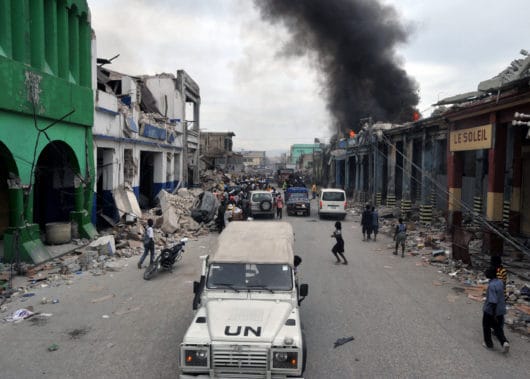
On January 12, 2010, large scale earthquake occurred, affecting the island of Hispaniola and most severely affecting the small country of Haiti. Five years after this catastrophe, many people in this country still suffer from post-traumatic stress disorder (PTSD) and other mental health issues.
Earthquake Consequences on Mental Health in Haiti
As a result of the earthquake, over 90.5 percent of Haitians had relatives that either died or were seriously injured and 93 percent saw dead bodies. Moreover, 24.6 percent of the earthquake survivors developed PTSD symptoms and 28.3 percent developed major depressive disorder (MDD) symptoms. That accounts for more than half the population suffering from mental illness post-quake.
It is not surprising that so many people were traumatized by the event, as the quake left more than two million affected, 222,750 killed, 80,000 bodies missing, 188,383 houses destroyed or damaged and 1.5 million displaced. Before the earthquake, the mental health system in Haiti was almost non-existent mostly due to stigma.
Problems in Resolving the Issue
The good news is that the earthquake united Haitians to put some focus on mental health, still not nearly enough, but just enough to get the ball rolling. However, due to the overwhelming need for mental health services and very limited resources, most Haitians are not getting the psychiatric help they need. Now that mental health issues are more widespread, there is a stronger push for the government to invest more in training professionals and increase resources for mental health in Haiti.
One of the issues around Haitians not receiving mental health is religion. Mental health issues tend to be attributed to supernatural forces, where three out of four Haitians will see an herbalist or Vodou priests for treatment instead of seeking clinical services. This is due to both cultural beliefs and inadequate resources for mental health. Clinical practice in Haiti must include mental health treatment intersected with Vodou beliefs to effectively care for patients of the country.
Center for Addiction and Mental Health
Out of more than 90 agencies that offered outreach to Haiti, only three offered psychiatric care. Center for Addiction and Mental Health (CAMH) Office of Transformative Global Health in Canada is one of those agencies. The organization collaborates with 40 religious healers of Haiti to provide cognitive behavioral therapy in an effective way that is in conjunction with cultural beliefs.
The adoption of task-shifting, or dedicating low-cost mental health workers such as community health workers (CHWs) who operate at the community and clinic levels to supplement integrated care, will help with efforts to decentralize mental health care. These improvements are being made in Haiti, however, there is still a long way to go. More investment in the health care system is needed to implement adequate mental health treatment for those still suffering from the trauma of the quake, and more generally, mental health treatment is needed for all.
In improving services for mental health in Haiti, poverty can also be reduced. Implementing adequate treatment can have far-reaching effects, as poor mental health is often the root cause of other health conditions, and it can inhibit people from participating in social and economic development.
Although not enough outreach to Haiti involved mental health services, mental health in Haiti is improving. Through the integration of community services between psychotherapy and religious or cultural practices, agencies like CAMH are facilitating change in the country. Reducing those inhibited by mental disorders also creates more contributors to the community and less burden placed on society due to mental disability. However, more funding is needing in the mental health practice to reduce illness and poverty.
– Anna Power
Photo: Google

Top 10 Facts About Life Expectancy in China
China’s life expectancy has increased dramatically since 1990. The life expectancy in the country in the 1990s was more similar to that of the developing world, but recently, it resembles that of a high-income nation. China has managed to reduce its burden of disease in the last few decades and has increased its child mortality rate and maternal health dramatically. In the text below, top 10 facts about life expectancy in China are presented.
Top 10 Facts About Life Expectancy in China
China has made great strides in its mission to increase life expectancy and quality of life. However, the country still faces issues such as inequality, air pollution, tuberculosis and NCDs. These top 10 facts about life expectancy in China provide hope for an ever-increasing life expectancy in a nation that has risen out of poverty and ill-health.
– Olivia Halliburton
Photo: Pixabay
Seahawks’ K J Wright Supports Clean Water in Kenya
Seahawks linebacker K.J. Wright is addressing the issue of clean water in Kenya. Currently, 41 percent of Kenyans (19 million people) still lack reliable, safe water sources for drinking water. While on vacation in the Maasai Mara region, Wright witnessed the challenges faced by locals, especially females, when it came to collecting drinking water and decided to start a fundraising campaign with the goal of building two wells in the village he stayed in.
The Global Issue of Clean Water
The availability of clean water has been a major issue across the globe. In July 2010, the United Nations deemed access to clean water and proper sanitation a human right. Yet in 2017, 2.1 billion people still lacked safe drinking water and 4.5 billion did not have sufficient sanitation services. Without safe management of sanitation services and wastewater from cities, businesses and farms, waterways are likely to be polluted. When these water sources are used by community members as drinking water, many health risks arise.
Contaminated water and poor sanitation remain the most common reason for child mortality and are associated with diseases including cholera, dysentery, hepatitis, typhoid and polio. By creating the infrastructure for water services, an impoverished community can significantly reduce the number of preventable health issues.
K.J. Wright’s Fundraiser for Wells in Kenya
Clean water infrastructure, however, can be expensive. To build a single well in the village K.J. Wright visited will cost $20,000. In order to adequately cover the expense of two wells, Wright has set a goal of $50,000 for his fundraising campaign. He will personally be donating $300 for every tackle he makes during the football season, which has added up to $1,500 as of November 2018. He has also created an online donation page through Healing Hands International for individuals wishing to support clean water in Kenya.
Women and girls are particularly affected by this problem because water sources are often miles away, and females are usually the ones expected to collect water for the family. Aside from the health impacts of walking great distances daily, the time invested in this chore also prevents many girls from attending school.
Seeing this had a profound effect on Wright. Commenting on his trip to Kenya, Wright said, “I noticed this young girl had dirty brown water. So, I just wanted to help this community. The young ladies have to walk many miles twice a day just to bring back water, and when they do get the water, it’s not even clean. […] I just want to bless this community that blessed me.” By building these two wells, Wright will be helping these young women not only by reducing the time it will take to collect water but also by giving them access to a clean water source.
Changing Lives
Local access to safe drinking water will drastically alter the lives of residents and improve the overall health of the village. Clean water in Kenya is just one example, but celebrity efforts, such as the steps taken by Wright, can have significant positive impacts on impoverished communities.
Fundraising campaigns and advocacy from public figures affect change quickly and can reach diverse audiences that otherwise would not be educated on issues of poverty, clean water, women’s rights and more. Wright plans on returning to Kenya next year and hopefully will continue supporting the world’s poor and inspiring others to take action as well.
– Georgia Orenstein
Photo: Flickr
Top 10 Facts About Living Conditions in Lithuania
Lithuania is a country of the rich history that dates as back as in the 1200s. It is home to lush forests, majestic glacial valleys and pristine rivers that flow from mainland Europe to the Baltic Sea. While the country still lags behind its fellow EU members economically, in the decade and a half since the country entered the European Union Lithuania has made a great stride in improving the quality of life for its citizens. These top 10 facts about living conditions in Lithuania will illustrate a place of progress and growth in the country and, most importantly, reasons for optimism.
Top 10 Facts about Living Conditions in Lithuania
While Lithuania may never reach the same standard of living as more developed Western Europe countries, the country has many things to look forward to. These top 10 facts about living conditions in Lithuania show that people in the country are optimistic about their outlook and they have a lot of reasons to be.
– John Glade
Photo: Pixabay
Education in the Nunavik
The Nunavik is a region located at the north of the Quebec region in Canada. With an area of 507,000 km2, it is home primarily to Aboriginal population, especially the Inuit. With struggles for land rights still occurring in this area, problems of large inequalities in health care and, in particular, education, persist. Inequity in education in the Nunavik is an important issue impacting many young lives and future livelihoods.
Country Overview
According to the OECD, Canada is the most educated country in the world with 56.2 percent of adults completing two-year, four-year or vocational program. In 2010, Canada had a graduation rate of 78.3 percent, making many think that almost everyone can get a diploma. While this national graduation rate may be high, the graduation rate for the Aboriginal youth population in 2011 was only about 24 percent. In comparison, the graduation rate for non-Aboriginal youths in the country was almost 87 percent. There is a huge disparity it the educational attainment in indigenous population, in this case, the Inuit, and in non-indigenous population.
Problems at Different Levels
The question, of course, is why this difference exists? Many failures can be linked to the ineffectiveness of policy initiatives created by officials at the local (Nunavik), regional (Quebec) and national (Canada) level. One example of the inefficiencies happened in 2015 when former Nunavik students learned that their high school diplomas were not in fact real diplomas, but certificates that indicate the “attestation of equivalence of secondary studies.”
While the school board apologized, nothing could be done for the students who worked hard with the resources that they had for their achievements. While this is a problem that came about at a local level, the provincial and national governments did not aide the local government either. The school board that oversees Nunavik education has also placed responsibility on the provincial Minister of Education for not providing more funds and help to the schools.
Alleviating the Problem of Education in the Nunavik
Improving education in the Nunavik is a key component to alleviating poverty and improving livelihoods of the citizens of the region. The first step to solving this education crisis is by recognizing the problem, and this is being done both by the Canadian government and by various nongovernmental organizations. The 2018 Canadian budget dedicated almost $12 billion for investment in indigenous populations through various education endeavors, housing programs and health initiatives.
One nongovernmental organization that is doing incredible work for the Inuit population in Canada is Pauktuutit Inuit Women of Canada. This a national organization that has a goal to represent all Inuit women in Canada, giving them a voice and better access to educational opportunities. This group works with policymakers, other organizations and community leaders to develop ideas and solutions that are most beneficial to the Inuit population.
Another incredibly important nongovernmental organization is Indspire, a cross-national Indigenous-led charity that invests in Indigenous education all across Canada. Indspire has a virtual learning center called the K-12 Institute that helps policymakers, educators and community members best educate the Indigenous population. It also has awarded over $14 million for 2018 school year through about 4,900 scholarships to Indigenous students to advance their studies. This is an incredible organization because it is run by people who understand the struggles of educational attainment in Indigenous communities.
Disparities between indigenous and non-indigenous population have a long history in Canada, but these disparities will decrease with the work of nongovernmental organization such as Indspire and Paktuutit Inuit Women of Canada, along with the country’s government actions. By educating as many people as possible about the inequality, individuals and the government can continue to work hard to close the gap of education in the Nunavik and in whole Canada as well.
– Isabella Niemeyer
Photo: Flickr
Top 10 Facts About Living Conditions in Belgium
The small country of Belgium is bordering with France, Germany, Netherlands and Luxemburg. This culturally diverse and overpopulated country has largely been shaped by the immigrants drawn to its border. What is attracting people to the uniquely progressive country of Belgium and why are they sticking around? In the text below, top 10 facts about living conditions in Belgium, that will try to answer these and other questions are presented.
Top 10 Facts about Living Conditions in Belgium
Despite its environmental flaws and dense population, Belgium’s unique way of life and relaxed leadership has set a guideline for economic success that has yet to be outdone by the country’s neighbors. High taxes have allowed the government to take care of its citizens and to enable them to have secure health care and education.
– Catherine Wilson
Photo: Flickr
Top 10 Facts About Living Conditions in Belarus
The Republic of Belarus is a landlocked nation located in Eastern Europe and a former satellite state of the Soviet Union (USSR). Despite independence and development that came after the USSR’s collapse, Belarus is one of the most repressive countries in Europe. Furthermore, democratic institutions often taken for granted in the West are mostly absent. In the article below, top 10 facts about living conditions in Belarus are presented.
Top 10 Facts about Living Conditions in Belarus
The top 10 facts about living conditions in Belarus presented above show a clear dependence of the country on both European Union and Russia, both economically and politically. Despite having autocratic government and being one of the most repressive countries in Europe, the country has seen an increase in economic development that benefited all citizens of the country.
– Joseph Banish
Photo: Flickr
10 Facts About Failed States
10 Facts About Failed States
Throughout history, civil wars, ethnic cleansing and human rights violations have led to states losing the capacity to regulate and control themselves. When a state loses the capacity to implement policies throughout the country, when it cannot establish public order and equity, and when the government cannot assure the independence of institutions, instability and insecurity reign.
North Korea is often called the ‘hermit kingdom’ due to its isolated nature. The country frequently receives low scores on its legitimacy of state. Aid organizations estimate that around 2 million people have died from food shortages since the mid-1990s. Part of this can be traced back to the economic institutions that prohibit people from owning property as the state collectively owns most land and capital.
Another sign of a faile state is forced labor. In Uzbekistan, students are forced to pick cotton, one of Uzbekistan’s biggest exports. In September, while teachers are relegated to the role of labor recruiters. The children are given quotas of between 20 and 60 kilograms, which varies according to their age. Thus, the children are unable to break out of the cycle of poverty due to their lack of learning.
Syria can be considered a failed state as it is experiencing a civil war that has claimed 100,000 lives and has no end in sight. The country receives an extremely low score for security apparatus, according to Foreign Policy magazine’s annual metric data.
Egypt’s elite is monopolizing the economy to block the entry of new competitors. Under Hosni Mubarak, the military and government own large portions of the economy. According to some estimates, they collectively own up to 40 percent. Even after liberalization, the economy was privatized into the hands of Mubarak’s friends and sons’ companies. Big businesses put a stranglehold on the economy while Mubarak’s family accumulated an estimated $70 billion fortune.
In most failed states, it is typical for the regime and its leaders to prey on its constituents. The regime tends to be motivated by ethnic or intercommunal hostility or even the insecurities of the elite, which lead to the victimization of their citizens or a subset demographic which is deemed ‘hostile.’ This is the case in Mobutu Seke Soso’s Zaire, where the ruling elite oppress and extort the majority of citizens while expressing preferential treatment for a specific sect or clan.
Failed states can often be identified by weak infrastructure. As the rulers or ruling class becomes more and more corrupt, there are often fewer capital resources available for road crews, equipment and raw materials. For example, in the Democratic Republic of Congo, refurbishing navigational aids along aerial waterways was not prioritized.
In order to have a successful economy, a country must have a strong, centralized nation-state. Without this, it becomes exceedingly difficult to provide law and order as mechanisms to solve disputes and provide basic public goods. Somalia exemplifies this failure to exercise control over territories beyond its capital. This can be attributed to the traditional social structure in Somalia where clans made decisions according to the adult males as opposed to adhering to a central authority figure. This persisted in the colonial era and into the modern day with Mohammed Siad Barre’s dictatorship failing to change it.
An economy based on extreme extraction breeds political instability as it incentivizes the non-elites to depose the ruling class and take over. In Sierra Leone, Siaka Stevens and his All People’s Congress (APC) party ran the country from 1967 to 1985 as a dictatorship until he handed control to his protege Joseph Momoh. This invited would-be strongmen such as Foday Sankoh to plunge the country into a vicious civil war in 1991. He was only interested in power in order to steal diamonds. The government revenue went from 15 percent of national income to essentially zero in 1991.
Corruption flourishes on a governmental, nationwide level. Examples include benefitting from anything that can be put to fake tender (medical supplies, bridges, roads, textbooks), wasteful construction projects and licenses for non-existent activities. The corrupt ruling elites mostly invest their ill-gotten money overseas, which worsens the economic situation domestically. Military officers too are guilty of profiting off these corrupt regimes.
In an earlier era where the world was less connected and globalized, it might have been possible to isolate the effects of a failed state from the others. However, in the connected state of today’s global economy and political system, the failures of one state poses grave threats to the security of others. These 10 facts about failed states shed a little more light on sign to look out for when identifying states that have failed or are going in that direction.
Photo: Flickr
Top 10 Facts About Living Conditions in Costa Rica
Costa Rica’s 4.8 million citizens enjoy a front-row view of the country’s picturesque coastal views and scenic landscapes. However, more recently, the country has been attracting more than just people looking to relocate for retirement and eco-tourists, as Costa Rica has been expanding a number of government programs in order to boost economy. In the text below, top 10 facts about living conditions in Costa Rica are presented.
Top 10 Facts About Living Conditions in Costa Rica
While poverty is still an issue that many Costa Ricans are facing, the policy makers of Costa Rica are taking an active role in trying to alleviate this issue and improving the living conditions of citizens. With life-changing initiatives, the number of people living in poverty has gone down drastically while setting an example for others to do the same.
– Catherine Wilson
Photo: Flickr
Education in St. Vincent and the Grenadines
Mental Health in Haiti
On January 12, 2010, large scale earthquake occurred, affecting the island of Hispaniola and most severely affecting the small country of Haiti. Five years after this catastrophe, many people in this country still suffer from post-traumatic stress disorder (PTSD) and other mental health issues.
Earthquake Consequences on Mental Health in Haiti
As a result of the earthquake, over 90.5 percent of Haitians had relatives that either died or were seriously injured and 93 percent saw dead bodies. Moreover, 24.6 percent of the earthquake survivors developed PTSD symptoms and 28.3 percent developed major depressive disorder (MDD) symptoms. That accounts for more than half the population suffering from mental illness post-quake.
It is not surprising that so many people were traumatized by the event, as the quake left more than two million affected, 222,750 killed, 80,000 bodies missing, 188,383 houses destroyed or damaged and 1.5 million displaced. Before the earthquake, the mental health system in Haiti was almost non-existent mostly due to stigma.
Problems in Resolving the Issue
The good news is that the earthquake united Haitians to put some focus on mental health, still not nearly enough, but just enough to get the ball rolling. However, due to the overwhelming need for mental health services and very limited resources, most Haitians are not getting the psychiatric help they need. Now that mental health issues are more widespread, there is a stronger push for the government to invest more in training professionals and increase resources for mental health in Haiti.
One of the issues around Haitians not receiving mental health is religion. Mental health issues tend to be attributed to supernatural forces, where three out of four Haitians will see an herbalist or Vodou priests for treatment instead of seeking clinical services. This is due to both cultural beliefs and inadequate resources for mental health. Clinical practice in Haiti must include mental health treatment intersected with Vodou beliefs to effectively care for patients of the country.
Center for Addiction and Mental Health
Out of more than 90 agencies that offered outreach to Haiti, only three offered psychiatric care. Center for Addiction and Mental Health (CAMH) Office of Transformative Global Health in Canada is one of those agencies. The organization collaborates with 40 religious healers of Haiti to provide cognitive behavioral therapy in an effective way that is in conjunction with cultural beliefs.
The adoption of task-shifting, or dedicating low-cost mental health workers such as community health workers (CHWs) who operate at the community and clinic levels to supplement integrated care, will help with efforts to decentralize mental health care. These improvements are being made in Haiti, however, there is still a long way to go. More investment in the health care system is needed to implement adequate mental health treatment for those still suffering from the trauma of the quake, and more generally, mental health treatment is needed for all.
In improving services for mental health in Haiti, poverty can also be reduced. Implementing adequate treatment can have far-reaching effects, as poor mental health is often the root cause of other health conditions, and it can inhibit people from participating in social and economic development.
Although not enough outreach to Haiti involved mental health services, mental health in Haiti is improving. Through the integration of community services between psychotherapy and religious or cultural practices, agencies like CAMH are facilitating change in the country. Reducing those inhibited by mental disorders also creates more contributors to the community and less burden placed on society due to mental disability. However, more funding is needing in the mental health practice to reduce illness and poverty.
– Anna Power
Photo: Google