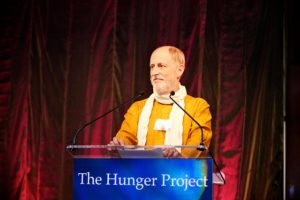
John Coonrod is the Executive Vice President of The Hunger Project — a non-profit organization that helps give poor people the means to lift themselves out of poverty. As part of this organization’s leadership, John Coonrod empowers poor people to lift themselves out of poverty by placing special emphasis on female farmers, who are among the poorest people in the world.
Origins
Coonrod has been advocating for social justice for a very long time. While he was training as a physicist at Stanford and the University of California-Berkeley, he was an active member of local civil rights and anti-war movements. When The Hunger Project was first founded in March of 1977, John Coonrod was its first volunteer and he continued to volunteer while he worked at Princeton University from 1978 to 1984.
In 1985, he became an official member of The Hunger Project’s staff. In addition to meeting his future wife while working at The Hunger Project, Coonrod used — and still uses — his expertise to help poor people in developing countries. To this day, John Coonrod empowers poor people to lift themselves out of poverty.
The Hunger Project
The Hunger Project is a non-profit organization that seeks to end poverty and world hunger by pioneering grassroots movements. While it believes that everyone should be free of poverty and hunger, they place a special focus on women and gender equality. The reason for this is that women are typically in charge of meeting a family’s needs, but are often denied the means and resources to do so by their society.
The Hunger Project currently works with organizations in 11 countries: Benin, Burkina Faso, Ethiopia, Ghana, Malawi, Mozambique, Senegal, Uganda, Bangladesh, India and Mexico. Between these countries, they have helped more than 85 organizations start 2,900 projects. In addition, they have chapters and investors in Australia, the U.S., Canada, Japan, Germany, the Netherlands, Sweden, Peru, Switzerland and the U.K.
In all of the countries where they work, The Hunger Project seeks to empower women, mobilize communities and engage local governments. In India, for example, their main focus is on helping women get elected into local governments. The organization has done this in nearly 2,000 panchayants (clusters of villages) across 6 states, and the women they have helped now lead 9 million people.
In Africa, The Hunger Project helps turn clusters of villages into epicenters where up to 15,000 people can band together to help their communities thrive. These epicenters, in turn, create their own development programs, which reach more than 1.6 million people across the continent. In Bangladesh, local volunteers, especially women and children, are mobilized to reach 185 sustainable development goals in their communities, reaching 5 million people. Finally, in Mexico, community development focuses on indigenous women and children, helping to improve childhood and maternal nutrition; this admirable work reaches 21,000 people.
Partners A-Plenty
The Hunger Project has numerous partners in the countries where they work. One of these partners is Rotary International, a global organization in which 1.2 million people work in sustainable projects to improve life in general across the globe. This includes fighting diseases, providing water, supporting educations, saving mothers and children, growing local economies and promoting peace. The Hunger Project mainly works with Rotary International in Ethiopia, where Rotary International uses vocational training to teach doctors how to resuscitate newborns.
In India, SKL International is a major partner of The Hunger Project. SKL International is a Swedish organization that uses the model of Sweden’s extensive local governments as a baseline to help developing countries achieve democracy. Like The Hunger Project, SKL International’s main goal in India is getting local women elected.
In Mexico, The Hunger Project works with Water For Humans — a non-profit organization that uses sustainable technology to bring clean water to those who need it, especially in Mexico. The organization is currently working on helping indigenous people build eco-cookstoves which require less wood than traditional stoves, need only one fire to work in multiple burners at once, and keeps coffee warm every day — as is culturally preferred.
Local Empowerment
All in all, John Coonrod empowers poor people to lift themselves out of poverty by helping to create and promote local movements, especially women-centric movements, that promote community welfare and engage with local governments. By working with several partners in various countries around the world, John Coonrod and The Hunger Project make lives better for women and other people across the globe.
– Cassie Parvaz
Photo: Flickr

Credit Access in Mauritius
Mauritius, the island nation in the Indian Ocean, has undergone a financial transformation since the early 2000s, promoted by the government in order to catalyze the economy of the country. This has impacted credit access in Mauritius in a big way. Since 2000, the country has experienced losses connected to its truncated access to EU sugar and textile markets and is facing steeper competition from China and other East Asian exports.
Mauritius Economy Compared to Other Countries
This loss of preferential treatment and high budget deficit spells a slight struggle for Mauritius to retain its middle-income standing. Currently, the country ranks 65th in the world on the Human Development Index, and in 2014, it was the second highest country in Africa on the development list. Mauritius’ Gross National Income (GNI) per capita is at $9,770 and the Organization for Economic Cooperation and Development (OECD) reports that the country performs better than the average compared with other sub-Saharan African and middle-income countries as far as information ability, involvement of the trade community, advance rulings, appeal procedures and internal border agency cooperation.
By continuing to focus on the area of governance and impartiality, Mauritius can increase its trade volumes and lower trade costs. A strengthened customs system and transparent ethics policy could be the final stretch to reach the Prime Minister’s dream of a high-income country.
Government Initiatives
The Prime Minister of Mauritius, Pravind Jugnauth, has predicted a revamping of the economy and expresses hope for Mauritius moving into the future. Key reforms introduced in the 2018/2019 budget helped bring Mauritius its present position. The Minister also touched on the government’s dedication to raising the country to high-income level country, thereby funneling benefits to every citizen. Already this commitment can be seen in the growth of Gross Domestic Product (GDP) and financial services, estimated to continue at 4.1 percent in 2019.
The government introduced changes to the legislative system in order to prevent money laundering and corrupt business. In his speech, the Prime Minister assured that the country is conducting a national risk assessment of terrorism financing.
Credit Access in Mauritius
A report from the Global Findex as of 2017 records 68.5 percent of Mauritians making or receiving digital payments, as well as 48.3 percent using credit or debit cards. The percentage of adults above the age of 15 who borrowed from a financial institution in Mauritius was at 22.9 percent, much higher than the sub-Saharan average of 8.4 percent, in comparison. Outstanding housing loans are increasing in availability as well, and almost 90 percent of adults were able to obtain access to financial institution accounts, banks or otherwise.
Enjoying past growth of upwards of 6 percent in the 1990s and continued economic performance, Mauritius is still dealing with the changes in the EU Sugar Protocol and falling sugar prices. As of 2006, the government incentivized seafood production in order to shift toward exporting fish instead of sugar, as well as a list of Integrated Resort Schemes offering luxury villas to foreigners. Diversifying the market and leveling the competition will surely launch Mauritius ahead in the economic playing field. The GDP by sector reveals the sugar sector operates at a modest 4.3 percent in 2007, led by government services at 15 percent, wholesale at 11, finance and real estate at 14.2 and many other diverse trade sectors.
Unfortunately, drastic adjustments meant one-third of employees for the sugar sector were redundant. The lost sugar income has still not been completely replaced, but the government is focused on diversification and increasing exports in the coming years.
In addition to experiencing an incredible 195 percent wealth growth from 2007 to 2017, credit access in Mauritius continues to increase due to strong ownership rights, a resilient economy, and ease of investment. Hopefully, the country’s example spearheads a movement throughout Asia for easier credit access and stable banks and economy.
– Hannah Peterson
Photo: Flickr
John Coonrod Empowers Poor People to Lift Themselves Out of Poverty
John Coonrod is the Executive Vice President of The Hunger Project — a non-profit organization that helps give poor people the means to lift themselves out of poverty. As part of this organization’s leadership, John Coonrod empowers poor people to lift themselves out of poverty by placing special emphasis on female farmers, who are among the poorest people in the world.
Origins
Coonrod has been advocating for social justice for a very long time. While he was training as a physicist at Stanford and the University of California-Berkeley, he was an active member of local civil rights and anti-war movements. When The Hunger Project was first founded in March of 1977, John Coonrod was its first volunteer and he continued to volunteer while he worked at Princeton University from 1978 to 1984.
In 1985, he became an official member of The Hunger Project’s staff. In addition to meeting his future wife while working at The Hunger Project, Coonrod used — and still uses — his expertise to help poor people in developing countries. To this day, John Coonrod empowers poor people to lift themselves out of poverty.
The Hunger Project
The Hunger Project is a non-profit organization that seeks to end poverty and world hunger by pioneering grassroots movements. While it believes that everyone should be free of poverty and hunger, they place a special focus on women and gender equality. The reason for this is that women are typically in charge of meeting a family’s needs, but are often denied the means and resources to do so by their society.
The Hunger Project currently works with organizations in 11 countries: Benin, Burkina Faso, Ethiopia, Ghana, Malawi, Mozambique, Senegal, Uganda, Bangladesh, India and Mexico. Between these countries, they have helped more than 85 organizations start 2,900 projects. In addition, they have chapters and investors in Australia, the U.S., Canada, Japan, Germany, the Netherlands, Sweden, Peru, Switzerland and the U.K.
In all of the countries where they work, The Hunger Project seeks to empower women, mobilize communities and engage local governments. In India, for example, their main focus is on helping women get elected into local governments. The organization has done this in nearly 2,000 panchayants (clusters of villages) across 6 states, and the women they have helped now lead 9 million people.
In Africa, The Hunger Project helps turn clusters of villages into epicenters where up to 15,000 people can band together to help their communities thrive. These epicenters, in turn, create their own development programs, which reach more than 1.6 million people across the continent. In Bangladesh, local volunteers, especially women and children, are mobilized to reach 185 sustainable development goals in their communities, reaching 5 million people. Finally, in Mexico, community development focuses on indigenous women and children, helping to improve childhood and maternal nutrition; this admirable work reaches 21,000 people.
Partners A-Plenty
The Hunger Project has numerous partners in the countries where they work. One of these partners is Rotary International, a global organization in which 1.2 million people work in sustainable projects to improve life in general across the globe. This includes fighting diseases, providing water, supporting educations, saving mothers and children, growing local economies and promoting peace. The Hunger Project mainly works with Rotary International in Ethiopia, where Rotary International uses vocational training to teach doctors how to resuscitate newborns.
In India, SKL International is a major partner of The Hunger Project. SKL International is a Swedish organization that uses the model of Sweden’s extensive local governments as a baseline to help developing countries achieve democracy. Like The Hunger Project, SKL International’s main goal in India is getting local women elected.
In Mexico, The Hunger Project works with Water For Humans — a non-profit organization that uses sustainable technology to bring clean water to those who need it, especially in Mexico. The organization is currently working on helping indigenous people build eco-cookstoves which require less wood than traditional stoves, need only one fire to work in multiple burners at once, and keeps coffee warm every day — as is culturally preferred.
Local Empowerment
All in all, John Coonrod empowers poor people to lift themselves out of poverty by helping to create and promote local movements, especially women-centric movements, that promote community welfare and engage with local governments. By working with several partners in various countries around the world, John Coonrod and The Hunger Project make lives better for women and other people across the globe.
– Cassie Parvaz
Photo: Flickr
Sustainable Agriculture in Senegal
The story of sustainable agriculture in Senegal is one of success that should be used as a guide for other countries. Between 1960 and the early 1980s, Senegal used monocropping, a dangerous practice where only one crop is grown year after year, leaching more and more nutrients from the ground. This eventually left the soil void of essential nutrients. When the area was hit by drought in the early 1980s, the land was unable to cope, and the country suffered from food shortages. However, over the last 20 years, Senegal has been using sustainable agriculture to bring back fertility to the soil.
In 1989, the United States government began working with Rodale International to come up with a plan to restore the soil. The plan was to use crop rotation. Every three years, one of four different plants would be sown in the soil. Each plant would only take certain nutrients from the ground and replace others. One of these plants was peanuts, the plant that caused the problem in the first place, and the second was millet. Both are now the main agricultural exports of Senegal. The other two crops in rotation are cowpeas and cassava.
The International Production and Pest Management Program
The United States and international companies are not the only organizations helping improve sustainable agriculture in Senegal. Senegal has been part of the Food and Agriculture Organization of the United Nations (FAO) IPPM program since 2001. The IPPM (Integrated Production and Pest Management Program) is dedicated to responsible pest control practices. The program touches on many points to control pests; however, its most important lesson is the responsible use of pesticides.
Pesticides remain a continuous problem in Senegal and most of the world due to their overuse. Pesticides stay in the water table, contaminating drinking water. They also hurt the soil since the chemicals build up over time and stay on the crops. When consumed pesticides are harmful to humans and animals. This is not to say that they are not sometimes necessary, but the IPPM suggests a less-is-more approach.
Syngenta
Private foundations are also doing their part. Syngenta, a Swiss-based based agricultural firm, has a foundation called the Syngenta Foundation for Sustainable Agriculture. The foundation works with public and private sector partners in order to finance innovations in sustainable agriculture. They also work with the World Bank, USAID and both the Swiss and Australian governments.
Since 2014, Syngenta has been promoting sustainable agriculture in Senegal’s rice production. In 2015, the organization began helping farmers gain access to better-mechanized equipment to facilitate rice cultivation in the Senegal River Valley. The overall approach of the Syngenta Foundation for Sustainable Agriculture is to work with the entire system. The work with NGO’s and governments to help small farmers become more productive has helped to increase the economic benefit of sustainable farming practices. It also helps the farmers better feed themselves and their families.
Improving the Economy Through Sustainable Agriculture
The soil is becoming productive again, and farmers are gaining access to better techniques and equipment. However, the fight is not over. Senegal suffers from an unemployment rate of 47 percent. In 2017, the agricultural industry employed 77 percent of the population in Senegal, an estimated 6.9 million people. However, the agriculture industry only makes up only about 17 percent of the of the country’s GDP. The next step to better economic stability will be to tackle these issues. Hopefully, like its soil, the Senegalese economy will now rejuvenate and grow for all.
– Nicholas Anthony DeMarco
Photo: Flickr
Purchasing Power Parity: The Russian Ruble vs. The American Dollar
There is a commonly understood equation that all world travelers parse out during their adventures to foreign countries: “How much will (x) of my currency buy (y) of their currency?” If an American travels to any of the 27 European nations, they will need to exchange a large portion of U.S. dollars into the EU’s respective currency, the Euro (€). Similarly, if Russians travel to the United States, they will need to buy American dollars ($) with their Russian Rubles (₽).
Purchasing Power Parity
The relative worth of one holder’s currency pegged to another’s in consideration of the purchase of the same basket of goods and services is referred to among economists as the purchasing power parity (PPP). The parity is a theory that suggests “exchange rates between currencies are in equilibrium when their purchasing power is the same in each of the two countries” (University of British Colombia School of Business).
The basis of PPP is the law of one price across nations; however, in the world of global economies and integrated wealth and trade, $10 spent in Russia gets one more goods and services than $10 spent in the United States. This is the economic disparity that leaves Russian consumers worse off in both their own country and the U.S.A.
Experimental Practicality
In order to better understand the purchasing power parity and how it adversely affects the Russian middle class, the following example will better illustrate its practicality:
Consider the two experimental countries, Russia and the U.S. A tall-sized latte from Starbucks costs approximately 255 ₽ or an American equivalent of $4.50; however, in the U.S., an identical product costs $2.95. The PPP between Russian and the U.S.A. for a tall-sized latte from Starbucks is the price paid in Russia in U.S. dollars ($4.50) divided by the price paid in the United States in U.S. dollars ($2.95).
Simple arithmetic leads to the conclusion that for this item, the PPP between Russia and the U.S. is approximately 1.52, which means the consumers pay $1.52 to make a purchase in Russia that would cost $1.00 in the United States. Alternatively, Russian consumers are using their weaker national currency to pay a 50 percent premium on a tall-sized latte from Starbucks. Apply this to the purchase of a flat, college education or vehicle, and the numbers and basic economic principle alone illustrates how worse-off the Russian middle class is than that of its western counterpart.
Poverty in Russia
The PPP between Russia and the U.S. and any other first-world country is relevant to the overarching issue of poverty in Russia because of relative wealth distribution and purchasing power. Russia’s geography necessitates a strong import business relationship with the world’s leading trading partners, including and especially the United States where embargoes do not apply. For Russian consumers, this means higher prices for finished goods and services that are not justifiably priced in the Russian Ruble (₽).
When Russian consumers want to spend on big-ticket items, they have to work harder and longer, save more and manage their money better than consumers in the U.S. Economics and the PPP explain why Russians often work abroad and repatriate foreign currencies with higher PPP than the Ruble so to afford goods and services in Russia. This consumption strategy tightens the labor market for Russians; however, in the long run, this is not an economically viable alternative to internal market corrections.
Creating Middle-Class Improvement
How can the rest of the world equal the playing field for Russia? The answer is difficult. First, the law of incentives must be prioritized in Russia’s labor environment to keep skilled and unskilled labor in Russia and reduce currency repatriation. Secondly, Russia needs to begin to play by the rules set by developing countries if the country wants to reduce its PPP relative to trade nations. Last but not least, these prior measures will work to benefit Russian importers, businesses, and most importantly, Russian consumers. It is time to bring more power back to the Russian Ruble for the middle class of Russia.
– Nicholas Maldarelli
Photo: Flickr
President Macron’s Fight Against Poverty in France
France, the world’s seventh-largest economy, gained national media attention as the “Yellow Vest” protest hit its 10th consecutive weekend. The protesters — originally citizens of the country’s rural areas — came to Paris to protest higher taxes on fuel. Now, three months into the protest, the movement has changed its message to target many economic problems that those living in poverty in France struggle with.
Poverty in France
This unrest has pressured French President Emmanuel Macron to do more to help the nation’s poor. He has now announced an anti-poverty plan worth 8 billion euros ($9.3 billion) aimed at appeasing the protestors and increasing the fight against poverty in France. He hopes it will get people into work and help the young. Specifically, this plan includes increasing: schooling until the age of 18, nurseries to get mothers into work, emergency accommodation with a priority for women and children, and breakfast for students in the poorest areas.
Additionally, the package includes wage increases and tax relief for low earners and retirees. Macron also launched a “national debate” to talk to the public about their economic situation. This period is to last two months, and end with a “new contract for the nation.”
Steps to Improvement
Poverty in France affects 9 million of the country’s 67 million people with a third of them being children. Macron has stated that the previous welfare system “does not do enough to prevent people from falling into poverty, does not do enough to eradicate poverty.” He has expressed frustration at previous plans, saying they “plow a wad of cash” into benefits, but produce very few results. Macron also plans to make these earlier systems more simple, as one in three people eligible for core benefits do not apply.
People know these low application rates well, in addition to the very real struggles of applying. A story on Expatica, a website that helps immigrants in Europe settle into their new countries, has a very telling story on a citizen’s attempt to apply for aid. The author describes the process of applying for three state programs providing assistance. Describing the welfare system as “tricky,” they share that one of their claims had boomeranged back to them four times and that this experience is something everyone applying should expect.
Complex Issues, Concrete Solutions
According to the author, the administration is well aware of the complexity of the process, which is exactly why it requests documents multiple times. This repetitive behavior requires applicants to deal with huge stacks of paperwork and multiple trips to state offices. Stories such as these may explain the low application numbers and also act as some of the issues Macron hopes to address in his new programs.
Although many of the protesters expressed concern over Macron’s national debate, it is extremely clear many people in the country need help, and many of the programs need reforming. With the debates and planning still in the works, it can be hard to tell exactly what is going to occur. However, the people are talking, and it appears the government is listening. The fight against French poverty is clearly still ongoing, but progress is steadily happening.
– Zachary Sparks
Photo: Flickr
Living Problems in West Bank and Gaza
The West Bank and Gaza are considered Palestinian territories that have struggled with political power since the Six-Day War in 1967. This dispute has been between Israel and Palestine and the end result of the war has left the country in political turmoil. This devastated economic opportunities, local livelihood, sanitation conditions and household food consumption. In 2017, the 50th anniversary of Israeli occupation and the 10th anniversary of the Gaza blockade were marked. This has been affecting all job opportunities and proper food aid from entering the region. All of these factors have only made it more difficult to live in already precarious conditions and more risk for the already struggling population.
Work of USAID
The U.S. government works closely with the authorities in Palestine to address the economic and humanitarian needs of the country. To improve economic growth, USAID has donated roughly $400 billion to improve in-house situations for companies and impoverished families in West Bank and Gaza. Providing basic needs like clean sanitation systems and safe work environments is essential to maximize productivity within the company and keep the workers healthy. Many companies suffer from a lack of resources and expertise for their products, so the project Compete will help business owners learn more about their product, how to maximize value for those products and increase employment within the surrounding areas. The goal is to increase competitiveness and revitalize the private sector, bringing to the table full-time jobs, part-time jobs, seasonal jobs and paid internships.
Food Sovereignty of West Bank and Gaza
Food insecurity is a huge issue in the West Bank and Gaza territory as over 70 percent of people in this area suffer from lack of food and proper nourishment. Some of the causes for this are also a global phenomenon, environmental degradation, rising food prices and Palestinian food sovereignty. With food sovereignty, a state can control its own food resources, though that state has to have a self-sufficient food source with the help of government-controlled policies.
Since the occupation in 1967, Israel has confiscated thousands of acres of farming land and then separated it with the West Bank wall. With the separation of land, farmers are struggling to keep up the health with crops due to vandalism and destruction from settlers and the military. In Gaza, 25 percent of fertile land has been destroyed by the buffer zone, a zone that borders Israel. Patrol boats in the area only allow fishermen 15 percent of their territorial waters, further reducing the areas self-sufficient food sources. With the limitations on trade, environmental issues, confiscation of land and destruction of land, food sovereignty is unachievable. This has hindered economic growth and social conditions to reduce the levels of food insecurity.
Clean Water Access
Access to clean, potable water is limited by the wall between the West Bank and Gaza. Beaches, rivers and lakes are polluted and overcrowded refugee camps create health hazards for the sanitation systems. About 26 percent of diseases in West Bank and Gaza are related to filthy water. During the winter months, household septic tanks overflow and mix with rainwater, flooding homes and streets in the area. During the summer, the heat dries the streets from the flood and the smell coming off the streets is so bad that families keep their windows shut. Mothers refuse to let their children out to play because of the rancid smell and infected water.
Diseases continue to spread as garbage continues to pile up in refugee camps. The Anera organization is working on building proper waste management systems across Palestine, improving sanitation systems in the process. In 2014, Anera reconstructed sewage lines damaged by bombs. In refugee camps, they are taking an approach where the youth take the lead. Through campaigns designed to clean and recycle, they have developed a staff to train on proper waste management and a new sorting facility. They are creating a cleaner environment for 13,000 members of their community so far and will continue to reach out and help their people.
Health System in West Bank and Gaza
The health system in West Bank and Gaza has been shaped by years of occupation, political stalemate, violence and human rights violations. The barrier placed between the two territories limits access to East Jerusalem, the closest area that has specialized hospitals. The placement of these hospitals is scattered due to the many health care providers in the country. With the blockade in place, Gaza’s health care locations are experiencing unstable power supply and recurring power cuts.
The medical equipment has been deteriorating because of inadequate maintenance and spare parts cannot reach them. The barrier has also made it difficult to transport proper medicines to treat patients. All of these factors are crushing the health care system in West Bank and Gaza, making people seek treatment elsewhere though traveling in and out of Gaza is heavily restricted. Even with these limitations, health care in these areas still thrives. With the help of the World Health Organization, technical support will be provided to health technicians and fund projects created for diseases affecting the population.
Even with all of these issues, West Bank and Gaza still work out solutions to everyday and past problems. If these areas can continue to receive the funding from developed countries and nongovernmental organizations, they can grow back into the self-sufficient economy they once had.
– Kayla Cammarota
Photo: Flickr
Top 10 Facts About Hunger in Bahrain
Illustrating the dynamic between existing struggles and state reform are the top 10 facts about hunger in Bahrain.
Top 10 Facts About Hunger in Bahrain
Though hunger itself is not a prevalent issue, issues stemming from poor nutrition practices continue to affect the country today. Obesity is currently the greatest threat to public health, affecting young and adult populations alike. Government resources used to help fight hunger and malnutrition may further benefit citizens by being apportioned to accessible education on better nutrition and health practices.
– Natalie Marie Abdou
Photo: Flickr
Updated: July 12, 2024
Top 10 Facts About Life Expectancy in Mexico
Before jumping into this discussion about life expectancy in Mexico, it seems important to explain the importance of measuring life expectancy when attempting to solve the problem of global poverty. Life expectancy, just like malnutrition and infant mortality statistics, shows how well a certain country is living.
If you notice that a country has high life expectancy rates while malnutrition rates are low, one can assume said country has beneficial living conditions and most likely, low poverty rates. From certain facts about life expectancy in Mexico, one will not be able to the whole story about living conditions and poverty in Mexico but will be able to gain some insight into how do Mexicans live.
Top 10 Facts About Life Expectancy in Mexico
To be certain, Mexico, just like every country on this Earth, can do better in terms of creating the conditions to make life expectancy rise, as well as making poverty fall. To those that may not know much about Mexico’s performance in the eradication of poverty and its symptoms, this fact sheet hopefully gave insight into what life might currently be like in this North American country and what can be improved.
– Kurt Thiele
Photo: Flickr
Top Five Reasons for School Dropouts in Tonga
Tonga, a Polynesian country and archipelago comprising of total 169 islands (36 inhabited) has achieved tremendous progress in improving the nation’s primary school enrollment. Although these rates are high, the school completion rates continue to decrease. About 3,000 Tongan students drop out of secondary school each year. In the text below, the top five reasons for school dropouts in Tonga are presented.
Top Five Reasons for School Dropouts in Tonga
Work of Nongovernmental Organizations
Various nongovernmental organizations have been working on providing employment and education opportunities for Tongan youths. The Skills Employment for Tongans Project aims to help the Tongan government to create a cash transfer program to help Tongan households with their tight household budgets. It also will provide technical and vocational education training courses to help Tongan youths establish skills that will allow them to become employable in Tonga and in other countries.
The Pacific Early Age Readiness and Learning Project (PEARL). The goals of this organization are to help children gain skills that will prepare them for school and help them learn to read and write for their first years of primary school. Preparing Tongan children at an early age will help implement the idea that education is important.
These top five reasons for school dropouts in Tonga are still problems that the nation of Tonga is facing, but the Tongan government is getting help from various nongovernmental organizations in trying to keep up with the high demand for employment and educational opportunities. It is a difficult task, but with the joint effort of government and NGOs, as well as other countries, this can be achieved.
– Jocelyn Aguilar
Photo: Flickr
Top 10 Facts About Girls’ Education in Kazakhstan
In 2012, Kazakhstan‘s President Nursultan Nazarbayev announced the ambitious Kazakhstan 2050 plan to make this Central Asian nation one of the world’s 30 most developed. Much of the plan revolves around the economic activity, but a crucial secondary function is to bolster and expand the country’s education system. Since Kazakhstan 2050 was kicked off, substantial strides have been made regarding making education and schools more accessible and high quality for all citizens. However, there are still barriers in place that prevent girls from utilizing of Kazakhstan’s growing scholastic offerings. In the article below, the top 10 facts about girls’ education in Kazakhstan are presented.
Top 10 Facts about Girls’ Education in Kazakhstan
Kazakhstan’s aspiration to be one of the world’s most developed nations seems very likely considering the progress the country has made in recent history. By investing in and rethinking the educational system, Kazakhstan shows the importance of education for the country’s future and that, in order for the country to realize its potential, so must its citizens regardless of their gender. Educating women is a must when achieving the status of a prosperous nation.
– Nick Sharek
Photo: UNICEF