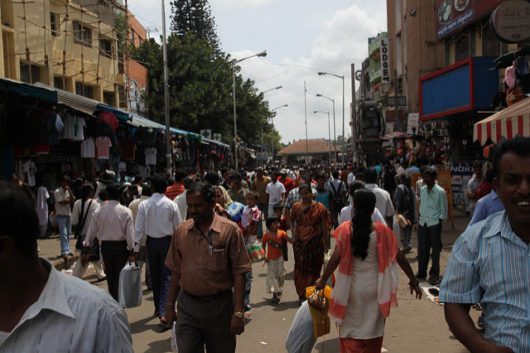
Overpopulation begets poverty. When a city is overpopulated, the ratio of available resources to the number of people sharply decreases. There simply is not enough to go around, because there are too many people for whom goods, services and economies such as food, water, shelter, health care and opportunities are available.
Below is a list of the 10 most overpopulated cities in the world. This list was compiled according to Demographia World Urban Areas and is based upon a study of 1,758 urban areas.
The 10 Most Overpopulated Cites In The World
10. Malegaon, India
Population: 720,000. Population density per square kilometer: 23,200. Malegaon is a city and Municipal Corporation in the Indian state of Maharashtra, nestled within the Nashik District. A series of bombings shook the land in 2006, but the country has since been able to retain peace in the land.
9. Vijayawada, India
Population: 1,900,000. Population density per square kilometer: 23,700. Vijayawada, which translates to “the Place of Victory,” is a city of nearly two million people located on the banks of the Krishna River. It is considered a major transportation hub and is known for being a significant location for Buddhist and Hindu ritual.
8. Tshikapa, The Democratic Republic of the Congo
Population: 810,000. Population density per square kilometer: 24,100. A city of Tshikapa is located roughly 30 miles north of the border with Angola. It is perhaps best known as a terrain fertile for diamonds. Since the first diamond was discovered on the land in 1907, diamond mining and exploitation have been the focus of the Tshikapa economy.
7. Hong Kong, China
Population: 7,380,000. Population density per square kilometer: 25,900. Being the Special Administrative Region of China, Hong Kong is the seventh most overpopulated city in the world, and perhaps one of the most familiar on the list. This is one of the most economically powerful cities in the world and it seemingly has something for everyone.
6. Macau, China
Population: 675,000- Population density per square kilometer: 26,100. Under Chinese sovereignty for 20 years, Macau was formerly under Portuguese control from 1557 up to 1999. Now a Special Administrative Region of China, Macau is known for its elaborate entertainment industry, so much so that it has come to be dubbed the “Las Vegas of Asia.”
5. Mumbai, India
Population: 23,260,000 million. Population density per square kilometer: 26,400. India’s largest city Mumbai is often considered among the major cities of the world. It is at the heart of India’s financial and commercial interests, built upon the site of an ancient settlement. Mumbai, formerly Bombay, also has the distinction of being the home of Bollywood.
4. Surat, India
Population: 6,200,000. Population density per square kilometer: 26,600. The eighth largest city in India and one of the world’s most rapidly growing cities, Surat plays a key role in the country’s textile industry.
3. Al-Raqqa, Syria
Population: 845,000. Population density per square kilometer: 27,200. Al-Raqqa, nestled along the Euphrates River, was an important city even in distant past, during the Abbasid dynasty (786-908 CE). Of recent, the city was prominence as the de facto headquarters of ISIS in their brief conquest of the land, but with ISIS overthrown, so too was this notoriety.
2. Mogadishu, Somalia
Population: 2,600,000. Population density per square kilometer: 28,600. The capital of Somalia, Mogadishu, has been considered one of the foremost ports of the world for thousands of years.
1. Dhaka, Bangladesh
Population: 17,400,000. Population density per square kilometer: 47,400. Dhaka, the most overpopulated city in the world and the capital of Bangladesh is known for its culture and education. It is also known for ornate architecture from its history as a prominent region in Muslim rule during the 17th century
These 10 most overpopulated cities in the world share many challenges, including a lack of resources and high poverty levels. However, with the unrelenting work of the international community, overpopulation is a problem predicted to end (with the current projections of global population peak in 2070 followed by a long-term decrease).
– Lacy Rab
Photo: Flickr

10 Facts About Life Expectancy in Venezuela
Life expectancy rates in Venezuela may have looked very different a decade ago under Hugo Chavez, but now the country caught the attention of the world with the presidency of Nicolas Maduro, which has resulted in civil unrest. The country is facing extreme hyperinflation and a reduced supply of power, healthcare and food, which has ensured the exodus of more than three million citizens in recent years. Although the country has the largest proven oil reserves in the world, its economy seems to have collapsed within months. Here are 10 facts about life expectancy in Venezuela.
10 Facts About Life Expectancy in Venezuela
The Fight Continues
The former Health Minister, Antonieta Caporale, was fired shortly after he had released the health statistics in 2017, which were the only data provided by the government. The Venezuelan National Assembly had announced a humanitarian crisis in the country, further pleading for international humanitarian aid, which was quashed by the President.
Though these 10 facts about life expectancy in Venezuela may seem bleak, there is hope for the country with NGOs playing a major role in helping improve the current state. Several organizations are working towards improving the condition of Venezuela, including the Trump administration who have shown support and held secret meetings with the opposing military forces to formulate plans to overthrow President Maduro.
– Nikhil Sharma
Photo: Flickr
Top 10 Facts About Life Expectancy in Haiti
The following 10 facts about life expectancy in Haiti reveal a domino-effect of massive natural disasters, fragile health care infrastructure and low access to preventative care in a country where half of the population lives in extreme poverty. On the bright side, poverty rates have improved and can continue to uplift if aid focuses on establishing long-term preventative care facilities and the government can effectively communicate with programs to meet needs. With the improvements in poverty rates and health care, life expectancy will consequentially improve.
Top 10 Facts About Life Expectancy in Haiti
These 10 facts about life expectancy in Haiti highlight the hard road ahead to establish a sustainable infrastructure to address the country’s health care needs. Part of the struggle lies with its need for disaster-relief programs, many of which operated mainly to bring emergency care. As Haiti stabilizes its economic and employment rates, and more citizens can afford or be provided with preventative care, the crisis will decelerate. However, the economic, political, and health-care infrastructure all require stabilizing and the continued partnering of foreign aid for the country to progress to a more sustainable future.
– Hannah Peterson
Photo: Flickr
The 10 Most Overpopulated Cites in the World
Overpopulation begets poverty. When a city is overpopulated, the ratio of available resources to the number of people sharply decreases. There simply is not enough to go around, because there are too many people for whom goods, services and economies such as food, water, shelter, health care and opportunities are available.
Below is a list of the 10 most overpopulated cities in the world. This list was compiled according to Demographia World Urban Areas and is based upon a study of 1,758 urban areas.
The 10 Most Overpopulated Cites In The World
10. Malegaon, India
Population: 720,000. Population density per square kilometer: 23,200. Malegaon is a city and Municipal Corporation in the Indian state of Maharashtra, nestled within the Nashik District. A series of bombings shook the land in 2006, but the country has since been able to retain peace in the land.
9. Vijayawada, India
Population: 1,900,000. Population density per square kilometer: 23,700. Vijayawada, which translates to “the Place of Victory,” is a city of nearly two million people located on the banks of the Krishna River. It is considered a major transportation hub and is known for being a significant location for Buddhist and Hindu ritual.
8. Tshikapa, The Democratic Republic of the Congo
Population: 810,000. Population density per square kilometer: 24,100. A city of Tshikapa is located roughly 30 miles north of the border with Angola. It is perhaps best known as a terrain fertile for diamonds. Since the first diamond was discovered on the land in 1907, diamond mining and exploitation have been the focus of the Tshikapa economy.
7. Hong Kong, China
Population: 7,380,000. Population density per square kilometer: 25,900. Being the Special Administrative Region of China, Hong Kong is the seventh most overpopulated city in the world, and perhaps one of the most familiar on the list. This is one of the most economically powerful cities in the world and it seemingly has something for everyone.
6. Macau, China
Population: 675,000- Population density per square kilometer: 26,100. Under Chinese sovereignty for 20 years, Macau was formerly under Portuguese control from 1557 up to 1999. Now a Special Administrative Region of China, Macau is known for its elaborate entertainment industry, so much so that it has come to be dubbed the “Las Vegas of Asia.”
5. Mumbai, India
Population: 23,260,000 million. Population density per square kilometer: 26,400. India’s largest city Mumbai is often considered among the major cities of the world. It is at the heart of India’s financial and commercial interests, built upon the site of an ancient settlement. Mumbai, formerly Bombay, also has the distinction of being the home of Bollywood.
4. Surat, India
Population: 6,200,000. Population density per square kilometer: 26,600. The eighth largest city in India and one of the world’s most rapidly growing cities, Surat plays a key role in the country’s textile industry.
3. Al-Raqqa, Syria
Population: 845,000. Population density per square kilometer: 27,200. Al-Raqqa, nestled along the Euphrates River, was an important city even in distant past, during the Abbasid dynasty (786-908 CE). Of recent, the city was prominence as the de facto headquarters of ISIS in their brief conquest of the land, but with ISIS overthrown, so too was this notoriety.
2. Mogadishu, Somalia
Population: 2,600,000. Population density per square kilometer: 28,600. The capital of Somalia, Mogadishu, has been considered one of the foremost ports of the world for thousands of years.
1. Dhaka, Bangladesh
Population: 17,400,000. Population density per square kilometer: 47,400. Dhaka, the most overpopulated city in the world and the capital of Bangladesh is known for its culture and education. It is also known for ornate architecture from its history as a prominent region in Muslim rule during the 17th century
These 10 most overpopulated cities in the world share many challenges, including a lack of resources and high poverty levels. However, with the unrelenting work of the international community, overpopulation is a problem predicted to end (with the current projections of global population peak in 2070 followed by a long-term decrease).
– Lacy Rab
Photo: Flickr
Top 10 Facts About Poverty in Palestine
Palestine, a country consisting of Gaza and the West Bank, faces ongoing conflict with Israel, political instability and resource insecurity. While the historical and political situation in Palestine is complex and difficult to explain, here are the top 10 facts about poverty in Palestine in order to provide a clearer picture of the country’s situation.
Top 10 Facts About Poverty in Palestine
Looking Ahead
These top 10 facts about poverty in Palestine are just snippets of the complex picture of political, historical and economic factors that influence the Palestinian standard of living. There is no magic bullet solution to poverty in any country, but a combination of international support and political collaboration has the potential to greatly improve the lives of many Palestinians.
– Carolina Sherwood Bigelow
Photo: Pixabay
Top 10 Facts About Living Conditions in Djibouti
Djibouti’s location in the Horn of Africa makes it a prime port for trade. The diverse population has taken an increased interest in this country’s urban areas bordering the coast. The country’s GDP is rising, but 16 percent of the population was still living under $1.90 per day in 2017. These top 10 facts about living conditions in Djibouti reveal the status of the country as well as the effects of welcomed foreign interactions.
Top 10 Facts About Living Conditions in Djibouti
Djibouti’s cosmopolitan port keeps it a central location for foreign affairs; however, an overpopulation of displaced people and drought have put a strain on food security. Equality is a work in progress. Though FGM still poses a threat to Djiboutian girls, there are organizations working to end the barbaric practice. Furthermore, women are on the rise towards entrepreneurship. These top 10 facts about living conditions in Djibouti show the continued external support that contributes to the country’s infrastructure in order to create a stronger country.
– Crystal Tabares
Photo: Flickr
Five Countries Fighting Against Hunger
Countries around the world suffer from hunger and are seeking help to fight the problem. Utilizing education and government can help tremendously to solve this problem, as well as people of those communities coming together can. In this article, five countries that are fighting against hunger are presented.
Five Countries Fighting Hunger
Many countries are fighting hunger today. Whether it is climate based, malnutrition, lack of government, lack of education, or even conflict. Organizations like Concern, World Food Bank, Food and Agriculture Organization of the United Nations, and the United Nations Children’s Fund are set on breaking the cycle. They have helped every one of these countries fighting hunger, and are helping to many more.
– Kayla Cammarota
Photo: Flickr
Top 10 Facts About Girls’ Education in the Kyrgyz Republic
Education breeds confidence and encourages young girls to pursue opportunities otherwise not available to them, which is one reason why it is so integral to learn about the top 10 facts about girls’ education in the Kyrgyz Republic and foster international and local policies that support equality in education. Working towards complete gender equality in education in the Kyrgyz Republic will not only improve the lives of millions of girls and women, but it will also benefit everyone in the country.
Top 10 Facts About Girls’ Education in the Kyrgyz Republic
Path to Independence
Education is the path to independence and a future of opportunities for young girls in the Kyrgyz Republic. Although these top 10 facts about girls’ education in the Kyrgyz Republic show that there is still gender inequality in the Kyrgyz economy, improving education standards for girls will benefit all of its citizens and lead to a fuller and more equal life for women in the Kyrgyz Republic.
– Alina Patrick
Photo: Flickr
Top 10 Facts About Living Conditions in The Bahamas
The Bahamas is an island country located in the Atlantic Ocean. The population totals at just over 400,000 people. The total GDP stands at $11.6 billion, and the country has a market economy. The Bahamas is one of the richest countries in the Americans today and their economy is finance and tourism based. These top 10 facts about living conditions in the Bahamas presented below will illustrate the way of life on the islands.
Top 10 Facts about Living Conditions in the Bahamas
These top 10 facts about living conditions in the Bahamas show the development of this island nation that has become one of the richest countries in the Americans, mainly due to its location and tourism. They also indicate fields where improvement is needed, such as prevention of spreadable diseases and freshwater resources.
– Natasha Eckelbarger
Photo: Flickr
The White Rose Organization & The Power of Education in Tanzania
Tanzania faces many challenges, including environmental pollution and poverty. The country has seen development in recent years, and poverty rates have declined by around one percent every year since 2007, according to a World Bank report. However, poverty remains high compared to neighboring countries, as 22.8 percent of Tanzania‘s population lives below the poverty line. Furthermore, 48 percent of children in Tanzania are deprived, even if they do not live in households that are monetarily poor.
Approximately 26 percent of youth in Tanzania have not completed primary education, as poverty is a barrier that keeps many children from going to school. The disparity between the richest and poorest children is stark — with the average primary school attendance rate being 68 percent for the poorest quantile of children and 90.5 percent attendance for the wealthiest quintile. Education in Tanzania still has room for improvement, and many regions and public schools lack qualified teachers and materials.
The White Rose: Hope for the Future of Education in Tanzania
The White Rose is a nongovernmental organization that believes fostering education in Tanzania is the key to tackling the nation’s problems and creating lasting social and economic change. The organization’s focus is on primary education, where children learn how to behave and form the mindset that will guide them throughout their lives. The organization works in several small villages in the Arusha region (Sanawari, Ilboru and Olturoto) located in the northern region of Tanzania.
The White Rose relies on volunteers to help fill in some gaps and bring a new and international perspective to local pupils. Nikolay Nedyalkov, a volunteer who completed a program with the White Rose organization, told The Borgen Project:
Nedyalkov’s experience illuminates another challenge in Tanzania’s education system. The government declared primary education free in 2001, and by 2016, 1.3 million students had enrolled. This high enrollment caused the student-to-classroom ratio to soar to 77:1. Private primary schools, on the other hand, are unattainable for a large portion of the population, with annual fees ranging from $1000 to $17,000. Therefore, while the White Rose provides the opportunity for its volunteers to teach in both public and private schools, the organization suggests that those volunteering for more than three weeks do so in a public school.
The White Rose volunteers teach a variety of subjects (ranging from English to geography) to primary school students. The organization currently operates in four private schools, two public schools, and a public library. Additionally, the Global Partnership for Education, UNICEF, and USAID have made strides to improve access to education for Tanzanian students. Tusome Pamoja, which translates to “let’s read together,” is USAID’s flagship program in coordination with Tanzania’s government. The program’s scope ranges from assisting with policy issues to coordinating teacher training and student materials; it seeks to benefit nearly 1.4 million children over the course of five years.
While the education system in Tanzania faces obstacles, the involvement of organizations like the White Rose and its team of volunteers are making a significant positive impact. With contributions of a multitude of aid organizations and the international community, the state of education in Tanzania is likely to improve.
– Aleksandra Sirakova
Photo: Flickr
Promising Potential: Rotavirus Vaccination Program in Malawi
The success of a new rotavirus vaccination program in Malawi has received global attention, as world leaders and advocates now call for the widespread distribution of the vaccination. In the last five years, this southeast African country has seen a significant decline in infant death by about one third.
Rotavirus Vaccination Program in Malawi
In many impoverished countries, rotavirus is a leading cause of death in children and infants; in fact, 121,000 deaths from the virus were reported in Africa in 2013. The infection is shed in the infected individual’s stool, which can then spread into the environment and infect other individuals. Rotavirus is most often transmitted within poor sanitation conditions. Handwashing is important to combatting such infection, and setting up handwashing stations in impoverished countries could help improve conditions and limit infections.
Unfortunately, such measures are not enough to completely prevent spreading, and thus why vaccination is an essential prevention tool. The rotavirus most often infects infants and young children and symptoms can take up to two days to appear. The most common symptoms are severe diarrhea, vomiting and abdominal pain that leads to extreme dehydration, which is often fatal in impoverished countries. Children who are not vaccinated often suffer from more severe symptoms.
Promising Studies Bring National Hope
Thankfully, the new rotavirus vaccination program in Malawi has demonstrated immense success. Studies from Liverpool University found that of the children who received the vaccination, 34 percent had a lower risk of dying from diarrhea. Such a promising statistic manifested the first major decline in Malawi’s infant mortality rate in decades.
Scientists from the University of Liverpool, University College London and Johns Hopkins University — alongside the help of Malawi health services — tracked the health and development of 48,672 infants following the implementation of the new vaccination program in over 1,800 villages. The data collected strongly advocated the incorporation of the rotavirus vaccination program in Malawi, as well as in other countries with high rates of diarrhea-caused deaths.
Despite the major health intervention brought by the rotavirus vaccination program in Malawi, some populous countries with high infant mortality rates have yet to adopt the program. Dr. Charles Mwasnsambo, Malawi’s chief of health services, asserts the value of vaccination programs by citing the study’s encouraging findings that show a large decrease in hospital admissions and a decline in infant mortality rates. Dr. Mwasnsambo told Global Citizen that he strongly believes the study to be a worthwhile investment.
Setting a Global Example
According to the Rota council of the 10 countries leading in rotavirus-related deaths, only six have rotavirus vaccination programs like Malawi’s. These countries include Kenya, Afghanistan and Pakistan. Rota council members, Malawi healthcare providers and medical researchers are calling for widespread distribution of the vaccination, especially in countries with high infant mortality rates.
Given the success of the rotavirus vaccination in Malawi, medical researchers and several world leaders agree that combatting this illness goes beyond handwashing. Leaders must advocate for vaccinations and implement such a measure in foreign aid packages if they plan to share Malawi’s success and continue to combat alarming rates of rotavirus-related deaths globally.
– Haley Newlin
Photo: Pixabay