• Link to X
  • Link to Facebook
  • Link to Instagram
  • Link to TikTok
  • Link to Youtube
  • About
    • About Us
      • President
      • Board of Directors
      • Board of Advisors
      • Financials
      • Our Methodology
      • Success Tracker
      • Contact
  • Act Now
    • 30 Ways to Help
      • Email Congress
      • Call Congress
      • Volunteer
      • Courses & Certificates
      • Be a Donor
    • Internships
      • In-Office Internships
      • Remote Internships
    • Legislation
      • Politics 101
  • The Blog
  • The Podcast
  • Magazine
  • Donate
  • Click to open the search input field Click to open the search input field Search
  • Menu Menu

Tag Archive for: Education

Posts

Education, Global Poverty

How Education is Affecting the Poverty Rate in India

Poverty Rate in India
India, which now has the world’s third-largest economy in terms of purchasing power parity, has been an urban-centered, industrializing nation since its independence in 1947. Over the last 25 years, India has been noted for its significant economic growth which looks to continue for the 2017 -2018 fiscal year with an expected growth rate of 7.2%. While India has maintained much economic success, many failures and weaknesses still debilitate the nation’s full potential. For example, the poverty rate in India has been less severe in recent years, but there is still much room for improvement.

In 2016, 270 million Indians were surviving on $1.90 or less a day, the World Bank’s definition of extreme poverty. Of the people living in these conditions, 80 percent lived in rural India, where the main source of income for the population is through casual labor. While the economy has appeared to have boomed over the last 25 years, most growth has been in urban areas where large multinational corporations, such as IBM and Microsoft, base their software development headquarters.

With this divide between urban and rural life, economic growth does not seem to remove the issues of extreme poverty in the way a neoliberal economist would suggest. A study in 2002 found that these conditions in India are partially due to educational poverty, which is defined as the deprivation of basic education and literacy. Only 6% of the income from poor households is invested in education and health, while the majority is spent on other necessities such as food and fuel.

However, Tsujita, a researcher of the Institute of Developing Economies, believes that “there may be a chance of escaping poverty through education.” The government in India seems to agree with this statement as they promoted the Sarva Shiksha Abhiyan (SSA) project as a part of their flagship program. SSA was a project in India that began in 2002 to enroll all six- to 14-year-olds in primary education by 2010. The project attempted to do so by improving the facilities and infrastructure of schools while also expanding access to these facilities nationally. As a result, by 2009, 98% of children were only 1 kilometer away from educational facilities and only 2.7 million children remained out of school.

With the extreme poverty rate in India falling from 53.86% in 1983 to 21.23% in 2011, the World Bank strongly believes that education is a powerful instrument for poverty reduction. While the reductions in the extreme poverty rate in India over the past 20 years in India are not due solely to educational improvements, the investment in enhancing basic education has had a significant impact on the poverty rate in India.

Although India’s literacy and education rates remain poor on a global scale, the recent achievements of the SSA are far greater than those previously undertaken, as the program was implemented throughout all districts of India. However, there is still more work to be done. A recent survey shows that half of the government schools in India have no teaching activity and low student progression rates. For the nation to truly eradicate extreme poverty, quality education must be promoted.

These same strides should be made internationally to ensure a better future. Today, 263 million children still do not attend school or lack access to such facilities due to conflicts or national instabilities. Former U.N. secretary-general, Ban Ki-Moon, professed that “with partnership, leadership and wise investments in education, we can transform individual lives, national economies and our world”.

The American people have the opportunity and ability to support such a transformation. The Reinforcing Education Accountability in Development (READ) Act aims to provide basic education and access to the remaining out-of-school children around the world. This piece of legislation has recently passed through the House of Representatives, but it must still be approved by the Senate. As the dramatic changes in India over a 10-year period were due partially to improvements in basic education, a bill such as the READ Act has the potential to improve living conditions for children globally.

– Tess Hinteregger

Photo: Flickr

July 23, 2017
https://borgenproject.org/wp-content/uploads/borgen-project-logo.svg 0 0 Borgen Project https://borgenproject.org/wp-content/uploads/borgen-project-logo.svg Borgen Project2017-07-23 07:30:292024-05-28 00:03:16How Education is Affecting the Poverty Rate in India
Development, Education, Global Poverty

WBG Funds Guyana Education Sector Improvement Project

Guyana Education Sector Improvement Project
On April 28, 2017, the World Bank approved a $13.3 million credit toward the Guyana Education Sector Improvement Project. The project aims to improve various aspects of school operations at the primary, secondary and tertiary levels in Guyana.

While school enrollment is rapidly expanding at all levels, many Guyanese students still fail to meet baseline standards in math or English. In the 1970s, Guyana faced major economic decline and public schools received little funding. Many teachers left the country in order to pursue higher-paying positions, leaving schools with untrained and inexperienced teachers.

The economy began to improve in the 1980s as Guyana diversified its exports. Several education-focused aid programs began implementation. Approved by the World Bank in 1989 and completed three years later, the Primary Education Improvement Program of Guyana aimed to train more teachers and provide better physical facilities at the primary level. From 1987-1992, UNESCO sponsored the Equal Opportunity for Girls in Technical and Vocational Education, which involved the training of teachers and female students in the industrial arts at the secondary level.

These and similar programs that ran at the same time had mixed successes. Girls studying the industrial arts program scored better than their peers on standardized tests, and a significant number went on to take courses in the industrial arts at the Guyana Industrial Training center. However, despite the amount of work that has been done to sufficiently train teachers in different disciplines, the Cyril Potter College of Education, Guyana’s main teacher-training facility, simply cannot meet primary and secondary schools’ demand for teachers.

Taking this into account, the Guyana Education Sector Improvement Project will mainly work toward developing new curriculums at the primary and secondary levels and training 6,500 teachers in these curriculums. As a lack of facilities continues to pose a problem, the project will also build a new facility to house the University of Guyana’s Faculty of Health Sciences.

Tahseen Sayed, the World Bank Country Director of the Caribbean, notes that “[q]uality education is one of the strongest instruments for reducing poverty.” As Guyana’s GDP has continued to rise dramatically every year since 2005, the Guyana Education Sector Improvement project will hopefully reinforce this economic growth–and vice versa.

– Caroline Meyers
Photo: Flickr

July 22, 2017
https://borgenproject.org/wp-content/uploads/borgen-project-logo.svg 0 0 Borgen Project https://borgenproject.org/wp-content/uploads/borgen-project-logo.svg Borgen Project2017-07-22 07:30:522024-06-07 05:07:41WBG Funds Guyana Education Sector Improvement Project
Education, Global Poverty

Improvements in Education in Mozambique


A southeast African nation with a population of approximately 26 million people, Mozambique prides itself on spending 7% of its GDP on education. Although just under half of the girls in the nation claim an ability to read, Mozambique maintains a 58.8% literacy rate. In fact, education in Mozambique plays a critical role in the lives of many children, as the average child is expected to spend approximately 10 years in the school system.

During the 2003-2004 academic school year, the nation abolished school fees, ensuring the provision of direct support to schools and free textbooks. Ultimately, this led to an influx of students, with primary school enrollment rates reaching 97% by 2014.

UNICEF initiatives have had tremendous success in the region. They have not only helped fund 800 schools through the Child Friendly Schools Programme, but they have also provided $150 million to mobilize funding for education in the nation.

Gender considerations have also impacted education in Mozambique. Rather than tolerate gender disparities in schooling, the country has made a significant effort in eliminating the education gap between boys and girls. Based on the gender parity index, which demonstrates how many girls finish school compared to boys, Mozambique has increased its rate from 0.62 in 2002 to 0.88 in 2014. In 2007, 37% of all girls completed primary school. By 2015, that rate had increased to 45%.

Education in Mozambique is structured similarly to systems in other nations in Africa and across the globe. The academic year, beginning in January and ending in October, welcomes students from the age of six to attend school. Primary school lasts seven years, secondary lasts three years and upper secondary lasts two years. At the moment, there are 6.1 million students enrolled in primary and secondary education in the country, with the majority of them being enrolled in primary education.

The incredible number of colleges and universities in Mozambique further benefits its education system. The most well-known university is Eduardo Mondlane University, founded in 1962. The university offers courses in disciplines such as agricultural sciences, biological sciences, humanities, natural sciences, social and applied sciences, engineering, arts and medicine. Other universities include One World University, Universidade Pedagogica and the MUST Institute for Business and Computer Science. Each of these institutions allows individuals studying in the nation to advance their careers, goals and lives through education.

Education in Mozambique is improving. As the nation continues to develop, there can be no denying that its continued emphasis on educational achievement will prove essential for success.

– Emily Chazen

Photo: Flickr

July 22, 2017
https://borgenproject.org/wp-content/uploads/borgen-project-logo.svg 0 0 Borgen Project https://borgenproject.org/wp-content/uploads/borgen-project-logo.svg Borgen Project2017-07-22 01:30:392024-05-27 23:53:05Improvements in Education in Mozambique
Education, Global Poverty

10 Important Facts About Schools in Africa

schools in Africa
Africa, the second-largest and second most-populous continent, is also home to the youngest population in the world. These young men and women are the future of Africa, but their future is also uncertain. Due to major limitations in education and other mitigating factors, the students of Africa fight an uphill battle to obtain their education.

Here are 10 facts about schools in Africa:

  1. In 2010, there were still approximately 9 million children of primary school age unable to attend schools in Africa due to various reasons.
  2. Girls, nomadic peoples, orphans, children with disabilities, children affected by HIV/AIDS, children affected by armed conflict and children affected by natural disasters are at a particular risk of missing out on education. Young girls are in significant danger due to the threat of bodily injury and sexual abuse while traveling to and from school.
  3. For every two children who attend school in Africa, one will drop out before graduating.
  4. Approximately 8 of the 10 countries with the lowest primary enrollment rates are in Sub-Saharan Africa. Additionally, 33 million primary school-aged children in Africa do not go to school.
  5. Many schools are located far away from children’s homes. Only 7 in 10 children who live in rural areas will ever set foot in a school. Secondary schools can only accommodate 36% of students of age and qualification.
  6. Regional primary enrollment rates now stand at 89% for boys and 86% for girls.
  7. Rates for secondary school enrollment are significantly lower than primary schools. Regional enrollment averages 32% for boys and 29% for girls and many do not actually attend school. Approximately 28% of both boys and girls will attend secondary schools in Africa.
  8. Enrollment in percent education programs is expanding throughout Africa. It nearly doubled between 1999 and 2012.
  9. Primary school attendance has more than doubled between 1999 and 2012. Enrollment rose from 62 million to 149 million during this time.
  10. Parents often can’t afford the cost of education, including books, uniforms, and tuition fees for their children to attend schools in Africa. In response, 15 countries have abolished school fees since 2000, enabling more children to attend primary school.

Africa has made significant strides in promoting healthy growth in enrollment. However, there is still much work to be done to ensure that all children in Africa receive a quality education.

– Drew Hazzard

Photo: Flickr

July 21, 2017
https://borgenproject.org/wp-content/uploads/borgen-project-logo.svg 0 0 Borgen Project https://borgenproject.org/wp-content/uploads/borgen-project-logo.svg Borgen Project2017-07-21 07:30:052024-12-13 17:58:0010 Important Facts About Schools in Africa
Education, Global Poverty

Eight Facts About Education in Somalia

In the coastal African country of Somalia, a long history of famine and war has made it difficult for the school system to flourish. Civil conflict, an underdeveloped government and natural disasters have all served to stunt the growth of education in Somalia.

But hope is not lost—both government and nonprofit organizations are developing methods to increase access to quality schools. Below are eight facts about the country’s education system and current efforts to improve the landscape.

  1. Few children have the opportunity to attend school in Somalia, with a 30 percent average primary school enrollment rate that dips to 18 percent in secluded regions. Due to severe poverty and the nomadic culture that pervades more than half of the population, sending children to traditional schools is impractical and impossible for many families.
  2. Vast gender disparity also plagues the education system. Less than half of all Somali students are girls, and just one-quarter of women between 15 and 24 are literate, versus 37.8 percent of men.
  3. Ninety-eight percent of Somali girls undergo female genital mutilation (FGM) at some point in their lives, 80 percent between ages five and nine. Girls who attend school, though, are less likely to face the procedure.
  4. Recognizing this correlation, Somali activist Hawa Aden Mohamed established the Galkayo Education Centre for Peace and Development (GECPD) in the 1990s to create increased access to education in Somalia, especially for girls. The organization has since provided primary schooling to 800 girls and an “un-formal” education to 1,600 adolescent women.
  5. Education itself works as an agent to prevent girls from experiencing FGM. In addition, the GECPD teaches its students about the dangers of FGM and encourages them to break the cycle within their own families, as nearly two-thirds of Somali women and girls approve of the practice of FGM.
  6. Thanks to the GECPD’s work, the girls’ school enrollment rate has risen to 40 percent in the northeast region of the country, while the national average is just 24.6 percent.
  7. Raising these numbers is vital, as 70 percent of the population is under 30 years old. In addition, youth unemployment swells at 67 percent. With a better education system and ample opportunities for both boys and girls, Somalia stands a great chance of breaking the cycle of poverty and building a successful economy.
  8. Earlier this year, an education summit was held in Garowe, where The Ministry of Education in Puntland discussed education policy and curriculum with the federal government. Federal Minister of Education Abdirahman Dahir Osman announced that committees will begin working on issues within the education system and that Egypt has contributed funding to the cause. The involved organizations will soon release more information on the summit’s conclusions.

While the current circumstances may look bleak, the future holds a wealth of possibilities. With the continued support of the government and organizations such as the GECPD, education in Somalia is on track to turn around.

– Madeline Forwerck

Photo: Flickr

July 20, 2017
https://borgenproject.org/wp-content/uploads/borgen-project-logo.svg 0 0 Borgen Project https://borgenproject.org/wp-content/uploads/borgen-project-logo.svg Borgen Project2017-07-20 01:30:062024-05-28 00:03:09Eight Facts About Education in Somalia
Children, Education, Global Poverty

Australian Aborigines and Barrel Train to Keep School Attendance

Barrel TrainIn the remote regions of Pilbara, Australia, a train snakes through red dirt tracks, but the cargo it carries is one of a kind. The Aboriginal community of Punmu, 700 kilometers east of Newman, have DIY’ed their way into converting a couple of metal drums into a unique barrel train.
John Reudavey, the chief architect of this novel school train, got the idea while holidaying in Perth, where he noticed a couple of drums being towed behind a ride – on the mower. He saw parents paying $2 for the kids to putt around the footy oval and an idea was born.

The Train

For the rugged and uneven terrain of Pilbara, Reudavey along with volunteers Donald Graham, Peter Doery and the Punmu community, linked barrels and attached them to a front tractor, which ultimately drives the entire system around. They mounted the drums onto metal framings with wheels and linked them together to form this 24-seater desert transit.

The carriages were decorated using design artwork from children and community members. Local industries like the Newcrest Mining, Telfer provided the necessary support for the successful creation of this project.

Reudavey’s Western Desert Express now serves around 40 Punmu children which go to RAWA community school which is an independent school catering to students from Kindergarten to Year 12.

According to the Principal Sarah Mortimer, the ride is safe and positive and is welcomed by parents with younger kids, who can now send their children safely and timely to school. While school attendance has never been an issue, the biggest challenge faced by Mortimer has been student arrivals. The principal hopes that the barrel train would help address the issue of late arrivals and encourage students to stay at schools for the entire day.

For Reudavey, the biggest driver is the eager look on the faces of young children as they wait for their unique barrel train ride each morning, rain, hail or shine.

The Punmu Aboriginal Community

Punmu is an Aboriginal community situated in the very heart of Western Australia, located 640 km southeast of Port Hedland in the Pilbara Region of Western Australia, within the Shire of East Pilbara. Punmu are considered to be the most isolated communities in Australia. The Punmu community has a population of approximately 180 people and Manyjiljarra (pronounced Mun-dul-jar-ah) is the spoken language. Two main reasons the Martu live out in the middle of the desert are: to return to their traditional land and to save the community from the ill effects of alcohol, petrol sniffing and drugs.

– Jagriti Misra

July 18, 2017
https://borgenproject.org/wp-content/uploads/borgen-project-logo.svg 0 0 Borgen Project https://borgenproject.org/wp-content/uploads/borgen-project-logo.svg Borgen Project2017-07-18 07:30:322020-06-17 17:30:30Australian Aborigines and Barrel Train to Keep School Attendance
Development, Education, Global Poverty

A New Reality: The Progress of Education and Development in Ethiopia

Ruled by kings until 1974, the Ethiopian Federal Democratic Republic now remains in the relatively early stages of development. With a total population of 99.4 million, Ethiopia has the second largest population in Sub-Saharan Africa.  However, it is one of the poorest countries in the world.
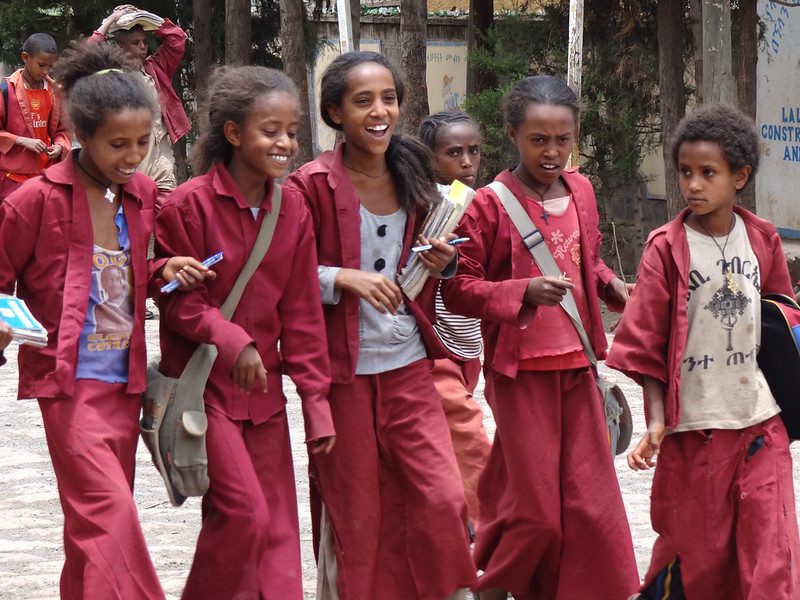
Fortunately, Ethiopia is also one of the world’s fastest-growing economies, and education and development in Ethiopia have become a legislative priority. Between 2005 and 2011, Ethiopian economic growth averaged to 11 percent, and although the country is still heavily reliant on agriculture, it has been working toward the lofty goal of becoming a lower-middle-income economy by 2025.

With an emphasis on education and development in Ethiopia, the country has seen impressive results.  As a result, universal education has become close to reality in the country. In 1990, Ethiopian university enrollment had peaked 10,000 students.  By 2015 enrollment skyrocketed to 360,000 students.

Training in technical and vocational careers has also significantly increased. From 1999 to 2014 the number of students in these fields rose from 5,264 to 271,389. The emphasis in these areas hopes that workers will be well suited for the growing construction and manufacturing sectors.

Despite skyrocketing employment, there remains a disconnect between schools and skills demanded in the market.  Even though the number of educational institutions has increased, the quality had decreased. Many students have since graduated with skills are unfit for the available jobs. This issue has led to some unemployment in the newly educated youth workforce.

Despite such economic pressures, overall unemployment has decreased. According to the World Bank Group, a major contributor of Ethiopia’s annual foreign aid, the country has been taking all the right steps forward. By decentralizing resources to regional governments, focusing on infrastructure and reorienting expenditures the country has seen enormous growth.

Today, Ethiopia requires continued aid to accelerate job creation and vastly decrease poverty in the country. This continued support will allow education and development in Ethiopia to continue to thrive.

– Shannon Golden

Photo: Flickr

July 17, 2017
https://borgenproject.org/wp-content/uploads/borgen-project-logo.svg 0 0 Borgen Project https://borgenproject.org/wp-content/uploads/borgen-project-logo.svg Borgen Project2017-07-17 01:30:072024-05-28 00:02:37A New Reality: The Progress of Education and Development in Ethiopia
Children, Education, Global Poverty

How One Man Brought the Strength of Words to His Community

Strength of WordsJose Alberto Gutierrez, a garbage man in Bogotá, Colombia, turns trashed books into treasure for the children in his community. For the past 20 years, Gutierrez has collected discarded books in the trash of the wealthier neighborhoods in Bogotá. He takes these books to his home in southern Bogotá, where he turned the first floor of his home into a free community library called The Strength of Words.

Gutierrez’s family could not afford for him to remain in school beyond primary. However, Gutierrez said his mother would still read to him every night and he credits her with his appreciation for books. So when he found a copy of Leo Tolstoy’s Anna Karenina, the idea sparked. He began taking 50 to 60 books home with him each day on the job.

The Strength of Words now holds more than 20,000 books, all of which were found in the trash. Before the library, the children in his neighborhood didn’t have easy access to reading material. Now, they have unlimited access to books that can help them with their schoolwork and fulfil their other interests. Either way, The Strength of Words has made it easier for the children in his community to learn.

The library is not just for school children. Adults also have access to the wide variety of texts. They can use the books to learn skills they otherwise did not have, which can help them get jobs or advance in those they already have. Gutierrez also provides books for Colombia’s peace process after being contacted by a fighter from the FARC rebel group, who wanted books to help transition fighters back into civilian life and prepare them for jobs.

No longer able to contain the whole collection in his home, Gutierrez distributes books to other poor and remote towns throughout Colombia. He believes that there should be multiple libraries in every neighborhood in all towns, cities and rural areas. And he is making strides to see his dream become a reality.

The success of The Strengths of Words is an inspiring story of how one man recognized a need in his community and sought to fix it. Because of Gutierrez, many children and adults now have easy access to educational reading materials in their own neighborhoods.

– Hannah Kaiser

Photo: Pixabay

July 16, 2017
https://borgenproject.org/wp-content/uploads/borgen-project-logo.svg 0 0 Borgen Project https://borgenproject.org/wp-content/uploads/borgen-project-logo.svg Borgen Project2017-07-16 01:30:462020-06-03 08:49:12How One Man Brought the Strength of Words to His Community
Education, Global Poverty

Facts About the State of Education in Papua New Guinea

Read more
July 16, 2017
https://borgenproject.org/wp-content/uploads/borgen-project-logo.svg 0 0 Borgen Project https://borgenproject.org/wp-content/uploads/borgen-project-logo.svg Borgen Project2017-07-16 01:30:092025-12-09 11:38:49Facts About the State of Education in Papua New Guinea
Education, Global Poverty

Five Organizations Promoting Education in Haiti

In the United States, public education is frequently taken for granted. The plethora of education choices we are afforded often blinds those with privilege from how fortunate they are. In developing countries such as Haiti, these options are non-existent. The following nonprofits and other organizations are promoting education in Haiti.

Education for Haiti
With only about nine percent of Haitian children graduating from high school, Education for Haiti sees it as vital to ensure that children stay in school. The founder, Richard Ireland, spent time in the Peace Corps working in Haiti and saw firsthand the lack of access to education. After identifying six families living in extreme poverty, he decided to pay their children’s tuition. Altogether the six families had 33 children that he was able to send to school.

This legacy carries on today as the organization continues to provide tuition assistance to children of Haiti. While six families were helped last year, the organization hopes to grow to help even more.

Global Partnership for Education
Global Partnership for Education focuses on education all over the world. Through a series of grants, this organization is affecting change in Haiti. The first grant awarded to Haiti lasted from 2010 to 2015 and was utilized to increase access to education, boost student performance and increase governance in the school system.

The second grant to promote education in Haiti, which is $24.1 million, is set to last from 2014 to 2018. This grant is more targeted at enrollment. This reached 102,000 students the first year and an additional 35,444 the following year. This program is a tuition assistance initiative aimed at reaching children who otherwise would not be able to afford a non-public education.

UNESCO
As the educational and cultural arm of the United Nations, the United Nations Educational, Scientific and Cultural Organization (UNESCO) is renowned for its contributions to discovery and innovation around the world. Haiti is one of 181 countries in which UNESCO has created schools that are part of the Associated Schools Project Network.

With two primary schools, six secondary schools and 13 colleges, the organization is making notable changes in Haiti. The establishment of these schools not only bolsters Haiti but also helps the United Nations to reach the Education for Sustainable Development plan. These schools bring new perspectives based on innovation and experience.

Hope for Haiti
Like many nonprofits, Hope for Haiti focuses on more than one problem in Haiti, but education remains a key issue. Rather than focusing on ground-relief, it uses donations to power the organization and promote education in Haiti.

The nonprofit requires only $5 to provide school supplies to a student, and $100 can support an entire education. The scholarships provided to students through donations are able to change lives. One student, Marie Francelene, was able to attend nursing school through the organization’s assistance. Without Hope for Haiti, she would have been like thousands of other unfortunate students and unable to continue her education.

Haiti Foundation Against Poverty
The Haiti Foundation Against Poverty has narrowed its view to a specific area of Haiti. The United Nations labeled the slum Cite Soleil one of the most dangerous places in the world, but this label only encouraged the Foundation. In 2008, Les Bours School was opened on the outskirts of the notorious slum.

Les Bours School was established to promote education among the most disadvantaged children in Haiti. These are children living in unimaginable conditions surrounded by violence and gangs. The school created hope for these children’s futures. To continue this program, each student at Les Bours School is matched with a sponsor in order to continue funding.

These organizations promoting education in Haiti have left a substantial impact on the small island country, with every bit of aid making a big difference.

– Sophie Casimes

Photo: Flickr

July 15, 2017
https://borgenproject.org/wp-content/uploads/borgen-project-logo.svg 0 0 Borgen Project https://borgenproject.org/wp-content/uploads/borgen-project-logo.svg Borgen Project2017-07-15 01:30:482024-06-05 23:47:11Five Organizations Promoting Education in Haiti
Page 25 of 67«‹2324252627›»

Get Smarter

  • Global Poverty 101
  • Global Poverty… The Good News
  • Global Poverty & U.S. Jobs
  • Global Poverty and National Security
  • Innovative Solutions to Poverty
  • Global Poverty & Aid FAQ’s
Search Search

Take Action

  • Call Congress
  • Email Congress
  • Donate
  • 30 Ways to Help
  • Volunteer Ops
  • Internships
  • Courses & Certificates
  • The Podcast
Borgen Project

“The Borgen Project is an incredible nonprofit organization that is addressing poverty and hunger and working towards ending them.”

-The Huffington Post

Inside The Borgen Project

  • Contact
  • About
  • Financials
  • President
  • Board of Directors
  • Board of Advisors

International Links

  • UK Email Parliament
  • UK Donate
  • Canada Email Parliament

Get Smarter

  • Global Poverty 101
  • Global Poverty… The Good News
  • Global Poverty & U.S. Jobs
  • Global Poverty and National Security
  • Innovative Solutions to Poverty
  • Global Poverty & Aid FAQ’s

Ways to Help

  • Call Congress
  • Email Congress
  • Donate
  • 30 Ways to Help
  • Volunteer Ops
  • Internships
  • Courses & Certificates
  • The Podcast
Scroll to top Scroll to top Scroll to top