The Cooperative Republic of Guyana is a northern South American country on the North Atlantic Ocean, bordering Venezuela, Suriname and Brazil. With a population of less than 800,000, it is the third-smallest country in South America. Originally a Dutch colony and then a British territory, it gained independence in 1966. The population is 40% East Indian, 30% African, and 20% mixed, with the remaining 10% being indigenous or ‘other”. Yet this highly multicultural country is the only English-speaking country in South America.
In 2016, after the discovery by ExxonMobil of large volumes of oil off its coast the previous year, the World Bank classified Guyana as an upper-middle-income country, with oil production leading to an upgrade to a high-income country in 2023.
Guyanese Education
From ages 5-15, education in Guyana is compulsory. After primary school (through grade 6), a Secondary School Entrance Examination sorts students into one of three types of secondary school: community high school, general secondary school or primary school with a secondary education department. The community high schools offer academic, vocational and occupational programs over four years. The general secondary schools offer five-year academic programs. Post-secondary education is offered by the country’s only university, the University of Guyana, as well as at the Guyana School of Agriculture, the Cyril Potter College of Education and several nursing schools. The literacy rate varies among sources, with AACRAO reporting a high of 98.8%.
Sustainable Development
Guyana’s total progress towards achieving all 17 of the United Nations Sustainable Development Goals, with a score of 66.28 out of 100, ranks the country 102nd of the 193 U.N. Member States. For SDG 4, Quality Education, Guyana is on track or maintaining the SDG achievement for literacy rate. However, there are some challenges still in the lower secondary completion rate, and significant challenges remaining with the participation rate in pre-primary organized learning and the net primary enrollment rate. To achieve the overall goal of sustainable development, Guyana will need to continue and strengthen efforts to improve education.
UNESCO: Partnerships to Strengthen Multicultural Education
UNESCO’s International Institute for Educational Planning has recognized that education for sustainable development demands a focus on multicultural diversity. In Guyana, focusing on multicultural diversity includes attention to gender, location (urban, riverine, hinterland), migrants and the disabled.
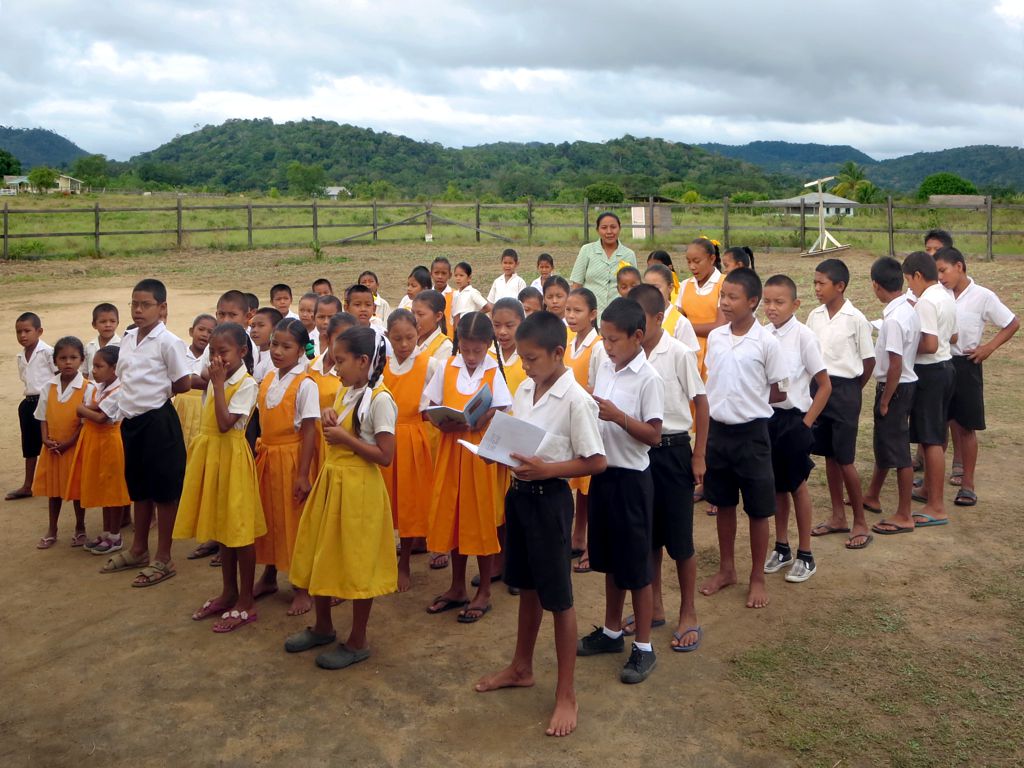
Location is important because Guyana’s indigenous people (or Amerindians) comprise the majority of the population of the interior, or hinterland, of the country.
In February 2023, Guyana signed on to system transformation reform as part of a System Capacity Grant from the Global Partnership for Education. This effort is to pay “close attention to the rich multicultural diversity” of a country with “a myriad of cultural and ethnic backgrounds.” With a focus on the “middle tier” of education systems—those between the classrooms and state-level policymaking—the project is working with those who will be “best placed to ensure the adaptation of national education policies to each specific context.”
The Guyana Partnership Compact to strengthen “culturally responsive and effective instructional leadership” at district and school levels was followed in November 2023. Partners included the Ministry of Education and the Local Education Group, who followed GPE guidelines, with UNESCO as the grant agency for the first phase. Gender, cultural and social disparities would be addressed at the school level, with one outcome to be the districts and schools becoming more inclusive and culturally responsive.
Strategic Planning for Education
Guyana’s partnership with GPE fits well with Guyana’s Education Strategic Plan 2021-2025 – Vision 2030, whose vision is “Providing opportunities for quality equitable education and lifelong learning for all.”
The plan’s Intermediate Outcome 4 is “reducing inequities in education.” The issues addressed are resources and access across subgroups that include those living in the remote riverine areas and the hinterland, as well as students with a disability and students with a different first language. Major concern was acknowledged in the plan regarding performance disparity of students in the remote riverine and hinterland communities, as “there can be no meaningful achievement of the goal of ‘Improving performance at all levels’ if ‘the disparities between sub-groups are not reduced.’”
One early approach, even predating the strategic plan, was Guyana’s first intercultural bilingual education program, the Quality Bilingual Education Program (QBEP). In 2023, this small community-based intercultural initiative for Wapichan indigenous students in the South Rupununi region celebrated its fifth anniversary. The purpose of the initiative was to affirm cultural identity and improve academic performance, rather than to be a stepping-stone to assimilation.
Guyana’s recognition of its multicultural educational challenge, combined with international support that addresses this challenge, puts the country on the right track for successfully achieving SDG 4, as well as overall sustainable development and growth.
– Borgen Project Team
Photo: Flickr
