• Link to X
  • Link to Facebook
  • Link to Instagram
  • Link to TikTok
  • Link to Youtube
  • About
    • About Us
      • President
      • Board of Directors
      • Board of Advisors
      • Financials
      • Our Methodology
      • Success Tracker
      • Contact
  • Act Now
    • 30 Ways to Help
      • Email Congress
      • Call Congress
      • Volunteer
      • Courses & Certificates
      • Be a Donor
    • Internships
      • In-Office Internships
      • Remote Internships
    • Legislation
      • Politics 101
  • The Blog
  • The Podcast
  • Magazine
  • Donate
  • Click to open the search input field Click to open the search input field Search
  • Menu Menu

Archive for category: Children

Information and stories addressing children.

Children, Global Poverty

Motivation is Everything

business
Motivation is what causes people to act in certain given circumstances. For example, motivation causes children to stand up to bullies or causes citizens to stand up to a dictator. Motivation is extremely important in daily life. Motivation can be either internal or external. Internal motivation comes from within and external motivation comes from the external environment such as from money or compliments. If people are internally motivated, they will not easily lose focus of their goals. On the other hand, if people are externally motivated, they are more likely to lose their focus when the external motivational factors are removed.

To eradicate global poverty, intrinsic motivation is extremely important. Intrinsic motivation is the combination of activation, persistence, and intensity.

The activation component helps people recognizing the need to reduce global poverty because reducing poverty means having more equality, better environment and a better world. In addition, people are social creatures and they want to help other. This instinct is built inside each and every one to ensure the survival of the human race.

The persistence component involves people keeping focus on the goal ahead – erasing global poverty. Global poverty is a big issue and it is impossible to erase it in a short amount of time.  Persistence is essential. Understanding the time and effort it takes to end global poverty, one must prepare and devote oneself, because it is a life time commitment.

The last and most important component is intensity. Intensity allows people to act aggressively to  go above and beyond to ensure the success of the goal. This component pushes people to realize their full potential. Intensity about eradicating global poverty is contagious. People will listen and follow the examples and ideals that are given to them and embrace it even more.

Anyone can be intrinsically motivated to take good actions to reduce global poverty. The job of the representative in ending poverty is to activate the motivation sleeping deep inside others and bring it to the surface.

– Phong Pham

Sources: About.com Psychology, Sparknotes
Photo: Giphy.com

January 15, 2014
https://borgenproject.org/wp-content/uploads/borgen-project-logo.svg 0 0 Borgen Project https://borgenproject.org/wp-content/uploads/borgen-project-logo.svg Borgen Project2014-01-15 17:12:162024-06-04 03:01:13Motivation is Everything
Children, Global Poverty

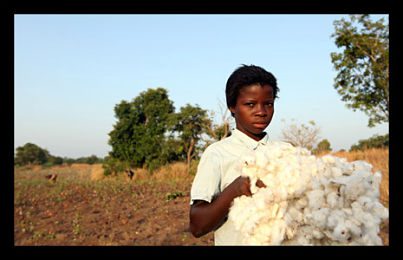
Profiles of Child Labor: Clarisse Kambire, 13

Clarisse_Kambire
Look past the tag on your cute cotton underwear – it says a lot more than, “Made with 20 percent organic fibers from Burkina Faso.”

Look closer and you will see a young girl drenched in sweat, picking cotton for hours on end, often while being whipped in sweltering heat that often breaks 100 degrees Fahrenheit. She has been beaten, malnourished, barred from education and abused on a daily basis. She is never paid for her back-breaking effort and sleeps on the floor of a tiny hut. This scenario is more than a nightmare.

It has a name: child labor – and it is a dark reality for 13-year-old foster child Clarisse Kambire.

The organic and fair-trade cotton program she works for is located in Burkina Faso, one of the poorest areas in West Africa. The poverty-stricken country relies on cotton as its chief export and, consequently, ropes many others like Kambire into child labor every day.

Subsistence farmers involved in the program say that they are unable to grow “ethically sourced” cotton without forcing children into their fields. The conditions in the fields, however, obviously do not support this claim. Workers as young as five years old are abused physically, mentally and emotionally. They are also never paid.

Though the circumstance may seem to be a foreign issue, that is not the case; Kambire’s cotton can be found quite close to home. In fact, you may be wearing it yourself. The fibers from the cotton program are ultimately used to make underwear for the popular American retailer known as Victoria’s Secret. After a revealing interview, the company’s ethical standards began to be regarded with much public suspicion.

Her parents separated when she was four years old. After that, the girl was tossed between relatives on her father’s side. An aunt then took Kambire to the village of Benvar in Burkina Faso and left her in the home of 30-year-old Victorien Kamboule, the man for whom she now works in the cotton fields. Though the two are cousins, Kambire is also considered to be Kamboule’s enfant confie, a French term meaning, “a child who can be vulnerable to exploitation.”

After being dumped at Kamboule’s house and forced into hard labor at the age of nine, Kambire’s only comfort was her makeshift mattress: a thin, faded plastic mat in a tiny mud hut.

Her bedroom doesn’t boast much–a slender wooden bench, a few hand-washed clothes drying on a line and nothing else. No toys, no photos, not even a toothbrush.

“Nothing,” she says.

At the same time Kambire is drowning in sweat and potentially deadly mosquito bites, Kamboule, his wife and their two children–a three-year-old girl and a one-year-old boy–sleep soundly underneath the safety of a mosquito net on a bed in an adjoining room.

Waking up is not much better; Kamboule only screams at her to get out into the field. Kamboule’s cruelty extends to every area of the field, not just sleeping arrangements for the workers. Sluggishness due to exhaustion is an error punished by severe whipping with a tree branch.

The fear of this punishment leaves the girl with a daily sense of dread. Every morning frightens her more.

“I’m starting to think about how he will shout at me and beat me again,” she says. “At night, I dream and wonder what can happen to me in the cotton field. I feel that something bad could happen to me.”

Cotton picking is not her only task. The 13-year-old girl also prepares the field by helping to dig over 500 rows with only a hoe–something that could be done easily with an ox and plow. Unfortunately, that is just the thing that Kamboule is unable to afford, and so he makes up for his lack of monetary funds with Kambire’s tears and sweat.

“I dream that a day will come when I shall no longer be working on the farm, but rather be in a kind of work which would be more interesting for me,” Kambire says. “Any other work would make me feel better, except for the farm work. I want to take care of my own needs.”

– Samantha Davis

Sources: Child Labor Public Education Project, New York Daily News, Bloomberg
Photo: Bloomberg


10 Facts about Child Labor


January 15, 2014
https://borgenproject.org/wp-content/uploads/borgen-project-logo.svg 0 0 Borgen Project https://borgenproject.org/wp-content/uploads/borgen-project-logo.svg Borgen Project2014-01-15 08:34:572024-05-26 23:03:25Profiles of Child Labor: Clarisse Kambire, 13
Children, Global Poverty

Families Separated in South Sudan

Separated_Families_in_South_Sudan
Fighting erupted in the South Sudan capital of Juba in December and has since spread throughout the country, not only displacing families, but separating them.

Save the Children fears that of the 121,000 people who have fled from their homes, countless children have been forced to fend for themselves in the surrounding swamp areas without access to shelter or clean water.

Over the course of three days in Juba alone, 60 children were reported as separated from their families. This is indicative of a larger problem, as the fighting is now concentrated in the northern part of the country, in Jonglei, Upper Nile and Malakal.

United Nations compounds and surrounding communities are providing refuge for some displaced families. However, due to the ongoing danger, access is limited where the fighting is at its worst, leaving the severity of the situation for South Sudanese children largely unknown.

United States missionaries in Malakal spent Christmas day protecting orphans from the conflict inside a U.N. peacekeeping base.

Forced from their home, the Campbells, a missionary family from Omaha, fled to their local base having pushed mattresses up against the inside of their doors and endured bullets through their windows.

Bradley Campbell, a former visual artist turned pastor, moved his family to South Sudan in 2012 as part of a Christian ministry based in Charlotte, North Carolina, Keeping Hope Alive.

Campbell recalls Christmas night spent trying to keep the orphans quiet inside the base, for fear the soldiers would find them.

400 U.S. government officials and private citizens have been evacuated since the conflict started, at least 60 more are awaiting evacuation, including the Campbells, although leaving may not be an option for the family.

The Campbells now count 10 Sudanese orphans as family members and fear what would happen to them if they are not considered U.S. citizens and granted the ability to leave.

Most of the orphans under Campbell’s care are ethnic Nuer, the tribe from which former vice president and current rebel leader Riek Macher hails.

The conflict arose when fighting broke out between those aligned with Macher and those with President Salva Kiir of the Dinka tribe. The president then accused Macher of starting a coup, after which an ethnic conflict erupted between the Nuer and the Dinka.

This recent violence in South Sudan is a continuation of Africa’s longest running civil war. Having gained independence just two years ago, South Sudan has endured decades of unrest, a total of two million lost lives as well as four million refugees.

An end to the current conflict does not seem eminent despite the insistence of East African mediators that the two sides must engage in peace talks.

Macher has requested the release of numerous imprisoned politicians before the talks can commence, a wish the government will not grant until the fighting has ceased.

– Zoë Dean

Sources: BBC, Save the Children, Washington Post
Photo: BBC

January 14, 2014
https://borgenproject.org/wp-content/uploads/borgen-project-logo.svg 0 0 Borgen Project https://borgenproject.org/wp-content/uploads/borgen-project-logo.svg Borgen Project2014-01-14 01:42:162024-12-13 17:49:54Families Separated in South Sudan
Advocacy, Children, Developing Countries, Global Health, Global Poverty, Health, Human Rights, Poverty Reduction, United Nations

Child Labor: An Overview

Child_Labor_an_Overview
“Millions of children are victims of violence and exploitation. They are physically and emotionally vulnerable and they can be scarred for life by mental or emotional abuse. That is why children should always have the first claim on our attention and resources. They must be at the heart of our thinking on challenges we are addressing on a daily basis. We know what to do, and we know how to do it. The means are at hand, it is up to us to seize the opportunity and build a world that is fit for children,” remarked Ban Ki-moon, Secretarty-General of the United Nations on November 20, 2009, on the Twentieth Anniversary of the Convention on the Rights of the Child.

Just as Ban Ki-moon mentioned, children are not physically or mentally ready to enter the labor force. With the lack of physical abilities, the safety of the workplace cannot be ensured, for both the children and other employees. In fact, children are more likely to be abused and mistreated in an environment centering around child labor.

“Few human rights abuses are so widely condemned, yet so widely practiced. Let us make (child labor) a priority. Because a child in danger is a child that cannot wait,” stated Kofi Annan, Former UN Secretary-General. Around the world, more than 211 million children between the age of 5 and 14 are being forced to work. Among these children, 120 million children are working full time.

To eradicate child labor, people should first understand what leads to such situations. For example, poverty is the first and foremost reason of child labor.  Since many parents do not have the capability to support their household, children end up working to help support the family’s daily lives. Another reason for child labor is a poor education system.

When education is expensive or not readily available, impoverished parents do not see the benefit of learning and think that working is a better alternative. In the United States, there are many laws that prohibit child labor, however, in some countries, child labor laws exist, but are not enforced. Companies can thus take advantage of the cheap labor and further exploit it.

On the other hand, many organizations have been striving to put a stop to child labor by various programs. For example, the United Nations has been running campaigns to raise the awareness of child labor across various nations and airing them in global events such as the World Cup. Moreover, in order to raise the level of education in poverty stricken areas, the Red Cross and governments of third world countries have been recruiting teachers to volunteer in remote areas.

– Phong Pham

Sources: Child Labor Public Education Project, UN: Agencies Urge Greater Action, International Labor Rights Forum, UN: Child Labor
Photo: Addicting Info


Facts about Child Labor

December 26, 2013
https://borgenproject.org/wp-content/uploads/borgen-project-logo.svg 0 0 Borgen Project https://borgenproject.org/wp-content/uploads/borgen-project-logo.svg Borgen Project2013-12-26 04:00:472024-05-25 00:32:50Child Labor: An Overview
Advocacy, Children, Global Poverty, Health, Human Rights, Human Trafficking, Slavery, Women & Children

Human Trafficking in the Philippines

philippines_human_trafficking
New Jersey Congressman Chris Smith and his congressional team traveled to the Philippines earlier this week to meet with victims, aid workers and government officials in the regions hit by Super Typhoon Hayian.  The U.S. government has spent $50 million in emergency aid to the Philippines, providing much needed food, water and emergency medical care. However Smith says that rising human trafficking in the Philippines is also a major issue. The Philippines is a large source for both sex and labor human trafficking. The poor are especially vulnerable to human trafficking in the aftermath of natural disasters when they have lost their homes as well as their communities and are looking for a way out.

Congressman Ed Royce hosted a house committee on foreign affairs hearing in Fullerton California on November 27, 2013.  One of the speakers was Angela Guanzon, who traveled to the U.S. from the Philippines in 2006 in hopes of a better life. “I worked 18 hour days and had to sleep on the floor in a hallway,” Guanzon said. “My co-workers and I were threatened if we tried to escape.”

Human trafficking is what the State Department, law enforcement officials and NGOs are calling “modern day slavery.” Following narcotics, it is the second most profitable criminal enterprise worldwide and the Philippines has the second largest victim population. Many poverty stricken Filipino women leave their families in the hope supporting them from abroad.

Approximately 1 million Filipino men and women migrate each year, currently there are 10 million Filipinos living abroad. Many of these workers are subject to forced labor and harsh conditions, not just in the U.S., but in Asia and the Middle East as well.  Women who work in domestic positions often suffer violence, sexual abuse and rape. Traffickers use local recruiters in villages and urban centers who often pretend to be representatives of government sponsored employment agencies.  Furthermore, victims are required to pay “recruitment fees” that leave the workers vulnerable to forced labor, debt bondage and prostitution.

Many Filipinos live in poverty and are often swayed by recruiters who offer work and a better life. Furthermore, the vast majority of victims are also women and girls; 300,000-400,000 are women and 60,000 -100,00 are children; over 80% are females under the age of 18.

To combat this, the Philippines government created the Anti-Trafficking in Persons Act of 2003 and has made minor improvements since then. For example, it increased funding to the anti-trafficking agency from $230,000 to $1.5 million and went from eight full time staff members to 37. They were also able to repatriate 514 Filipinos from Syria in the winter of 2012, 90% of whom were trafficked. Even with an upgraded version of the Anti-Trafficking in Persons Act of 2003, much work still needs to be done in the Philippines and in the U.S. to ensure that women and the poor in the Philippines are not vulnerable to modern day slavery.

– Lisa Toole

Sources: CNN, NJ.com, ABS CBN, HumanTrafficking.org
Photo: The Guardian

December 21, 2013
https://borgenproject.org/wp-content/uploads/borgen-project-logo.svg 0 0 Borgen Project https://borgenproject.org/wp-content/uploads/borgen-project-logo.svg Borgen Project2013-12-21 04:00:182017-03-20 13:10:51Human Trafficking in the Philippines
Children, Global Poverty

Poverty and the Coffee Industry

Coffee is the second most valuable export, bringing in $55 billion per year.  The coffee industry is dominated by a few key players—Nestle, Kraft, Proctor & Gamble, and Sara Lee.  Farms tied to these companies often cannot recoup production costs.  There is no shortage of coffee beans, so plantations compete to offer lower and lower prices to the big companies.  In recent years, the supply of coffee has grown even more due to improved coffee cultivation methods in South Asia.

To stay competitive, coffee plantations are notorious for paying subsistence wages and exposing workers to unsafe conditions.  Coffee beans are produced for $2 per kilo, and then sold to middlemen for about 14 cents.  Large companies then buy the beans at this low price, roast them, package them and mark up the price to around $8 per pound.  This “Coffee Paradox” essentially means that big companies win and local plantations lose.

Most coffee farmers struggle to support their families, and cannot afford healthcare or education.  This not only worsens the cycle of poverty, but also shows that coffee farmers have no control over the practices of industries which create these conditions.  In countries like Brazil, where coffee production has long been a cash crop, plantations are forced to grow lower-quality beans like Robusta that sell for cheap, instead of the high-quality Arabica beans the area is known for.

In the long run, coffee plantations around the world need to unionize and demand a fair price for their product.  As consumers, buying fair trade ensures our coffee comes from plantations that treat their workers with respect and do not use child labor.  Some of the proceeds from fair trade products even go back into the plantation community.  Buying higher-quality Arabica beans supports long-standing industries that are struggling to compete with the cheaper alternatives.

– Stephanie Lamm

Sources: Seattle PI
Photo: Media Tree Hugger

December 19, 2013
https://borgenproject.org/wp-content/uploads/borgen-project-logo.svg 0 0 Borgen Project https://borgenproject.org/wp-content/uploads/borgen-project-logo.svg Borgen Project2013-12-19 22:05:142024-06-05 01:53:42Poverty and the Coffee Industry
Advocacy, Children, Education, Gender Equality, Global Poverty, Philanthropy, Poverty Reduction, United Nations, Women and Female Empowerment

Africa’s Philanthropic Billionaires

When it comes to international aid programs, everyone has heard of the Bill and Melinda Gates Foundation, as well as Warren Buffett’s astronomical donation track record, with last year’s donations reaching $1.87 billion. However, outside of the American audience, African billionaires are also stepping up and contributing to causes they care about. Here is a list of African philanthropic billionaires that lead programs in their own countries.

The wealthiest African, Aliko Dangote, worth an estimated $20.2 billion, donates millions of his wealth to education, health and social causes. Last year Dangote took part in the first ever Forbes 400 Summit on Philanthropy, where he discussed the benefits of donating, listing Gates and Buffett as inspirations.

Nathan Kirsh, a South African native, earned his $3.6 billion wealth by monopolizing the small goods market in New York City. According to Forbes, his philanthropic efforts focus on Swaziland, where he supplied approximately 10,000 people with starter capital for small businesses. Kirsh states that 70 percent of his recipients are women with a 70 percent success rate for his program overall. He also hopes to make Swazi schools the first in Africa to boast guaranteed computer literacy for all graduates.

Folorunsho Alakija hails from Lagos, Nigeria and is Africa’s richest woman thanks to her very profitable ownership of an oil block in the 1990’s. Since then, Alakija has expanded her $7.3 billion enterprise to real estate around the world, notably $200 million worth in the United Kingdom alone. With her money, Alakija founded the Rose of Sharon Foundation in 2008 which aids orphans and widows in her native country of Nigeria.

Mohamed Mansour has an estimated $2.3 billion fortune from his investment company the Mansour Group, which owns Egypt’s largest grocery store Metro and Egypt’s McDonald’s franchises, among other businesses. Mansour founded the Lead Foundation, a nonprofit that has provided over 1.3 million loans to small business endeavors and under-privileged women in Egypt. Mansour also chairs the Mansour Foundation for Development, which strives to eliminate illiteracy, poverty, and disease in order to expedite the development of Egyptian society.

– Emily Bajet

Sources: Daily Mail, Forbes, Rose of Sharon Foundation, Mansour Foundation For Development

December 16, 2013
https://borgenproject.org/wp-content/uploads/borgen-project-logo.svg 0 0 Borgen Project https://borgenproject.org/wp-content/uploads/borgen-project-logo.svg Borgen Project2013-12-16 04:00:062024-05-25 00:52:28Africa’s Philanthropic Billionaires
Activism, Children, Education, Global Poverty, Technology

How MP3s Promote Education in Africa

For many high school teachers, the explosion of the iPod represented another way for their students to become distracted in the classroom.  It turns out that instead of using those MP3 players to blast music, they are being used to promote literacy and education all across Africa.

Meet the Lifeplayer MP3.  A solar-powered radio, recorder and MP3 player, the Lifeplayer is manufactured by Lifeline Technologies to give rural African communities greater access to education.  The Lifeplayer comes with reading and writing lesson plans already pre-loaded.  Since it is solar-powered, rural communities without access to electricity can now enjoy this technological wonder without worrying about access to electrical outlets for recharging.

The company currently runs initiatives in Ethiopia, Kenya, Rwanda, South Sudan and Zambia.  In Ethiopia, Lifeline has partnered with the British Council to promote English language education to over 50,000 school children.  Kristine Pearson, the CEO of Lifeline, traveled to South Sudan to deliver 15,000 Lifeplayers to educators.

Pearson instructed trainers and teachers on how to use the technologically-advanced device in the hopes of reversing the discouraging education trends in the country.

“Nearly three-quarters of the population can neither read nor write,” states Pearson.  “According to the Overseas Development Index (ODI), less than 2% of the population have completed a primary education and even less completed secondary school.”

In addition to the Lifeplayer MP3, the company also produces two other solar-powered marvels: the Prime Radio, an analogue radio with an LCD display, and the Solarstor, a portable charging station for cell phones.

The Prime Radio has been especially beneficial in Rwanda, where the company spearheads an initiative called Project Muraho.  Partnering with organizations such as UNICEF, the initiative has provided 13,000 radios and power sources to families ravaged by the effects of the Rwandan genocide and the continued devastation of HIV/AIDS.

Although access to education has improved worldwide in the past decade, there are still great disparities in rural areas and communities without power and electricity.  The Lifeplayer MP3 is a wonderful invention to help push education in these struggling communities.

– Taylor Diamond 

Sources: World Economic Forum, Lifeline Energy: Technology, Lifeline Energy: Projects
Photo: Texarkana Gazette

December 15, 2013
https://borgenproject.org/wp-content/uploads/borgen-project-logo.svg 0 0 Borgen Project https://borgenproject.org/wp-content/uploads/borgen-project-logo.svg Borgen Project2013-12-15 04:00:352024-05-25 00:31:40How MP3s Promote Education in Africa
Children

How to Teach Kids to Give Back

Teach Kids to Give Back
1. Teach kids to be empathetic toward others in need.
Children naturally want to help others, with a little guidance and encouragement it comes easily. For example, when a child at a playground sees another child fall down, their automatic instinct is to help. Foster this instinct and lead by example.  When you’re walking into a store with a food drive bin, toss in a can of soup. Offer change to a homeless man on the street or water to a stray dog. These simple yet impactful acts of giving will instill empathy in children. Also, allow them to see you do this and they will have questions. This opens up conversations about giving at a very early age.

2. Take advantage of every opportunity to give back. There are always times when someone is in need of help. When you spot that need, fulfill it. The help could be as simple as holding a door open for an elderly woman or as big as volunteering at the food bank holiday drive. Moms and Dads are a child’s first and most important role model.  Let your kids see that helping others is simple and an everyday occurrence.

3. Create a list of annual charity events the whole family can be involved in. There are many organizations that allow whole family involvement and help from smaller kids. In fact it’s encouraged. For instance, make it a point to give change every time your family sees those familiar bell ringers with their red kettles. Doing this each time will cause your little ones to become excited to give.  Use those opportunities to start the dialog about who the money in the red kettles benefits and what a difference they are making. The Tree of Sharing is another great campaign held annually.

Children feel good knowing they are making another child’s Christmas gift wish come true. Trick or Treat for UNICEF is also a fun way for children to give back to others globally. For over 60 years UNICEF has joined little ghosts and ghouls on their journey for treats. Children simply say trick or treat for UNICEF and hold up a UNICEF print out box to hold donations. Participating in the various walks and runs for charity is a perfect way to give back in the warmer months, as well.

Make giving a part of your everyday life and it will become a part of your child’s as well.

– Amy Robinson

Sources: Giving Tuesday

December 3, 2013
https://borgenproject.org/wp-content/uploads/borgen-project-logo.svg 0 0 Borgen Project https://borgenproject.org/wp-content/uploads/borgen-project-logo.svg Borgen Project2013-12-03 15:52:162015-01-12 14:38:44How to Teach Kids to Give Back
Children

Crisis in China: Online Child Trafficking

Online Child Trafficking
While technology provides many benefits to an ever-globalizing world, it also has several down falls. With technology comes the digital marketplace, including online black markets. Throughout China and the world, traffickers, doctors and parents are using the Internet to sell children and babies for cash.

A young couple from southern China was arrested last week for posting their baby for sale online, International Business Times (IBT) reports.  This child was priced at 40,000 Yuan, about $6,500 USD. A child trafficking activist who –pretending to be an interest buyer – intercepted the advertisement, alerted authorities and met the father at a nearby hospital where he was then arrested. The parents claimed they intended to put the child up for adoption, but were unaware of the proper procedures.

A similar incidence occurred a month earlier. Another couple sold their daughter for 50,000 Yuan via an online auction. The couple then used the money to purchase material items such as shoes and Apple products. According to the Telegraph, the parents expressed that selling the child was in the child’s own interests: “We did not give the baby away for money but to give [the baby] more security.”

Doctors have also been caught selling newborn children, though these transactions are not necessarily online. Just recently, an obstetrician from Fuping was arrested for selling a newborn child to traffickers after convincing the mother that the baby was too ill to survive. Under these false pretenses, the mother willingly gave the child over to the hospital. Shortly after, the mother changed her mind, demanded the baby back and called the police. According to the Daily Mail Online, police are investigating at least seven similar cases in the region.

Online trafficking represents the newest phase of a longstanding problem in China. Child trafficking rings have been operating for years, generating outlandish profits. In August, authorities broke up a major trafficking network spanning more than four Chinese provinces and trafficking ten children annually, says IBT. The willingness of parents to sell their children to traffickers stems from factors such as deep poverty and lack of education.

– Mallory Thayer

Sources: The Daily Mail, International Business Times

December 3, 2013
https://borgenproject.org/wp-content/uploads/borgen-project-logo.svg 0 0 Borgen Project https://borgenproject.org/wp-content/uploads/borgen-project-logo.svg Borgen Project2013-12-03 11:56:482016-12-15 08:53:55Crisis in China: Online Child Trafficking
Page 130 of 137«‹128129130131132›»

Get Smarter

  • Global Poverty 101
  • Global Poverty… The Good News
  • Global Poverty & U.S. Jobs
  • Global Poverty and National Security
  • Innovative Solutions to Poverty
  • Global Poverty & Aid FAQ’s
Search Search

Take Action

  • Call Congress
  • Email Congress
  • Donate
  • 30 Ways to Help
  • Volunteer Ops
  • Internships
  • Courses & Certificates
  • The Podcast
Borgen Project

“The Borgen Project is an incredible nonprofit organization that is addressing poverty and hunger and working towards ending them.”

-The Huffington Post

Inside The Borgen Project

  • Contact
  • About
  • Financials
  • President
  • Board of Directors
  • Board of Advisors

International Links

  • UK Email Parliament
  • UK Donate
  • Canada Email Parliament

Get Smarter

  • Global Poverty 101
  • Global Poverty… The Good News
  • Global Poverty & U.S. Jobs
  • Global Poverty and National Security
  • Innovative Solutions to Poverty
  • Global Poverty & Aid FAQ’s

Ways to Help

  • Call Congress
  • Email Congress
  • Donate
  • 30 Ways to Help
  • Volunteer Ops
  • Internships
  • Courses & Certificates
  • The Podcast
Scroll to top Scroll to top Scroll to top