• Link to X
  • Link to Facebook
  • Link to Instagram
  • Link to TikTok
  • Link to Youtube
  • About
    • About Us
      • President
      • Board of Directors
      • Board of Advisors
      • Financials
      • Our Methodology
      • Success Tracker
      • Contact
  • Act Now
    • 30 Ways to Help
      • Email Congress
      • Call Congress
      • Volunteer
      • Courses & Certificates
      • Be a Donor
    • Internships
      • In-Office Internships
      • Remote Internships
    • Legislation
      • Politics 101
  • The Blog
  • The Podcast
  • Magazine
  • Donate
  • Click to open the search input field Click to open the search input field Search
  • Menu Menu

Archive for category: Aid Effectiveness & Reform

Information and stories about aid effectiveness and reform

Aid Effectiveness & Reform, Development

Four Downsides of Big Data

Downsides of Big Data
It is easy to get excited about all the new information we now have about the world’s development projects. Maps and tables, charts and graphs flood our inboxes with ‘big data.’ Most recently, AidData published a huge dataset on Tracking Chinese Aid to Africa. All the hype has caused some backlash, and rightfully so. Big data is still data and requires the same careful handling as any other dataset. This is not meant to dull enthusiasm or lessen the use of data. This is a precaution against the misuse and overgeneralization of big data. One size does not fit all, and overgeneralizations from large or small datasets can be dangerous. Here are Big Data’s 4 downsides found by practitioners and academics.

1) Big data is not a panacea. One size does not fit all. The dynamic nature of development projects means that many are time-place specific. While sweeping data collection projects can lead to better practices at high-level institutions, implementing policies based on improperly generalized data is bad policy and poor use of data.

2) Difficulties in filtering relevant information. Data from developing countries regarding health systems, political upheaval, natural disasters, etc. are most often reported by vulnerable people experiencing the event first hand. The sourcing of the data is often social media. Aside from possible problems with the validity of the data, the sheer amount of potential data is enormous. Key word searches across selected media yield thousands of data points which have to be carefully reviewed to filter for relevancy. The computer programs are simply not nuanced enough to pull out the differences between hate speech, for example, and slang (as shown in a study on mapping hate speech in twitter recently). Additionally, a parallel problem is availability of reliable and secure statistical processing. Unlike data processing for pharmaceutical companies, aid data processing is not backed by billions of dollars in profit.

3) Data exhaustion on the ground. By the time social scientists are through cleaning, manipulating, and making sense of the data, the situation on the ground has often changed. This is called “data exhaustion.” The big data collectors (UN, World Bank, USAID, AidData) are constantly playing catch up. This means that the people on the ground are not able to use the most up-to-date information. The use of social media has mitigated the delay; however, data extraction and implementation of policies based on data is a top-down approach that may not accord with the culture of the project or practical feasibility. For example, the best way to empower women according to big data analyses might be to get women into the work place allowing them independent incomes. The on-the-ground reality might be that they are already responsible for non-paid work, such as childcare or maintaining subsistence crops, which already takes up their whole day.

4) Validity of data is questionable. As indicated by the debates over the validity of AidData’s Tracking Chinese Aid to Africa, socially sourced data cannot be the only source of data to influence policy. Self-reporting has inherent “barriers, blindspots and biases.” For example, the information collected from the Arab Spring was based on self-reporting of goings-on. The outside world used information from texts, Tweets, Facebook and blog posts to analyze the situation.

These four potential downsides of big data all suggest the need for caution in using data to inform development policy.

– Katherine Zobre

Source: Relief Web
Photo:
AidData

June 10, 2013
https://borgenproject.org/wp-content/uploads/borgen-project-logo.svg 0 0 Borgen Project https://borgenproject.org/wp-content/uploads/borgen-project-logo.svg Borgen Project2013-06-10 04:00:332024-06-07 04:44:45Four Downsides of Big Data
Advocacy, Aid Effectiveness & Reform, USAID

Rice Farming Productivity in Ghana Increases

ricepaddy

Rice farming in Botanga, Ghana, has seen an increase in productivity due to an agricultural project funded by the USAID.  The Agricultural Development and Value Chain Enhancement (ADVANCE) program started two years ago to help farmers who use the lands of the Botanga Irrigation Scheme. The program was designed to increase productivity.

Marketing companies and produce buyers were brought into the project to help the rice farmers grow and cultivate improved rice varieties. Currently around 600 farmers are farming the land and many of them have benefited from the ADVANCE project. The rice cultivated is used mainly for cereal and vegetables. The project brought in combine harvesters that have improved rice harvesting and helped to lower some of the post-harvest losses in Botanga. Rice farmers were educated on better farming techniques. They were shown how to create nurseries and replant with adequate spacing to ensure better yields for future crops. The ADVANCE project also helped improve the business side of rice farming.  Farmers were offered support in selling crops and provided information and expert knowledge on controlling pests and disease.

Food insecurity is a major issue across all developing nations and Ghana is no exception. The USAID-ADVANCE project hoped to improve food security and increase the incomes of households of rice farmers in the Botanga region.  A value-chain method was developed to allow farmers access to all parts of the production process such as input dealers, seed suppliers, and produce buyers.  The method starts first with identifying a buyer and demand for the product to ensure crops can be sold. Premium Foods and AMSIG Resources were two buyers linked to the rice farmers. The buyers then developed contracts with the farmers that provide support, weed control, seeds, and an agreed upon price to buy the rice from the farmers.

Since the ADVANCE program began, 29,000 low income farmers are being supported. These farmers grow maize, rice, and soybeans. They are getting the help they need to grow successful crops and are being paid a fair market price for their produce. 269 demonstration sites have also been set up to show farmers new technology and how to best utilize it.  The introduction of infrastructure and technology have helped Botanga rice farmers improve their lifestyles. The project also falls in line with President Obama’s Feed the Future initiative.

– Amanda Kloeppel
Source: GhanaWeb

June 6, 2013
https://borgenproject.org/wp-content/uploads/borgen-project-logo.svg 0 0 Borgen Project https://borgenproject.org/wp-content/uploads/borgen-project-logo.svg Borgen Project2013-06-06 05:00:582024-06-04 01:17:30Rice Farming Productivity in Ghana Increases
Aid Effectiveness & Reform

U.S. Generals Want Congress to Help the Poor

U.S. Generals Want Congress to Help the Poor
A surprising number of U.S. generals feel very strongly that the American Congress has the responsibility to fund U.S. programs to help the world’s poor. Many U.S. Generals have vocalized their beliefs to U.S. Congress that they should promote legislation and budgets that would increase funding to USAID and foreign investment, calling it an investment not only in our future, but also in American National Security.

Recently, many of these generals signed party to a letter to Congresswoman Barbara Mikulski and Congressman Richard Shelby, Chairwoman and Vice Chairman, respectively, of the U.S. Senate Appropriations Committee. In the letter, the  U.S. generals and admirals, a group of more than 115 retired U.S. three and four star generals and admirals, urge the committee to, “support a strong allocation for FY14 State-Foreign Operations.”

The U.S. generals and admirals urge the committee to support this funding because, in their professional opinions, decreasing the current funding would diminish America’s ability to influence foreign affairs at a time of increasing global threats and competitors. They claim that our defense department’s military strength is not sufficient to combat instability in the world. The United States requires more to address the deep-rooted causes of instability and to foster strength in our national interests and to bolster economic growth.

The letter indicates the importance of balancing defense, diplomacy and development, and it also condemns the lack of focus on diplomacy and development. The generals and admirals remind the U.S. Senate appropriations committee that investing in diplomacy and development in the form of foreign aid is a critical component of America’s national security strategy, and that it helps to complete this goal at a far lower cost- in both dollars and American lives lost.

– Caitlin Zusy 
Source USGLC
Photo Center for American Progress

June 4, 2013
https://borgenproject.org/wp-content/uploads/borgen-project-logo.svg 0 0 Borgen Project https://borgenproject.org/wp-content/uploads/borgen-project-logo.svg Borgen Project2013-06-04 05:00:142020-06-27 03:11:17U.S. Generals Want Congress to Help the Poor
Advocacy, Aid Effectiveness & Reform, Developing Countries

Colin Brannen to Cycle for World’s Poor

Colin Brannen to Cycle for World's Poor

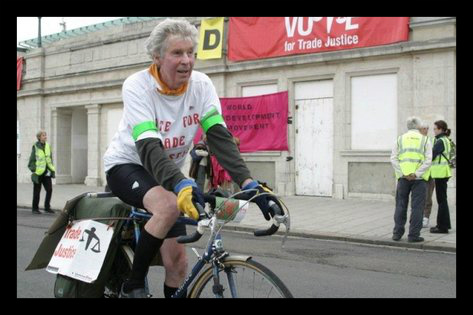
Age is but a number for Colin Brannen, a 76-year old from London who plans to ride his bike from Newcastle-Upon-Tyne to London and back to raise awareness to end global hunger. The former teacher does not own a car and will take time along his route to stop and talk to people about global hunger and the IF Campaign.  This campaign tackles the idea that the world makes enough food for everyone, and yet not everyone has enough food.

Brannen’s goal is to get to London to take part in the IF campaign’s rally in Hyde Park on June 8.  The rally and campaign is being supported by Christian Aid and over 200 different development organizations.  Brannen has been a Christian Aid organizer for over 30 years.  Throughout his ride he will discuss with people what Christian Aid is doing to support the IF campaign.

According to Brannen, campaigning is increasingly important in current times.  Poverty reduction is not all about raising money, although that is important, it is equally about raising awareness and inspiring action.  Brannan hopes to bring change and encourage the government to be more supportive of the fight against poverty.

As an avid cyclist, Brannen has cycled to raise awareness for social and justice issues throughout his life.  In 1998, he cycled to Birmingham for the G8 conference and part of the way to Cologne, Germany in 1999 for another G8 rally. In 2004, he cycled to Brighton for a trade justice event.  Christian Aid is asking people to show their support for ending global hunger by attending the rally.  In a world where we produce enough food for everyone, it is inexcusable that one in eight people still go hungry.

The IF campaign is calling for G8 leaders to take action at the meeting in Northern Ireland later in June and continue to fight hunger.  For more details go to the Christian Aid website at www.christianaid.org.uk/if.

– Amanda Kloeppel

Source: Christian Today

June 3, 2013
https://borgenproject.org/wp-content/uploads/borgen-project-logo.svg 0 0 Borgen Project https://borgenproject.org/wp-content/uploads/borgen-project-logo.svg Borgen Project2013-06-03 06:00:542020-06-27 02:46:46Colin Brannen to Cycle for World’s Poor
Advocacy, Aid Effectiveness & Reform, Health

Collaboration is Key to Effective Aid

aid
The old model of aid consisted of rich countries bringing funds and ideas to poor countries and implementing plans to “save” the country.  Recent criticism has brought to light the idea that collaboration is key to effective aid. In the arena of healthcare, this is even more important as oftentimes, developing countries are given funds for healthcare uses, but told exactly what they have to do with it beforehand.

Ethiopia led the way in 2002 with their ambitious plan to provide primary healthcare to 85 million rural citizens. These citizens did not live within accessible distance of a doctor or hospital.  The Ministry of Health gave themselves 5 years to accomplish their goal.  Without resources or facilities to train the 30,000 community health workers necessary, Ethiopia embarked. Health workers were trained and sent out and since the program’s implementation, decreases in the number of women dying in childbirth and in the number of children dying before age 5 have been reported.  The relatively successful plan began with simple, community-level improvements.

Ethiopia is far from the regular standard as, typically, governments receiving outside aid do not start their own programs.  A representative from Rwanda’s Ministry of Finance and Economic Planning remarked that rarely do they get a say in where the money goes at all. Rwanda has requested money for low-income health insurance and was denied. Using tax money instead, Rwanda funded the pilot program and today over 90% of Rwandans have health insurance.

Developing countries are not being ungrateful for aid, but are slowly starting to speak up and question the potential of effectiveness for the money and programs involved in it.  The World Health Organization (WHO) is helping change the way aid is delivered by using coordination and collaboration. Donors are asked to contribute to health plans managed and implemented by the government rather than go in and start their own. The initiative is called the International Health Partnership. The goal is to allow developing countries a say in how and where the money is used, preventing rich countries from bullying or denigrating their plans and ideals.

As the economy continues to struggle and aid dollars are decreasing, collaboration and coordination are very important to continue to meet needs like adequate healthcare worldwide. Allowing developing nations to innovate and have a seat at the table will enable aid to be used more effectively and efficiently.

– Amanda Kloeppel

Source: The Atlantic

June 2, 2013
https://borgenproject.org/wp-content/uploads/borgen-project-logo.svg 0 0 Borgen Project https://borgenproject.org/wp-content/uploads/borgen-project-logo.svg Borgen Project2013-06-02 04:47:572020-06-27 02:49:22Collaboration is Key to Effective Aid
Advocacy, Aid Effectiveness & Reform, Children, Developing Countries

Middle School Students Fight Global Hunger

francisstudents
Middle school can be an unforgiving time for young people, but one group of students at St. Francis Episcopal Day School in Texas are using their middle school years to fight global hunger. Under the direction of faculty Debbie Harris, the St. Francis Wolves Against Hunger are making a global difference. The group consists of 7 eighth grade students. They participated in the World Hunger Leadership Challenge, an initiative founded by Lead2Feed with the purpose of promoting leadership among middle school students in the fight against world hunger.  It is important to develop future leaders and foster a spirit of giving back to the community especially during the tough middle school years.

The St. Francis Episcopal Day School was awarded a $25,000 check from the Yum! Brand Foundation for the work the Wolves Against Hunger did in the World Hunger Leadership Challenge.  More than 300,000 students participated from over 1,500 schools and the Yum! Foundation provided close to $250,000 in prize money grants to 140 schools. The grants will support US public charities engaged in hunger relief. The recognition ceremony was shared with another student group located in Utaar Pradesh, India. The students from St. Francis have been in close contact with the students from K.L. International (KLI) in Utaar Pradesh over the last two semesters.  The St. Francis students packed 5,100 sack lunches, collected more than 6,500 cans of food, and packed boxes at a local food back. The KLI students volunteered time at a local orphanage run by Mother Teresa Missionaries of Charity as well as created Project 365 in which at least one hungry person is fed every day of the year.

Harris had heard about the World Hunger Leadership Challenge and entered her students in the hopes of gaining them some recognition for all their hard work. She noted the students participated in events on the weekends in addition to school activities. The program began when Harris organized a campaign for World Water Day in 2012 and came in contact with Jasdeep Lamba, whose father-in-law runs KLI School. They worked together to get a Skype discussion scheduled between the students and faculty of the two schools. The next school year, they arranged for six Skype forums to be held. The forums gave the US students a greater appreciation for hunger and poverty as well as motivated both groups of students to get more involved in their respective communities.

The award money won by St. Francis will be donated to Kids’ Meals Houston, a charity working to feed children under 5. The work done by the KLI students will benefit The Earth Saviours Foundation, a local charity in New Delhi, India.

– Amanda Kloeppel
Source: Indo American News

May 28, 2013
https://borgenproject.org/wp-content/uploads/borgen-project-logo.svg 0 0 Borgen Project https://borgenproject.org/wp-content/uploads/borgen-project-logo.svg Borgen Project2013-05-28 04:00:422024-05-24 23:42:50Middle School Students Fight Global Hunger
Advocacy, Aid Effectiveness & Reform, Health, Women and Female Empowerment

Mobile Technology for Women is a Global Development Must

rsz_1mother
Closing the gender gap is high on the priorities of those working in global development and one way to accomplish this is through increasing the availability of mobile technology to women according to Patricia Mechael, Executive Director of mHealthAlliance.  In her years working in global health and development, she saw first hand the realities of poverty and gender inequality. The social status of women has a negative effect on their health and ability to care for their families. Problems such as maternal mortality and unintended pregnancies are often the result of poor maternal health care and poor gender representation in countries.

Mobile technology is working to reduce the gender gap and provide women around the globe a chance at a healthy life. Women who would force abortions to save themselves from another mouth to feed now have access to vital family planning information and commodities through the increase of mobile technology. While less than a decade ago, the mobile penetration rate was in the single digits among low-income nations, today reports indicate it stands at 89%.  The digital divide is shrinking between low and high-income nations, but women are still 21% less likely to own a mobile device compared to men. Millennium Development Goal #3 is to promote gender equality and empower women and providing them with mobile technology is a way to get closer to accomplishing that goal.

Beyond meeting MDG3, mobile technology is key in accomplishing MDG5, improving maternal health. The mHealth Alliance and the World Health Organization have worked to bring about mobile technology to improve maternal health. These projects use a variety of mobile technologies to provide everything from information about vaccines to improving access to essential medicine through reducing depletion of stock.

The advances in mobile technology have come a long way and will continue to be essential to promoting global development and accomplishing the MDGs.  In addition, Mechael is working with her company to come up with ways to further include women in the development and discussion of mobile technology and applications to serve and assist them.

– Amanda Kloeppel
Source: Forbes
Photo: WAHA

May 28, 2013
https://borgenproject.org/wp-content/uploads/borgen-project-logo.svg 0 0 Borgen Project https://borgenproject.org/wp-content/uploads/borgen-project-logo.svg Borgen Project2013-05-28 04:00:352024-12-13 17:49:21Mobile Technology for Women is a Global Development Must
Advocacy, Aid Effectiveness & Reform, Development, Technology, USAID

USAID and Qualcomm Expand Relationship

cell_phone
USAID and Qualcomm announced a formal agreement to work to expand global technology and increase collaborative efforts in development.  Qualcomm, a San-Diego based telecommunications company, has been working with USAID in recent years to improve access to technology in developing countries. The formal agreement will give Qualcomm’s Wireless Reach Division the ability to carry out projects.

Those that have already benefited from USAID and Qualcomm’s projects are fishermen in Brazil, police officers in El Salvador, and health workers in the Philippines.  In Brazil, the joint project provided small-scale fisherman with mobile devices and applications to connect with buyers, track sales, and get weather updates. Qualcomm was able to equip police in high-crime neighborhoods in El Salvador with smart phones that allowed them to connect to a database to work to reduce crime. Collaboration in the Philippines helped rural health clinics establish electronic records.

USAID commended Qualcomm for being an innovative, nimble, and strategic global technology leader.  USAID and Qualcomm share a vision of how to address the challenges in the developing world. Among the current goals of the formal agreement are to close the mobile phone gender gap, expand access to broadband, reduce the negative effects of climate change, and connect small farmers to market data.  Projects in Africa and Asia are the top priority and future consideration will be given to other areas including Latin America.

The future of technology in developing nations is changing quickly and this is just more step in the right direction.

– Amanda Kloeppel

Source: UT San Diego
Photo: CIAT News

May 26, 2013
https://borgenproject.org/wp-content/uploads/borgen-project-logo.svg 0 0 Borgen Project https://borgenproject.org/wp-content/uploads/borgen-project-logo.svg Borgen Project2013-05-26 07:33:012020-06-18 19:49:50USAID and Qualcomm Expand Relationship
Advocacy, Aid Effectiveness & Reform, USAID

UTSA Partners with Small Business in Tunisia

tunisia

The International Trade Center housed within the UTSA (University of Texas at San Antonio) institute of Economic Development is partnering with USAID to train small businesses in Tunisia.  UTSA will take their Small Business Development Center (SBDC) Counselor and Director Certificate Training program to Tunisia.  The goal of the training is to help Tunisia establish SBDCs to train and support small business owners and entrepreneurs. Many of these are women and young adults with little hope of a sustainable future.

UTSA’s training program is just one component of a larger initiative focused on strengthening Tunisia’s economic development. The initiative is funded and led by USAID.  UTSA and USAID will provide the SBDC training in Tunisia, as well as stay involved with providing technical support to owners and employees of small and medium-sized enterprises.  The program will work to provide a competitive  advantage to these small business owners and work to improve  their lifestyles.

North Africa’s smallest country, Tunisia, is working to rebuild its democracy after the 2011 revolution. It is bordered by Algeria, Libya, and the Mediterranean Sea. Tunisia is ready to promote economic growth and trade opportunities with a special focus on small and medium businesses.

The International Trade Center at UTSA has grown to be one of the largest trade assistance organizations in Texas. They have been  working with countries in Central and South America.  The trade center helps companies increase their global competiveness through technical trade consulting, market research, and innovative training. Follow them on Twitter (@TexasTrade) or find them on Facebook (facebook.com/texastrade).

– Amanda Kloeppel
Source: UTSA

May 23, 2013
https://borgenproject.org/wp-content/uploads/borgen-project-logo.svg 0 0 Borgen Project https://borgenproject.org/wp-content/uploads/borgen-project-logo.svg Borgen Project2013-05-23 05:00:132020-06-16 13:20:16UTSA Partners with Small Business in Tunisia
Advocacy, Aid Effectiveness & Reform, Health

Top 10 Global Health Blogs

Top 10 Global Health Blogs

Interested in global health? Check out this list of global health blogs!

1. https://blogs.plos.org/globalhealth/

PLOS Blogs covers a wide range of science and health topics but has a particular blog devoted to global health. Their Translational Global Health blog gathers knowledge and blogs from emerging knowledge leaders around the world. Most recently they highlighted the TEDMED 2013 conference. This blog is full of interesting information and is updated regularly which is why it took a spot on the top 10 list.

2. https://www.cgdev.org//globalhealth

The Center for Global Development has a blog specifically dedicated to Global Health Policy.  Writers post on issues related to global health policy and changes going on within that arena. The articles are relevant and contain solid, evidence-based research and topics.

3. https://www.who.int/mediacentre/en/

This is the media center for the World Health Organization. While not exactly a blog in the truest sense of the word, the media center offers news, events, features, stories, and resources on world health. It is comprehensive and contains a wealth of knowledge on global health which is why it made the list.

4. https://blogs.cdc.gov/global/

The official CDC blog contains all things related to global health.  The blog has a nice list of categories on the side and provides interesting and relevant information for the public relating to global health.  The CDC blog is a well-rounded source of global health information and resources.

5. https://capsules.kaiserhealthnews.org/

The Henry J. Kaiser Family Foundation is another excellent resource for world health.  They work through advocacy and policy to help change global health.  Within their health news section, they have a blog with short posts on news and events in both national and global health.

6. https://ghcorps.org/fellows/blog/

The Global Health Corps works with activists and leaders under the common vision that health is a human right. Fellows in the program work all over the world in various global health fields and blog about their experiences. The blog provides both information and a personal component highlighting the experience of the fellows as they work in global healthcare.

7. https://www.publichealthnewswire.org/

The American Public Health Association blog was chosen for its focus on advocacy and change. While the focus on global health is small, the organization has some great tips on advocating for change and activities one can do to get involved in advocacy and policy change.

8. https://www.unfoundation.org/blog/

The United Nations Foundation plays a significant role in global health. From eradicating polio to providing mosquito nets, the UN works hard in the arena of global health.  The blog is not especially focused on global health but covers an array of UN topics.  It can be narrowed down to global health topics and is a great resource for global development in general.

9. https://globalhealtheducation.org/SitePages/Home.aspx

The Global Health Education Consortium made the list because of the extensive list of resources available to educators.  The resources tab under the home pages has units, PowerPoint presentations, and handouts on global health geared towards the classroom.  It is a great place to get students started in advocacy and awareness of global health issues and ways to get involved in global action.

10. https://www.ghi.gov/

Closing out the Top 10 list is the U.S. Global Health Initiative blog.  The GHI works to engage in global health through strategic engagement with foreign countries. Sustainability is key in the programs the GHI funds as well as the overall impact on global health. The blog provides updates on key programs and initiatives as well as news relating to global health.

– Amanda Kloeppel
Photo: Twitter

May 15, 2013
https://borgenproject.org/wp-content/uploads/borgen-project-logo.svg 0 0 Borgen Project https://borgenproject.org/wp-content/uploads/borgen-project-logo.svg Borgen Project2013-05-15 04:00:062024-12-13 17:49:19Top 10 Global Health Blogs
Page 13 of 16«‹1112131415›»

Get Smarter

  • Global Poverty 101
  • Global Poverty… The Good News
  • Global Poverty & U.S. Jobs
  • Global Poverty and National Security
  • Innovative Solutions to Poverty
  • Global Poverty & Aid FAQ’s
Search Search

Take Action

  • Call Congress
  • Email Congress
  • Donate
  • 30 Ways to Help
  • Volunteer Ops
  • Internships
  • Courses & Certificates
  • The Podcast
Borgen Project

“The Borgen Project is an incredible nonprofit organization that is addressing poverty and hunger and working towards ending them.”

-The Huffington Post

Inside The Borgen Project

  • Contact
  • About
  • Financials
  • President
  • Board of Directors
  • Board of Advisors

International Links

  • UK Email Parliament
  • UK Donate
  • Canada Email Parliament

Get Smarter

  • Global Poverty 101
  • Global Poverty… The Good News
  • Global Poverty & U.S. Jobs
  • Global Poverty and National Security
  • Innovative Solutions to Poverty
  • Global Poverty & Aid FAQ’s

Ways to Help

  • Call Congress
  • Email Congress
  • Donate
  • 30 Ways to Help
  • Volunteer Ops
  • Internships
  • Courses & Certificates
  • The Podcast
Scroll to top Scroll to top Scroll to top