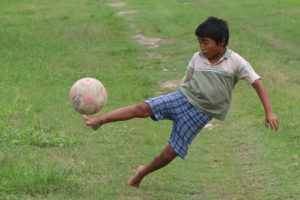
A 5-year-old boy named Alex* stood on the dirt patch in San Pedro, Belize, and punched a fellow soccer player. He had caused a lot of fights in the previous weeks. Katherine Lord, a volunteer with More Than Fútbol, pulled him aside. Lord had just begun running a soccer extracurricular program for The Holy Cross School, the poorest school in Ambergris Caye. She explained to him that the school would not tolerate violence at practice. She told him that he was a natural leader, so if he chose not to fight anymore, he could be team captain. In just a few weeks, Alex began helping her run drills, organize his teammates and even break up fights. For Alex, this after-school soccer program offered a safe space to play and have fun. For years, More than Fútbol has been effectively using soccer to combat poverty in Belize.
More Than Fútbol
Founded by Ali Andrzejewski in 2008, More Than Fútbol is using soccer to combat poverty in Belize. Every year, the organization sends volunteers to San Pedro, Belize for a few weeks. After these few weeks, everyone but one volunteer returns home. This volunteer runs the soccer program and teaches empowerment classes at The Holy Cross School. More Than Fútbol also works in Nicaragua.
In spring 2018, Lord volunteered to stay in San Pedro for five months. She volunteered with More Than Fútbol for four years prior to living in Belize. While there, she taught empowerment, English and math classes and ran the after-school soccer program.
Child Poverty in Belize
In Belize, 58% of children live in poverty. UNICEF estimates that 60% of children do not have access to at least one of proper drinking water, sanitation, housing, nutrition or education. One study from UNICEF found that 19% of children in Belize experience growth stunting due to poverty and 27% of schools do not have clean water.
Poverty in San Pedro, a town in Ambergris Caye, is a serious problem. Many students, like Alex, who attend The Holy Cross School do not have access to electricity or running water at home. Sewage and trash line the streets so acutely that wood boards must cover the roads so that no one steps in the waste. Despite the fact that Ambergris Caye generates about 18% of the country’s GDP from tourism, the island does not receive most of this money. This makes the residents unable to escape poverty.
The Link Between Poverty, Stress and Violence
Poverty, stress and violence all correlate. Children in poverty are seven times more likely to self-harm and become involved in violence. According to the American Psychological Association, “poorer children and teens are… at greater risk for several negative outcomes such as poor academic achievement, school dropout, abuse and neglect, behavioral and socioemotional problems, physical health problems, and developmental delays.” Children in poverty are more likely to have emotional or behavioral concerns such as anxiety, depression, aggression, conduct disorder, difficulty getting along with others and self-esteem issues. Children in poverty are also more likely to experience violence from a young age, which predisposes them to violent behaviors in the future. Parents living in poverty may also experience chronic stress or depression, which can cause them to parent in more severe ways, leading to worse socioemotional outcomes for children.
In Belize, estimates determined that 65% of children (ages 1-14) experience physical and psychological abuse or aggression at home. The Holy Cross School estimates that 90% of the children attending experience abuse from caregivers either physically, psychologically or sexually. Lord explained to The Borgen Project that “there’s a lot of fighting, especially among lower-income people. And it’s just because that’s how kids are treated by their parents. And it’s… I don’t want to say cultural– maybe systematic…. And so the kids would always be… fist fighting with each other and throwing rocks at each other.”
How Sports Can Reduce Stress and Fight Against Poverty
Despite the fact that the children often fought, Lord realized that soccer helped lower their aggression, improve their behaviors and their levels of happiness. Her first-hand experience influenced her to believe in the power of using soccer to combat poverty in Belize. The World Bank has found that empirically speaking, sports can help increase educational outcomes, empower players and encourage leadership. Playing sports can also alleviate anger and frustration and promote happiness.
Furthermore, sports can positively impact children’s development and goal-making. According to the University of Edinburgh, sports “matter because they are proven to boost educational capability, confidence, mental health and other learning skills that help not just education levels but working and social lives.” Sports can also benefit international development.
Other Organizations
Lord’s experience volunteering with More Than Fútbol is unique. However, there are many other organizations working to combat poverty in Belize and other parts of the world through soccer. For example, Street Football World works to empower communities and build soccer programs and stadiums. Love Futbol finances stadiums and supports the surrounding community. The work of these organizations is invaluable because sports can help empower children emotionally and socially. Like Katherine expressed to The Borgen Project, no matter the environment the kids come from, allowing them a space to grow and feel safe and supported can positively impact their moods, behaviors and self-confidence. Overall, it is clear that using sports to combat poverty in Belize is crucial because they can change children’s lives for the better and act as a source of international development.
* Name of Alex changed for privacy
– Sophie Shippe
Photo: Flickr

The Rwandan Genocide: Consequences and Yearly Remarks
Rwanda. 1994. 100 days. This was all it took for a band of Hutu extremists to commit the Rwandan Genocide, killing just under a million civilians. The 1994 genocide against the Tutsi in Rwanda has prompted yearly remarks around the world. The United Nations sponsors these, discussing the horrific implications of the event. Survivors have come forth to tell their stories as they work to make impacts to prevent genocides in the future.
What Was The Rwandan Genocide?
Two neighboring castes lead Rwanda; the Tutsis and the Hutus. The 1994 Rwandan Genocide against the Tutsi was a power struggle between these dividing castes. Although the Hutus largely outnumbered the Tutsis, with “about 85% of Rwandans,” the Tutsi had been in power for a long time. In 1959, the Hutus overthrew the Tutsi monarchy and civilians fled to neighboring countries. Rwanda remained under the Hutu dictatorship for many years following.
Long thereafter, a group of Tutsi exiles formed a rebel group known as the Rwandan Patriotic Front (RPF). They stormed Rwanda in 1990 and fought until 1993 when both parties agreed upon a peace deal.
However, the peace agreement broke on April 6, 1994, when a plane carrying President Juvenal Habyarimana, a known Hutu, was shot down. Hutu extremists blamed the RPF for the killing. Soon thereafter started the mass genocide that resulted in the killing of over 800,000 people. Government troops backed up the Hutus, many of whom forced civilians and youths to fight and to exercise the slaughters. The RPF stormed the capital, Kigali, on July 4, 1994, to gain back power.
Help from The World Food Programme
The Rwandan genocide forced many civilians into starvation, often unable to provide for themselves or their families. The World Food Programme provided emergency food assistance to those in need, targeting the “fundamental role food plays for vulnerable communities fleeing from conflict.” One Rwandan that the WFP helped is Liberee Kayumba. A survivor of the genocide, she was only 12 when she lost both of her parents and brother, experiencing starvation following the conflict. Now working as a monitoring officer for the Mahama Refugee Camp organization, she helps others suffering from food insecurity.
On the WFP’s Website, Liberee tells her story. She says that the memories from the genocide helped motivate her to want to help people in need. Liberee remembers how food availability was the main problem after the genocide for her and other survivors. Therefore, she has exact memories of the meals the WFP distributed, which she thinks saved her life.
The United Nations Conducts The International Day of Reflection
The U.N. has mandated an information and educational outreach programme to help survivors and others cope with the ramifications of the Rwandan Genocide and their resulting losses. This program emerged in 2005 with the main themes of preventing genocide and supporting survivors. Around the world, events such as “roundtable discussions, film screenings, exhibits and debates” occur yearly.
The slogan of 2020’s event was International Day of Reflection. It marked the 26th anniversary of the genocide, with a virtual observance for all to join in on. Multiple officials and survivors made sure to show up, including Jacqueline Murekatete. She is a lawyer, human rights activist and founder of the nonprofit organization Genocide Survivors Foundation. Murekatete lost her entire family in the 1994 Rwandan Genocide when she was only 9 years old.
The U.N.’s yearly observance reminds us to reflect on past events and recount what we can do to promote resilience and growth among countries facing hardships. Those this horrific event impacted have the chance to mourn and reflect, looking toward the greater good as individuals strive to create a better future for all.
– Natalie Whitmeyer
Photo: Flickr
Female Leaders in India: Fighting Discrimination at the Workplace
In 2020, Priya Periyasmy became the leader of her village council in Tamil Nadu, a South Indian state that 68 million people populated. Despite gender quota laws in village council elections, female leaders in India are the vast minority and women must fight to do their jobs in a hostile work environment. Additionally, women who run for office often face sexual harassment and slanderous attacks. Following Periyasmy’s brave example, 15 female village council leaders in Tamil Nadu state have filed complaints about discrimination in the past six months.
Village Councilwomen Fight Discrimination
Periyasmy tolerated daily annoyances, with other council members not greeting her and asking her to sit on the floor during meetings. She initially ignored the discrimination, but the abuse she faced interfered with her ability to work. The panchayat vice-president regularly threatened her and once attacked her for sitting on a chair at work. Periyasmy went on strike and organized a sit-in protest with her husband. She and 15 other Dalit women in the same situation are demanding action under the SC/ST (Prevention of Atrocities) Act. Dalit female leaders in India face heightened discrimination. They belong to the lowest caste in India’s social hierarchy.
In another village in Tamil Nadu called Attupakan, V. Sasikumar quit his factory job to support his mother when she became the first female Dalit village council president. After other members stopped her from talking at meetings and hoisting the flag on Independence Day, she asked the Madras High Court to protect her family.
Sasikumar points out the daily wage earner status of his parents. After the struggle of getting into a leading position, his mother now faces discrimination. Other council members would not allow her to do her job. Still, she has the full support of her family.
India reserves half of each state’s village council posts for women, resulting in the election of 1 million female village councilors. However, proposals for similar legislation for state and federal elections exist for 20 years already. The bills did not pass yet. The bipartisan Girls LEAD Act challenges this, increasing global female participation in democracy, human rights and governance.
Girls LEAD Act
About 132 million girls between 6-17 years old are not enrolled in school and only 24% of all national parliamentarians are women, which are two highly connected problems. Women largely have underrepresentation in politics, allowing men to sway important decisions, many of which only women. Through U.S. foreign assistance initiatives, the Girls LEAD Act identifies and addresses barriers to female political participation, providing support for civil society organizations that women lead. The act ensures that each foreign organization engages girls under 18, introducing them to political leadership early.
Promoting girls’ education and political engagement will reduce violence against women and transform more societies into democracies. Women’s leadership supports democracy through cooperation between parties and the understanding of citizens’ needs. According to research, female inclusion in peace negotiations decreases corruption. Additionally, the likelihood of childhood marriage will decrease by 5% for each year of a girl’s continued secondary schooling.
Normalizing women’s leadership in politics will break the stigma and negative cultural attitudes behind it, which is the root of the bigotry that Periyasmy faces. Passing the Girls LEAD Act would protect marginalized politicians, including the 16 female leaders in India who actively fight discrimination.
– Rebecca Pomerantz
Photo: Flickr
The Process of Improving Bank Access in Afghanistan
Bank access in Afghanistan is a step toward financial inclusion for the rural poor. According to Jan Chipchase and Panthea Lee’s research on the nascent mobile-phone-based financial services that were available in Afghanistan in 2010, theft and bribery plagued the banking system. Person-to-person transfers were not widely available until the creation of the M-Paisa mobile money transfer service. Roshan launched the M-Paisa mobile money transfer banking in Kabul in 2010 when 83 bank accounts existed per 1,000. Through this service and other programs, improvements in the availability and quality of bank access in Afghanistan have been a major contributor towards reducing income inequality and poverty.
Gradually Improving Access
With limited credit available, Afghans were hiding money at home under the mattress, and forms of money ranged anywhere from banknotes to gold jewelry to livestock. The rural poor did not trust the banking system, and the use of the word “Paisa” helped to make the service seem more trustworthy, although it posed access challenges for the rural poor. By 2014, banking access improved for 40% of Afghanistan’s population, with a 7% increase in the availability of financial services. However, access to credit was still out of reach to the rural poor as most of the banks were located in Kabul province, an urban area. This made it more difficult for rural people to get loans to start businesses.
In 2015, a project to bolster bank access in Afghanistan made a step toward financial inclusion for the rural poor with the start of the Afghan Rural Enterprise Development. The project sought to integrate rural agricultural communities into the economy. Employment opportunities emerged in poor rural villages by the creation of savings and enterprise groups along with loan associations. According to The World Bank, the rural poor received assistance in building their own businesses, which increased the value of trade, ensuring new opportunities. This created access to credit through internal lending, which focused on small and medium-sized enterprises, or SMEs. This program was so important because it targeted people who traditionally could not access the banking system.
The Reason it Matter
As of November 2019, more data exists to support the successes of bank access in Afghanistan that The United Nations Economic and Social Commission for Asia and the Pacific published. The goal of the report was to assess the status of financial inclusion for all adults in Afghanistan age 15 to 64 including women. Financial inclusion in a “broad range of quality and affordable financial services including but not limited to account, payment, saving, and credit provided by formal financial institutions in a fair, transparent, and sustainable manner.” According to this presentation, 15,000 bank accounts exist per 100,000 adults, and in 2021, projections determined them to be 20,000. Expectations have determined that mobile money accounts and accounts that women hold will also grow during the same period. Although the success of banking the unbanked in Afghanistan has been slow, steady progress has occurred toward financial inclusion of the rural poor and women.
It is clear that bank access in Afghanistan and credit is allowing the rural poor in Afghanistan to do better financially. However, according to the World Bank Afghanistan, “the COVID-19 crisis will have a serious and sustained impact on Afghanistan’s economy. Recovery is expected to take several years, with new investment constrained by political uncertainties, continued insecurity, and questions around ongoing international support.” It is important to maintain international support for improving banking access to preserve opportunities for Afghanistan’s rural population.
– Kathleen Shepherd-Segura
Photo: Flickr
India’s Foreign Aid Explained
The Republic of India receives millions of dollars each year in foreign aid. This money goes toward ending poverty and improving living standards. However, as India develops and modernizes, the government has started to lend a helping hand to poorer nations across the world. Many see India’s foreign aid as both a tool for diplomacy and an act of good faith. As in the words of India’s Development Partnership, its approach to foreign aid is, “shaped by India’s struggle for independence and solidarity with other colonized and developing countries and the inspiring leadership of Mahatma Gandhi…” The nation is transitioning from a recipient to a donor, as the nation often gives more in foreign aid than it receives.
By The Numbers
The Indian Government allocated $1.32 billion for foreign aid in its 2019-2020 budget year (around 0.3% of the budget). This amount follows a trend of India drastically stepping up its foreign aid over the past decade. The budget went from around $500 million in 2010 to a peak of $1.5 billion in 2015. Despite a three-year slump in funding, the central government is now stepping back up to the plate. The main focus of India’s foreign aid centers around the development and modernization of its recipients.
Most of India’s foreign aid goes to countries in Asia and Africa, as it seeks to improve relations with its neighbors and assert its global presence. The nations India is providing aid to include Myanmar ($56 million), Bangladesh ($24.5 million) and Bhutan ($392.7 million). Aid that these nations receive has the goal of promoting regional stability and creating higher living standards. The Indian Government has also taken more interest in Indian Ocean countries such as Mauritius ($161 million), Sri Lanka ($35 million) and The Maldives (~$81 million) to increase Indian presence in the Indian Ocean.
How India’s Foreign Aid Helps
India’s foreign aid goes to a variety of projects such as infrastructure, agriculture and energy. The nation has invested billions in infrastructure projects in nations like Nepal and Afghanistan, such as hydroelectric plants, dams and schools. Famously, India and Afghanistan finished the Salma Dam, renamed the Afghan-India Friendship Dam. The Dam cost India around $300 million and provides hydroelectric power and irrigated farmland to the surrounding area. Additionally, India gave millions in foreign aid to Caribbean nations to improve their renewable/clean energy sectors that combat pollution and environmental challenges.
India is also heavily active in humanitarian efforts and disaster relief, frequently giving out loans, medical supplies and other types of assistance. The Brookings Institute has even called the nation “The Neighborhood First Responder,” helping with disaster relief in Sri Lanka, Afghanistan and Myanmar. Humanitarian aid has gone to nations like Fiji after Cyclone Winston hit the nation in 2016. Recently, India has helped combat the COVID-19 pandemic through monetary aid, donating food and distributing vaccines. Brazil, which faces a vaccine shortage, received 2 million doses from the Indian government.
Indian-US Relations
India is a prime example of how U.S. Foreign Aid benefits all sides. Nations like the United States have invested heavily in India and continue to help the government combat problems that plague the nation. As a result, India and the U.S. are now close allies and often cooperate on shared goals such as combating environmental challenges and ending extreme poverty. The two nations also cooperate with each other in international organizations like the U.N. and IMF. Both nation’s economies benefit from a strong India, with bilateral trade totaling around $149 billion. A diverse array of U.S. businesses operate in India, from energy and infrastructure business to ones involving technology and entertainment.
– Malcolm Schulz
Photo: Flickr
The Use of Soccer to Combat Poverty in Belize
A 5-year-old boy named Alex* stood on the dirt patch in San Pedro, Belize, and punched a fellow soccer player. He had caused a lot of fights in the previous weeks. Katherine Lord, a volunteer with More Than Fútbol, pulled him aside. Lord had just begun running a soccer extracurricular program for The Holy Cross School, the poorest school in Ambergris Caye. She explained to him that the school would not tolerate violence at practice. She told him that he was a natural leader, so if he chose not to fight anymore, he could be team captain. In just a few weeks, Alex began helping her run drills, organize his teammates and even break up fights. For Alex, this after-school soccer program offered a safe space to play and have fun. For years, More than Fútbol has been effectively using soccer to combat poverty in Belize.
More Than Fútbol
Founded by Ali Andrzejewski in 2008, More Than Fútbol is using soccer to combat poverty in Belize. Every year, the organization sends volunteers to San Pedro, Belize for a few weeks. After these few weeks, everyone but one volunteer returns home. This volunteer runs the soccer program and teaches empowerment classes at The Holy Cross School. More Than Fútbol also works in Nicaragua.
In spring 2018, Lord volunteered to stay in San Pedro for five months. She volunteered with More Than Fútbol for four years prior to living in Belize. While there, she taught empowerment, English and math classes and ran the after-school soccer program.
Child Poverty in Belize
In Belize, 58% of children live in poverty. UNICEF estimates that 60% of children do not have access to at least one of proper drinking water, sanitation, housing, nutrition or education. One study from UNICEF found that 19% of children in Belize experience growth stunting due to poverty and 27% of schools do not have clean water.
Poverty in San Pedro, a town in Ambergris Caye, is a serious problem. Many students, like Alex, who attend The Holy Cross School do not have access to electricity or running water at home. Sewage and trash line the streets so acutely that wood boards must cover the roads so that no one steps in the waste. Despite the fact that Ambergris Caye generates about 18% of the country’s GDP from tourism, the island does not receive most of this money. This makes the residents unable to escape poverty.
The Link Between Poverty, Stress and Violence
Poverty, stress and violence all correlate. Children in poverty are seven times more likely to self-harm and become involved in violence. According to the American Psychological Association, “poorer children and teens are… at greater risk for several negative outcomes such as poor academic achievement, school dropout, abuse and neglect, behavioral and socioemotional problems, physical health problems, and developmental delays.” Children in poverty are more likely to have emotional or behavioral concerns such as anxiety, depression, aggression, conduct disorder, difficulty getting along with others and self-esteem issues. Children in poverty are also more likely to experience violence from a young age, which predisposes them to violent behaviors in the future. Parents living in poverty may also experience chronic stress or depression, which can cause them to parent in more severe ways, leading to worse socioemotional outcomes for children.
In Belize, estimates determined that 65% of children (ages 1-14) experience physical and psychological abuse or aggression at home. The Holy Cross School estimates that 90% of the children attending experience abuse from caregivers either physically, psychologically or sexually. Lord explained to The Borgen Project that “there’s a lot of fighting, especially among lower-income people. And it’s just because that’s how kids are treated by their parents. And it’s… I don’t want to say cultural– maybe systematic…. And so the kids would always be… fist fighting with each other and throwing rocks at each other.”
How Sports Can Reduce Stress and Fight Against Poverty
Despite the fact that the children often fought, Lord realized that soccer helped lower their aggression, improve their behaviors and their levels of happiness. Her first-hand experience influenced her to believe in the power of using soccer to combat poverty in Belize. The World Bank has found that empirically speaking, sports can help increase educational outcomes, empower players and encourage leadership. Playing sports can also alleviate anger and frustration and promote happiness.
Furthermore, sports can positively impact children’s development and goal-making. According to the University of Edinburgh, sports “matter because they are proven to boost educational capability, confidence, mental health and other learning skills that help not just education levels but working and social lives.” Sports can also benefit international development.
Other Organizations
Lord’s experience volunteering with More Than Fútbol is unique. However, there are many other organizations working to combat poverty in Belize and other parts of the world through soccer. For example, Street Football World works to empower communities and build soccer programs and stadiums. Love Futbol finances stadiums and supports the surrounding community. The work of these organizations is invaluable because sports can help empower children emotionally and socially. Like Katherine expressed to The Borgen Project, no matter the environment the kids come from, allowing them a space to grow and feel safe and supported can positively impact their moods, behaviors and self-confidence. Overall, it is clear that using sports to combat poverty in Belize is crucial because they can change children’s lives for the better and act as a source of international development.
* Name of Alex changed for privacy
– Sophie Shippe
Photo: Flickr
Fighting Poverty in the Cocoa Industry
Tony’s Chocolonely, a chocolate company in the Netherlands, emerged in 2005. When police arrested a journalist by the name of Teun van de Keuken, he asked to go to prison. He hired a lawyer to help send him to prison and asked a judge to convict him of driving child slavery. However, the judge would not convict him, stating that his crime was simply eating a bar of chocolate. Keuken was not satisfied with this decision and ventured to create a chocolate company that would both combat child labor and poverty in the cocoa industry.
A Better Idea
Instead, Keuken decided to try to stop child slavery from the inside. He wanted to do this by setting up a chocolate company with the mission of ending child slavery in general by fighting poverty in the cocoa industry. Since 2005, the company has grown, and with it, so have its missions. The brand is now the Netherlands’ favorite chocolate company and it has an international reach as many supermarkets in Europe sell its products. Additionally, it is inspiring cooperatives and chocolate companies across the world. Here are Tony’s Chocolonely’s five guiding principles.
Tony’s 5 Guiding Principles
Walk the Walk, Talk the Talk
Tony’s Chocolonely leads by example in how it is fighting poverty in the cocoa industry. However, it has extended its mission to raise awareness and inspire others to act in the same way. It is spreading its message to more people every day in an effort to acknowledge the problems of slavery and poverty in the cocoa industry so that citizens can be more conscious consumers. Such awareness promotion is having an effect; in the Netherlands, where the company is based, 75% of people now know about the problems of child slavery and poverty in the cocoa industry and say they will try to be more ethical consumers.
Advocacy
Tony’s Chocolonely’s advocacy aims to inspire others. This is evident in its partnership with the Netherlands’ largest supermarket Albert Heijn, which has worked to make the chocolate it sells slave-free. In 2019, Tony’s Chocolonely also broke into the markets of the U.K. and Germany.
The company is aiming to pressure big chocolate producers like Nestle and Cadburys to eliminate child slavery from their practices. Tony’s Chocolonely wants to get to that tipping point where ethical practice becomes necessary for business and would like this to occur either through law or by requirement. In fact, it would like it to be necessary for businesses to have a license to operate in the cocoa industry.
– Lizzie Alexander
Photo: Flickr
IMF’s Role in Preventing a Post-Pandemic Debt Crisis
With the 2020 onset of the COVID-19 pandemic came a drastic slow in economic activity and collapse in government revenue, prompting a widespread increase in both government and private debt levels. Currently, at the beginning of 2021, with no concrete prediction for the end of the COVID-19 pandemic, businesses and the private sector continue to accumulate great foreign currency debt. There is a steady increase in government loans for funding and there has been at least a 20% reduction in 2020 remittances from global citizens and diasporas. Developing nations report skyrocketing borrowing needs that are usually that advanced economies can usually only manage. Additionally, central bank purchases of corporate bonds to boost the money supply of local firms have stifled the debt ratings of local firms in emerging markets and developing economies. As a result, our world is facing rising budget pressures, which a wave of sovereign debt downgrades that are likely to lead to a post-pandemic debt crisis are accompanying.
Context and the Role of the IMF
In comparison to the end of 2019, in addition to already unusually elevated figures and debt distress, expectations have determined that 2021 debt ratios will increase by 20% GDP in advanced economies, 10% in emerging market economies and 7% in low-income economies. Unfortunately, the emerging and developing world have much smaller borrowing capacities, and so for some, a post-pandemic debt crisis appears imminent.
In the past, debt crises have set the global economy into long-lasting instability. In order to prevent such an economic downfall on top of a global health crisis, many of the leading international organizations such as the International Monetary Fund (IMF) have prepared to help keep nations afloat. While the IMF has provided over $30 billion in emergency funding to its member countries in a response to the pandemic, it has also given direct attention to implementing measures that contribute to debt-service relief. Here are some of these measures.
4 Measures to Contribute to Debt-Service Relief
Cause for Optimism
With the measures above, as well as the collaborative effort of the entire globe, according to the IMF Managing Director Kristalina Georgieva, “the global economy is beginning to climb back from the depths of the crisis, but this calamity is far from over.”
Thankfully, the IMF continues to show its commitment to providing financial support, capacity development and debt relief, especially for its poorest, most affected and vulnerable member countries in this unprecedented time, as the world works to stave off an impending debt crisis.
– Rebecca Harris
Photo: Flickr
Changes in Foreign Aid to Greece from 2010-2020
The history of foreign aid to Greece dates back to the late 1940s and the Truman administration when the Marshall Plan underwent enactment. Although the Marshall Plan funding came to an end in 1951, the European nations collected almost $13 billion in aid. This money acquired shipments in fuel, food, machinery and more, creating investments in industrial capacity in Europe.
According to The George C. Marshall Foundation, between April 3, 1948, and June 30, 1952, the Marshall Plan provided grants to Greece in the amount of $706.7 million. Today, that would add over $69.7 million.
Council on Foreign Relations
According to the Council on Foreign Relations, in 1957, a common market-free area of trade emerged known as The Treaty of Rome. It led to the acceptance of Greece as the “10th member of the European Economic Community (EEC).”
The Council on Foreign Relations reported that in 1992, 12 member states of the ECC signed the Treaty of Maastricht forming the European Union (E.U.) and the Economic and Monetary Union (EMU). This led to the 1999 Euro currency in existence today.
However, as the Council on Foreign Relations reported, in 1999 Greece could not adopt the Euro currency because it could not meet the economic rules that the Maastricht established. All members must meet the fiscal criteria. This means inflation has to be, “below 1.5 percent, a budget deficit below 3 percent, and a debit-to-GDP ratio below 60 percent.”
How Geography Affects Foreign Aid
The need for foreign aid to Greece continues due to its geographic location. Greece is a destination for refugees and asylum seekers. According to The Library of Congress LAW, the European Court of Human Rights and the Court of Justice of the E.U. in 2011 found Greece was lacking in its ability to handle the influx of refugees. More reception centers are necessary to house them.
A plan proposal in 2010 led to more services for asylum seekers in Greece. Although the plan ultimately failed, some things underwent adoption such as Law 3907. It supplied more services such as appeals authority and first-line reception. In 2015, the influx of refugees overwhelmed Greece’s already inefficient system to fingerprint, register and house asylum seekers.
The humanitarian needs such as access to healthcare and education are great in reception centers for refugees. In 2016 the White House Press Secretary announced, “Since the start of Europe’s refugee crisis, the United States has contributed over $44 million in humanitarian aid through international organizations.”
Recent Actions
From 2014 to 2020, the Commission and European Union increased funding to Greece for asylum and immigration.
As a result, the Migration and Integration Fund provided Greece with €294.5 million (about $328 million). The Internal Security Fund – Borders and Visas presented €214.8 million (about $240 million). Another contribution under the European Refugee Fund was emergency funding of over €50.6 million Euros (about $56.5 million).
In 2019, the U.S. assisted Greece’s military when it signed a mutual defense cooperation agreement. The intention of this agreement is for the U.S. to spend on Greece’s military infrastructure.
The need to send foreign aid to Greece continues to grow especially during the COVID-19 pandemic. As Aljazeera reported, in September 2020, Greek authorities were still having trouble with overcrowding. It is still a struggle to house every migrant and refugee but with more funding, a change can hopefully occur.
– Kathleen Shepherd-Segura
Photo: Flickr
Why Syrian Children Feel Their Country Is Unsafe
The year 2021 marks 10 years since the start of the war for Syria and its citizens. This war started shortly after Syrians launched the anti-government Arab Spring uprisings. Authorities swiftly took action and pushed back against Syrian citizens, leading to the deaths of over 500,000 people and 55,000 children, and causing Syrian children to feel their country is unsafe.
Product of War
This war scattered Syrian children throughout several countries as refugees. A Save the Children report has displayed testimonies from over 1,900 children ages 3-17, who are currently located in Syria, Jordan, Lebanon, Turkey and the Netherlands. About 87% of these children say they can never see themselves returning to Syria. Meanwhile, one in three children is still living in Syria. They go on daily runs through rumble-torn streets, collecting freshwater from large coolers and sitting in abandoned buildings. Some even sit with their parents at their still open food carts in front of bombed-down buildings. Understandably, these children wish they were anywhere else.
While many children in Syria do not feel safe, often children who have relocated do not feel safe either. Many children who left Syria with their families now find themselves in refugee camps, crammed into small tents with a dozen other refugees. The children feel that life is about nothing but war these days and wish to go to a place where they can be safe with toys, warm beds, plenty of food and education.
Lack of Education
About 42% of Syrian children did not attend school at the start of the war. In fact, Syria does not offer education to more than 3 million children. Meanwhile, only 31% of Syrian children have access to education in Lebanon and only 49% have access to education in Jordan. Additionally, about 25% of the schools undergo continuous bombing. As the war continues, poverty is continuing to rise, schools are experiencing destruction and teachers are becoming scarce. These circumstances help explain why Syrian children feel their country is unsafe.
Without schools, many children who still live in Syria feel no attachment to their homes and their communities. Children who still live in Syria and partook in the Save the Children survey said that they have no connection to Syria, and 58% of those surveyed have said that they experience discrimination. In fact, 44% of the children living in Lebanon and Jordan have experienced discrimination in their neighborhoods and schools.
A Better Future
When asked what they wish for the most, 26% of the children wished for a better future without violence. However, even after fleeing war-torn Syria, a country that many Syrian children feel is unsafe, refugee children frequently face extreme poverty. In Lebanon, which is facing an economic crisis, rapid spreading COVID-19 cases and an overabundance of refugees, about nine out of 10 Syrian refugees are struggling with severe poverty.
Some hope exists, though. About 70% of Syrian refugee children in the Netherlands have been receiving an education, with opportunities and freedom. About eight in 10 of these children say they wish to stay in the Netherlands where they continue to feel safe. However, while some children have been able to get opportunities for a better life, it is important to remember that millions of Syrian children are still in peril.
Solutions
Organizations like UNICEF are doing their part to help children who have relocated due to the violence in Syria. In fact, UNICEF’s efforts have led to polio vaccines, nutrition plans, safe drinking water, education services, infection prevention, a push for educational services and an expansion of social services and social skills to ensure Syrian children have the best tools for a better future. Through efforts like UNICEF’s, hopefully, the situation for Syrian children will improve.
– Claire Olmstead
Photo: Flickr
3 Standout Children’s Programs in Vietnam
Children of Vietnam
Children of Vietnam was founded in 1998 by two friends bringing essential items to children and families by scooter. These two individuals, Ben Wilson and Luong Thi Huong, rode all the way to the Vietnam countryside. They brought food, medicine and clothing to ensure a brighter future for children growing up in poverty.
Today, Children of Vietnam has grown into an NGO that aims to “assist children, families and communities in breaking the cycle of poverty, ill health and homelessness.” It has several initiatives offering aid to children in Vietnam including education, healthcare, housing and nutrition. It also offers support systems for struggling single mothers and children with disabilities.
In 2019, Children of Vietnam successfully completed its Cycling Out Child Poverty tour. The organization was able to raise $146,974 to help Vietnamese children living in poverty.
Room to Read
Room to Read is an organization that aims to empower millions of children in low-income communities by improving literacy and gender equality in education. It operates in developing countries like Tanzania, South Africa, Bangladesh and Cambodia. Almost 90% of the staff are from the countries the organization works in. The organization particularly prioritizes the education of girls, ensuring girls receive equal opportunities for education, no matter their financial background. Room to Read supports young girls so that they can finish secondary school and learn essential life skills that can help them progress and advance.
The organization launched in Vietnam in 2001. Since then, 1.1 million children in Vietnam have benefited from the program. Almost 1,000 schools in Vietnam partnered with the Room to Read Literacy Program and 98% of students passed the program’s “gatekeeping exam” and advanced to the next level in their schooling.
Save the Children
Another organization that works to help children in multiple countries is Save the Children. Founded in 1919, the mission of Save the Children is to ensure a future for children where they grow up healthy, safe and educated. Working in more than 100 different countries, Save the Children has helped more than 144 million children around the world in 2019 alone.
Working in Vietnam since 1990, Save the Children has launched several initiatives to give Vietnamese children the opportunity for quality education, a healthier life and protection from harm. Save the Children has positively affected more than seven million Vietnamese children in 2020. In specific, Save the Children ensured:
These standout children’s programs in Vietnam have made significant strides in improving the lives of Vietnamese children over the years. From health to education and safety, organizations have committed to protecting vulnerable children.
– Celia Brocker
Photo: Flickr